The end of Western domination

By Thierry Meyssan

Source: VoltaireNet.org

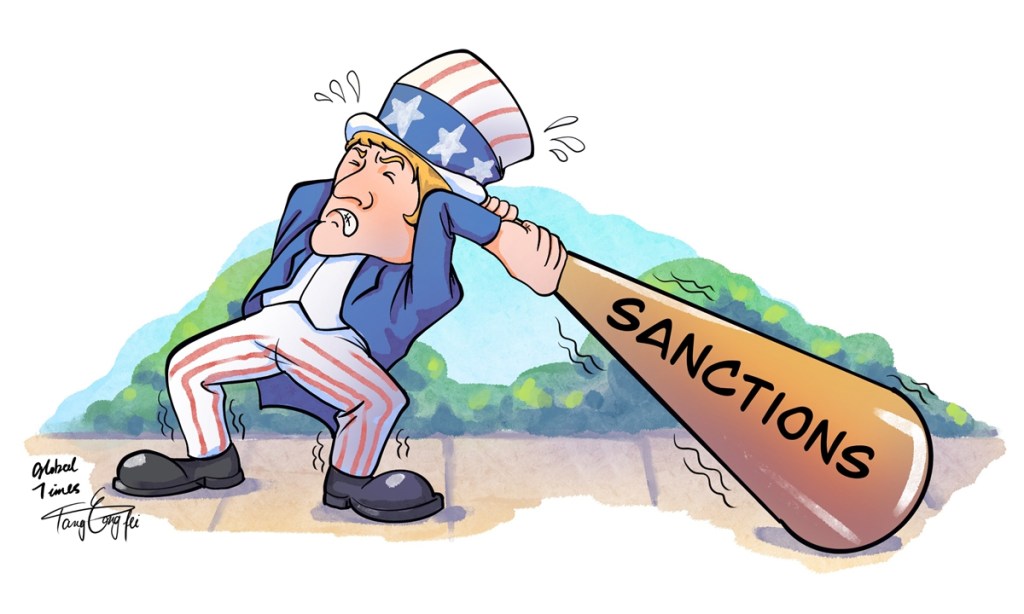
The Western sanctions against Russia, decided unilaterally by Washington, are presented as a just punishment for the aggression against Ukraine. But, without mentioning their illegality under international law, everyone can see that they do not reach their target. In practice, the United States is isolating the West in the hope of maintaining its hegemony over its allies.

The United States, which was a late participant in the World Wars and suffered no losses on its territory, emerged victorious from the world conflicts. Inheriting the European empires, it developed a system of domination that made it the “world’s policeman. However, their hegemony was fragile and could not resist the development of large nations. As early as 2012, political scientists began to describe the “Thucydides trap” by analogy with the Greek strategist’s explanation of the wars between Sparta and Athens. According to them, China’s rise to power also made a confrontation with the United States inevitable. Noting that, if China had become the first world economic power, Russia had become the first military power, Washington decided to fight them one after the other.

It is in this context that the war in Ukraine took place. Washington presents it as “Russian aggression”, adopts sanctions and forces its allies to take them too. The first thing that comes to mind is that the United States, knowing that it is militarily inferior but economically superior, decided to choose its battlefield. However, an analysis of the forces involved and the measures taken belies this reading of events.

THE WORLD ECONOMIC SYSTEM

The global economic system was created by the Bretton Woods Agreement in 1944. They aimed to establish a framework for capitalism beyond the crisis of 1929, for which Nazism had not been the solution. The United States imposed its currency as a gold-convertible benchmark. Neither the Soviet Union nor China participated in the conference.

In 1971, President Richard Nixon decided to unofficially end the dollar’s parity with gold. This allowed him to finance the war in Vietnam. In practical terms, there were no longer any fixed exchange rates. The measure was not formalized until after the war, in 1976. It was also at this time that China formed an alliance with the Anglo-Saxon multinationals. The European Community (the forerunner of the European Union) adapted by regulating the now-floating exchange rates in 1972 (the “currency snake”), and then by creating the euro.

From 1981 onwards, the United States began to let its debt slip away. It went from 40% of its GDP to 130% today. They tried to globalize the world economy, i.e. to impose their rules on the solvent countries and to destroy the state structures of the remaining countries (the Rumsfeld/Cebrowski strategy). To pay their debt, they printed dollars, spied on the companies of their allies and stole all the reserves of two big oil states, Iraq and Libya. Nobody dared to say anything, but from 2003 onwards, the US economic system was no longer what it claimed to be. Officially they were still liberal, but everyone could see that they were no longer producing their own food and necessities, and that they were living on rapine.

The US economy, which was one third of the world economy when the USSR dissolved, is now only one tenth.

Many states anticipated the end of the Bretton Woods rules and thought about a new deal. In 2009, Brazil, Russia, India and China, soon joined by South Africa for Africa, created the BRICS. These countries have set up financial institutions which, unlike the IMF and the World Bank, do not make their loans conditional on structural reforms or political commitments to align with Washington. They prefer to invest on a leasing basis, with the host country becoming the owner of the investment when it is profitable.

In 2010, Belarus, Kazakhstan and Russia, soon joined by Armenia, founded the Eurasian Economic Union. These border countries established a free trade zone with Egypt, China, Iran, Serbia, Singapore and Vietnam. They could be joined by South Korea, India, Turkey and Syria.
In 2013, China began its vast “New Silk Roads” project. The following year, when its GDP surpassed that of the United States at purchasing power parity, Beijing created the Asian Infrastructure Investment Bank (AIIB), and in 2020, it regulated foreign capital.

In 2021, the European Union devised its Global Gateway to compete with China and impose its political model. But this demand was seen as colonial overreach by many countries and was rejected en masse.

Gradually, the Russian and Chinese blocs have come closer together thanks to the joint project of the Great Eurasian Global Partnership (2016) within the framework of the Shanghai Cooperation Organization. The aim is to develop the whole space by creating balanced communication channels on the ideological bases defined by Kazakh Sultan Nazerbayev: inclusiveness, sovereign equality, respect for cultural and socio-political identity, openness and readiness to integrate other ensembles.

Washington’s attempt to destroy this emerging entity has no chance of success. It is striking that :
the economic attack began not with the invasion of Ukraine, but two days before.
it is primarily directed against Russian banks, Russian billionaires and the Russian gas industry and not at all against the new Eurasian communication system. Finally, it aims at excluding Russia from international organizations, but does not concern the states that refuse to condemn Russia. Therefore it will push them into the arms of Beijing.

In other words, the US is not isolating Russia, but it is isolating the West (10% of humanity) from the rest of the world (90% of humanity).

THE PROCESS OF SEPARATING THE WEST FROM THE REST OF THE WORLD

 0. The very day after Moscow recognized the independence of the Donetsk and Lugansk People’s Republics (February 21, 2022), the United States launched an economic attack on Russia (February 22). The European Union followed suit the day after (February 23). Vnesheconombank and Promsvyazbank were excluded from the global financial system.

Vnesheconombank (VEB.RF) is a regional development bank. It could have helped the Donbass. Promsvyazbank (PSB) invests mainly in the defense sector. It could have played a role under the Mutual Assistance Treaty.

 1. As Russia started a special military operation in Ukraine (February 24), the United States extended the exclusion of the first two banks from the global financial system to all Russian banks (February 25). The European Union followed suit (February 25).

 2. In order to prevent as many states as possible from joining Russia, Washington extended the trade bans to Belarus. The European Union began to deny Russian banks access to the SWIFT system as previously instructed by the United States, extended sanctions to Belarus and censored the Russian state media, Russia Today and Sputnik (March 2)

 3. Washington began to target wealthy Russian citizens (erroneously called “oligarchs”) with bad relations with the Kremlin (March 3) and to ban imports of Russian energy sources (March 8). The European Union followed suit, but resisted a ban on the import of much-needed Russian gas (March 9).

 4. Washington extended financial sanctions in the IMF and World Bank, expanded the list of oligarchs and bannned the export of luxury goods to Russia (March 11). The European Union followed suit (March 15).

 5. Washington ensuref that members of the Duma and oligarchs no longer have any rights in the West; that Russia would no longer be able to use its assets in the USA to pay its debts to the USA; and that it would no longer be able to use its gold to pay its debts abroad (24 March). The European Union followed in these prohibitions. It pronounced a ban on the import of Russian coal and oil, but still no ban on gas.

The table below summarizes the communications from the White House and Brussels.

United StatesEuropean Union
«United States Imposes First Tranche of Swift and Severe Costs on Russia» (Feb. 22)EU adopts sanctions package in response to recognition of areas of Ukraine’s Donetsk and Luhansk oblasts not controlled by the government (Feb. 23)
«United States and Allies and Partners Impose Additional Costs on Russia» (Feb. 24)First set of EU sanctions (February 25)
«The United States Continues to Impose Costs on Russia and Belarus for Putin’s War of Choice» (March 2)Second set of EU sanctions (March 2)
«The United States Continues to Target Russian Oligarchs Enabling Putin’s War of Choice» (March 3)«United States Bans Imports of Russian Oil, Liquefied Natural Gas, and Coal» (March 8)Third set of EU sanctions (March 9)
«United States, European Union, and G7 to Announce Further Economic Costs on Russia» (March 11)Fourth set of sanctions (March 15)
«United States and Allies and Partners Impose Additional Costs on Russia» (Mar. 24)«United States, G7 and EU Impose Severe and Immediate Costs on Russia» (Apr 6)Fifth round of EU sanctions

THE REST OF THE WORLD’S RESPONSE

It is an extremely surprising phenomenon to observe: the U.S. has managed to sway a majority of states to its side, but these states are the least populous in the world. It is as if they have no means of putting pressure on countries capable of independence.

Due to the unilateral actions of the Anglo-Saxons and the European Union, the world is being divided into two heterogeneous spaces. The era of economic globalization is over. The economic and financial bridges are being broken one by one.

Reacting swiftly, Russia has convinced its BRICS partners to stop trading in dollars and to eventually create a common virtual currency for their exchanges. Until then, they will proceed in gold. This currency should be based on a basket of BRICS currencies, weighted according to the GDP of each member state, and on a basket of commodities listed on the stock exchange. This system should be much more stable than the current one.

Above all, Russia and China appear to be much more respectful of their partners than the West. They never demand structural reforms, neither economic nor political. The Ukrainian affair shows that Moscow does not seek to take power in Kiev and occupy Ukraine, but to push back NATO and fight the Banderites (the “neo-Nazis” according to Kremlin terminology). Nothing but very legitimate, even if the method is brutal.

In practice, we are witnessing the end of four centuries of domination by Westerners and their empires. It is a confrontation between different ways of thinking.
 Westerners now think only in terms of weeks. With this short-sightedness, they may have the impression that the United States is right and the Russians wrong. On the contrary, the rest of the world thinks in decades, even centuries. In this case, there is no doubt that the Russians are right and the West as a whole is wrong.
 Moreover, the West rejects international law. They attacked Yugoslavia and Libya without the authorization of the Security Council and lied to attack Afghanistan and Iraq. They only accept the rules they make. On the contrary, the other states aspire to a multipolar world in which each actor would think according to their own culture. They are aware that only international law would make it possible to preserve peace in the world as they dream of it.

Rather than confronting Russia and China, the United States has chosen to withdraw into its empire: to isolate the West in order to maintain its hegemony.

Since 2001, all world leaders have viewed the West, and particularly the United States, as wounded predators. They do not dare to confront them and look for ways to accompany them gently to the cemetery. No one ever imagined that they would isolate themselves to die.

Translation
Roger Lagassé

This article is a follow-up to :
 1. “Russia wants to force the US to respect the UN Charter,” January 4, 2022.
 2. “Washington pursues RAND plan in Kazakhstan, then Transnistria,” January 11, 2022.
 3. “Washington refuses to hear Russia and China,” January 18, 2022.
 4. “Washington and London, deafened“, February 1, 2022.
 5. “Washington and London try to preserve their domination over Europe“, February 8, 2022.
 6. “Two interpretations of the Ukrainian affair”, 16 February 2022.
 7. “Washington sounds the alarm, while its allies withdraw”, 22 February 2022.
 8. “Russia declares war on the Straussians”, by Thierry Meyssan, Voltaire Network, 5 March 2022.
 9. “A gang of drug addicts and neo-nazis”, 5 March 2022.
 10 “Israel stunned by Ukrainian neo-Nazis”, 8 March 2022.
 11. “Ukraine: the great manipulation“, March 22, 2022.
 12. “The New World Order being prepared under the pretext of war in Ukraine“, 29 March 2022.
 13. “The war propaganda changes its shape”, 5 April 2022.
 14. “The alliance of MI6, the CIA and the banditry“, 12 April 2022.

‘Rublegas:’ the world’s new resource-based reserve currency

The Russian ruble is sitting pretty right now, having regained its pre-sanctions value and set to become a major commodity currency.Photo Credit: The Cradle

Rublegas is the commodity currency du jour and it isn’t nearly as complicated as NATO pretends. If Europe wants gas, all it needs to do is send its Euros to a Russian account inside Russia.

By Pepe Escobar

Source: The Cradle

Saddam, Gaddafi, Iran, Venezuela – they all tried but couldn’t do it. But Russia is on a different level altogether.

The beauty of the game-changing, gas-for-rubles, geoeconomic jujitsu applied by Moscow is its stark simplicity.

Russian President Vladimir Putin’s presidential decree on new payment terms for energy products, predictably, was misunderstood by the collective west. The Russian government is not exactly demanding straightforward payment for gas in rubles. What Moscow wants is to be paid at Gazprombank in Russia, in its currency of choice, and not at a Gazprom account in any banking institution in western capitals.

That’s the essence of less-is-more sophistication. Gazprombank will sell the foreign currency – dollars or euros – deposited by their customers on the Moscow Stock Exchange and credit it to different accounts in rubles within Gazprombank.

What this means in practice is that foreign currency should be sent directly to Russia, and not accumulated in a foreign bank – where it can easily be held hostage, or frozen, for that matter.

All these transactions from now on should be transferred to a Russian jurisdiction – thus eliminating the risk of payments being interrupted or outright blocked.

It’s no wonder the subservient European Union (EU) apparatus – actively engaged in destroying their own national economies on behalf of Washington’s interests – is intellectually unequipped to understand the complex matter of exchanging euros into rubles.

Gazprom made things easier this Friday, sending official notifications to its counterparts in the west and Japan.

Putin himself was forced to explain in writing to German Chancellor Olaf Scholz how it all works.

Once again, very simple: Customers open an account with Gazprombank in Russia. Payments are made in foreign currency – dollars or euros – converted into rubles according to the current exchange rate, and transferred to different Gazprom accounts.

Thus it is 100 percent guaranteed that Gazprom will be paid.

That’s in stark contrast to what the United States was forcing the Europeans to do: pay for Russian gas in Gazprom accounts in Europe, which would then be instantly frozen. These accounts would only be unblocked with the end of Operation Z, Russia’s military ops in Ukraine.

Yet the Americans want the war to go on indefinitely, to “bog down” Moscow as if this was Afghanistan in the 1980s, and have strictly forbidden the Ukrainian Comedian in front of a green screen somewhere – certainly not Kiev – to accept any ceasefire or peace deal.

So Gazprom accounts in Europe would continue to be frozen.

As Scholz was still trying to understand the obvious, his economic minions went berserk, floating the idea of nationalizing Gazprom’s subsidiaries – Gazprom Germania and Wingas – in case Russia decides to halt the gas flow.

This is ridiculous. It’s as if Berlin functionaries believe that Gazprom subsidiaries produce natural gas in centrally heated offices across Germany.

The new rubles-for-gas mechanism does not in any way violate existing contracts. Yet, as Putin warned, existing contracts may indeed be stopped: “If such [ruble] payments are not made, we will consider this to be the buyers’ failure to perform commitments with all ensuing implications.”

Kremlin spokesman Dmitri Peskov was adamant that the mechanism will not be reversed under the current, dire circumstances. Still that does not mean that the gas flow would be instantly cut off. Payment in rubles will be expected from ‘The Unfriendlies’ – a list of hostile states that includes mostly the US, Canada, Japan and the EU – in the second half of April and early May.

For the overwhelming majority of the Global South, the overarching Big Picture is crystal clear: an Atlanticist oligarchy is refusing to buy the Russian gas essential to the wellbeing of the population of Europe, while fully engaged in the weaponization of toxic inflation rates against the same population.

Beyond Rublegas

This gas-for-rubles mechanism – call it Rublegas – is just the first concrete building block in the construction of an alternative financial/monetary system, in tandem with many other mechanisms: ruble-rupee trade; the Saudi petroyuan; the Iran-Russia SWIFT- bypassing mechanism; and the most important of all, the China-Eurasia Economic Union (EAEU) design of a comprehensive financial/monetary system, with the first draft to be presented in the next few days.

And all of the above is directly linked to the stunning emergence of the ruble as a new, resource-based reserve currency.

After the predictable initial stages of denial, the EU – actually, Germany – must face reality. The EU depends on steady supplies of Russian gas (40 percent) and oil (25 percent). The sanction hysteria has already engineered certified blowback.

Natural gas accounts for 50 percent of the needs of Germany’s chemical and pharmaceutical industries. There’s no feasible replacement, be it from Algeria, Norway, Qatar or Turkmenistan. Germany is the EU’s industrial powerhouse. Only Russian gas is capable of keeping the German – and European – industrial base humming and at very affordable prices in case of long-term contracts.

Disrupt this set up and you have horrifying turbulence across the EU and beyond.

The inimitable Andrei Martyanov has summed it up this way: “Only two things define the world: the actual physical economy, and military power, which is its first derivative. Everything else are derivatives but you cannot live on derivatives.”

The American turbo-capitalist casino believes its own derivative “narrative” – which has nothing to do with the real economy. The EU will eventually be forced by reality to move from denial to acceptance. Meanwhile, the Global South will be fast adapting to the new paradigm: the Davos Great Reset has been shattered by the Russian Reset.

Searching for War Criminals

By Philip Giraldi

Source: The Unz Review

The United States is now insisting that Russian President Vladimir Putin should be put on trial for “war crimes” committed in Ukraine. As Putin is still insisting that he will attend the upcoming G20 summit in November on the island of Bali, Indonesia, it will be a great opportunity to have US Marshalls snatch him from the stage and whisk him off to a federal courthouse in Virginia for justice to be served. Or a form of justice anyway, since the United States has no actual jurisdiction over where Putin’s alleged crimes might have taken place and it will be impossible to prove that he actually ordered anyone to carry out so-called “crimes against humanity.” We’ll see how it all works out.

Indeed, there is no other phrase that has been more misunderstood and generally abused of late than “war crimes” or “war criminals.” It belongs with several other labels, including “weapons of mass destruction” and “crimes against humanity” that are used to indicate an adversary has crossed a red line and is so deplorable that anything that is done to him either during actual fighting or in the aftermath is completely acceptable. Going back to Greek and Roman times it has always been understood that even in wartime there are certain activities that are unacceptable, but the attempted definition and codification of “war crimes” as a concept is largely a twentieth century creation used to inflict additional punishment on the losers after the fighting is over. The Treaty of Versailles that ended the First World War punished Germany far beyond what most would consider reasonable, largely because the victorious powers were able to do so without any consequences until the next war began. Likewise, the linked concepts of war crimes and crimes against humanity came largely out of the post-Second World War Nuremberg Trials, which shaped the legal arguments around alleged German behavior, not that of the allies.

The Second World War certainly included atrocities of various kinds on both sides, but the Anglo-American deliberate bombing of German cities has to stand out as particularly disproportionate. Forty-two thousand mostly civilians died in Hamburg in the 1943 firebombing and the bombing of Dresden in 1945, at a point when Germany was on the verge of defeat, was remarkable in that the city was not a military target and was full of refugees from the east. At least 200,000 civilians died. Judge Andrew Napolitano has suggested that the greatest war crime in history, if one makes a case based on unnecessary human suffering, was President Harry Truman’s nuclear bombing of Hiroshima and Nagasaki, which almost certainly killed more than 200,000 mostly civilians, when Japan was preparing to surrender. As Truman was on the side that won the war and controlled the prosecution process, there were no legal consequences or punishment relating to his decision, though critics since 1945 have sometimes decried the first use of nuclear weapons.

If killing civilians unnecessarily is the standard definition of a war crime, then America’s most recent five presidents have been war criminals. In other words, historically speaking, accusations of war crimes, which have no real meaning in law and are both infinitely elastic and subject to interpretation, have often depended on which side of the fence one is standing on when the war ends. And it gets more complicated than that, given the politics of what is sometimes referred to as the rules based international order, which in theory arose from the ashes of World War Two. The new world order was US-centric from the start, with the United Nations (UN) situated in New York City, the World Bank in Washington, and the dollar as the world’s reserve currency. At the UN, American primacy was reinforced through the creation of a Security Council, which alone has the power to authorize military action against a rogue state. The Security Council had five permanent members, each of whom was armed with a veto, meaning that no effective action against them could ever take place no matter what they had done. And so it has played out, with the US plus China, Russia, Britain and France being effectively immune from censure authorizing military action by the United Nations.

It is of particular interest to observe that the International Criminal Court (ICC) in the Hague was set up to deal with “war crimes and crimes against humanity” that were otherwise ignored. Neither the US, nor the Russians nor the Israelis recognize the authority of the court and the US has stated that no ICC investigator will be allowed entry into the United States. Given that, it becomes possible to witness how the whole farce of war crimes and other violations of the new world order have played out in practice.

Currently the US and its allies are waging economic warfare on Russia without an actual declaration of war, to include an avalanche of sanctions plus completely illegal confiscations of the property of Russian citizens. It is also blocking Moscow from the use of the international monetary conventions and systems that it has had access to. The clearly stated intention is to destroy the Russian economy due to Russia having been charged by the US government with the commission of what it is calling war crimes in its invasion of Ukraine. Vladimir Putin argues in turn that Ukraine’s apparent intention to join NATO, which is a hostile military alliance directed against Russia, is a direct threat to his country and is already manifesting itself in military action undertaken against breakaway parts of Ukraine which are largely inhabited by Russian speakers and ethnics.

There are other issues, but those are the most important. It should also be noted that the issues themselves were at least somewhat negotiable prior to the outbreak of fighting, which Putin sought to do but Joe Biden and NATO were not interested. So ultimately the war, from a third-party point of view, is pitting a Russian vital interest against what really amounts to no genuine interest at all for NATO and the US, apart from goading the Russian bear and removing its government as a way to prevent against any change in the international order.

Since objective reality has no place in United States foreign policy, it is interesting to look at how the US sees itself and how it regards other countries that are doing what Russia is doing or worse. When it comes to its own self-perception, America’s so-called leaders believe that their global leadership role is one by right and they can do no wrong by virtue of a quality referred to as “American exceptionalism.” That is of course a mythical attribute created to permit the United States to get away with mass murder and regime change without any consequences.

A principal beneficiary of American financial and political largesse is, of course, Israel, which consists not only of people “chosen” by Yahweh but also by the media, the United States Senate, House of Representatives and the White House. A comparison of what Russia is doing that is being condemned by Washington versus what both what the US and Israel have been able to get away with might be considered to be in order.

Russia has invaded Ukraine after months of warnings that the status quo was untenable in national security terms, largely due to intentionally fruitless negotiations with stonewalling United States representatives and NATO. Israel, widely acknowledged to be an apartheid state, is currently bombing Syria on an almost daily basis, unnoticed by the US media and the Biden Administration. It in the past has attacked all its neighbors, including the renowned Seven Days War in June 1967 which was a surprise attack staged against Egypt, Syria and Jordan. Subsequent to that war, Israel occupied nearly all of what had been Palestine. It also seized the Golan Heights belonging to Syria and has recently received consent from Washington to illegally annex Arab East Jerusalem as a part of Israel, making the whole of the city Israel’s capital. The Golan Heights have also recently been annexed with Washington’s approval and there are 700,000 heavily armed and violent Jewish settlers now sitting in 261 settlements on stolen Palestinian land on the West Bank.

And what has the United States and its allies done to dissuade Israel? Well, nothing. One rule for Israel and the US and another quite different Washington dictated “rules based” system for everyone else, most particularly if one is Russian. In fact, the more belligerently Israel behaves, the more it gets in terms of US taxpayer money and made-in-USA weapons. Israel has also been the favored destination for traveling congress-critters of late because it is an election year and Jewish donors are being hotly pursued. Recently, a large group of Democrats was departing just before former Vice President Mike Pence arrived in Tel Aviv on Miriam Adelson’s private jet so he could kiss Prime Minister Naftali Bennett’s ring and also spend some quality time with Benjamin Netanyahu.

Ironically, while Joe Biden was turning the screws on Russia, the Congress was showering gifts on Israel above and beyond the billions of dollars in “aid” that the wealthy Jewish state already receives. Alison Weir of IfAmericansKnew has examined the recently signed pork laden 2022 federal government spending bill and has identified numerous line-item instances of money going directly to Israel or in support of causes that benefit Israel in some fashion. She estimates that Israel’s economy, which is able to support both free medical care and higher education, now benefits to the tune of $22 million per day from the United States taxpayer, for a total of $8 billion per year, and the number might actually be much higher. And there are other sources of income indirectly funded by the US Treasury, most notably the ability of Israel-focused charities to contribute tax exempt money to Israeli foundations and groups. Many of the “charities” are essentially fraudulent, funding the illegal settlements, domestic terrorism and other anti-Palestinian activities. Every artifice is used by some Jewish groups and billionaire donors to keep the US dollars flowing to Israel while no one of any significance in the federal government complains about the double standard when one compares Israel to Russia. And the Zionist controlled media are completely silent.

The hypocrisy that pervades United States foreign policy is difficult to ignore, but Washington has successfully manipulated its financial instruments to keep its remaining friends and allies in line. Whether that will survive the inevitable pushback coming from Russia, China and a number of non-aligned nations remains to be seen. At a minimum, the Cold War alignment that was broken in 1991 and which seems to again be taking shape around the Ukraine issue appears to have exceeded its expiry date. Ukraine might indeed wind up doing severe damage to the Russian economy, but it seems plausible that it will also bring with it the long overdue demise of American hegemonistic fantasies and NATO.

Status of Perpetual War on Humanity by the Empire of Lies

By Stephen Lendman

Source: StephenLendman.org

US history includes forever war on humanity in pursuit of its hegemonic aims.

The same goes for its decadent Western allies.

Russia and most other countries prioritize peace, stability, cooperative relations with other countries and compliance with the rule of law — notions the empire of lies and its subservient satellites abhor and don’t tolerate.

Commenting on Russia’s denunciation of the decadent Council of Europe (CoE), Russia’s Foreign Ministry spokeswoman Maria Zakharova said the following on Thursday:

Hostile to Russia CoE regimes are destroying “humanitarian and legal space in Europe.”

Things are fast “approaching a point of no return.”

“Russia will not accept subversive actions taken by the West to replace international law.”

Hegemon USA and “its satellites are trampling (it) underfoot, with a ‘rules-based order’ on the rule of law.

Russia wants no part of it and is walking away to higher ground.

Separately, Zakharova slammed the US for longstanding “persecution and discrimination of Russian compatriots in the US, including in everyday life, on ethnic, cultural, linguistic (or other) grounds.”

Its war on Russia by other means includes false charges against Russian nationals in the US and abroad, bullying other countries to extradite targeted individuals to the US.

Once on its territory, longterm imprisonment without due process follows, including torture and other human rights abuses.

Despotic regimes across the board operate this way.

Hegemon USA ranks with the worst of the worst.

Separately, Sergey Lavrov slammed the BoJo regime’s imitation foreign secretary Truss, an embarrassment to the position she holds, saying:

She lied accusing Russia of intending to attack Baltic countries and Moldova.

“It’s not us that are talking about it.”

It’s “Liz Truss, (an infamous figure known) for her aphorisms.”

Her Russophobia is “quite exemplary of (decadent) English culture, politics and diplomacy.”

“That’s because the British wrote the fake testament of Peter the Great in exactly the same way.” 

“This basically goes along the same lines.”

On possible talks between Vladimir Putin and US-installed puppet Zelensky, Lavrov said Russia rejects talks for the sake of holding them alone.

Its leadership and officials across the board “seek to formalize agreements” that advance positive interests, notably by resolving issues.

Talks between preeminent world leader Putin and US-controlled Zelensky would be farcical and unproductive at best, an embarrassment to Russia at worst by dealing with a powerless figure controlled by his master in Washington.

Separately on Thursday, Russian Defense Ministry’s spokesman General Konashenkov updated the results of Russia special military operation so far, saying:

“Strikes against Ukrainian military infrastructure are continuing.” 

“Since the launch of the operation, Russian forces have incapacitated 2,911 military facilities in Ukraine.”

Its campaign destroyed 98 planes, 110 unmanned aerial vehicles, 144 anti-aircraft missile defense systems, 86 radar stations, 1,007 tanks and other armored combat vehicles, 109 multiple rocket launchers, 374 field artillery and mortars, and 793 special military vehicles.”

It’s just a matter of time before Ukraine’s war machine is a spent force.

As more US/Western weapons pour into Ukraine, they’ll be destroyed.

Perhaps a good many weapons will end up outside the country in hostile hands, posing a major threat to other countries.

Nations that “pump up Ukraine with weapons must also understand that they are responsible for their actions,” said Lavrov. 

“(C)ountries in favor of sending mercenaries to Ukraine to fight in the spirit of traditions, which ultra-radicals and other military battalions installed in a daily-life of Ukrainians,” may end up dealing with them on their own territory.

In similar fashion to hostile US/Western actions against Russia, Zelensky signed a decree to confiscate Russian property in Ukraine.

A Final Comment

Lavrov stressed the following about Russia’s special military operation:

It was launched because the “situation (in Ukraine) poses threats to 

Russia’s security” by waging forever war on Donbass on its border.

“Despite our years-long warnings, reminders, calls and proposals, no one listened to us.”

Vladimir Putin spoke “on this topic more than once and in meticulous detail.”

“And new facts that are now being exposed on liberated territories, in particular in the Donetsk and Lugansk regions, indicate that (a large-scale cross-border) attack on these republics was plotted.” 

“It was planned thoroughly and was scheduled for this month.”

Russia has no plans to occupy Ukrainian territory.

Its aims are to demilitarize and deNazify the country, wanting it returned to independent status free from foreign control, to prevent it from developing dirty or conventional nukes, — to restore peace and stability to central Europe.

Separately on Thursday, Russia’s Finance Minister Anton Siluanov slammed the US-dominated West for “default(ing) on its financial obligations to Russia, (for) fr(eezing) our gold and foreign exchange reserves, (for waging full-scale) financial and economic war,” adding:

US/Western regimes “are trying to create a shortage of everyday imported goods in our country.”

“They are forcing the closure of successfully operating enterprises with foreign capital.”

Do its ruling regimes have humanity-destroying nuclear war in mind?

In response to what’s going on, Siluanov said stabilization of Russia’s financial system is a top priority.

A number of steps are being taken, including to prevent capital from leaving the country and establishment of “special procedures for servicing external debt.”

Some actions have already been taken.

“(T)he outflow of funds is stabilizing.”

“Cash withdrawals have practically stopped.”

Russia’s balance of payments “is improving.”

Public sector conditions are under control.

Salaries, benefits and pensions are being paid.

“Non-oil and gas revenues are expected to decline.”

“This is offset by an increase in oil and gas revenues.” 

They’ll be used “to reduce borrowing and public debt in the current environment, and finance priority spending.”

At this time, about 310 foreign companies, suspended, terminated or are limiting their operations in Russia.

Vladimir Putin expressed support for nationalizing assets they left behind to protect employment of their staff under new management.

Separately on phony Western and Kiev accusation of bombing a Mariupol hospital by Russian forces, its Defense Ministry spokesman General Konashenkov said the following:

Russian aircraft performed “absolutely no tasks” in the Mariupol area.

“Analysis of statements made by…the Kiev nationalist regime, photographic materials from the hospital leaves no doubt.” 

“The (fabricated) ‘airstrike’ (claim) is a completely orchestrated provocation to maintain anti-Russian hype for the Western audience.”

“A high-explosive aviation munition simply would not have left anything from the outer walls of the building.”

The facility’s “staff and patients were dispersed by the nationalists.”

“Due to the favorable tactical location close to the city center, the hospital building was converted into a stronghold of the Azov nationalist battalion.”

Its Nazified forces attacked Russian medical personnel and vehicles — “deliberately ambushing” them.

The American Empire self-destructs.

By Michael Hudson

Source: Michael-Hudson.com

But nobody thought that it would happen this fast.

Empires often follow the course of a Greek tragedy, bringing about precisely the fate that they sought to avoid. That certainly is the case with the American Empire as it dismantles itself in not-so-slow motion.

The basic assumption of economic and diplomatic forecasting is that every country will act in its own self-interest. Such reasoning is of no help in today’s world. Observers across the political spectrum are using phrases like “shooting themselves in their own foot” to describe U.S. diplomatic confrontation with Russia and allies alike.

For more than a generation the most prominent U.S. diplomats have warned about what they thought would represent the ultimate external threat: an alliance of Russia and China dominating Eurasia. America’s economic sanctions and military confrontation has driven them together, and is driving other countries into their emerging Eurasian orbit.

American economic and financial power was expected to avert this fate. During the half-century since the United States went off gold in 1971, the world’s central banks have operated on the Dollar Standard, holding their international monetary reserves in the form of U.S. Treasury securities, U.S. bank deposits and U.S. stocks and bonds. The resulting Treasury-bill Standard has enabled America to finance its foreign military spending and investment takeover of other countries simply by creating dollar IOUs. U.S. balance-of-payments deficits end up in the central banks of payments-surplus countries as their reserves, while Global South debtors need dollars to pay their bondholders and conduct their foreign trade.

This monetary privilege – dollar seignorage – has enabled U.S. diplomacy to impose neoliberal policies on the rest of the world, without having to use much military force of its own except to grab Near Eastern oil.

The recent escalation U.S. sanctions blocking Europe, Asia and other countries from trade and investment with Russia, Iran and China has imposed enormous opportunity costs – the cost of lost opportunities – on U.S. allies. And the recent confiscation of the gold and foreign reserves of Venezuela, Afghanistan and now Russia, along the targeted grabbing of bank accounts of wealthy foreigners (hoping to win their hearts and minds, along with recovery of their sequestered accounts), has ended the idea that dollar holdings or those in its sterling and euro NATO satellites are a safe investment haven when world economic conditions become shaky.

So I am somewhat chagrined as I watch the speed at which this U.S.-centered financialized system has de-dollarized over the span of just a year or two. The basic theme of my Super Imperialism has been how, for the past fifty years, the U.S. Treasury-bill standard has channeled foreign savings to U.S. financial markets and banks, giving Dollar Diplomacy a free ride. I thought that de-dollarization would be led by China and Russia moving to take control of their economies to avoid the kind of financial polarization that is imposing austerity on the United States. But U.S. officials are forcing them to overcome whatever hesitancy they had to de-dollarize.

I had expected that the end of the dollarized imperial economy would come about by other countries breaking away. But that is not what has happened. U.S. diplomats have chosen to end international dollarization themselves, while helping Russia build up its own means of self-reliant agricultural and industrial production. This global fracture process actually has been going on for some years now, starting with the sanctions blocking America’s NATO allies and other economic satellites from trading with Russia.For Russia, these sanctions had the same effect that protective tariffs would have had.

Russia had remained too enthralled by free-market ideology to take steps to protect its own agriculture or industry. The United States provided the help that was needed by imposing domestic self-reliance on Russia (via sanctions). When the Baltic states lost the Russian market for cheese and other farm products, Russia quickly created its own cheese and dairy sector – while becoming the world’s leading grain exporter.

Russia is discovering (or is on the verge of discovering) that it does not need U.S. dollars as backing for the ruble’s exchange rate. Its central bank can create the rubles needed to pay domestic wages and finance capital formation. The U.S. confiscations thus may finally lead Russia to end neoliberal monetary philosophy, as Sergei Glaziev has long been advocating in favor of MMT.

The same dynamic undercutting ostensible U.S aims has occurred with U.S. sanctions against the leading Russian billionaires. The neoliberal shock therapy and privatizations of the 1990s left Russian kleptocrats with only one way to cash out on the assets they had grabbed from the public domain. That was to incorporate their takings and sell their shares in London and New York. Domestic savings had been wiped out, and U.S. advisors persuaded Russia’s central bank not to create its own ruble money.

The result was that Russia’s national oil, gas and mineral patrimony was not used to finance a rationalization of Russian industry and housing. Instead of the revenue from privatization being invested to create new Russian means of protection, it was burned up on nouveau-riche acquisitions of luxury British real estate, yachts and other global flight-capital assets. But the effect of making the Russian dollar, sterling and euro holdings hostage has been to make the City of London too risky a venue in which to hold their assets. By imposing sanctions on the richest Russians closest to Putin, U.S. officials hoped to induce them to oppose his breakaway from the West, and thus to serve effectively as NATO agents-of-influence. But for Russian billionaires, their own country is starting to look safest.

For many decades now, the Federal Reserve and Treasury have fought against gold recovering its role in international reserves. But how will India and Saudi Arabia view their dollar holdings as Biden and Blinken try to strong-arm them into following the U.S. “rules-based order” instead of their own national self-interest? The recent U.S. dictates have left little alternative but to start protecting their own political autonomy by converting dollar and euro holdings into gold as an asset free of political liability of being held hostage to the increasingly costly and disruptive U.S. demands.

U.S. diplomacy has rubbed Europe’s nose in its abject subservience by telling its governments to have their companies dump the Russian assets for pennies on the dollar after Russia’s foreign reserves were blocked and the ruble’s exchange rate plunged. Blackstone, Goldman Sachs and other U.S. investors moved quickly to buy up what Shell Oil and other foreign companies were unloading.

Nobody thought that the postwar 1945-2020 world order would give way this fast. A truly new international economic order is emerging, although it is not yet clear just what form it will take. But “prodding the Bear” with the U.S./NATO confrontation with Russia has passed critical-mass level. It no longer is just about Ukraine. That is merely the trigger, a catalyst for driving much of the world away from the US/NATO orbit.

The next showdown may come within Europe itself. Nationalist politicians could seek to lead a break-away from the over-reaching U.S. power-grab over its European and other Allies, trying in vain to keep them dependent on U.S.-based trade and investment. The price of their continuing obedience is to impose cost-inflation on their industry while relinquishing their democratic electoral politics in subordination to America’s NATO proconsuls.

These consequences cannot really be deemed “unintended.” Too many observers have pointed out exactly what would happen – headed by President Putin and Foreign Secretary Lavrov explaining just what their response would be if NATO insisted in backing them into a corner while attacking Eastern Ukrainian Russian-speakers and moving heavy weaponry to Russia’s Western border. The consequences were anticipated. The neocons in control of U.S. foreign policy simply didn’t care. Recognizing its concerns was deemed to make one a Putinversteher.

European officials did not feel uncomfortable in telling the world about their worries that Donald Trump was crazy and upsetting the apple cart of international diplomacy. But they seem to have been blindsided at the Biden Administration’s resurgence of visceral Russia-hatred by Secretary of State Blinken and Victoria Nuland-Kagan. Trump’s mode of expression and mannerisms may have been uncouth, but America’s neocon gang has much more globally threatening confrontation obsessions. For them, it was a question of whose reality would emerge victorious: the “reality” that they believed they could make, or economic reality outside of U.S. control.

What foreign countries have not done for themselves – replacing the IMF, World Bank and other arms of U.S. diplomacy – American politicians are forcing them to do. Instead of European, Near Eastern and Global South countries breaking away out of their own calculation of their long-term economic interests, America is driving them away, as it has done with Russia and China. More politicians are seeking voter support by asking whether they would be better served by new monetary arrangements to replace dollarized trade, investment and even foreign debt service.

The energy and food price squeeze is hitting Global South countries especially hard, coinciding with their own Covid-19 problems and the looming dollarized debt service coming due. Something must give. How long will these countries impose austerity to pay foreign bondholders?

How will the U.S. and European economies cope in the face of their sanctions against imports of Russian gas and oil, cobalt, aluminum, palladium and other basic materials? American diplomats have made a list of raw materials that their economy desperately needs and which therefore are exempt from the trade sanctions being imposed. This provides Mr. Putin a handy list of pressure points to use in reshaping world diplomacy, in the process helping European and other countries break away from the Iron Curtain that America has imposed to lock its satellites into dependence on high-priced U.S. supplies.

But the final breakaway from NATO’s adventurism must come from within the United States itself. As this year’s midterm elections approach, politicians will find a fertile ground in showing U.S. voters that the price inflation led by gasoline and energy is a policy byproduct of the Biden administration blocking Russian oil and gas exports. Gas is needed not only for heating and energy production, but to make fertilizer, of which there already is a world shortage. This is exacerbated by blocking Russian and Ukrainian grain exports, sending U.S. and European food prices soaring.

Trying to force Russia to respond militarily and thereby looking bad to the rest of the world is turning out to be a stunt aimed simply at demonstrating Europe’s need to contribute more to NATO, buy more U.S. military hardware and lock itself deeper into trade and monetary dependence on the United States. The instability that this has caused is turning out to have the effect of making the United States look as threatening as Russia.

Follow the Money – How Russia Will Bypass Western Economic Warfare

By Pepe Escobar

Source: OpEdNews.com

So a congregation of NATO’s top brass ensconced in their echo chambers target the Russian Central Bank with sanctions and expect what? Cookies?

What they got instead was Russia’s deterrence forces bumped up to “a special regime of duty” – which means the Northern and Pacific fleets, the Long-Range Aviation Command, strategic bombers, and the entire Russian nuclear apparatus on maximum alert.

One Pentagon general very quickly did the basic math on that, and mere minutes later, a Ukrainian delegation was dispatched to conduct negotiations with Russia in an undisclosed location in Gomel, Belarus.

Meanwhile, in the vassal realms, the German government was busy “setting limits to warmongers like Putin” – quite a rich undertaking considering that Berlin never set any such limits for western warmongers who bombed Yugoslavia, invaded Iraq, or destroyed Libya, in complete violation of international law.

While openly proclaiming their desire to “stop the development of Russian industry,” damage its economy, and “ruin Russia” – echoing American edicts on Iraq, Iran, Syria, Libya, Cuba, Venezuela and others in the Global South – the Germans could not possibly recognize a new categorical imperative.

They were finally liberated from their WWII culpability complex by none other than Russian President Vladimir Putin. Germany is finally free to support and weaponize neo-Nazis out in the open all over again – now of the Ukrainian Azov battalion variety.

To get the hang of how these NATO sanctions will “ruin Russia,” I asked for the succinct analysis of one of the most competent economic minds on the planet, Michael Hudson, author, among others, of a revised edition of the must-read Super-Imperialism: The Economic Strategy of American Empire.

Hudson remarked how he is “simply numbed over the near-atomic escalation of the US.” On the confiscation of Russian foreign reserves and cut-off from SWIFT, the main point is “it will take some time for Russia to put in a new system with China. The result will end dollarization for good, as countries threatened with ‘democracy’ or displaying diplomatic independence will be afraid to use US banks.”

This, Hudson says, leads us to “the great question – whether Europe and the Dollar Bloc can buy Russian raw materials – cobalt, palladium, etc, and whether China will join Russia in a minerals boycott.”

Hudson is adamant that “Russia’s Central Bank, of course, has foreign bank assets in order to intervene in exchange markets to defend its currency from fluctuations. The ruble has plunged. There will be new exchange rates. Yet it’s up to Russia to decide whether to sell its wheat to West Asia, that needs it; or to stop selling gas to Europe via Ukraine, now that the US can grab it.”

About the possible introduction of a new Russia-China payment system – bypassing SWIFT and combining the Russian SPFS (System for Transfer of Financial Messages) with the Chinese CIPS (Cross-Border Interbank Payment System) – Hudson has no doubts, “the Russian-China system will be implemented. The Global South will seek to join and at the same time keep SWIFT – moving their reserves into the new system.”

I’m going to de-dollarize myself

So the US itself, in another massive strategic blunder, will speed up de-dollarization. As the managing director of Bocom International Hong Hao told the Global Times, with energy trade between Europe and Russia de-dollarized, “that will be the beginning of the disintegration of dollar hegemony.”

It’s a refrain the US administration was quietly hearing last week from some of its own largest multinational banks, including notables like JPMorgan and Citigroup.

Bloomberg article sums up their collective fears:

“Booting Russia from the critical global system – which handles 42 million messages a day and serves as a lifeline to some of the world’s biggest financial institutions – could backfire, sending inflation higher, pushing Russia closer to China, and shielding financial transactions from scrutiny by the west. It might also encourage the development of a SWIFT alternative that could eventually damage the supremacy of the US dollar.”

Those with IQs over 50 in the European Union (EU) must have understood that Russia simply could not be totally excluded from SWIFT, but maybe only a few of its banks: after all, European traders depend on Russian energy.

From Moscow’s point of view, that’s a minor issue. A number of Russian banks are already connected to China’s CIPS system. For instance, if someone wants to buy Russian oil and gas with CIPS, payment must be in the Chinese yuan currency. CIPS is independent of SWIFT.

Additionally, Moscow already linked its SPFS payment system not only to China but also to India and member nations of the Eurasia Economic Union (EAEU). SPFS already links to approximately 400 banks.

With more Russian companies using SPFS and CIPS, even before they merge, and other maneuvers to bypass SWIFT, such as barter trade – largely used by sanctioned Iran – and agent banks, Russia could make up for at least 50 percent in trade losses.

The key fact is that the flight from the US-dominated western financial system is now irreversible across Eurasia and that will proceed in tandem with the internationalization of the yuan.

Russia has its own bag of tricks

Meanwhile, we’re not even talking yet about Russian retaliation for these sanctions. Former President Dmitry Medvedev already gave a hint – everything, from exiting all nuclear arms deals with the US, to freezing the assets of western companies in Russia, is on the table.

So what does the “Empire of Lies” want? – Putin terminology, on Monday’s meeting in Moscow to discuss the response to sanctions.

In an essay published this morning, deliciously titled America Defeats Germany for the Third Time in a Century: the MIC, OGAM and FIRE conquer NATO, Michael Hudson makes a series of crucial points, starting with how “NATO has become Europe’s foreign policy-making body, even to the point of dominating domestic economic interests.”

He outlines the three oligarchies in control of US foreign policy:

First is the military-industrial complex, which Ray McGovern memorably coined as MICIMATT (military industrial Congressional intelligence media academia think tank).

Hudson defines their economy base as “monopoly rent, obtained above all from its arms sales to NATO, to West Asian oil exporters, and to other countries with a balance-of-payments surplus.”

Second is the oil and gas sector, joined by mining (OGAM). Their aim is “to maximize the price of energy and raw materials so as to maximize natural resource rent.

Monopolizing the Dollar Area’s oil market and isolating it from Russian oil and gas has been a major US priority for over a year now, as the Nord Stream 2 pipeline from Russia to Germany threatened to link the western European and Russian economies together.”

Third is the “symbiotic” Finance, Insurance and Real Estate (FIRE) sector, which Hudson defines as “the counterpart to Europe’s old post-feudal landed aristocracy living by land rents.”

As he describes these three rentier sectors that completely dominate post-industrial finance capitalism at the heart of the western system, Hudson notes how “Wall Street always has been closely merged with the oil and gas industry namely, the Citigroup, and Chase Manhattan banking conglomerates.”

Hudson shows how “the most pressing US strategic aim of NATO confrontation with Russia is soaring oil and gas prices. In addition to creating profits and stock market gains for US companies, higher energy prices will take much of the steam out of the German economy.”

He warns how food prices will rise “headed by wheat” – Russia and Ukraine account for 25 percent of world wheat exports. From a Global South perspective, that’s a disaster: “This will squeeze many West Asian and Global South food-deficient countries, worsening their balance of payments, and threatening foreign debt defaults.”

As for blocking Russian raw materials exports, “this threatens to cause breaks in supply chains for key materials, including cobalt, palladium, nickel, aluminum.”

And that leads us, once again, to the heart of the matter – “The long-term dream of the US new Cold Warriors is to break up Russia, or at least to restore its managerial kleptocracy seeking to cash in their privatizations in western stock markets.”

That’s not going to happen. Hudson clearly sees how “the most enormous unintended consequence of US foreign policy has been to drive Russia and China together, along with Iran, Central Asia, and countries along the Belt and Road initiative.”

Let’s confiscate some technology

Now compare all of the above with the perspective of a central European business tycoon with vast interests, east and west, and who treasures his discretion.

In an email exchange, the business tycoon posed serious questions about the Russian Central Bank support for its national currency, the ruble, “which according to US planning is being destroyed by the west through sanctions and currency wolf packs who are exposing themselves by selling rubles short. There is really almost no amount of money that can beat the dollar manipulators against the ruble. A 20 percent interest rate will kill the Russian economy unnecessarily.”

The businessman argues that the chief effect of the rate hike “would be to support imports that should not be imported. The fall of the ruble is thus favorable to Russia in terms of self-sufficiency. As import prices rise, these goods should start to be produced domestically. I would just let the ruble fall to find its own level which will for a while be lower than natural forces would permit as the US will be driving it lower through sanctions and short selling manipulation in this form of economic war against Russia.”

But that seems to tell only part of the story. Arguably, the lethal weapon in Russia’s arsenal of responses has been identified by the head of the Center for Economic Research of the Institute of Globalization and Social Movements (IGSO), Vasily Koltashov – the key is to confiscate technology – as in Russia ceasing to recognize US rights to patents.

In what he qualifies as “liberating American intellectual property,” Koltashov calls for passing a Russian law on “friendly and unfriendly states. If a country turns out to be on the unfriendly list, then we can start copying its technologies in pharmaceuticals, industry, manufacturing, electronics, medicine. It can be anything – from simple details to chemical compositions.” This would require amendments to the Russian constitution.

Koltashov maintains that “one of the foundations of success of American industry was copying of foreign patents for inventions.” Now, Russia could use “China’s extensive know-how with its latest technological production processes for copying western products: the release of American intellectual property will cause damage to the United States to the amount of $10 trillion, only in the first stage. It will be a disaster for them.”

As it stands, the strategic stupidity of the EU beggars belief. China is ready to grab all Russian natural resources with Europe left as a pitiful hostage of the oceans and of wild speculators.

It looks like a total EU-Russia split is ahead – with little trade left and zero diplomacy.

Now listen to the sound of champagne popping all across the MICIMATT.

Creating New Enemies

SHANGHAI, CHINA – MAY 20: Russian President Vladimir Putin (L) and Chinese President Xi Jingping (R) attend a welcoming ceremony on May 20, 2014 in Shanghai, China. Putin is on a two day visit to China (Photo by Sasha Mordovets/Getty Images)

By Philip Giraldi

Source: The Unz Review

It should come as no surprise that many observers, from various political perspectives, are beginning to note that there is something seriously disconnected in the fumbling foreign policy of the United States. The evacuation failure in Afghanistan shattered the already waning self-confidence of the American political elite and the continuing on-again off-again negotiations that were by design intended to go nowhere with Iran and Russia provide no evidence that anyone in the White House is really focused on protecting American interests. Now we have an actual shooting war in Ukraine as a result, a conflict that might easily escalate if Washington continues to send the wrong signals to Moscow.

To cite only one example of how outside influences distort policy, in a phone call on February 9th, Israeli Prime Minister Naftali Bennett advised President Joe Biden not to enter into any non-proliferation agreement with Iran. Biden was non-committal even though it is an actual American interest to come to an agreement, but instead he indicated that as far as the US is concerned, Israel could exercise “freedom of action” when dealing with the Iranians. With that concession has ended in all probability the only possible diplomatic success that the Administration might have been able to point to.

The Biden Administration’s by default global security policy is currently reduced to what some critics have described as “encirclement and containment.” That is why an overstretched US military is being tasked with creating ever more bases worldwide in an effort to counter perceived “enemies” who often are only exercising their own national sovereignty and right to security within their own zones of influence. Ironically, when nations balk at submitting to Washington’s control, they are frequently described as “aggressors” and “anti-democratic,” the language that has most particularly been used relating to Russia. The Biden policy, such as it actually exists, appears to be a throwback to the playing field in 1991-2 when the Soviet empire collapsed. It is all about maintaining the old American dream of complete global dominance coupled with liberal interventionism, but this time around the US lacks both the resources and the national will to continue in the effort. Hopefully the White House will understand that to do nothing is better than to make empty threats.

Meanwhile, as the situation continues to erode, it is becoming more and more obvious that the twin crises that have been developing over Ukraine and Taiwan are “Made in Washington” and are somewhat inexplicable as the US does not have a compelling national interest that would justify threats to “leave on the table” military options as a possible response. The Administration has yet again responded to Russian moves by initiating devastating sanctions. But Russia also has unconventional weapons in its arsenal. It can, for starters, shift focus away from Ukraine by intervening much more actively in support of Syria and Iran in the Middle East, disrupting feeble American attempts to manage that region to benefit Israel.

According to economists, Russia has also been effectively sanction-proofing its economy and is capable of selective reverse-sanctioning of countries that support an American initiative with any enthusiasm. Such a response would likely hurt the Europeans much more than it would damage the leadership in the Kremlin. Barring Russian gas from Europe by shutting down Nord Stream 2 would, for example, permit increased sales to China and elsewhere in Asia and would inflict more pain on the Europeans than on Moscow. Shipping US supplied liquid gas to Europe would, for example, cost more than twice the going rate being offered by the Kremlin and would also be less reliable. The European NATO members are clearly nervous and not fully behind the US agenda on Ukraine, largely because there is the legitimate concern that any and possibly all options being considered by Washington could easily produce missteps that would escalate into a nuclear exchange that would be catastrophic for all parties involved.

Apart from the real immediate danger to be derived from the fighting currently taking place in Ukraine, the real long-term damage is strategic. The Joe Biden Administration has adroitly maneuvered itself into a corner while America’s two principal adversaries Russia and China have drawn closer together to form something like a defensive as well as economic relationship that will be dedicated to reducing and eventually eliminating Washington’s assumed role as the global hegemon and rules enforcer.

In a recent article in the New Yorker foreign affairs commentator Robin Wright, who might reasonably described as a “hawk,” declares the new development to be “Russia and China Unveil[ing] a Pact Against America and the West.” And she is not alone in ringing the alarm bell, with former Donald Trump National Security Council (NSC) Russia watcher Anita Hill warning that the Kremlin’s intention is to force the United States out of Europe while former NSC Ukrainian expert Alexander Vindman is advising that military force be used to deter Russia now before it is too late.

Wright provides the most serious analysis of the new developments. She argues that “Vladimir Putin and Xi Jinping, the two most powerful autocrats, challenge the current political and military order.” She describes how, in a meeting between the two leaders before the Beijing Olympics, they cited an “agreement that also challenges the United States as a global power, NATO as a cornerstone of international security, and liberal democracy as a model for the world.” They pledged that there would be “No ‘forbidden’ areas of cooperation” and a written statement that was subsequently produced declared that “Russia and China stand against attempts by external forces to undermine security and stability in their common adjacent regions, intend to counter interference by outside forces in the internal affairs of sovereign countries under any pretext, oppose color revolutions, and will increase cooperation.” Wright notes that there is considerable strength behind the agreement, “As two nuclear-armed countries that span Europe and Asia, the more muscular alignment between Russia and China could be a game changer militarily and diplomatically.” One might add that China now has the world’s largest economy and Russia has a highly developed military deploying new hypersonic missiles that would give it the advantage in any conflict with NATO and the US. Both Russia and China, if attacked, would also benefit because they would be fighting close to their bases on interior lines.

And, of course, not everyone agrees that nudging the United States out of its self-proclaimed hegemonic role would be a bad thing. Former British diplomat Alastair Crooke argues that there will be perpetual state of crisis in the international order until a new system emerges from the status quo that ended the Cold War, and it would be minus the United States as the semi-official transnational rules maker and arbiter. He observes that “The crux of Russia’s complaints about its eroding security have little to do with Ukraine per se but are rooted in the Washington hawks’ obsession with Russia, and their desire to cut Putin (and Russia) down to size – an aim which has been the hallmark of US policy since the Yeltsin years. The Victoria Nuland clique could never accept Russia rising to become a significant power in Europe – possibly eclipsing the US control over Europe.”

What is happening in Europe and Asia should all come down to a very simple realization about the limits of power: America has no business in risking a nuclear war with Russia over Ukraine or with China over Taiwan. The United States has been fighting much of the world for over two decades, impoverishing itself and killing millions in avoidable wars starting with Iraq and Afghanistan. The US government is cynically exploiting memories of old Cold War enemy Russia to create a false narrative that goes something like this: “If we don’t stop them over there, they will be in New Jersey next week.” It is all nonsense. And besides, who made the US the sole arbiter of international relations? It is past time Americans started asking what kind of international order is it that lets the United States determine what other nations can and cannot do.

Worst of all, the bloodshed in Ukraine has all been unnecessary. A little real diplomacy with honest negotiators weighing up real interests could easily have come to acceptable solutions for all parties involved. It is indeed ironic that the burning desire to go to war with Russia demonstrated in the New York Times and Washington Post as well as on Capitol Hill has in fact created a real formidable enemy, tying Russia and China together in an alliance due to their frustration at dealing with a Biden Administration that never seems to know what it is doing or where it wants to go.

Russian bear wants justice

By Batko Milacic for the Saker Blog

Source: The Saker

Despite possible sanctions and their hard-hitting economic consequences, the hunted Russian bear has got out of the den and is going after the hunters. Until recently, Russians, Ukrainians, and Europeans believed that there would be no war. What we see now, however, is a full-scale Russian intervention and quite a successful one too. Where are the Russian troops going, and most importantly, why? And where will they stop?

Strengthened since the breakup of the Soviet Union, Russia was quite content with its new status of a leading regional power, and only verbally recalled its glorious imperial past. During the early 2000s, Russia even mulled the possibility of integrating into NATO and the EU, only to see its natural and legitimate interests repeatedly and shamelessly ignored. Millions of Russian-speakers living in the post-Soviet republics were deprived of their right to use their native language, while the Baltic countries and Ukraine profited from the transit of gas, oil, and raw materials. There was even a new “policy of gas pipelines,” when Russia was pressured into make concessions in exchange for being allowed to build a gas pipeline or simply put a stop to the syphoning off of its pipeline gas.

In fact, a resurgent Russia was gradually being presented as a “potential enemy” for the sake of reiterating NATO’s role as a defender against the imagined Russian threat. All this resulted in the 2013 events in Ukraine where nationalists came to power not without outside help, flatly refusing to safeguard the interests of the country’s Russian-speaking population, primarily in eastern Ukraine. Facing the risk of losing its naval base in Sevastopol (existing there since the 18th century) and wishing to protect the Russian-speaking people living in Ukraine, Russia, with the full support of the local population, re-absorbed Crimea and supported the separatists of Donbass. This was followed by Kiev’s ban on the use of the Russian language in the country (not entirely successful, though, since it was the main spoken language of Ukraine) and police persecution of those who advocated a dialogue with Moscow. In its effort to support Ukraine, the West introduced a series of anti-Russian sanctions, which seriously damaged the Russian economy. Still, for the past eight years, Russia was ready for dialogue. In exchange for autonomy for Russian-speakers and guarantees of non-deployment of a NATO infrastructure in eastern Ukraine, Moscow was prepared to roll back its support for the separatists and, possibly, even hold a new referendum in Crimea on its reunification with Russia.

However, during all these eight years, people continued to die along the disengagement line in Donbass, separating Kiev’s armed forces and the separatists (at the rate of more than 100 a year). Meanwhile, Russia was officially branded by Kiev as an “aggressor,” and those in power in Ukraine started to busily prepare for a big war, demanding military and financial assistance from the EU and Washington. And while President Zelensky’s predecessor, the millionaire Petro Poroshenko, was still able to maintain a dialogue with Moscow with the help of the oligarchs, the current president, who came to power on the strength of promises to seek peace and reconciliation, was trying hard to enter NATO and was threatening Russia with missiles deployed near Chernigov (750 km from Moscow). As for the Kremlin, it has spent the past six months trying to negotiate with Brussels, Washington and Zelensky himself. All that Putin was asking for were security guarantees for Russia. In fact, Moscow never really threatened Ukraine but was still being systematically pushed towards a military solution.

It should be noted that prior to the intervention, Putin explained in great detail to his compatriots what was going on, recalling how the borders of the Soviet republics had been cut and how Russian-speaking territories had been handed over to Ukraine. He also made it clear that one cannot talk about a violation of international law after the invasion of Iraq, the bombing of Serbia, the recognition of Kosovo and NATO’s move to the Russian borders.

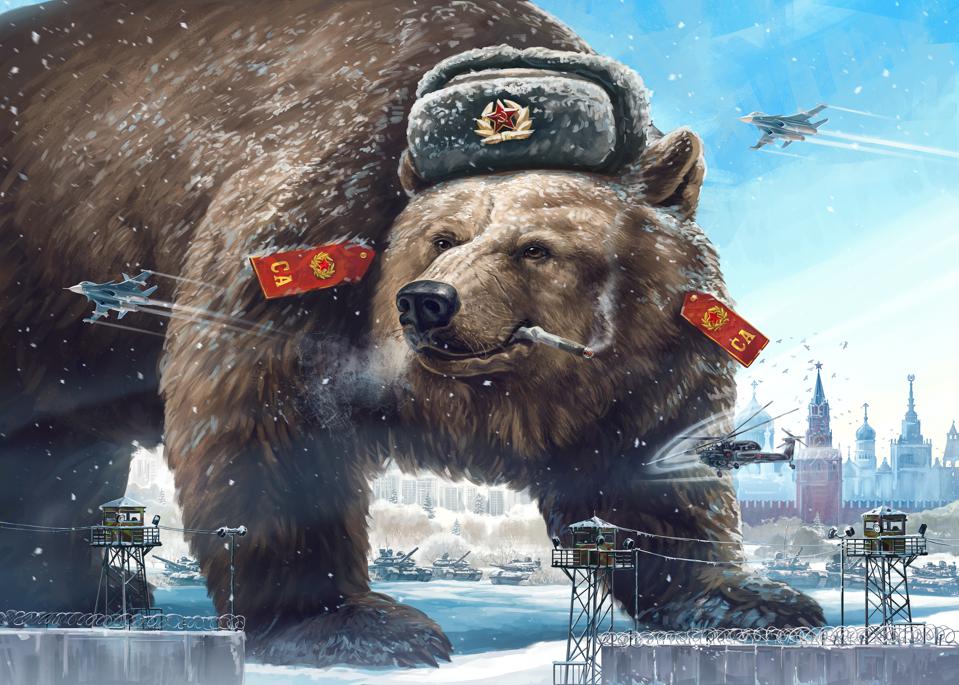
Let’s be honest: a bear sleeping peacefully in its den was smoked out of there by being poked with a stick, and now they are wondering why it is chasing those who did that. Moscow has been pushed into a corner and is now demonstrating its strength and standing up for its interests. Now Putin will at best be satisfied with a change of guard in Kiev, and at worst, Ukraine as a state will disappear from the map of Europe. Is it possible to justify an aggression that has been provoked for a long time? This is a matter of a lengthy discussion. One thing is clear: 20 years ago, Russia could and wanted to join NATO and united Europe. However, the latter chose to make Russia an enemy…

Related Articles:

From the Black Sea to the East Med, Don’t Poke the Russian Bear – By Pepe Escobar

Scholz Caves on Nord Stream While Putin Throws Donbass a Lifeline – By Mike Whitney