
The Big Stiff: Russia-Iran dump the dollar and bust US sanctions

News of Russian banks connecting to Iran’s financial messaging system strengthens the resistance against US-imposed sanctions on both countries and accelerates global de-dollarization.  
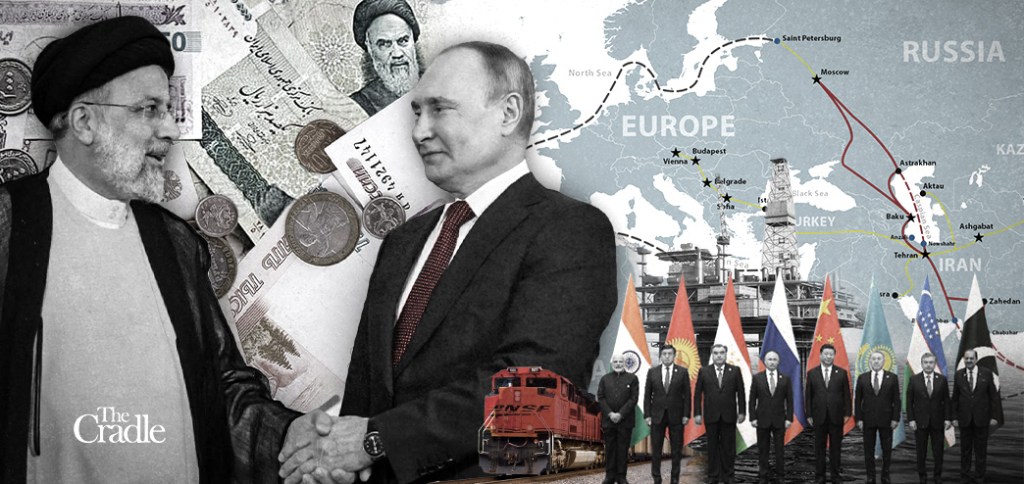
By Pepe Escobar

Source: The Cradle

The agreement between the Central Banks of Russia and Iran formally signed on 29 January connecting their interbank transfer systems is a game-changer in more ways than one.

Technically, from now on 52 Iranian banks already using SEPAM, Iran’s interbank telecom system, are connecting with 106 banks using SPFS, Russia’s equivalent to the western banking messaging system SWIFT.

Less than a week before the deal, State Duma Chairman Vyachslav Volodin was in Tehran overseeing the last-minute details, part of a meeting of the Russia-Iran Inter-Parliamentary Commission on Cooperation: he was adamant both nations should quickly increase trade in their own currencies.

Ruble-rial trade

Confirming that the share of ruble and rial in mutual settlements already exceeds 60 percent, Volodin ratified the success of “joint use of the Mir and Shetab national payment systems.” Not only does this bypass western sanctions, but it is able to “solve issues related to mutually beneficial cooperation, and increasing trade.”

It is quite possible that the ruble will eventually become the main currency in bilateral trade, according to Iran’s ambassador in Moscow, Kazem Jalali: “Now more than 40 percent of trade between our countries is in rubles.”

Jalali also confirmed, crucially, that Tehran is in favor of the ruble as the main currency in all regional integration mechanisms. He was referring particularly to the Russian-led Eurasian Economic Union (EAEU), with which Iran is clinching a free trade deal.

The SEPAM-SPFS agreement starts with a pilot program supervised by Iran’s Shahr Bank and Russia’s VTB Bank. Other lenders will step in once the pilot program gets rid of any possible bugs.

The key advantage is that SEPAM and SPFS are immune to the US and western sanctions ruthlessly imposed on Tehran and Moscow. Once the full deal is up and running, all Iranian and Russian banks can be interconnected.

It is no wonder the Global South is paying very close attention. This is likely to become a landmark case in bypassing Belgium-based SWIFT – which is essentially controlled by Washington, and on a minor scale, the EU. The success of SEPAM-SPFS will certainly encourage other bilateral or even multilateral deals between states.

It’s all about the INSTC

The Central Banks of Iran and Russia are also working to establish a stable coin for foreign trade, replacing the US dollar, the ruble, and the rial. This would be a digital currency backed by gold, to be used mostly in the Special Economic Zone (SEZ) of Astrakhan, in the Caspian Sea, already very busy moving plenty of Iranian cargo.

Astrakhan happens to be the key Russian hub of the International North-South Transportation Corridor (INSTC), a vast network of ship, rail, and road routes which will drastically increase trade from Russia – but also parts of Europe – across Iran to West Asia and South Asia, and vice-versa.

And that reflects the full geoconomic dimension of the SEPAM-SPFS deal. The Russian Central Bank moved early to set up SPFS in 2014, when Washington began threatening Moscow with expulsion from SWIFT. Merging it with the Iranian SEPAM opens up a whole new horizon, especially given Iran’s ratification as a full member of the Shanghai Cooperation Organization (SCO), and now a leading candidate to join the extended BRICS+ club.

Already three months before the SEPAM-SPFS agreement, the Russian Trade Representative in Iran, Rustam Zhiganshin, was hinting that the decision “to create an analog of the SWIFT system” was a done deal.

Tehran had been preparing the infrastructure to join Russia’s Mir payment system since last summer. But after Moscow was hit with extremely harsh western sanctions and Russian banks were cut off from SWIFT, Tehran and Moscow decided, strategically, to focus on creating their own non-SWIFT for cross-border payments.

All that relates to the immensely strategic geoeconomic role of the INSTC, which is a much cheaper and faster trade corridor than the old Suez Canal route.

Russia is Iran’s largest foreign investor

Moreover, Russia has become Iran’s largest foreign investor, according to Iranian Deputy Finance Minister Ali Fekri: this includes “$2.7 billion worth of investment to two petroleum projects in Iran’s western province of Ilam in the past 15 months.” That’s about 45 percent of the total foreign investment in Iran over the October 2021 – January 2023 period.

Of course the whole process is in its initial stages – as Russia-Iran bilateral trade amounts to only US$3 billion annually. But a boom is inevitable, due to the accumulated effect of SEPAM-SPFS, INSTC, and EAEU interactions, and especially further moves to develop Iran’s energy capacity, logistics, and transport networks, via the INSTC.

Russian projects in Iran are multi-faceted: energy, railways, auto manufacturing, and agriculture. In parallel, Iran supplies Russia with food and automotive products.

Ali Shamkhani, the secretary of Iran’s Supreme National Security Council, is fond of reminding anyone that Russia and Iran “play complementary roles in global energy and cargo transit.” The Iran-EAEU free agreement (FTA) is nearly finalized – including zero tariffs for over 7,500 commodities.

In 2022, the EAEU traded more than $800 billion worth of goods. Iran’s full access to the EAEU will be inestimable in terms of providing a market gateway to large swathes of Eurasia – and bypassing US sanctions as a sweet perk. A realistic projection is that Tehran can expect $15 billion annual trade with the five members of the EAEU in five years, as soon as Iran becomes the sixth member.

The legacy of Samarkand

Everything we are tracking now is in many ways a direct consequence of the SCO summit in Samarkand last September, when Russian President Vladimir Putin and his Chinese counterpart Xi Jinping, in person, placed their bet on strengthening the multipolar world as Iran signed a memorandum to join the SCO.

Putin’s private talks with Iranian President Ebrahim Raisi in Samarkand were all about deep strategy.

The INSTC is absolutely crucial in this overall equation. Both Russia and Iran are investing at least $25 billion to boost its capabilities.

Ships sailing the Don and Volga Rivers have always traded energy and agricultural commodities. Now Iran’s Maritime News Agency has confirmed that Russia will grant their ships the right of passage along the inland waterways on the Don and Volga.

Meanwhile, Iran is already established as the third largest importer of Russian grain. From now on, trade on turbines, polymers, medical supplies, and automotive parts will be on a roll.

Tehran and Moscow have signed a contract to build a large cargo vessel for Iran to be used at the Caspian port of Solyanka. And RZD logistics, a subsidiary of Russian railway RZD, operates container cargo trains regularly from Moscow to Iran. The Russian Journal for Economics predicts that just the freight traffic on INTSC could reach 25 million tons by 2030 – no less than a 20-fold increase compared to 2022.

Inside Iran, new terminals are nearly ready for cargo to be rolled off ships to railroads crisscrossing the country from the Caspian to the Persian Gulf. Sergey Katrin, head of Russia’s Chamber of Commerce and Industry, is confident that once the FTA with the EAEU is on, bilateral trade can soon reach $40 billion a year.

Tehran’s plans are extremely ambitious, inserted in an “Eastern Axis” framework that privileges regional states Russia, China, India, and Central Asia.

Geostrategically and geoeconomically, that implies a seamless interconnection of INSTC, EAEU, SCO, and BRICS+. And all of this is coordinated by the one Quad that really matters: Russia, China, India, and Iran.

Of course there will be problems. The intractable Armenia-Azerbaijan conflict might be able to derail the INSTC: but note that Russia-Iran connections via the Caspian can easily bypass Baku if the need arises.

BRICS+ will cement the dollar’s descent

Apart from Russia and Iran, Russia and China have also been trying to interface their banking messaging systems for years now. The Chinese CBIBPS (Cross-Border Inter-Bank Payments System) is considered top class. The problem is that Washington has directly threatened to expel Chinese banks from SWIFT if they interconnect with Russian banks.

The success of SEPAM-SPFS may allow Beijing to go for broke – especially now, after the extremely harsh semiconductor war and the appalling balloon farce. In terms of sovereignty, it is clear that China will not accept US restrictions on how to move its own funds.

In parallel, the BRICS in 2023 will delve deeper into developing their mutual financial payments system and their own reserve currency. There are no less than 13 confirmed candidates eager to join BRICS+ – including Asian middle powers like Iran, Saudi Arabia, and Indonesia.

All eyes will be on whether – and how – the $30 trillion-plus indebted US will threaten to expel BRICS+ from SWIFT.

It’s enlightening to remember that Russia’s debt to GDP ratio stands at only 17 percent. China’s is 77 percent. The current BRICS without Russia are at 78 percent. BRICS+ including Russia may average only 55 percent. Strong productivity ahead will come from a BRICS+ supported by a gold and/or commodities-backed currency and a different payment system that bypasses the US dollar. Strong productivity definitely will not come from the collective west whose economies are entering recessionary times.

Amid so many intertwined developments, and so many challenges, one thing is certain. The SEPAM-SPFS deal between Russia and Iran may be just the first sign of the tectonic plates movement in global banking and payment systems.

Welcome to one, two, one thousand payment messaging systems. And welcome to their unification in a global network. Of course that will take time. But this high-speed financial train has already left the station.

The agony of the West

Like Rome, the Anglo-Saxon Empire is collapsing by its own decadence.

Sergey Lavrov used to compare the West to a wounded predator. According to him, it should not be provoked because it would be taken by madness and could break everything. It is better to accompany it to the graveyard. The West does not see it that way. Washington and London are leading a crusade against Moscow and Beijing. They roar and are ready for anything. But what can they really do?

By Thierry Meyssan

Source: VoltaireNet.org

The G7 summit in Bavaria and the Nato summit in Madrid were supposed to announce the West’s punishment of the Kremlin for its “special military operation in Ukraine”. But, if the image given was that of Western unity, the reality attests to their disconnection from reality, their loss of audience in the world and ultimately the end of their supremacy.

While the West is convinced that what is at stake is in Ukraine, the world sees it facing the “Thucydides trap” [1]. Will international relations continue to be organized around them or will they become multipolar? Will the peoples who have been subjugated until now break free and gain sovereignty? Will it be possible to think differently than in terms of global domination and to devote themselves to the development of each individual?

The West has devised a narrative of the Russian “special military operation” in Ukraine that overlooks their own actions since the dissolution of the Soviet Union. They have forgotten their signing of the Charter for European Security (also known as the OSCE Istanbul Declaration) and the way they violated it by making almost all the former members of the Warsaw Pact and some of the new post-Soviet states join one by one. They have forgotten the way they changed the Ukrainian government in 2004 and the coup d’état by which they put Banderist nationalists in power in Kiev in 2014. Having made a clean sweep of the past, they blame Russia for all the ills. They refuse to question their own actions and consider, at the time, they were forced into power. For them, their victories make the Law.

To preserve this imaginary narrative, they have already silenced the Russian media at home.

No matter how much they claim to be “democrats”, it is better to censor dissenting voices before lying.

So they approach the Ukrainian conflict, without contradiction, by convincing themselves that they have the duty to judge alone, to condemn and sanction Russia. By blackmailing small states, they managed to obtain a text from the UN General Assembly that seems to prove them right. They now plan to dismantle Russia as they did in Yugoslavia and tried to do in Iraq, Libya, Syria and Yemen (Rumsfeld/Cebrowski strategy).

To do this, they began to isolate Russia from world finance and trade. They cut off its access to the SWIFT system and Lloyds, preventing it from buying and selling as well as transferring goods. They thought this would cause its economic collapse. In fact, on June 27, 2022, Russia was unable to pay a debt of $100 million and the rating agency Mody’s declared it in default [2].

But this did not have the desired effect: everyone knows that the reserves of the Russian Central Bank are full of foreign currency and gold. The Kremlin paid the 100 million, but could not transfer it to the West because of Western sanctions. It has placed them in an escrow account where they await their debtors.

Meanwhile, the Kremlin, which is no longer paid by the West, has begun to sell its production, especially its hydrocarbons, to other buyers, particularly China. The exchanges that can no longer be made in dollars are made in other currencies. As a result, the dollars that their customers used to use are flowing back to the United States. This process had already begun several years ago. But Western unilateral sanctions have accelerated it sharply. The huge amount of dollars accumulating in the US is causing a massive price increase. The Federal Reserve is doing everything it can to share it with the eurozone. The price increase is spreading at high speed across the entire Western European continent.

The European Central Bank is not an economic development agency. Its main task is to manage inflation within the Union. it cannot slow down the sudden rise in prices at all, so it tries to use it to reduce its debt. The Member States of the Union are therefore invited to compensate for the drop in purchasing power of their “citizens” by lowering taxes and providing benefits. But this is a never-ending circle: by helping their citizens, they tie their hands and feet to the European Central Bank, they chain themselves a little more to the US debts and become even poorer.

There is no remedy for this inflation. This is the first time that the West has had to mop up the dollars that Washington has recklessly printed for years. The rise in prices in the West corresponds to the cost of imperial spending over the last thirty years. Today and only today is the West paying for its wars in Yugoslavia, Afghanistan, Iraq, Libya, Syria and Yemen.

Until now, the United States killed anyone who threatened the supremacy of the dollar. It hanged President Saddam Hussein for refusing it and looted the Iraqi Central Bank. They tortured and lynched the leader Muamar el-Gaddafi who was preparing a new pan-African currency and looted the Libyan Central Bank. The gigantic sums amassed by these oil states disappeared without a trace. The only thing we saw was GI’s taking tens of billions of dollars wrapped in large garbage bags. By excluding Russia from dollar trade, Washington itself has brought about what it so feared: the dollar is no longer the international reference currency.

The majority of the rest of the world is not blind. It has understood what is happening and has rushed to the St. Petersburg Economic Forum, then tried to register for the virtual Brics summit. They realize -a little late- that Russia launched the “Partnership of Greater Eurasia”, in 2016 and that its Foreign Minister, Sergei Lavrov, had solemnly announced it at the UN General Assembly, in September 2018 [3]. During four years, quantities of roads and railroads were built to integrate Russia into the networks of the new “Silk Roads”, land and sea, imagined by China. It was thus possible to shift the flow of goods within a few months.

The fall in the value of the dollar and the shift in the flow of goods are causing an even greater rise in energy prices. Russia, which is one of the world’s leading exporters of hydrocarbons, has seen its revenues increase considerably. Its currency, the ruble, has never been in better shape. In response, the G7 has set a price ceiling for Russian oil and gas. It ordered the “international community” not to pay more.

But Russia is obviously not going to let the West set the prices of its products. Those who do not want to pay market prices will not be able to buy them, and no customer intends to go without to please the West.

The G7 tries to organize, at least intellectually, its supremacy [4].. This no longer works. The wind has changed. The four centuries of Western domination are over.

In desperation, the G7 has committed itself to solving the global food crisis that its policies have caused. The countries concerned know what the G7 commitments mean. They are still waiting for the great African development plan and other smoke and mirrors. They know that the West cannot produce nitrogen fertilizers and that they prevent Russia from selling theirs. The G7 aid is only a band-aid to keep them waiting and not to question the sacred principles of free trade.

The only possible option for the rescue of Western domination is war. Nato must succeed in destroying Russia militarily as Rome once razed Carthage. But it’s too late: the Russian army has much more sophisticated weapons than the West. It has already experimented with them since 2014 in Syria. It can crush its enemies at any time. President Vladimir Putin exposed the staggering progress of its arsenal to his parliamentarians in 2018 [5]

The Nato summit in Madrid was a nice communication operation [6]. But it was only a swan song. The 32 member states proclaimed their unity with the despair of those who fear to die. As if nothing had happened, they first adopted a strategy to dominate the world for the next ten years, naming China’s “growth” as a concern [7]. In doing so, they admitted that their goal is not to ensure their own security, but to dominate the world. They then opened the accession process for Sweden and Finland and considered approaching China with, as a first step, the possible accession of Japan.

The only incident, which was quickly brought under control, was the Turkish pressure that forced Finland and Sweden to condemn the PKK [8]. Unable to resist, the United States dropped its allies, the Kurdish mercenaries in Syria and their leaders abroad.

With this, they decided to increase the NATO Rapid Reaction Force from 40,000 to 300,000 men, 7.5 times, and station it on the Russian border. In doing so, they have once again violated their own signature, that of the Charter for Security in Europe, by directly threatening Russia. Russia has no possibility to defend its huge borders and can only ensure its security by ensuring that no foreign force sets up a military base on its borders (scorched earth strategy). Already, the Pentagon is circulating prospective maps of the dismantling of Russia that it hopes to implement.

The former Russian ambassador to NATO and current director of Roscosmos, Dmitry Rogozin, has responded by publishing on his Telegram account the coordinates of the NATO decision-making centers, including the Madrid summit room [9]. Russia has hypersonic launchers, for the moment impossible to intercept, which can carry a nuclear warhead in a few minutes to the NATO headquarters in Brussels and the Pentagon in Washington. To avoid any misunderstanding, Sergei Lavrov specified, alluding to the Straussians, that the martial decisions of the West were not taken by the military, but by the US State Department. It would be the first target.

So the question is: will the West play for all it’s worth? Will they take the risk of a Third World War, even though it has already been lost, just to avoid dying alone?

Translation
Roger Lagassé

Dollar As World’s Reserve Currency Threatened

dollar_2977362b

By Stephen Lendman

Source: Stephen Lendman Blog

US dollar dominance finances Washington’s reckless spending, global militarism, its empire of bases, endless wars, corporate takeovers, as well as speculative excess creating bubbles and economic crises – at the expense of democratic freedoms and beneficial social change.

China, Russia and other nations increasingly trading in their own currencies pose a significant threat to dollar dominance. Mahdi Darius Nazemroaya explained Washington’s currency war on China, saying:

“The Chinese are in the process of displacing the monopoly of the US dollar. They are dropping their US Treasury bonds, stockpiling gold reserves, and opening regional distribution banks for their own national currency.”

“This will give them easier access to capital markets and insulate them from financial manipulation by Washington and Wall Street.”

China bashing by public and private US officials is part of a campaign to denigrate its government – making inflammatory accusations without proof about hacking, defying its legitimate right to do what it wishes in its own waters, and threatening sanctions – legal only by Security Council members, never by individual countries against others, Washington’s longstanding weapon against independent governments.

“As the financial architecture of the world is being altered by China and Russia, the US dollar is gradually being neutralized as one of Washington’s weapon of choice,” Nazemroaya explained.

The post-WW II US-dominated international monetary system is threatened with unraveling. Washington is fighting back with propaganda, energy, financial, economic and currency wars against China and Russia, said Nazemroaya.

Russia sold a fifth of its $125 billion in US Treasuries holdings last March. China’s US Treasuries holdings exceed $1 trillion dollars. It’s been aggressively dumping them.

It’s gone from the world’s largest buyer to its biggest seller. Will other countries follow suit? Nations are increasingly trading in their own currencies. Weakening America’s financial strength is the best way curb its imperial ambitions.

Russia drafted legislation aimed at eliminating dollars and euros in trade between Commonwealth of Independent States (CIS) countries: Armenia, Belarus, Kazakhstan, Kyrgyzstan, Tajikistan, Russia, and other former Soviet republics.

A Kremlin statement said “(t)his would help expand the use of national currencies in foreign trade payments and financial services and thus create preconditions for greater liquidity of domestic currency markets.”

It would facilitate regional trade and help achieve economic stability. It would reduce dependency on the world’s two dominant currencies.

China’s central bank launched a Heilongjiang Province yuan/ruble program – Russia’s currency replacing the dollar.

Both countries are increasingly trading in their own currencies – bypassing dollar transactions. If enough other countries follow suit, dollar strength will weaken. Its hegemonic ambitions will be curbed – how much, how soon remains to be seen.


Stephen Lendman lives in Chicago. He can be reached at lendmanstephen@sbcglobal.net.

His new book as editor and contributor is titled “Flashpoint in Ukraine: US Drive for Hegemony Risks WW III.”

http://www.claritypress.com/LendmanIII.html

Visit his blog site at sjlendman.blogspot.com.