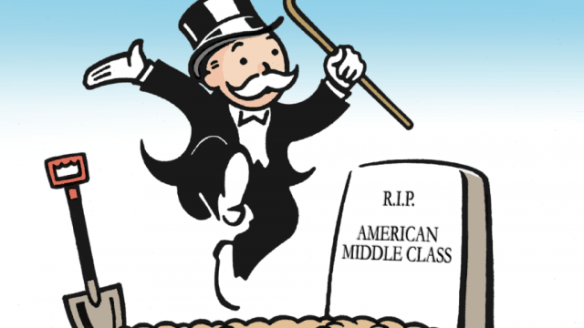
Disposable Americans: The Numbers are Growing

middle-class

By Paul Buchheit

Source: Information Clearing House

As often noted in the passionate writings of Henry Giroux, poor Americans are becoming increasingly ‘disposable’ in our winner-take-all society. After 35 years of wealth distribution to the super-rich, inequality has forced much of the middle class towards the bottom, to near-poverty levels, and to a state of helplessness in which they find themselves being blamed for their own misfortunes.

The evidence keeps accumulating: income and wealth — and health — are declining for middle-class America. As wealth at the top grows, the super-rich feel they have little need for the rest of society.

Income Plummets for the Middle Class

According to Pew Research, in 1970 three of every ten income dollars went to upper-income households. Now five of every ten dollars goes to them.

The Social Security Administration reports that over half of Americans make less than $30,000 per year. That’s less than an appropriate average living wage of $16.87 per hour, as calculated by Alliance for a Just Society.

Wealth Collapses for Half of Us

Numerous sources report that half or more of American families have virtually no savings, and would have to borrow money or sell possessions to cover an emergency expense. Between half and two-thirds of Americans have less than $1,000.

For every $100 owned by a middle-class household in 2001, that household now has just $72.

Not surprisingly, race plays a role in the diminishing of middle America. According to Pew Research, the typical black family has only enough liquid savings to last five days, compared to 12 days for the typical Hispanic household, and 30 days for a white household.

Our Deteriorating Health

In a disgraceful display of high-level disregard for vital health issues, House Republicans are attempting to cut back on lunches for over 3 million kids.

The evidence for the health-related disposability of poor Americans comes from a new study that finds nearly a 15 year difference in life expectancy for 40-year-olds among the richest 1% and poorest 1% (10 years for women). Much of the disparity has arisen in just the past 15 years.

It’s not hard to understand the dramatic decline in life expectancy, as numerous studies have documented the health problems resulting from the inequality-driven levels of stress and worry and anger that make Americans much less optimistic about the future. The growing disparities mean that our children will likely see less opportunities for their own futures.

It May Be Getting Worse

The sense derived from all this is that half of America is severely financially burdened, at risk of falling deeper into debt.

It may be more than half. The Wall Street Journal recently reported on a JP Morgan study’s conclusion that “the bottom 80% of households by income lack sufficient savings to cover the type of volatility observed in income and spending.” Fewer than one in three 25- to 34-year-olds live in their own homes, a 20 percent drop in just the past 15 years.

It may be even worse for renters. The number of families spending more than half their incomes on rent — the ‘severely’ cost-burdened renters — has increased by a stunning 50 percent in just ten years. Billionaire Steve Schwarzman, whose company Blackstone has been buying up tens of thousands of homes at rock-bottom prices and then renting them back while waiting out the housing market, finds the growing anger among voters “astonishing.”

What’s astonishing is the disregard that many of the super-rich have for struggling Americans.


Paul Buchheit is a college teacher, an active member of US Uncut Chicago, founder and developer of social justice and educational websites (UsAgainstGreed.org, PayUpNow.org, RappingHistory.org), and the editor and main author of “American Wars: Illusions and Realities” (Clarity Press). He can be reached at paul@UsAgainstGreed.org.

A Phony Victim, and a Lot of Real Ones

Justin Kelly’s cinematic doppelgänger: Fancy Lad from the film “Cabin Boy”

By Kevin Carson

Source: Center for a Stateless Society

In a recent open letter to the mayor (Julia Carrie Wong, “San Francisco tech worker: ‘I don’t want to see homeless riff-raff,’ The Guardian, Feb. 17), entitled tech bro Justin Keller whined that the sight of homeless people ruins his enjoyment of the local atmosphere in San Francisco. And when his family comes to visit, it just brings everybody down. Keller, owner of the Commando.io startup, added

I know people are frustrated about gentrification happening in the city, but the reality is, we live in a free market society. The wealthy working people have earned their right to live in the city. They went out, got an education, work hard, and earned it…. I shouldn’t have to see the pain, struggle, and despair of homeless people to and from my way to work every day.

But a closer look at the history of class privilege and ethnic cleansing in San Francisco suggests that “free market reality” isn’t as obvious as Keller makes it out to be.

About three days after reading about Keller’s traumatic encounters with the homeless (I can’t help thinking of “Cabin Boy” Chris Elliott — the Fancy Lad in a powdered wig — screaming in terror as a rabbit runs across his path), I learned of some other people in San Francisco with problems of their own.

Back in the ’60s, under the “Civic Redevelopment” program — San Francisco’s version of Urban Renewal — over 100 city blocks of black residential neighborhoods, businesses and churches deemed “slum areas” were bulldozed and their residents forcibly relocated. Under the cumulative effect of such Urban Renewal policies, in the ’60s and ’70s, the black population of San Francisco declined from 13.4% to less than 6% of the total. In 1968 the Midtown Park Apartments were opened to house residents “relocated” from one of the demolished neighborhoods, the Fillmore-Western Addition (“Petition — #BlackHomesMatter: Stop the displacement of long-term San Francisco residents at Midtown” Change.org).

Today, Midtown is a close-knit working-class community of long-time Black residents as well as immigrants from all over the world, including fixed-income seniors, disabled veterans, and children. Some tenants have lived at Midtown for over 40 years.

Despite decades of promises to convert the apartments to cooperative ownership by the residents, the city is once again collaborating with local real estate interests to rack rent the tenants, drive them out, and — ahem — “redevelop” the property.

Midtown residents have been working for decades towards the co-operative ownership of their homes and even paid off the mortgage for the Midtown property. Despite repeated promises from the City of San Francisco that Midtown residents would be eventual owners of their homes, two days before Christmas Eve in 2013, the City terminated the lease with the tenant’s association and without warning awarded it to Mercy Housing, a national Catholic affordable housing nonprofit. Since then, Mercy has raised the rent on many tenants (some up to 300%), implemented restrictive and discriminatory new rules, and has put forth plans to eventually demolish the entire Midtown property. Mercy Housing has also begun a program of harassing tenants – targeting seniors and tenants with low English literacy, cutting locks to enter apartments illegally and other tactics meant to intimidate tenants from fighting back.

The residents of 65 of the apartments have declared a tenant strike and are withholding rent in protest.

I guess that’s pretty small potatoes compared to the horror of having Mumsy and Daddy see a homeless person on their way to the grand tour of your new luxury condo.

Keller makes it clear, by the way, that his own idea of a “free market society” is fully compatible with such ethnic cleansing by the government. In his meltdown over the injustice of sensitive people like himself having to look at homeless people, he made positive reference to “street sweeps” by local government as a positive example:

I don’t have a magic solution … It is a very difficult and complex situation, but somehow during Super Bowl, almost all of the homeless and riff raff seem to up and vanish. I’m willing to bet that was not a coincidence. Money and political pressure can make change. So it is time to start making progress, or we as citizens will make a change in leadership and elect new officials who can.

So we live in the kind of “free market society” where local government, working on behalf of local real estate interests, can ethnically cleanse 100 city blocks of their inhabitants, in the process reducing the city’s black population by more than half, and then send uniformed thugs to drive people off the streets by the thousands for the crime of being homeless in public.

More generally, just about any city government is nothing but a showcase property of the local real estate interests, and its central function is to serve what Harvey Molotch called the “urban growth machine” by driving up real estate prices. And most of the many billions of dollars of wealth in Silicon Valley — with which tech bros like Keller are driving rents into the stratosphere — result from a business model centered on state-enforced “intellectual property” monopolies.

But it’s not as though these things are some kind of departure from the “free market” ideal, or that there has ever been a “free market society” at any point in history. Right-wing libertarians celebrate the 19th century Gilded Age as some kind of near laissez-faire utopia. But it never even remotely approached such a thing.

The so-called “laissez-faire” Gilded Age was heir to four centuries of land enclosure and other nullifications of customary peasant tenure rights in the land, mass enslavement, and the colonization and robbery of half the planet. Capitalism never emerged from a “free market”; it was a direct outgrowth of the “bastard feudalism” of the late Middle Ages, in which a major segment of the old landed classes reinvented themselves as agrarian capitalists and, in alliance with absolute monarchies and large mercantile interests, converted their own countries into prison societies and then forcibly conquered most of the world. The  so-called “lassez-faire” 19th century was built directly atop the structure of inequality and concentrated property resulting from these centuries of robbery.

And the political centerpiece of the Gilded Age was the Great Betrayal of 1877, in which Rutherford B. Hayes agreed to end Reconstruction in return for the electoral votes of the southern states, despite his having a minority of the popular vote. This was a devil’s bargain in which the agrarian capitalists of the former Confederacy were allowed to institute a regional system of Apartheid, in return for giving industrial capitalists uncontested control the American state. Once this control was secured, the national government immediately began imposing a top-down corporate transformation of the economic system, and using the full power of the federal government to suppress the workers’ and farmers’ movements.

This groundwork having been established, the twentieth century saw an alliance between large corporations and the American state so massive that the very distinction between “public” and “private” ceased to have meaning. The tech industry itself was a direct outgrowth of the corporate state, as even a cursory overview of the role of the military-industrial complex in creating the cybernetic revolution and building the Internet backbone should tell you.

So no, Justin — this is not a “free market society,” and you and your ilk did not earn your wealth. As Ann Richards said of George Bush, “you were born on third base and thought you hit a triple.” But I like even better a saying of Martin Luther King Jr’s: “When you see a turtle sitting on a fencepost, you know he had help getting up there.”

If there’s anybody in the tech industry pushing for something resembling a genuine “free market society,” it’s not the venture capitalists and start-ups. It’s the people trying to free information work from the legacy of its origins in the bureaucracy of a total war state, and rebuild it on the basis of horizontalism, self-organization and p2p, rather than allowing it to fall under the control of new corporate bureaucracies through government-enforced “intellectual property” enclosure; the drivers unionizing Uber and Lyft; the people jailbreaking proprietary apps or developing open-source, cooperative versions of them; the hackers doing their best to destroy proprietary information culture; and the people organizing freelancers’ unions, cooperative temp agencies and other cost- and income-pooling platforms for precarious labor. If a “free market society” actually means anything, it also encompasses the struggles of the people rendered homeless by government collusion with capital, for the right to exist in public spaces. And above all, it includes the people displaced from their homes by brutal ethnic cleansing schemes, who are fighting to maintain occupancy of apartments of which they, by any acceptable moral standard, are the rightful owners.

So to tie this all up, let’s break the power of the real estate interests and tech monopolies in alliance with local government. I call on everyone reading this to support the Midtown rent strikers, to express unconditional solidarity for their resistance to eviction, and to unconditionally condemn local government, law enforcement, and the real estate interests that stand to benefit from this robbery. Force the city government to honor its promises and immediately transfer ownership to the residents of Midtown Park Apartment. At the very least, sign the petition in support of them and circulate the story of this injustice as widely as possible.

From Shanghai to San Francisco, the rent is too damn high

homeless-read-tweets

By Jerome Roos

Source: RoarMag.org

Capitalism is a strange beast. Though incredibly resilient in the face of systemic crises and remarkably adaptive to ever-changing conditions, it never truly overcomes its structural contradictions. As the Marxist geographer David Harvey often points out, it merely displaces them in space and time.

The global financial crisis of 2008-’09 has been no exception in this regard. In fact, the very response to that calamity has already laid the foundations for the next big crisis. And just like its immediate predecessor, it looks like this one will be centered, at least in part, on a massive speculative housing bubble.

Officials and investors may still be turning a blind eye, but the warning signs are flashing red everywhere. From Shanghai to San Francisco, from London to L.A., a wave of real-estate speculation is washing over the world, gentrifying popular neighborhoods, pushing housing prices and rents to historically unprecedented highs, and forcing low-income tenants out of their increasingly unaffordable homes. The result is widespread social displacement and deepening discontent.

Unlike the subprime mortgage crisis of 2007-’08, which was centered on the complex packaging of risky loans to low-income households across the U.S., the new housing crisis is a product of real-estate speculation in the world’s major metropolitan areas. Take London, which according to the Financial Times finds itself confronted with “its biggest housing challenge since the Victorian era.” Residential property prices in the British capital have risen 44 percent since 2008, and are now well above their pre-crisis highs.

According to an analysis by the UK charity Shelter, there are currently only 43 homes in Greater London that could still be considered affordable to the average first-time buyer, pushing everyone but the richest of the rich into the rental market, where landlords are known to exact more than a pound of flesh in return for a roof and running water. In the majority of London boroughs, the median rent for a one-bedroom apartment is now over £1,000 per month. On average, Londoners spend about 60 percent of their income on rent.

A similar picture has emerged in New York, where property prices — in the words of the BBC — “have gone turbo-ballistic, as global capital in search of a safe haven has rocketed in.” The average monthly rent in Manhattan now exceeds $3,800, even as half of New York’s urban population lives near or below the poverty line. As a gubernatorial candidate for New York once aptly pointed out, “the rent is too damn high.”

Again, the unsurprising result has been widespread social displacement. Al Jazeera recently reported that “evictions [in New York] have reached epidemic proportions and created a new homeless crisis born out of an affordable housing shortage.” Other major cities like Boston and Los Angeles are not doing much better, as gentrification proceeds apace from coast to coast. Today, even the downtown area of derelict Detroit is rapidly gentrifying, while much of the city still languishes in a state of post-industrial decline.

It is San Francisco, however, that has emerged in recent years as the most paradigmatic case of unbridled gentrification. With median monthly rent hitting $3,530, the city has become the most expensive in the U.S. Desperate to get rid of old tenants who still enjoy rent controls and attract high-income professionals from the tech industry in their place, landlords have gone on an eviction spree: in the past five years, the eviction rate has soared more than 50 percent. Immigrant and working class neighborhoods like the Mission have been reduced to multi-million dollar playgrounds for the “bohemian bourgeois”, complete with snazzy coffee places and expensive vegan restaurants.

The urban sociologist Saskia Sassen has encapsulated the nature of this violent process in strikingly succinct terms: the social reality of financialized capitalism, she argues in her book Expulsions, is all about “systemic complexity producing simple brutality.” And as usual, those feeling the brunt of this brutality are the urban poor and marginalized communities, especially immigrants and people of color, who — along with artists and precarious youths — are increasingly being displaced from city centers towards the periphery.

It is not just cities in the advanced capitalist countries that have been undergoing this turbulent process of urban stratification: the major metropolitan areas of the Global South are firing on all cylinders as well — with the notable difference being that the bubble in emerging markets already appears to be in the process of popping, raising fears of a new international financial crisis centered on China, Brazil and Turkey, among others.

In China’s biggest cities, property prices shot up 60 percent between 2008 and 2014, with residential prices in Shanghai and Beijing rapidly closing in on those of London, Paris and New York. According the consultancy firm McKinsey, some$9 trillion — almost half of China’s total debt, excluding financial sector debt — “is directly or indirectly tied to real estate.” Price increases have exceeded the rise in income by 30 percent in Shanghai and by 80 percent in Beijing.

Other major cities that have been experiencing similar real-estate booms include São Paulo and Rio de Janeiro in Brazil, where residential property prices in the most-desired neighborhoods doubled between 2008 and 2013, and Istanbul, along with the other big cities of Turkey, where a credit-fueled construction boom has accounted for 30 percent of GDP in the period since Erdogan’s AKP came to power on the heels of a previous financial crisis in 2002. Since 2007, property prices in Turkey have shot up 36 percent.

To be sure, the local specificities vary from place to place. In London, the housing crisis has been fueled at least in part by massive capital inflows from wealthy elites in countries like China, Saudi Arabia and the Gulf States, as well as the municipality’s failure to build adequate housing for the large influx of new inhabitants. In Barcelona, by contrast, it has been driven primarily by the tourism industry, while in San Francisco it is largely driven by the tech industry. In Rio, the process has been intensified by preparations for the FIFA World Cup and the Olympic Games, while widespread cronyism and corruption have been an important catalyst for the construction boom in Istanbul.

Yet for all differences between them, the gentrification processes and housing crises in each of these global cities share two crucial commonalities: first in their causes, and second in their consequences.

In terms of the underlying causes, the new housing crisis should be seen as a direct outcome of the response to the previous crisis, which was based on massive bank bailouts and central banks opening the floodgates of cheap credit. With the notable exception of the ECB, which only embarked on quantitative easing earlier this year, the world’s largest central banks dropped interest rates to historic lows, kept them there for years on end, and pumped trillions of dollars of fresh liquidity into the global financial system, effectively subsidizing private investors out of bankruptcy.

This unlimited flow of free money (for the 1% only, of course) produced a tide of surplus capital that had to be absorbed somewhere. With “secular stagnation” taking hold across the developed world, investors were still wary to direct this surplus towards the productive economy, where profit margins remained relatively low. And so, in their insatiable quest for yield, they turned to speculative investment in various asset classes instead: stocks, bonds — and, once again, real-estate. The profits were phenomenal. By 2012-’13, the resulting speculative boom had led U.S. corporate profits back to a new all-time high.

But now that the first signs of overheating have become apparent, we can already begin to identify the second crucial commonality between today’s urban housing crises; a commonality that sets the current crisis apart from the last one: in almost all of the major world cities today, ordinary citizens are already actively mobilizing and fighting back against processes of gentrification, dispossession and displacement, building innovative social movements and powerful political platforms in the process.

From urban insurrections to defend the last-remaining green space of Istanbul or the favelas and public transport system of Rio, to the local direct action of anti-gentrification activists targeting Google buses in the San Francisco Bay Area and reclaiming housing projects in London, it is already clear that the next major crisis, unlike the last one, will not go uncontested.

Of all the urban struggles that have ignited across the globe in recent years, the radically democratic municipal platforms of Spain are undoubtedly among the most advanced and the most promising. With the left-wing anti-eviction activist Ada Colau now holding the mayoralty of Barcelona, an important sign is being sent to the landlords, gentrifiers and real-estate speculators of the world: even in the deepest crises, there will be a limit to your capacity to evict us from our homes and destroy our cities — and that limit, ultimately, is us.

Jerome Roos is a PhD researcher in International Political Economy at the European University Institute, and founding editor of ROAR Magazine. Follow him on Twitter at @JeromeRoos.