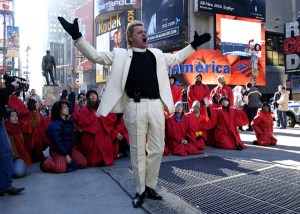
By Reverend Billy
Source: Reality Sandwich
What did you call me?
That is a traditional last bit of language before the shove, the fist and the bullet.
We have a circus in our benighted city New York, of name-calling, misunderstanding, and yes, murder. This week we have Quentin Tarantino using the word “murdered” for the victims of police violence, a few hours from the funeral of a cop named Ralph Holder, who was murdered in the line of duty. Police commissioner Bill Bratton lashes out, calling the film-maker “contemptible.” (But the number of unarmed Americans shot and killed by police is approaching a thousand this year.)
This merry-go-round of words is very close to the end of language, the “What Did You Call Me?” of every B-movie western… This has gone on since before 9/11. Rudolf Giuliani took it to a new level. Then Mike Bloomberg, with his commissioner Ray Kelly – pandered to language-destroying emotions of fear every single day of the three terms of that administration.
You have to ask – how could the two sides work together? Is it possible to even begin in this canyon of clichés? The police are so defensive, they act like Scientologists. They are hair-trigger-ready to be disrespected. On the other hand, Black Lives Matter is the first successful social movement in memory, and people like me treasure this historical moment. It proves that a social movement in this age of Consumerism and Militarism is still possible. Black Lives Matter is our daylight.
We ask – how would we heal? One development this week intrigues. Al Sharpton was called to preside at the funeral by the father of the Officer Ralph Holder, and then he backed away as the pack of Irish cops Bratton and the union heads Lynch and Mullins – laid it on thick.
But the choice by the father is fascinating. It showed a moment of healing leadership coming from a not-in-the-media-circus regular citizen. It was daringly hopeful, and probably not realistic. Clearly, though, it was the kind of gesture we need. No politician could’ve done this, though our mayor Bill de Blasio may have tried – really no public figure could ever be this creative.
“Never assume that every critic is a hater, not everyone is hating on you, some people are telling you the truth.” —Nina Simone
What Tarantino did that really gets to the police is – he claimed the word “murder.” Murder is a crime and crime is the territory of the police.
It didn’t seem to matter to them that so many called out, “Stop killing us!” But if you shout “Stop murdering us.” – the police are incensed. “Murder” is something only they understand. The police own the word “Murder.”
You could say that Tarantino is a player in a very long game of healing. Other public figures may join him in using such language. Murder is murder. More police who murder need to go on trial for murder. That word can no longer be held sacred, with the police the only priests allowed to speak it.
This is one trail of healing, but there must be others. One that I think of, as a many-times arrested and jailed New York activist, is this: How would any non-police person ever criticize the cops openly? How would that be possible? At this point in time – this is how far it’s gone – no public language can criticize cops that is not immediately damned by cops. I used the word “damned” rather than “attacked,” because the police hunt down critics in the manner of a religious cult.
“I love this country more than in any in the world, and exactly for this reason I insist on the right to criticize her perpetually.” —James Baldwin
Don’t you find yourself grateful and amazed that the children of slaves continue to risk their lives in the act of citizenship? This is a key to possible healing. In New York City, we have a standing army of 35,000 police and they are systematically denied the education of the 1st Amendment, and they are armed. They are led by demagogues in the old style of Mussolini: And yet, African-Americans get out of bed every day and go outside into public space a willful, risky act of citizenship.
The healing that we see is so needed for this divided city will not come from Black Lives Matter backing down, changing language, acquiescing. We are in a long recovery from 9/11, which only strengthened the racism already in us.
The movement for the return to “Peace Officers” is very like the Earth Movement. Entrenched power that believes it is the owner of legalized violence must be faced down in public space. Since citizens cannot exercise their 1st Amendment rights in the privatized parks and streets now, the healing of violent law enforcement will involve some form of trespassing.
It may sound novel to suggest that healing comes from continuing the advancement of one of the antagonists. Yes – Black Lives Matter needs to advance and grow. Safety for black citizens must be normalized and formalized – and this will heal the law enforcement community. Healing in this case mostly means the education of the police.
Black Lives Matter was sparked by young blacks who refused to leave the sidewalk in front of the Ferguson police department for months. Here in NYC, the bridges and tunnels and Macy’s and Grand Central Station were occupied. The die-ins were always called trespassing. Those die-ins must be the seeds of healing.
“I stand with the murdered.” —Quentin Tarantino
Our Hollywood buddy trespassed on police language. We hope that he continues to use such direct, honest words – and so must we.
RiseUpOctober was criticized for scheduling the “rally” at the same time as Officer Holder’s funeral, but we were going to a funeral too. Throughout the week the police and their media called the Union Square rally a political exercise, as if it were a vested interest group.
This is simply psychological bullying. They don’t think of us as experiencing sorrow. If they showed contrition for the results of their bullets, it might dawn on them that we are gathered with sorrow in our anger. Last year, the number of deaths from police use of deadly force was about 20 times the number of police deaths while on duty. And if you cannot imagine sorrow in another human being, you are more likely to hurt them. Out of this de-humanization, cops kill.
Following Black Lives Matter as our teacher, we must use all the words and all the space with our bodies. The healing is the pulling back, slowly and painfully, of these people from their fearful violence. We must pull them back to a trust of their neighbors that they haven’t enjoyed in so long.
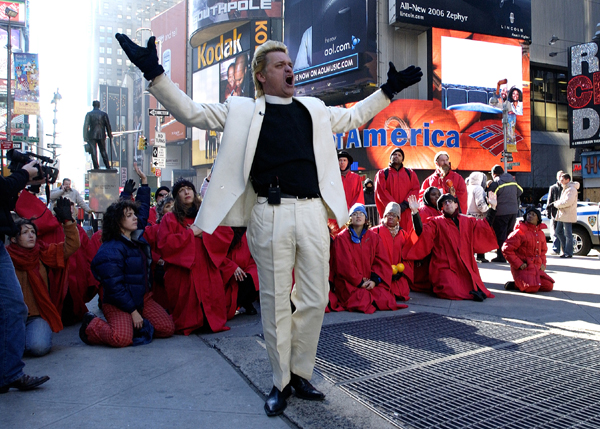
Reverend Billy and the Stop Shopping Choir open their show “The Earth Wants YOU!” at Joes’ Pub at New York’s Public Theater on Sunday November 15. Contact Revbilly.com for show times and ticket info.

 After the Crash