Kick Open the Doorway to Liberty: What Are We Waiting For?

0823e935c920bdf2c31447b67612bfc6

By John W. Whitehead

Source: The Rutherford Institute

“The greatness of America lies in the right to protest for right.”—Martin Luther King Jr.

Everything this nation once stood for is being turned on its head.

Free speech, religious expression, privacy, due process, bodily integrity, the sanctity of human life, the sovereignty of the family, individuality, the right to self-defense, protection against police abuses, representative government, private property, human rights—the very ideals that once made this nation great—have become casualties of a politically correct, misguided, materialistic, amoral, militaristic culture.

Indeed, I’m having a hard time reconciling the America I know and love with the America being depicted in the daily news headlines, where corruption, cronyism and abuse have taken precedence over the rights of the citizenry and the rule of law.

What kind of country do we live in where it’s acceptable for police to shoot unarmed citizens, for homeowners to be jailed for having overgrown lawns (a Texas homeowner was actually sentenced to 17 days in jail and fined $1700 for having an overgrown lawn), for kids to be tasered and pepper sprayed for acting like kids at school (many are left with health problems ranging from comas and asthma to cardiac arrest), and for local governments to rake in hefty profits under the guise of traffic safety (NPR reports that police departments across the country continue to require quotas for arrests and tickets, a practice that is illegal but in effect)?

Why should we Americans have to put up with the government listening in on our phone calls, spying on our emails, subjecting us to roadside strip searches, and generally holding our freedoms hostage in exchange for some phantom promises of security?

As I document in my new book Battlefield America: The War on the American People, it doesn’t matter where you live—big city or small town—it’s the same scenario being played out over and over again in which government agents ride roughshod over the rights of the citizenry.

In such an environment, it’s not just our Fourth Amendment rights—which protect us against police abuses—that are being trampled. It’s also our First Amendment rights to even voice concern over these practices that are being muzzled. Just consider some of the First Amendment battles that have taken place in recent years, and you too will find yourself wondering what country you’re living in:

  • Harold Hodge was arrested for standing silently in front of the U.S. Supreme Court building, holding a sign in protest of police tactics.
  • Marine Brandon Raub was arrested for criticizing the government on Facebook.
  • Pastor Michael Salman was arrested for holding Bible studies in his home.
  • Steven Howards was arrested for being too close to a government official when he voiced his disapproval of the war in Iraq.
  • Kenneth Webber was fired from his job as a schoolbus driver for displaying a Confederate flag on the truck he uses to drive from home to school and back.
  • Fred Marlow was arrested for filming a SWAT team raid that took place across from his apartment.

And then there were the three California high school public school students who were ordered to turn their American flag t-shirts inside out on May 5 (Cinco de Mayo) because school officials were afraid it might cause a disruption and/or offend Hispanic students. Incredibly, the U.S. Supreme Court actually sided with the school and the Ninth Circuit Court of Appeals, affirming that it might be disruptive for American students to wear the American flag to an American public school.

While there are all kinds of labels being put on so-called “unacceptable” speech today, from calling it politically incorrect and hate speech to offensive and dangerous speech, the real message being conveyed is that Americans don’t have a right to express themselves if what they are saying is unpopular, controversial or at odds with what the government determines to be acceptable.

Whether it’s through the use of so-called “free speech zones,” the requirement of speech permits, the policing of online forums, or a litany of laws and policies that criminalize expressive activities, what we’re seeing is the caging of free speech and the asphyxiation of the First Amendment.

Long before the menace of the police state, with its roadside strip searches, surveillance drones, and SWAT team raids, it was our First Amendment rights that were being battered by political correctness, hate crime legislation, the war on terror and every other thinly veiled rationale used to justify censoring our free speech rights.

By suppressing free speech, the government is contributing to a growing underclass of Americans who are being told that they can’t take part in American public life unless they “fit in.” Mind you, it won’t be long before anyone who believes in holding the government accountable to respecting our rights and abiding by the rule of law is labeled an “extremist” and is relegated to an underclass that doesn’t fit in and must be watched all the time.

It doesn’t matter how much money you make, what politics you subscribe to, or what God you worship: we are all potential suspects, terrorists and lawbreakers in the eyes of the government.

In other words, if and when this nation falls to tyranny, we will all suffer the same fate: we will fall together. However, if it is possible to avert such an outcome, it will rest in us remembering that we are also all descendants of those early American revolutionaries who pushed back against the abuses of the British government. These people were neither career politicians nor government bureaucrats. Instead, they were mechanics, merchants, artisans and the like—ordinary people groaning under the weight of Britain’s oppressive rule—who, having reached a breaking point, had decided that enough was enough.

The colonists’ treatment at the hands of the British was not much different from the abuses meted out to the American people today: they too were taxed on everything from food to labor without any real say in the matter, in addition to which they had their homes invaded by armed government agents, their property seized and searched, their families terrorized, their communications, associations and activities monitored, and their attempts to defend themselves and challenge the government’s abuses dismissed as belligerence, treachery, and sedition.

Unlike most Americans today, who remain ignorant of the government’s abuses, cheerfully distracted by the entertainment spectacles trotted out before them by a complicit media, readily persuaded that the government has their best interests at heart, and easily cowed by the slightest show of force, the colonists responded to the government’s abuses with outrage, activism and rebellion. They staged boycotts of British goods and organized public protests, mass meetings, parades, bonfires and other demonstrations, culminating with their most famous act of resistance, the Boston Tea Party.

On the night of December 16, 1773, a group of men dressed as Indians boarded three ships that were carrying tea. Cheered on by a crowd along the shore, they threw 342 chests of tea overboard in protest of a tax on the tea. Many American merchants were aghast at the wanton destruction of property. A town meeting in Bristol, Massachusetts, condemned the action. Ben Franklin even called on his native city to pay for the tea and apologize. But as historian Pauline Maier notes, the Boston Tea Party was a last resort for a group of people who had stated their peaceful demands but were rebuffed by the British: “The tea resistance constituted a model of justified forceful resistance upon traditional criteria.”

The rest, as they say, is history. Yet it’s a history we cannot afford to forget or allow to be rewritten.

The colonists suffered under the weight of countless tyrannies before they finally were emboldened to stand their ground. They attempted to reason with the British crown, to plea their cause, even to negotiate. It was only when these means proved futile that they resorted to outright resistance, civil disobedience and eventually rebellion.

More than 200 years later, we are once again suffering under a long train of abuses and usurpations. What Americans today must decide is how committed they are to the cause of freedom and how far they’re willing to go to restore what has been lost.

Nat Hentoff, one of my dearest friends and a formidable champion of the Constitution, has long advocated for the resurgence of grassroots activism. As Nat noted:

This resistance to arrant tyranny first became part of our heritage when Samuel Adams and the Sons of Liberty formed the original Committees of Correspondence, a unifying source of news of British tyranny throughout the colonies that became a precipitating cause of the American Revolution. Where are the Sons of Liberty, the Committees of Correspondence and the insistently courageous city councils now, when they are crucially needed to bring back the Bill of Rights that protect every American against government tyranny worse than King George III’s? Where are the citizens demanding that these doorways to liberty be opened … What are we waiting for?

What are we waiting for, indeed?

On the Unasked Question of Morality in Police Shootings of Black Bodies

15713475938_299bf78d0b

By Dr. Jason Michael Williams

Source: The Hampton Institute

In the past year much has happened regarding police shootings of Black bodies, and the majority of these shootings go unpunished. They go unpunished due to defensive statements such as, “I followed procedure” or “I feared for my life”. Nevertheless, these two quintessential defense statements are disproportionately applied to instances where Blacks are killed by police, yet as a society the United States does or says very little to contextualize the impact such defensive statements have on our collective consciousness and morality. However, it should be noted that this silence is deliberate, historical, and quintessentially American. Thus, morality, to many on the margins, is nonexistent at the foundation of the criminal justice system and many of the laws that govern society specifically laws that disproportionately target the poor.

There is a social-historical pathology attached to the ways in which the American public responds to the killing of Black bodies. Just as police officers claim fear today, so did white mobs during Jim Crow. Black men were hunted and killed countless times out of so-called fear due to often false allegations of rape, murder, and a myriad of other unreasonable accusations. Black women were often murdered for trivial reasons too. Nevertheless, these false and unreasonable accusations were justifiable to the American public whose barbarity knew no measures when directed at Black bodies. This pathology exists today, in the hearts and minds of many mainstreamers who dare utter “#AllLivesMatter”, as if to suppose that the murdering of Black bodies is somehow contemporary. Some mainstreamers have considered #BlackLivesMatter as a form of reverse racism. Thus arguing that the statement is somehow exclusive to other people who are killed, but this is, of course, a testament to the lack of critical thinking and historical intelligence writ large in America.

In modern society, this pathology is played out most vividly via the tumultuous relationship between Blacks and police officers. There had been countless murders of Black citizens by police, and yet many of them have been legally justified-that is, these cases have gone through the investigative processes of so-called fact-finding and rendered permissible. However, every so often, there are cases that wreck the consciousness of even the greatest conformers to the social order. For example, the case of Eric Garner, to many Americans of all colors was a prima facie case of wrongdoing, and yet the officer involved in Mr. Garner’s death faced no punishment. Another case in Cleveland where two Black bodies were shot 137 times by police officers has too failed to accomplish moral justice. Cleveland police officer, Michael Brelo cried as he heard his verdict of not-guilty. Brelo was accused of firing 49 shots of which 15 were shot while on the hood of the victims’ car. In clear opposition to an increasingly irritated public regarding police brutality, Judge John P. O’Donnell uttered, “I will not sacrifice him to a public frustrated by historical mistreatment at the hands of other officers.” If the judge were truly neutral to the concerns of the irritated public, such a reckless and defining statement would not have been made.

Nevertheless, the Judge’s rationale coexists with the feelings of many throughout the country. Whether one is scrolling through social media commentary, internet articles or watching mainstream media, the mainstream narrative is quite clear: Black lives don’t matter! And the insistence of this reality is cemented each time a Black is immorally murdered by the state. These ceremonial constants have caused many people throughout the nation to lose faith in the American justice system, including mainstreamers. Although Judge O’Donnell in the Cleveland case believed that the evidence was not solid to convict Officer Brelo, like the Garner case, many feel discontent. This discontentment is the proper manifestation of people realizing that justice in America isn’t always the moral outcome, a concept that a true justice system would strive to achieve. In fact, when “fact-finding” exist within an adversarial system easily corrupted by extralegal factors (race, gender, wealth, power, etc.), justice will undoubtedly fail those who aren’t privy to the game. Thus, American justice isn’t always about siding with moral rights, but rather it often swings on the side of barbarity and injustice as it falsely masquerades as one of the world’s most advanced and civilized systems.

The countless cases of police officers walking free from killing American citizens who happen to be Black is a testament to the limitations of American justice. Black lives don’t matter. As a result, demonstrators of late have continued to take to the streets against the immorality of American justice. They have continued to expose lady justice for the two-faced symbolism that she represents, as the global community pays witness. For these courageous individuals, the legality of justice and the majoritarian trickery invested in trying fact does not seem to fit within a moralistic frame. To these people, lives were unjustly lost, and police officers can get away with murder for simply stating what White men were able to hide behind since slavery: Fear of a Black body.

The Black lives matter movement at best should force the public to question the purpose of the criminal justice system seriously, and whether or not the processes that are currently embraced serve the interest of justice. The subjective citizenship of Black Americans should be the next topic of discussion. For instance, are Blacks to be treated as human beings, citizens, and, therefore, worthy of the right to live, breathe, and seek justice? These are key discussions that must begin to happen if justice is to be taken seriously in America. This conversation should also be raw, wide-reaching, and aided by both historical and contemporary facts. Certain acts of “justice” should be studied as violence. For example, the deliberate mass incarceration of minorities and poor people is, in fact, violence. Mass incarceration breaks up families (much like how slavery did), predisposes people to crime, destroys communities (politically, economically, and ecologically) thus pushing these spaces further beyond the margins, and render most to a life of poverty and outcast. The effects of so-called justice seem to perpetuate further inequality. In a real democracy, the state would not engage in such violence.

Furthermore, the creation of immoral laws like the war on drugs that create the contexts for Michael Browns are inhumane and violent. Such laws are neither safe for its targets (predominantly Black and Brown although now increasingly White) nor police officers. Also, the over policing of the poor is violent and extremely telling for a nation that considers itself a democracy. Over policing is violent, repressive, and undemocratic, as it mandates surveillance for the bottom and liberty for those at the top. While many people advocate for community policing in America’s ghettos, such arguments should be met with extreme caution, as community policing furthers the paternalistic mindset that the poor must be governed. Meanwhile, there are zero discussions regarding the need for community policing or surveillance programs on Wall Street or within other corporate spaces that are obviously privileged against the criminal justice system. These basic statements are more than enough for a conversation to be had on the purpose of the criminal justice system. Who does it serve? Who is most affected by it? What are the collateral consequences? Is a system of violence capable of delivering justice? Is the system morally bankrupt? Does there need to be a revolution regarding the criminal justice system?

The Public Execution of Mumia Abu-Jamal?

By Linn Washington Jr.

Source: This Can’t Be Happening

In August 1936 nearly 20,000 people filled a vacant lot next to a municipal building in a small Kentucky town to watch the hanging of a man convicted of rape. This hanging, conducted by two executioners retained by that town, would be the last official ‘public execution’ in America.

Although states across this country have banned executions where the public can freely attend, some contend that the American public is again witnessing the spectacle of a public execution – more precisely: the spectacle of a killing occurring in plain sight administered by governmental authorities.

This current spectacle of governmental killing involves a high-profile inmate in Pennsylvania that evidence indicates is quite possibly experiencing a ‘slow execution’ through calculated medical mistreatment.

Author/activist Mumia Abu-Jamal, perhaps the most widely known prison inmate in America, is gravely ill, hardly able to walk or talk because of severe complications related largely to the diabetes which medical personnel inside a Pennsylvania prison failed to diagnose for months. Prison medical personnel either did not detect the diabetes earlier this year while giving Abu-Jamal numerous blood tests that easily identify the elevated blood sugar levels of diabetes or did not inform Abu-Jamal of the blood test results.

That failure to find his raging diabetes led to Abu-Jamal’s emergency hospitalization at the end of March, after he collapsed, unconscious and in sugar shock. When authorities finally transported Abu-Jamal from the SCI Mahanoy prison to the hospital, he was on the verge of a potentially fatal diabetic coma. Weeks before that emergency hospitalization, Abu-Jamal’s blood pressure spiked to a level that required hospitalization that he did not receive, stated persons working with Abu-Jamal.

Despite Abu-Jamal’s obvious painful and deteriorating medical condition, Pennsylvania prison authorities have barred Abu-Jamal from receiving access to or consultation from medical experts assembled by his supporters.

Those experts could provide the quality of care unavailable at either the demonstrably incompetent infirmary inside SCI Mahanoy or that non-prison hospital authorities utilized. (Abu-Jamal has had adverse reactions to medications he has received from the Mahanoy prison infirmary, his supporters said.)

The refusal of Pennsylvania prison authorities to properly treat Abu-Jamal or permit him access to non-prison medical personnel who could effectively treat his conditions fuel understandable fears among Abu-Jamal’s far-flung supporters that anti-Abu-Jamal forces are trying to effectuate the death sentence that once hung over Abu-Jamal.

The ‘fear’ that foul play could be apart of Abu-Jamal’s poor medical care arises from the fact that police, politicians and others had vigorously campaigned for Abu-Jamal’s execution for 28-years. Abu-Jamal received a death sentence following his controversial 1982 conviction for killing a Philadelphia policeman. That campaign for execution included many forms of harassment. The extraordinary punishments from that campaign provide proof for many that Abu-Jamal is a political prisoner.

“They are outright killing him in front of us,” Pam Africa said. Africa, a close associate of Abu-Jamal and head of International Concerned Friends and Family of Mumia Abu-Jamal, visits him regularly.
(Abu-Jamal’s death sentence was converted to life in prison after federal courts repeatedly upheld the dismissal of the death sentence citing constitutional violations.)

“He is in pain. His skin is so bad from that rash that he looks like a burn victim,” Africa said. “The is F*%king horrible …”

When prison authorities returned Abu-Jamal to SCI Mahanoy from that hospital, following a few days care in the ICU, he was still seriously ill.

Yet, prison authorities ordered him returned to his prison cell after a brief stay in the Mahanoy infirmary following his return from the ICU. Authorities returned him to his cell despite his visibly weakened condition, dramatic 70-lb.weight loss, labored breathing, swelling of his body parts and open sores on his skin from a festering rash.

Prison authorities certainly knew that Abu-Jamal’s weakened condition would make it difficult for him to walk back to the infirmary for help since the distance from his cell to the infirmary is the distance of about three-city-blocks. Certainly authorities knew the difficulties facing Abu-Jamal even in obtaining meals from the dining hall, a nearly two-block distance from his cell.

Prison Radio, the San Francisco-based media entity that has broadcast Abu-Jamal’s prison commentaries for decades, recently issued an update on his medical condition utilizing information provided by Abu-Jamal’s wife, Wadiya following her latest visit.

According to that report Abu-Jamal “is extremely swollen in his neck, chest, legs and his skin is worse than ever, with open sores. He was not in a wheelchair, but can only take baby steps. He is very weak. He was nodding off during the visit. He was not able to eat – he was fed with a spoon. These are symptoms that could be associated with hyper glucose levels, diabetic shock, diabetic coma, and with kidney stress and failure.”

Prison Radio, a few days before that updated report on Abu-Jamal’s condition, had released information that Pennsylvania prison authorities were refusing proposals to address Abu-Jamal’s worsening medical condition.

Prison Radio revealed that prison authorities had notified Bret Grote, a lawyer for Abu-Jamal, that they would not allow Abu-Jamal to be examined by his own doctor, and would not allow his doctor to speak with prison medical staff to assist or direct Abu-Jamal’s care. Prison officials are also refusing to allow regular phone calls between Abu-Jamal and his doctor and they said they would not allow Abu-Jamal to be examined by an endocrinologist (a diabetes specialist).

Proposals for Abu-Jamal receiving medical care from personnel outside the prison system are not out of line. Authorities allowed millionaire John DuPont to have his medical issues treated by his own private physician at his expense while he served a life sentence for murder before dying in a Pennsylvania prison. Authorities denying Abu-Jamal allowances that authorities have extended to other inmates is a part of the pattern of punishments that target Abu-Jamal.

Charges that prison authorities are deliberating mistreating Abu-Jamal are routinely dismissed as hyperbole by authorities despite abundant examples of mistreatment directed at Abu-Jamal and other inmates.

For example, in 2010 an inmate serving a life sentence like Abu-Jamal filed a lawsuit against Pennsylvania prison authorities challenging their refusal to provide him with medical treatment for acute kidney stones despite a previous court settlement where authorities had agreed to provide that inmate with his needed treatment.

That inmate, Walter Chruby, secured an injunction from a trial court judge ordering immediate treatment. Chruby’s lawsuit, according to a court ruling on that injunction, stated that immediately after Chruby won that first court order for treatment, prison authorities “began withholding or intentionally delaying adequate medical care…”

The medical mistreatment of Mumia Abu-Jamal comes at a time when callous law enforcement, particularly brutality and fatal shootings by police, is in the national spotlight. Abu-Jamal, in his books and commentaries produced in prison, has been a strident critic of inequities in the criminal justice system. The medical mistreatment of Abu-Jamal is rife with callousness and inhumanity.
Call and write these people and demand that Abu-Jamal be provided with appropriate medical care for this eminently treatable disease!:

Gov. Tom Wolf, PA Governor: 717-787-2500 • governor@PA.gov 508 Main Capitol Building, Harrisburg PA 17120

John Wetzel Secretary of the Deparment of Corrections ra-crpadocsecretary@pa.gov 717-728-4109 • 717-728-4178 Fax 1920 Technology Pkwy, Mechanicsburg PA 17050

John Kerestes, Superintendent SCI Mahanoy: 570-773-2158 x8102 570-783-2008 Fax 301 Morea Road, Frackville PA 17932

Susan McNaughton, Public Information Office PA DOC DOC Press secretary: 717-728-4025 PA DOC smcnaughton@pa.gov
Public Information Officer, SCI Mahanoy

Jane Hinman 570-773-2158; then dial zero SCI Mahanoy: 570-773-2158 x8102 • 570-783-2008 Fax 301 Morea Road, Frackville PA 17932

Baltimore and the Human Right to Resistance: Rejecting the Framework of the Oppressor

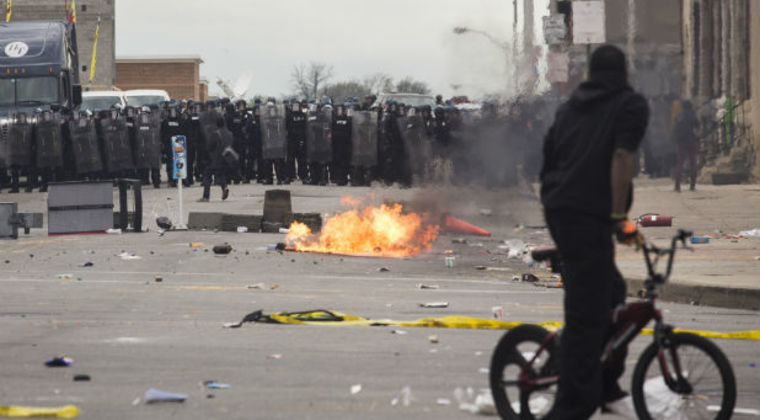
Baltimore-Riots.jpg_23790e32da49a4d09d45db82b7634b69To hear President Obama and Baltimore mayor Rawlings tell it, politeness, nonviolence and respect for law and property are the fundamental obligations of those confronting the brazen and lawless violence of police in Baltimore and beyond. This is a truly upside-down reality.

By Ajamu Baraka

Source: Black Agenda Report

Anti-Black racism, always just beneath the surface of polite racial discourse in the U.S., has exploded in reaction to the resistance of black youth to another brutal murder by the agents of this racist, settler-colonialist state. With the resistance, the focus shifted from the brutal murder of Freddie Gray and the systematic state violence that historically has been deployed to control and contain the black population in the colonized urban zones of North America, to the forms of resistance by African Americans to the trauma of ongoing state violence.

The narrative being advanced by corporate media spokespeople gives the impression that the resistance has no rational basis. The impression being established is that this is just another manifestation of the irrationality of non-European people – in particular, Black people – and how they are prone to violence. This is the classic colonial projection employed by all white supremacist settler states, from the U.S., to South Africa and Israel.

The accompanying narrative is that any kind of resistance that does not fit the narrow definition of “non-violent” resistance is illegitimate violence and, therefore, counter-productive because – “violence doesn’t accomplish anything.”  Not only does this position falsely equate resistance to oppression as being morally equivalent to the violence of the oppressor, it also attempts to erase the role of violence as being fundamental to the U.S. colonial project.

The history of colonial conquest saw the U.S. settler state shoot and murdered its’ way across the land mass of what became the U.S. in the process of stealing indigenous land to expand the racist White republic from “sea to shining sea.”  And the marginalization of the role of violence certainly does not reflect the values of the Obama administration that dutifully implements the bi-partisan dictates of the U.S. strategy of full spectrum dominance that privileges military power and oppressive violence to protect and advance U.S. global supremacy. The destruction of Libya; the reinvasion of Iraq; the civil war in Syria; Obama’s continued war in Afghanistan; the pathological assault by Israel on Palestinians in Gaza and the U.S. supported attack on Yemen by the Saudi dictatorship, are just a few of the horrific consequences of this criminal doctrine.

Race and oppressive violence has always been at the center of the racist colonial project that is the U.S. It is only when the oppressed resist — when we decide, like Malcolm X said, that we must fight for our human rights — that we are counseled  to be like Dr. King, including by war mongers like Barack Obama. However, resistance to oppression is a right that the oppressed claim for themselves. It does not matter if it is sanctioned by the oppressor state, because that state has no legitimacy.

No rational person exalts violence and the loss of life. But violence is structured into the everyday institutional practices of all oppressive societies. It is the deliberate de-humanization of the person in order to turn them into a ‘thing’ — a process Dr. King called “thing-afication.” It is a necessary process for the oppressor in order to more effectively control and exploit. Resistance, informed by the conscious understanding of the equal humanity of all people, reverses this process of de-humanization. Struggle and resistance are the highest expressions of the collective demand for people-centered human rights – human rights defined and in the service of the people and not governments and middle-class lawyers.

That resistance may look chaotic at this point – spontaneous resistance almost always looks like that. But since the internal logic of neoliberal capital is incapable of resolving the contradiction that it created, expect more repression and more resistance that will eventually take a higher form of organization and permanence. In the meantime, we are watching to see who aligns with us or the racist state.

The contradictions of the colonial/capitalist system in its current expression of neoliberalism have obstructed the creation of decent, humane societies in which all people are valued and have democratic and human rights. What we are witnessing in the U.S. is a confirmation that neoliberal capitalism has created what Chris Hedges called “sacrificial zones” in which large numbers of black and Latino people have been confined and written off as disposable by the system. It is in those zones that we find the escalation of repressive violence by the militarized police forces. And it is in those zones where the people are deciding to fight back and take control of their communities and lives.

These are defining times for all those who give verbal support to anti-racist struggles and transformative politics. For many of our young white comrades, people of color and even some black ones who were too young to have lived through the last period of intensified struggle in the 1960s and ‘70s and have not understood the centrality of African American resistance to the historical social struggles in the U.S., it may be a little disconcerting to see the emergence of resistance that is not dependent on and validated by white folks or anyone else.

The repression will continue, and so will the resistance. The fact that the resistance emerged in a so-called black city provides some complications, but those are rich and welcoming because they provide an opportunity to highlight one of the defining elements that will serve as a line of demarcation in the African American community – the issue of class.  We are going to see a vicious ideological assault by the black middle class, probably led by their champion – Barack Obama – over the next few days. Yet the events over the last year are making it more difficult for these middle-class forces to distort and confuse the issue of their class collaboration with the white supremacist capitalist/colonialist patriarchy. The battle lines are being drawn; the only question that people must ask themselves is which side they’ll be on.

Ajamu Baraka is a human rights activist, organizer, geo-political analyst and editor and contributing columnist for the Black Agenda Report. Baraka serves as the Public Intervenor for Human Rights as a member of the Green Shadow Cabinet and coordinates the International Affairs Committee of the Black Left Unity Network. He is also an Associate Fellow at the Institute for Policy Studies (IPS) in Washington, D.C.

Michael Brown was Killed Because He Didn’t Prostrate Himself to Police Authority

darren-wilson-5hqdefault

This Killing, in Combat, Would Have Been a War Crime

by DAVE LINDORFF

Source: This Can’t Be Happening

What’s wrong with Ferguson Police Officer Darren Wilson’s killing of the unarmed 18-year-old black teenager, Michael Brown, and with a Grand Jury decision not to indict him for that outrageous slaying, is what is wrong with American law enforcement and American “justice” in general.

Both actions were permeated not only with racism, which clearly played a huge rule in both the verdict rendered by a Grand Jury composed of nine whites and only three blacks, and in this tragic police killing by a white cop of a black child, but also by a mentality on the part of police — and apparently by at least a majority of the citizen jurors on a panel evaluating Wilson’s actions — that cops are authorities who must be obeyed without question, on pain of death.

Let’s recall the most crucial evidence in this killing: According to the New York Times it was two shots into the top of the head by Officer Wilson that killed Brown — shots that multiple witnesses confirm were fired after the unarmed Brown was on his knees, already seriously wounded by four other apparently non-lethal shots to arm, neck and upper right chest, with his hands raised and pleading “Don’t shoot.” The Times also reports that those shots, apparently fired when Brown’s head was leaning forward, or from a position above him, appeared to have been fired “not from close range,” a determination based upon an absence of gun powder residue around the area of the entry wounds.

It should not matter in the slightest whether or not Brown had first struck Officer Wilson inside his squad car during a scuffle, as claimed by the cop, or even that the officer, as he testified in an unusual appearance before jurors, “felt terrified” at that time. Nor does it matter, beyond being evidence of an inherent racism, that Wilson says he thought that Brown, approaching him at his car initially, “looked like a demon.” If the non-lethal shots that first hit Brown in arm, neck and upper chest had been fired at that early point, perhaps Wilson would have been justified in firing them in self defense, but it’s what happened after Brown tried to leave the scene that matter.

Dave Lindorff is a founding member of ThisCantBeHappening!, an online newspaper collective, and is a contributor to Hopeless: Barack Obama and the Politics of Illusion (AK Press).