“Biden was personally engaged in corruption in Ukraine”
Viktor Shokin – The Ukrainian Prosecutor Joe Biden BRAGGED about getting FIRED speaks out
SHOKIN: "The fact that Joe Biden gave away one billion dollars – in exchange for my dismissal, my firing. – Is that alone a case of corruption?" pic.twitter.com/gy3VCc6JqE
The former Ukrainian prosecutor who was fired at the insistence of then-Vice President Joe Biden in 2016 after investigating Burisma, claimed that Biden treated Ukraine like his “own backyard,” according to comments made during an interview with Fox News’ Brian Kilmeade on Saturday.
Viktor Shokin was fired by Ukrainian President Petro Poroshenko in 2016 after Biden — who was in charge of Ukrainian policy during the Obama administration — gave him an ultimatum, saying that Ukraine would not receive $1 billion dollars in aid until Shokin was dismissed. In an interview with Brian Kilmeade on “One Nation” on Saturday, Shokin claimed that Biden treated Ukraine as if it were his “own backyard.”
“I developed a very firm understanding of the fact that the vice president was only acting in his own interest. He, generally speaking, handled Ukraine like it was his own backyard,” Shokin told Kilmeade. “The office of Poroshenko, the president, was humiliated, but the entire country was humiliated,” Shokin added, describing Biden’s ultimatum that he be dismissed, which Biden publicly boasted about at a Council on Foreign Relations event on Jan. 23, 2018.
“I’m going to be leaving here in six hours. If the prosecutor is not fired, you’re not getting the money. Well, son of a bitch, he got fired and they put in place someone who was solid,” Biden said at the event.
At the time of Shokin’s firing, his office was investigating Burisma, a Ukrainian energy company that had hired Biden’s son, Hunter, to join its board. FBI documents released by Congress in July suggested that Hunter was hired to enable Burisma to utilize his father’s political influence and avoid threats to the company.
Shokin also suggested that Biden was personally engaged in corruption in Ukraine, citing his firing as one instance. “They were being bribed. The fact that Joe Biden gave away $1 billion in U.S. money in exchange for my dismissal, my firing, isn’t that alone a case of corruption?” he said.
“For years, these false claims have been debunked, and no matter how much air time Fox gives them, they will remain false,” said White House spokesperson Iam Sams in a statement to the Daily Caller News Foundation. “Fox is giving a platform for these lies to a former Ukrainian prosecutor general whose office his own deputy called a hotbed of corruption, drawing demands for reform not only from then-Vice President Biden but also from U.S. diplomats, international partners, and Republican Senators like Ron Johnson.”
The Ukrainian government mysteriously disappeared online records of its fundraising arrangement with the FTX crypto scam just days before the scandal erupted. The initiative claims to have raised $60 million for Ukraine, but where did the money go?
The demise of FTX, the fifth-biggest cryptocurrency exchange by trade volume in 2022, and the second-largest by holdings, has sent a wave of chaos through global financial markets.
As the turbulence grows, the government of Ukraine is conducting an ongoing cleanup and whitewashing operation to rid any and all references to a high-level cryptocurrency fundraising arrangement it struck with FTX from the web. Eerily, it seems to have commenced just days before the scandal erupted.
Online records unearthed by The Grayzone claim tens of millions were raised by FTX for the Ukrainian government, and put to a variety of belligerent uses. But with the company now exposed as a Potemkin village lacking underlying assets, and major question marks hanging over whether its operations were from day one fraudulent top to bottom, where does that leave the supposedly successful donation scheme? Were those sums truly raised, and if so, to what purposes were they actually put?
FTX’s destruction resulted from a mass sell-off of the company’s native bitcoin token, FTT, by the rival exchange, Binance. Its value plummeted, prompting a three-day “run” on billions of dollars worth of cryptocurrency, which in turn created – or exposed – a “liquidity crisis” within FTX, as it did not have the available assets required to redeem client withdrawals. FTX filed for bankruptcy on November 11th.
FTX founder and top Democrat Party donor Sam Bankman-Fried now faces criminal investigations in the Bahamas, where the exchange was headquartered, and calls for official investigations into the largely unregulated cryptocurrency industry are reverberating across the globe.
The sudden death of FTX has been compared to the 2008 disintegration of Lehman Brothers that precipitated the financial crisis.
Massive customer holdings have apparently gone missing thanks to a secret “back door” in the FTX bookkeeping system that allowed Bankman-Fried to make changes to the company’s financial records without any accountability. This connivance may have been used to hide at least $10 billion in client funds Bankman-Fried transferred from exchange to another company he founded, digital asset trader Alameda Research.
While mainstream media pores over the details of Bankman-Fried’s gargantuan crypto scam, not one single major outlet has investigated or even acknowledged FTX’s relationship with the government of Ukraine.
Were client holdings unaccountably and illegally funneled into the West’s proxy war? Or did the supposed aid FTX sent to Kiev find its way into the hands of Ukrainian scammers, corrupt warlords and illicit actors?
The corporate media’s failure to explore these questions appears all the more perverse given Bankman-Fried’s flamboyant promotion of his intimate financial relationship with the government of Ukrainian President Volodymyr Zelensky.
FTX pledges to “turn bitcoin into bullets, bandages and other war materiel” for Ukraine
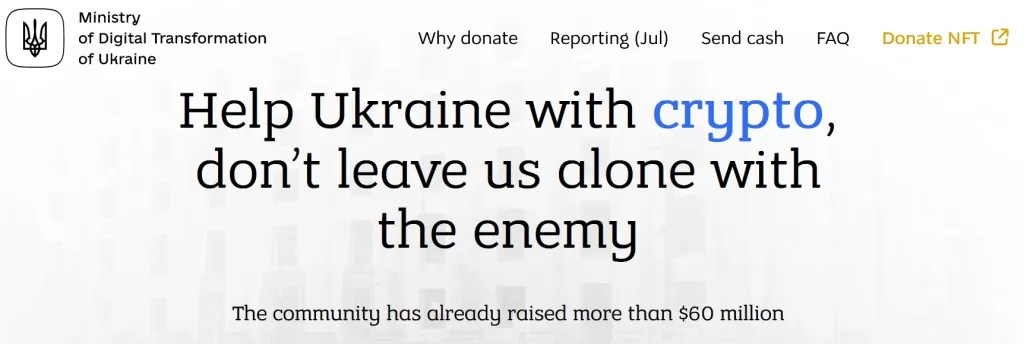
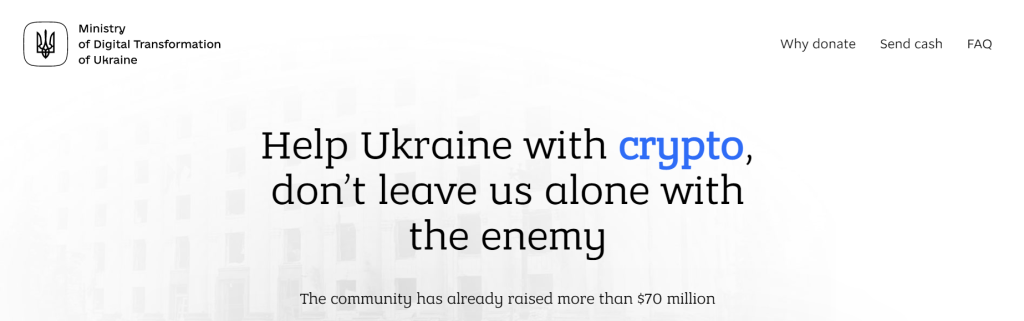
The partnership between FTX and the Ukrainian government was first publicized on March 14th when the leading cryptocurrency website CoinDesk announced Kiev had launched a dedicated webpage for cryptocurrency donations dubbed Aid for Ukraine.
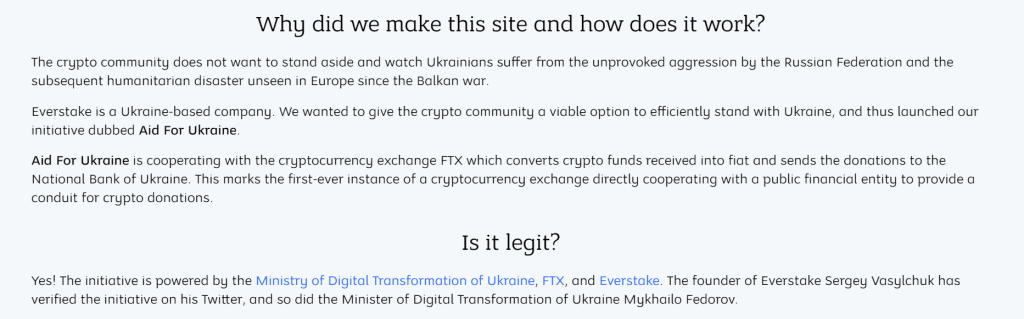
Under its auspices, FTX pledged to “convert crypto contributions to Ukraine’s war effort into fiat for deposit” at the National Bank of Kiev, allowing the embattled government to “turn bitcoin into bullets, bandages and other war materiel.” CoinDesk stated the initiative “deepens an unprecedented tie-up between public and private sector forces in crypto.”
Oleksandr Bornyakov, an official at Ukraine’s Ministry of Digital Transformation, hinted to CoinDesk about an “upcoming NFT collection” auction to “give the next boost to the crypto fundraising process.”
(Bornyakov’s Ministry of Digital Transformation played a key role in the successful, Zelensky-led campaign to cancel The Grayzone’s Max Blumenthal and Aaron Mate’s appearance at Web Summit, a major international gathering of the tech industry in Lisbon, Portugal).
In a press release accompanying the announcement of the FTX partnership with Ukraine, Bankman-Fried explained that, “at the onset of the conflict in Ukraine, FTX felt the need to provide assistance in any way it could.” He promised that the arrangement provided “the ability to deliver aid and resources to the people who need it most.”
Kiev disappears Aid for Ukraine site days before FTX scandal goes public
The Aid for Ukraine webpage has now been deleted, but can still be accessed via the Internet Archive. Until very recently, it encouraged visitors to “help Ukraine with crypto” and pleaded, “don’t leave us alone with the enemy.”
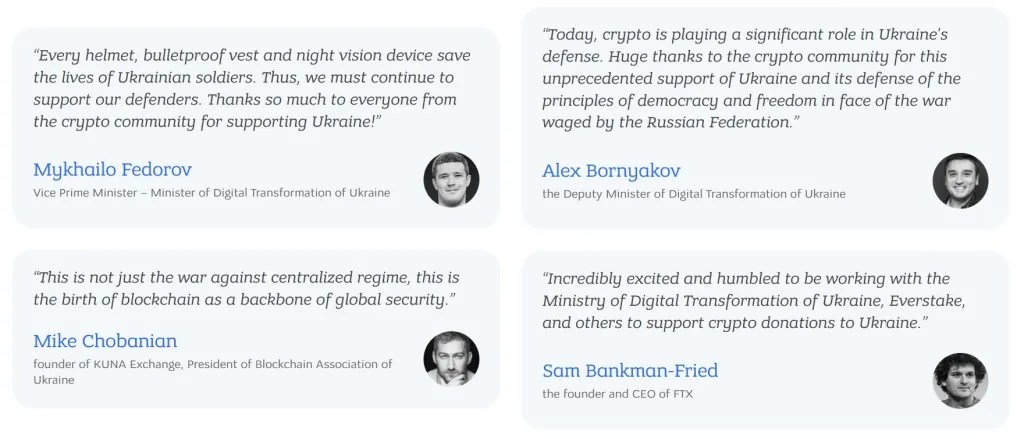
The site featured promotional quotes from an assortment of Ukrainian government officials and bitcoin bros – among them, FTX’s founder.
Mykhailo Fedorov, Ukraine’s deputy Prime Minister, and Minister of Digital Transformation of Ukraine, thanked “the crypto community” for funding the purchase of helmets, bulletproof vests, and night vision devices. For his part, Bankman-Fried declared himself “incredibly excited and humbled” to “support crypto donations to Ukraine.”
The last available Internet Archive capture of Aid for Ukraine” took place on the afternoon of October 26th. Throughout the webpage’s existence, the Internet Archive captured multiple snapshots of it weekly. This clearly indicates the page was purged by Kiev in late October, several days before the FTX crisis initially broke out.
Once it was deleted, the Ukrainian government created a standalone websiteon November 1st to promote the endeavor. The page was identical, and quotes from Bankman-Fried, and references to FTX’s involvement and its logo, remained in place until the morning of November 15th.
Was the original webpage’s dumping and erasure, and the shift to a totally new interface, at that time merely a spooky coincidence, or were the Ukrainians warned of what was coming? What did Kiev know, and when did it know it?
Bankman-Fried channeled millions to Biden through “stealth” PAC
Though FTX has been accused of serving as a money laundering vehicle for the US Democratic Party, concrete evidence supporting this claim has yet to materialize. But given Bankman-Fried’s background as one of the most prolific donors to the Democrats, and the role he played as a nexus between party power-brokers and the cryptocurrency sphere, the allegations are understandable.
Bankman-Fried is the son of Stanford law professor Barbara Friedman, founder of a shadowy Super PAC called Mind the Gap which quietly channeled millions to Democratic party candidates, primarily from nameless Silicon Valley investors.
The organization has no website or social media footprint, and its founders do not advertise their involvement publicly. Chosen through complex data analysis, beneficiaries of the Super PAC often have no idea themselves who or what has donated to their campaigns.
“The raison d’être is stealth,” an individual “with ties to the organization” told Vox back in 2020.
Bankman-Fried establishment of FTX in April 2019 – the same month Joe Biden announced his 2020 Presidential run – has added to the intrigue surrounding the scandal. Once vast sums started flowing into and through the FTX exchange, its founder channeled profits into Biden’s campaign coffers. Oddly, Bankman-Fried had no prior history of political giving.
Throughout the 2020 campaign, Bankman-Fried gifted over $5 million to Biden and groups supporting him. This reportedly helped fuel a potentially decisive “nine-figure, eleventh-hour blitz of TV advertising” targeting swing states, and made the crypto bro the second-largest donor to the president, right behind Michael Bloomberg.
Bankman-Fried claimed this wellspring of generosity was “motivated less by specific issues than by the Biden team’s ‘generic stability and decision-making process.’” Such an apparent lack of enthusiasm for the President stands at odds with the staggering sums he has pumped into Democratic party coffers ever since.
In 2022 alone, Bankman-Fried lavished almost $40 million on Democratic candidates, campaigns, and PACs. The giving spree made him the second-largest individual donor to Democratic causes, behind liberal venture capitalist George Soros.
More recently, Bankman-Fried pledged to donate a staggering $1 billion between this year and 2024 to ensure a Democratic victory in the next presidential vote. On October 14th, however, he completely backtracked, branding the investment a “dumb” move. Something scandalous was brewing behind the scenes.
One week later, the Texas State Securities Board announced it was investigating FTX on suspicion of selling unregistered securities. The development went largely unnoticed by the media. To the extent it generated any interest at all, it was framed as just one of several examples of financial authorities scrutinizing crypto players.
What happened to the $60 million raised by Aid for Ukraine?
If FTX was indeed laundering funds for the proxy war in Ukraine, the slightest indication that regulators were investigating its operations would have triggered alarm bells throughout Washington – and by extension, Kiev. This may be why the Ukrainian government switched the Aid for Ukraine webpage with a dedicated website, and scrubbed the original entirely from the internet just days after the announcement.
Also curious are the Internet Archive captures of the Aid for Ukraine website that show records of funds purportedly flowing to Kiev via Bitcoin had not been updated since July. At the time, the webpage reported that over $60 million had been raised by the “community.” This figure is reflected on the updated standalone Aid for Ukraine fundraising site.
A breakdown of spending on the new Aid for Ukraine website states Kiev had spent a total of $54,573,622 in cryptocurrency donations by July 7th on a wide variety of equipment, vehicles, drones, “lethal equipment” and other resources. One of the biggest single expenditures was $5,250,519 on a “worldwide anti-war media campaign,” the details of which would only “be published after our victory” due to “security reasons.”
Ukrainian government officials and private sector actors involved in the operation of Aid for Ukraine have scoffed at suggestions of impropriety regarding its use, but have only raised further questions with their denials.
Oleksandr Bornyakov of Ukraine’s Ministry of Digital Transformation declared that Aid for Ukraine simply used FTX to “convert donations into fiat in March.” The CEO of Everstake, the “validator” company that in theory guaranteed crypto funds donated via Aid for Ukraine reached Kiev’s Ministry of Defense, also thanked “every crypto holder for donating…in those early day [sic], when every cent and every minute was crucial.”
Taken in tandem, these comments suggest Aid for Ukraine was set up purely to receive donations in the initial stages of the war, and the $60 million figure represents sums received and converted in the weeks immediately following the launch of the initiative. This interpretation is reinforced by an Everstake staffer’s presentation at a cryptocurrency conference at Web Summit on November 1st, on the subject of “raising [over] $60m in crypto for Ukraine.”
Our Segment Lead @jane_everstake is getting ready to speak at a #FILLisbon panel about @_AidForUkraine and raising >$60m in crypto for Ukraine. The panel kicks off in just 15 min, at 11.30 Lisbon time. Don’t miss it if you’re there! pic.twitter.com/wTnC9Qfqvx
But an Internet Archive capture of Aid for Ukraine on April 1st adds to the confusion, showing that two-and-a-half-weeks after the initiative launched, the webpage was updated to claim “over $70 million” had been raised from crypto donors. This was revised down to “over $60 million” five days later.
More strangely, Aid for Ukraine records show that from the time of the initiative’s launch to April 14th, a total of $45,103,538 was spent. This means just $9,470,084 was spent between April 14 and July 7th, a period in which the war developed into a “bloody war of attrition” according to The Guardian.
This leaves a gap of at least $5.5 million in the money Aid for Ukraine claimed to have raised in its initial weeks, and the funds it says it distributed in Ukraine.
The disparity was confirmed in a tweet by the official Aid for Ukraine Twitter account, posted on the evening of November 15th, which stated that “out of $60 million received, $54 million have already been spent on Ukraine’s humanitarian and military needs.”
7/11 Here is a tweet from Deputy Minister of Digital Transformation of Ukraine @abornyakov refuting those rumors:https://t.co/vUsGNkkjh5
This implies that no further funds of any size were received after early April, and the total has remained static ever since, despite the resource being open for donations. Which would be highly unusual.
The government of Ukraine, FTX, and Everstake all now have serious questions to answer. Namely, why the funds purportedly raised appear to have decreased in a span of a few days, why no donations have been received since then on the Aid for Ukraine webpage or its new website, how much has been donated since the alleged initial influx, and where did the rest of the money go?
Ukraine: a black hole for Western aid
Stories of potential financial impropriety by Ukrainian officials and the country’s military are invariably ignored or outright buried by the Western media. An August exposé by the Kyiv Independent documented wide-ranging abuses by the leadership of a wing of the International Legion, including sexual harassment, looting, threatening soldiers at gunpoint and sending them unprepared on reckless missions. Though the Kyiv Independent often influences Western media’s coverage of the Ukraine conflict, this story was completely ignored in mainstream quarters.
That same month, CBS broadcast an investigative feature revealing that only 30 percent of Western arm shipments to Ukraine ever reach the frontline. Due to intense backlash from the Pentagon and other powerful sources, CBS temporarily pulled its own documentary and an accompanying promotional trailer and article from the web. The feature has since been “updated” to claim that “the situation has significantly improved” since filming, and “a much larger quantity now gets where it’s supposed to go.”
When it comes to Ukraine, Democrats at the highest levels are also immensely skilled at burying embarrassing stories. In December 2015, Joe Biden coerced Kiev’s then-leader Petro Poroshenko into firing prosecutor general Viktor Shokin as a condition for the US underwriting a $1 billion IMF loan to Ukraine.
“I’m going to be leaving here in six hours. If [Shokin] is not fired, you’re not getting the money,” Biden threatened.
With Shokin’s firing, the experienced lawyer’s ongoing probe into the energy giant Burisma ended as well. Which meant that Burisma’s most famous board member, Hunter Biden, the son of then-US Vice President’s son, eluded official scrutiny.
Now, a politically connected crypto-billionaire who used a secret financial “back door” to fleece customers of ungodly sums of money has become the latest character in the saga of shady US aid to Ukraine. And though the collapse of his FTX firm is front page news, mainstream outlets are studiously avoiding the Ukraine angle.
The United States has perfected the art of regime change operations. The US is the largest empire in world history with more than 1,000 military bases and troops operating throughout the world. In addition to military force, the US uses the soft power of regime change, often through ‘Color Revolutions.’ The US has been building its empire since the Civil War era, but it has been in the post-World War II period that it has perfected regime change operations.
Have the people of the United States been the victims of regime change operations at home? Have the wealthiest and the security state created a government that serves them, rather than the people? To answer these questions, we begin by examining how regime change works and then look at whether those ingredients are being used domestically.
Color Revolutions and Regime Change Operations
Almost from the start, the CIA’s role has been more than intelligence gathering. It has been a key player in putting in place governments friendly to the United States and conducting other operations, e.g. the CIA is currently involved in drone strikes.
One of the first regime change operations of the CIA was Operation Ajax conducted in Iran, and led by Kermit Roosevelt, the grandson of Teddy Roosevelt, who was president when the US solidified its global empire ambitions. The CIA was founded in 1947 and the regime change coup in Iran was 1953. Greg Maybury writes in “Another Splendid Little Coup“: “Placing to one side an early dress rehearsal in Syria in 1949, the Iran coup was the first post-War exercise in regime change upon the part of Anglo-American alliance…” Just this month the US government released documents showing the CIA and State Department’s planning and implementation of the coup against the democratically-elected prime minister of Iran, Mohammed Mossadegh. This release supplements one from 2013 that did not reveal the full role of the US in the coup.
The Iran coup was crude compared to more modern efforts but had the ingredients that have become common – civil society protests against the government, media reports supporting the protests, agents within the government supporting the coup and replacement of the government with a US-friendly regime. The Iran coup may have been the most costly mistake in US foreign policy because it undermined a secular democratic government in Iranthat could have been the example for the region. Instead the US installed the brutal Shah of Iran, whose rule ended in the 1979 revolution, in which, as Maybury reports, the US was also implicated because it felt the Shah had overstayed his welcome.
The Iran coup was perceived as a great CIA success, so it was copied in other Middle Eastern countries as well as countries in Latin America, Africa, and the Caribbean. Regime change is still a major tool of US foreign policy. There is a long-term ongoing coup campaign in Venezuela, with its most recent episode last week in which a helicopter attack on the Supreme Court was tied to the US DEA and CIA. The US has allied with oligarchs, supported violent protests and provided funds for the opposition, which has also worked to undermine the Venezuelan economy — a tactic the US has used in other coups, e.g. the coup of Allende in Chile.
The coup in Ukraine, which the media falsely calls a ‘democratic revolution,’ was, as the head of the ‘private CIA’ firm Stratfor says, “the most blatant coup in history.” The CIA and State Department played the lead roles.
Victoria Nuland, an assistant secretary of state under Clinton, bragged that the US spent $5 billion to build civil society opposition against a government that leaned toward Russia. The government funded civil society opposition through US AID, which is the open vehicle for what the CIA used to do covertly, along with the National Endowment for Democracy. This funding was used to build oppositional civil society groups and create destabilization. They focused on the issue of corruption, which exists in every government, and built it up to a centerpiece for regime change. The US allied with extremist right-wing groups in Ukraine.
The US has perfected regime change operations from the 1950s up through today. The standard method of operation is finding an issue to cause dissent, building opposition in a well funded civil society ‘movement’, manipulating the media, putting in place US friendly leaders and blaming US opposition for the coup to hide US involvement. This approach is consistent no matter which party is in power in the US.
The Kleptocratic Oligarch Coup In The United States
One difference in the US is that money plays an outsized influence in US elections. The wealthy can buy the government they want through campaign donations and by anonymous spending but the tools of color revolutions are still needed to legitimize the government. Legitimacy is getting harder to buy. Many realize we live in a mirage democracy. The Associated Press-NORC Center for Public Affairs reported in 2016 the extent of the loss of legitimacy of US government:
“Nine in 10 Americans lack confidence in the country’s political system, and among a normally polarized electorate, there are few partisan differences in the public’s lack of faith in the political parties, the nominating process, and the branches of government.”
The Donald Trump presidency, which we regularly criticize, brings a lot of these tools to the forefront because Trump beat the system and defeated the elites of both parties. As a result, Democratic Party propaganda is being used to undermine Trump not only based on his policies but also through manufactured crises such as RussiaGate. The corporate media consistently hammers home RussiaGate, despite the lack of evidenceto support it. Unlike the Watergate or Iran-Contra scandals, there is no evidence that Trump colluded with Russia to get elected. And, the security state – the FBI and the agencies that conduct regime change operations around the world – is working to undermine Trump in a still unfolding domestic coup.
Civil society also has a strong role. John Stauber writes that:
“The professional Progressive Movement that we see reflected in the pages of The Nation magazine, in the online marketing and campaigning of MoveOn and in the speeches of Van Jones, is primarily a political public relations creation of America’s richest corporate elite, the so-called 1%, who happen to bleed Blue because they have some degree of social and environmental consciousness, and don’t bleed Red. But they are just as committed as the right to the overall corporate status quo, the maintenance of the American Empire, and the monopoly of the rich over the political process that serves their economic interests.”
Civil society groups created or aligned with the Democratic Party are defining the new form of false-resistance as electing Democrats. The Democrats, as they have done throughout history as the oldest political party, know how to control movements and lead them into ineffectiveness to support the Democratic Party agenda. We described, in “Obamacare: The Biggest Insurance Scam in History,” how this was done skillfully during the health reform process in 2009. This new resistance is just another tool to empower the elites, not resistance to the oligarchic-kleptocrats that control both parties. In fact, a major problem in progressive advocacy is the funding ties between large non-profits and corporate interests. The corruption of money is seen in organizations that advocate for corporate-friendly policies in education, health care, energy and climate, labor, and other issues.
Color Revolution Tools Used In The US
Now the tools the US uses for regime change around the world are being used at home to funnel activist energy and efforts into the Democratic party and electoral activities. In order to resist this new “resistance” we need to be aware of it and how it operates. We need to see through propaganda, such as RussiaGate, and attempts to manipulate the masses through scripted events that are portrayed as organic, such as the recent “sit in” by Rep. John Lewis and Sen. Cory Booker on the Capitol steps, or through highly emotional cultural content that portrays the plutocratic parties as parties of the people. We have to remember that the root issue is plutocracy and the US has two plutocratic parties, often referred to as “The Duopoly.”
We must continue to focus on the issues that are in crisis such as the economy, health care, education, housing, racism, inequality and militarization at home and abroad. We must fight for these issues independent of political party. We must be clear and uncompromising in our demands so that we are not taken off track. And we must have a clear vision of the future that we want to see.
Popular Resistance is a co-convener of the People’s Congress of Resistance. The People’s Congress will bring people together from around the US to meet in Washington, DC this September to outline a vision from the grassroots. A draft of that vision will be circulated over the next few months so that many people will provide input. Check out the People’s Congress here and get involved however you are able.
While it seems the Panama Papers are a genuine attempt at exposing rampant corruption of the world’s corporate-political uber-elite, a closer inspection reveals a likely Western geopolitical power play utilizing the latest techniques in information warfare.
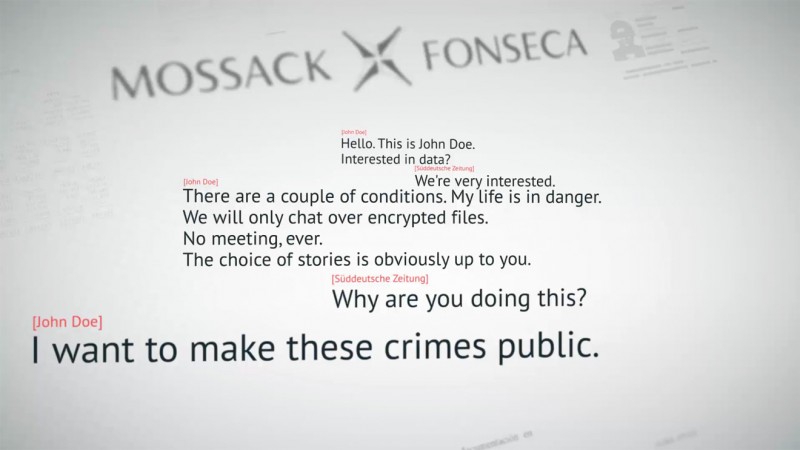
The 11.5 million documents that were stolen from Mossack Fonseca were leaked to Suddeutsche Zeitung, which then turned to the International Consortium of Investigative Journalists to investigate the documents.
This process created a dynamic where control of the information resides in the hands of corporate mainstream media, thus allowing them to cherry pick stories they deem “newsworthy” – this exclusive access is troubling.
Had the Mossack Fonseca documents been turned over to WikiLeaks, the information would have been released en mass, as to allow for a publicly searchable database that would allow for anyone to search the documents in detail.
The immediate initial reporting on the Panama Papers has been curiously focused on Russian President Putin and Chinese President Xi Jinping, the leaders of two countries that have been recently labeled as strategic threats by Washington – with explicit implications that both of their leaders are corrupt.
Coincidentally, the U.S. has been working to actively “contain” both of these states – actively hedging against Russian influence in Syria and Ukraine, as well as actively engaging in an “Asian pivot” strategically designed to usurp a rising China and maintain U.S. hegemony.
And while there are some pro-Western interests revealed thus far, such as holdings by British Prime Minister David Cameron’s father, Ukrainian President Petro Poroshenko and Saudi Arabian King Salman, the vast amount of the reporting has focused on the usual suspects demonized by the West.
Curiously, there is no mention of any Western corporations or billionaires – the primary customers of Mossack Fonseca – in any of the articles written on the leak thus far, with The Guardian ominously stating that “much of the leaked material will remain private.”
With so much power residing in the hands of journalists, it begs the question; who or what is behind the International Consortium of Investigative Journalists?
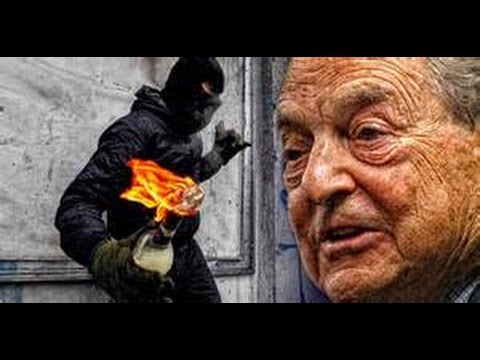
The International Consortium of Investigative Journalists was launched by the Center for Public integrity – a group heavily funded by Putin arch-nemesis George Soros. Soros has been implicated in being a hidden hand behind numerous revolutions across the world.
Rockefeller Family Fund
Open Society Foundation (Soros)
Carnegie Endowment
Ford Foundation
W K Kellogg Foundation
The simple fact that information is being kept out of the public’s reach seems to speak clearly to the fact that this leak is most likely being perpetrated with an agenda to destabilize certain powerful states that are working to create a more multipolar world i.e. (Russia and China) at the expense of U.S. hegemony.
While there is no mistaking the corruption within every state apparatus on earth, curiously these leaks seem to focus heavily on those the U.S. political elite has established as threats. Perhaps there is more to come that will bring to light the corruption of the West as well… but until then, it looks to be a geopolitical hit job by the West — with a few sacrificial lambs thrown in to cause reasonable doubt.
Sadly, some important duties of journalism, such as applying evenhanded standards on human rights abuses and financial corruption, have been so corrupted by the demands of government propaganda – and the careerism of too many writers – that I now become suspicious whenever the mainstream media trumpets some sensational story aimed at some “designated villain.”
Far too often, this sort of “journalism” is just a forerunner to the next “regime change” scheme, dirtying up or delegitimizing a foreign leader before the inevitable advent of a “color revolution” organized by “democracy-promoting” NGOs often with money from the U.S. government’s National Endowment for Democracy or some neoliberal financier like George Soros.
We are now seeing what looks like a new preparatory phase for the next round of “regime changes” with corruption allegations aimed at former Brazilian President Luiz Ignacio Lula da Silva and Russian President Vladimir Putin. The new anti-Putin allegations – ballyhooed by the UK Guardian and other outlets – are particularly noteworthy because the so-called “Panama Papers” that supposedly implicate him in offshore financial dealings never mention his name.
Or as the Guardian writes: “Though the president’s name does not appear in any of the records, the data reveals a pattern – his friends have earned millions from deals that seemingly could not have been secured without his patronage. The documents suggest Putin’s family has benefited from this money – his friends’ fortunes appear his to spend.”
Note, if you will, the lack of specificity and the reliance on speculation: “a pattern”; “seemingly”; “suggest”; “appear.” Indeed, if Putin were not already a demonized figure in the Western media, such phrasing would never pass an editor’s computer screen. Indeed, the only point made in declarative phrasing is that “the president’s name does not appear in any of the records.”
A British media-watch publication, the Off-Guardian, which criticizes much of the work done at The Guardian, headlined its article on the Putin piece as “the Panama Papers cause Guardian to collapse into self-parody.”
But whatever the truth about Putin’s “corruption” or Lula’s, the journalistic point is that the notion of objectivity has long since been cast aside in favor of what’s useful as propaganda for Western interests.
Some of those Western interests now are worried about the growth of the BRICS economic system – Brazil, Russia, India, China and South Africa – as a competitor to the West’s G-7 and the International Monetary Fund. After all, control of the global financial system has been central to American power in the post-World War II world – and rivals to the West’s monopoly are not welcome.
What the built-in bias against these and other “unfriendly” governments means, in practical terms, is that one standard applies to a Russia or a Brazil, while a more forgiving measure is applied to the corruption of a U.S. or European leader.
Take, for instance, former Secretary of State Hillary Clinton’s millions of dollars in payments in speaking fees from wealthy special interests that knew she was a good bet to become the next U.S. president. [See Consortiumnews.com’s “Clinton Stalls on Goldman-Sachs Speeches.”]
Or, similarly, the millions upon millions of dollars invested in super-PACS for Clinton, Sen. Ted Cruz and other presidential hopefuls. That might look like corruption from an objective standard but is treated as just a distasteful aspect of the U.S. political process.
But imagine for a minute if Putin had been paid millions of dollars for brief speeches before powerful corporations, banks and interest groups doing business with the Kremlin. That would be held up as de facto proof of his illicit greed and corruption.
Losing Perspective
Also, when it’s a demonized foreign leader, any “corruption” will do, however minor. For example, in the 1980s, President Ronald Reagan’s denounced Nicaraguan President Daniel Ortega for his choice of eyewear: “The dictator in designer glasses,” declared Reagan, even as Nancy Reagan was accepting free designer gowns and free renovations of the White House funded by oil and gas interests.
Or, the “corruption” for a demonized leader can be a modest luxury, such as Ukrainian President Viktor Yanukovych’s “sauna” in his personal residence, a topic that got front-page treatment in The New York Times and other Western publications seeking to justify the violent coup that drove Yanukovych from office in February 2014.
Incidentally, both Ortega and Yanukovych had been popularly elected but were still targeted by the U.S. government and its operatives with violent destabilization campaigns. In the 1980s, the CIA-organized Nicaraguan Contra war killed some 30,000 people, while the U.S.-orchestrated “regime change” in Ukraine sparked a civil war that has left some 10,000 people dead. Of course, in both cases, Official Washington blamed Moscow for all the trouble.
In both cases, too, the politicians and operatives who gained power as a result of the conflicts were arguably more corrupt than the Nicaraguan Sandinistas or Yanukovych’s government. The Nicaraguan Contras, whose violence helped pave the way for the 1990 election of U.S.-backed candidate Violeta Chamorro, were deeply implicated in cocaine trafficking. [See Consortiumnews.com’s “The Sordid Contra-Cocaine Saga.”]
Today, the U.S.-supported Ukrainian government is wallowing in corruption so deep that it has provoked a new political crisis.[See Consortiumnews’com’s “Reality Peeks Through in Ukraine.”]
Ironically, one of the politicians actually named in the Panama Papers for having established a shadowy offshore account is the U.S.-backed Ukrainian President Petro Poroshenko, although he got decidedly second-billing to the unnamed Putin. (Poroshenko denied there was anything improper in his offshore financial arrangements.)
Double Standards
Mainstream Western journalism no longer even tries to apply common standards to questions about corruption. If you’re a favored government, there might be lamentations about the need for more “reform” – which often means slashing pensions for the elderly and cutting social programs for the poor – but if you’re a demonized leader, then the only permissible answer is criminal indictment and/or “regime change.”
One stark example of these double standards is the see-no-evil attitude toward the corruption of Ukraine’s Finance Minister Natalie Jaresko, who is touted endlessly in the Western media as the paragon of Ukrainian good governance and reform. The documented reality, however, is that Jaresko enriched herself through her control of a U.S.-taxpayer-financed investment fund that was supposed to help the people of Ukraine build their economy.
According to the terms of the $150 million investment fund created by the U.S. Agency for International Development (USAID), Jaresko’s compensation was supposed to be capped at $150,000 a year, a pay package that many Americans would envy. But it was not enough for Jaresko, who first simply exceeded the limit by hundreds of thousands of dollars and then moved her compensation off-books as she amassed total annual pay of $2 million or more.
The documentation of this scheming is clear. I have published multiple stories citing the evidence of both her excessive compensation and her legal strategies for covering up evidence of alleged wrongdoing. [See Consortiumnews.com’s “How Ukraine’s Finance Minister Got Rich” and “Carpetbagging Crony Capitalism in Ukraine.”]
Despite the evidence, not a single mainstream Western news outlet has followed up on this information even as Jaresko is hailed as a “reform” candidate for Ukrainian prime minister.
This disinterest is similar to the blinders that The New York Times and other major Western newspapers put on when they were assessing whether Ukrainian President Yanukovych was ousted in a coup in February 2014 or just wandered off and forgot to return.
In a major “investigative” piece, the Times concluded there was no coup in Ukraine while ignoring the evidence of a coup, such as the intercepted phone call between U.S. Assistant Secretary of State for European Affairs Victoria Nuland and U.S. Ambassador to Ukraine Geoffrey Pyatt discussing who they would put into power. “Yats is the guy,” said Nuland – and surprise, surprise, Arseniy Yatsenyuk ended up as prime minister.
The Times also ignored the observation of George Friedman, president of the global intelligence firm Stratfor, who noted that the Ukraine coup was “the most blatant coup in history.” [See Consortiumnews.com’s “NYT Still Pretends No Coup in Ukraine.”]
The Propaganda Weapon
The other advantage of “corruption” as a propaganda weapon to discredit certain leaders is that we all assume that there is plenty of corruption in governments as well as in the private sector all around the world. Alleging corruption is like shooting large fish crowded into a small barrel. Granted, some barrels might be more crowded than others but the real decision is whose barrel you choose.
That’s part of the reason why the U.S. government has spread around hundreds of millions of dollars to finance “journalism” organizations, train political activists and support “non-governmental organizations” that promote U.S. policy goals inside targeted countries. For instance, before the Feb. 22, 2014 coup in Ukraine, there were scores of such operations in the country financed by the National Endowment for Democracy (NED), whose budget from Congress exceeds $100 million a year.
But NED, which has been run by neocon Carl Gershman since its founding in 1983, is only part of the picture. You have other propaganda fronts operating under the umbrella of the State Department and USAID. Last year, USAID issued a fact sheet summarizing its work financing friendly journalists around the globe, including “journalism education, media business development, capacity building for supportive institutions, and strengthening legal-regulatory environments for free media.”
USAID estimated its budget for “media strengthening programs in over 30 countries” at $40 million annually, including aiding “independent media organizations and bloggers in over a dozen countries,” In Ukraine before the coup, USAID offered training in “mobile phone and website security,” which sounds a bit like an operation to thwart the local government’s intelligence gathering, an ironic position for the U.S. with its surveillance obsession, including prosecuting whistleblowers based on evidence that they talked to journalists.
USAID, working with billionaire George Soros’s Open Society, also funds the Organized Crime and Corruption Reporting Project, which engages in “investigative journalism” that usually goes after governments that have fallen into disfavor with the United States and then are singled out for accusations of corruption. The USAID-funded OCCRP also collaborates with Bellingcat, an online investigative website founded by blogger Eliot Higgins.
Despite his dubious record of accuracy, Higgins has gained mainstream acclaim, in part, because his “findings” always match up with the propaganda theme that the U.S. government and its Western allies are peddling. Though most genuinely independent bloggers are ignored by the mainstream media, Higgins has found his work touted by both The New York Times and The Washington Post.
In other words, the U.S. government has a robust strategy for deploying direct and indirect agents of influence. Indeed, during the first Cold War, the CIA and the old U.S. Information Agency refined the art of “information warfare,” including pioneering some of its current features like having ostensibly “independent” entities and cut-outs present U.S. propaganda to a cynical public that would reject much of what it hears from government but may trust “citizen journalists” and “bloggers.”
But the larger danger from this perversion of journalism is that it sets the stage for “regime changes” that destabilize whole countries, thwart real democracy (i.e., the will of the people), and engender civil warfare. Today’s neoconservative dream of mounting a “regime change” in Moscow is particularly dangerous to the future of both Russia and the world.
Regardless of what you think about President Putin, he is a rational political leader whose legendary sangfroid makes him someone who is not prone to emotional decisions. His leadership style also appeals to the Russian people who overwhelmingly favor him, according to public opinion polls.
While the American neocons may fantasize that they can generate enough economic pain and political dissension inside Russia to achieve Putin’s removal, their expectation that he will be followed by a pliable leader like the late President Boris Yeltsin, who will let U.S. operatives back in to resume plundering Russia’s riches, is almost certainly a fantasy.
The far more likely possibility is that – if a “regime change” could somehow be arranged – Putin would be replaced by a hard-line nationalist who might think seriously about unleashing Russia’s nuclear arsenal if the West again tries to defile Mother Russia. For me, it’s not Putin who’s the worry; it’s the guy after Putin.
So, while legitimate questions about Putin’s “corruption” – or that of any other political leader – should be pursued, the standards of evidence should not be lowered just because he or anyone else is a demonized figure in the West. There should be single not double standards.
Western media outrage about “corruption” should be expressed as loudly against political and business leaders in the U.S. or other G-7 countries as it is toward those in the BRICS.
Investigative reporter Robert Parry broke many of the Iran-Contra stories for The Associated Press and Newsweek in the 1980s. You can buy his latest book, America’s Stolen Narrative, either in print here or as an e-book (from Amazon and barnesandnoble.com).

 After the Crash