Except, of course, in the parallel bubble of U.S. mainstream media, which has totally ignored it, or in a few select cases, decided to shoot the messenger, dismissing Hersh as a “discredited” journalist, a “blogger”, and a “conspiracy theorist”.
I have offered an initial approach, focused on the plentiful merits of a seemingly thorough report, but also noting some serious inconsistencies.
Old school Moscow-based foreign correspondent John Helmer has gone even further; and what he uncovered may be as incandescent as Sy Hersh’s own narrative.
The heart of the matter in Hersh’s report concerns attribution of responsibility for a de facto industrial terror attack. Surprisingly, no CIA; that falls straight on the toxic planning trio of Sullivan, Blinken and Nuland – neoliberal-cons part of the “Biden” combo. And the final green light comes from the Ultimate Decider: the senile, teleprompt-reading President himself. The Norwegians feature as minor helpers.
That poses the first serious problem: nowhere in his narrative Hersh refers to MI6, the Poles (government, Navy), the Danes, and even the German government.
There’s a mention that on January 2022, “after some wobbling”, Chancellor Scholz “was now firmly on the American team”. Well, by now the plan had been under discussion, according to Hersh’s source, for at least a few months. That also means that Scholz remained “on the American team” all the way to the terror attack, on September 2022.
As for the Brits, the Poles and all NATO games being played off Bornhom Island more than a year before the attack, that had been extensively reported by Russian media – from Kommersant to RIA Novosti.
The Special Military Operation (SMO) was launched on February 24, almost a year ago. The Nord Stream 1 and 2 blow up happened on September 26. Hersh assures there were “more than nine months of highly secret back and forth debate inside Washington’s national security community about how to ‘sabotage the pipelines’”.
So that confirms that the terror attack planning preceded, by months, not only the SMO but, crucially, the letters sent by Moscow to Washington on December 2022, requesting a serious discussion on “indivisibility of security” involving NATO, Russia and the post-Soviet space. The request was met by a dismissive American non-response response.
While he was writing the story of a terror response to a serious geopolitical issue, it does raise eyebrows that a first-rate pro like Hersh does not even bother to examine the complex geopolitical background.
In a nutshell: the ultimate Mackinderian anathema for the U.S. ruling classes – and that’s bipartisan – is a Germany-Russia alliance, extended to China: that would mean the U.S. expelled from Eurasia, and that conditions everything any American government thinks and does in terms of NATO and Russia.
Hersh should also have noticed that the timing of the preparation to “sabotage the pipelines” completely blows apart the official United States government narrative, according to which this a collective West effort to help Ukraine against “unprovoked Russian aggression”.
That elusive source
The narrative leaves no doubt that Hersh’s source – if not the journalist himself – supports what is considered a lawful U.S. policy: to fight Russia’s “threat to Western dominance [in Europe].”
So what seems a U.S. Navy covert op, according to the narrative, may have been misguided not because of serious geopolitical reasons; but because the attack planning intentionally evaded U.S. law “requiring Congress to be informed”. That’s an extremely parochial interpretation of international relations. Or, to be blunt: that’s an apology of Exceptionalism.
And that brings us to what may be the Rosebud in this Orson Welles-worthy saga. Hersh refers to a “secure room on the top floor of the Old Executive Office Building …that was also the home of the President’s Foreign Intelligence Advisory Board”.
This was supposedly the place where the terror attack planning was being discussed.
Hersh’s source, according to his narrative, asserts, without a shadow of a doubt, that “Russian troops had been steadily and ominously building up on the borders of Ukraine” and that “alarm was growing in Washington”. It’s beggars belief that this supposedly well informed lot didn’t know about the massing of NATO-led Ukrainian troops across the line of contact, getting ready to launch a blitzkrieg against Donbass.
What everyone already knew by then – as the record shows even on YouTube – is that the combo behind “Biden” were dead set on terminating the Nord Streams by whatever means necessary. After the start of the SMO, the only thing missing was to find a mechanism for plausible deniability.
For all its meticulous reporting, the inescapable feeling remains that what Hersh’s narrative indicts is the Biden combo terror gambit, and never the overall U.S. plan to provoke Russia into a proxy war with NATO using Ukraine as cannon fodder.
Moreover, Hersh’s source may be eminently flawed. He – or she – said, according to Hersh, that Russia “failed to respond” to the pipeline terror attack because “maybe they want the capability to do the same things the U.S. did”.
In itself, this may prove that the source was not even a member of PIAB, and did not receive the classified PIAB report assessing Putin’s crucial speech of September 30, which identifies the “responsible” party. If that’s the case, the source is just connected (italics mine) to some PIAB member; was not invited to the months-long situation-room planning; and certainly is not aware of the finer details of this administration’s war in Ukraine.
Considering Sy Hersh’s stellar track record in investigative journalism, it would be quite refreshing for him to elucidate these inconsistencies. That would get rid of the fog of rumors depicting the report as a mere limited hangout.
Considering there are several “silos” of intel within the U.S. oligarchy, with their corresponding apparatuses, and Hersh has cultivated his contacts among nearly all of them for decades, there’s no question the allegedly privileged information on the Nord Stream saga came from a very precise address – with a very precise agenda.
So we should see who the story really indicts: certainly the Straussian neo-con/neoliberal-con combo behind “Biden”, and the wobbly President himself. As I pointed out in my initial analysis, the CIA gets away with flying colors.
And we should not forget that the Big Narrative is changing fast: the RAND report, the looming NATO humiliation in Ukraine, Balloon Hysteria, UFO psy op. The real “threat” is – who else – China. What’s left for all of us is to swim in a swamp crammed with derelict patsies, dodgy cover stories and intel debris. Knowing that those who really run the show never show their hand.
The U.S. Navy’s Diving and Salvage Center can be found in a location as obscure as its name—down what was once a country lane in rural Panama City, a now-booming resort city in the southwestern panhandle of Florida, 70 miles south of the Alabama border. The center’s complex is as nondescript as its location—a drab concrete post-World War II structure that has the look of a vocational high school on the west side of Chicago. A coin-operated laundromat and a dance school are across what is now a four-lane road.
The center has been training highly skilled deep-water divers for decades who, once assigned to American military units worldwide, are capable of technical diving to do the good—using C4 explosives to clear harbors and beaches of debris and unexploded ordinance—as well as the bad, like blowing up foreign oil rigs, fouling intake valves for undersea power plants, destroying locks on crucial shipping canals. The Panama City center, which boasts the second largest indoor pool in America, was the perfect place to recruit the best, and most taciturn, graduates of the diving school who successfully did last summer what they had been authorized to do 260 feet under the surface of the Baltic Sea.
Last June, the Navy divers, operating under the cover of a widely publicized mid-summer NATO exercise known as BALTOPS 22, planted the remotely triggered explosives that, three months later, destroyed three of the four Nord Stream pipelines, according to a source with direct knowledge of the operational planning.
Two of the pipelines, which were known collectively as Nord Stream 1, had been providing Germany and much of Western Europe with cheap Russian natural gas for more than a decade. A second pair of pipelines, called Nord Stream 2, had been built but were not yet operational. Now, with Russian troops massing on the Ukrainian border and the bloodiest war in Europe since 1945 looming, President Joseph Biden saw the pipelines as a vehicle for Vladimir Putin to weaponize natural gas for his political and territorial ambitions.
Asked for comment, Adrienne Watson, a White House spokesperson, said in an email, “This is false and complete fiction.” Tammy Thorp, a spokesperson for the Central Intelligence Agency, similarly wrote: “This claim is completely and utterly false.”
Biden’s decision to sabotage the pipelines came after more than nine months of highly secret back and forth debate inside Washington’s national security community about how to best achieve that goal. For much of that time, the issue was not whether to do the mission, but how to get it done with no overt clue as to who was responsible.
There was a vital bureaucratic reason for relying on the graduates of the center’s hardcore diving school in Panama City. The divers were Navy only, and not members of America’s Special Operations Command, whose covert operations must be reported to Congress and briefed in advance to the Senate and House leadership—the so-called Gang of Eight. The Biden Administration was doing everything possible to avoid leaks as the planning took place late in 2021 and into the first months of 2022.
President Biden and his foreign policy team—National Security Adviser Jake Sullivan, Secretary of State Tony Blinken, and Victoria Nuland, the Undersecretary of State for Policy—had been vocal and consistent in their hostility to the two pipelines, which ran side by side for 750 miles under the Baltic Sea from two different ports in northeastern Russia near the Estonian border, passing close to the Danish island of Bornholm before ending in northern Germany.
The direct route, which bypassed any need to transit Ukraine, had been a boon for the German economy, which enjoyed an abundance of cheap Russian natural gas—enough to run its factories and heat its homes while enabling German distributors to sell excess gas, at a profit, throughout Western Europe. Action that could be traced to the administration would violate US promises to minimize direct conflict with Russia. Secrecy was essential.
From its earliest days, Nord Stream 1 was seen by Washington and its anti-Russian NATO partners as a threat to western dominance. The holding company behind it, Nord Stream AG, was incorporated in Switzerland in 2005 in partnership with Gazprom, a publicly traded Russian company producing enormous profits for shareholders which is dominated by oligarchs known to be in the thrall of Putin. Gazprom controlled 51 percent of the company, with four European energy firms—one in France, one in the Netherlands and two in Germany—sharing the remaining 49 percent of stock, and having the right to control downstream sales of the inexpensive natural gas to local distributors in Germany and Western Europe. Gazprom’s profits were shared with the Russian government, and state gas and oil revenues were estimated in some years to amount to as much as 45 percent of Russia’s annual budget.
America’s political fears were real: Putin would now have an additional and much-needed major source of income, and Germany and the rest of Western Europe would become addicted to low-cost natural gas supplied by Russia—while diminishing European reliance on America. In fact, that’s exactly what happened. Many Germans saw Nord Stream 1 as part of the deliverance of former Chancellor Willy Brandt’s famed Ostpolitik theory, which would enable postwar Germany to rehabilitate itself and other European nations destroyed in World War II by, among other initiatives, utilizing cheap Russian gas to fuel a prosperous Western European market and trading economy.
Nord Stream 1 was dangerous enough, in the view of NATO and Washington, but Nord Stream 2, whose construction was completed in September of 2021, would, if approved by German regulators, double the amount of cheap gas that would be available to Germany and Western Europe. The second pipeline also would provide enough gas for more than 50 percent of Germany’s annual consumption. Tensions were constantly escalating between Russia and NATO, backed by the aggressive foreign policy of the Biden Administration.
Opposition to Nord Stream 2 flared on the eve of the Biden inauguration in January 2021, when Senate Republicans, led by Ted Cruz of Texas, repeatedly raised the political threat of cheap Russian natural gas during the confirmation hearing of Blinken as Secretary of State. By then a unified Senate had successfully passed a law that, as Cruz told Blinken, “halted [the pipeline] in its tracks.” There would be enormous political and economic pressure from the German government, then headed by Angela Merkel, to get the second pipeline online.
Would Biden stand up to the Germans? Blinken said yes, but added that he had not discussed the specifics of the incoming President’s views. “I know his strong conviction that this is a bad idea, the Nord Stream 2,” he said. “I know that he would have us use every persuasive tool that we have to convince our friends and partners, including Germany, not to move forward with it.”
A few months later, as the construction of the second pipeline neared completion, Biden blinked. That May, in a stunning turnaround, the administration waived sanctions against Nord Stream AG, with a State Department official conceding that trying to stop the pipeline through sanctions and diplomacy had “always been a long shot.” Behind the scenes, administration officials reportedly urged Ukrainian President Volodymyr Zelensky, by then facing a threat of Russian invasion, not to criticize the move.
There were immediate consequences. Senate Republicans, led by Cruz, announced an immediate blockade of all of Biden’s foreign policy nominees and delayed passage of the annual defense bill for months, deep into the fall. Politico later depicted Biden’s turnabout on the second Russian pipeline as “the one decision, arguably more than the chaotic military withdrawal from Afghanistan, that has imperiled Biden’s agenda.”
The administration was floundering, despite getting a reprieve on the crisis in mid-November, when Germany’s energy regulators suspended approval of the second Nord Stream pipeline. Natural gas prices surged 8% within days, amid growing fears in Germany and Europe that the pipeline suspension and the growing possibility of a war between Russia and Ukraine would lead to a very much unwanted cold winter. It was not clear to Washington just where Olaf Scholz, Germany’s newly appointed chancellor, stood. Months earlier, after the fall of Afghanistan, Scholtz had publicly endorsed French President Emmanuel Macron’s call for a more autonomous European foreign policy in a speech in Prague—clearly suggesting less reliance on Washington and its mercurial actions.
Throughout all of this, Russian troops had been steadily and ominously building up on the borders of Ukraine, and by the end of December more than 100,000 soldiers were in position to strike from Belarus and Crimea. Alarm was growing in Washington, including an assessment from Blinken that those troop numbers could be “doubled in short order.”
The administration’s attention once again was focused on Nord Stream. As long as Europe remained dependent on the pipelines for cheap natural gas, Washington was afraid that countries like Germany would be reluctant to supply Ukraine with the money and weapons it needed to defeat Russia.
It was at this unsettled moment that Biden authorized Jake Sullivan to bring together an interagency group to come up with a plan.
All options were to be on the table. But only one would emerge.
PLANNING
In December of 2021, two months before the first Russian tanks rolled into Ukraine, Jake Sullivan convened a meeting of a newly formed task force—men and women from the Joint Chiefs of Staff, the CIA, and the State and Treasury Departments—and asked for recommendations about how to respond to Putin’s impending invasion.
It would be the first of a series of top-secret meetings, in a secure room on a top floor of the Old Executive Office Building, adjacent to the White House, that was also the home of the President’s Foreign Intelligence Advisory Board (PFIAB). There was the usual back and forth chatter that eventually led to a crucial preliminary question: Would the recommendation forwarded by the group to the President be reversible—such as another layer of sanctions and currency restrictions—or irreversible—that is, kinetic actions, which could not be undone?
What became clear to participants, according to the source with direct knowledge of the process, is that Sullivan intended for the group to come up with a plan for the destruction of the two Nord Stream pipelines—and that he was delivering on the desires of the President.
THE PLAYERS Left to right: Victoria Nuland, Anthony Blinken, and Jake Sullivan.
Over the next several meetings, the participants debated options for an attack. The Navy proposed using a newly commissioned submarine to assault the pipeline directly. The Air Force discussed dropping bombs with delayed fuses that could be set off remotely. The CIA argued that whatever was done, it would have to be covert. Everyone involved understood the stakes. “This is not kiddie stuff,” the source said. If the attack were traceable to the United States, “It’s an act of war.”
At the time, the CIA was directed by William Burns, a mild-mannered former ambassador to Russia who had served as deputy secretary of state in the Obama Administration. Burns quickly authorized an Agency working group whose ad hoc members included—by chance—someone who was familiar with the capabilities of the Navy’s deep-sea divers in Panama City. Over the next few weeks, members of the CIA’s working group began to craft a plan for a covert operation that would use deep-sea divers to trigger an explosion along the pipeline.
Something like this had been done before. In 1971, the American intelligence community learned from still undisclosed sources that two important units of the Russian Navy were communicating via an undersea cable buried in the Sea of Okhotsk, on Russia’s Far East Coast. The cable linked a regional Navy command to the mainland headquarters at Vladivostok.
A hand-picked team of Central Intelligence Agency and National Security Agency operatives was assembled somewhere in the Washington area, under deep cover, and worked out a plan, using Navy divers, modified submarines and a deep-submarine rescue vehicle, that succeeded, after much trial and error, in locating the Russian cable. The divers planted a sophisticated listening device on the cable that successfully intercepted the Russian traffic and recorded it on a taping system.
The NSA learned that senior Russian navy officers, convinced of the security of their communication link, chatted away with their peers without encryption. The recording device and its tape had to be replaced monthly and the project rolled on merrily for a decade until it was compromised by a forty-four-year-old civilian NSA technician named Ronald Pelton who was fluent in Russian. Pelton was betrayed by a Russian defector in 1985 and sentenced to prison. He was paid just $5,000 by the Russians for his revelations about the operation, along with $35,000 for other Russian operational data he provided that was never made public.
That underwater success, codenamed Ivy Bells, was innovative and risky, and produced invaluable intelligence about the Russian Navy’s intentions and planning.
Still, the interagency group was initially skeptical of the CIA’s enthusiasm for a covert deep-sea attack. There were too many unanswered questions. The waters of the Baltic Sea were heavily patrolled by the Russian navy, and there were no oil rigs that could be used as cover for a diving operation. Would the divers have to go to Estonia, right across the border from Russia’s natural gas loading docks, to train for the mission? “It would be a goat fuck,” the Agency was told.
Throughout “all of this scheming,” the source said, “some working guys in the CIA and the State Department were saying, ‘Don’t do this. It’s stupid and will be a political nightmare if it comes out.’”
Nevertheless, in early 2022, the CIA working group reported back to Sullivan’s interagency group: “We have a way to blow up the pipelines.”
What came next was stunning. On February 7, less than three weeks before the seemingly inevitable Russian invasion of Ukraine, Biden met in his White House office with German Chancellor Olaf Scholz, who, after some wobbling, was now firmly on the American team. At the press briefing that followed, Biden defiantly said, “If Russia invades . . . there will be no longer a Nord Stream 2. We will bring an end to it.”
Twenty days earlier, Undersecretary Nuland had delivered essentially the same message at a State Department briefing, with little press coverage. “I want to be very clear to you today,” she said in response to a question. “If Russia invades Ukraine, one way or another Nord Stream 2 will not move forward.”
Several of those involved in planning the pipeline mission were dismayed by what they viewed as indirect references to the attack.
“It was like putting an atomic bomb on the ground in Tokyo and telling the Japanese that we are going to detonate it,” the source said. “The plan was for the options to be executed post invasion and not advertised publicly. Biden simply didn’t get it or ignored it.”
Biden’s and Nuland’s indiscretion, if that is what it was, might have frustrated some of the planners. But it also created an opportunity. According to the source, some of the senior officials of the CIA determined that blowing up the pipeline “no longer could be considered a covert option because the President just announced that we knew how to do it.”
The plan to blow up Nord Stream 1 and 2 was suddenly downgraded from a covert operation requiring that Congress be informed to one that was deemed as a highly classified intelligence operation with U.S. military support. Under the law, the source explained, “There was no longer a legal requirement to report the operation to Congress. All they had to do now is just do it—but it still had to be secret. The Russians have superlative surveillance of the Baltic Sea.”
The Agency working group members had no direct contact with the White House, and were eager to find out if the President meant what he’d said—that is, if the mission was now a go. The source recalled, “Bill Burns comes back and says, ‘Do it.’”
THE OPERATION
Norway was the perfect place to base the mission.
In the past few years of East-West crisis, the U.S. military has vastly expanded its presence inside Norway, whose western border runs 1,400 miles along the north Atlantic Ocean and merges above the Arctic Circle with Russia. The Pentagon has created high paying jobs and contracts, amid some local controversy, by investing hundreds of millions of dollars to upgrade and expand American Navy and Air Force facilities in Norway. The new works included, most importantly, an advanced synthetic aperture radar far up north that was capable of penetrating deep into Russia and came online just as the American intelligence community lost access to a series of long-range listening sites inside China.
In return, the Norwegian government angered liberals and some moderates in its parliament last November by passing the Supplementary Defense Cooperation Agreement (SDCA). Under the new deal, the U.S. legal system would have jurisdiction in certain “agreed areas” in the North over American soldiers accused of crimes off base, as well as over those Norwegian citizens accused or suspected of interfering with the work at the base.
Norway was one of the original signatories of the NATO Treaty in 1949, in the early days of the Cold War. Today, the supreme commander of NATO is Jens Stoltenberg, a committed anti-communist, who served as Norway’s prime minister for eight years before moving to his high NATO post, with American backing, in 2014. He was a hardliner on all things Putin and Russia who had cooperated with the American intelligence community since the Vietnam War. He has been trusted completely since. “He is the glove that fits the American hand,” the source said.
Back in Washington, planners knew they had to go to Norway. “They hated the Russians, and the Norwegian navy was full of superb sailors and divers who had generations of experience in highly profitable deep-sea oil and gas exploration,” the source said. They also could be trusted to keep the mission secret. (The Norwegians may have had other interests as well. The destruction of Nord Stream—if the Americans could pull it off—would allow Norway to sell vastly more of its own natural gas to Europe.)
Sometime in March, a few members of the team flew to Norway to meet with the Norwegian Secret Service and Navy. One of the key questions was where exactly in the Baltic Sea was the best place to plant the explosives. Nord Stream 1 and 2, each with two sets of pipelines, were separated much of the way by little more than a mile as they made their run to the port of Greifswald in the far northeast of Germany.
The Norwegian navy was quick to find the right spot, in the shallow waters of the Baltic sea a few miles off Denmark’s Bornholm Island. The pipelines ran more than a mile apart along a seafloor that was only 260 feet deep. That would be well within the range of the divers, who, operating from a Norwegian Alta class mine hunter, would dive with a mixture of oxygen, nitrogen and helium streaming from their tanks, and plant shaped C4 charges on the four pipelines with concrete protective covers. It would be tedious, time consuming and dangerous work, but the waters off Bornholm had another advantage: there were no major tidal currents, which would have made the task of diving much more difficult.
After a bit of research, the Americans were all in.
At this point, the Navy’s obscure deep-diving group in Panama City once again came into play. The deep-sea schools at Panama City, whose trainees participated in Ivy Bells, are seen as an unwanted backwater by the elite graduates of the Naval Academy in Annapolis, who typically seek the glory of being assigned as a Seal, fighter pilot, or submariner. If one must become a “Black Shoe”—that is, a member of the less desirable surface ship command—there is always at least duty on a destroyer, cruiser or amphibious ship. The least glamorous of all is mine warfare. Its divers never appear in Hollywood movies, or on the cover of popular magazines.
“The best divers with deep diving qualifications are a tight community, and only the very best are recruited for the operation and told to be prepared to be summoned to the CIA in Washington,” the source said.
The Norwegians and Americans had a location and the operatives, but there was another concern: any unusual underwater activity in the waters off Bornholm might draw the attention of the Swedish or Danish navies, which could report it.
Denmark had also been one of the original NATO signatories and was known in the intelligence community for its special ties to the United Kingdom. Sweden had applied for membership into NATO, and had demonstrated its great skill in managing its underwater sound and magnetic sensor systems that successfully tracked Russian submarines that would occasionally show up in remote waters of the Swedish archipelago and be forced to the surface.
The Norwegians joined the Americans in insisting that some senior officials in Denmark and Sweden had to be briefed in general terms about possible diving activity in the area. In that way, someone higher up could intervene and keep a report out of the chain of command, thus insulating the pipeline operation. “What they were told and what they knew were purposely different,” the source told me. (The Norwegian embassy, asked to comment on this story, did not respond.)
The Norwegians were key to solving other hurdles. The Russian navy was known to possess surveillance technology capable of spotting, and triggering, underwater mines. The American explosive devices needed to be camouflaged in a way that would make them appear to the Russian system as part of the natural background—something that required adapting to the specific salinity of the water. The Norwegians had a fix.
The Norwegians also had a solution to the crucial question of when the operation should take place. Every June, for the past 21 years, the American Sixth Fleet, whose flagship is based in Gaeta, Italy, south of Rome, has sponsored a major NATO exercise in the Baltic Sea involving scores of allied ships throughout the region. The current exercise, held in June, would be known as Baltic Operations 22, or BALTOPS 22. The Norwegians proposed this would be the ideal cover to plant the mines.
The Americans provided one vital element: they convinced the Sixth Fleet planners to add a research and development exercise to the program. The exercise, as made public by the Navy, involved the Sixth Fleet in collaboration with the Navy’s “research and warfare centers.” The at-sea event would be held off the coast of Bornholm Island and involve NATO teams of divers planting mines, with competing teams using the latest underwater technology to find and destroy them.
It was both a useful exercise and ingenious cover. The Panama City boys would do their thing and the C4 explosives would be in place by the end of BALTOPS22, with a 48-hour timer attached. All of the Americans and Norwegians would be long gone by the first explosion.
The days were counting down. “The clock was ticking, and we were nearing mission accomplished,” the source said.
And then: Washington had second thoughts. The bombs would still be planted during BALTOPS, but the White House worried that a two-day window for their detonation would be too close to the end of the exercise, and it would be obvious that America had been involved.
Instead, the White House had a new request: “Can the guys in the field come up with some way to blow the pipelines later on command?”
Some members of the planning team were angered and frustrated by the President’s seeming indecision. The Panama City divers had repeatedly practiced planting the C4 on pipelines, as they would during BALTOPS, but now the team in Norway had to come up with a way to give Biden what he wanted—the ability to issue a successful execution order at a time of his choosing.
Being tasked with an arbitrary, last-minute change was something the CIA was accustomed to managing. But it also renewed the concerns some shared over the necessity, and legality, of the entire operation.
The President’s secret orders also evoked the CIA’s dilemma in the Vietnam War days, when President Johnson, confronted by growing anti-Vietnam War sentiment, ordered the Agency to violate its charter—which specifically barred it from operating inside America—by spying on antiwar leaders to determine whether they were being controlled by Communist Russia.
The agency ultimately acquiesced, and throughout the 1970s it became clear just how far it had been willing to go. There were subsequent newspaper revelations in the aftermath of the Watergate scandals about the Agency’s spying on American citizens, its involvement in the assassination of foreign leaders and its undermining of the socialist government of Salvador Allende.
Those revelations led to a dramatic series of hearings in the mid-1970s in the Senate, led by Frank Church of Idaho, that made it clear that Richard Helms, the Agency director at the time, accepted that he had an obligation to do what the President wanted, even if it meant violating the law.
In unpublished, closed-door testimony, Helms ruefully explained that “you almost have an Immaculate Conception when you do something” under secret orders from a President. “Whether it’s right that you should have it, or wrong that you shall have it, [the CIA] works under different rules and ground rules than any other part of the government.” He was essentially telling the Senators that he, as head of the CIA, understood that he had been working for the Crown, and not the Constitution.
The Americans at work in Norway operated under the same dynamic, and dutifully began working on the new problem—how to remotely detonate the C4 explosives on Biden’s order. It was a much more demanding assignment than those in Washington understood. There was no way for the team in Norway to know when the President might push the button. Would it be in a few weeks, in many months or in half a year or longer?
The C4 attached to the pipelines would be triggered by a sonar buoy dropped by a plane on short notice, but the procedure involved the most advanced signal processing technology. Once in place, the delayed timing devices attached to any of the four pipelines could be accidentally triggered by the complex mix of ocean background noises throughout the heavily trafficked Baltic Sea—from near and distant ships, underwater drilling, seismic events, waves and even sea creatures. To avoid this, the sonar buoy, once in place, would emit a sequence of unique low frequency tonal sounds—much like those emitted by a flute or a piano—that would be recognized by the timing device and, after a pre-set hours of delay, trigger the explosives. (“You want a signal that is robust enough so that no other signal could accidentally send a pulse that detonated the explosives,” I was told by Dr. Theodore Postol, professor emeritus of science, technology and national security policy at MIT. Postol, who has served as the science adviser to the Pentagon’s Chief of Naval Operations, said the issue facing the group in Norway because of Biden’s delay was one of chance: “The longer the explosives are in the water the greater risk there would be of a random signal that would launch the bombs.”)
On September 26, 2022, a Norwegian Navy P8 surveillance plane made a seemingly routine flight and dropped a sonar buoy. The signal spread underwater, initially to Nord Stream 2 and then on to Nord Stream 1. A few hours later, the high-powered C4 explosives were triggered and three of the four pipelines were put out of commission. Within a few minutes, pools of methane gas that remained in the shuttered pipelines could be seen spreading on the water’s surface and the world learned that something irreversible had taken place.
FALLOUT
In the immediate aftermath of the pipeline bombing, the American media treated it like an unsolved mystery. Russia was repeatedly cited as a likely culprit, spurred on by calculated leaks from the White House—but without ever establishing a clear motive for such an act of self-sabotage, beyond simple retribution. A few months later, when it emerged that Russian authorities had been quietly getting estimates for the cost to repair the pipelines, the New York Times described the news as “complicating theories about who was behind” the attack. No major American newspaper dug into the earlier threats to the pipelines made by Biden and Undersecretary of State Nuland.
While it was never clear why Russia would seek to destroy its own lucrative pipeline, a more telling rationale for the President’s action came from Secretary of State Blinken.
Asked at a press conference last September about the consequences of the worsening energy crisis in Western Europe, Blinken described the moment as a potentially good one:
“It’s a tremendous opportunity to once and for all remove the dependence on Russian energy and thus to take away from Vladimir Putin the weaponization of energy as a means of advancing his imperial designs. That’s very significant and that offers tremendous strategic opportunity for the years to come, but meanwhile we’re determined to do everything we possibly can to make sure the consequences of all of this are not borne by citizens in our countries or, for that matter, around the world.”
More recently, Victoria Nuland expressed satisfaction at the demise of the newest of the pipelines. Testifying at a Senate Foreign Relations Committee hearing in late January she told Senator Ted Cruz, “Like you, I am, and I think the Administration is, very gratified to know that Nord Stream 2 is now, as you like to say, a hunk of metal at the bottom of the sea.”
The source had a much more streetwise view of Biden’s decision to sabotage more than 1500 miles of Gazprom pipeline as winter approached. “Well,” he said, speaking of the President, “I gotta admit the guy has a pair of balls. He said he was going to do it, and he did.”
Asked why he thought the Russians failed to respond, he said cynically, “Maybe they want the capability to do the same things the U.S. did.
“It was a beautiful cover story,” he went on. “Behind it was a covert operation that placed experts in the field and equipment that operated on a covert signal.
In recent weeks, the New York Times reports, “Moscow has opened what amounts to a separate war: missile and drone strikes aimed at destroying Ukraine’s infrastructure, degrading the quality of life for millions of civilians in an effort to demoralize them.” Russia’s attacks, the Washington Post adds, have “battered Ukraine to the brink of a humanitarian disaster,” cutting off electricity, heat and running water. Ukrainian officials estimate that Russia has damaged or destroyed half of Ukraine’s energy infrastructure. “This winter will be life-threatening for millions of Ukrainians,” a senior World Health Organization official warns.
Russia claims that it only targets infrastructure that serves a military purpose. No matter what legal rationale Moscow can construe, the attacks are a clear act of collective punishment against Ukrainian civilians.
Without ignoring Russia’s criminal liability, another reality can be acknowledged: The fact that Russia “opened” a “separate war” on civilian infrastructure eight months into the invasion, and not beforehand, also results from decisions taken by Ukraine’s far-right and their allies in Washington.
The intensified Russian strikes were predicted by NATO states, whose leaders chose to prolong the proxy war by shunning diplomacy and — most likely — blowing up possible off-ramps, namely the now-forgotten Nord Stream 2 pipeline. The New York Times reported in September that Western officials were “baffled” that Russia, at that point, had “avoided escalating the war” and “made only limited attempts to destroy critical infrastructure”, leading them to fear that “the most dangerous moments are yet to come.” Rather than seeking a diplomatic solution, the US-led NATO alliance chose to help push Ukraine into the predicted danger. After all, the US “strategy for the war,” the Washington Post noted that same month, has entailed “fueling a war with global consequences, while attempting to remain agnostic about when and how Kyiv might strike a deal to end it.”
One does not need to justify Russia’s actions to acknowledge that the Kremlin, by contrast, has adopted positions that offered the chance of a preferable – or at minimum, pursuable – negotiated settlement.
The Minsk II Accords, the framework for ending the post-2014 Donbas war between Kiev and Russia-backed Ukrainian rebels, were officially supported by both Ukraine and the U.S., yet both refused to implement them. Ukraine’s far-right nationalists intimidated President Volodymyr Zelensky into abandoning his peace mandate with direct threats of a coup and even murder. The Biden administration, by refusing to even discuss NATO expansion prior to the invasion; sitting idle as Zelensky refused to negotiate with the Donbas rebels; and apparently sabotaging a Ukraine-Russia peace deal in April, has effectively taken the nationalists’ side.
Even Ukrainian officials and establishment US media outlets concede that Russia’s current war aim is to compel diplomacy. The strikes on Ukrainian infrastructure, the New York Times notes, “are meant to force Kyiv to the negotiating table.”
“It is clear they want to impose certain conditions, they want to make us negotiate,” Ukrainian Air Force spokesman Col. Yuriy Ihnat said. But Ukrainian officials, the Times adds, “are in no mood to negotiate.”
Kremlin spokesperson Dmitry Peskov has issued the same message, describing the strikes as “the consequences” of Ukraine’s unwillingness to “enter into negotiation.”
Ukrainians have every right to reject negotiations with their invader. Yet there can also be no denying that a significant percentage of the population – including people around Zelensky — has, for years, favored positions that could have avoided the war, and end it today.
President Joe Biden, with German Chancellor Olaf Scholz by his side, promised a White House press conference in early February that the U.S. was “able” to shut down the German-Russian Nord Stream 2 gas pipeline in the Baltic Sea if Russia invaded Ukraine.
A reporter asked Biden, “But how will you do that, exactly, since…the project is in Germany’s control?” Biden said: “I promise you, we will be able to do that.”
When Russia indeed invaded Ukraine on Feb. 24, Washington was able to get Berlin to suspend the pipeline project that was about to go online, even though it wasn’t in Germany’s interests.
The pipeline has remained closed ever since. Why then did someone attack the pipeline on Monday, releasing the gas it contained into the Baltic Sea? As long as the war continues, the U.S. has what it wants regarding the pipeline.
Evidently, the fear in Washington is that the war might not continue for as long as it wants. I argued on Feb. 4, twenty days before the invasion, that the U.S. was setting a trap for Russia and needed it to invade Ukraine in order to unleash an information, economic and proxy war with the ultimate aim of regime change in Moscow. All that was confirmed by March 27.
Since then the U.S. and Britain have done everything it can to keep the war going, and the economic sanctions in place. But those sanctions on Russia are devastating the European economy, driving energy prices up and shutting businesses down. Ordinary Europeans are facing a winter in which they may not be able to afford to heat their homes.
This has led to growing popular unrest and pressure on European governments to end the war, lift the sanctions and save their economies. Ending the war and lifting sanction would lead to the reopening of Nord Stream 2.
Offer to Resume Shipments
Three weeks ago, President Vladimir Putin told a press conference in Samarkand that Russia was ready to resume supplying natural gas to Germany if Germany lifted its economic sanctions against Russia. Putin said:
“After all, if they need [gas] urgently, if things are so bad, just go ahead and lift sanctions against Nord Stream 2, with its 55 billion cubic metres per year – all they have to do is press the button and they will get it going. But they chose to shut it off themselves; they cannot repair one pipeline and imposed sanctions against the new Nord Stream 2 and will not open it. Are we to blame for this? Let them think hard about who is to blame and let none of them blame us for their own mistakes. Gazprom and Russia have always fulfilled and will fulfil all obligations under our agreements and contracts, with no failures ever.”
So the offer is there to return normal gas supplies to Europe if the sanctions are lifted. With the war having passed into its most dangerous phase, there is a growing urgency to stop the war, including talk of a Saudi-led peace process in which Ukraine would cede territory to Russia in exchange for peace.
If momentum grows for a peace deal of any kind it would ruin Washington’s long-term plans to weaken Russia. It would mean Nord Stream 2 would reopen, which would help Germany and Russia, but crush U.S. aims at regime change and making Europe dependent on U.S. energy.
“I promise you, we will be able” to shut down Nord Stream 2, Biden vowed. But how would the U.S. do that if Germany became poised to reopen it?
So a congregation of NATO’s top brass ensconced in their echo chambers target the Russian Central Bank with sanctions and expect what? Cookies?
What they got instead was Russia’s deterrence forces bumped up to “a special regime of duty” – which means the Northern and Pacific fleets, the Long-Range Aviation Command, strategic bombers, and the entire Russian nuclear apparatus on maximum alert.
One Pentagon general very quickly did the basic math on that, and mere minutes later, a Ukrainian delegation was dispatched to conduct negotiations with Russia in an undisclosed location in Gomel, Belarus.
Meanwhile, in the vassal realms, the German government was busy “setting limits to warmongers like Putin” – quite a rich undertaking considering that Berlin never set any such limits for western warmongers who bombed Yugoslavia, invaded Iraq, or destroyed Libya, in complete violation of international law.
While openly proclaiming their desire to “stop the development of Russian industry,” damage its economy, and “ruin Russia” – echoing American edicts on Iraq, Iran, Syria, Libya, Cuba, Venezuela and others in the Global South – the Germans could not possibly recognize a new categorical imperative.
They were finally liberated from their WWII culpability complex by none other than Russian President Vladimir Putin. Germany is finally free to support and weaponize neo-Nazis out in the open all over again – now of the Ukrainian Azov battalion variety.
To get the hang of how these NATO sanctions will “ruin Russia,” I asked for the succinct analysis of one of the most competent economic minds on the planet, Michael Hudson, author, among others, of a revised edition of the must-read Super-Imperialism: The Economic Strategy of American Empire.
Hudson remarked how he is “simply numbed over the near-atomic escalation of the US.” On the confiscation of Russian foreign reserves and cut-off from SWIFT, the main point is “it will take some time for Russia to put in a new system with China. The result will end dollarization for good, as countries threatened with ‘democracy’ or displaying diplomatic independence will be afraid to use US banks.”
This, Hudson says, leads us to “the great question – whether Europe and the Dollar Bloc can buy Russian raw materials – cobalt, palladium, etc, and whether China will join Russia in a minerals boycott.”
Hudson is adamant that “Russia’s Central Bank, of course, has foreign bank assets in order to intervene in exchange markets to defend its currency from fluctuations. The ruble has plunged. There will be new exchange rates. Yet it’s up to Russia to decide whether to sell its wheat to West Asia, that needs it; or to stop selling gas to Europe via Ukraine, now that the US can grab it.”
About the possible introduction of a new Russia-China payment system – bypassing SWIFT and combining the Russian SPFS (System for Transfer of Financial Messages) with the Chinese CIPS (Cross-Border Interbank Payment System) – Hudson has no doubts, “the Russian-China system will be implemented. The Global South will seek to join and at the same time keep SWIFT – moving their reserves into the new system.”
I’m going to de-dollarize myself
So the US itself, in another massive strategic blunder, will speed up de-dollarization. As the managing director of Bocom International Hong Hao told the Global Times, with energy trade between Europe and Russia de-dollarized, “that will be the beginning of the disintegration of dollar hegemony.”
It’s a refrain the US administration was quietly hearing last week from some of its own largest multinational banks, including notables like JPMorgan and Citigroup.
A Bloomberg article sums up their collective fears:
“Booting Russia from the critical global system – which handles 42 million messages a day and serves as a lifeline to some of the world’s biggest financial institutions – could backfire, sending inflation higher, pushing Russia closer to China, and shielding financial transactions from scrutiny by the west. It might also encourage the development of a SWIFT alternative that could eventually damage the supremacy of the US dollar.”
Those with IQs over 50 in the European Union (EU) must have understood that Russia simply could not be totally excluded from SWIFT, but maybe only a few of its banks: after all, European traders depend on Russian energy.
From Moscow’s point of view, that’s a minor issue. A number of Russian banks are already connected to China’s CIPS system. For instance, if someone wants to buy Russian oil and gas with CIPS, payment must be in the Chinese yuan currency. CIPS is independent of SWIFT.
Additionally, Moscow already linked its SPFS payment system not only to China but also to India and member nations of the Eurasia Economic Union (EAEU). SPFS already links to approximately 400 banks.
With more Russian companies using SPFS and CIPS, even before they merge, and other maneuvers to bypass SWIFT, such as barter trade – largely used by sanctioned Iran – and agent banks, Russia could make up for at least 50 percent in trade losses.
The key fact is that the flight from the US-dominated western financial system is now irreversible across Eurasia and that will proceed in tandem with the internationalization of the yuan.
Russia has its own bag of tricks
Meanwhile, we’re not even talking yet about Russian retaliation for these sanctions. Former President Dmitry Medvedev already gave a hint – everything, from exiting all nuclear arms deals with the US, to freezing the assets of western companies in Russia, is on the table.
So what does the “Empire of Lies” want? – Putin terminology, on Monday’s meeting in Moscow to discuss the response to sanctions.
He outlines the three oligarchies in control of US foreign policy:
First is the military-industrial complex, which Ray McGovern memorably coined as MICIMATT (military industrial Congressional intelligence media academia think tank).
Hudson defines their economy base as “monopoly rent, obtained above all from its arms sales to NATO, to West Asian oil exporters, and to other countries with a balance-of-payments surplus.”
Second is the oil and gas sector, joined by mining (OGAM). Their aim is “to maximize the price of energy and raw materials so as to maximize natural resource rent.
Monopolizing the Dollar Area’s oil market and isolating it from Russian oil and gas has been a major US priority for over a year now, as the Nord Stream 2 pipeline from Russia to Germany threatened to link the western European and Russian economies together.”
Third is the “symbiotic” Finance, Insurance and Real Estate (FIRE) sector, which Hudson defines as “the counterpart to Europe’s old post-feudal landed aristocracy living by land rents.”
As he describes these three rentier sectors that completely dominate post-industrial finance capitalism at the heart of the western system, Hudson notes how “Wall Street always has been closely merged with the oil and gas industry namely, the Citigroup, and Chase Manhattan banking conglomerates.”
Hudson shows how “the most pressing US strategic aim of NATO confrontation with Russia is soaring oil and gas prices. In addition to creating profits and stock market gains for US companies, higher energy prices will take much of the steam out of the German economy.”
He warns how food prices will rise “headed by wheat” – Russia and Ukraine account for 25 percent of world wheat exports. From a Global South perspective, that’s a disaster: “This will squeeze many West Asian and Global South food-deficient countries, worsening their balance of payments, and threatening foreign debt defaults.”
As for blocking Russian raw materials exports, “this threatens to cause breaks in supply chains for key materials, including cobalt, palladium, nickel, aluminum.”
And that leads us, once again, to the heart of the matter – “The long-term dream of the US new Cold Warriors is to break up Russia, or at least to restore its managerial kleptocracy seeking to cash in their privatizations in western stock markets.”
That’s not going to happen. Hudson clearly sees how “the most enormous unintended consequence of US foreign policy has been to drive Russia and China together, along with Iran, Central Asia, and countries along the Belt and Road initiative.”
Let’s confiscate some technology
Now compare all of the above with the perspective of a central European business tycoon with vast interests, east and west, and who treasures his discretion.
In an email exchange, the business tycoon posed serious questions about the Russian Central Bank support for its national currency, the ruble, “which according to US planning is being destroyed by the west through sanctions and currency wolf packs who are exposing themselves by selling rubles short. There is really almost no amount of money that can beat the dollar manipulators against the ruble. A 20 percent interest rate will kill the Russian economy unnecessarily.”
The businessman argues that the chief effect of the rate hike “would be to support imports that should not be imported. The fall of the ruble is thus favorable to Russia in terms of self-sufficiency. As import prices rise, these goods should start to be produced domestically. I would just let the ruble fall to find its own level which will for a while be lower than natural forces would permit as the US will be driving it lower through sanctions and short selling manipulation in this form of economic war against Russia.”
But that seems to tell only part of the story. Arguably, the lethal weapon in Russia’s arsenal of responses has been identified by the head of the Center for Economic Research of the Institute of Globalization and Social Movements (IGSO), Vasily Koltashov – the key is to confiscate technology – as in Russia ceasing to recognize US rights to patents.
In what he qualifies as “liberating American intellectual property,” Koltashov calls for passing a Russian law on “friendly and unfriendly states. If a country turns out to be on the unfriendly list, then we can start copying its technologies in pharmaceuticals, industry, manufacturing, electronics, medicine. It can be anything – from simple details to chemical compositions.” This would require amendments to the Russian constitution.
Koltashov maintains that “one of the foundations of success of American industry was copying of foreign patents for inventions.” Now, Russia could use “China’s extensive know-how with its latest technological production processes for copying western products: the release of American intellectual property will cause damage to the United States to the amount of $10 trillion, only in the first stage. It will be a disaster for them.”
As it stands, the strategic stupidity of the EU beggars belief. China is ready to grab all Russian natural resources with Europe left as a pitiful hostage of the oceans and of wild speculators.
It looks like a total EU-Russia split is ahead – with little trade left and zero diplomacy.
Now listen to the sound of champagne popping all across the MICIMATT.
It should come as no surprise that many observers, from various political perspectives, are beginning to note that there is something seriously disconnected in the fumbling foreign policy of the United States. The evacuation failure in Afghanistan shattered the already waning self-confidence of the American political elite and the continuing on-again off-again negotiations that were by design intended to go nowhere with Iran and Russia provide no evidence that anyone in the White House is really focused on protecting American interests. Now we have an actual shooting war in Ukraine as a result, a conflict that might easily escalate if Washington continues to send the wrong signals to Moscow.
To cite only one example of how outside influences distort policy, in a phone call on February 9th, Israeli Prime Minister Naftali Bennett advised President Joe Biden not to enter into any non-proliferation agreement with Iran. Biden was non-committal even though it is an actual American interest to come to an agreement, but instead he indicated that as far as the US is concerned, Israel could exercise “freedom of action” when dealing with the Iranians. With that concession has ended in all probability the only possible diplomatic success that the Administration might have been able to point to.
The Biden Administration’s by default global security policy is currently reduced to what some critics have described as “encirclement and containment.” That is why an overstretched US military is being tasked with creating ever more bases worldwide in an effort to counter perceived “enemies” who often are only exercising their own national sovereignty and right to security within their own zones of influence. Ironically, when nations balk at submitting to Washington’s control, they are frequently described as “aggressors” and “anti-democratic,” the language that has most particularly been used relating to Russia. The Biden policy, such as it actually exists, appears to be a throwback to the playing field in 1991-2 when the Soviet empire collapsed. It is all about maintaining the old American dream of complete global dominance coupled with liberal interventionism, but this time around the US lacks both the resources and the national will to continue in the effort. Hopefully the White House will understand that to do nothing is better than to make empty threats.
Meanwhile, as the situation continues to erode, it is becoming more and more obvious that the twin crises that have been developing over Ukraine and Taiwan are “Made in Washington” and are somewhat inexplicable as the US does not have a compelling national interest that would justify threats to “leave on the table” military options as a possible response. The Administration has yet again responded to Russian moves by initiating devastating sanctions. But Russia also has unconventional weapons in its arsenal. It can, for starters, shift focus away from Ukraine by intervening much more actively in support of Syria and Iran in the Middle East, disrupting feeble American attempts to manage that region to benefit Israel.
According to economists, Russia has also been effectively sanction-proofing its economy and is capable of selective reverse-sanctioning of countries that support an American initiative with any enthusiasm. Such a response would likely hurt the Europeans much more than it would damage the leadership in the Kremlin. Barring Russian gas from Europe by shutting down Nord Stream 2 would, for example, permit increased sales to China and elsewhere in Asia and would inflict more pain on the Europeans than on Moscow. Shipping US supplied liquid gas to Europe would, for example, cost more than twice the going rate being offered by the Kremlin and would also be less reliable. The European NATO members are clearly nervous and not fully behind the US agenda on Ukraine, largely because there is the legitimate concern that any and possibly all options being considered by Washington could easily produce missteps that would escalate into a nuclear exchange that would be catastrophic for all parties involved.
Apart from the real immediate danger to be derived from the fighting currently taking place in Ukraine, the real long-term damage is strategic. The Joe Biden Administration has adroitly maneuvered itself into a corner while America’s two principal adversaries Russia and China have drawn closer together to form something like a defensive as well as economic relationship that will be dedicated to reducing and eventually eliminating Washington’s assumed role as the global hegemon and rules enforcer.
In a recent article in the New Yorker foreign affairs commentator Robin Wright, who might reasonably described as a “hawk,” declares the new development to be “Russia and China Unveil[ing] a Pact Against America and the West.” And she is not alone in ringing the alarm bell, with former Donald Trump National Security Council (NSC) Russia watcher Anita Hill warning that the Kremlin’s intention is to force the United States out of Europe while former NSC Ukrainian expert Alexander Vindman is advising that military force be used to deter Russia now before it is too late.
Wright provides the most serious analysis of the new developments. She argues that “Vladimir Putin and Xi Jinping, the two most powerful autocrats, challenge the current political and military order.” She describes how, in a meeting between the two leaders before the Beijing Olympics, they cited an “agreement that also challenges the United States as a global power, NATO as a cornerstone of international security, and liberal democracy as a model for the world.” They pledged that there would be “No ‘forbidden’ areas of cooperation” and a written statement that was subsequently produced declared that “Russia and China stand against attempts by external forces to undermine security and stability in their common adjacent regions, intend to counter interference by outside forces in the internal affairs of sovereign countries under any pretext, oppose color revolutions, and will increase cooperation.” Wright notes that there is considerable strength behind the agreement, “As two nuclear-armed countries that span Europe and Asia, the more muscular alignment between Russia and China could be a game changer militarily and diplomatically.” One might add that China now has the world’s largest economy and Russia has a highly developed military deploying new hypersonic missiles that would give it the advantage in any conflict with NATO and the US. Both Russia and China, if attacked, would also benefit because they would be fighting close to their bases on interior lines.
And, of course, not everyone agrees that nudging the United States out of its self-proclaimed hegemonic role would be a bad thing. Former British diplomat Alastair Crooke argues that there will be perpetual state of crisis in the international order until a new system emerges from the status quo that ended the Cold War, and it would be minus the United States as the semi-official transnational rules maker and arbiter. He observes that “The crux of Russia’s complaints about its eroding security have little to do with Ukraine per se but are rooted in the Washington hawks’ obsession with Russia, and their desire to cut Putin (and Russia) down to size – an aim which has been the hallmark of US policy since the Yeltsin years. The Victoria Nuland clique could never accept Russia rising to become a significant power in Europe – possibly eclipsing the US control over Europe.”
What is happening in Europe and Asia should all come down to a very simple realization about the limits of power: America has no business in risking a nuclear war with Russia over Ukraine or with China over Taiwan. The United States has been fighting much of the world for over two decades, impoverishing itself and killing millions in avoidable wars starting with Iraq and Afghanistan. The US government is cynically exploiting memories of old Cold War enemy Russia to create a false narrative that goes something like this: “If we don’t stop them over there, they will be in New Jersey next week.” It is all nonsense. And besides, who made the US the sole arbiter of international relations? It is past time Americans started asking what kind of international order is it that lets the United States determine what other nations can and cannot do.
Worst of all, the bloodshed in Ukraine has all been unnecessary. A little real diplomacy with honest negotiators weighing up real interests could easily have come to acceptable solutions for all parties involved. It is indeed ironic that the burning desire to go to war with Russia demonstrated in the New York Times and Washington Post as well as on Capitol Hill has in fact created a real formidable enemy, tying Russia and China together in an alliance due to their frustration at dealing with a Biden Administration that never seems to know what it is doing or where it wants to go.
Following the Taliban’s victory over US-NATO forces in Afghanistan, Washington is walking into another death trap, but this time on Russia’s borders with the neighboring Ukraine. So now, Washington’s non-partisan bureaucrats and the Military-Industrial Complex are calling for ways to fight “Russian aggression”. On November 30th, a report published by Reuters ‘Putin warns Russia will act if NATO crosses its red lines in Ukraine’said that Putin mentioned what is at stake if NATO expands eastward while they deployed the Aegis Ashore missile defense systems in Poland and Romania:
The Russian leader, who questioned why NATO had ignored repeated Russian warnings and expanded its military infrastructure eastwards, singled out the deployment in Poland and Romania of the Aegis Ashore missile defence system. He made it clear he did not want to see the same launch MK41 systems, which Russia has long complained can be used to also launch offensive Tomahawk cruise missiles, in Ukraine.
“Creating such threats (in Ukraine) would be red lines for us. But I hope it doesn’t come to that. I hope that a sense of common sense, responsibility for both our countries and the world community will prevail,” said Putin
To make matters worse, US senators from the Republican party submitted a bill that calls for $450 million in military aid to the Ukraine with new sanctions on the Nord Stream 2 project. The bill will also label Russia a “state sponsor of terrorism” according to a December 18th report from rt.com, ‘Russia reacts to US ‘state sponsor of terrorism threat’:
On Wednesday, eight American Republican party senators submitted a bill, speculatively titled the ‘GUARD Act’, containing a range of measures designed to support Kiev. The proposed legislation would authorize an additional $450 million in military aid and impose new sanctions on Nord Stream 2, the recently constructed pipeline that will bring Russian gas to Europe through the Baltic Sea, which Ukraine and the US have strongly opposed.
The bill would also officially designate Russia as a “state sponsor of terrorism” if Moscow advances militarily on its eastern European neighbor. In recent weeks, American and Ukrainian intelligence services have accused the Kremlin of “aggressive actions” on the border with Ukraine, including troop buildup, and said they suspected a Russian invasion could be in the works
A financial partnership between China and Russia, the world’s largest energy importer and the world’s largest energy exporter, is an indispensable instrument for dethroning the petrodollar. In 2015, approximately 90% of trade between Russia and China was settled in dollars, and by 2020, dollar-denominated trade between the two Eurasian giants had almost reduced by half, with only 46% of trade in dollars. Russia has also been leading the way in cutting the share of US dollars in its foreign reserves. The mechanisms for de-dollarizing China-Russia trade are also used to end the use of the greenback with third parties – with advancements being seen in places such as Latin America, Turkey, Iran, India, etc. The US has been pumping out dollars to the entire world for decades, and at some point, the tide will change as the sea of dollars return home with increasingly diminished value
Russia and China has also been working on alternatives to the SWIFT system:
The SWIFT system for financial transactions between banks worldwide was previously the only system for international payments. This central role for SWIFT began to erode when the US used it as a political weapon. The Americans first expelled Iran and North Korea, and in 2014, Washington began threatening to expel Russia from the system as well. Over the past few weeks, the threat of using SWIFT as a weapon against Russia has intensified.
China has responded by creating CIPS and Russia developed SPFS, both being alternatives to SWIFT. Even several other European countries have banded together with an alternative to SWIFT to curb Washington’s extra-territorial jurisdiction and thus continue trading with Iran. A new China-Russia financial architecture should integrate CIPS and SPFS, and make them more available to third parties. If the US expels Russia, then the decoupling from SWIFT would intensify further
The US wants its dollar to remain king by any means necessary. One of the main reasons Washington went to war with Iraq was not only about oil, it was because Saddam Hussein had switched from selling oil in US dollars to accepting payments in Euros as retribution for US sanctions. In Libya, Muammar Gaddafi was overthrown and murdered by US-backed forces because he was creating an alternative currency which was a gold-backed African dinar to replace U.S. dollars and Euros in the African continent.
A recent press conference, the US president and liberal war hawk, Joe Biden was asked about what consequences Russia would face if they invaded Ukraine’s territory. The liberal cheerleaders for war at CNN have been reporting what US and European leaders have been up to in regards to planning harsh sanctions on Russia because it’s President, Vladimir Putin is misbehaving, therefore punishment must be served by the American empire, So how dare you Vlad for wanting to protect your country!, “the kinds of costs the US and European allies are discussing for Russia are “designed to be implemented very, very fast,” the official said, without detailing what those measures would be. “That is partly why we have chosen the measures that we are working on.” One of their actions is most likely to cut Russia off the Swift payment system since the US dollar is still the world’s reserve currency for the moment. “The Biden administration has repeatedly said there will be severe economic consequences. Biden’s national security adviser Jake Sullivan also made clear last week there will be further US defensive military support for Ukraine as well as US support for NATO countries on the eastern flank of Russia invades Ukraine”, continued:
I’ve made it absolutely clear to President Putin,” Biden said. “If he moves on Ukraine, the economic consequences for his economy are going to be devastating. Devastating, number one. Number two, we will find it required that we’ll have to send more American and NATO troops into the Eastern Flank, the (Bucharest) 9, all those NATO countries where we have a sacred obligation to defend them against any attack by Russia. And number three, the impact of all of that on Russia and his attitude, the rest of the world, his view of Russia would change markedly. He’ll pay a terrible price
In early December, rt.com also has been documenting what’s been happening with the Ukraine’s decision to recklessly build-up its troop levels in the Donbass region which is a clear threat to Russia’s security concerns:
Ukraine has now stationed well over 100,000 troops and large quantities of hardware in the war-torn Donbass region, the Russian Foreign Ministry alleged on Wednesday morning, amid rising tensions. Speaking at a briefing on Wednesday, diplomatic spokeswoman Maria Zakharova claimed that “the Armed Forces of Ukraine are increasing [their] military force, pulling heavy equipment and personnel.”
“According to some reports, the number of troops… in the conflict zone already reaches 125,000 people, and this, if anyone does not know, is half of the entire composition of the Armed Forces of Ukraine,” she said. Zakharova also condemned Ukrainian President Volodymyr Zelensky for submitting a bill to the national parliament that would allow units from foreign armed forces to enter the country as part of multinational exercises next year. According to her, such a move directly contradicts the Minsk agreement, signed in 2014 in a bid to end the fighting between Kiev’s forces and troops loyal to two self-declared breakaway republics
What’s even more dangerous is the talk of a first-strike option with nuclear weapons against Russia by Mississippi’s high-ranking member of the Senate Armed Services Committee, Senator Roger Wicker as reported by FOX news:
Sen. Wicker made the startling comment during an on-air interview where he was asked about the escalating situation abroad. Wicker, who sits on the Senate Armed Services Committee, said that he is ruling nothing out as a potential response to defend Ukraine’s sovereignty against Russia and its leader, President Vladimir Putin. “I would not rule out American troops on the ground,” Wicker said, adding, that “We don’t rule out first-use nuclear action”
Let’s make something clear, if the US and Europe are considering a war against Russia through Ukraine, it can escalate into another nuclear standoff reminiscent of the 1962 Cuban Missile crisis.
Russia is well-prepared for an all-out war with the west because they know that the American empire will not quit until they submit to Washington’s demands. Russia is ready, they learned a long-time ago when they were the former Soviet Union during World War II when more than 27 million Russian civilians and soldiers lost their lives fighting Nazi Germany within their borders. Washington is backing Ukraine’s aggressive behavior which will bring them closer to war with Russia. Although I believe cooler heads will prevail, anything at this point in time can happen with an out of control empire worried about losing their control over the planet. The US has its back against the wall, the question is what will they do knowing that Russia and China have the military capabilities including their new hypersonic missiles that can hit the US mainland at anytime.
The US-NATO forces would not prevail on a multi-front war with Russia and China, they should have learned a lesson in Afghanistan with the Taliban who had by far, a less-developed fighting force than Russia or China but had managed to defeat US-NATO forces after 20 years of conflict. Washington and the Pentagon knows deep down that defeating Russia, China and the rest of their adversaries will be a difficult mission, but it seems that the psychopaths in Washington and Brussels live in a fantasy land and believe they can win this coming war. Let’s hope it don’t get that far because it would be disastrous for the entire world.
Blinken is staying close to his boss during the whirlwind tour, because Biden is liable to spin out of control and reap an embarrassing collapse.
It’s a big ask for a frail 78-year-old U.S. president to rally the world around a series of myths and falsehoods. Biden flies to Europe this week to galvanize allies under strong American leadership of supposed shared “democratic values” in a “historic confrontation” with the “autocracies” of China and Russia.
President Joe Biden’s worldview is so disconnected from reality that it is going to prove difficult mentally for him to consistently and coherently make the case over a series of summits in the next week.
That’s why he has his more youthful Secretary of State Antony Blinken (59) tagging along when Biden meets G7 leaders in England on June 11-13, followed by a NATO summit on June 14 in Brussels as well as top-level discussions with European Union leaders. After all that, Blinken is “to participate” in the face-to-face meeting between Biden and Russian President Vladimir Putin on June 16 in Geneva, according to the U.S. State Department.
The latter detail in the busy itinerary – Biden’s first overseas trip since taking office in January – is the most salient. It is unprecedented that the U.S. foreign secretary should “participate” in what was previously billed as a one-on-one meeting between the American and Russian leaders. There is no indication so far from Russian media reports that Sergei Lavrov – Blinken’s counterpart – is to take part in the Geneva summit.
What this unusual arrangement suggests is that Biden is not up to the task of dealing with Putin in an equal setting. The American president’s health and mental acuity have been under the media spotlight after several public gaffes in which Biden has forgotten names of his aides and has seemed befuddled in recalling details. The Democrat-supporting U.S. media have been criticized for giving Biden an easy time from their soft approach towards the president.
This raises further questions about Biden’s health condition when he has to have his top diplomat at his side during the forthcoming summits, especially the final one with Putin whom the American president disparaged previously as a “killer”.
It is all the more taxing on Biden given that his mission is more about contriving a narrative than actually engaging with reality. The contrived narrative is the attempt to rally European and other Western allies under American leadership against “autocratic adversaries” China and Russia. In other words, fabricating a new Cold War. The trouble is the fabrication is based on myths, falsehoods, smears, delusions, and outright lies. All in all, that’s a tall order for a president who tends to get people and names mixed up and who appears to struggle at finishing press conferences with coherent thoughts.
In an op-ed for the Washington Post before his big tour of Europe, Biden presented his mission thus: “My trip to Europe is about America rallying the world’s democracies”.
In a familiar mantra of the 46th president, he demarcated the world into two camps: one under “strong American leadership” with “shared democratic values”, and the other purportedly represented by rival “autocracies” of China and Russia. This is nothing but the recreation of a Cold War whereby Washington polarizes the world into hostile entities in order to give itself a position of “moral leadership” as a guise for imperialist hegemony.
To accept this mythical framing of the world, then it is necessary to demonize the designated adversaries. Lamentably, the European allies of America (more accurately, “vassals”) are all too credulous in accepting the provocative fantasies.
Nevertheless, sometimes self-interests intrude and the Europeans find the American depiction of the world too much to bear. Hence, there is pushback from the European Union on Biden’s attempts to sabotage the economic partnership between the 27-member bloc and China. There are limits to which the EU will go in damaging the landmark Comprehensive Investment Agreement it signed with Beijing in December.
Likewise, Germany is not tolerating any attempts by the Biden administration to scupper the Nord Stream 2 gas pipeline with Russia which will be vital for fuelling German industry. Again, self-interest kicks in to bring mundane common sense into conflict with the American mythology of a Cold War.
Notwithstanding, Biden’s itinerary is purposed to orchestrate an adversarial transatlantic position towards Russia and China.
In his Washington Post op-ed, Biden pointedly outlines how his first meetings are aimed at drumming up American leadership pitted against Moscow.
The president wrote: “So, when I meet with Vladimir Putin in Geneva, it will be after high-level discussions with friends, partners and allies who see the world through the same lens as the United States, and with whom we have renewed our connections and shared purpose. We are standing united to address Russia’s challenges to European security, starting with its aggression in Ukraine, and there will be no doubt about the resolve of the United States to defend our democratic values, which we cannot separate from our interests.”
Note the inane assertion as if fact that Russia is threatening Europe’s security and is aggressing Ukraine, when in reality it is the U.S. and NATO powers that are weaponizing a rogue regime in Kiev against Russia. The U.S. has supplied $2 billion in weaponry to Kiev since the Western-backed coup d’état in 2014 and NATO forces are on the ground in Ukraine. It is NATO forces building up offensive power around Russia, not the other way around.
Biden threw in a few bromides such as “the United States does not seek conflict” with Russia, and he mentioned his extension of the New START treaty back in February (preventing an arms race is hardly a claim to virtue). But these platitudes aside, Biden went on to make lame accusations about Russia’s “interference in our democratic elections”.
It can be confidently posited that President Putin will demolish the baseless claims that Biden is attempting to put forward in Geneva. It will be an intellectual slamming match, not simply due to Putin’s formidable command of detail and argumentation, but largely because the American side has an untenable case owing to its fundamental fallacies.
Let’s just say, the American case against Russia and China is a weak charade of myths and lies, full of hypocrisy and contradiction. It would be hard enough for an agile mind to maintain the implausible narrative that underpins America’s bid for global hegemony. It’s all the more difficult for an aging president to keep up the performance.
That’s why Blinken is staying close to his boss during the whirlwind tour. Because Biden is liable to spin out of control and reap an embarrassing collapse.
The State Department said Biden will be coming from his meeting with allies with “the wind at his back” as he goes on to challenge Putin. More accurately, it should be said, with Blinken propping up the president by reminding him of the dubious script.

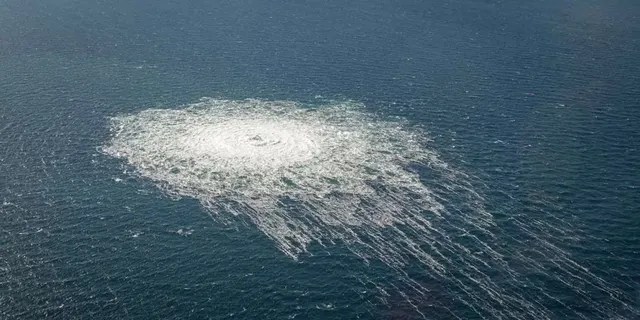
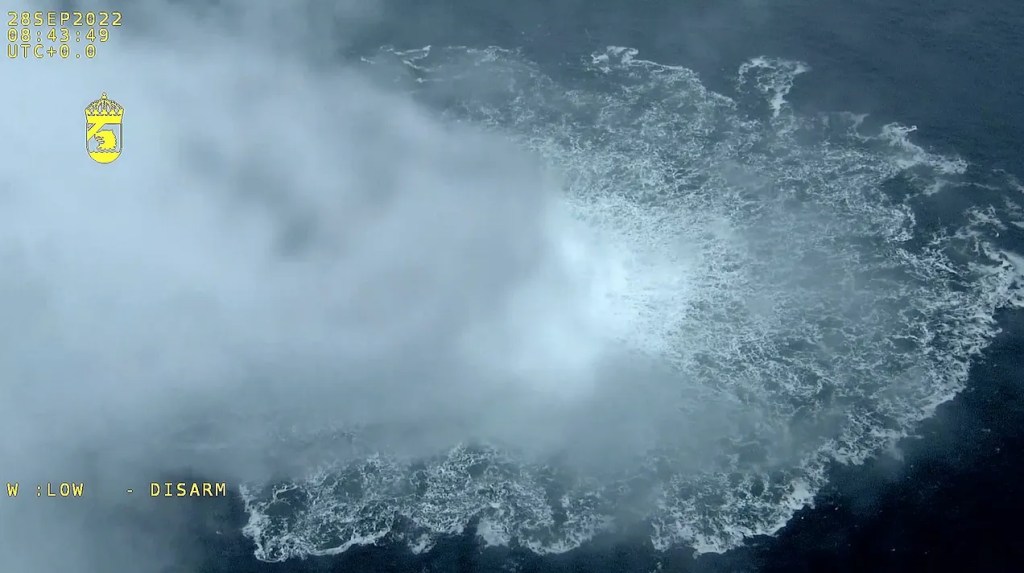
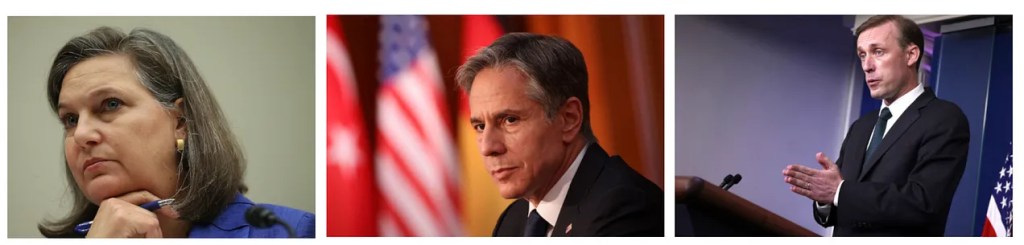
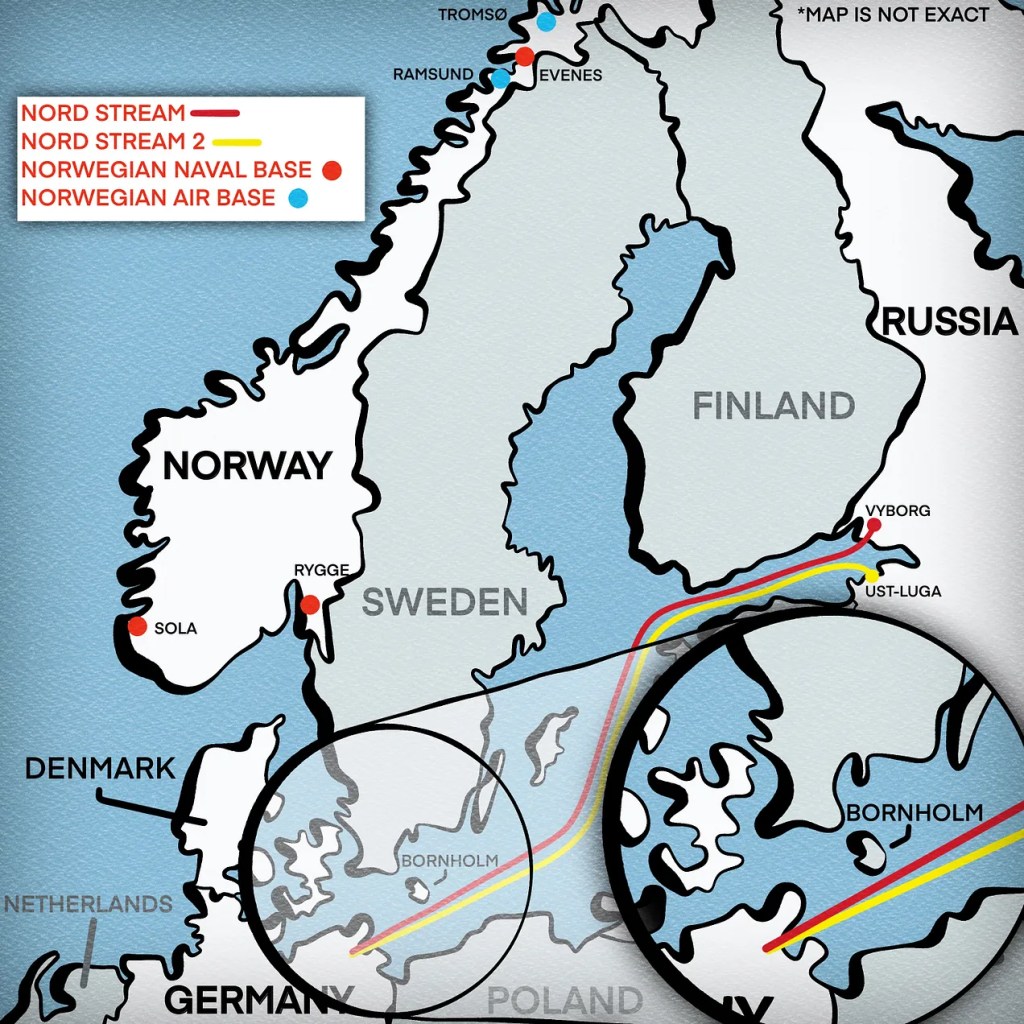




 After the Crash