Three interesting facets of news over Niger appear to be doing the rounds. Firstly, that a terrorist group in Nigeria has openly appealed to the Nigerian President – who also happens to be the ECOWAS leader – to avoid at all costs a military intervention in Niger; secondly, that Joe Biden took the initiative to meet the same gentleman Bola Ahmed Tinubu in the corridors of the United Nations, hinting that huge amounts of U.S. investment could be directed towards Nigeria if Tinubu played ball; and thirdly, that just recently, the stakes were raised in Niger when its junta announced that it had invited the armies of both Mali and Burkina Faso onto its soil to help defend themselves against an “intervention” which ECOWAS has threatened was on the cards only days earlier.
But Biden’s little chat with Tinubu says a lot about the realities of what is going to happen and what can happen on the ground as clearly his administration does not want another proxy war between East and West on its hands before the re-election run up next year. The question of whether the U.S. would support ECOWAS militarily has been answered by Biden’s bribe to the Nigerian president. It’s not going to happen.
Tinubu, who is certainly the man at the centre of events, gives the impression in interviews that he is under great pressure from ECOWAS members to intervene, but he is the one cooling tempers and looking for a diplomatic solution. And yet, his comments to the press seem to have been written by the U.S. state department such is the proximity of his office and the U.S. administration – debunking the myth of how much ECOWAS is influenced by France (given that the majority of the countries are former French colonies). The Nigerian president’s role as ECOWAS chief is under the spotlight.
What does he really want? Are his objectives focussed more on Nigeria rather than the bloc?
Joe Biden’s offer of a fresh injection of investment from U.S. firms hasn’t seemed to hit the mark. It seems that Tinubu is after even faster and even easier cash.
Tinubu said that African democracies are “currently under assault by anti-democratic forces within and outside the continent”, which is really state department jargon for “the Russians are coming”.
He then called on the “American-backed development finance and multilateral institutions, which were designed to support war-torn Europe after World War II, to adopt a swift and comprehensive reform to meet the developmental requirements of young democracies in Africa”.
The translation isn’t too cryptic. Can the U.S. intervene and, also, while they’re at it, pump our central bank full of never-never-pay soft loans from IMF and World bank? Cheers!
Neither Biden nor Tinubu though seem to be bothered about the possibility of a fourth francophone African country falling into the hands of Mother Russia. Mali and Burkina Faso, who both can be assumed to be vassals of Russia have shown great solidarity with Niger which has lost no time kicking the French out and becoming a major pain in the arse for western elites who are confused about the events and want to oversimplify the nuances. “We lost Niger to the Russians” may be the well worn cliché although the facts on the ground and more complicated. There certainly seems in Niger to be an endearment towards the new junta’s government but Russia’s role so far is unclear.
About the only thing that Putin and Biden agree on is they don’t want a war in Niger.
It’s easy to forget though that Niger was a key player in ECOWAS and that many of its members placed great importance on Niger’s front line assault on Islamic groups in the region – which, if given more freedoms, could cause havoc right across West Africa but in particular in neighbouring Nigeria.
For the moment though, the so-called pressure from ECOWAS is unlikely to manifest itself beyond chest beating. ECOWAS members may have the hunger for intervention but they don’t have the guts for a war, which neither the U.S. or Russia will bankroll, so sobriety is likely to take over the narrative in the coming days. The war in Ukraine, the abysmal foreign policy blunders of Biden, the deluded arrogance of Macron and the emergence of BRICS have all contributed to the current crisis in Africa as the old relationship with the West is put to the test, with disastrous consequences. The only thing left of Obama’s “soft power” idea he conjured up in 2015 after his humiliation in Syria is a suitcase full of cash for a corrupt West African leader to share with his cabal. Pretty pathetic.
Since the overthrow of Niger’s US-friendly government, West African nations of the ECOWAS bloc have threatened an invasion of their neighbor.
Before leading the charge for intervention, ECOWAS chair Bola Tinubu spent years laundering millions for heroin dealers in Chicago, and has since been ensnared in numerous corruption scandals.
Hours after Niger’s Western-backed leader was detained by the country’s presidential guard on July 28, Nigerian President and chair of the Economic Community of West African States (ECOWAS) Bola Tinubu leapt into action, warning that the group of nations “will not tolerate any situation that incapacitates the democratically-elected government.”
“As the Chairperson of ECOWAS…I state without equivocation that Nigeria stands firmly with the elected government in Niger.”
Two days later, ECOWAS imposed severe sanctions on Niger, and the bloc issued a stark ultimatum: if the newly-inaugurated junta won’t reinstall the ousted president in a week’s time, the group’s pro-Western African governments will — by military means, if necessary.
On Saturday, July 6 — one day before the deadline — ECOWAS leaders approved a plan to invade the country, with the ominous caveat that they are “not going to tell the coup plotters when and where we are going to strike.”
If ECOWAS gets its way, member states Benin, Cabo Verde, Côte d’Ivoire, The Gambia, Ghana, Guinea Bissau, Liberia, Nigeria, Sierra Leone, Sénégal and Togo will be pressured to send their soldiers to invade Niger.
These developments have thrust the typically-overlooked West African country of Niger into the Western media spotlight. But if hostilities break out, it wouldn’t just be one single impoverished African state in the crosshairs.
Neighboring Burkina Faso, Mali and Guinea, which are also governed by military administrations that recently seized power by force, have all warned that any attack on Niger will be viewed as an attack on them too. If their ECOWAS rivals make the first move, the nations which mainstream media have dubbed Africa’s “coup belt” have pledged to unleash their military forces as well — an announcement which should end any illusions that restoring the country’s previous president would be a painless process.
Leading the pro-Western coalition is the president of its most powerful country, Nigeria: Bola Tinubu. One of Nigeria’s wealthiest men, the source of the scandal-plagued president’s fortune remains unclear.
Documents reviewed by The Grayzone reveal Tinubu as a longtime US asset who was named as an accomplice in a massive drug running operation that saw him launder millions on behalf of a heroin-dealing relative.
I had a great time with other Heads of State and important dignitaries at the State Banquet hosted by President Emmanuel Macron in Paris, France, this evening. President Macron and his wife, First Lady Brigitte Macron were both gracious and warm, making the event a very pleasant… pic.twitter.com/lTHTZfTIMC
Bola Tinubu’s career marred by drug-trafficking, corruption allegations
For over 30 years, Bola Tinubu has been a major force in Nigeria’s political scene and the country’s economy, with local nicknames ranging from “the Mother of the Market” to “the Godfather of Lagos” and “the Lion of Bourdillon.” But his power inside Nigeria went largely unnoticed by international audiences until 2023, when he became ECOWAS chair after winning the presidency in an election closely tracked by the US government.
As president, Tinubu quickly instituted a regime of economic reforms backed by the US-controlled International Monetary Fund and the World Bank. Over the course of Tinubu’s political career in Nigeria, the African operator has cultivated a close relationship with the US embassy. According to a slew of classified State Department cables released by WikiLeaks, American officials relied heavily on Tinubu’s assessments of the domestic political landscape.
The ECOWAS chair’s early life is shrouded in mystery, and even his exact age is unknown. Nearly every detail of Tinubu’s personal history — prior to his appearance in Chicago on a student visa — is in dispute, including his legal birth name.
Records from Chicago State University show that Tinubu received a degree in Business Administration in 1979. In the following years, media reports indicate that Tinubu was employed in some capacity at a number of major US-based multinationals, including Mobil Oil Nigeria, consulting firm Deloitte, and GTE, which was the largest communication and utilities company in the US at the time.
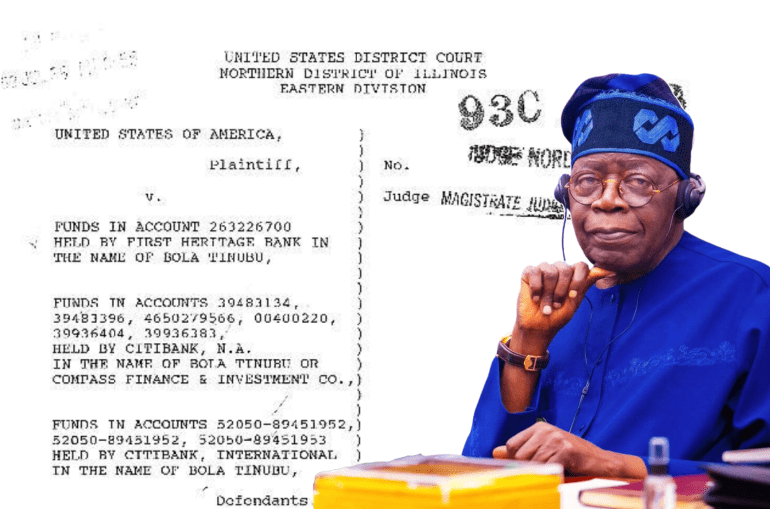
Of the few details about the Nigerian President’s early exploits which can be confirmed, many are derived from a 1993 court docket naming Tinubu as an accomplice in a massive midwestern drug smuggling operation.
As journalist David Hundeyin has detailed, court documents from the US District Court’s Northern District of Illinois make it clear that Tinubu amassed a small fortune laundering money for a heroin-trafficking relative in Chicago, and that US government officials ultimately seized well over a million dollars from various bank accounts registered under the current Nigerian president’s name.
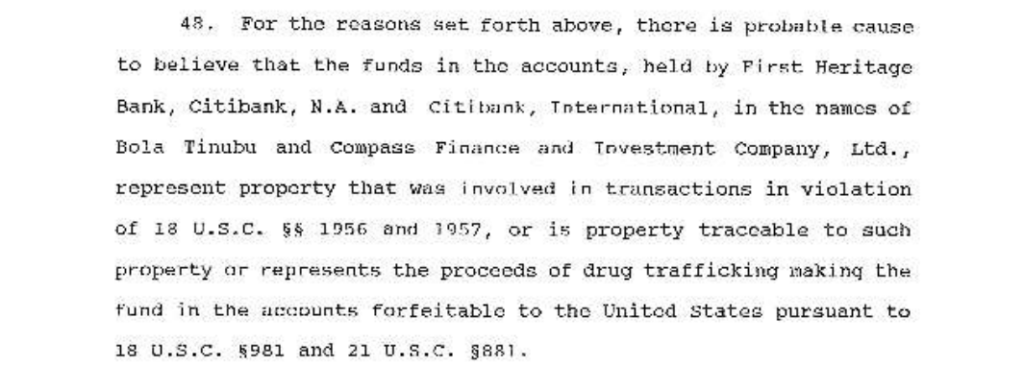
A 1993 report by IRS Special Agent Kevin Moss explained that “there is probable cause to believe that funds in certain bank accounts controlled by Bola Tinubu… represent proceeds of drug trafficking; therefore these funds are forfeitable to the United States.”
In the documents, Moss describes an extremely close working relationship between the future Nigerian president and two Nigerian heroin dealers named Abiodun Olasuyi Agbele and Adegboyega Mueez Akande, the latter of whom was listed as Tinubu’s cousin on an application for a vehicle loan.
“According to bank employees, when Bola Tinubu came to First Heritage Bank in December 1989 to open the accounts, he was introduced to them by Adegboyega Mueez Akande, who at that time maintained an account at the bank.” What’s more, bank records indicate that “Bola Tinubu also opened a joint checking account in his name and the name of his wife, Oluremi Tinubu,” who had “previously opened a joint bank account also at this bank with Audrey Akande, the wife of Adegboyega Mueez Akande,” Moss explained. In several of the applications, the addresses used by Tinubu exactly matched those previously used by Akande.
“According to bank records… Tinubu opened an individual money market account and a NOW account” at First Heritage Bank in December 1989, the special agent noted. “In the application, Tinubu stated that his address was 7504 South Stewart, Chicago, Illinois” — “the same address used previously by Akande.”
“Bank records disclosed that five days after the account was opened, on January 4, 1990, $80,000 was deposited into the NOW account at First Heritage Bank by wire transfer through First Chicago from Banc One Houston,” the report continues. According to the IRS, the money was sent by Akande.
But the Nigerian president’s financial dealings with the heroin traffickers went even further, according to the IRS special agent. He wrote that Citibank records documented “two additional corporate accounts held in the name of Compass Finance and Investment Company, Ltd. which were controlled by Bola Tinubu.”
“When Bola Tinubu opened these accounts,” he provided “a memorandum of association and articles of association” which “identified Mueez Adegboyega Akande and Abiodun Olasuyi Agbele as directors of Compass Finance and Investment Company, Ltd.,” Moss wrote.
In the end, Tinubu somehow managed to deposit over $660,000 in his First Heritage Bank account in 1990, and more than $1.2 million the next year — all while claiming to take home just $2,400 a month from his position at Mobil Oil Nigeria.
As the investigation into the money laundering scheme began to gain traction, Tinubu left the US and returned to Nigeria. Ultimately, Moss was able to speak to Tinubu by telephone on a number of occasions, and the special agent reported that the future president initially acknowledged his personal and financial dealings with the pair of drug traffickers.
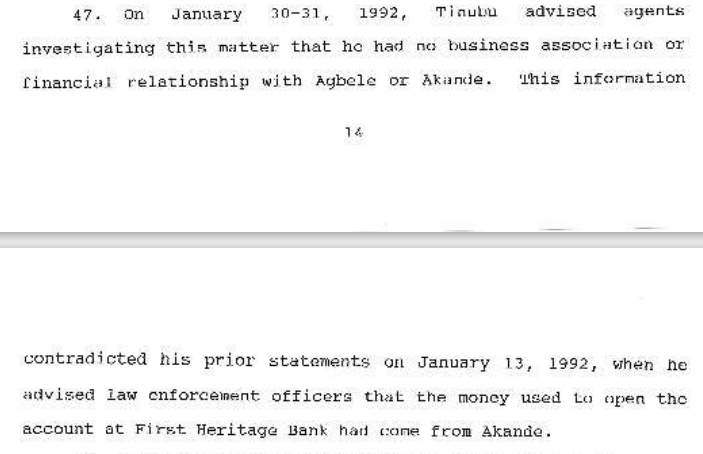
But in late January of 1992, “Tinubu advised agents investigating this matter that he had no business association or financial relationship with Abele or Akande,” Moss wrote. “This information contradicted his prior statements on January 13, 1992, when he advised law enforcement officers that the money used to open the account at First Heritage Bank had come from Akande.”
Back in Nigeria, Tinubu had already begun to transition into the political arena. By 1992, he’d been elected to the Senate, and in 1999 he became the Governor of Lagos State, a position he retained until 2007. At some point in his tenure, Tinubu established a relationship with the US Embassy which would last for years to come, according to a trove of diplomatic cables released by Wikileaks.
But even his State Department allies couldn’t help noticing Tinubu’s penchant for dishonesty. One particularly noteworthy cable pointed out that the politician was “known to play fast and loose with the facts” and “has been caught in the past embellishing his educational achievements.”
In the end, however, Tinubu’s usefulness seemed to outweigh his casual relationship with the truth, and the future Nigerian president went on to provide American officials with a near-continuous assessment of the political situation in his country. One typically intimate meeting with Tinubu ended with the US ambassador to Nigeria commenting: “as always, we found his take on the national political scene to be insightful.”
When the cables came to light in 2011, many Nigerians were shocked at the candor with which their elected officials spoke to Washington’s envoys. “The willingness of our elites to divulge unsolicited information about the nation to U.S. officials betrays an infantile thirst for a paternal dictatorship,” Nigerian-American professor and columnist Farooq Kperogi wrote.
Though Tinubu appeared to have escaped justice for his alleged role in a heroin trafficking conspiracy, accusations of corruption would continue to dog the ECOWAS chair throughout his political career in Nigeria. Since leaving office as governor of Lagos in 2007, Tinubu “picked every subsequent winning candidate,” according to German broadcaster DW, which noted earlier this year that the tycoon “is believed to be one of Nigeria’s richest politicians but the source of his wealth is unknown.”
In recent years, clues about the origins of the fortune amassed by one of Africa’s leading political players have begun to come to light.
In 2009, Tinubu came under investigation by the Metropolitan Police of London, who were probing allegations that the politician had pooled money with two other Nigerian governors to create a front company known as the “African Development Fund Incorporation.”
Investigators alleged the unusual business arrangement was actually a joint effort to illegally acquire shares of ECONET, a telecommunications firm founded by US intelligence asset and Gates Foundation trustee Strive Masiyiwa. But attempts to probe the legitimacy of the transactions in question were sidelined when the Nigerian federal government stonewalled the British investigation, which ultimately concluded without a single arrest. To this day, Nigerian authorities have yet to release the evidence requested by UK authorities.
In 2011, Tinubu was tried before the Code of Conduct Tribunal in Nigeria for illegally operating 16 foreign bank accounts. Eager to avoid the embarrassment he’d previously suffered when being photographed in court, the ECOWAS chair reportedly refused to take his place at the dock in a judicial hearing.
But the unwelcome attention appears to have done little to rein in the politician’s extravagant taste, and Tinubu once again found himself embroiled in a corruption scandal following an investigation into the luxurious 7,000-square foot mansion where the Nigerian president stays when receiving medical care in London.
According to Nigerian outlet Premium Times, the massive villa in London’s exclusive Westminster borough was picked up for a song by Tinubu’s son, who somehow managed to purchase the property at a discount of approximately $10 million from a wealthy fugitive – even though the seller’s assets, including the mansion in question, had been frozen by a Nigerian court. Photos published on social media in 2017 show Tinubu posing inside the villa alongside Nigeria’s president at the time, Muhammadu Buhari.
The current and previous president worked closely for decades, and Tinubu has publicly claimed sole credit for Buhari’s presidency while campaigning. “If it were not for me standing before you leading the army, saying ‘Buhari, go ahead, we’re behind you,’ he could never have become the president,” he told supporters at a rally last year.
But the suspicious confluence of money and influence didn’t end with the mysterious mansion in London. During Nigeria’s 2019 general election, footage of armored trucks entering Tinubu’s residence went viral on social media, and the incident was widely seen as proof that the politician was engaged in a fraudulent vote-buying scheme. But Tinubu remained defiant, telling reporters, “I keep money wherever I want.”
“Excuse me, is it my money or government money?” he asked. “If I don’t represent any agency of government and I have money to spend, if I have money, if I like, I give it to the people free of charge,” he insisted.
This January, the official explanation for the episode evolved again when one of his party’s representatives told a Nigerian TV station that the armored trucks in question had simply “missed [their] way” and arrived at the wrong address. Asked why Tinubu had seemingly admitted to dispensing cash to the public, the party’s organizing secretary in Lagos offered the bemused presenters an equally improbable explanation: “he said that jokingly.”
ECOWAS as a neocolonial weapon
While ECOWAS was officially founded via the Treaty of Lagos in 1975, its official history notes the bloc’s origins date back to the creation of the CFA Franc in 1945, which consolidated France’s West African empire into a single-currency union. Publicly, the move was described as a benevolent attempt to shield these colonies from the consequences of the French franc’s sharp devaluation in 1945, following the creation of the US-dominated Bretton Woods system. As the French finance minister said at the time:
“In a show of her generosity and selflessness, metropolitan France, wishing not to impose on her faraway daughters the consequences of her own poverty, is setting different exchange rates for their currency.”
In reality, the introduction of the CFA Franc meant that Paris was able to maintain highly unequal trading relationships with its African colonies, at a time when its economy was ravaged by World War II and its overseas empire was rapidly disintegrating. The currency made it cheap for member states to import from France and vice versa, but prohibitively expensive for them to export anything anywhere else.
This forced dependency in Francophone West Africa created a captive market for the French, and by extension the rest of Europe. That dynamic, which has stunted regional economic development for decades, persists to this day. The CFA Franc’s continued dominance ensures West African states remain under the economic and political control of France. Those African nations are powerless to enact meaningful policy changes, as they lack control over their own monetary policy.
That the currency features so prominently in the authorized history of ECOWAS is instructive, because the bloc has long-been criticized as an extension of French imperialism. It was not for nothing that in 1960, then-French President Charles de Gaulle made membership of the CFA Franc a precondition for decolonization in Africa.
Though ECOWAS is theoretically meant to maximize member states’ collective bargaining power by fostering “interstate economic and political cooperation,” such harmonization makes it easier for former imperial powers like France to exploit and enfeeble their constituent countries. The bloc imposes a strict, Western-approved legal and financial framework upon its members, and any state deviating from these rules is harshly punished.
In January 2022, ECOWAS imposed strict sanctions on Mali, prompting thousands to take to the streets in support of the military government that seized power in January the previous year. The new government’s efforts to purge the country of malign foreign influence saw a complete ban on French media imposed, a decision which was slammed by the UN but cheered by average Malians.
ECOWAS applied similar measures to Burkina Faso in response to a September 2022 military coup, which saw Paul-Henri Sandaogo Damiba removed after just eight months in power. Though Damiba himself seized via military coup, there was little condemnation from Western officials and few suggestions that ECOWAS impose sanctions — perhaps due to the ousted leader’s pro-Western orientation and status as a graduate of multiple elite US military and State Department training courses.
Since 1990, ECOWAS has waged seven separate conflicts in West Africa, in order to protect the West’s preferred despots across the region. Meanwhile, between 1960 and 2020, Paris launched 50 separate overt interventions in Africa. Figures for clandestine activities conducted during this time are unavailable, but the country’s fingerprints are plastered all over multiple rigged elections, coups, and assassinations that have sustained compliant, corrupt governments in power throughout the continent.
As President Jacques Chirac remarked in 2008, “without Africa, France will slide down into the rank of a third [world] power.” This perspective was reaffirmed in a 2013 French Senate report, Africa is Our Future. Indeed, the mere existence of anti-imperialist governments anywhere in the region is intolerable to Paris.
Luckily for the French elite, compromised figures like Bola Tinubu are still on hand to do their dirty work for them.
Since Bitcoin (BTC) was introduced to the world as an alternative to the current central bank system with a dying US dollar that is backed by nothing as its reserve currency, but now there is a plan by several governments to move ahead with implementing their own central bank digital currencies (CBDCs), which is a digital form of currency that is still backed by, you guessed it, nothing. The Nigerian government had made the decision to be the financial guinea pig for the globalist CBDC scheme, and so far, it has failed and that’s the good news. The bad news is that certain governments are still moving forward with the idea of using government-issued digital currencies. In the case of Nigeria, its citizens rejected their government’s plan to issue CBDCs by restricting cash in efforts to create a cashless society and so far, it seems that it has failed in epic fashion according to an opinion piece by author Nicholas Anthony that was published by coindesk.com ‘Nigerians’ Rejection of Their CBDC Is a Cautionary Tale for Other Countries’ is a warning to governments who are willing to take the same step:
In Nigeria, citizens have taken to the streets to protest the nation’s cash shortage, further objecting to their government’s implementation of a central bank digital currency (CBDC). The shortage came about due to cash restrictions aimed at pushing the country into a 100% cashless economy. Yet, instead of adopting the CBDC, Nigerian protesters are demanding paper money be restored.
The country’s experience strongly suggests the average citizen understands that CBDCs present a substantial risk to financial freedom while providing no unique benefit
Not only did the Nigerian people reject CBDCs, but they also demanded a return to paper currencies because they quickly found out that financial freedoms would be severely limited.
The concerns ranged from risking financial privacy to the possibility of financial oppression by government institutions. Anthony mentioned how “the Nigerian government has unleashed a flurry of tricks to spur adoption, but none has proven effective.” He even gave credit to the Nigerian government in terms of using modest approaches to influence its citizens to use CBDCs and it still failed:
To its credit, the Nigerian government initially tried to encourage use through modest measures. In August 2022, it removed access restrictions so that bank accounts were no longer required to use the CBDC. Then, in October, it offered discounts if people used the CBDC to pay for cabs. Yet, neither effort proved to be fruitful. Put simply, Nigerians prefer cash
However, the Nigerian government continued its assault on cash:
Unfortunately, the Nigerian government doubled down and moved to more drastic measures by restricting cash itself. In December the Central Bank of Nigeria began restricting cash withdrawals to 100,000 naira (US$225) per week for individuals and 500,000 naira ($1,123) for businesses.
To make matters worse, the Nigerian government also chose to redesign the currency during this time in a “move aimed at restoring the control of the Central Bank of Nigeria (CBN) over currency in circulation” and to “further deepen the push to [a] cashless economy,” according to a CBN press release
The Nigerians had a hard time adapting to the government’s restrictions on their hard earned cash, so they posted their concerns on Twitter, Tik Tok and other social media platforms to let the world know what went wrong. Soon after, major protests erupted on the streets because of the cash shortages imposed by the Central Bank of Nigeria:
NAIRA SCARCITY: Viral video shows the moment Benin protesters attempted to invade CBN office.
Protesters attempted to invade the Central Bank of Nigeria at Ring road in Benin, Edo State on Wednesday. pic.twitter.com/5sQcLfFeDo
The government decided to redesign the currency to restore control over the Central Bank of Nigeria as its governor, Godwin Emefiele claimed that “the destination, as far as I am concerned, is to achieve a 100% cashless economy in Nigeria.” To add insult to injury, “the company that designed the Nigerian CBDC called the cash restrictions a creative use of marketing and said other countries could be expected to take similar steps.” A top manager from a financial institutional ratings firm called Agusto and Co., Ayokunle Olumbunmi said that the central bank “doesn’t want us to be spending cash. They want us to be doing transactions electronically, but you can’t legislate a change in behavior.” Anthony concluded that the idea of CBDCs will not go very far, “CBDCs may be popular among central bankers, but money is ultimately a tool for the people. So long as the risks outweigh the benefits, it’s unlikely any CBDC will gain traction in Africa or elsewhere.”
Nicholas Anthony was correct to point out that CBDCs will not become mainstream as several countries have already demonstrated their unwillingness to move forward with the new form of digitized currencies.
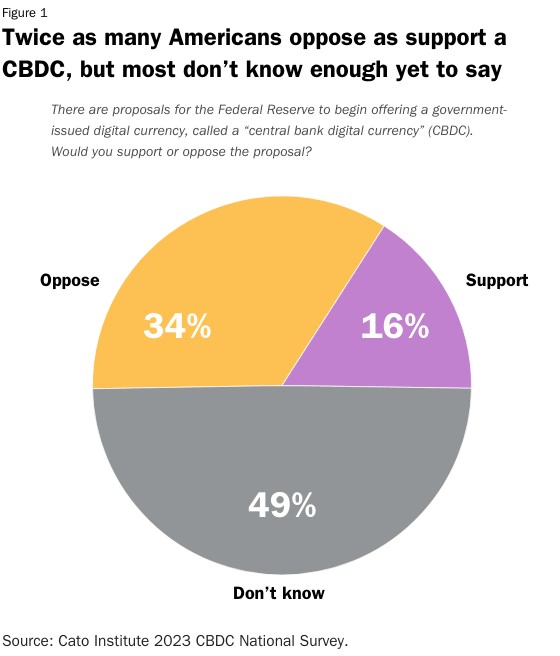
The average human being on earth understands that CBDCs is a bad idea, even in the United States where two-thirds of the population believes almost anything that their government tells them to believe are skeptical of CBDCs according to the Cato Institute, a think tank who also published an article by Nicholas Anthony on the findings of a survey that was conducted by the US federal Reserve Bank on how people view CBDCs. Here is what they found, “Specifically, more than 66 percent of the 2,052 commenters were concerned or outright opposed to the idea of a CBDC in the United States (Figure 1).”
Bitcoin.com published an article on the GOP’s 2024 presidential candidate, Florida’s governor, Ron DeSantis who is opposed to CBDCs,‘Ron DeSantis Vows to Prohibit CBDC, ‘Woke Politics,’ and ‘Financial Surveillance’ in Florida,’ he said “I think what the danger of the digital currency is that, one, they want to make that the sole currency, they want to get rid of crypto,” DeSantis continued, “They don’t like crypto because they can’t control crypto. So, they want to put everything in a central bank digital currency.” There were other politicians who also have similar views on CBDCs:
DeSantis shares the view of several Republican officials who have criticized the idea of a central bank digital currency (CBDC). Minnesota congressman Tom Emmer introduced the Central Bank Digital Currency (CBDC) Anti-Surveillance State Act, while Texas senator Ted Cruz has created legislation against the government developing a CBDC. Georgia representative Marjorie Taylor Greene has also spoken out against CBDCs, and 2024 Democratic presidential candidate Robert Kennedy Jr. has warned that a central bank digital currency could lead to financial slavery
Cash is King! How the CBDC Failed in Japan and Ecuador
Cointelegraph.com, an independent digital news platform that focuses on crypto assets, blockchain technology and emerging fintech trends published an article last year written by Helen Partz based on which countries have rejected CBDCs for one reason or another titled ‘Some central banks have dropped out of the digital currency race’ mentions Japan, who is a major player in the global economy, ultimately rejected developing a CBDC scheme. The Bank of Japan (BOJ) started testing their digital currency proof-of-concept in 2021 and had planned to finish the first phase by 2022 but in January “former BOJ official Hiromi Yamaoka advised against using the digital yen as part of the country’s monetary policy, citing risks to financial stability.”
The BOJ issued a report in July 2022 and stated that it had no plan to establish a CBDC system since there is a “strong preference for cash and high ratio of bank account holding in Japan” and that the regulator suggested for a CBDC to be used as a “public good” and it “must complement and coexist” with “private payment services in order for Japan to achieve secure and efficient payment and settlement systems.” However, it also said that “the fact that CBDC is being seriously considered as a realistic future option in many countries must be taken seriously,” in other words, the CBDC scheme in Japan will not move forward although several countries are still in the early stages of developing a plan for the use of CBDCs, but for Japan, cash is still and will be king well into the foreseeable future.
Ecuador is another example as its central bank, Banco Central del Ecuador (BCE) who launched its own electronic currency known as dinero electrónico (DE) in 2014 to increase some sort of financial inclusion for the public as well as to control the flow of fiat currencies. According to Partz “As of February 2015, Ecuador managed to adopt DE as a functional means of payment, allowing qualified users to transfer money via a mobile app. The application specifically allowed citizens to open an account using a national identity number and then deposit or withdraw money via designated transaction centers.” But industry observers were not so sure that the DE can take the form of a CBDC since Ecuador’s currency is the US dollar, and since Ecuador does not currently have its own sovereign currency, many were not so sure that they can call the DE, a form of CBDC. “The Ecuadorian government cited the support of its dollar-based monetary system as one of the goals behind its DE platform after it started to accept U.S. dollars as legal tender in September 2000.” It seems that Ecuador remains skeptical on any possibility that issuing CBDCs will be a success:
According to online reports, Ecuador’s DE operated from 2014 to 2018, amassing a total of 500,000 users at its peak out of a population of roughly 17 million people. The project was eventually deactivated in March 2018, with the BCE reportedly citing legislation abolishing the central bank’s electronic money system. Passed in December 2021, the law stated that e-payment systems should be outsourced to private banks.
Years after dropping its central bank digital money initiative, Ecuador has apparently remained skeptical about the whole CBDC phenomenon. In August 2022, Andrés Arauz, the former general director at Ecuador’s central bank, warned eurozone policymakers that a digital euro could potentially disrupt not only privacy but also democracy
Bottom line, the CBDC will not be a standard for financial transactions for the few countries who already tried launching their versions of digital currencies.
However, in the US, the Federal Reserve’s ‘FedNow’ was supposed to be launched sometime in July 2023. Here is the Federal Reserve’s Press Release:
The Federal Reserve announced that the FedNow Service will start operating in July and provided details on preparations for launch. The first week of April, the Federal Reserve will begin the formal certification of participants for launch of the service. Early adopters will complete a customer testing and certification program, informed by feedback from the FedNow Pilot Program, to prepare for sending live transactions through the system.
Certification encompasses a comprehensive testing curriculum with defined expectations for operational readiness and network experience. In June, the Federal Reserve and certified participants will conduct production validation activities to confirm readiness for the July launch.
“We couldn’t be more excited about the forthcoming FedNow launch, which will enable every participating financial institution, the smallest to the largest and from all corners of the country, to offer a modern instant payment solution,” said Ken Montgomery, first vice president of the Federal Reserve Bank of Boston and FedNow program executive. “With the launch drawing near, we urge financial institutions and their industry partners to move full steam ahead with preparations to join the FedNow Service”
For the US population, FedNow is a test that will eventually fail. People will be skeptical about a central bank digital currency once it proves that it is used to surveil people’s spending habits and control what they spend their money on, and God forbid they are anti-war, anti-vaccine activists, homeschoolers, pro-gun supporters or conspiracy theorists, the bankers can cut them off from using CBDCs and then what happens? Will there be riots in the streets?
Since Bitcoin was introduced as an alternative to central bank control, the creation of the CBDC is their answer in hopes of retaining their power, but that idea is not likely to happen, it will in some way, backfire.
When it comes to Bitcoin, it’s a different story. In an interesting article written by Jay Speakman of beincrypto.com ‘When You Buy Bitcoin You Gain Freedom’ says that “in a world where economic and political uncertainties abound, owning Bitcoin (BTC) could provide the path toward financial freedom and autonomy. It’s no longer just about investing in a digital asset. It’s about making a revolutionary move to gain control over your finances and future.” Speakman makes several main points on why people should own Bitcoins and one of those points is that owning sovereign cryptos such as Bitcoins, Ethereum’s and others is a step towards financial freedom:
It provides the opportunity to participate in the global economy without the limitations of traditional banking systems. Bitcoin is not subject to government regulations. At least not yet, and it is free from the inflationary policies which can erode fiat currency values. This means Bitcoin provides an alternative and potentially more secure, store of value
Another reason for owning Bitcoins is for future investment purposes:
Investing in Bitcoin is no longer simply making money. It is about investing in your future and securing your financial freedom. Bitcoin’s decentralized financial system operates independently of central authorities or governments. This means it is resistant to censorship and regulation. Bitcoin holders can make transactions without the need for banks, which are subject to government intervention
“Investment Diversification” is another reason to own Bitcoins since putting all your eggs in one basket, especially in a globalist banking system, is a bit risky:
Investing in Bitcoin can provide portfolio diversification as it is not correlated to traditional assets such as stocks and bonds. This means it may provide a hedge against inflation and market volatility, mitigating the risks associated with traditional investment portfolios
However, owning Bitcoins does have risks like everything else since the “market is notoriously volatile. Prices often fluctuate wildly based on a range of factors, from government regulations to media coverage.” Speakman also mentions that “BTC transactions can result in a permanent loss of funds. There is also the risk of hacking and theft, as these transactions are irreversible and untraceable.”
In conclusion, the article lays out what owning Bitcoins could mean for individuals and investors alike especially for those who do not trust the traditional banking system:
The decision to buy BTC is more than just a financial investment. It’s a move towards financial freedom, control, and security. Bitcoin’s feature of allowing individuals to act as their own banks. Providing a secure alternative to traditional banking systems which have exhibited instability and vulnerability to failures. Furthermore, the appeal goes beyond just financial security and autonomy. The digital currency resonates with libertarians who value individual freedom and limited government intervention. Despite a torrent of dissenting voices Bitcoin continues to gain mainstream adoption. As the technology continues to mature, it may address some of the concerns raised by the dissenting voices.
Investing in digital assets may involve risks such as volatility and the potential for hacking and theft. Yet, the benefits of financial freedom outweigh the downsides. As the world becomes increasingly uncertain, owning Bitcoin could be the first step toward financial security and autonomy
When you look at the difference between CBDCs along with the system imposed by international banking cartels who still maintain some form of financial dominance versus the Bitcoin revolution, there is a difference. CBDCs means no financial freedoms and owning Bitcoins means the exact opposite. Even though Bitcoins are still in the early stages, there is hope in the new crypto technology. But like everything else, you should be cautious, do not invest 100% of your net worth in just one asset, in other words, invest maybe 5% in bitcoins, and the rest? 15% in emergency preparedness (food, water filters, guns, flashlights, etc.) 20% in real estate or invest in a second passport, 20% in hard assets like gold, silver and copper, 20% in high-end watches, antiques, aged wines and liquor, collectibles etc. and the last 20% in foreign stocks especially those that are in politically stabilized environments or in gold and silver mining companies, but that’s just my opinion.
Government-backed CBDCs will be a failure because the people already do not trust international banking cartels to totally control their finances. So, for these banks to have total control over your financial wellbeing under their CBDC scheme would be an extremely difficult task for them to manage.
The banking cartel or the financial bureaucrats are about to discover that they will be in over their heads with an angry population. Just imagine if the banking cartels, certain governments and their corporate conglomerates are in control over the people’s finances, they will get to determine who eats and who will starve. This is the ultimate power grab the globalist bankers have been dreaming about for a very long time, but will the people stop this from happening? I’m an optimist, so I believe that they will demand their financial freedoms and that is something of value that they can hold and control in their own hands. The case for CBDCs will be a hard sell, so central banks who are proposing this idea should think twice about what they are trying to impose on the public, if not, they will face some form of resistance just like they did in Nigeria.
Pfizer’s long history of scandals, and the fact that they have never been held to account for their crimes, continues to be ignored by the media, even as its experimental mRNA vaccine candidate for Covid-19 draws ever closer to US government approval.
The vaccine information war has kicked up a gear, and the mainstream media vultures are circling to descend on any content that they can easily label and dismiss as misinformation. Laws will be passed throughout legislatures globally to criminalise anyone who publicly misunderstands any part of the complex biological processes involved in many of the new experimental vaccine technologies that are being used to produce Covid-19 vaccine candidates.
Even now, intelligence agencies and intelligence-backed tech companies are set to deploy sophisticated methods to censor content and deplatform news websites that they view as promoting ‘vaccine hesitancy’ as well as ‘vaccine misinformation’, particularly as a Covid-19 vaccine candidate lurches closer to approval.
It is expected that by month’s end the mRNA vaccine produced by the scandal-ridden pharmaceutical giant Pfizer will be approved by the US government via an emergency-use authorization, with other countries expected to follow suit. Pfizer, in anticipation of the seemingly imminent and assured approval of their vaccine candidate, has already been manufacturing hundreds of millions of doses of its vaccine for weeks and has received praise from governments and mainstream media alike for its self-reported claims that its vaccine is 90 percent effective.
In particular, the success of the experimental mRNA mass vaccination program appears to hinge on the general population being unable to effectively articulate their concerns and objections. Whilst the mainstream media are quick to point out when somebody makes an error in how they believe the mRNA vaccine works, they don’t offer any further information than the official government line. Public distrust in vaccination programs is not the fault of those who don’t understand the way this brand-new technology works. Public distrust is all-pervasive because only one side of the argument is allowed to be heard. We do need to understand the technology involved, as there is a difference between mRNA vaccines and DNA vaccines. Having a general understanding of the reason why someone should object to being given an experimental mRNA vaccine is necessary for creating a clear and coherent argument.
We are about to examine a subject that has been one of the most censored topics in the modern era. But now, more than ever before, we are in desperate need of the information that is being systematically hidden from the public. This article will be banned and attacked by those who believe we, the general public, shouldn’t know all the information about what they want to achieve from the coming mass global vaccinations. The reason for the current establishment’s unwillingness to speak about this subject leads to perhaps unnecessary suspicion. Such suspicions will never be dismissed via the currently employed tactic of smearing anyone who questions intentions. If governments worldwide want their populations to submit to these vaccinations, then they need to stop patronising people and speak honestly. However, since that is unheard of, they will continue to employ coercive tactics, as they will be trying out a never-before-approved experimental method to boost the immune system by manipulating the process our DNA uses to signal for the creation of certain proteins, and we have little idea of what the long-term impact this brand-new therapeutic technology could have on our health. No politician, medical expert, or pharmaceutical representative is willing to accept responsibility for challenges that might be around the corner.
Many of the pharmaceutical companies researching potential coronavirus vaccines are using old methods. They take a proverbial pinch of the virus and infect your immune system at a very low and slow rate, allowing your body the time it needs to build up a natural immunological resistance to the illness. But developing those types of vaccines is a slow and arduous process, and the current leaders in the race to mass global vaccination are pharmaceutical companies using a radical new method that has never been tried before.
‘They are going to hack the cells in your body in order to make them into drug factories’, says Nathan Vardi, a staff writer for Forbes, in a video titled Why Pfizer Is Betting Big on an Unproven Treatment for Covid-19, from March 2020. ‘The problem is with this approach’, Vardi admits, ‘is there’s never been an approved mRNA product’.
The various scientific explorations into the therapeutic applications of potential mRNA treatments are still in their infancy, but the method has been lauded as a potential solution to the treatment of cancer and infectious diseases, for protein replacement, and for gene therapy.
In January 2020, the de facto leader in the mRNA field was the pharmaceutical company Moderna, but—in the wake of Covid-19—other major companies began to focus on the mRNA method. Moderna was able to pioneer that method several years ago, thanks to funding largely provided by the Pentagon’s Defense Advanced Research Projects Agency (DARPA) and the Bill and Melinda Gates Foundation.
Now, as 2020 draws to a close, the race to develop the winning Covid-19 vaccine is in full swing, and another Big Pharma company has seemingly beaten Moderna to the development of a supposedly effective mRNA vaccine, thanks to Pfizer teaming up with BioNTech, a small German company, to pip Moderna to the post. But, in this race to ‘save humanity’, there are bound to be pitfalls, especially when introducing completely new health technologies into mainstream use. Has Pfizer rung the finishing bell in this global race to end the current pandemic, or, instead, is it hurtling towards a disaster of epic proportions?
There are very informative scientific papers available from just before the pandemic began that give us an insight into this new mRNA technology. So here I’ll examine the DNA manipulating method, the vaccine, the people behind the research and development at BioNTech, but most important, I’ll examine Pfizer, and look at how the company has avoided accountability when things go wrong—and things do go wrong at Pfizer.
mRNA Vaccine Technology and How It Works
The vital interaction that mRNA has with our DNA has made selling mRNA vaccine technology extremely difficult for those who believe it’s the future of human medicine. The fact that it will alter the function of your DNA in your body has made many people suspicious of what unexpected horrors could arise through mass use of this new and experimental technique.
Unsurprisingly, the people marketing the vaccines have tried to downplay the aggressive and genetically manipulative nature of the treatment. In fairness, trying to explain the workings of such a complex new technology in plain English is exceedingly difficult. This is apparent when one listens to representatives of the mainstream media, who are often mealy mouthed when describing the biological processes that will take place when you receive the mRNA vaccine. But inability to articulate the technology isn’t surprising when you consider that part of your DNA, after breaking in two through a natural process, will then be combined with the experimental mRNA in a way that seems esoteric to many of us. It’s almost impossible to imagine such a process taking place in one’s own vulnerable biological system, in one’s DNA, the most precious building blocks of life that define your very existence.
After a preprogrammed strand of mRNA has merged with a naturally severed part of your DNA, it will request the production of a protein that should help trigger your immune system. In theory, this should boost your immune system and aid in the mass production of the proteins necessary to successfully fight the specific illness. The inserted messenger-RNA (thus, mRNA) should be relatively easy to design and programme as long as the scientists involved have the genetic coding for the infection it is to fight. In this case, the necessary data was released in January 2020 by the Chinese. Mild side effects to this process should be expected.
Although no extreme side effects were reported by Pfizer during the stage 3 testing of their mRNA vaccine, nearly every participant suffered mild symptoms, including swelling of the arm, irritation of the skin, and headaches, to name just a few. But, as we shall see, the information that Pfizer releases about its clinical trials and what happens in reality can be quite different.
I have just described the basic information you require for understanding how the coming mRNA vaccine works, but what I can’t describe to you is what happens in the long term. This form of therapeutic alternative has never been allowed or sanctioned before, aside from small clinical trials. There has never been an FDA-approved clinical trial for mRNA medicine because its usage comes with an abundance of ethical and moral questions and unknown possibilities.
At the same time, the utilisation of the mRNA method could also be one of the biggest leaps forward in technology ever recorded in human history. If we give the technology the benefit of the doubt and assume that it has no negative long-term side effects, then it is a potential treatment for almost every human illness on earth. Opening this mRNA floodgate would mean normalising regular vaccinations for nearly every imaginable ailment. In the best-case scenario, you could be vaccinated against cancer, heart disease, diabetes, dementia and Alzheimer’s, and any other human ailment that derives from a fault in your DNA. In the worst-case scenario, you could be left dead or crippled like Pfizer’s victims in its experiments on Nigerian children during the late 1990s.
All that being said, the Pfizer/BioNTech vaccine has a major downside to it. Pfizer and Moderna have stated that their mRNA vaccines need to be kept at -70° C and -20° C, respectively, which is a significant logistical challenge. Without these extremely cold temperatures, the mRNA and combined nanoparticles will lose their integrity. There are no studies on the effect of poorly stored mRNA vaccines on the human body. In comparison, DNA vaccines are much easier to transport and store as they are much more stable molecules.
As we have seen, the potential for mRNA technology is boundless. If the vaccine is successful in normalising the process of gene editing for medicinal benefit, there will be pressure to continue editing genes in other ways. It isn’t hard to see that the technology could have cosmetic, medical, and military applications that could range from phosphorescent skin to military bioweapons beyond our imagination. That is the reason why the people behind this technology are reluctant to speak about its potential game-changing mRNA method, for it represents our first real steps into transhumanism.
Pfizer’s Profitable Partnership with Germany’s BioNTech
As we have seen, Pfizer wasn’t the primary company in the mRNA business at the turn of 2020, but its immediate partnership with BioNTech saw it beat its main competitor, Moderna, to the finish line. BioNTech, based in Mainz, Germany, is led by a husband and wife team and, prior to the partnership with Pfizer, was dedicated to mRNA-related cancer-treatment research.
Uğur Şahin and Özlem Türeci, the couple leading BioNTech, are of Turkish descent. Şahin’s family were from southern Turkey, and he studied for his doctorate in Cologne, whilst Türeci’s family came from Istanbul. The two met at the University of Hamburg.
BioNTech already had a collaboration agreement to develop mRNA‐based vaccines for prevention of influenza with Pfizer as far back as February 2019, and their commercial strategy of collaborating with selected partners paid off when the race to the coronavirus vaccine began. Since then, there has been global media interest in BioNTech, mainly in the form of puff pieces focussing on Şahin and Türeci’s romantic life. But BioNTech also has many links to other Big Pharma giants and some of the well-known movers and shakers in the medical world. As well as its partnership with Pfizer, in 2019 BioNTech also had partnership deals with Bayer, Genentech, Sanofi, Genmab, Eli Lilly, Roche, and of course they received funding from the Bill and Melinda Gates Foundation. In September 2019, just before the first people were infected with the new strain of SARS-CoV-2, the German news outlet Handelsblatt reported that ‘the Gates Foundation is investing around 50 million euros in the Mainz biotech company BioNTech. The money will be used to research HIV and tuberculosis vaccines’.
BioNTech has a small five-person management team and a four-person supervisory board. Şahin is the CEO of the company; he was also the head of the scientific advisory board of Ganymed Pharmaceuticals AG from 2008 until 2016, when the company was acquired by Astellas Pharma. BioNTech’s chief business officer, Sean Marett, previously worked in global strategic and regional marketing, and in sales at GlaxoSmithKline in the United States and at Pfizer Europe, as well as for Evotec and Lorantis. The company’s chief operating officer and CFO, Dr Sierk Poetting, joined BioNTech in September 2014 from Novartis. The chief strategy officer at BioNTech is Ryan Richardson, who had previously been an executive director of the global health-care investment-banking team at J. P. Morgan in London, where he advised companies in the biotech and life sciences industry on mergers and acquisitions, equity, and debt capital finances. The German BioNTech’s four-man supervisory board includes Ulrich Wandschneider, who is also a member of Trilantic Europe.
Pfizer: A Company Never Held to Account
If it were only BioNTech that was responsible for the creation of this futuristic vaccine technology, then maybe people would have more faith in the product. But Pfizer casts a dark shadow of conspiracy wherever it does business. Pfizer’s previous use of experimental drugs in secretive and scandalous studies has inspired Hollywood movies and court cases lasting over a decade, as it resulted in the death of many children. Yet, the media organisations touting its coronavirus vaccine as a heaven-sent miracle have provided little to no coverage of Pfizer’s previous experimental disasters.
Pfizer entered into the vaccine business in late 2006 by acquiring the British influenza-vaccine company PowderMed for an undisclosed fee. Pfizer was admittedly excited about the deal, stating that ‘PowderMed’s unique DNA vaccine technology is particularly promising’ and that ‘its pipeline of vaccine candidates for influenza and chronic viral diseases could have major potential’. In fact, beginning in autumn 2005, many Big Pharma companies had taken their first steps into the vaccine industry. Novartis entered the vaccine business by acquiring 56 percent of Chiron, whilst GlaxoSmithKline expanded its vaccine base by acquiring ID Biomedical of Canada. Competition was heating up among the big players, and the vaccine industry was seen as a safe bet, with reports of new vaccines selling for hundreds of dollars. But Pfizer’s reputation over the preceding decade had taken a severe knock due to the company’s disastrous experimental trials in Africa.
In 1996, an experimental trial took place in Nigeria. Under the cover of severe outbreaks of cholera, measles, and meningitis in northern Nigeria, Pfizer set up the secretive trials in Kano, the second largest city in Nigeria, to test its experimental antibiotic, Trovan (trovafloxacin). It tested the experimental drug on two hundred children. The children’s parents assumed that the children would receive the standard meningitis jab, but Pfizer staff instead set up two control groups. Half of the children were given the experimental Trovan, and the other hundred were given a reduced dosage of the leading meningitis equivalent. The lower dose was to help artificially skew the results in the favour of Trovan for marketing and competitive purposes.
In 2002, a group of Nigerian children and their legal guardians sued Pfizer in the US District Court for the Southern District of New York. In court documents, the plaintiffs alleged that five children who received Trovan and six children whom Pfizer had ‘low-dosed’ had died as a result, whilst others suffered paralysis, deafness and blindness. The alleged actual number of those who died due to their involvement in the trial, per Nigerian sources, is over fifty.
Pfizer was supposed to check the children’s blood samples five days into the trials to look for any abnormalities and then change their treatment to the full-strength leading meningitis drug if there were any problems. However, they failed to do so. Instead, the Pfizer team waited for the irreversible symptoms to manifest physically before switching the treatment for the study’s unwitting participants. After realising that they had just murdered and crippled these children, Pfizer, like any giant pharmaceutical corporation would, left the scene of the crime in a hurry, failing to do any further evaluation of the patients.
Pfizer spent the next ten years denying any responsibility for the disaster, eventually releasing a statement entitled ‘Trovan, Kano State Civil Case—Statement of Defense’, in which the pharmaceutical bigwig stated among other things ‘that mortality in the patients treated by Pfizer was lower than that observed historically in African meningitis epidemics, and that no unusual side effects, unrelated to meningitis, were observed after 4 weeks’.
Pfizer eventually settled the case for $75 million on condition that it would not be held responsible for its actions. The Guardian newspaper reported in 2011 that the first four settlements in the lengthy court battle had been given to the families of four of the children who were killed during the trial. In an unabashed attempt to make the court settlement of $175,000 harder for each of the surviving families to claim, the victims’ families were forced to provide DNA samples to prove they were actually related to the deceased. This tactic turned out to be very effective from the company’s perspective, as many of the families didn’t trust Pfizer, which led some to pull out and refuse the settlement because they thought the DNA samples were a ploy by Pfizer to commit further illegal secret experiments upon them, or worse.
The Nigerians were represented by two brave lawyers, a Nigerian lawyer named Etigwe Uwo and a Connecticut-based lawyer, Richard Altschuler. According to Altschuler, it was the story of Pfizer’s Kano coverup that prompted John le Carré to write the novel The Constant Gardener that was adapted in the feature film. Like the situation depicted in the movie, Pfizer used scare tactics and smear campaigns to try and hinder any investigation into the Kano incident.
In 2006, Pfizer cut its workforce by 20 percent, reducing the number of its US employees by 2,200 people. The Financial Timesreported on 29 November 2020 that this was something that was happening in all of the major pharmaceutical firms stating, ‘Big pharma is rushing to restructure across its business from manufacturing to how it markets and sells its drugs’. But Pfizer was mainly concentrating on radical change to its drugs salesforce.
Pfizer was hit by further major scandals over the following year. One included the illegal premarketing of the HIV drug Maraviroc, which initially stalled the drug’s approval by the FDA. The scandal saw Pfizer publicly fire three of its top executives, including its assistant sales manager, Kelly Fitzgerald, (who returned to work for Pfizer and is currently their assistant sales director), HIV sales director, Art Rodriguez, now working for California’s Valued Trust, and the Mid-Atlantic director, Bob Mumford.
Get Your Facts Straight and Another Way Out
Whilst a DNA vaccine will change your DNA permanently, an mRNA vaccine will not permanently change your DNA. It takes one sentence to clear up that misunderstanding of the technology, and people should not be criminalised for such a simple misunderstanding. However, the mRNA vaccine does bind with part of your DNA to alter the proteins being produced. This is the very place where companies wish to trap opponents of their experimental vaccine campaigns. Just because someone doesn’t fully understand the process involved shouldn’t mean they should be demonised and forced into taking this experimental combination of nanoparticles. In fact, individuals should reject the vaccine until companies explain how it works and if there are any long-term side effects. You shouldn’t let anybody put anything into your body until they can tell you if any long-term consequences could occur. This is a basic principle of self-preservation that trumps any risk of a virus, especially a virus that has proven to be just a little bit more deadly than the common flu.
Our bodies should be the most important concern for us all. Fundamentally speaking, all our liberties and freedoms are of little concern if we’re dead or crippled. Don’t let them shame you into giving over your precious and delicate shell to medical scientific experimentation by companies that are incapable of taking accountability for their actions. This is the core argument that you need to keep at the forefront of any debate, rather than whether your DNA is permanently changed or whether its functions are just altered. If you’re going to get into the gutter to battle out the science then you must get your facts straight. They will use any potential misunderstanding you have to wipe your voice from the debate. It is they who bear the burden of articulating clearly why we should take the vaccine; it is your right to refuse.
However, there is something no one has mentioned so far about this new mRNA technology that could give those who oppose the vaccine another way out. Normally, to be effective, a vaccine must be given to as much of the population as possible. Mass vaccination has been used historically as a synthetic herd immunity to stop the spread of a virus to the vulnerable people in our society. But this technology is different, and its method of working means it is no longer necessary to use mass vaccination.
The whole point of why mRNA vaccines are more effective than our current vaccine technologies, per its proponents, is that it precisely targets the protein-production part of your DNA’s normal life cycle. This improves the response that an individual’s immune system will have when fighting a virus. It can be targeted socially in a similar way. If the majority of people who catch Covid-19 are asymptomatic, then it’s ridiculous to give them a vaccine. Because this vaccine protects individuals in their response, there is no good reason why everybody in our society should be forced to take it. It is used to increase specific protein production in someone who’s at severe risk—that’s how a medicine works normally. You don’t take HIV medication if you don’t have HIV. You shouldn’t be taking cancer drugs unless you have cancer. And you shouldn’t need to change your DNA’s production of specific proteins unless it’s personally necessary to do so.
The biggest lie being told to the people of the world is that everybody needs to take this vaccine. And ironically, the experimental mRNA technology that they’re desperate to use makes mass vaccination unnecessary.
One of the more welcomed outcomes of the paring back of the U.S. State Department bureaucracy is the elimination of scores of “status quo enthusiasts.” Since the end of World War II, the State Department’s ranks have been populated by foreign service officers and career diplomats who have championed the international status quo.
These minions of Foggy Bottom received encouragement for their protective stance on post-World War II and the Cold War in President George H. W. Bush’s speech on September 11, 1990, which was titled, “Toward a New World Order.” Under the “new world order,” regional and global security concerns would supplant democratic independence movements. The immediate effect of this “order” was brutal crackdowns on secession in the periphery of the former Soviet Union, including Abkhazia, South Ossetia, Nagorno-Karabakh, Transnistria, as well as in Somalia, the Kurdish regions of Iraq and Turkey, East Timor, Sudan, and Ethiopia. However, in Yugoslavia, which the United States and European Union wanted to see dissolved, secessionists in seven constituent states were encouraged to secede from the federation. That resulted in the bloodiest military conflicts in Europe since World War II.
Leaders of secessionist groups visiting Washington were traditionally shunned by the State Department. These hapless would-be presidents and prime ministers would be lucky to meet with a low-ranking State Department employee. However, if their independence movements were championed by the Central Intelligence Agency, they would get red carpet treatment. Such was the case with Secretary of State Madeleine Albright’s favorite Balkans “toy boy,” Hashim Thaci, the leader of the terrorist Kosovo Liberation Army and now president of the Republic of Kosovo, which was carved out of Serbia but is still unrecognized by many of the world’s most important nations, including China and Russia.
Today, one of the most-commonly seen words in State Department Country Desk reports is “secession.” In the past, State Department senior bureaucrats would be raising this development with the secretary of state as a major threat to U.S. interests. The CIA would then be instructed to remedy the situation by providing intelligence support to the countries where secessionist activity was a rising problem. “Support” would range from intelligence assistance to full-blown military aid.
As the United States recedes from the “world’s only superpower” status, to the chagrin of neoconservatives who are pouring into the Donald Trump administration in order to right the capsizing ship-of-state, secessionist activity is seen from the streets of Catalonia, which recently re-elected a pro-independence parliament, to virtual city-states in Mexico, which are increasingly going it alone to offset the breakdown in federal security and law enforcement support.
In the secessionist-minded Republika Srpska, a restive constituent region of the Bosnia-Herzegovina federation, Serbian nationalists have held a banned “statehood” celebration in the regional capital of Banja Luka. Srpska President Milorad Dodik demanded more autonomy for his region, declaring there were two Serbian states, Serbia and Republika Srpska. Present at the banned event were Serbian Defense Minister Aleksandar Vulin, Interior Minister Nebojsa Stefanovic, and former Serbian President Tomislav Nikolic. Joining them was Anatoly Bibilov, the president of the breakaway Republic of the Republic of South Ossetia–the State of Alania in the Caucasus region.
To the consternation of Eurocrats in Brussels and in the Balkans, also in attendance was Aleksandar Karadjordjevic and his wife, the heirs presumptive to the throne of the former Yugoslavia, and Johann Gudenus, the chairman of the Austrian Freedom Party (FPO), which makes up half of the governing coalition of Austria. Dodik awarded a Republika Srpska medal to Austrian Vice-Chancellor Hans Christian Strache, the leader of the FPO faction in the Austrian government. In the past, such an international outpouring of support for a secessionist-minded republic would have resulted in a flurry of diplomatic protests and démarches from the State Department.
After a recent election returned a coalition of pro-independence Catalonian parties to a majority of 70 seats in the Catalonian 135-seat parliament, the neofascist Madrid government of Mariano Rajoy has been put into a quandary. The Catalonian parliament has re-elected former Catalonian President Carles Puigdemont, who was removed by Rajoy after an October 1, 2017, referendum that favored independence. Puigdemont, who is in self-exile in Belgium, where he has the support of the powerful Flemish pro-independence party, faces arrest by the Madrid regime if he returns to Catalonia. The thuggish reaction by the Rajoy regime has engendered sympathy for the Catalonian cause in other secessionist-minded regions of Spain, including the Basque region, Valencia, and Galicia, and around the world.
The case of Catalonia has resulted in popular blowback against Spain from other parts of Europe, including Scotland, which is demanding a second referendum on independence upon Britain’s exit from the European Union. Support for continued membership in the EU has also increased demands for independence from Wales and Northern Ireland in the United Kingdom.
Taking a cue from the Madrid government, Nigerian authorities recently arrested Cameroonian Anglophone secessionist movement leader Sessekou Julius Ayuk Tabe, along with some of his aides, in the Nigerian capital of Abuja. The arrests came after Cameroon accused Nigeria of harboring supporters of the breakaway region of Ambazonia on the Nigerian side of the border. French-speaking Cameroon considers the English-speaking secessionist movement to be a “terrorist” organization, the usual appellation assigned by Third World dictatorships to pro-democracy groups and movements.
The newly-inaugurated president of Somaliland, Muse Bihi Abdi, was received with full diplomatic honors on his first trip abroad to neighboring Djibouti. What makes this newsworthy is that no country has formally recognized Somaliland’s self-declared independence from Somalia, even though the country has been independent for 19 years. Somaliland, which has its own currency and issues its own passports, maintains an effective government as compared to that of Somalia’s. In the past, Djibouti’s full honors for the Somaliland president would have resulted in a curt diplomatic note from the U.S. embassy in Djibouti for extending de facto recognition of Somaliland. There is now a scramble for military and political influence in the Horn of Africa by the United States, China, France, Turkey, Germany, Russia, Japan, Britain, the United Arab Emirates, Iran, Saudi Arabia, Egypt, and Qatar.
The UAE sees Somaliland and a restored independent South Yemen as in its national interests, hence, the oil-rich federation is establishing de facto bases in Somaliland’s port of Berbera, the Yemeni island of Socotra in the Gulf of Aden, and two key Yemeni islands in the Red Sea: Perim and Kamaran. In the past, the United States, which always wanted Socotra for its own military use, merely because it was once a Soviet intelligence base, would have threatened Yemen and the UAE with reprisals. However, Yemen is a failed state and the UAE is now overshadowing American influence in the Red Sea/Gulf of Aden region.
In Mexico, the town of Tancítaro, which lies deep within the drug cartel-controlled state of Michoacán, has decided to establish a de facto city-state. The “avocado capital of the world” is now governed by a “junta,” which is backed by wealthy avocado growers who have hired their own security force to contend with the narco-gangs. Similar quasi-city states have been established in Monterrey, where local businesses have taken over security duties from corrupt police, and Ciudad Nezahualcóуotl (or “Neza”), outside of Mexico City, where the local leftist administration has established its control over the local police, monitoring their every activity for corruption or human rights abuses.
The Algerian government has decided, after years of opposition, to acceding to some of the demands of the minority Berber Kabylie Independence Movement. Amazigh, the Berber language, is now an official language of Algeria. Algeria now celebrates January 12 as Yennayer, the Amazigh New Year. An Amazigh language academy is now planned in Algeria. In the past, the U.S. State Department, influenced by U.S. oil and gas firms active in southern Algeria, would have been aghast at concessions by the Algerian government to Berber nationalists. In what worries Spain, Amazigh is now the third most widely spoken language in Catalonia, after Spanish and Catalan. The Catalans and Amazigh share common ancient roots that have manifested themselves in modern cooperation to advance their statehood goals.
In India, some “scheduled tribals,” the name assigned by the government to indigenous tribal groups, are examining historical documents between British colonial officials and their own past leaders and are discovering they have every right to independence from India. Indian police recently arrested for “sedition” the 83-year-old Ramo Birua, from a village in Jharkhand state, because he called for the raising of the flag of an independent Kolhan state. Birua and his followers cited the rule imposed in 1837 by the British Agent for Kolhan region, Sir Thomas Wilkinson. The “Wilkinson Rule” stipulated that the existing civil and criminal laws of tribal states would be recognized by the British authorities. India’s independence did nothing to change the Wilkinson Rule, thus, “scheduled tribes” across India have a legal right to go their own way. In the case of Mr. Birua, he claims his tribe’s right to sovereignty is ensured by British Queen Elizabeth II, as the heir to Queen Victoria, the British monarch whose royal imprimatur was conferred upon the Wilkinson Rule.
Even within the United States, there is talk of “autonomy” by states from federal intrusions. Colorado is prepared to fight the Trump administration’s stated crack down on marijuana sales. In Colorado and other states that have legalized marijuana, Democratic and Republican officials are prepared to fight the Drug Enforcement Administration in any moves against their legalized medical and recreational marijuana industries. The same applies to federal authority to conduct offshore oil exploration and drilling. California, which has also declared its independence from Trump’s withdrawal from the Paris Climate Accord, is standing opposed to drilling in its Pacific waters. Florida successfully persuaded Trump to exempt it from the drilling order, however, Virginia, North Carolina, and other states are seeking similar exemptions. Other matters that are driving states’ rights rebellions against Washington are in the areas of immigration, federal land use, engine emissions standards, voting rights, health care, and public education. Puerto Rico and the U.S. Virgin Islands, abandoned by Washington after repeated hurricane disasters, are subtly re-evaluating their previous opposition to independence.
The demise of neo-colonialist busybody diplomats at the State Department has ushered a “global spring,” where both active and long-dormant independence movements are seeing glimmers of hope for their own nation-states.





 After the Crash