
Democrats’ Wimpy Impeachment Has Made Trump Stronger Than Ever

By Ted Rall

Source: CounterPunch

“Many Democrats fear that Trump may be laying an impeachment trap,” Stephen Collins wrote for CNN last May. “It’s possible that the wider political divides get, the more Trump benefits. The spectacle would help him charge up the political base he needs to turn out in droves in 2020 with claims their 2016 votes were being stolen by political elites.”

Give that man whatever passes for a cigar in this smokeless age.

Any number of metaphors serves to illustrate the unintended effect that the hapless failed impeachment of Donald Trump is having on his base of support. What doesn’t kill you makes you stronger; the Democrats did just that with an attack that didn’t stand a chance of felling its target.

If you’re thinking about taking a swing at a bully at a bar, be sure you can deliver a roundhouse punch that’s going to lay the bastard out flat on the floor. But if you don’t have what it takes to bring him down with the first blow, sneak out to the parking lot.

The coronavirus outbreak has me thinking about disease. There’s a medical metaphor that I like best: when fighting off an infection it’s better not to use any medication than to take a weak antibiotic and risk strengthening what ails you.

No matter the analogy, President Trump emerges from his Senate impeachment trial as a more formidable adversary than he was before. While his overall popularity remains at about 46%, the number of voters who “strongly” support him just hit a three-year high, indicating that he is better off than before impeachment. This should come to the surprise of no one who remembers the humiliation of Bill Clinton. Republican overreach over Clinton’s affair with Monica Lewinsky led to the Democrat leaving office in 2000 with soaring popularity.

Probably the biggest movement in favor of Trump has been with formerly “anti-Trump Republicans” who now see the truth of the President’s supporters’ claims that Democrats would do and say anything in order to get rid of a sitting Republican president. The ranks of Never Trumpers are shrinking, throwing a wrench into the strategy of centrist candidates like Biden and Buttigieg.

Polls in key swing states show disproportionately high disapproval for impeachment. Voters in these places tend to prefer antiestablishment candidates. Impeachment allows Trump to frame himself as the rebel getting picked on by the in-crowd, Congressional Democrats.

Impeachment — more specifically, this very lame, rushed, pro forma impeachment — also dispirits Democratic voters who see, once again, that the Democratic Party only seems to wage wars it knows it can’t win. What’s the point of voting for these clowns?

One thing is for sure: no matter what perfidy is discovered or comes to light in the future, it’s going to be all but impossible to take a second stab at impeachment. Now Trump really could shoot someone on Fifth Avenue and get away with it. Impeaching the same President twice is all but inconceivable.

How did this happen? Democrats made one mistake after another.

First and foremost was the lousy choice of impeachment counts. Pressuring Ukraine to investigate the Bidens looked and felt too much like political business as usual, not a breach of normality so outrageous as to justify removal from office. Shades of Rob Blagojevich, former governor of Illinois.

The Ukraine line of inquiry prompted as many questions as it tried to ask. If Trump is corrupt, what about the Bidens? Why were we giving aid to Ukraine in the first place when millions of Americans are homeless or poor? Why should Americans care about Ukraine? The country certainly isn’t, as Democrats alleged, important to American national security.

A slim majority thought the Ukraine call was wrong. But they didn’t care enough to impeach him over it.

Americans did care about emoluments and the president using his office to enrich himself. They did care about his wacko temperament and erratic behavior. They did care about separating children from their parents at the U.S.-Mexico border. Inexplicably, the Democrats let the good bad stuff go.

Democrats screwed up badly with timing. You don’t have to be James Carville to know that it’s foolish to start an impeachment trial at the beginning of a presidential election campaign. You certainly don’t do it when many of your big-name candidates are senators who can’t campaign because they are stuck in Washington. Yet that’s exactly what Nancy Pelosi and Adam Schiff did.

Starting the impeachment process so late in Trump’s first term forced Democrats into a rushed pro-forma process. Because Trump Administration officials broadcasted their intention to resist congressional subpoenas and the courts might have taken months to compel them to testify, Democratic prosecutors didn’t bother to subpoena key Republican witnesses or documents. (GOP obstruction became the basis for a dubious second count, “contempt of Congress.”)

None of this would have been a problem had the “resistance” started working on impeachment in 2017. If they were worried about the politicizing effort of impeachment on the midterm elections, they could have begun impeachment in December 2018, which would have given them enough time to work through the court system last year.

No serious student of politics thought there was a real chance that this process, rushed over a relatively inconsequential issue, could convince 17 Republican Senators to vote to remove a president for the first time in American history. Nevertheless, Democrats started a fight they knew they couldn’t win.

Now liberals are dispirited. The president goes into his reelection campaign stronger than ever. A second term looks likelier than ever. Heckuva job, Nancy and Adam.
Trump escalates war threats after drone shootdown over Iran

By Bill Van Auken

Source: WSWS.org

US President Donald Trump authorized military strikes against Iran Thursday before unexpectedly cancelling them, the New York Times reported. The abrupt move leaves open the imminent possibility of a major new war in the Middle East with the potential to kill millions and spark a global military conflict.

The Times reported on Thursday that “Officials said the president had initially approved attacks on a handful of Iranian targets, like radar and missile batteries.”

The news came after Trump delivered a series of contradictory statements threatening retaliation over the Iranian downing of a unmanned drone spying on Iranian territory, while at the same time suggesting that the action may have been a “mistake” committed by a member of the Iranian military.

“It’s hard to believe it was intentional, if you want to know the truth,” Trump told reporters at the White House. “I think it could have been somebody loose and stupid that day.”

The statement contrasted with his reaction earlier in the day, when he declared that “Iran made a very big mistake” and answered reporters’ questions about whether it would lead to war by declaring, “You’ll find out.”

The US administration’s real intentions remain opaque. Trump summoned top congressional leaders to the White House “situation room” late Thursday for a classified briefing on Iran. Those attending included Senate Majority Leader Mitch McConnell, House Speaker Nancy Pelosi, Senate Minority Leader Charles E. Schumer, House Minority Leader Kevin McCarthy and the chairmen and ranking members of the House and Senate intelligence and armed services committees.

Such a meeting could well be the prelude to US military action.

Trump’s claim that the shootdown of the drone was a “mistake” is wildly at odds with what the Iranian government itself has said.

Iran’s Islamic Revolutionary Guard Corps (IRGC) immediately claimed responsibility for shooting down the drone, which took place near the strategic Strait of Hormuz, declaring that the action was meant to send a message to Washington.

“The message is that the guardians of the borders of Islamic Iran will decisively respond to the violation of any stranger to this land,” Gen. Hossein Salami, commander of the IRGC, said on Thursday. “The only solution for the enemies is to respect the territorial integrity and national interests of Iran,” he added in a speech that was broadcast live on Iranian television.

While Iran immediately acknowledged that it had shot down the drone because it had violated the country’s airspace in an “illegal and provocative” manner, the US military initially made no comment on the shootdown, beyond denying that any US aircraft were “operating in Iranian airspace today.”

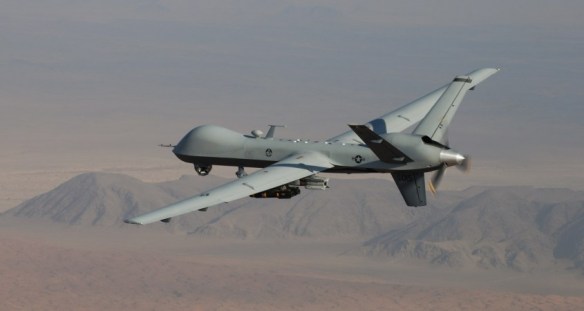
The drone that was destroyed by an Iranian surface-to-air missile was an RQ-4B Global Hawk, used by the US Navy as a “Broad Area Maritime Surveillance Unmanned Aircraft System.” These aircraft, which have the wingspan of a 737 passenger jet, are stuffed with electronic surveillance equipment and cost the Pentagon upwards of $200 million apiece.

The drone is capable of flying at altitudes of up to 65,000 feet and has been used in the US military interventions in Iraq and Syria with no concern about it being vulnerable to attacks from the ground. The buildup to war against Iran, however, as the downing of the drone makes clear, is another matter.

Iran has reported that it brought down the drone with the Iranian-manufactured Sevom Khordad missile defense system. The country has also, however, received missile capabilities from Russia including the S400 surface-to-air missile system, which it has just begun to deploy.

The shooting down of the high-priced US drone has come as a shock to the Pentagon and another warning that the costs of an all-out US war against Iran will be far higher than US imperialism’s previous military interventions in the Middle East.

It marks the second time this month that a US drone has been shot down in the region. On June 6, a US MQ-9 Reaper drone was shot down by Houthi rebels over Yemen as it was supporting the near-genocidal war being waged against that country by Saudi Arabia and its allies, which has killed over 80,000 civilians and driven millions to the brink of starvation.

Iran itself has claimed to have downed or taken possession of five other US drones before the latest shootdown. In December 2011, it captured a US Lockheed Martin RQ-170 stealth drone operated from a base in Afghanistan and flying over Iranian territory. It was able to reverse-engineer the drone to produce its own version of the aircraft.

Once the US Central Command (CENTCOM) responded to Thursday’s downing of the drone over Iran, it claimed that the missile strike was an “unprovoked attack” and that the aircraft had been flying over international waters.

As in the case of the claims of Iranian responsibility for the damage to tankers in the Gulf of Oman, no evidence has been provided to substantiate the latest US charges over the downing of the drone.

Both the Pentagon and the Iranian government have provided maps supporting their respective claims that the drone was flying over international versus Iranian territory.

The truth of the matter is that there is no agreement between Washington and Tehran over what constitutes Iranian territory. It was the US-backed dictatorship of the Shah that laid Iran’s claim to territorial waters extending 12 nautical miles from its shores, including into the Strait of Hormuz, which at its narrowest is only 21 nautical miles.

Whatever the flight path of the US spy drone, the claim that its downing by an Iranian missile was “unprovoked” is ludicrous on its face.

The unmanned aircraft was being used to spy on Iran under conditions in which Washington has steadily escalated military threats against the country, with the dispatch of a carrier battle group, a bomber strike force led by nuclear-capable B-52s and an amphibious landing group carrying US Marines. This has been followed by the dispatch to the region of first 1,500 and then another 1,000 US troops, all in the name of “deterring” unsubstantiated claims of Iranian threats to “US interests” in the region.

This military buildup has been carried out in the context of a US economic siege against Iran that is tantamount to a state of war. The Trump administration, having unilaterally ripped up the 2015 Iranian nuclear agreement with the major powers, has carried out what it touts as a “maximum pressure” campaign. This act of economic strangulation is aimed at reducing Iranian energy exports to zero and starving the Iranian population into submission to the re-imposition of a US-backed puppet regime along the lines of the hated dictatorship of the Shah.

The strategic aim of this economic and military siege against Iran–pursued by Republican and Democratic administrations alike over the past 40 years–is to assert US hegemony over the oil-rich Middle East and thereby place Washington in a position to ration, or cut off, energy imports by the principal US global rival, China.

While there are indications of deep divisions within the US state apparatus over the drive toward war against Iran, the US provocations in the Persian Gulf are driving inexorably toward an armed conflict that could quickly claim the lives of tens of thousands.

At the same time, the tensions over the US siege against Iran with both Europe and China are an unmistakable warning that the eruption of a military confrontation could spill over into a new world war.