
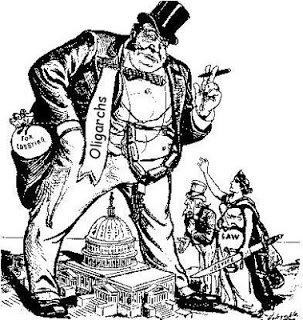
Five Studies: The Psychology of the Ultra-Rich, According to the Research

OLIGARCHY

Bernie Sanders says that billionaires have “psychiatric issues.” He’s not entirely incorrect.

By Livia Gershon

Source: Pacific Standard

“Let me tell you about the very rich. They are different from you and me. They possess and enjoy early, and it does something to them, makes them soft where we are hard, and cynical where we are trustful, in a way that, unless you were born rich, it is very difficult to understand. They think, deep in their hearts, that they are better than we are because we had to discover the compensations and refuges of life for ourselves. Even when they enter deep into our world or sink below us, they still think that they are better than we are. They are different.”
—F. Scott Fitzgerald

Bernie Sanders’ unexpectedly popular presidential campaign features a lot of rhetoric that we don’t usually hear in mainstream politics. One striking example is the Vermont senator’s contention that the ultra-rich suffer from “psychiatric issues” that manifest in an addiction to money and a worldview divorced from reality.

When we talk about inequality, we often spend lot of time considering poor people’s attitudes and behaviors, from whether they get married to how they talk to their kids. We’re less likely to stop and look at how the rich are different. But extremely wealthy people play a huge role in increasing inequality. With their heavy political clout, they help shape government economic policies, supporting very different positions from those of average Americans. From their perches on corporate boards and compensation committees they also give direct raises to their fellow oligarchs.

As inequality grows, in the United States and in the world, the shape of the wealthiest classes is also changing. The significance of inherited wealth fell rapidly in the mid-20th century, making way for the “self-made” rich. Now, though, there’s growing evidence that, as Thomas Piketty has famously argued, dynasties are making a comeback.

So there’s good reason to pay at least as much attention to the behaviors and beliefs of the rich as we do to those of the poor. But what does research tell us about the nature of wealth? How does it affect those who have it? Studies suggest the wealthy really do have significant psychological differences from the middle class in how they view money, and how they look at their relationship with society.

1. MONEY BUYS HAPPINESS—KIND OF

Richer people tend to be happier, but not by all that much. And it’s not really right to say money makes them happy. Wealth only makes affluent people more satisfied to the extent that it gives them more control over their own lives, making them feel richer. (Anyone who feels financially and personally stable because they’ve got a steady job, enough money to get them through an emergency, and a nicer house than their neighbor is likely to be happier than the poorest multi-millionaire in a hyper-rich enclave they can’t really afford.) Still, holding everything else equal, people who have more money have more stability. Of course, they also usually know they’re well off. And those two factors make them happier.

—”How Money Buys Happiness: Genetic and Environmental Processes Linking Finances and Life Satisfaction,” Wendy Johnson and Robert F. Krueger, Journal of Personality and Social Psychology, Vol 90(4), Apr 2006

 2. BUT RICH PEOPLE HAVE DIFFERENT CRITERIA FOR HAPPINESS

Asked about what makes people happy, extremely rich Americans, just like average Americans, typically put love first. But the ultra-wealthy are more likely than everyone else to say happiness depends on winning the appreciation and respect of others. They’re also more likely to cite the realization of personal potential as a key to happiness. But they’re much less likely than non-wealthy people to say that physical health is most important. (Perhaps because they’ve never been uninsured?) Rich people are also a bit more likely than the rest of us to say having a lot of money can occasionally present an obstacle to happiness.

—”Happiness of the Very Wealthy,” Ed Diener, Jeff Horwitz, and Robert A. Emmons, Social Indicators Research, April 1985

3. THE WEALTHY ARE MORE AND MORE LIKELY TO IDENTIFY WITH AN INTERNATIONAL ECONOMIC ELITE

Board members of the world’s largest corporations—a significant and influential segment of the ultra-rich—are increasingly likely to serve on the boards of foreign and multinational companies. Even directors who don’t serve on the boards of foreign companies usually interact with others who do. In other words, modern corporate elites are likely to be part of cosmopolitan, global social networks, whereas most poor and middle-class people are more likely to identify with their home populations.

—”Transnationalists and National Networkers in the Global Corporate Elite,” William K. Carroll, Global Networks, June 2009

4. AS A RESULT, THEY’RE NOT GREAT AT EMPATHY

People from higher socioeconomic classes do worse on a test where they’re asked to identify emotions in photographs of human faces. They’re also less accurate at perceiving the emotional states of others in real-life interactions. In fact, researchers can reduce people’s empathy just by prompting them to think of themselves as relatively high-status. Test subjects who are asked to imagine an interaction with someone from a lower social rung get worse at understanding other people’s emotions. The trouble higher-status people have recognizing emotions is tied to the fact that they tend to think about themselves and others in terms of fixed traits (“She’s a nervous person.”) In contrast, people from lower social classes are more likely to use contextual explanations for people’s behavior (“This interview is making her uncomfortable.”)

—”Social Class, Contextualism, and Empathic Accuracy,” Michael W. Kraus, Stéphane Côté, and Dacher Keltner, Psychological Science, October 25, 2010

5. AND THEY THINK DOMESTIC INEQUALITY REPRESENTS JUST DESSERTS

Americans are known for our trust in an ideal of meritocracy. When you ask the general public to assess statements like “most people who want to get ahead can make it if they’re willing to work hard,” well over 70 percent of us agree. But what happens when people see high levels of income inequality in their daily lives? It turns out that low-income Americans are less likely to believe in meritocracy if they live in counties with extreme economic inequality—places where they’re likely to run into much richer people a lot. For high-income people, the effect is exactly the opposite. The study’s authors suggest that rich people could be using a defense mechanism to stave off guilt and justify their relatively privileged position within a visibly unequal system. But, for whatever reason, the more inequality rich people see in their home county, they more likely they are to believe that meritocracy is working.

—”False Consciousness or Class Awareness? Local Income Inequality, Personal Economic Position, and Belief in American Meritocracy,” Benjamin J. Newman, Christopher D. Johnston, and Patrick L. Lown, American Journal of Political Science, April 2015


 

Sumerian Economics

sumerian-king-list

By Peter Lamborn Wilson

Source: Reality Sandwich

Public secret: everyone knows but no one speaks. Another kind of public secret: the fact is published but no one pays attention.

A cuneiform tablet called The Sumerian King List states that “kingship first descended from heaven in the city of Eridu,” in the south of Sumer. Mesopotamians believed Eridu the oldest city in the world, and modern archaeology confirms the myth. Eridu was founded about 5000 BC and disappeared under the sand around the time of Christ.

Eridu’s god Ea or Enki (a kind of Neptune and Hermes combined) had a ziggurat where fish were sacrificed. He owned the ME, the fifty-one principles of Civilization. The first king, named “Staghorn,” probably ruled as Enki’s high priest. After some centuries came the Flood, and kingship had to descend from heaven again, this time in Uruk and Ur. Gilgamesh now appears on the list. The flood actually occurred; Sir Leonard Wooley saw the thick layer of silt at Ur between two inhabited strata.

Bishop Ushher once calculated according to the Bible that the world was created on October 19th 4004 BC at 9 o’clock in the morning. This makes no Darwinian sense, but provides a good date for the founding of the Sumerian state, which certainly created a new world. Abraham came from Ur of the Chaldees; Genesis owes much to the Enuma Elish (Mesopotamian Creation Myth). Our only text is late Babylonian but obviously based in a lost Sumerian original. Marduk the wargod of Babylon has apparently been pasted over a series of earlier figures beginning with Enki.

Before the creation of the world as we know it a family of deities held sway. Chief among them at the time, Tiamat (a typical avatar of the universal Neolithic earth goddess) described by the text as a dragon or serpent, rules a brood of monsters and dallies with her “Consort” (high priest) Kingu, an effeminate Tammuz/Adonis prototype. The youngest gods are dissatisfied with her reign; they are “noisy,” and Tiamat (the text claims) wants to destroy them because their noise disturbs her slothful slumber. In truth the young gods are simply fed up with doing all the shitwork themselves because there are no “humans” yet. The gods want Progress. They elect Marduk their king and declare war on Tiamat.

A gruesome battle ensues. Marduk triumphs. He kills Tiamut and slices her body lengthwise in two. He separates the halves with a mighty ripping heave. One half becomes sky above, the other earth below.

Then he kills Kingu and chops his body up into gobs and gobbets. The gods mix the bloody mess with mud and mold little figurines. Thus humans are created as robots for the gods. The poem ends with a triumphalist paean to Marduk, the new king of heaven.

Clearly the Neolithic is over. City-god, war-god, metal-god, vs. country-goddess, lazy goddess, garden goddess. The creation of the world equals the creation of civilization, separation, hierarchy, masters and slaves, above and below. Ziggurat and pyramid symbolizes the new shape of life.

Combining Enuma elish and the King List we get an explosive secret document about the origin of civilization not as gradual evolution towards inevitable future, but as violent coup, conspiratorial overthrow of primordial rough-egalitarian Stone Age society by a crew of black magic cult cannibals. (Human sacrifice first appears in the archaeological record at Ur III. Similar grisly phenomena in the first few Egyptian dynasties.)

About 3100 writing was invented at Uruk. Apparently you can witness the moment in the strata: one layer no writing, next layer writing. Of course writing has a prehistory (like the State). From ancient times a system of accounting had grown up based on little clay counters in the shapes of commodities (hides, jars of oil, bars of metal, etc.) Also glyptic seals had been invented with images used heraldically to designate the seals’ owners. Counters and seals were pressed into slabs of wet clay and the records were held in Temple archives-probably records of debts owed to the Temple. (In the Neolithic Age the temples no doubt served as redistribution centers. In the Bronze Age they began to function as banks.)

As I picture the invention of real writing took place within a singly brilliant family of temple archivists over three or four generations, say a century. The counters were discarded and a reed stylus was used to impress signs in clay, based on the shapes of the old counters, and with further pictograms imitated from the seals. Numbering was easily compacted from rows of counters to number-signs. The real break-through came with the flash that certain pictographs could be used for their sound divorced from their meaning and recombined to “spell” other words (especially abstractions). Integrating the two systems proved cumbersome, but maybe the sly scribes considered this an advantage. Writing needed to be difficult because it was a mystery revealed by gods and a monopoly of the New Class of scribes. Aristocrats rarely learned to read and write — a matter for mere bureaucrats. But writing provided the key to state expansion by separating sound from meaning, speaker from hearer, and sight from other senses. Writing as separation both mirrors and reinforces separation as “written,” as fate. Action-at-a-distance (including distance of time) constitutes the magic of the state, the nervous system of control. Writing both is and represents the new “Creation” ideology. It wipes out the oral tradition of the Stone Age and erases the collective memory of a time before hierarchy. In the text we have always been slaves.

By combining image and word in single memes or hieroglyphs the scribes of Uruk (and a few years later the pre-dynastic scribes of Egypt) created a magical system. According to a late syncretistic Greco-Egyptian myth, when Hermes-Toth invents writing he boasts to his father Zeus that humans never need forget anything ever again. Zeus replies, “On the contrary my son, now they’ll forget everything.” Zeus discerned the occult purpose of the text, the forgetfulness of the oral/aural, the false memory of the text, indeed the lost text. He sensed a void where others saw only a plenum of information. But this void is the telos of writing.

Writing begins as a method of controlling debt owed to the Temple, debt as yet another form of absence. When full-blown economic texts appear a few strata later we find ourselves already immersed in a complex economic world based on debt, interest, compound interest, debt peonage as well as outright slavery, rents, leases, private and public forms of property, long distance trade, craft monopolies, police, and even a “money-lenders bazaar.” Not money as we understand it yet, but commodity currencies (usually barley and silver), often loaned for as much as 33 1/3rd % per year. The Jubilee or periodic forgiveness of debts (as known in the Bible) already existed in Sumer, which would have otherwise collapsed under the load of debt.

Sooner or later the bank (i.e. the temple) would solve this problem by obtaining the monopoly on money. By lending at interest ten or more times its actual assets, the modern bank simultaneously creates debt and the money to pay debt. Fiat, “let it be.” But even in Sumer the indebtedness of the king (the state) to the temple (the bank) had already begun.

The problem with commodity currencies is that no one can have a monopoly on cows or wheat. Their materiality limits them. A cow might calve, and barley might grow, but not at rates demanded by usury. Silver doesn’t grow at all.

So, the next brilliant move, by King Croesus of Lydia (Asia Minor, 7th century BC) was the invention of the coin, a refinement of money just as the Greek alphabet (also 7th cen.) was a refinement of writing. Originally a temple token or souvenir signifying one’s “due portion” of the communal sacrifice, a lump of metal impressed with a royal or temple seal (often a sacrificial animal such as the bull), the coin begins its career with mana, something super-natural, something more (or less) than the weight of the metal. Stage two, coins showing two faces, one with image, the other with writing. You can never see both at once, suggesting the metaphysical slipperiness of the object, but together they constitute a hieroglyph, a word/image expressed in metal as a single meme of value.

Coins might “really” be worth only their weight in metal but the temple says they’re worth more and the king is ready to enforce the decree. The object and its value are separated; the value floats free, the object circulates. Money works the way it works because of an absence not a presence. In fact money largely consists of absent wealth-debt — your debt to king and temple. Moreover, free of its anchor in the messy materiality of commodity currencies, money can now compound unto eternity, far beyond mere cows and jars of beer, beyond all worldly things, even unto heaven. “Money begets money,” Ben Franklin gloated. But money is dead. Coins are inanimate objects. Then money must be the sexuality of the dead.

The whole of Greco-Egypto-Sumerian economics compacts itself neatly into the hieroglyphic text of the Yankee dollar bill, the most popular publication in the history of History. The owl of Athena, one of the earliest coin images, perches microscopically on the face of the bill in the upper left corner of the upper right shield (you’ll need a magnifying glass), and the Pyramid of Cheops is topped with the all-seeing eye of Horus or the panopticonical eye of ideology. The Washington family coat of arms (stars and stripes) combined with imperial eagle and fasces of arrows, etc.; a portrait of Washington as Masonic Grand Master; and even an admission that the bill is nothing but tender for debt, public or private. Since 1971 the bill is not even “backed” by gold, and thus has become pure textuality.

Hieroglyph as magic focus of desire deflects psyche from object to representation. It “enchains” imagination and defines consciousness. In this sense money constitutes the great triumph of writing, its proof of magic power. Image wields power over desire but no control. Control is added when the image is semanticized (or “alienated”) by logos. The emblem (picture plus caption) gives desire or emotion an ideological frame and thus directs its force. Hieroglyph equals picture plus word, or picture as word (“rebus”), hence hieroglyph’s power and control over both conscious and unconscious — or in other words, its magic.

Money Woes and the Trials of Job

6

By Mark Anthony Rockeymoore

Source: Sacred Space in Time

Being broke seems to be endemic. Money woes, bills pilling up, creditors calling for blood and first born children. Money flowing in is gone before it is received and there seems to be no end in sight.

How can we focus on higher spiritual ideals when the daily grind calls for all our attention?

We can’t, as long as the two are separated.

By two, I mean, material concerns and spiritual concerns. Simply put, Divinity is not separate from the world. How we deal with our worldly concerns is directly related to how we deal with our spiritual concerns. If we diligently apply ourselves to becoming more accountable and responsible in our daily lives, carefully attending to the details of a normative life, then this concentration will similarly affect our pursuit of the higher goals. And vice versa, if balance is sought.

Money is energy. It greases the wheels of the mechanism of life, providing impetus to support our lifestyles. Money flows where energy goes. And our work, produces that energy. Labors of love produce value that result in success in life. If you do not care for what you do then your efforts are in vain and doomed to failure.

How hard are you working toward your goals? Or are you a debt slave, working toward someone else’s goals? Do you love what you do? If so, could you – in any conceivable way – get paid for it?

Whatever you are thinking about right this moment – that art, that writing, that building, that repairing, that knitting, that video game, that party you put together, the food you make – whatever it may be, if your passion is there then your joy is there as well. If you can get paid by doing what you love to do, then your success is guaranteed.

Money woes – being broke – are a transitory state, as money comes and goes. The idea of wealth itself is subjective and not necessarily even related to money. Health, family, friends are a form of wealth that are worth more than gold. Ask Job, of bible fame, who lost all – money, family, friends – but never disbelieved in the oneness of spirituality, thereafter receiving what he had lost and more as a result of his faith. For Job, there was no separation between his life and his relationship to his god. He saw all he experienced as expressive of his own failures, although the test of his faith through physical illness also challenged his understanding of the Greater Plan for his life. His humility in the face of total ruin is an exemplar of true faith, which is certain knowledge of the efficacy and necessity of each and every lesson we go through that we perceive as negative in nature. The appearance of God in the storm was all that was necessary for his faith to be restored, despite his continuing ignorance in the face of the Adversary’s enmity. It is funny, how, in life, so many things that appear bad, turn out good at some point.

As life shifts, perspectives shift. Life shifts as the mind and spirit undergo transformation. What occurs within, affects that which occurs without.

The trials of Job occurred because he was the best, not the worst. A faithful servant to his god. His faith and devotion were cast upon the flames of tribulation, resulting in the loss of his wealth, his health and his family. And yet, throughout his torment, Job’s confusion, misery and even anger reveal his pain and desperation and also his utter reliance upon his god as the ultimate salvation from his problems. Throughout his trials, his knowledge of the interwoven strands of body and soul remained intact. For him, there was no separation and, in the end, this knowing was his saving grace.

Hard times can be instructional if the lesson is internalized. As we undergo one or more of the trials of Job, realizing that, in the end, even though the workings of creation can be inscrutable and beyond our ability to understand, there is a reason for every iota of pain, suffering and heartache we experience. That the experience, no matter its intensity, is designed to lift us up, to make us stronger, and to bring us closer to the God that holds us in his arms, that loves, that is Love itself.

Building upon strong foundations can only lead to a solid structure. Living, then, within this structure – this house of many mansions – can be the realization of one’s highest dreams and aspirations, if the dream, the joy and the energy coincide.