
US ‘success’ is Ukraine’s disaster

In adopting “Success is confrontation” as a credo toward Russia, NATO states have invited catastrophe and undermined Ukrainian voices for peace.

( Jeff J. Mitchell/Getty Images)

By Aaron Maté

Source: Aaron Maté Substack

In recent weeks, the New York Times reports, “Moscow has opened what amounts to a separate war: missile and drone strikes aimed at destroying Ukraine’s infrastructure, degrading the quality of life for millions of civilians in an effort to demoralize them.” Russia’s attacks, the Washington Post adds, have “battered Ukraine to the brink of a humanitarian disaster,” cutting off electricity, heat and running water. Ukrainian officials estimate that Russia has damaged or destroyed half of Ukraine’s energy infrastructure. “This winter will be life-threatening for millions of Ukrainians,” a senior World Health Organization official warns.

Russia claims that it only targets infrastructure that serves a military purpose. No matter what legal rationale Moscow can construe, the attacks are a clear act of collective punishment against Ukrainian civilians.

Without ignoring Russia’s criminal liability, another reality can be acknowledged: The fact that Russia “opened” a “separate war” on civilian infrastructure eight months into the invasion, and not beforehand, also results from decisions taken by Ukraine’s far-right and their allies in Washington.

The intensified Russian strikes were predicted by NATO states, whose leaders chose to prolong the proxy war by shunning diplomacy and — most likely — blowing up possible off-ramps, namely the now-forgotten Nord Stream 2 pipeline. The New York Times reported in September that Western officials were “baffled” that Russia, at that point, had “avoided escalating the war” and “made only limited attempts to destroy critical infrastructure”, leading them to fear that “the most dangerous moments are yet to come.” Rather than seeking a diplomatic solution, the US-led NATO alliance chose to help push Ukraine into the predicted danger. After all, the US “strategy for the war,” the Washington Post noted that same month, has entailed “fueling a war with global consequences, while attempting to remain agnostic about when and how Kyiv might strike a deal to end it.”

One does not need to justify Russia’s actions to acknowledge that the Kremlin, by contrast, has adopted positions that offered the chance of a preferable – or at minimum, pursuable – negotiated settlement.

The Minsk II Accords, the framework for ending the post-2014 Donbas war between Kiev and Russia-backed Ukrainian rebels, were officially supported by both Ukraine and the U.S., yet both refused to implement them. Ukraine’s far-right nationalists intimidated President Volodymyr Zelensky into abandoning his peace mandate with direct threats of a coup and even murder. The Biden administration, by refusing to even discuss NATO expansion prior to the invasion; sitting idle as Zelensky refused to negotiate with the Donbas rebels; and apparently sabotaging a Ukraine-Russia peace deal in April, has effectively taken the nationalists’ side.

Even Ukrainian officials and establishment US media outlets concede that Russia’s current war aim is to compel diplomacy.  The strikes on Ukrainian infrastructure, the New York Times notes, “are meant to force Kyiv to the negotiating table.”

“It is clear they want to impose certain conditions, they want to make us negotiate,” Ukrainian Air Force spokesman Col. Yuriy Ihnat said. But Ukrainian officials, the Times adds, “are in no mood to negotiate.”

Kremlin spokesperson Dmitry Peskov has issued the same message, describing the strikes as “the consequences” of Ukraine’s unwillingness to “enter into negotiation.”

Ukrainians have every right to reject negotiations with their invader. Yet there can also be no denying that a significant percentage of the population – including people around Zelensky — has, for years, favored positions that could have avoided the war, and end it today.
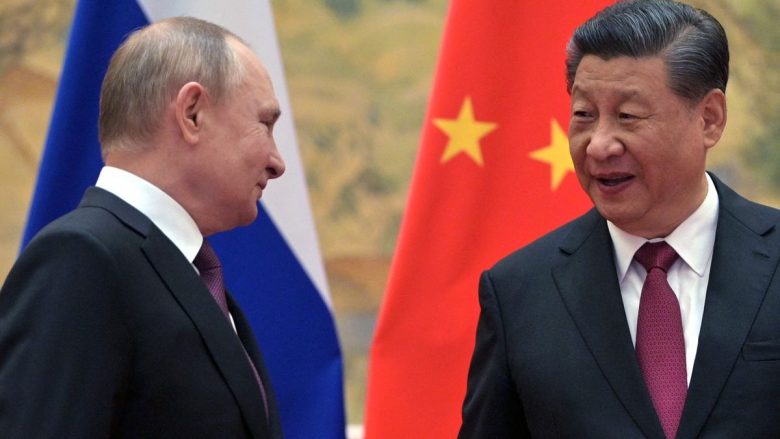
THE WEST’S FALSE NARRATIVE ABOUT RUSSIA AND CHINA

Vladimir Putin meets with Xi Jinping in Beijing just weeks before the invasion of Ukraine. Photograph: SPUTNIK/Reuters

By Jeffrey Sachs

Source: New Cold War

The world is on the edge of nuclear catastrophe in no small part because of the failure of Western political leaders to be forthright about the causes of the escalating global conflicts. The relentless Western narrative that the West is noble while Russia and China are evil is simple-minded and extraordinarily dangerous. It is an attempt to manipulate public opinion, not to deal with very real and pressing diplomacy.
___________________________

The essential narrative of the West is built into US national security strategy. The core US idea is that China and Russia are implacable foes that are “attempting to erode American security and prosperity.” These countries are, according to the US, “determined to make economies less free and less fair, to grow their. militaries, and to control information and data to repress their societies and expand their influence.”

The irony is that since 1980 the US has been in at least 15 overseas wars of choice (Afghanistan, Iraq, Libya, Panama, Serbia, Syria, and Yemen just to name a few), while China has been in none, and Russia only in one (Syria) beyond the former Soviet Union. The US has military bases in 85 countries, China in 3, and Russia in 1 (Syria) beyond the former Soviet Union.

President Joe Biden has promoted this narrative, declaring that the greatest challenge of our time is the competition with the autocracies, which “seek to advance their own power, export and expand their influence around the world, and justify their repressive policies and practices as a more efficient way to address today’s challenges.” US security strategy is not the work of any single US president but of the US security establishment, which is largely autonomous, and operates behind a wall of secrecy.

The overwrought fear of China and Russia is sold to a Western public through manipulation of the facts. A generation earlier George W. Bush, Jr. sold the public on the idea that America’s greatest threat was Islamic fundamentalism, without mentioning that it was the CIA, with Saudi Arabia and other countries, that had created, funded, and deployed the jihadists in Afghanistan, Syria, and elsewhere to fight America’s wars.

Or consider the Soviet Union’s invasion of Afghanistan in 1980, which was painted in the Western media as an act of unprovoked perfidy. Years later, we learned that the Soviet invasion was actually preceded by a CIA operation designed to provoke the Soviet invasion! The same misinformation occurred vis-à-vis Syria. The Western press is filled with recriminations against Putin’s military assistance to Syria’s Bashar al-Assad beginning in 2015, without mentioning that the US supported the overthrow of al-Assad beginning in 2011, with the CIA funding a major operation (Timber Sycamore) to overthrow Assad years before Russia arrived.

Or more recently, when US House Speaker Nancy Pelosi recklessly flew to Taiwan despite China’s warnings, no G7 foreign minister criticised Pelosi’s provocation, yet the G7 ministers together harshly criticised China’s “overreaction” to Pelosi’s trip.

The Western narrative about the Ukraine war is that it is an unprovoked attack by Putin in the quest to recreate the Russian empire. Yet the real history starts with the Western promise to Soviet President Mikhail Gorbachev that NATO would not enlarge to the East, followed by four waves of NATO aggrandisement: in 1999, incorporating three Central European countries; in 2004, incorporating 7 more, including in the Black Sea and Baltic States; in 2008, committing to enlarge to Ukraine and Georgia; and in 2022, inviting four Asia-Pacific leaders to NATO to take aim at China.

Nor do the Western media mention the US role in the 2014 overthrow of Ukraine’s pro-Russian president Viktor Yanukovych; the failure of the Governments of France and Germany, guarantors of the Minsk II agreement, to press Ukraine to carry out its commitments; the vast US armaments sent to Ukraine during the Trump and Biden Administrations in the lead-up to war; nor the refusal of the US to negotiate with Putin over NATO enlargement to Ukraine.

Of course, NATO says that is purely defensive, so that Putin should have nothing to fear. In other words, Putin should take no notice of the CIA operations in Afghanistan and Syria; the NATO bombing of Serbia in 1999; the NATO overthrow of Moammar Qaddafi in 2011; the NATO occupation of Afghanistan for 15 years; nor Biden’s “gaffe” calling for Putin’s ouster (which of course was no gaffe at all); nor US Defence Secretary Lloyd Austin stating that the US war aim in Ukraine is the weakening of Russia.

At the core of all of this is the US attempt to remain the world’s hegemonic power, by augmenting military alliances around the world to contain or defeat China and Russia. It’s a dangerous, delusional, and outmoded idea. The US has a mere 4.2% of the world population, and now a mere 16% of world GDP (measured at international prices). In fact, the combined GDP of the G7 is now less than that of the BRICS (Brazil, Russia, India, China, and South Africa), while the G7 population is just 6 percent of the world compared with 41 percent in the BRICS.
There is only one country whose self-declared fantasy is to be the world’s dominant power: the US. It’s past time that the US recognised the true sources of security: internal social cohesion and responsible cooperation with the rest of the world, rather than the illusion of hegemony. With such a revised foreign policy, the US and its allies would avoid war with China and Russia, and enable the world to face its myriad environment, energy, food and social crises.

Above all, at this time of extreme danger, European leaders should pursue the true source of European security: not US hegemony, but European security arrangements that respect the legitimate security interests of all European nations, certainly including Ukraine, but also including Russia, which continues to resist NATO enlargements into the Black Sea. Europe should reflect on the fact that the non-enlargement of NATO and the implementation of the Minsk II agreements would have averted this awful war in Ukraine. At this stage, diplomacy, not military escalation, is the true path to European and global security.