
Militarization of the Police: A Reflection of United States Foreign Policy

By Abayomi Azikiwe

Source: Global Research

Over the last 14 months the notion of the United States as a bastion of human rights and democracy has been further shattered.

With the police killing of 18-year-old Michael Brown in Ferguson, Missouri, it set off not only a rebellion in this St. Louis County suburb but nationwide demonstrations across the country. The rebellion in Ferguson forced the Obama administration to pay some symbolic attention to the plight of African American people who have been largely ignored as it relates to domestic policy over the last several decades.

In fact when it comes to Civil Rights and Human Rights, there has only been regressive legislation and “benign neglect” since the late 1960s. Realizing the complexity of the crisis facing the African American people, other people of color communities and working people in general, the system would rather ignore the problems rather pay any attention to them.

Nonetheless, Ferguson proved to be a turning point in U.S. history. Periodicals published in states that are aligned with Washington issued editorial questioning the domestic and foreign policy posture of the administration of President Barack Obama.

Even though the Justice Department was sent into to St. Louis County to investigate the circumstances surrounding the killing of Michael Brown, no federal charges were ever filed against Darren Wilson or anyone else within the law-enforcement, judicial and municipal systems in the area. The lack of critical response by the Obama administration compounded the discontent after the local authorities decided that there was no probable cause for charges to be brought against Wilson and others in Ferguson.

The report issued by the Justice Department Civil Rights Division did demonstrate clearly that collusion was rampant within these various departments in St. Louis County. Electronic communications were retrieved which illustrated that the African American community was being grossly exploited through traffic stops, citations, questionable arrests and prosecutions.

Many of the suburban municipalities within St. Louis County are economically unviable and consequently utilized racial profiling and targeting as a means of generating revenue. The New York Times reported several weeks after the rebellion and mass demonstrations began in Ferguson that over 12,000 outstanding warrants existed in the small city of barely over 20,000 residents. This came out to approximately two warrants per household in Ferguson.

Residents with outstanding warrants were subjected to immediate arrests and even higher fines or possible jail terms. Such legal problems hampered people’s abilities to find and retain employment as well as maintain a stable family life.

What appears to have happened in regard to the situation in Ferguson and St. Louis County is there was an apparent agreement that Wilson and other officials would resign their positions in exchange for not being pursued further by the federal government. It was also announced that some form of amnesty would be granted for residents facing high fines and jail time after being systematically targeted by the police throughout the County.

Such a compromise does not approach the resolution of the deeper problems of national oppression and racism so prevalent within law-enforcement culture. High rates of unemployment and poverty are by-products of national oppression and class exploitation which the American system is built upon.

Militarization Unveiled in Ferguson

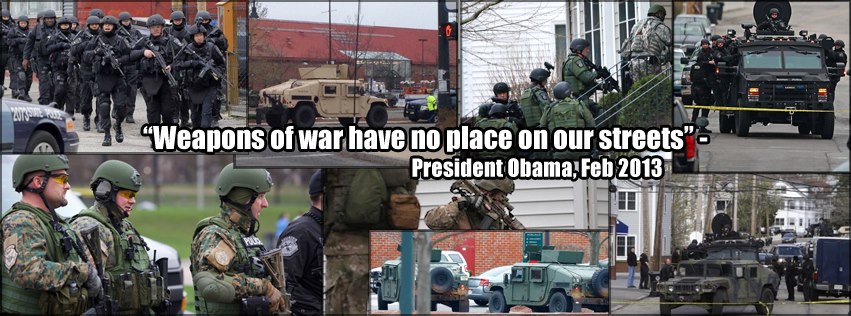
Rather than examine the causes behind the explosion in Ferguson, the response of the political superstructure and the law-enforcement agencies was to put down the rebellion with a vengeance. Police came on the scene with armored vehicles, batons, rubber bullets, tear gas, pepper spray, long range acoustic devices (LRAD) and other forms of highly-sophisticated and deadly weaponry.

Numerous law-enforcement departments were deployed in Ferguson along with the National Guard. Missouri Governor Jay Nixon declared a “state of emergency” while law-enforcement implemented a “no-fly zone” over the region.

The youth and workers who took to the streets both violently and non-violently were immediately criminalized. Journalists seeking to cover the story were attacked and arrested.

Corporate media pundits took to the airwaves over cable television networks to put their own spin on developments surrounding the mass demonstrations and rebellions. Those who fought back against the police and destroyed private property were labeled as criminals and thugs. These characterizations provided a rationale for the use of deadly force and the denial of basic democratic rights of due process.

Governor Nixon and local authorities blamed the unrest on “outside agitators” seeking to deflect attention away from the exploitative and repressive conditions so widespread in St. Louis County. President Obama and former U.S. Attorney General Eric Holder sought to define the forms of dissent that were acceptable those that were not.

Moreover, the question becomes: where did these weapons, tanks, noxious gases and sound devices come from? These are the same weapons that have been used against the people of Afghanistan, Iraq, Libya, Syria, Palestine, Lebanon, Yemen and other geo-political regions over the last several decades.

The federal government through the Pentagon supplies these armaments through grants to local law-enforcement agencies. Are these the best tools to fight street crime? Or are these weapons supplied to fight existing unrest and more violent rebellions and revolts that are bound to come in the future?

We Can’t Breathe: Eric Garner and the Impunity of the State

In Staten Island New York the police killing of Eric Garner provided additional lessons in our understanding of the current character of state repression. Garner’s encounter with the police was caught on a cellphone video and transmitted worldwide. His last words gasping “I Can’t Breathe” became a rallying cry for those who went into the streets by the tens of thousands in New York and across the country.

Apparently recording of this crime did not matter to the grand jury that acquitted the only police officer investigated in the killing. The billions around the world who saw the video knew that there were many officers who were involved in Garner’s death by holding him down, applying pressure to his vital areas and refusing to provide any medical attention while he lay dying.

The youth who videoed the killing was himself targeted for prosecution and jailed. Once again the Justice Department did not take any action against the cops or the grand jury which allowed the police and emergency medical technicians to walk free.

In response to the grand jury decision, tens of thousands of people went out in protest in Manhattan and other areas of New York City. They blocked streets, expressways, businesses and bridges. The city had not seen such an outpouring of spontaneous demonstrations in many years.

New York City has been notorious for its “stop and frisk” and “broken windows” theory of policing. This style of law-enforcement conduct rides the waves of gentrification and forced removals of African Americans, Latinos and working class people in general throughout the municipality.

Obviously there is a concerted effort to drive millions of oppressed, working class and poor people out of the cities throughout the U.S. In New York, despite claims by officials that crime has been reduced by 80 percent, the plight of marginalized working class has worsened.

The homeless problem in New York is worse than it has ever been in the city’s history. A recent front-page article in the Sunday New York Times published on August 29 exposed the plight of those living in homeless shelters.

Those are the ones who are inside although living with bed bugs and other vermin in over-crowded buildings. Others are unfortunately sleeping on the streets in subways, storefronts, in Times Square and other areas.

Nonetheless, the liberal administration of De Blassio has no program for providing decent housing to those who need it. Wall Street with all of its propaganda about an economic recovery ignores the conditions of the most vulnerable and miserable.

Baltimore: A Flashpoint for Repression and Impoverishment

Just earlier this year in late April young Freddie Grey was killed by the Baltimore Police Department. This was by no means an isolated incident since the city has a long tradition of systematic racism in housing and police-community relations.

However, after the killing of Grey who died in police custody, the community rose up in rebellion. Immediately the Governor declared yet another “state of emergency” moving into Baltimore personally and effectively taking control of the city from its African American woman Mayor Stephanie Rawlings-Blake.

What was interesting about the rebellion in Baltimore was the more developed counter-insurgency strategy and tactics implemented. Thousands of police officers from various agencies were deployed from across the state as was the case in Ferguson, along with thousands more National Guard troops.

Nonetheless, the authorities utilized a cadre of so-called “community groups” including churches, gang members, elected officials, and other operatives to come into the unrest areas encouraging youth and workers to leave the streets and go home. They were told by these “community activists” to abide by an unjust curfew and to work with the cops and the National Guard.

Tactically they were also covered by the corporate and government-controlled media to present another face of the community to the public. After the first three days of demonstrations and unrest, the media portrayed the community as being hostile to law-enforcement and private property. Suddenly by the time the National Guard and Governor had entered the city, the people who were presented to the press were residents opposed to the unrest and working towards “restoring order”, or we should say restoring the existing order.

Hundreds of these “community activists” stood between the crowds and the police with their backs to the law-enforcement agents and their faces towards the people. This was quite a symbolic effort to turn a section of the city against those who were fed up with the repression and exploitation.

Baltimore, like Detroit, has been hit over the last decade by massive home foreclosures and neighborhood blight. Hundreds of thousands have been forced out of their neighborhoods in East and West Baltimore to make room for the “developers and investors.” The banks were at the root cause of this displacement.

Also in Baltimore, it was announced during the spring that 25,000 households would be subjected to water shut-offs as what has been happening here since the imposition of emergency management and bankruptcy in 2013-2014. Although the emergency managers are being ostensibly withdrawn in Michigan, those who are the purported “elected officials” are carrying out the same draconian program of forced removals and benign neglect of the masses.

The lessons of Baltimore, Ferguson, New York and here in Detroit is that the workers and oppressed must be organized independently of the established two-party system. There must be a link drawn between law-enforcement repression, economic deprivation, gentrification and the denial of public services. The militarization of the police is designed to reinforce the system of oppression. All of these variables must be taken into consideration in any program of resistance and fightback against the structures of exploitation and political repression.

Militarization: From the 1960s to 2015

The militarization of U.S. society is as old as the American system itself. However, for the purpose of this discussion tonight we must look to events of the 1960s when cities exploded from Watts to Detroit during the period of 1965-1968.

Detroit proved to be a turning point in the militarization of the U.S. police when thousands of National Guard and federal troops were deployed to put down the rebellion in July 1967. The National Advisory Commission on Civil Disorder found in its report that the police played an integral part in sparking urban rebellions.

Rather than heed to a program of reform, the society became more militarized and repressive. Under the presidential administration of Lyndon B. Johnson an Office of Law Enforcement Assistance was created.

According to a website entitled “What-When-How”, it says that “In 1965, the Office of Law Enforcement Assistance was created in the U.S. Department of Justice. This was the predecessor to the Law Enforcement Assistance Administration (LEAA), which was established as a result of the work of the President’s Commission on Law Enforcement and Administration of Justice.”

By 1968, as a result of a Congressional Commission on crime in the streets, the Law-Enforcement Assistance Administration (LEAA) was created continuing to the early 1980s. This same above-mentioned website notes that to ostensibly achieve the aims of reducing crime in the cities:

“To achieve this objective, the notion of criminal justice planning was introduced to the country. Heretofore, planning in criminal justice was virtually nonexistent. With the passage of the Omnibus Crime Control and Safe Streets Act (1968), LEAA was authorized to provide funds to create a ‘state planning agency’ in each state that would have as its primary function the responsibility to develop a comprehensive statewide plan for the improvement of law enforcement throughout the state. The act also authorized the states to make grants from a population-based block grant allocation to units of local government to carry out programs and projects in accordance with the planning effort to improve law enforcement.”

By the early 1980s the further criminalization of African American and other oppressed communities was well underway. We have witness the growth in the prison-industrial-complex with a rise in the incarcerated population by 500 percent over the last three decades. The “school to prison pipeline” is a reality for the majority of the African American people.

A recent article in Atlantic magazine looks at this phenomena through the experiences of former inmates and the families whose loved ones have been incarcerated. With no real jobs program on a federal level and the rising rates of poverty and marginalization, this problem will not be solved short of drastic and sweeping policy initiatives that are well beyond anything that is being advocated by the White House, Congress and the corporate community.

Therefore, the struggle for justice in the U.S. is up to the people themselves. The organized masses working in solidarity with the oppressed and working people around the globe are the remedies to seriously address these concerns.

This is the charge of the labor movement and the international solidarity struggle. We are part of both and will work with any and every one to achieve total freedom.

Abayomi Azikiwe is the editor of Pan-African News Wire.

Note: This address was delivered on October 7, 2015 before the UAW Local 140 School of the Americas Watch (SOAW) Labor Caucus mobilization and recruitment meeting held at the union hall in Warren, Michigan right outside of Detroit.

The meeting entitled “Resisting Oppression: Reflecting on Our Communities a Global and Local Perspective,” also featured Maria Luisa Rosal, Field Organizer for SOA Watch, who presented a historical review of the SOA in Latin America. Jerry and Laronda King of the Civil and Human Rights Committee co-chaired the meeting. Azikiwe began his talk with expressions of solidarity with the UAW members at Fiat Chrysler who were just hours away from a possible strike that would have shut down auto production. Another tentative deal was reached prior to the Midnight deadline at least temporarily averting a strike. This tentative deal like the first one will have to be voted on by the rank and file workers.

On the Unasked Question of Morality in Police Shootings of Black Bodies

15713475938_299bf78d0b

By Dr. Jason Michael Williams

Source: The Hampton Institute

In the past year much has happened regarding police shootings of Black bodies, and the majority of these shootings go unpunished. They go unpunished due to defensive statements such as, “I followed procedure” or “I feared for my life”. Nevertheless, these two quintessential defense statements are disproportionately applied to instances where Blacks are killed by police, yet as a society the United States does or says very little to contextualize the impact such defensive statements have on our collective consciousness and morality. However, it should be noted that this silence is deliberate, historical, and quintessentially American. Thus, morality, to many on the margins, is nonexistent at the foundation of the criminal justice system and many of the laws that govern society specifically laws that disproportionately target the poor.

There is a social-historical pathology attached to the ways in which the American public responds to the killing of Black bodies. Just as police officers claim fear today, so did white mobs during Jim Crow. Black men were hunted and killed countless times out of so-called fear due to often false allegations of rape, murder, and a myriad of other unreasonable accusations. Black women were often murdered for trivial reasons too. Nevertheless, these false and unreasonable accusations were justifiable to the American public whose barbarity knew no measures when directed at Black bodies. This pathology exists today, in the hearts and minds of many mainstreamers who dare utter “#AllLivesMatter”, as if to suppose that the murdering of Black bodies is somehow contemporary. Some mainstreamers have considered #BlackLivesMatter as a form of reverse racism. Thus arguing that the statement is somehow exclusive to other people who are killed, but this is, of course, a testament to the lack of critical thinking and historical intelligence writ large in America.

In modern society, this pathology is played out most vividly via the tumultuous relationship between Blacks and police officers. There had been countless murders of Black citizens by police, and yet many of them have been legally justified-that is, these cases have gone through the investigative processes of so-called fact-finding and rendered permissible. However, every so often, there are cases that wreck the consciousness of even the greatest conformers to the social order. For example, the case of Eric Garner, to many Americans of all colors was a prima facie case of wrongdoing, and yet the officer involved in Mr. Garner’s death faced no punishment. Another case in Cleveland where two Black bodies were shot 137 times by police officers has too failed to accomplish moral justice. Cleveland police officer, Michael Brelo cried as he heard his verdict of not-guilty. Brelo was accused of firing 49 shots of which 15 were shot while on the hood of the victims’ car. In clear opposition to an increasingly irritated public regarding police brutality, Judge John P. O’Donnell uttered, “I will not sacrifice him to a public frustrated by historical mistreatment at the hands of other officers.” If the judge were truly neutral to the concerns of the irritated public, such a reckless and defining statement would not have been made.

Nevertheless, the Judge’s rationale coexists with the feelings of many throughout the country. Whether one is scrolling through social media commentary, internet articles or watching mainstream media, the mainstream narrative is quite clear: Black lives don’t matter! And the insistence of this reality is cemented each time a Black is immorally murdered by the state. These ceremonial constants have caused many people throughout the nation to lose faith in the American justice system, including mainstreamers. Although Judge O’Donnell in the Cleveland case believed that the evidence was not solid to convict Officer Brelo, like the Garner case, many feel discontent. This discontentment is the proper manifestation of people realizing that justice in America isn’t always the moral outcome, a concept that a true justice system would strive to achieve. In fact, when “fact-finding” exist within an adversarial system easily corrupted by extralegal factors (race, gender, wealth, power, etc.), justice will undoubtedly fail those who aren’t privy to the game. Thus, American justice isn’t always about siding with moral rights, but rather it often swings on the side of barbarity and injustice as it falsely masquerades as one of the world’s most advanced and civilized systems.

The countless cases of police officers walking free from killing American citizens who happen to be Black is a testament to the limitations of American justice. Black lives don’t matter. As a result, demonstrators of late have continued to take to the streets against the immorality of American justice. They have continued to expose lady justice for the two-faced symbolism that she represents, as the global community pays witness. For these courageous individuals, the legality of justice and the majoritarian trickery invested in trying fact does not seem to fit within a moralistic frame. To these people, lives were unjustly lost, and police officers can get away with murder for simply stating what White men were able to hide behind since slavery: Fear of a Black body.

The Black lives matter movement at best should force the public to question the purpose of the criminal justice system seriously, and whether or not the processes that are currently embraced serve the interest of justice. The subjective citizenship of Black Americans should be the next topic of discussion. For instance, are Blacks to be treated as human beings, citizens, and, therefore, worthy of the right to live, breathe, and seek justice? These are key discussions that must begin to happen if justice is to be taken seriously in America. This conversation should also be raw, wide-reaching, and aided by both historical and contemporary facts. Certain acts of “justice” should be studied as violence. For example, the deliberate mass incarceration of minorities and poor people is, in fact, violence. Mass incarceration breaks up families (much like how slavery did), predisposes people to crime, destroys communities (politically, economically, and ecologically) thus pushing these spaces further beyond the margins, and render most to a life of poverty and outcast. The effects of so-called justice seem to perpetuate further inequality. In a real democracy, the state would not engage in such violence.

Furthermore, the creation of immoral laws like the war on drugs that create the contexts for Michael Browns are inhumane and violent. Such laws are neither safe for its targets (predominantly Black and Brown although now increasingly White) nor police officers. Also, the over policing of the poor is violent and extremely telling for a nation that considers itself a democracy. Over policing is violent, repressive, and undemocratic, as it mandates surveillance for the bottom and liberty for those at the top. While many people advocate for community policing in America’s ghettos, such arguments should be met with extreme caution, as community policing furthers the paternalistic mindset that the poor must be governed. Meanwhile, there are zero discussions regarding the need for community policing or surveillance programs on Wall Street or within other corporate spaces that are obviously privileged against the criminal justice system. These basic statements are more than enough for a conversation to be had on the purpose of the criminal justice system. Who does it serve? Who is most affected by it? What are the collateral consequences? Is a system of violence capable of delivering justice? Is the system morally bankrupt? Does there need to be a revolution regarding the criminal justice system?

“Protect and Serve?” More like Hate and Fear

dyqniri

By Kevin Carson

Source: Center for a Stateless Society

The recent trajectory of events leading up to the shooting of NYPD officers Wenjian Liu and Rafael Ramos, and the nationwide police backlash afterward, have made it clearer than ever how police feel about the public they supposedly protect and serve: they’re terrified of us. For more than twenty years, the Drug War and associated police militarization encouraged an increasing tendency of urban police to see local populations as a dangerous occupied enemy. In Radley Balko’s Rise of the Warrior Cop they admit to stopping and exiting patrol cars randomly in non-white neighborhoods solely to make a show of force, reminding cowed residents who’s boss. And thanks to the mushroom proliferation of SWAT teams (originally designed for use in rare situations like hostage crises) even in small towns, and the enormous flow of surplus military equipment to local police forces like Ferguson, that hostile and fearful attitude towards the local population has spread downward into suburbs and towns.

Meanwhile internal police culture has taken on the same paranoid coloring that caused Lt. Calley and his men to snap and massacre the population of My Lai. Since Hill Street Blues days, cops have commonly described their jobs patrolling the community using “Band of Brothers” rhetoric reminiscent of extended recon missions in Vietnam. But these self-perceptions are utterly detached from reality. Soldiers in Vietnam actually had a high risk of getting killed. But police on-duty casualty rates have fallen steadily for decades. Policing is the ninth-most dangerous job (the top two are logging and fishing); sanitation work is twice as deadly.

That embattled self-image has been the police norm, to an increasing extent, for the past twenty years or more. In recent years police resentment ratcheted further upward over the “chilling effect” of widespread citizen recording of brutality with smart phones, and social media criticism after the Occupy camp shutdowns. But internal police culture went into full-blown panic mode in response to protests over the shooting of Michael Brown, and to the nationwide #WeCantBreathe and #BlackLivesMatter demonstrations after the verdicts in the Michael Brown and Eric Garner shootings.

On police-only message boards, off-duty cops feel free to admit how they really see us: a bunch of sniveling ingrates too spoiled to appreciate the “thin blue line” protecting them from chaos.  Virtually any unarmed non-white person killed by a cop is referred to in such venues as a “criminal” or “thug.” Police apologists go frantically to work digging up dirt on the victims. They depict the victims in language appealing to the most bestial, menacing stereotypes of black men (like the fixation on 12-year-old Tamir Rice’s height and the description of Michael Brown as a hulking linebacker grunting like an animal).

Poul Anderson once wrote that government is the only institution that’s entitled to kill you for disobeying it. That comes through loud and clear with the police — especially the “entitled” part. A police union spokesman flat-out said, if you don’t want to get killed, obey police orders without question. (As if even that were a sufficient guarantee, considering the people having epileptic seizures or in diabetic comas who were killed for “resisting arrest.”) Among the general public “Stop resisting! Stop resisting!” is a punchline, but police even joke among themselves about literally getting away with murder (for example those “We Show Up Early to Beat the Crowds” t-shirts).

To police any criticism at all, even a suggestion that police may sometimes engage in racial profiling or excessive force, is seen as an existential threat. Those same police message boards mentioned above were rife with complaints that protests over the Brown and Garner verdicts were creating an “open season” on cops. The NYPD union gave Mayor Bill de Blasio notice, after he mentioned warning his biracial son to be especially careful around cops, that he would not be welcome at police funerals.

Police paranoia increased its simmer to a boil in response to the protests over Brown’s death and the verdicts; the shooting of Liu and Ramos made it an exploding pressure cooker. Internal NYPD emails accused de Blasio of having “blood on his hands” for his remarks, and implicated protestors as accomplices. Police nationwide have echoed the sentiments.

In short, the cops blame everyone for the hostility that led to Liu’s and Ramos’s death except themselves. Police are professionals at playing the victim card.

The NYPD now considers itself at war. Cops only patrol in pairs, serving warrants and summonses only when absolutely necessary to make an arrest. After decades of asserting how inconceivably dangerous their jobs are, the NYPD responds to two line-of-duty deaths in a force of thousands — the first in THREE YEARS — like it was Pearl Harbor. That speaks volumes about how privileged and entitled they really are.

We can safely assume that, NYPD officers minimize interactions with the public to when an arrest is absolutely necessary, rates of crime by both the public and the cops themselves can only decrease. While they’re at it, maybe they can go on strike — another phenomenon that’s historically associated with drastic drops in the crime rate. That’s one good way of taking criminals off the street.

Michael Brown was Killed Because He Didn’t Prostrate Himself to Police Authority

darren-wilson-5hqdefault

This Killing, in Combat, Would Have Been a War Crime

by DAVE LINDORFF

Source: This Can’t Be Happening

What’s wrong with Ferguson Police Officer Darren Wilson’s killing of the unarmed 18-year-old black teenager, Michael Brown, and with a Grand Jury decision not to indict him for that outrageous slaying, is what is wrong with American law enforcement and American “justice” in general.

Both actions were permeated not only with racism, which clearly played a huge rule in both the verdict rendered by a Grand Jury composed of nine whites and only three blacks, and in this tragic police killing by a white cop of a black child, but also by a mentality on the part of police — and apparently by at least a majority of the citizen jurors on a panel evaluating Wilson’s actions — that cops are authorities who must be obeyed without question, on pain of death.

Let’s recall the most crucial evidence in this killing: According to the New York Times it was two shots into the top of the head by Officer Wilson that killed Brown — shots that multiple witnesses confirm were fired after the unarmed Brown was on his knees, already seriously wounded by four other apparently non-lethal shots to arm, neck and upper right chest, with his hands raised and pleading “Don’t shoot.” The Times also reports that those shots, apparently fired when Brown’s head was leaning forward, or from a position above him, appeared to have been fired “not from close range,” a determination based upon an absence of gun powder residue around the area of the entry wounds.

It should not matter in the slightest whether or not Brown had first struck Officer Wilson inside his squad car during a scuffle, as claimed by the cop, or even that the officer, as he testified in an unusual appearance before jurors, “felt terrified” at that time. Nor does it matter, beyond being evidence of an inherent racism, that Wilson says he thought that Brown, approaching him at his car initially, “looked like a demon.” If the non-lethal shots that first hit Brown in arm, neck and upper chest had been fired at that early point, perhaps Wilson would have been justified in firing them in self defense, but it’s what happened after Brown tried to leave the scene that matter.

Dave Lindorff is a founding member of ThisCantBeHappening!, an online newspaper collective, and is a contributor to Hopeless: Barack Obama and the Politics of Illusion (AK Press).

Onion Dispatches from Ferguson

1416945465-covernytevawfSource: The Onion

Nation Doesn’t Know If It Can Take Another Bullshit Speech About Healing

In the wake of a grand jury’s divisive decision not to charge Ferguson, MO police officer Darren Wilson in the shooting death of unarmed black teenager Michael Brown, a weary American populace told reporters Tuesday that they are not sure if they can take another bullshit speech about healing. “If I have to watch some politician, law enforcement official, or pretty much anyone regurgitate the same meaningless platitudes about setting aside our differences and coming together as a nation, I might just lose it,” said Atlanta resident Samantha Hubbard, echoing the sentiment of hundreds of millions of Americans who are uncertain if they can stomach even a single empty call for respect and civility. “I honestly don’t know if I’m physically capable of listening to another community leader recite the same unbearable garbage about how it’s time for an open and honest dialogue. I swear to God, if I hear even one goddamn person assert there’s more that unites us than divides us, I will immediately blow my brains out.” At press time, the nation was particularly apprehensive at the prospect of a bullshit speech that declared words were not enough.


Ferguson Decision Reaffirms Right Of Police To Use Deadly Force When They Feel Sufficiently Inclined

Following a legal precedent established over the course of decades, the St. Louis County grand jury decision Monday to not indict officer Darren Wilson in the shooting death of an unarmed teen reportedly reaffirmed the right of police to use deadly force whenever they feel sufficiently inclined. “The outcome of this grand jury investigation further supports a police officer’s right to shoot to kill if, and only if, he feels absolutely willing to do so and it suits his purposes,” said Georgetown law professor Adrienne Hoffman, adding that reasonable suspicion to use lethal force is 100 percent optional when an officer fires on a suspect, regardless of circumstances. “This decision makes it completely clear that, when confronted in the line of duty, police are legally justified in using extreme force against a suspect whenever they need to or just feel like it.” Hoffman added that the decision further asserts an officer’s right to claim self-defense against anyone within range of his weapon.


Heavy Police Presence In Ferguson To Ensure Residents Adequately Provoked

FERGUSON, MO—Ahead of a grand jury’s decision over whether to indict officer Darren Wilson in the shooting death of unarmed black teenager Michael Brown, police in the city of Ferguson have reportedly heavily increased their presence this week to ensure residents are adequately provoked. “We’ve deployed additional officers throughout Ferguson in order to make absolutely certain that residents feel sufficiently harassed and intimidated,” said St. Louis County police chief Jon Belmar, assuring locals that officers in full riot gear will be on hand to inflame members of the community for as long as is necessary. “It’s absolutely essential that the people of Ferguson have full confidence that law enforcement is committed to antagonizing them every step of the way.” At press time, the Missouri National Guard was on standby with tanks and urban assault vehicles in case Ferguson residents required additional incitement.

Darren Wilson Wasn’t the First: A Short History of Killer Cops Let Off the Hook

michael-brown-darren-wilson

The U.S. has a long history of allowing police to walk free after vicious racist violence.

By Flint Taylor

Source: In These Times

The Ferguson grand jury’s decision not to indict Ferguson police officer Darren Wilson for the killing of African-American teenager Michael Brown is heartless but unsurprising. But it is important to place the case in context with the history of police violence investigations and prosecutions in high profile cases—and the systemic and racist police brutality that continues to plague the nation. In doing so, there are lessons for the movement for justice in the Michael Brown case, as well as for those who are engaged in the broader struggle against law enforcement violence.

What follows, then, is a brief history of similar high profile cases where public outrage compelled the justice system to confront acts of racially motivated police violence—with, to say the least, less than satisfactory results.

Chicago

Over the past 45 years, Chicago has been a prime example of official indifference and cover-up when it comes to prosecuting the police for wanton brutality and torture.

On December 4, 1969, Black Panther leaders Fred Hampton and Mark Clark were slain in a police raid that implicated the Cook County State’s Attorney and the FBI’s Cointelpro program. A public outcry led to a Federal Civil Rights investigation. Despite finding that the raiding police fired more than 90 shots to one by the Panthers, the Grand Jury in 1970 did not indict, but rather issued a report that equally blamed the police perpetrators and the Panther victims.

Outrage at this decision led to the appointment of a Special Prosecutor who, in the face of extreme official resistance, obtained an indictment against the police and the State’s Attorneys who planned and executed the raid—not for murder and attempted murder, but rather for obstruction of justice.

The case came to trial in front of a politically connected judge who dismissed the case without even requiring that the charged officials put on a defense. Again, the outrage, particularly in the African-American community was so extreme that the chief prosecutor, Edward V. Hanrahan, was voted out of office a week after the verdict was rendered in 1972.

The Jon Burge police torture scandal provides another stark example. Evidence that had been unearthed over the years demonstrated that a crew of predominately white Chicago police detectives, led by Jon Burge, tortured at least 120 African-American men from 1972 to 1991.

Cook County State’s Attorney Richard M. Daley was tendered powerful evidence of this torture as early as 1982, but did not investigate or prosecute Burge and his men. Daley’s office continued to use confessions tortured from the victims to send scores of them to prison—10 of whom went to death row, though they were later saved by a death penalty moratorium in 2000 and by a grant of clemency in 2003 by then-Governor George Ryan—during the next seven years.

In 1989, the local U.S. Attorneys’ office declined to prosecute, as did the Department of Justice in 1996 and Cook County State’s Attorney Richard Devine for the five years directly thereafter. In 2001, due to continuing public pressure, a politically connected Special Prosecutor was appointed to investigate the torture. But after a four year, $7 million investigation, he too refused to indict, instead issuing what is widely considered to be a whitewash report that absolved Daley, Devine, and numerous high Chicago police officials.
Finally, in 2008 the U.S. Attorney indicted Burge for perjury and obstruction of justice, and he was convicted in 2010, and sentenced to 4 ½ years in prison. However, the U.S. Attorney has subsequently declined to prosecute Burge’s confederates for similar offenses.

New Orleans

Chicago is by no means an isolated example of how difficult it is to obtain justice for wanton police violence through the judicial system. In New Orleans, a crew of white detectives responded to the killing of a white police officer in 1980 by terrorizing the black community of Algiers, killing four innocent people and torturing numerous others by “booking and bagging” them: beating suspects with telephone books and suffocating them with bags over their heads.

Seven officers were indicted by the Department of Justice for civil rights violations arising from the torture of one of the victims and three were convicted.  No officers were charged for the four killings or for the other acts of torture.

In 2005, in the wake of Hurricane Katrina, an NOPD officer fatally shot an unarmed black man named Henry Glover, then several of his fellow officers burned his body to cover-up their crime. NOPD officers also shot and killed two unarmed black men on the Danziger Bridge.

After state authorities botched their investigation, the Civil Rights Division of the Justice Department indicted the officers involved in the two cases and obtained convictions of some of the main police actors. However, the Court of Appeals for the Fifth Circuit overturned the verdict in the Glover case, and the trial judge, citing government misconduct, took the extraordinary step of granting the convicted officers a new trial in the Danziger case. 

New York

In 1997, an NYPD officer sexually assaulted a Haitian-American man named Abner Louima in a precinct station bathroom by shoving a broken broomstick up his rectum. Louima’s attacker was subsequently charged with federal civil rights violations, while three of his police accomplices were charged with covering up the crimes.

After Louima’s attacker pleaded guilty, his accomplices were convicted, but the Second Circuit Court of Appeals overturned their convictions on the grounds that the lawyers who represented the officers had a conflict of interest. After they were convicted a second time, the Appeals Court again overturned their convictions—this time on the basis that there was insufficient evidence of intent.

In 1999, four officers from the NYPD’s Street Crimes Unit fired 41 shots at Amadou Diallo, a Guinean immigrant who was reaching for his wallet, hitting him 19 times. The officers were indicted for second degree murder and the case was moved to upstate New York, where a jury acquitted the officers. 

In July of this year, NYPD officers arrested an African-American man named Eric Garner, allegedly for selling untaxed cigarettes. They put a prohibited chokehold on him, forced him to the ground face first with his hands behind his back, and shoved his face into the pavement, where he died a few minutes later of a heart attack. The deadly assault, which was captured on videotape, is now under investigation by a Special Grand Jury empaneled by the District Attorney’s Office.

Los Angeles

Among the most notorious cases was the brutal 1991 beating of Rodney King by five LAPD officers. A videotape captured most of the brutality and also showed several other officers standing by and doing nothing to stop the pummeling of a defenseless black man.

Four officers were charged at the state level with assault with a deadly weapon and use of excessive force. The trial was moved to a predominantly white suburban county, and three of the officers were acquitted of all charges, while the fourth was acquitted of assault with a deadly weapon and other lesser charges. But the jury failed to reach a verdict on his use of excessive force.

After an angry uprising in the Africa- American community of Los Angeles that left 53 dead and around 2,000 injured, the U.S. Justice Department indicted the four officers, and a federal jury convicted two of them, while acquitting the other two.

This past August, LAPD officers fatally shot an unarmed mentally ill African-American man named Ezell Ford, who witnesses said was shot in the back while lying on the ground. Despite massive protests, there has been no grand jury investigation to date, the autopsy report is yet to be released, and the LAPD has not completed its investigation.

Oakland

In Oakland, California in the late 1990s, a unit of police officers dubbed the “Rough Riders” systematically beat, framed and planted narcotics on African Americans whom they claimed were dealing drugs. Four of the “Riders” were indicted by the District Attorney’s Office, and the trial was moved to a suburban county. The ringleader fled the country, and was tried in absentia.

After a year-long trial before a bitterly divided jury on which there were no blacks, the officers were acquitted of eight charges, and the jury was hung on the remaining 27 counts. At the urging of then-Mayor Jerry Brown, the officers were not re-tried.

Also in Oakland, in the early morning hours of New Years Day, 2009, a BART officer shot and killed a young black man named Oscar Grant, who was lying face down, unarmed,  in a busy transit station. The shooting was videotaped, and led to militant protests in Oakland.

Another jury with no black members rejected the charge of murder and instead found the officer guilty of involuntary manslaughter. As a result, Oscar Grant’s killer spent less than a year behind bars. The Department of Justice subsequently opened a civil rights investigation, but no charges were brought.

Milwaukee

From 2007-2012 in Milwaukee, a unit of white police officers, spurred on by the Department’s CompStat program of aggressive policing, stopped and illegally body cavity searched more than 70 African-American men whom they claimed to be investigating for drug dealing. In conducting these searches, most commonly performed on the street, the searching officer reached inside the men’s underwear, and probed their anuses and genitals.

After this highly illegal practice came to light, the unit’s ringleader, Michael Vagnini, was indicted by the Milwaukee County District Attorney on numerous counts of sexual assault, illegal searches, and official misconduct, while three of the other unit officers were also charged for participating in two of the searches. The unit’s sergeant and several other members of the unit, all of whom were present for many of the searches, were not charged.

The charged officers were permitted to plead guilty to the lesser included offenses of official misconduct and illegal strip searches, with Vagnini receiving a 36-month sentence while the other three received sentences that totaled, collectively, less than a month in jail. By pleading guilty, they also received promises that they would not be charged with federal civil rights violations.

Pattern and Practice Investigations

These high profile cases represent only the tip of the iceberg when it comes to cases where racist police violence has not been subjected to equal justice under the law.

Recently, the Justice Department declined to prosecute Little Rock, Arkansas, officers who shot and killed Eugene Ellison, an elderly African American man who was walking out of his home with a cane in his hand, while there have been documented reports of unarmed black men recently being shot down by the police in Chicago; Houston; San Antonio; Beaver Creek, Ohio; and Sarasota, Florida.

In 1994, the United States Congress, recognizing that police misconduct and violence was systemic in many parts of the country, passed 42 U.S. Code Section 14141, which empowered the Justice Department to file suit against police departments alleging patterns and practices of unconstitutional conduct, and to obtain wide ranging court orders, consent decrees, and independent monitors in order to implement reforms to those practices.

Although understaffed, the Pattern and Practice Unit of the Justice Department has attacked systemic and discriminatory deficiencies in police hiring, supervision, and monitoring in numerous police departments over the past 20 years.  A particularly egregious act or series of acts of police violence often prompts the Unit to initiate an investigation, and its lawyers have obtained consent decrees or court orders in Cincinnati, Pittsburgh, Steubenville, Ohio, New Orleans, Puerto Rico, Oakland, and Miami.

Last month, lawyers handling the Little Rock cases requested that the DOJ do a pattern and investigation of the LRPD, and the Unit is reportedly now investigating the practices of the Ferguson Police Department. While these investigations are not a panacea, they offer a mechanism for exposing and reforming blatantly unconstitutional police practices, and have also demonstrated how pervasive the problem systemic police violence continues to be.

In light of this history, the pre-ordained failure of a biased local prosecutor to obtain an indictment against Darren Wilson should not surprise us. But the movement for justice for Michael Brown has brought widespread attention to the nationwide problem of systemic and racist police violence and highlighted the movement that has come together to battle against it.

Just two weeks ago, the Brown case, along with the Burge torture cases, was presented to the United Nations Committee Against Torture in Geneva. The movement should now turn its attention to the Department of Justice, demanding a federal civil rights indictment against Wilson a full scale pattern and practice investigation of the Ferguson Police Department, and, more broadly, an end to systemic and racist police violence.

As the history of the battle against racist police violence so pointedly teaches, the public outcry and agitation must continue not only in Ferguson but across the nation. Because as Frederick Douglas rightly stated many years ago, power concedes nothing without a demand.
Flint Taylor is one of the lawyers for the families of slain Black Panther leaders Fred Hampton and Mark Clark and together with his law partner Jeffrey Haas was trial counsel in the marathon 1976 civil trial. For more information on the Hampton/Clark case, the history of Black Panther Party, and the FBI’s Program to destroy it, visit peopleslawoffice.com.