
Why Don’t Billionaires Pay the Same High Tax Rates the Rest of Us Pay?

By Charles Hugh Smith

Source: Of Two Minds

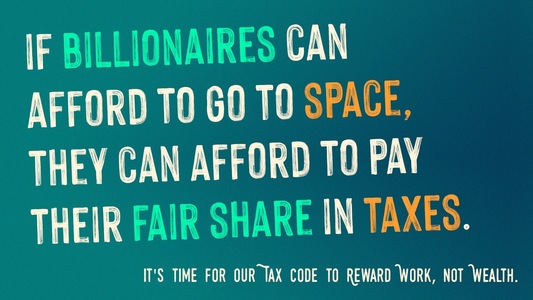
The truth is America has lost its way if commoners pay a rate of 40% but its billionaires pay next to nothing.

As with everything else in polarized America, billionaires proclaiming space tourism is the next big thing for humanity neatly divides opinion into two camps: those who laud the initiative, hard work and innovations of the billionaires as examples of the American Can-Do Dream, and those who wished the billionaire space tourists had taken a one-way flight to a distant orbit of blissful silence.

Setting aside that bitter divide, let’s explore another divide: how our two-tier tax system enables billionaires to become billionaires while the rest of us get poorer. Whenever I discuss the taxes of the non-billionaire self-employed, armies of apologists leap to the defense of the status quo with various quibbles: the 0.9% Medicare surcharge only kicks in above $200,000, the cap on Social Security taxes is $142,800, and so on.

Setting aside the quibbles–and recall the tax code with regulatory notes is thousands of pages–let’s deal with the real issue, which is that billionaires and their corporations pay a thin slice of taxes as a percentage of total income/gains if they pay any at all, while self-employed and small business pay extraordinarily high tax rates.

To all the quibblers: please add the 15.3% Social Security/Medicare tax rate (self-employed / sole proprietors pay both the employee and employer share of this tax) to the federal tax rate of 24% for income above $85,520. It’s 39.3%.

Just how hard would it be to conclude that everyone earning more than $142,000 should pay at least the same rate the rest of us pay? Aren’t we demonstrating all those same laudable traits of the billionaires, just on a smaller scale? Why should we pay 40% and the billionaires pay essentially zero?

Gee, do you reckon paying no taxes might help folks become richer? Garsh, nobody ever asked that question before. And do you reckon paying 40% of your income might make you poorer over time? Golly gee, how come the talking heads worshiping the billionaires never ask these questions?

Since Social Security and Medicare/Medicaid are the bedrock of America’s social safety net, why shouldn’t billionaires pay to support these programs? Well, why not? Just how lame do the excuses have to be to be recognized as laughably self-serving?

Here’s the trick billionaires use to evade taxes. There are countless ways for the super-wealthy to evade taxes–funnel earnings through an Irish post office box, buy a tax break in Washington DC, slide the money into one of dozens of global tax havens, and so on.

But a simple one is to report no income and live large off borrowed money. As the billions of dollars in capital gains pile up as the billionaire’s stock holdings soar (thanks, Federal Reserve, for the free trillions; awful swell of you to give us all that free money), there’s no income generated until the billionaire sells some shares. No sale, no income. Just pay yourself $1 a year in salary, borrow against your billions at super-low rates of interest, and voila, you’re tax-free while you build your super-yacht, buy your private island, and so on.

Just as a thought experiment, suppose the first $50,000 in earnings for everyone were tax-free, and a 40% tax rate was collected on all income above $1 million, both earned and unearned (capital gains), not when the gains were realized in a sale but at the end of every tax year, whether the shares that rose in value were sold or not.

So Billionaire Space Tourist reaped $10 billion in capital gains from the appreciation of stocks held, then the Billionaire pays 40% of those gains: $4 billion. There is a way to not pay any taxes on capital gains–have your portfolio lose value. No gains, no taxes. And to close all the loopholes, the tax rate is on all assets and income connected in any way, shape or form with the U.S. First they pay the U.S. taxes, then if they want to pay other nations’ taxes as well, be my guest. But the 40% is due and payable regardless of any other conditions.

You don’t like it, then stop selling any products in the U.S. or holding any assets in the U.S. Why should billionaires get to set up immensely profitable monopolies, quasi-monopolies, cartels and corporations in the U.S. but pay near-zero in taxes? Why should billionaires be free to profit from America’s economy but pay nothing to support its citizenry?

What precisely is the logic of reducing taxes on the wealthiest few to near-zero? If there is no logic, then we’re left with corruption: America is a moral cesspool.

The truth is America has lost its way if commoners pay a rate of 40% but its billionaires pay next to nothing. Please note Karma and Divine Retribution are not controlled by the billionaire’s lackeys and apparatchiks in the Federal Reserve. The pendulum of exploitation has reached its extreme, and the reversal to the opposite extreme is underway.
Are Profit and Healthcare Incompatible?

By Charles Hugh Smith

Source: Of Two Minds

The only way to systemically lower costs is to make prevention and transparency the top priorities.

As I have been noting for a decade, the broken U.S. healthcare system will bankrupt the nation all by itself. We all know the basic facts: the system delivers uneven results in terms of improving health and life expectancy while costing two or three times more per person compared to our advanced-economy global competitors.

U.S. Lifestyle + “Healthcare” = Bankruptcy (June 19, 2008)

Sickcare Will Bankrupt the Nation–And Soon (March 21, 2011)

How Healthcare Is Dooming the U.S. Economy (Three Charts) (May 2015)

You Want to Fix the Economy? Then First Fix Healthcare (September 29, 2016)

This chart says it all: the global outlier in low life expectancy and exorbitant cost is the U.S.

The profit motive is supposed to lower costs, not increase them. In the idealized model of a completely free market, the profit motive is supposed to lower costs as customers are free to choose the best product/service for the lowest price.

In U.S. healthcare, the profits are stupendous, yet the costs are even more stupendous. Rather than lower costs, the U.S. system of for-profit healthcare has sent costs spiraling into the stratosphere, to the point that the system’s costs are threatening to bankrupt the government and the nation.

Why is this so? Karl Marx provided the answer in the 19th century. In the idealized model of free-market capitalism, those who provide superior services for the lowest price reap more profit than their less agile/productive competitors.

But as Marx observed, in real-world capitalism, open competition drives profits to zero. Every attempt to gain a competitive advantage in price increases supply and further commoditizes the product/service. This dynamic pushes prices down to the point that nobody can make a profit until competitors are driven out of business and a cartel or monopoly secures the market and controls supply, price and profit.

The most profitable structures in real-world capitalism are monopolies or cartels– which is precisely what characterizes U.S. healthcare. The only way to maximize profits is to ruthlessly eliminate competition in the marketplace–which is exactly how the U.S. healthcare system operates: the pharmaceutical industry is a cartel, hospital chains are a cartel, insurance companies are a cartel, and so on.

In the real world of state-cartel-capitalism, competition is eliminated so cartels can maximize profits.

Do-gooders are always claiming that the system could be fixed by re-introducing competition– this was the core idea behind Obamacare’s insurance exchanges–but the do-gooders are blind to the core dynamic of state-cartel-capitalism, which is cartels own the machinery of governance via lobbying and campaign contributions. The state creates and protects the cartels, period.

In state-cartel-capitalism, there is no way to maintain real competition, as the cartels instruct the state to protect their monopolies/cartels. State reformers can try all sorts of complex reform schemes (ObamaCare) but they fail to lower costs because they all leave the cartel structure and cartel ownership of governance intact.

In the good old days of the 1950s and 1960s, U.S. healthcare was more localized, and the central state (federal government) wasn’t the Sugar Daddy for the cartels. Hospitals were community hospitals (what a quaint idea in today’s hyper-cartelized system) managed by physicians and administrators who saw their role as serving the community rather than arranging for $20 million annual salaries and millions of dollars in stock options.

This is why the cartels love Medicare For All proposals: the federal government–protector and funder of the cartels–will give the cartels a blank check not just for the 120 million people currently drawing benefits from Medicare/Medicaid but for all 325 million Americans.

Fast facts on Medicare and Medicaid (Center for Medicare and Medicaid Services)

Medicare Beneficiaries: 57.7 million
Medicaid Beneficiaries: 72.3 million
estimated dual Beneficiaries (drawing benefits from both programs): 10 million

Total Beneficiaries: 120 million

Medicare/Medicaid budget, 2015: $1.2 trillion

Total U.S. healthcare costs: $3.2 trillion, 18% of GDP

Department of Defense budget, 2015: $575 billion
source

Are profit and healthcare incompatible? In the real world of state-cartel-capitalism, the answer is yes: a profit-maximizing system fails to deliver prevention while pushing costs higher, eventually bankrupting the Sugar Daddy government and the nation.

Prevention, like a bag of carrots, is intrinsically low-profit. Illness, especially chronic illness, is highly profitable because the profits flow continuously from treatments, medications, procedures, tests, visits, hospitalization, home care, a constant churn of billing, etc.

The only way to systemically lower costs is to make prevention and transparency the top priorities. Prevention, community ownership of healthcare services, transparency and unfettered competition kill profits, period. Yet these are the only way to lower costs to be in line with our competitors.

You can reconfigure the system any way you want, but you have to eliminate cartels, cartel ownership of governance, opaque pricing, government blank checks and incentives for profiteering from chronic illness. If you don’t eliminate all these, you’ve fixed nothing.


Trump proposes huge hike in military and police spending

discretionary_spending_pie_2015_enacted

By Patrick Martin

Source: WSWS.org

The Trump administration sent instructions to federal agencies Monday proposing a $54 billion increase in spending for the Pentagon, the intelligence agencies and the Department of Homeland Security, to be offset by $54 billion in cuts for other agencies, mainly those involved in domestic social services and regulation of business.

Trump’s budget outline sets the stage for his first address to Congress on Tuesday. It provides further evidence that the Trump administration will be dedicated to radically rolling back social spending to finance a dramatic escalation of military operations, both in the neo-colonial wars in the Middle East and against the United States’ ‘great power’ rivals: China and Russia.

Federal departments are being told to file budget requests for the fiscal year that begins October 1, 2017 based on the numbers they were given by the Office of Management and Budget. Each agency will be responsible for working out the cuts required to meet proposed reductions, while the Pentagon, CIA and DHS will propose expanded operations with the additional funds they are to be awarded.

There were no details made public about the exact budget ceilings given to each federal department, but White House officials made it clear that foreign aid programs in the State Department and anti-pollution regulation through the Environmental Protection Agency (EPA) would suffer some of the largest cuts.

The total budget of the EPA is only $9 billion, so many other domestic programs are certain to be hard-hit, involving such departments as Education, Labor, Transportation, Agriculture (which includes food stamps), Housing and Urban Development and Health and Human Services.

The biggest federal social programs, Social Security, Medicare and Medicaid, are not affected by the budget order, which involves only funding for so-called discretionary programs, those financed through annual congressional appropriations. Entitlement programs, where benefits are paid out automatically to those who establish their eligibility, are covered by a separate budget process.

OMB Director Mick Mulvaney appeared at the White House press briefing Monday afternoon to explain the action taken by the Trump administration. He emphasized that setting what he called the “top-line budget number” for each department was only the start of a protracted process.

The OMB will use the figures from each department and agency to prepare a budget outline to be submitted to Congress on March 16. A full budget will not be ready until sometime in May, Mulvaney said. He also indicated that while spending on Social Security, Medicare and Medicaid were not addressed in the action taken Monday, “entitlement reform”—i.e., cuts in these critical programs—would be a subject of discussion with congressional leaders later in the budget process.

Press reports identified the three White House officials who have played the main roles in the initial budgeting: Mulvaney, who was confirmed on February 16 as budget director; National Economic Council Director Gary Cohn, the former president of Goldman Sachs, the huge investment bank; and Stephen K. Bannon, Trump’s chief strategist, the former chief executive of the fascistic Breitbart News site, who exercises increasingly broad sway over all White House policy decisions.

While no details have yet been released of what the $54 billion increase in military-police spending will pay for, the scale of the increase, in and of itself, shows the real character of the Trump administration. This is to be a government of war abroad and mass repression at home.

Trump himself touched on this theme in typically rambling and unfocused remarks to a meeting of the National Governors Association Monday. “We never win a war,” he said. “We never win. And we don’t fight to win. We don’t fight to win. So we either got to win, or don’t fight at all.”

He continued, telling the governors, “My first budget will be submitted to the Congress next month. This budget will be a public safety and national security budget, very much based on those two with plenty of other things, but very strong. And it will include a historic increase in defense spending to rebuild the depleted military of the United States of America at a time we most need it.”

Additional money for the Pentagon is likely to go to a dramatically increased tempo of operations in Iraq and Syria. Defense Secretary James Mattis delivered proposals to the White House Monday for an offensive against Islamic State in Iraq and Syria (ISIS), as required by an executive order issued by Trump last month. No details are available yet, but any acceleration of the bombing campaign, let alone the deployment of significant numbers of the US ground troops, would increase the cost of that war by many billions.

The $54 billion increase would also presumably include funds for the construction of Trump’s planned wall on the US-Mexico border, as well as a massive increase in spending on detention facilities for the hundreds of thousands of immigrants to be rounded up under the executive orders already issued by the White House.

The federal budget is operating under the constraints imposed by the 2011 Budget Control Act, the bipartisan legislation negotiated by the Obama White House, the Republican-controlled House of Representatives, and a Democratic-controlled Senate. This set up the so-called sequester process, under which all discretionary spending is subject to a budget freeze, for both domestic and military programs.

Each year, increased spending for programs under the sequester has been worked out on the basis of roughly equal increases for domestic and military programs. Last year, for fiscal year 2016, Congress approved $543 billion for domestic discretionary programs and $607 billion for the military. The Trump White House plan would thus represent a cut of about 10 percent for domestic programs, and an increase of nearly that amount for the military.

Any significant change in the sequester process would require support from congressional Democrats, particularly in the Senate, where the Republican party holds only a narrow 52-48 edge, and any major legislation would require a 60-vote majority to pass.

Several congressional Republican leaders criticized the White House plan as insufficiently skewed to the military. House Armed Services Committee Chairman Mac Thornberry of Texas issued a statement criticizing the “low budget number” and adding, “The administration will have to make clear which problems facing our military they are choosing not to fix.”

Senator John McCain of Arizona, chairman of the Senate Armed Services Committee, declared that the Trump plan is “a mere 3 percent above President Obama’s defense budget, which has left our military underfunded, undersized and unready.”

For all the statements by Trump and the Republicans bemoaning the supposedly “depleted” state of the US military, the United States spends more on its armed forces than the next 15 countries in the world combined. The military budget is only inadequate if the mission of the US military is assumed to be the conquest of the entire planet and the subduing of all armed resistance from any quarter—which is actually the perspective of the American ruling elite.