
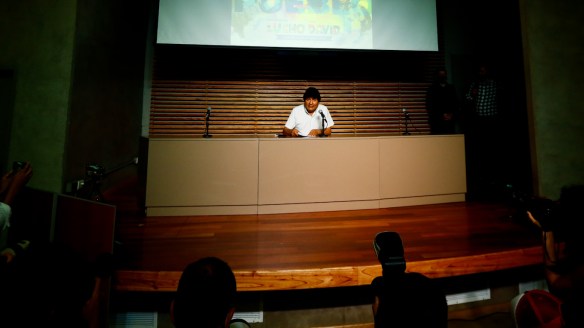
Former Bolivian President Evo Morales attends a press conference in Buenos Aires, Argentina, after general elections in his home country, Monday, Oct. 19. 2020. (AP Photo/Marcos Brindicci)
Across the spectrum, corporate media has endorsed last year’s rightwing takeover of Bolivia, refusing to label it as a coup. Coverage of Sunday’s historical elections hasn’t been much better.
By Alan Macleod
Source: Mint Press News
Bolivia’s Movement to Socialism (MAS) party is celebrating what appears to be a crushing, landslide victory in Sunday’s elections. Although official vote counting is far from over, exit polls show an overwhelming triumph for the socialists, and a repudiation of the right-wing military government of Jeanine Añez, who has ruled since the coup last November. At the same time, the corporate press appears less than pleased about the return to democracy for the Andean country.
In order to win outright in the first round, the top candidate needs at least 40 percent of the popular vote and a lead of 10 points over their nearest rival, and multiple polls have indicated that the MAS ticket of Luis Arce and David Choquehuanca has won more than 50 percent, and have achieved a lead of over 20 points on their nearest challenger, Carlos Mesa (president between 2003 and 2005) — quite a feat in a five-way election. The MAS is also expected to have won a large majority in the senate.
Añez, who came to power in a coup overthrowing President Evo Morales last November, and whose government has constantly postponed the election throughout the year, knew the game was up and lauded the MAS on their remarkable achievement. “We do not yet have an official count, but from the data we have, Mr. Arce and Mr. Choquehuanca have won the election. I congratulate the winners and ask them to govern with Bolivia and democracy in mind,” she wrote. Añez decided to drop out of the election herself last month in an attempt to boost Mesa’s chances of stopping Arce. However, today Mesa accepted defeat as well. “The result is overwhelming and clear. The difference is wide,” he lamented.
Media disappointment at return of democracy
Across the spectrum, corporate media endorsed the events of November, refusing to label them a coup. The New York Times editorial board claimed that the “increasingly autocratic” tyrant Morales had actually “resigned,” after “protests” over a “highly fishy vote.” The Washington Post did the same. “There can be little doubt who was responsible for the chaos: newly resigned president Evo Morales,” their editorial board wrote, as they expressed their relief that Bolivia was finally in the hands of “more responsible leaders” like Añez, (who, at the time, was giving security forces orders to shoot her opponents in the streets). Despite this, The Wall Street Journal’s board decided the events of November constituted “a democratic outbreak in Bolivia.”
Today, therefore, the corporate press is in a very tough spot, as they have to explain to their readers why the Bolivian people have just handed an overwhelming, landslide victory to a party they have been presenting as an authoritarian dictatorship who were overthrown by popular protests last year.
A number of outlets solved this by simply fastidiously avoiding reporting on the events of November or using the word “coup” to describe them. NPR’s Philip Reeves, for example, claimed Morales “resigned” amid an annulled election after “allegations of fraud,” leading to an “interim government” (Añez’s own public relations-minded phrase for her administration). The word “coup” only appears in the mouth of Morales, someone whose credibility the outlet has spent months undermining. Other organizations like Deutsche Welt and Bloomberg failed to use the word at all in their reporting.
The Associated Press, meanwhile, referenced the coup, but did not use the word, instead describing it as when “police and military leaders suggested he [Morales] leave.” It takes great linguistic skill to refrain from using by far the most appropriate word to describe events in Bolivia for what they are: a coup. Indeed, the linguistic gymnastics necessary to avoid using the word would be genuinely impressive were not an exercise in deceit and manufacturing consent for regime change.
CNN at least included the phrase “claims of a coup,” but presents it beside apparently equally justified “allegations of fraud among contested national elections.” But these two things are nothing like the same. One is a statement of fact while another is a debunked, discredited talking point used to overthrow a legitimate government.
Meanwhile, the BBC’s article on the election had an entire section called “why is the country so divided” which did not mention the massacres, the firesale of the country’s economy, the repression of media or activists, the persecution of the MAS or the U.S. role in overthrowing the elected government. Instead, it presented Morales himself as the prime agent of polarization, a common tactic among media discussing enemy states.
The New York Times also published a long, in-depth article on the election, yet it appeared that the only MAS “supporters” it was willing to quote were ones who constantly badmouthed Morales, the article also suggesting that MAS’ figures might be inflated, despite the fact they have now been accepted by Añez and Mesa as essentially accurate.
As such the corporate press refused to cover the incredible story of nationwide nonviolent resistance to authoritarian rule, forcing a government into accepting its own defeat, reminiscent of Gandhi’s campaign against the British in India.
A year of political turbulence
Last October, Morales won an unprecedented and not uncontentious fourth term. Yet the U.S.-backed opposition refused to accept the results, claiming that they had been rigged. The Organization of American States immediately backed them up, producing a flawed report on election meddling, something that was almost immediately disproven. Nevertheless, the right-wing mobilized and began a widespread campaign of terror, targeting, attacking, and kidnapping MAS politicians. On November 10, police and military commanders joined the coup, demanding Morales resign or else they would take matters into their own hands. Morales decided to flee to Mexico but made clear he was only leaving to prevent a bloodbath.
The military picked Añez, a little known senator from a party who gained only four percent of the public vote, to become president. She immediately granted security forces total pre-immunity for all crimes committed during the “re-establishment of order.” Her new interior minister, Arturo Murillo, oversaw the creation of masked, black-clad paramilitary units specifically aimed at political subversives, foreigners, and human rights groups. Journalists were attacked and, in one case, beaten to death, while foreign and alternative media were shut down completely. Murillo promised to “hunt down” his opponents like dogs. Morales himself was charged with crimes against humanity and faces spending the rest of his life in prison if he returns to his home country. Other MAS leaders on yesterday’s ballot also face long prison terms on dubious charges.
https://twitter.com/AliMortell/status/1318221632306089985
Añez pushed through the privatization of natural resources and state-owned businesses while in office, accepting loans from predatory organizations like the International Monetary Fund. She also reorientated her country’s foreign policy away from an independent path towards one completely in line with U.S. foreign policy aims, pulling out of multiple regional alliances and entering new ones. Under Morales, for example, Bolivia had declared Israel a ‘terrorist state.” Yet less than a month after the coup, Añez and Murillo were inviting IDF troops to the country to train their police forces in dealing with “leftist terrorism.”
The government’s response to the coronavirus pandemic has also taken on a decidedly right-wing tone. Cuts to health provisions and the expulsion of hundreds of Cuban doctors (whom the government labeled as “terrorists”) caused the public health system to crash just before the pandemic became worldwide news. As a result, Bolivia has the third-highest COVID-19 death per capita rate in the world, comfortably surpassing the United States in severity. Añez herself contracted the virus in July.
Añez used the intensity of the pandemic as justification to continually suspend the elections she claimed she would hold, calling herself merely an “interim president.” Yet many inside the country felt the coronavirus was being used as an excuse to keep herself in power indefinitely. Throughout the year, Bolivia was engulfed in near continual protests, shutting the country down. As a result, the summer was marked by the rise of the virus and by a weeks-long peaceful general strike calling for elections. Fearing a potential revolution, Añez conceded and agreed to hold them in October.
After months of organized popular struggle in the face of a coup government that had been massacring them, Sunday’s result has been widely interpreted as a repudiation of the coup and a vote for socialism. MintPress’ Ollie Vargas, who has never made a secret of his political persuasions, said in the wake of the results:
On a personal level, I can’t believe this is finally happening, but it’s what we’ve always known. Despite the massacres, despite the persecution, despite U.S. intervention, the MAS is back and even more powerful. They can’t put a lid on the majority of the people.”
Morales celebrated the ascension of his former minister of finance to Bolivia’s top job. “We’ve received our democracy” he declared. “Sisters and brothers: the will of the people has been imposed. There has been a resounding victory for the MAS. Our political movement will have a majority in both houses. We have returned millions, now we are going to restore dignity and freedom to the people,” he added on Twitter.
Arce himself was in an equally joyous mood, telling Vargas last night that, “It seems that a great part of the Bolivian people have recovered their soul.” “I think the Bolivian people want to retake the path we were on,” he added. MAS supporters took to the streets to celebrate their victory, made all the more unlikely given the repression they have been subject to under Añez’s military regime.
Fears of violence and vote rigging against the MAS were rife, especially as the government had blocked foreign election observers from overseeing events, threatening to jail them. On Saturday, Argentinian congressman Federico Fagioli, an official observer representing his government, was arrested by police at El Alto airport. Video of the incident shows Fagioli shouting “I am being kidnapped” as multiple officers pick him up and forcefully carry him away.
What’s Next?
If Añez’s government does indeed step down, it will represent only the second time in Latin American history that a U.S.-backed coup against a progressive administration has been overturned. However, in Venezuela in 2002, the countercoup took less than 48 hours. In Bolivia, people have organized for nearly a year to achieve the same ends, giving the government far more time to embed and establish itself. The Bolivian people have a long history of organized struggle bringing down governments. In the early 2000s, nationwide protests against gas and water privatizations rocked the country, toppling unrepresentative regimes (including that of Mesa’s in 2005), setting the stage for Morales to become the most influential figure in Bolivian politics of the last 15 years.
The first indigenous president in the majority indigenous country’s history, Morales ran on the idea of 21st-century socialism, using his country’s considerable mineral wealth to fund social programs that cut poverty by half and extreme poverty by three-quarters, halving unemployment and increasing the country’s GDP by 50 percent. Yet his nationalization program and his outspoken criticism of capitalism and American imperialism on the world stage made him a prime target for regime change in Washington, who strongly supported the events of November, immediately recognizing and supporting Añez’s legitimacy.
Despite the fact that the MAS’ electoral victory looks certain, it is far from clear what sort of resistance they will face from other sources of power. “The next few days will be key for consolidating democracy in Bolivia. The MAS will need to embrace the patriotic elements within the police and military, to ensure the U.S./Murillo don’t launch a second coup against the majority of Bolivians,” Vargas warned. And how will the MAS deal with the coup plotters themselves, clearly guilty of serious human rights abuses. Are they really in any position to exert authority over the situation?
Of late, wherever there are governments critical of U.S. power (Cuba, Nicaragua, Venezuela, Iran, etc.) they are met with crushing sanctions in an attempt to destroy their ability to oppose Washington. Bolivia under Morales had already been labeled by some in the U.S. as a “narco-dictatorship.” If Arce does indeed come to rule his country, will he receive the Nicolas Maduro treatment?
For MAS supporters, however, those are questions for a different day. Today, they are celebrating a stunning and historic victory cheered by progressives the world over but angering Washington and corporate journalists in equal measure.

 After the Crash