
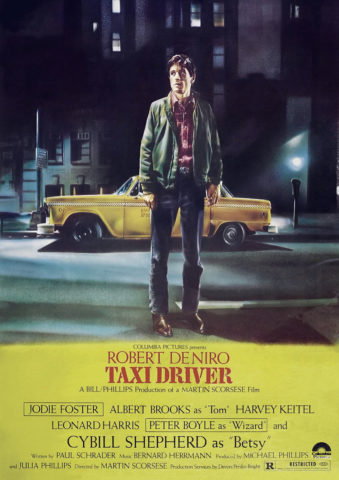
Saturday Matinee: Taxi Driver

By Roger Ebert

Source: RogerEbert.com

Are you talkin’ to me? Well, I’m the only one here. –Travis Bickle in “Taxi Driver”

It is the last line, “Well, I’m the only one here,” that never gets quoted. It is the truest line in the film. Travis Bickle exists in “Taxi Driver” as a character with a desperate need to make some kind of contact somehow–to share or mimic the effortless social interaction he sees all around him, but does not participate in.

The film can be seen as a series of his failed attempts to connect, every one of them hopelessly wrong. He asks a girl out on a date, and takes her to a porno movie. He sucks up to a political candidate, and ends by alarming him. He tries to make small talk with a Secret Service agent. He wants to befriend a child prostitute, but scares her away. He is so lonely that when he asks, “Who you talkin’ to?” he is addressing himself in a mirror.

This utter aloneness is at the center of “Taxi Driver,” one of the best and most powerful of all films, and perhaps it is why so many people connect with it even though Travis Bickle would seem to be the most alienating of movie heroes. We have all felt as alone as Travis. Most of us are better at dealing with it.

Martin Scorsese’s 1976 film (re-released in theaters and on video in 1996 in a restored color print, with a stereophonic version of the Bernard Herrmann score) is a film that does not grow dated, or over-familiar. I have seen it dozens of times. Every time I see it, it works; I am drawn into Travis’ underworld of alienation, loneliness, haplessness and anger.

It is a widely known item of cinematic lore that Paul Schrader’s screenplay for “Taxi Driver” was inspired by “The Searchers,” John Ford’s 1956 film. In both films, the heroes grow obsessed with “rescuing” women who may not, in fact, want to be rescued. They are like the proverbial Boy Scout who helps the little old lady across the street whether or not she wants to go.

“The Searchers” has Civil War veteran John Wayne devoting years of his life to the search for his young niece Debbie (Natalie Wood), who has been kidnapped by Commanches. The thought of Debbie in the arms of an Indian grinds away at him. When he finally finds her, she tells him the Indians are her people now, and runs away. Wayne then plans to kill the girl, for the crime of having become a “squaw.” But at the end, finally capturing her, he lifts her up (in a famous shot) and says, “Let’s go home, Debbie.”

The dynamic here is that Wayne has forgiven his niece, after having participated in the killing of the people who, for 15 years or so, had been her family. As the movie ends, the niece is reunited with her surviving biological family, and the last shot shows Wayne silhouetted in a doorway, drawn once again to the wide open spaces. There is, significantly, no scene showing us how the niece feels about what has happened to her.

In “Taxi Driver,” Travis Bickle also is a war veteran, horribly scarred in Vietnam. He encounters a 12-year-old prostitute named Iris (Jodie Foster), controlled by a pimp named Sport (Harvey Keitel). Sport wears an Indian headband. Travis determines to “rescue” Iris, and does so, in a bloodbath that is unsurpassed even in the films of Scorsese. A letter and clippings from the Steensmas, Iris’ parents, thank him for saving their girl. But a crucial earlier scene between Iris and Sport suggests that she was content to be with him, and the reasons why she ran away from home are not explored.

The buried message of both films is that an alienated man, unable to establish normal relationships, becomes a loner and wanderer, and assigns himself to rescue an innocent young girl from a life that offends his prejudices. In “Taxi Driver,” this central story is surrounded by many smaller ones, all building to the same theme. The story takes place during a political campaign, and Travis twice finds himself with the candidate, Palatine, in his cab. He goes through the motions of ingratiating flattery, but we, and Palatine, sense something wrong.

Shortly after that Travis tries to “free” one of Palatine’s campaign workers, a blonde he has idealized (Cybill Shepherd), from the Palatine campaign. That goes wrong with the goofy idea of a date at a porno movie. And then, after the fearsome rehearsal in the mirror, he becomes a walking arsenal and goes to assassinate Palatine. The Palatine scenes are like dress rehearsals for the ending of the film. With both Betsy and Iris, he has a friendly conversation in a coffee shop, followed by an aborted “date,” followed by attacks on the men he perceived as controlling them; he tries unsuccessfully to assassinate Palatine, and then goes gunning for Sport.

There are undercurrents in the film that you can sense without quite putting your finger on them. Travis’ implied feelings about blacks, for example, which emerge in two long shots in a taxi driver’s hangout, when he exchanges looks with a man who may be a drug dealer. His ambivalent feelings about sex (he lives in a world of pornography, but the sexual activity he observes in the city fills him with loathing). His hatred for the city, inhabited by “scum.” His preference for working at night, and the way Scorsese’s cinematographer, Michael Chapman, makes the yellow cab into a vessel by which Travis journeys the underworld, as steam escapes from vents in the streets, and the cab splashes through water from hydrants–a Stygian passage.

The film has a certain stylistic resonance with “Mean Streets” (1973), the first Scorsese film in which Keitel and De Niro worked together. In the earlier film Scorsese uses varying speeds of slow-motion to suggest a level of heightened observation on the part of his characters, and here that technique is developed even more dramatically; as the taxi drives through Manhattan’s streets, we see it in ordinary time, but Travis’ point-of-view shots are slowed down: He sees hookers and pimps on the sidewalks, and his heightened awareness is made acute through slow motion.

The technique of slow motion is familiar to audiences, who usually see it in romantic scenes, or scenes in which regret and melancholy are expressed–or sometimes in scenes where a catastrophe looms, and cannot be avoided. But Scorsese was finding a personal use for it, a way to suggest a subjective state in a POV shot. And in scenes in a cab driver’s diner, he uses closeups of observed details to show how Travis’s attention is apart from the conversation, is zeroing in on a black who might be a pimp. One of the hardest things for a director to do is to suggest a character’s interior state without using dialog; one of Scorsese’s greatest achievements in “Taxi Driver” is to take us inside Travis Bickle’s point of view.

There are other links between “Mean Streets” and “Taxi Driver” that may go unnoticed. One is the “priest’s-eye-view” often used in overhead shots, which Scorsese has said are intended to reflect the priest looking down at the implements of the Mass on the altar. We see, through Travis’ eyes, the top of a taxi dispatcher’s desk, candy on a movie counter, guns on a bed, and finally, with the camera apparently seeing through the ceiling, an overhead shot of the massacre in the red-light building. This is, if you will, the final sacrifice of the Mass. And it was in “Mean Streets” that Keitel repeatedly put his finger in the flame of a candle or a match, testing the fires of hell: here De Niro’s taxi driver holds his fist above a gas flame.

There has been much discussion about the ending, in which we see newspaper clippings about Travis’ “heroism,” and then Betsy gets into his cab and seems to give him admiration instead of her earlier disgust. Is this a fantasy scene? Did Travis survive the shoot-out? Are we experiencing his dying thoughts? Can the sequence be accepted as literally true?

I am not sure there can be an answer to these questions. The end sequence plays like music, not drama: It completes the story on an emotional, not a literal, level. We end not on carnage but on redemption, which is the goal of so many of Scorsese’s characters. They despise themselves, they live in sin, they occupy mean streets, but they want to be forgiven and admired. Whether Travis gains that status in reality or only in his mind is not the point; throughout the film, his mental state has shaped his reality, and at last, in some way, it has brought him a kind of peace.


Watch the full film for free here.
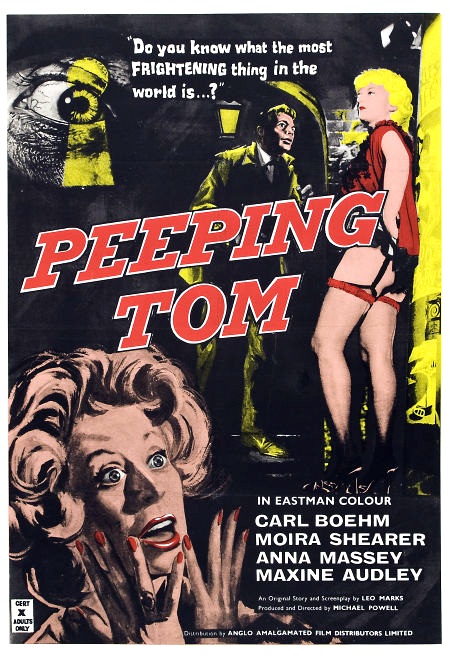
Saturday Matinee: Peeping Tom

Review by Roger Ebert

Source: RogerEbert.com

The movies make us into voyeurs. We sit in the dark, watching other people’s lives. It is the bargain the cinema strikes with us, although most films are too well-behaved to mention it.

Michael Powell‘s “Peeping Tom,” a 1960 movie about a man who filmed his victims as they died, broke the rules and crossed the line. It was so loathed on its first release that it was pulled from theaters, and effectively ended the career of one of Britain’s greatest directors.

Why did critics and the public hate it so? I think because it didn’t allow the audience to lurk anonymously in the dark, but implicated us in the voyeurism of the title character.

Martin Scorsese once said that this movie, and Federico Fellini’s “8 1/2,” contain all that can be said about directing. The Fellini film is about the world of deals and scripts and show biz, and the Powell is about the deep psychological process at work when a filmmaker tells his actors to do as he commands, while he stands in the shadows and watches.

Scorsese is Powell’s most famous admirer. As a child, he studied the films of “the Archers”–the team of director Powell and writer Emric Pressburger. Scorsese haunted the late show screenings of their films, drinking in Powell’s bold images and confident, unexpected story development.

Powell and Pressburger made some of the best and most successful films of the 1940s and ’50s, including “The Life and Death of Colonel Blimp,” with Roger Livesey’s great performance spanning three wars; “The Red Shoes,” with Moira Shearer as a ballet dancer; “Black Narcissus,” with Deborah Kerr as a nun in the Himalayas, and “Stairway To Heaven (A Matter Of Life And Death),” with David Niven as a dead airman. Then came “Peeping Tom.”

It is a movie about looking. Its central character is a focus puller at a British movie studio; his job is to tend the camera, as an acolyte might assist at the mass. His secret life involves filming women with a camera that has a knife concealed in its tripod; as they realize their fate, he films their faces, and watches the footage over and over in the darkness of his rooms. He is working on a “documentary,” he tells people, and only in the film’s final shot do we realize it is not only about his crimes, but about his death. He does not spare himself the fate of his victims.

This man, named Mark Lewis, has been made into a pitiful monster by his own upbringing. When Helen (Anna Massey), the friendly girl who lives downstairs, shows an interest in his work, he shows her films taken by his father. Films of Mark as a little boy, awakened in the night by a flashlight in his eyes. Films of his father dropping lizards onto his bedclothes as he slept.

Tapes of his frightened cries. Mark’s father, a psychologist specializing in the subject of fear, used his son for his experiments. When a police psychologist learns the story, he muses, “He has his father’s eyes … ”

There is more. We see little Mark filmed beside his mother’s dead body. Six weeks later, another film, as his father remarries. (Wheels within wheels: The father is played by Michael Powell. Mark’s childhood home is the London house where Powell was reared, and Mark as a child is played by Powell’s son.) At the wedding, Mark’s father gives him a camera as a present.

For Mark, the areas of sex, pain, fear and filmmaking are connected. He identifies with his camera so much that when Helen kisses him, he responds by kissing the lens of his camera. When a policeman handles Mark’s camera, Mark’s hands and eyes restlessly mirror the officer’s moves, as if Mark’s body yearns for the camera and is governed by it. When Helen tries to decide whether she should wear a piece of jewelry on the shoulder or at the neckline, Mark’s hands touch his own body in the same places, as if he is a camera, recording her gestures.

Powell originally thought to cast Laurence Harvey in the lead, but he settled instead on Karl Boehm, an Austrian actor with such a slight accent in English that it sounds more like diffidence. Boehm was blond, handsome, soft and tentative; Powell was interested to learn that his new star was the son of the famous symphony conductor. He might know something of overbearing fathers.

Boehm’s performance creates a vicious killer, who is shy and wounded. The movie despises him, yet sympathizes with him. He is a very lonely man.

He lives upstairs in a rooming house. The first room is conventional, with a table, a bed, a kitchen area. The second room is like a mad scientist’s laboratory, with cameras and film equipment, a laboratory, a screening area, obscure equipment hanging from the ceiling.

Helen is startled when he reveals that the house is his childhood home, and he is the landlord: “You? But you walk around as if you can’t afford the rent.” Helen lives with her mother (Maxine Audley), who is alcoholic and blind, and listens to Mark’s footsteps. When Helen tells her mother they’re going out together, her mother says, “I don’t trust a man who walks so softly.” Later Mark surprises the mother inside his inner room, and she cuts right to the heart of his secret: “I visit this room every night. The blind always visit the rooms they live under. What am I seeing, Mark?”

Powell’s film was released just months before “Psycho” (1960), another shocking film by a British director. Hitchcock’s film arguably had even more depraved subject matter than Powell’s, and yet it was a boost for his career, perhaps because audiences expected the macabre from Hitchcock but Powell was more identified with elegant and stylized films.

There is a major sequence in “Peeping Tom” that Hitchcock might have envied. After hours at the film studio, Mark persuades an extra (Moira Shearer) to stay behind so he can film her dancing. She is almost giddy to have her own solo shots, and dances around a set and even into a big blue trunk. The next day, the body is discovered inside the trunk–while Mark, unseen, films the discovery.

The film’s visual strategies implicate the audience in Mark’s voyeurism. The opening shot is through Mark’s viewfinder. Later, we see the same footage in Mark’s screening room, in a remarkable shot from behind Mark’s head. As the camera pulls back, the image on the screen moves in for a closeup, so the face of the victim effectively remains the same size as Mark’s head shrinks. In one shot, Powell shows us a member of the audience being diminished by the power of the cinematic vision. Other movies let us enjoy voyeurism; this one extracts a price.

Powell (1905-1990) was a director who loved rich colors, and “Peeping Tom” is shot in a saturated Technicolor with shots such as one where a victim’s body under a bright red blanket stands out against the gray street. He was a virtuoso of camera use, and in “Peeping Tom” the basic strategy is to always suggest that we are not just seeing, but looking. His film is a masterpiece precisely because it doesn’t let us off the hook, like all of those silly teenage slasher movies do. We cannot laugh and keep our distance: We are forced to acknowledge that we watch, horrified but fascinated.

“Peeping Tom” essentially finished Powell’s career, although he made more films. By the late 1970s, however, Scorsese was sponsoring revivals and restorations, and joined Powell on the audio commentary tracks of several laser discs. Indeed, Powell and Scorsese’s editor, Thelma Schoonmaker, fell in love and married, and she assisted him in writing the most remarkable directorial autobiographies, A Life in Movies and Million-Dollar Movie.

Saturday Matinee: Bringing Out the Dead

“Bringing Out the Dead” (1999) is the fourth collaboration between director Martin Scorsese and screenwriter Paul Schrader (and their most underrated). Based on a novel by Joe Connelly, the plot follows New York paramedic Frank Pierce (Nicolas Cage), who’s on the verge of a nervous breakdown as he struggles to save a steady stream of victims of a heroin plague in the early 90s. As could be expected, the film is full of grim and harrowing situations but is punctuated by darkly humorous moments as well. Given the current wave of opiate overdoses caused primarily by the drug war and big pharma, Bringing Out the Dead is unfortunately more topical than ever.

Watch the full film here.

Saturday Matinee: The Saragossa Manuscript

936full-the-saragossa-manuscript-poster

“The Saragossa Manuscript” (1965) is a Polish film directed by Wojciech Has and based on the novel “The Manuscript Found in Saragossa” (1815) by Jan Potocki. It is a long and complex film but endlessly fascinating for its humor and uniquely dreamlike narrative connecting numerous interrelated stories within stories. The film starts off in Spain during the Napoleonic Wars when soldiers from opposing armies find a manuscript in a deserted house which happens to tell the story of the Spanish officer’s grandfather. The film was a success in Poland in the 60s, is said to be a favorite of surrealist director Luis Bunuel, and was restored in the 90s with financial backing from Francis Ford Coppola, Martin Scorsese and Jerry Garcia. The original US release of The Saragossa Manuscript had nearly an hour cut from the film but the version posted below is the full three hour director’s cut.

To activate English subtitles, click on the “cc” button on the bottom right corner of the video window, click on the field that reads “French”, click “Translate Captions”, scroll down and click “English” and “OK”.

https://www.youtube.com/watch?v=7_23aK5UFA8