Julian Assange’s Day in Court

Julian Assange’s lawyers — in a final bid on Tuesday to stop his extradition — fought valiantly to poke holes in the case of the prosecution to obtain an appeal.
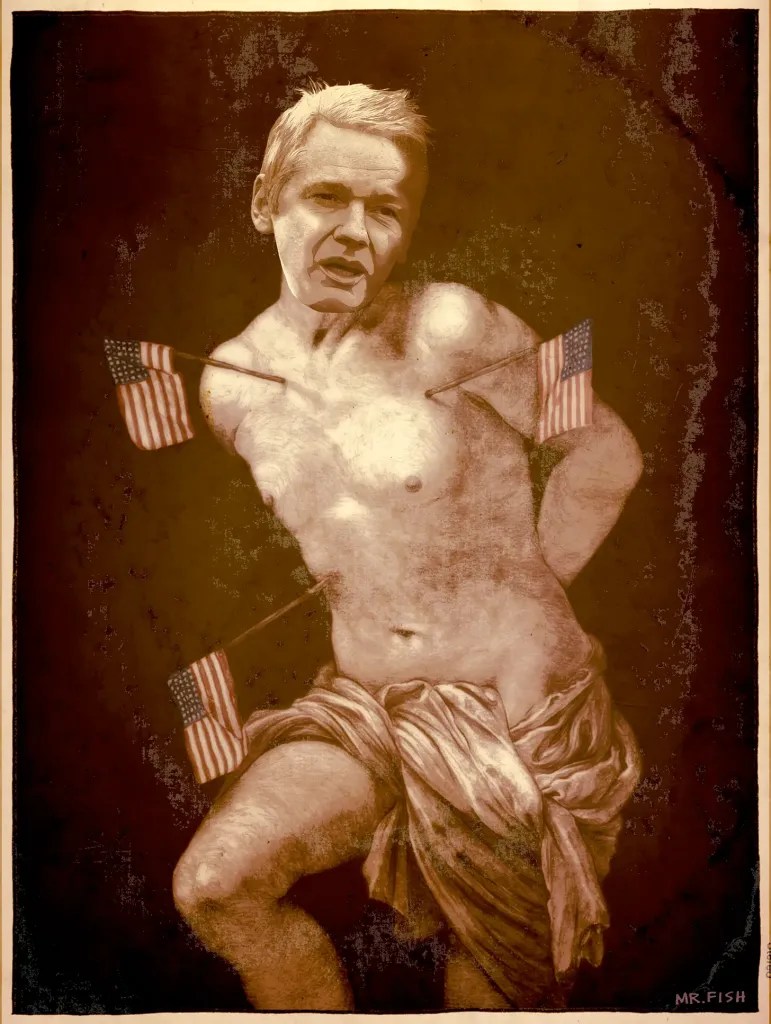
And Our Flags Are Still There – by Mr. Fish

By Chris Hedges

Source: Scheer Post

By the afternoon the video link, which would have allowed Julian Assange to follow his final U.K. appeal to prevent his extradition, had been turned off. Julian, his attorneys said, was too ill to attend, too ill even to follow the court proceedings on a link, although it was possible he was no longer interested in sitting through another judicial lynching. The rectangular screen, tucked under the black wrought iron bars that enclosed the upper left hand corner balcony of the courtroom where Julian would have been caged as a defendant, was perhaps a metaphor for the emptiness of this long and convoluted judicial pantomime. 

The arcane procedural rules — the lawyers in their curled blonde wigs and robes, the spectral figure of the two judges looking down on the court from their raised dais in their gray wigs and forked white collars, the burnished walnut paneled walls, the rows of lancet windows, the shelves on either side filled with law books in brown, green, red, crimson, blue and beige leather bindings, the defense lawyers, Edward Fitzgerald KC and Mark Summers KC, addressing the two judges, Dame Victoria Sharp and Justice Johnson, as “your lady” and “my lord” — were all dusty Victorian props employed in a modern Anglo-American show trial. It was a harbinger of a decrepit justice system that, subservient to state and corporate power, is designed to strip us of our rights by judicial fiat.

The physical and psychological disintegration of Julian, seven years trapped in the Ecuadorian Embassy in London and nearly five years held on remand in the high-security HM Prison Belmarsh, was always the point, what Nils Melzer the former U.N. Special Rapporteur on torture calls his “slow-motion execution.”  Political leaders, and their echo chambers in the media, fall all over themselves to denounce the treatment of Alexei Navalny but say little when we do the same to Julian. The legal farce grinds forward like the interminable case of Jarndyce and Jarndyce in Charles Dickens’ novel Bleak House. It will probably grind on for a few more months — one can’t expect the Biden administration to add the extradition of Julian to all its other political woes. It may take months to issue a ruling, or grant one or two appeal requests, as Julian continues to waste away in HM Prison Belmarsh. 

Julian’s nearly 15-year legal battle began in 2010 when WikiLeaks published classified military files from the wars in Iraq and Afghanistan — including footage showing a U.S. helicopter gunning down civilians, including two Reuters journalists in Baghdad. He took refuge in London’s Ecuadorian embassy, before being arrested by the Metropolitan Police in 2019 who were permitted by the Ecuadorian embassy to enter and seize him. He has been held for nearly five years in HM Prison Belmarsh.

Julian did not commit a crime. He is not a spy. He did not purloin classified documents. He did what we all do, although he did it in a far more important way. He published voluminous material, leaked to him by Chelsea Manning, which exposed U.S. war crimesliescorruptiontorture and assassinations. He ripped back the veil to expose the murderous machinery of the U.S. empire.

The two-day hearing is Julian’s last chance to appeal the extradition decision made in 2022 by the then British home secretary, Priti Patel. On Wednesday the prosecution will make its arguments. If he is denied an appeal he can request the European Court of Human Rights (ECtHR) for a stay of execution under Rule 39, which is given in “exceptional circumstances” and “only where there is an imminent risk of irreparable harm.” But the British court may order Julian’s immediate extradition prior to a Rule 39 instruction or may decide to ignore a request from the ECtHR to allow Julian to have his case heard by the court.

District Judge Vanessa Baraitser in January 2021, at Westminster Magistrates’ Court, refused to authorize the extradition request. In her 132-page ruling, she found that there was a “substantial risk” Julian would commit suicide due to the severity of the conditions he would endure in the U.S. prison system. At the same time, she accepted all the charges leveled by the U.S. against Julian as being filed in good faith. She rejected the arguments that his case was politically motivated, that he would not get a fair trial in the U.S. and that his prosecution is an assault on the freedom of the press.

Baraitser’s decision was overturned after the U.S. government appealed to the High Court in London. Although the High Court accepted Baraitser’s conclusions about Julian’s “substantial risk” of suicide if he was subjected to certain conditions within a U.S. prison, it also accepted four assurances in U.S. Diplomatic Note no. 74, given to the court in February 2021, which promised Julian would be treated well. The “assurances” state that Julian will not be subject to Special Administrative Measure. They promise that Julian, an Australian citizen, can serve his sentence in Australia if the Australian government requests his extradition. They promise he will receive adequate clinical and psychological care. They promise that, pre-trial and post-trial, Julian will not be held in the Administrative Maximum Facility in Florence, Colorado.

The defense must convince the two judges that the District Judge made serious legal errors to see an appeal granted.  

They argued that espionage is, as a matter of law, a political offense and that the extradition treaty with the U.S. prohibits extradition for political offenses. They focused on the extensive UK law, common law and international law that defines espionage as a “pure political offense” because it is directed against a state apparatus. For this reason, those charged with espionage should be protected from extradition. The lawyers spent a long time adjudicating the case of Chelsea Manning to justify her leak of documents that exposed war crimes as in the public interest, then arguing that if she was justified in leaking the documents Julian was justified in publishing them.

As the day wore on it became evident that the two judges were not well versed in the case, constantly asking for citations and expressing surprise that senior officials in the U.S., such as Mike Pompeo when he was head of the CIA, said Julian would not be protected by the First Amendment in an American court because he was not a citizen. Julian’s lawyers brought up past espionage cases, such as that of MI5 agent David Shaylerprosecuted under the Official Secrets Act 1989 for passing secret documents to The Mail on Sunday in 1997 — which included the names of agents. He also disclosed that MI5 (Britain’s domestic intelligence service) kept files on prominent politicians, including Labour ministers, and that MI6 (Britain’s foreign intelligence service) was involved in a plot to assassinate Libyan leader Colonel Momar Gaddafi. The British extradition request was rejected by the French Cour d’Appel because it was a “political offense.”  

All 18 counts filed against Julian allege that his purpose was “that such information so obtained could be used to the injury of the United States and the advantage of any foreign nation.”

The hearing was, after those in 2020 that focused on Julian’s mental and psychological health, refreshing in that it discussed the crimes committed by the U.S. and the importance of making them public. The two judges rarely interrupted, unlike other court proceedings for Julian I have attended where the judge often condescendingly cut short the defense. This may be a reflection of the broad public support, including by major media organizations, which have belatedly rallied behind Julian. Hundreds of people thronged the entrance to The Royal Courts of Justice, an expansive Victorian Gothic stone building adorned with statues of Jesus, Moses, Solomon and Alfred the Great, the celebrated pillars of the English legal tradition, to call for Julian’s freedom.

The afternoon session was different. On about a half dozen occasions the judges halted the defense to ask about how the leaks, because they were not thoroughly redacted, had endangered lives, although the U.S. has never been able to provide evidence of anyone whose life was lost as a result of the leaks. This canard has long been the cross on which U.S. officials have sought to crucify Julian. The two judges — one wonders if they had been given instructions during the lunch break — hurled these accusations at the defense lawyers until we adjourned.

“These indiscriminate disclosures were condemned by The Guardian and The New York Times,” Judge Sharp admonished the defense team. “They could have been done differently.”

This reference was especially egregious since the unredacted documents were first made public not by WikiLeaks or Julian but by the website Cryptome after reporters from The Guardian printed the password to the unredacted documents in their book.

The U.S. is officially seeking Julian’s extradition, where he potentially faces up to 175 years in prison, for the 2010 publication of the Iraq and Afghanistan war logs and US diplomatic cables. But the U.S. did not request his extradition until the release in March 2017 of the files known as Vault 7 which detailed how the CIA could hack Apple and Android smartphones and turn internet-connected televisions — even when they were off — into listening devices. Joshua Schulte, a former CIA employee, was found guilty last year of four counts each of espionage and computer hacking and one count of lying to FBI agents after handing over classified materials to WikiLeaks. He was given a forty-year sentence in February.

After the release of Vault 7 then CIA Director Mike Pompeo called WikiLeaks “a non-state hostile intelligence service.” The Attorney General at the time, Jeff Sessions, said that Julian’s arrest was a priority. By August the U.S. Senate had passed a 78-page intelligence finance bill which included a sentence declaring that “it is the sense of Congress that Wikileaks and the senior leadership of Wikileaks resemble a non-state hostile intelligence service often abetted by state actors and should be treated as such a service by the United States.” In May 2019 the Trump administration accused Julian of violating the Espionage Act and asked the UK to extradite him to stand trial in the U.S. Trump has called the allegations against Julian treason and called for “the death penalty or something.” Other politicians, including former Republican presidential candidate Mike Huckabee, have also called for Julian to be executed.

If Julian is extradited and additionally charged for the release of the Vault 7 documents, Fitzgerald told the court, “it could result in additional charges that merit the death penalty for aiding and abetting the enemy.” The U.S., he said, especially if Trump is elected again to the presidency, could easily “reformulate these charges into a capital offense.”

Summers brought up President Donald Trump’s request for “detailed options” of how to assassinate Julian when he was in the Ecuadorian Embassy. “Sketches were even drawn up,” he said, adding that the plot fell apart when the UK authorities backed down, especially over a potential shootout, in the streets of London”.

“The evidence showed that the US was prepared to go to any lengths, including misusing its own criminal justice system, to sustain impunity for US officials in respect of the torture/war crimes committed in its infamous ‘war on terror’, and to suppress those actors and courts willing and prepared to try to bring those crimes to account,” he said.

 The lawyers were right. The CIA is the driving force behind the extradition. The leak was highly embarrassing and to the CIA highly damaging. The CIA intends to make Julian pay. Schulte, who leaked Vault 7, was given a forty year sentence. Julian, if extradited, will be next. 
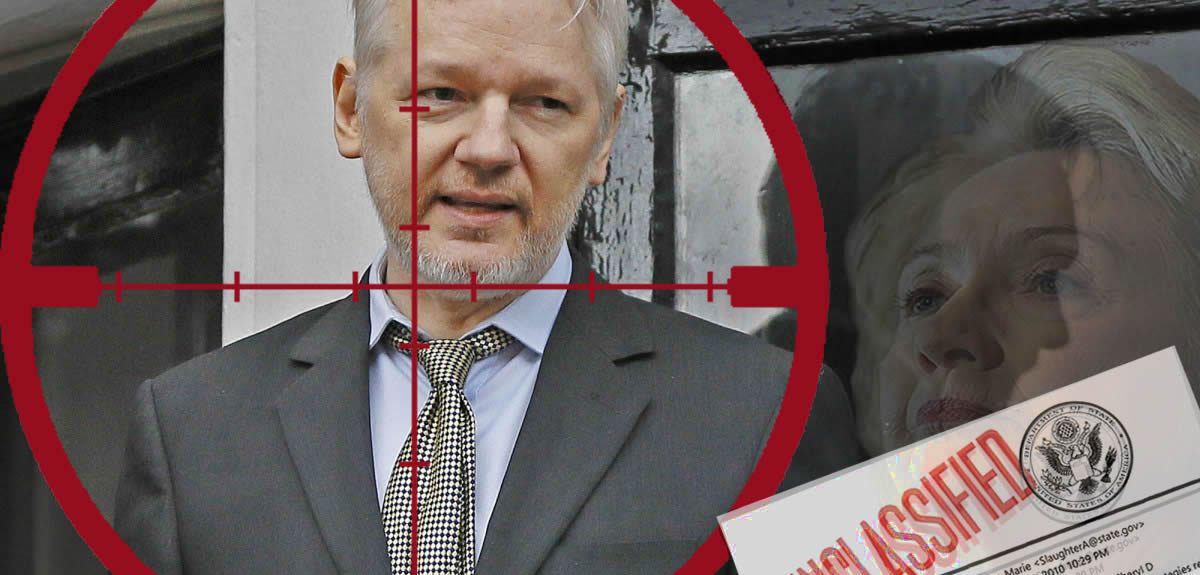
Slow-Motion US/UK Killing of Julian Assange

By Stephen Lendmen

Source: StephenLendmen.org

Establishment media are in cahoots with US/UK ruling regimes against Assange for the “crime” of truth-telling journalism abhorred in the West — totalitarian rule where these societies are heading.

In mid-October, UN special rapporteur on torture Nils Melzer denounced Assange’s judicial lynching and egregious mistreatment, saying the following:

“What has the man done? He has disclosed an enormous amount of information that governments want to remain secret, most infamously the ‘Collateral Murder’ video, which, in my view, is evidence for war crimes.”

“What is the scandal in this case is that everyone focuses on Julian Assange. Here is someone who exposes evidence for war crimes, including torture and murder, and he is under this constant pressure.”

“I am absolutely convinced he will not receive a fair trial in Virginia, and he will remain in prison under inhumane conditions for the rest of his life.”

Tulsi Gabbard is the only US presidential aspirant expressing support for journalist Assange, as well as whistleblowers Chelsea Manning, Edward Snowden, and others like them, opposing their “prosecution like criminals.”

If elected president, she’d drop charges against them, she said, calling for greater “protect(ion) (of) our civil liberties,” adding:

Assange’s arrest in Britain “poses a great threat to our freedom of the press and to our freedom of speech” — the same true about how Chelsea Manning, Snowden, and other whistleblowers are mistreated.

What happened to them “could happen to you. It could happen to any of us,” she stressed.

Bipartisan politicians in the US and UK, along with establishment media, refuse to support Assange’s struggle for justice.

On Monday, he appeared in London’s Westminster Magistrates Court. Showing the effects of egregious mistreatment since unlawfully dragged from the city’s Ecuadorian embassy and imprisoned under harsh conditions, he was too physically and emotionally shattered to participate in his defense.

He’s an investigative journalist/whistleblower, publishing material supplied by sources believed to be credible, unidentified for their protection.

WikiLeaks is not an intelligence operation. Nor it it connected to Russia or any other country. Claims otherwise are fabricated.

Assange earlier explained that WikiLeaks has the right “to publish newsworthy content. Consistent with the US Constitution, we publish material that we can confirm to be true,” he stressed.

US charges against him are fabricated and malicious, what no legitimate tribunal would accept.

Justice Department lawyer James Lewis falsely accused him of “spying,” lied saying he’s “not a journalist,” turned truth on its head claiming his actions were “criminal in both the US and UK” — the above Big Lies how all fascist police states operate.

Assange attorney Mark Summers called for dismissal of Washington’s illegitimate extradition request, saying:

According to the 2003 UK/US extradition treaty, it “shall not be granted if the offense for which extradition is requested is a political offense,” adding:

The unjustifiable persecution of Assange and Chelsea Manning is “part of an avowed war on whistleblowers to include investigative journalists and publishers.”

Summers requested a three-month delay of Assange’s February 25 extradition hearing because “we need more time” to prepare a proper defense, given the “enormity” of issues involved, requiring “evidence gathering that would test most lawyers.”

Operating as an imperial tool, judge Vanessa Baraitser denied the request, saying the extradition hearing will proceed as schedule on February 25 at Woolwich Magistrates Court near Belmarsh Prison.

Its public gallery has three seats, assuring Assange’s judicial lynching will be virtually closed to public scrutiny.

Barely able to stand and speak after months of barbaric mistreatment, when asked if there’s “anything (he) would like to say, he replied barely audibly that he doesn’t “understand how this is equitable,” adding:

Imperial USA “had 10 years to prepare (its judicial lynching). I can’t remember anything. I can’t access any of my written work.”

“It’s very difficult to do anything with such limited resources against a superpower intent on” an illegitimate crucifixion. “I can’t think properly” from the barbaric ordeal he’s endured.

Baraitser dismissively replied that “conditions of your detainment are not the subject of this court.”

Following the hearing, WikiLeaks editor-in-chief Kristinn Hrafnsson called for the case against Assange to “be thrown out immediately,” adding:

“Not only is it illegal on the face of the (extradition) treaty, the US has conducted illegal operations against Assange and his lawyers which are the subject of a major investigation in Spain.”

John Pilger witnessed Monday’s spectacle, saying “(t)he whole thing is a grotesque absurdity. There is an extradition law between this country and the United States.”

“It states specifically that someone cannot be extradited if the offenses are political.”

“The source of this is a rogue (US) state — a state that ignores its own laws and international laws and the laws of this country.”

Summers called Assange’s crucifixion “a political attempt to signal to journalists the consequences of publishing information” ruling regimes want suppressed.

“It’s legally unprecedented…part of an avowed war on (truth-telling) whistleblowers to include investigative journalists and publishers.”

In cahoots with the Trump regime, police state Britain is killing Assange slowly, wanting him, whistleblowers like Chelsea Manning, and other truth-tellers silenced.

What’s going on is the hallmark of totalitarian rule – controlling the message, eliminating what conflicts with it, notably on major geopolitical issues.

Losing the right of free expression endangers all others. When truth-telling and dissent are considered threats to national security, free and open societies no longer exist – the slippery slope America and other Western societies are heading on.

Judge Denies Assange Extension on Extradition Hearing

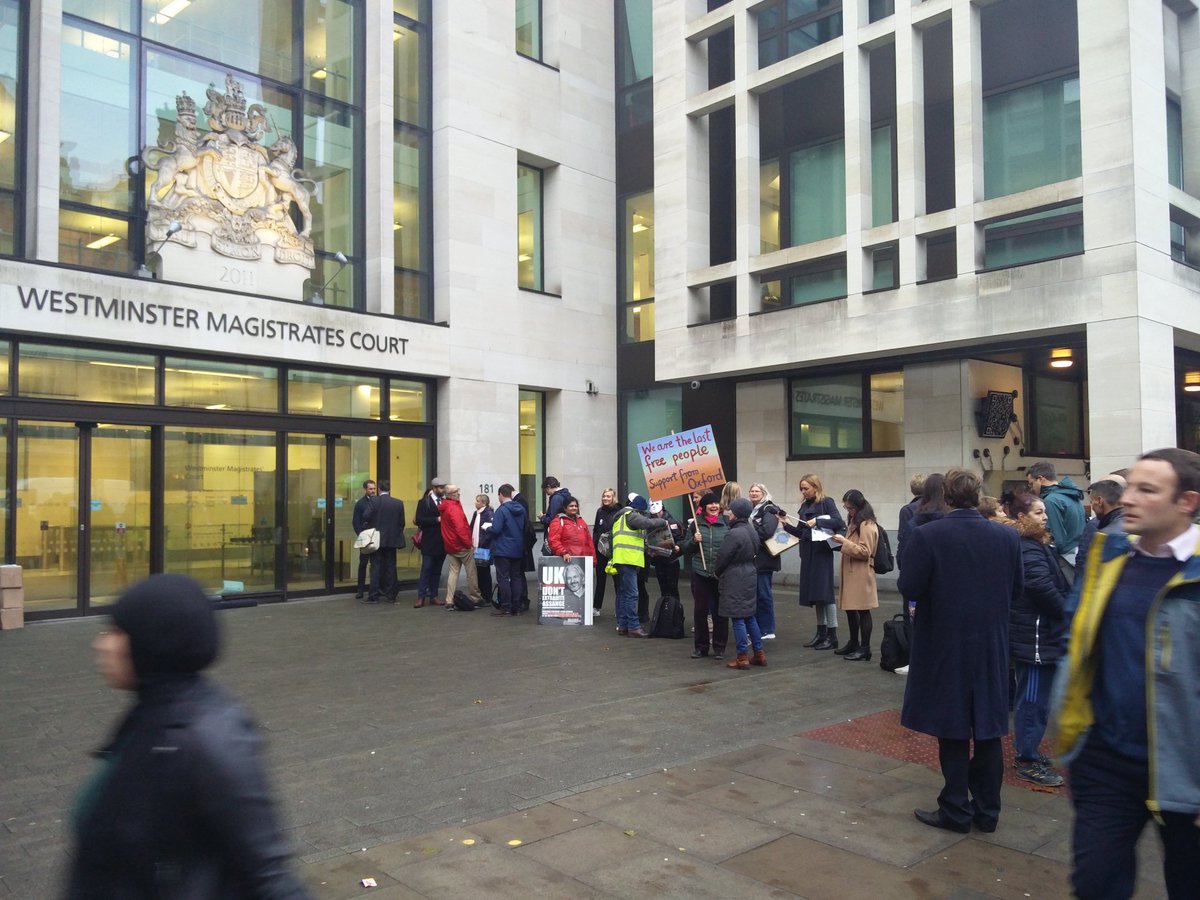
Protestors line up at courthouse Monday morning. (Gordon Dimmack)

A judge at a hearing in London has denied the WikiLeaks’ publisher more time to prepare his defense, while a group of Australian politicians coalesce around a demand to return Julian Assange home.

By Joe Lauria

Source: Consortium News

The judge in Julian Assange’s extradition process on Monday denied his lawyer’s appeal for more time to prepare his case as the imprisoned WikiLeaks publisher weakly told the court he was unable to “research anything” in the conditions under which he is being held in high-security Belmarsh Prison.

Assange appeared in person at Westminster Magistrate’s Court in London Monday morning for a case management hearing on the request by the United States for Assange to be sent to Virginia to face 18 charges, including allegedly violating the U.S. Espionage Act for possessing and disseminating classified information that revealed prima facie evidence of U.S. war crimes.

Mark Summers, Assange’s lawyer, told the court the charges were “a political attempt” by the U.S. “to signal to journalists the consequences of publishing information.” The Espionage Act indictment against Assange by the Trump Administration is the first time a journalist has been charged under the 1917 Act for publishing classified material.

“It is legally unprecedented,” Summers told Judge Vanessa Baraitser. He argued that President Donald Trump was politically motivated by the 2020 election to pursue Assange.

Summers also argued before Baraitser that the U.S. “has been actively engaged in intruding into privileged discussions between Assange and his lawyers.” It was revealed this month that the Central Intelligence Agency was given access to surveillance video shot by a private Spanish company of all interactions Assange had with lawyers, doctors and visitors.

“This is part of an avowed war on whistleblowers to include investigative journalists and publishers,” Summers said. “The American state has been actively engaged in intruding on privileged discussions between Mr Assange and his lawyer.”

Because of this surveillance, including “unlawful copying of their telephones and computers” as well as “hooded men breaking into offices,” Assange’s lawyers needed more time to prepare his defense, Summers argued. But Baraitser refused the request, and ordered Assange back in court for a second management hearing on Dec. 19. The full extradition hearing is scheduled to begin on Feb. 25 next year.

Not Equitable

As the hearing ended Monday, Baraitser asked Assange if he understood what had just transpired. “Not really. I can’t think properly,” he said.

“I don’t understand how this is equitable. This superpower had 10 years to prepare for this case and I can’t access my writings. It’s very difficult where I am to do anything but these people have unlimited resources. They are saying journalists and whistleblowers are enemies of the people. They have unfair advantages dealing with documents. They [know] the interior of my life with my psychologist. They steal my children’s DNA. This is not equitable what is happening here.”

The Guardian quoted WikiLeaks Editor-in-Chief Kristinn Hrafnsson as saying that Assange’s case should be thrown out because of interference with preparing his defense. “Not only is it illegal on the face of the treaty, the U.S. has conducted illegal operations against Assange and his lawyers which are the subject of a major investigation in Spain,” Hrafnsson said.

According to witnesses in the courtroom, Assange appeared physically and mentally enfeebled after months in isolation in prison. Tristan Kirk, correspondent for the London Evening Standard, tweeted: “Julian Assange struggled to say his own name and date of birth as he appeared in the dock. He claimed to have not understood what happened in the case management hearing, and was holding back tears as he said: ‘I can’t think properly.’”

In response to Kirk’s message, Assange’s mother, Christine Assange, tweeted: “This breaks my heart! They are breaking my beautiful bright, brave journalist son, the corrupt bastards!”

https://twitter.com/AssangeMrs/status/1186254253481811970

Supporters Outside

Assange’s supporters swarmed the van in which Assange was driven away from the courthouse back to his dreary isolation in the hospital ward at Belmarsh.

https://twitter.com/matthabusby/status/1186239398385504256

Speaking outside the courthouse after the hearing, journalist John Pilger called the legal assault on Assange a “deliberate action of a rogue state, a state that ignores its own laws and international law.”

“There were people crying in the gallery,” said Assange supporter Emmy Butlin. “He is like a ghost. He could hardly talk. He’s dying.”

Australian MPs Back Assange

Meanwhile in Assange’s native Australia, members of Parliament have demanded that Assange be returned to his country.

MP Andrew Wilkie told the House of Representatives last week that Assange is “an Australian citizen and must be treated like any other Australian. He was not in the U.S. when he provided evidence of U.S. war crimes in Iraq. He can’t possibly have broken their laws.”

If Assange is extradited, Wilkie said he

“faces serious human rights violations including exposure to torture and a dodgy trial. And this has serious implications for freedom of speech and freedom of the press here in Australia, because if we allow a foreign country to charge an Australian citizen for revealing war crimes, then no Australian journalist or publisher can ever be confident that the same thing won’t happen to them. Put simply, he must be allowed to return to Australia.”

Wilkie, an Australian former intelligence officer who resigned because of the falsehoods about WMD in Iraq before the 2003 invasion, is reportedly working to set up a parliamentary committee that crosses party lines to demand that the Liberal government of Prime Minister Scott Morrison opposes Assange’s extradition.

The Australian TV program “The Project” reported on Sunday that up to 10 politicians were ready to join the committee.

“It’s important that parliamentarians learn the facts of this matter,” Wilkie told the program. “There’s so much naiveté and ignorance and disinformation swirling around that it’s no wonder that a lot of people are wary or even dislike Julian, but I reckon that when people find out the facts of the matter they will get behind him.

“This is about the right of person not to be extradited to another country based on a whim or the politics of it. The whole thing stinks quite frankly, I think he should be allowed to come to Australia.”

Wilkie called the ability for Morrison to stand up to Trump, with whom he’s said to be close, “a test for the prime minister.”

“It’s one thing to be mates with someone, but it’s another thing entirely to agree to do something which is entirely improper. I mean ScoMo is the prime minister of Australia, he’s not the vice president of the United States I hope. And this is an opportunity for Australia to say we stand for the rule of law and we stand behind people who stand up and speak about war crimes. Australian politicians kowtow to the U.S. all the time without realizing that our alliance would be even stronger if sometimes we said, ‘No.’ Because if ScoMo just rolls over on this and is happy for Julian Assange to be extradited from Belmarsh Prison in the UK to the U.S., well that just means Australia can be taken for granted. You actually lose leverage bizarrely by having a really close relationship that Scott Morrison seems to have with Donald Trump. Rather than putting Australia in a better position it can put Australia in a weaker position because the U.S. knows it can be taken for granted.”

Wilkie joined right-wing MP Barnaby Joyce who the previous week came out in Assange’s defense. “Whether you like a person or not, they should be afforded the proper rights and protections and the process of justice,” Joyce said.

Wilkie told “The Project,” “When someone like Barnaby Joyce thinks there’s an issue here then people should pay attention.”


Joe Lauria is editor-in-chief of Consortium News and a former correspondent for The Wall Street Journal, Boston GlobeSunday Times of London and numerous other newspapers. He can be reached at joelauria@consortiumnews.com and followed on Twitter @unjoe .