Language Leaps and the Information Shuffle

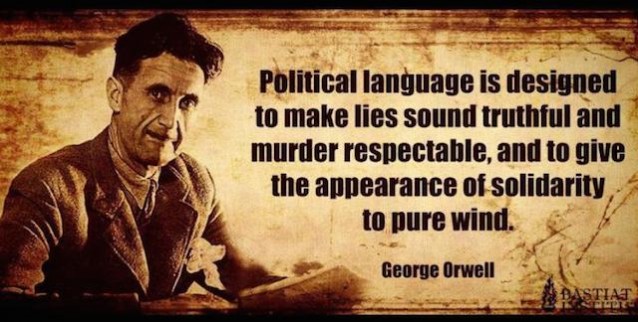
George-Orwell-political-speech-638x322

By Zen Gardner

Source: ZenGardner.com

So much can be told by language shifts. Both what’s being used more frequently in general as well as substantial new additions, and deletions, to the lexicon. This goes two ways. The controllers keep shifting their language and euphemisms to blanket their intentions, while the awakening community grabs hold of and proliferates empowering and revealing words and concepts that grow in usage at an astounding and truly inspiring rate.

This is a powerful manifestation of the awakening.

Just look how easily and readily words like Zionism, the matrix, the Illuminati, social engineering, transhumanism, freemasonry, psychopathy, cognitive dissonance, geoengineering, false flags and big brother surveillance are being used now. These were considered side line or taboo issues discussed by whack jobs not long ago. Now? They’re mainstays of conversation that bleed more and more into the mainstream dialogue.

That speaks volumes as to the effect the onslaught of true information is having. And something to be very encouraged and inspired about.

Droning Psychopaths Tell No Truth

The official narrative of the “powers that shouldn’t be” is also a changing landscape. While our language is rooted in truth, theirs is a constant smokescreen of disinformation designed to deceive, decoy and disempower.

Examples du jour? We’re all too familiar with misleading names like the “Patriot Act” or the always ready handle “national security” and the like, but lately they’ve taken to covering their tracks even more, no doubt due to the awakening taking place, even in simple language recognition they’re no doubt following with all of their invasive computer algorithms.

Mass surveillance has now become “bulk data collection” while torture is conveniently labelled “extraordinary renditions” and “enhanced interrogation programs.” All arrogantly perpetrated as if no one even notices. But these shifts in contrived perception work on the unwary, which is why the official narrative is laden with such misleading and obfuscating terms and labels couched in complete blather like any one of Obama’s wet cardboard speeches.

After all, to them, truth isn’t the issue, it’s control and getting their program across as seamlessly as possible. Therein lies the rub, and a very important one to identify.

Look for Real Empathy

What really resonates with you? And what confuses or disanimates you? These are ways to discern between the lines in the barrage of information coming at us. It’s truly an informational war going on in so many ways, but thankfully one that the truth is always destined to win.

It may be ever so incremental, but Truth stands its ground no matter what assails it.

There is no resonant sense of love or down to earth practical truth with propaganda. It always falls flat and only appeals to very dry and distant programmed self justification mechanisms. That’s the intent. Keep us in our self circumscribed socially engineered limits in a dazed state of some far off distant “belief” guaranteed by some voice from somewhere leading people on with some promised carrot to chase after.

However, real, good information feeds. It nourishes. It’s clear and empowering in some way. It embraces your soul, encourages your convictions, and leads you to new understandings that positively affect your life.

Know the difference.

You already do, just listen to your heart. And respond accordingly.

Much love always, Zen
Out of the Wild

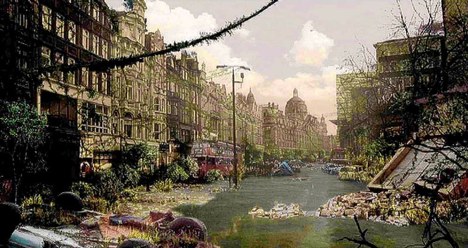
london20after20people-jj-001

At Orion Magazine, authors William Cronon and Michael Pollan share a stimulating conversation about how language shapes our world. They cover questions such as “what is wild?”, “what is cultivated?”, and “what can these ideas teach us about our relationship to landscape?”. What I found most compelling was the last part of the conversation where they talk about the power and importance of storytelling:

Bill:  Right. Ecology, storytelling, history—they all render connections visible. We make that which is invisible visible through story, and thereby reveal people’s relationships to other living things.

Michael:  Stories establish canons of beauty, too. There is a role for art in changing cultural norms about what’s worth valuing. One hundred fifty years ago, certain people looked at a farm and saw what you might see if you look today at a nuclear power plant or some other degraded landscape. Part of the reason we tell stories is to create fresh value for certain landscapes, certain relationships.

Bill:  And stories make possible acts of moral recognition that we might not otherwise experience. They help us see our own complicity in things we don’t ordinarily see as connected to ourselves.

Michael:  Yes, exactly. That recognition can help remove the condescension in so much environmental writing by showing us that, look, these things we abhor are done in our name, and we are complicit in them, and we need to take account of them. It was Wendell Berry’s idea that the environmental crisis is a crisis of character. The big problem is the result of all the little problems in our everyday lives. That can be a guilt trip, but it doesn’t have to be. You can tell that story in ways that empower people.

Storytelling can also help us find hopeful solutions. For example, when I was writing Omnivore’s Dilemma and I went to Joel Salatin’s farm in Virginia, I learned how his grazing worked—intensive rotational grazing—and he explained to me what happens under the surface, how every time the ruminants come through and shear that pasture and reduce that leaf mass, a roughly equivalent amount of root mass is broken down and turned into soil. I learned that he takes vast amounts of food off this pastureland, without subtracting anything. To the contrary, the sun is feeding the grass, and the grass is feeding the ruminants; the ruminants are feeding us, and they’re also feeding the soil.

I suddenly saw a whole other way of conceiving our relationship to nature, that there are systems that exist, and could exist, that are non zero sum. There is a free lunch in nature: it’s solar energy, which means it isn’t necessarily true that for us to feed ourselves we have to diminish the world.

When you tell an audience that story, it fills them with hope and a sense of possibility, and that’s a function of storytelling. But, of course, it isn’t always so neat. There are questions of scale, and if you eat meat, there are problems with cattle. But I’m always looking for stories that refresh this narrative about nature that we’re so stuck in.

Bill:  Messy stories invite us into politics. They also invite us to laugh at ourselves. And those things together—the ability to laugh, to experience hope, to be inspired toward action at the personal and political levels—these strike me as the work of engaged storytelling in a world we’re trying to change for the better.

Michael:  I do have a lot of faith in the power of stories to do things. My greatest thrill as a writer is when I see people changed by the work, when people tell me that they’ve changed their behavior in some way because of something they’ve read.

One of the things I’ve fought very hard to do with my editors is to talk about alternatives when I talk about problems. For example, if I’m writing an incredibly dark story about industrial meat production and following a cow through the feedlot and slaughterhouse, I really want three paragraphs on the alternative to this system, which is to say, grass-finished beef. Those three paragraphs have more impact than anything else in the piece. And I still hear from ranchers that it was on the day that an article on that topic came out that we began to see the stirrings of a new market for grass-finished beef. “We no longer send them to the auction barn right away,” they tell me. “We’re finishing on grass now.”

Bill:  That’s a good story about storytelling.

Michael:  You have to pass through the dark wilderness of the feedlot before you can get there, but I think that there’s an appetite for hope that journalists don’t often satisfy.

I’ve met people, in their twenties especially, who really hate the model of the investigative article that tells them how messed up things are and doesn’t point to some alternative. True, the alternative you’re proposing can seem tacked on, and it can be incommensurate with the scale of the evils—but I think people want hope, a course of action they can take. This is something many journalists are missing right now. I think if our writing doesn’t include that dimension in some way, we lose people.

Bill:  It strikes me that you’re pointing to a great tradition in the environmental movement, which is the power of good storytelling, going back to Rachel Carson.

Michael:  She was incredibly effective rhetorically. Silent Spring is a very sophisticated piece of work.

Bill:  It’s stunningly done.

Michael:  It’s stunningly done. And it speaks to the power of fictional ideas like wilderness. Carson understood that, even if you’re writing about science, narrative is important. The trick I learned from her is never to talk about “neurotoxins”; instead, you tell the story of the molecule in the cell. Because there’s a narrative everywhere, even at the level of molecules.

Bill:  Maybe that’s a good note for us to end on, don’t you think? The poet Muriel Rukeyser once said that “the world is made of stories, not of atoms.” When we lose track of the narratives that human beings need to suffuse their lives and the world with meaning, we forget what makes the world worth saving. Telling stories is how we remember.

Read the complete transcript here: http://www.orionmagazine.org/index.php/articles/article/7811