
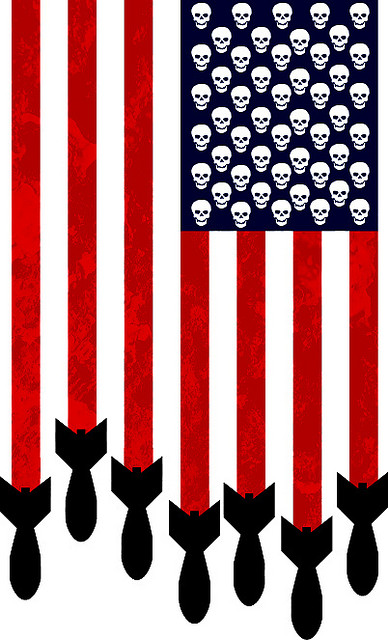
AS WAR DRUMS BEAT FOR UKRAINE, REMEMBER, LIES AND PROPAGANDA STARTED NEARLY EVERY WAR IN US HISTORY

By Don Via Jr,

Source: Waking Times

War is one of the most primitive and senseless manifestations of the human experience, so naturally, most sane people with families, ambitions and kind hearts want nothing to do with such things. Unfortunately, as we are seeing with the Ukraine / Russia escalation, governments thrive on war, as it gives them a pressing excuse to grab more power and take extrajudicial measures—both at home and abroad.

To get around the obstacle of public opinion, governments have an extensive history of lying their way into war. This is hard to believe for people who think that government has their best interest in mind, but it is something that rulers have been doing since the beginning of time. In the modern United States, people are led to believe that the establishment accidentally flounders its way into war with the good intentions of protecting the country from harm or liberating an ally in distress.

This strategy of deception was illustrated by the Nazi propagandist Herman Goering, who famously said:

“Of course the people don’t want war. Why should some poor slob on a farm want to risk his life in a war when the best he can get out of it is to come back to his farm in one piece? Naturally, the common people don’t want war neither in Russia, nor in England, nor for that matter in Germany. That is understood. But, after all, it is the leaders of the country who determine the policy and it is always a simple matter to drag the people along, whether it is a democracy, or a fascist dictatorship, or a parliament, or a communist dictatorship. Voice or no voice, the people can always be brought to the bidding of the leaders. That is easy. All you have to do is tell them they are being attacked, and denounce the peacemakers for lack of patriotism and exposing the country to danger. It works the same in any country.

Of course, the Nazi regime is notorious for their brutality and deceit, so this admission is not as stunning as it would be from an American general, but make no mistake that these are the types of thoughts that American generals and politicians have—they are just not brazen enough to say it out loud.

Believe it or not, using deceptive tactics to sway public opinion in favor of war is actually an official part of the US military’s playbook. According to Wikileaks, the U.S. Army’s publication “Special Forces Foreign Internal Defense Tactics Techniques and Procedures for Special Forces” recommends funding terrorists for regime change operations and using false flag attacks to destabilize regimes that were unfriendly to western interests.

This is nothing new though, this is a part of American history, as nearly every war that the U.S. has ever been involved in was built upon lies. Below are some of the most well-documented examples of wars that were started because of lies and government propaganda.

Spanish-American War – 1898

In January 1898, President William McKinley ordered the USS Maine to port in Havana, Cuba, despite years of conflict between Cuban rebels and the Spanish government. The move was intended to be a show of force against the Spanish government, in line with the Monroe doctrine, to establish U.S. dominance in the Western hemisphere.

At 9:40 p.m., on February 15, 1898, The USS Maine exploded with a crew of 354 men on board, killing 266. While the Spanish government insisted the explosion was caused by a fire in a coal bunker that ignited the forward magazines, politicians in the U.S. were quick to blame Spain because they wanted an excuse to wage a war of conquest for territory in Mexico, the Caribbean, and the Pacific.

Although President McKinley had previously voiced his opposition to a military conflict, on April 25, the U.S. declared war on Spain.

The “Ten-Week War” resulted in not only the defeat of the last remnants of the Spanish empire but in a new era of U.S. “expansionism” as the United States took control of Puerto Rico, Guam, and the Philippine islands.

In 1976, a team of naval explosive experts examined the evidence and corroborated Spanish claims that the USS Maine’s sinking was caused by an internal explosion from ammunition being stored on board.

World War 1 – 1915

The first world war was opposed by most Americans from the start, as they rightly saw it as a power struggle between European aristocrats that they had no business in. This was a problem for the British military, led by Winston Churchill, as they were desperate to get the United States behind them in the war.

The U.S. did finally enter the war in 1915, when a U.S. ship called the Lusitania was sent through hostile waters as bait, filled with more than a thousand civilians and an unusually large amount of ammunition. The ship was hit by a German torpedo and exploded instantly due to all of the ammunition onboard, killing more than half of the passengers and crew.

A week before the sinking of Lusitania, Churchill wrote to Walter Runciman, the President of the Board of Trade, stating that it is “most important to attract neutral shipping to our shores, in the hope especially of embroiling the United States with Germany.”

After investigating the tragedy, former British naval intelligence officer Patrick Beesly said, “unless and until fresh information comes to light, I am reluctantly driven to the conclusion that there was a conspiracy deliberately to put Lusitania at risk in the hope that even an abortive attack on her would bring the United States into the war. Such a conspiracy could not have been put into effect without Winston Churchill’s express permission and approval.”

In addition to this treacherous military maneuver, there was a relentless campaign in the U.S. to dehumanize Germans and to paint them as monsters. In some propaganda that was peddled to U.S. citizens, German soldiers were depicted killing babies and sometimes eating them. There were even false reports of crucifixions.

World War 2 – 1941

The history books suggest that Pearl Harbor was an unprovoked attack, killing thousands of Americans and “forcing” the government to enter a war that was extremely unpopular at the time. However, the U.S. government was enacting strict sanctions on both Japan and Germany, hoping that either country would make the first move and give them an excuse to enter the war. Not only was the attack provoked, but President Roosevelt and the U.S. military knew the attack was coming and moved their most expensive aircraft to other locations while leaving thousands of people as sacrificial pawns.

The history books also sell the war against the Nazis as a humanitarian war to save people from the Holocaust, but the U.S. denied safe passage to Jewish refugees, and UK intelligence even planned to blow up refugee ships, in a plot called Operation Embarrass.

Many American businesses and politicians worked very closely with the Nazis even after the two countries were at war with each other. The Holocaust had already claimed the lives of millions of German people by that point, and a police state had long since been established, so whoever was doing business with the Nazis knew exactly who they were getting involved with.

Prior to the Americans getting involved in the war, there were corners of the political arena that were actually big supporters of the Nazi party—both for business purposes and common interests such as eugenics.

The most prominent American politician to work with the Nazis was actually George W. Bush’s grandfather, Prescott Bush. There is no doubt that he was funding and working with the Nazis because his company’s assets were seized in 1942 by the United States government under the “trading with the enemy” act. He worked at the head of a financial firm called Brown Brothers Harriman, which acted as a U.S. base for the Nazi business interests.

Brown Brothers Harriman was one of the biggest international investment firms in the 1930s and they sent millions of dollars in gold overseas to rebuild the German army and fund the Nazi party. This racket was finally exposed on July 30, 1942, when the New York Herald Tribune posted an article titled, “Hitler’s Angel Has three million dollars in US Bank.” This article raised suspicion about the bank being a “secret nest” for Nazi elites and eventually sparked the investigation that took down the operation.

Korean War – 1950

The propaganda of war has led many to believe that the North Korean government launched an unprovoked attack on South Korea, on behalf of the larger communist powers of Russia and China. Yet, once again, this was another case where the U.S. was propping up one dictator to fight another, in an attempt to gain control of an entire continent—all the while, lying to the people back home about the true motivations for war.

As historian Mark E. Caprio, professor of history at Rikkyo University in Tokyo points out:

“On February 8, 1949, the South Korean president met with Ambassador John Muccio and Secretary of the Army Kenneth C. Royall in Seoul. Here the Korean president listed the following as justifications for initiating a war with the North: the South Korean military could easily be increased by 100,000 if it drew from the 150,000 to 200,000 Koreans who had recently fought with the Japanese or the Nationalist Chinese. Moreover, the morale of the South Korean military was greater than that of the North Koreans. If war broke out he expected mass defections from the enemy. Finally, the United Nations’ recognition of South Korea legitimized its rule over the entire peninsula (as stipulated in its constitution). Thus, he concluded, there was “nothing [to be] gained by waiting.”

Vietnam War – 1964

Information released in 2005 by the National Security Agency showed that the Gulf of Tonkin incident on August 1964 was deliberately falsified to make it appear that North Vietnamese gunboats attacked an American destroyer patrolling in international waters when in reality, they did not. This was the event that the U.S. military used as an excuse to go to war in Vietnam and it was surrounded by mystery and controversy until decades later when the official facts were released.

It has now been 49 years since the U.S. withdrew the last of its combat troops from Vietnam and the last prisoners of war that were held in North Vietnam returned to U.S. soil. According to estimates, more than 2 million civilians, 1.1 million North Vietnamese and Viet Cong fighters, 250,000 South Vietnamese fighters, and nearly 58,000 U.S. military members were killed in Vietnam during the war—all because of lies that were used to create propaganda that made American fear for their safety.

Libya – 1984 (then 2015)

Former Mossad agent Victor Ostrovsky admitted that the Mossad planted a radio transmitter in Libyan Prime Minister Muammar Gaddafi’s compound in Tripoli, which broadcast fake terrorist transmissions that were recorded by Mossad and used to frame Gaddafi as a terrorist supporter. President Reagan bombed Libya immediately after the false reports, but this was not the first or last time the U.S. would involve itself in Libya.

As The Free Thought Project has reported, 3,000 emails from former Secretary of State Hillary Clinton released by the State Department contained damning evidence of Western nations using NATO as a tool to overthrow Gaddafi.

The NATO overthrow was not for the protection of the people, but instead, it was to thwart Gaddafi’s attempt to create a gold-backed African currency to compete with the Western central banking monopoly. As per usual, the U.S. and its Western counterparts left the country to its own devices after slashing the once-thriving nation to the ground.

“Today there is no government of Libya. It’s simply mobs that patrol the streets and kill one another,” Virginia State Senator Richard Black told RT of the mess left behind.

Despite certain issues in Libya before the coup, “Libyans had an incredibly high standard of living, the highest in Africa,” international lawyer Francis Boyle told RT. “When I first went to Libya in 1986, I was amazed by the empowerment of women. What I saw in Libya was that women could do anything they wanted to do.”

Iraq – 1990

At the onset of Operation Desert Storm in 1990, a public relations firm by the name of Hill and Knowlton spent millions of dollars on the U.S. government’s behalf, constructing news pieces that would sell the war to the American public. One of the most moving hoaxes to come from this push to war was the testimony of a 15-year-old Kuwaiti girl, known only by her first name of Nayirah.

In a videotaped testimony that was later distributed to the media, she claimed that Iraqi soldiers killed babies in incubators at a hospital.

I volunteered at the al-Addan hospital, While I was there, I saw the Iraqi soldiers come into the hospital with guns, and go into the room where… babies were in incubators,” Nayirah said. “They took the babies out of the incubators, took the incubators, and left the babies on the cold floor to die.”

Sounds horrible, right? Well, luckily it never happened. This was a fabricated event designed to dehumanize the Iraqi people in the eyes of the American public. The whole thing was exposed when journalists discovered that the witness, Nayirah was actually the daughter of a U.S. ambassador, who was being coaxed by military psychological operations specialists.

In addition to this false testimony, the U.S. government also showed Saudi Arabia fake satellite images that depicted Iraqi troops massing on their border.

Iraq – 2003-Present

Emails that were declassified in 2015 paint a much different picture of the Bush administration’s invasion of Iraq than they led the public to believe. A memo drafted by the U.S. embassy in London revealed how the Bush administration used “spies” in the British Labor Party to help shape British public opinion in favor of the war, prior to U.S. invasion.

In the weeks leading up to the invasion of Iraq, the Bush administration inundated American airwaves with assertions ranging from Saddam Hussein’s connections to Al-Qaeda, to Colin Powell’s ‘badly flawed’ claims that Iraq had weapons of mass destruction.

After invading a sovereign foreign nation, President George W. Bush blatantly lied to the American public and when news came to light that there were, in fact, no weapons of mass destruction, he simply accused anyone who criticized him of attempting to “revise history.” 

During his presidency, while giving a speech about that very issue, Bush saidThis nation acted to a threat from the dictator of Iraq. Now there are some who would like to rewrite history—revisionist historians is what I like to call them.

War on Terror – 2001-Present

Now the United States military and its allies are exporting their wars of terror across the globe, in the name of fighting terrorism, and most of these wars are also justified with propaganda and lies.

In the early days of the “War on Terror,” the Macedonian government was caught staging a fake terror attack in an attempt to get funding from western forces. Six innocent Pakistani immigrants were accused of being terrorists and killed in the incident.

In 2001, U.S. media spent weeks circulating the idea that anthrax attacks were being carried out by Arabs connected with Afghanistan, when in reality it was a government scientist behind the attacks.

In 2005, former Department of Justice lawyer John Yoo suggested that the U.S. should create a false terrorist organization to give the military an excuse to attack places where they believed real terrorists might be hiding:

“Our intelligence agencies create a false terrorist organization,” Yoo said. “It could have its own websites, recruitment centers, training camps, and fundraising operations. It could launch fake terrorist operations and claim credit for real terrorist strikes, helping to sow confusion within al-Qaeda’s ranks, causing operatives to doubt others’ identities and to question the validity of communications.”

In 2005, Israeli soldiers admitted to throwing stones at other Israeli soldiers so they could blame it on Palestinians to justify using violent force against protesters. Israel also has a deep history of using lies and false attacks to justify military action.

In an incident that came to be known as The Lavon Affair in 1954, undercover Israeli agents set off bombs against U.S. and Brittish targets, hoping that the attack would be blamed on local rebels. Luckily, they were caught and the plot was exposed.

This long track record of deception is important to consider as the U.S. military is beating the war drum again, this time in Iran, where there has also been a long list of false attacks at the hands of western powers.

Starting all the way back in 1957, politicians in the U.S. and UK developed a plot to train Islamic extremists to carry out false flag attacks to push for regime change in Iran. Now, decades later, history is repeating itself in the same part of the world, as regime change in Iran is back on the agenda, and the western powers are following the same playbook.

Current Push For A Proxy War Against Russia In Ukraine — 2022

As this report has demonstrated, the use of falsified evidence, propaganda, disinformation, and even outright false flag attacks, has been common practice within the military industrial complex handbook of expanding US imperialism and the neo-liberal world order.

This latest push to essentially turn the Ukraine into Syria 2.0, a convoluted dirty war among proxy States/ groups to maintain American hegemony — and potentially bring the world to the brink of annihilation in the process — is no different.

While it is of course pertinent to recognize that the reality for the Ukrainian people on the ground is a complex one rooted in nearly a century of culture and history weaving its own tensions among the local populations;  A number of facts clearly demonstrate the reality of the driving forces behind today’s conflict.

In 2010, diplomatic cables released by WikiLeaks show correspondence between American and French officials that paint plainly the intentions of Western policymakers to absorb Ukraine into NATO. Being in direct violation of the agreements made between the United States and former Soviet leader Mikhail Gorbachev in 1990.

Fast forward four years and we see the beginning stages US/ NATO’s aggressive expansionism eastward come to fruition.

Following Ukrainian President Viktor Yanukovych’s rejection of joining NATO, small anti-corruption protests that had already been ongoing were co-opted by Western agent provocateurs and shifted into a regime change color revolution.

What was touted in the western media as an organic people’s uprising to overthrow their communist leader, was really a carefully crafted coup d’état.

We know this due to a leaked phone call from then US Assistant Secretary of State Victoria Nuland. In it, she can be heard discussing with U.S. Ambassador to Ukraine Geoffrey Pyatt the key figures which should be installed in a post-Yanukovych government.

Showing that not only were the protests not organic, but the US was directly involved in the government overthrow.

In 2022, Victoria Nuland is now acting as the Under Secretary of State. The call also acknowledged the cooperation of then-and-current National Security Advisor Jake Sullivan, and Vice President at the time now President Joe Biden. It’s no wonder things are developing the way they are when these figures have been maneuvered into such crucial positions.

But to make matters worse, in 2014 as the coup was in full swing, the United States took to facilitating the most repugnant of individuals to install their new puppet regime. Providing armaments, funding, and training to openly admitted Neo-Nazi paramilitary forces.

Years later, it seems maintaining a fascist state in Ukraine has essentially become an openly accepted part of America’s policy in the region. In December of 2021, the United Nations brought forth its annual resolution to condemn Nazism, urging nations to work together to prevent the spread of ultra-nationalist and racist ideologies. It should have been a common sense resolution for everyone to agree on.

Yet out of all members of the United Nations, the United States and Ukraine were the only two to vote against it. Sadly, this has become tradition. Both Nations have regularly voted against the resolution since 2014.

In line with this, Western media is still permeated with propaganda distorting the facts driving the conflict. As elaborated in this brilliant piece by Mintpress News’ Alan Macleod, the US has spent upwards of 22 million dollars sowing the seeds of discontent to favor an anti-russian, pro-US and NATO expansionist agenda.

No one here is claiming that Vladimir Putin or Russia is a saint. As is the case with all governments they are surely just as vile and corrupt in their own ways. But the facts contradict the narrative. The idea that Russia is acting as the aggressor “threatening freedom and democracy” and “endangering the innocent” is a farce.

Even on international corporate media, the true attitudes and intentions for the crisis are openly admitted.

On the February 20th, 2022, episode of Al jazeera’s Inside Story hosting a panel of three experts regarding the Minsk agreements; Ukrainian Associate Professor of Sociology, National University of Kyiv-Mohyla Academy, Mychailo Wynnyckyj, while first claiming that Ukrainians are interested in de-escalation, closed the segment by stating brazenly —

“Looking at peaceful solutions, of course. But at the end of the day I think Ukrainians understand today that the existential threat that Russia presents to Ukraine is long-term, and we will have to deal with that long-term. It’s not something that’s going to go away tomorrow, or as long as the Putin regime remains in the Kremlin.

Openly admitting the desire for regime change. This is the prevailing attitude of elitist powers. And as mentioned earlier while it may also in part be fostered by generations of uneasy ongoings, it is also certainly augmented and exacerbated by the west’s geostrategic activities.

If the Russians were to have an organization similar to NATO, aligning themselves with China, North Korea, Iran, Venezuela, and any of the other nations America considers its adversaries; and proceeded to push its military up to our borders of Canada and Mexico. Bullying, threatening, and cajoling other nations into compliance. Openly demanding a chamge in our government. You can be damn certain we wouldn’t stand for it.

Why should any less be expected when the shoe is on the other foot, and the globalist power that is the American Empire and its allies — having a demonstrable history of flagrant war crimes and abuse — saunter its way up to Russian borders after expressing it’s desire for regime-change?
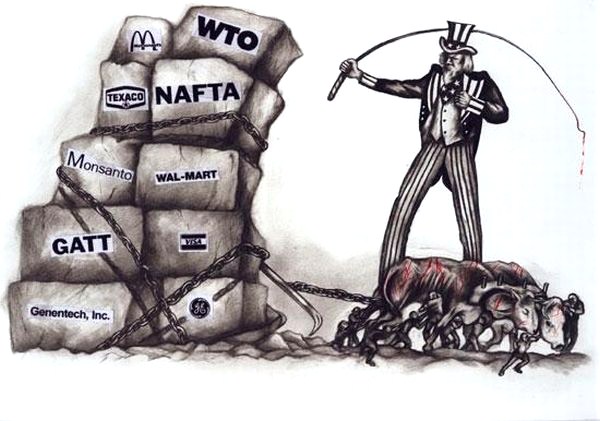
The World Will Not Mourn the Decline of U.S. Hegemony

By Paul Street

Source: Consortium News

There are good reasons to bemoan the presence of the childish, racist, sexist and ecocidal, right-wing plutocrat Donald Trump in the White House. One complaint about Trump that should be held at arm’s-length by anyone on the left, however, is the charge that Trump is contributing to the decline of U.S. global power—to the erosion of the United States’ superpower status and the emergence of a more multipolar world.

This criticism of Trump comes from different elite corners. Last October, the leading neoconservative foreign policy intellectual and former George W. Bush administration adviser Eliot Cohen wrote an Atlantic magazine essay titled “How Trump Is Ending the American Era.” Cohen recounted numerous ways in which Trump had reduced “America’s standing and ability to influence global affairs.” He worried that Trump’s presidency would leave “America’s position in the world stunted” and an “America lacking confidence” on the global stage.

But it isn’t just the right wing that writes and speaks in such terms about how Trump is contributing to the decline of U.S. hegemony. A recent Time magazine reflection by the liberal commentator Karl Vick (who wrote in strongly supportive terms about the giant January 2017 Women’s March against Trump) frets that that Trump’s “America First” and authoritarian views have the world “looking for leadership elsewhere.”

“Could this be it?” Vick asks. “Might the American Century actually clock out at just 72 years, from 1945 to 2017? No longer than Louis XIV ruled France? Only 36 months more than the Soviet Union lasted, after all that bother?”

I recently reviewed a manuscript on the rise of Trump written by a left-liberal American sociologist. Near the end of this forthcoming and mostly excellent and instructive volume, the author finds it “worrisome” that other nations see the U.S. “abdicating its role as the world’s leading policeman” under Trump—and that, “given what we have seen so far from the [Trump] administration, U.S. hegemony appears to be on shakier ground than it has been in a long time.”

I’ll leave aside the matter of whether Trump is, in fact, speeding the decline of U.S. global power (he undoubtedly is) and how he’s doing that, to focus instead on a very different question: What would be so awful about the end of “the American Era”—the seven-plus decades of U.S. global economic and related military supremacy between 1945 and the present? Why should the world mourn the “premature” end of the “American Century”?

What Would the Rest of the World Say?

It would be interesting to see a reliable opinion poll on how the politically cognizant portion of the 94 percent of humanity that lives outside the U.S. would feel about the end of U.S. global dominance. My guess is that Uncle Sam’s weakening would be just fine with most Earth residents who pay attention to world events.

According to a global survey of 66,000 people conducted across 68 countries by the Worldwide Independent Network of Market Research (WINMR) and Gallup International at the end of 2013, Earth’s people see the United States as the leading threat to peace on the planet. The U.S. was voted top threat by a wide margin.

There is nothing surprising about that vote for anyone who honestly examines the history of “U.S. foreign affairs,” to use a common elite euphemism for American imperialism. Still, by far and away world history’s most extensive empire, the U.S. has at least 800 military bases spread across more than 80 foreign countries and “troops or other military personnel in about 160

foreign countries and territories.” The U.S. accounts for more than 40 percent of the planet’s military spending and has more than 5,500 strategic nuclear weapons, enough to blow the world up 5 to 50 times over. Last year it increased its “defense” (military empire) spending, which was already three times higher than China’s, and nine times higher than Russia’s.

Think it’s all in place to ensure peace and democracy the world over, in accord with the standard boilerplate rhetoric of U.S. presidents, diplomats and senators?

Do you know any other good jokes?

Pentagon study released last summer laments the emergence of a planet on which the U.S. no longer controls events. Titled “At Our Own Peril: DoD Risk Assessment in a Post-Primary World,” the study warns that competing powers “seek a new distribution of power and authority commensurate with their emergence as legitimate rivals to U.S. dominance” in an increasingly multipolar world. China, Russia and smaller players like Iran and North Korea have dared to “engage,” the Pentagon study reports, “in a deliberate program to demonstrate the limits of U.S. authority, reach influence and impact.” What chutzpah! This is a problem, the report argues, because the endangered U.S.-managed world order was “favorable” to the interests of U.S. and allied U.S. states and U.S.-based transnational corporations.

Any serious efforts to redesign the international status quo so that it favors any other states or people is portrayed in the report as a threat to U.S. interests. To prevent any terrible drifts of the world system away from U.S. control, the report argues, the U.S. and its imperial partners (chiefly its European NATO partners) must maintain and expand “unimpeded access to the air, sea, space, cyberspace, and the electromagnetic spectrum in order to underwrite their security and prosperity.” The report recommends a significant expansion of U.S. military power. The U.S. must maintain “military advantage” over all other states and actors to “preserve maximum freedom of action” and thereby “allow U.S. decision-makers the opportunity to dictate or hold significant sway over outcomes in international disputes,” with the “implied promise of unacceptable consequences” for those who defy U.S. wishes.

“America First” is an understatement here. The underlying premise is that Uncle Sam owns the world and reserves the right to bomb the hell out of anyone who doesn’t agree with that (to quote President George H.W. Bush after the first Gulf War in 1991: “What we say goes.”

Investment Not Democracy

It’s nothing new. From the start, the “American Century” had nothing to do with advancing democracy. As numerous key U.S. planning documents reveal over and over, the goal of that policy was to maintain and, if necessary, install governments that “favor[ed] private investment of domestic and foreign capital, production for export, and the right to bring profits out of the country,” according to Noam Chomsky. Given the United States’ remarkable possession of half the world’s capital after World War II, Washington elites had no doubt that U.S. investors and corporations would profit the most. Internally, the basic selfish national and imperial objectives were openly and candidly discussed. As the “liberal” and “dovish” imperialist, top State Department planner, and key Cold War architect George F. Kennan explained in “Policy Planning Study 23,” a critical 1948 document:

We have about 50% of the world’s wealth, but only 6.3% of its population. … In this situation, we cannot fail to be the object of envy and resentment. Our real task in the coming period is to devise a pattern of relationships which will permit us to maintain this position of disparity. … To do so, we will have to dispense with all sentimentality and day-dreaming; and our attention will have to be concentrated everywhere on our immediate national objectives. … We should cease to talk about vague and … unreal objectives such as human rights, the raising of the living standards, and democratization. The day is not far off when we are going to have to deal in straight power concepts. The less we are then hampered by idealistic slogans, the better.

The harsh necessity of abandoning “human rights” and other “sentimental” and “unreal objectives” was especially pressing in the global South, what used to be known as the Third World. Washington assigned the vast “undeveloped” periphery of the world capitalist system—Africa, Latin America, Southeast Asia and the energy-rich and thus strategically hyper-significant Middle East—a less than flattering role. It was to “fulfill its major function as a source of raw materials and a market” (actual State Department language) for the great industrial (capitalist) nations (excluding socialist Russia and its satellites, and notwithstanding the recent epic racist-fascist rampages of industrial Germany and Japan). It was to be exploited both for the benefit of U.S. corporations/investors and for the reconstruction of Europe and Japan as prosperous U.S. trading and investment partners organized on capitalist principles and hostile to the Soviet bloc.

“Democracy” was fine as a slogan and benevolent, idealistic-sounding mission statement when it came to marketing this imperialist U.S. policy at home and abroad. Since most people in the “third” or “developing” world had no interest in neocolonial subordination to the rich nations and subscribed to what U.S. intelligence officials considered the heretical “idea that government has direct responsibility for the welfare of its people” (what U.S. planners called “communism”), Washington’s real-life commitment to popular governance abroad was strictly qualified, to say the least.

“Democracy” was suitable to the U.S. as long as its outcomes comported with the interests of U.S. investors/corporations and related U.S. geopolitical objectives. Democracy had to be abandoned, undermined and/or crushed when it threatened those investors/corporations and the broader imperatives of business rule to any significant degree. As President Richard Nixon’s coldblooded national security adviser Henry Kissinger explained in June 1970, three years before the U.S. sponsored a bloody fascist coup that overthrew Chile’s democratically elected socialist president, Salvador Allende: “I don’t see why we need to stand by and watch a country go Communist because of the irresponsibility of its own people.”

The U.S.-sponsored coup government that murdered Allende would kill tens of thousands of real and alleged leftists with Washington’s approval. The Yankee superpower sent some of its leading neoliberal economists and policy advisers to help the blood-soaked Pinochet regime turn Chile into a “free market” model and to help Chile write capitalist oligarchy into its national constitution.

“Since 1945, by deed and by example,” the great Australian author, commentator and filmmaker John Pilger wrote nearly nine years ago, “the U.S. has overthrown 50 governments, including democracies, crushed some 30 liberation movements and supported tyrannies from Egypt to Guatemala (see William Blum’s histories). Bombing is apple pie.” Along the way, Washington has crassly interfered in elections in dozens of “sovereign” nations, something curious to note in light of current liberal U.S. outrage over real or alleged Russian interference in “our” supposedly democratic electoral process in 2016. Uncle Sam also has bombed civilians in 30 countries, attempted to assassinate foreign leaders and deployed chemical and biological weapons.

If we “consider only Latin America since the 1950s,” writes the sociologist Howard Waitzkin:

[T]he United States has used direct military invasion or has supported military coups to overthrow elected governments in Guatemala, the Dominican Republic, Chile, Haiti, Grenada, and Panama. In addition, the United States has intervened with military action to suppress revolutionary movements in El Salvador, Nicaragua, and Bolivia. More recently … the United States has spent tax dollars to finance and help organize opposition groups and media in Honduras, Paraguay, and Brazil, leading to congressional impeachments of democratically elected presidents. Hillary Clinton presided over these efforts as Secretary of State in the Obama administration, which pursued the same pattern of destabilization in Venezuela, Ecuador, Argentina, Chile, and Bolivia.

Death Count: In the Millions

The death count resulting from “American Era” U.S. foreign policy runs well into the many millions, including possibly as many as 5 million Indochinese killed by Uncle Sam and his agents and allies between 1962 and 1975. The flat-out barbarism of the American war on Vietnam is widely documented on record. The infamous My Lai massacre of March 16, 1968, when U.S. Army soldiers slaughtered more than 350 unarmed civilians—including terrified women holding babies in their arms—in South Vietnam was no isolated incident in the U.S. “crucifixion of Southeast Asia” (Noam Chomsky’s phrase at the time). U.S. Army Col. Oran Henderson, who was charged with covering up the massacre, candidly told reporters that “every unit of brigade size has its My Lai hidden somewhere.”

It is difficult, sometimes, to wrap one’s mind around the extent of the savagery the U.S. has unleashed on the world to advance and maintain its global supremacy. In the early 1950s, the Harry Truman administration responded to an early challenge to U.S. power in Northern Korea with a practically genocidal three-year bombing campaign that was described in soul-numbing terms by the Washington Post years ago:

The bombing was long, leisurely and merciless, even by the assessment of America’s own leaders. ‘Over a period of three years or so, we killed off—what—20 percent of the population,’ Air Force Gen. Curtis LeMay, head of the Strategic Air Command during the Korean War, told the Office of Air Force History in 1984. Dean Rusk, a supporter of the war and later Secretary of State, said the United States bombed ‘everything that moved in North Korea, every brick standing on top of another.’ After running low on urban targets, U.S. bombers destroyed hydroelectric and irrigation dams in the later stages of the war, flooding farmland and destroying crops … [T]he U.S. dropped 635,000 tons of explosives on North Korea, including 32,557 tons of napalm, an incendiary liquid that can clear forested areas and cause devastating burns to human skin.

Gee, why does North Korea fear and hate us?

This ferocious bombardment, which killed 2 million or more civilians, began five years after Truman arch-criminally and unnecessarily ordered the atom bombing of hundreds of thousands pf civilians in Hiroshima and Nagasaki to warn the Soviet Union to stay out of Japan and Western Europe.

Some benevolent “world policeman.”

The ferocity of U.S. foreign policy in the “America Era” did not always require direct U.S. military intervention. Take Indonesia and Chile, for two examples from the “Golden Age” height of the “American Century.” In Indonesia, the U.S.-backed dictator Suharto killed millions of his subjects, targeting communist sympathizers, ethnic Chinese and alleged leftists. A senior CIA operations officer in the 1960s later described Suharto’s 1965-66 U.S.-assisted coup as s “the model operation” for the U.S.-backed coup that eliminated the democratically elected president of Chile, Salvador Allende, seven years later. “The CIA forged a document purporting to reveal a leftist plot to murder Chilean military leaders,” the officer wrote, “[just like] what happened in Indonesia in 1965.”

As Pilger noted 10 years ago, “the U.S. embassy in Jakarta supplied Suharto with a ‘zap list’ of Indonesian Communist party members and crossed off the names when they were killed or captured. … The deal was that Indonesia under Suharto would offer up what Richard Nixon had called ‘the richest hoard of natural resources, the greatest prize in south-east Asia.’ ”

“No single American action in the period after 1945,” wrote the historian Gabriel Kolko, “was as bloodthirsty as its role in Indonesia, for it tried to initiate [Suharto’s] massacre.”

Two years and three months after the Chilean coup, Suharto received a green light from Kissinger and the Gerald Ford White House to invade the small island nation of East Timor. With Washington’s approval and backing, Indonesia carried out genocidal massacres and mass rapes and killed at least 100,000 of the island’s residents.

Mideast Savagery

Among the countless episodes of mass-murderous U.S. savagery in the oil-rich Middle East over the last generation, few can match for the barbarous ferocity of the “Highway of Death,” where the “global policeman’s” forces massacred tens of thousands of surrendered Iraqi troops retreating from Kuwait on Feb. 26 and 27, 1991. Journalist Joyce Chediac testified that:

U.S. planes trapped the long convoys by disabling vehicles in the front, and at the rear, and then pounded the resulting traffic jams for hours. ‘It was like shooting fish in a barrel,’ said one U.S. pilot. On the sixty miles of coastal highway, Iraqi military units sit in gruesome repose, scorched skeletons of vehicles and men alike, black and awful under the sun … for 60 miles every vehicle was strafed or bombed, every windshield is shattered, every tank is burned, every truck is riddled with shell fragments. No survivors are known or likely. … ‘Even in Vietnam I didn’t see anything like this. It’s pathetic,’ said Major Bob Nugent, an Army intelligence officer. … U.S. pilots took whatever bombs happened to be close to the flight deck, from cluster bombs to 500-pound bombs. … U.S. forces continued to drop bombs on the convoys until all humans were killed. So many jets swarmed over the inland road that it created an aerial traffic jam, and combat air controllers feared midair collisions. … The victims were not offering resistance. … [I]t was simply a one-sided massacre of tens of thousands of people who had no ability to fight back or defend.

The victims’ crime was having been conscripted into an army controlled by a dictator perceived as a threat to U.S. control of Middle Eastern oil. President George H.W. Bush welcomed the so-called Persian Gulf War as an opportunity to demonstrate America’s unrivaled power and new freedom of action in the post-Cold War world, where the Soviet Union could no longer deter Washington. Bush also heralded the “war” (really a one-sided imperial assault) as marking the end of the “Vietnam Syndrome,” the reigning political culture’s curious term for U.S. citizens’ reluctance to commit U.S. troops to murderous imperial mayhem.

As Chomsky observed in 1992, reflecting on U.S. efforts to maximize suffering in Vietnam by blocking economic and humanitarian assistance to the nation it had devastated: “No degree of cruelty is too great for Washington sadists.”

But Uncle Sam was only getting warmed up building his Iraqi body count in early 1991. Five years later, Bill Clinton’s U.S. Secretary of State Madeline Albright told CBS News’ Leslie Stahl that the death of 500,000 Iraqi children due to U.S.-led economic sanctions imposed after the first “Persian Gulf War” (a curious term for a one-sided U.S. assault) was a “price … worth paying” for the advancement of inherently noble U.S. goals.

“The United States,” Secretary Albright explained three years later, “is good. We try to do our best everywhere.”

In the years following the collapse of the counter-hegemonic Soviet empire, however, American neoliberal intellectuals like Thomas Friedman—an advocate of the criminal U.S. bombing of Serbia—felt free to openly state that the real purpose of U.S. foreign policy was to underwrite the profits of U.S.-centered global capitalism. “The hidden hand of the market,” Friedman famously wrote in The New York Times Magazine in March 1999, as U.S. bombs and missiles exploded in Serbia, “will never work without a hidden fist. McDonald’s cannot flourish without McDonnell Douglas, the designer of the F-15. And the hidden fist that keeps the world safe for Silicon Valley’s technologies to flourish is called the U.S. Army, Air Force, Navy and Marine Corps.”

In a foreign policy speech Sen. Barack Obama gave to the Chicago Council of Global Affairs on the eve of announcing his candidacy for the U.S. presidency in the fall of 2006, Obama had the audacity to say the following in support of his claim that U.S. citizens supported “victory” in Iraq: “The American people have been extraordinarily resolved. They have seen their sons and daughters killed or wounded in the streets of Fallujah.”

It was a spine-chilling selection of locales. In 2004, the ill-fated city was the site of colossal U.S. war atrocities, crimes including the indiscriminate murder of thousands of civilians, the targeting even of ambulances and hospitals, and the practical leveling of an entire city by the U.S. military in April and November. By one account, “Incoherent Empire,” Michael Mann wrote:

The U.S. launched two bursts of ferocious assault on the city, in April and November of 2004 … [using] devastating firepower from a distance which minimizes U.S. casualties. In April … military commanders claimed to have precisely targeted … insurgent forces, yet the local hospitals reported that many or most of the casualties were civilians, often women, children, and the elderly… [reflecting an] intention to kill civilians generally. … In November … [U.S.] aerial assault destroyed the only hospital in insurgent territory to ensure that this time no one would be able to document civilian casualties. U.S. forces then went through the city, virtually destroying it. Afterwards, Fallujah looked like the city of Grozny in Chechnya after Putin’s Russian troops had razed it to the ground.

The “global policeman’s” deployment of radioactive ordnance (depleted uranium) in Fallujah created an epidemic of infant mortality, birth defects, leukemia and cancer there.

‘Bug-Splat’

Fallujah was just one especially graphic episode in a broader arch-criminal invasion that led to the premature deaths of at least 1 million Iraqi civilians and left Iraq as what Tom Engelhardt called “a disaster zone on a catastrophic scale hard to match in recent memory.” It reflected the same callous mindset behind the Pentagon’s early computer program name for ordinary Iraqis certain to be killed in the 2003 invasion: “bug-splat.” America’s petro-imperial occupation led to the death of as many as one million Iraqi “bugs” (human beings). According to the respected journalist Nir Rosen in December 2007, “Iraq has been killed. … [T]he American occupation has been more disastrous than that of the Mongols who sacked Baghdad in the thirteenth century.”

As the Senate is poised to confirm an alleged torturer as CIA director it is important to remember that along with death in Iraq came ruthless and racist torture. In an essay titled “I Helped Create ISIS,” Vincent Emanuele, a former U.S. Marine, recalled his enlistment in an operation that gave him nightmares more than a decade later:

I think about the hundreds of prisoners we took captive and tortured in makeshift detention facilities. … I vividly remember the marines telling me about punching, slapping, kicking, elbowing, kneeing and head-butting Iraqis. I remember the tales of sexual torture: forcing Iraqi men to perform sexual acts on each other while marines held knives against their testicles, sometimes sodomizing them with batons. … [T]hose of us in infantry units … round[ed] up Iraqis during night raids, zip-tying their hands, black-bagging their heads and throwing them in the back of HUMVEEs and trucks while their wives and kids collapsed to their knees and wailed. … Some of them would hold hands while marines would butt-stroke the prisoners in the face. … [W]hen they were released, we would drive them from the FOB (Forward Operating Base) to the middle of the desert and release them several miles from their homes. … After we cut their zip-ties and took the black bags off their heads, several of our more deranged marines would fire rounds from their AR-15s into their air or ground, scaring the recently released captives. Always for laughs. Most Iraqis would run, still crying from their long ordeal.

The award-winning journalist Seymour Hersh told the ACLU about the existence of classified Pentagon evidence files containing films of U.S-“global policeman” soldiers sodomizing Iraqi boys in front of their mothers behind the walls of the notorious Abu Ghraib prison. “You haven’t begun to see [all the] … evil, horrible things done [by U.S. soldiers] to children of women prisoners, as the cameras run,” Hersh told an audience in Chicago in the summer of 2014.

It isn’t just Iraq where Washington has wreaked sheer mass murderous havoc in the Middle East, always a region of prime strategic significance to the U.S. thanks to its massive petroleum resources. In a recent Truthdig reflection on Syria, historian Dan Lazare reminds us that:

[Syrian President Assad’s] Baathist crimes pale in comparison to those of the U.S., which since the 1970s has invested trillions in militarizing the Persian Gulf and arming the ultra-reactionary petro-monarchies that are now tearing the region apart. The U.S. has provided Saudi Arabia with crucial assistance in its war on Yemen, it has cheered on the Saudi blockade of Qatar, and it has stood by while the Saudis and United Arab Emirates send in troops to crush democratic protests in neighboring Bahrain. In Syria, Washington has worked hand in glove with Riyadh to organize and finance a Wahhabist holy war that has reduced a once thriving country to ruin.

Chomsky has called Barack Obama’s targeted drone assassination program “the most extensive global terrorism campaign the world has yet seen.” The program “officially is aimed at killing people who the administration believes might someday intend to harm the U.S. and killing anyone else who happens to be nearby.” As Chomsky adds, “It is also a terrorism generating campaign—that is well understood by people in high places. When you murder somebody in a Yemen village, and maybe a couple of other people who are standing there, the chances are pretty high that others will want to take revenge.”

The Last, Best Hope

“We lead the world,” presidential candidate Obama explained, “in battling immediate evils and promoting the ultimate good. … America is the last, best hope of earth.”

Obama elaborated in his first inaugural address. “Our security,” the president said, “emanates from the justness of our cause; the force of our example; the tempering qualities of humility and restraint”—a fascinating commentary on Fallujah, Hiroshima, the U.S. crucifixion of Southeast Asia, the “Highway of Death” and more.

Within less than half a year of his inauguration and his lauded Cairo speech, Obama’s rapidly accumulating record of atrocities in the Muslim world would include the bombing of the Afghan village of Bola Boluk. Ninety-three of the dead villagers torn apart by U.S. explosives in Bola Boluk were children. “In a phone call played on a loudspeaker on Wednesday to outraged members of the Afghan Parliament,” The New York Times reported, “the governor of Farah Province … said that as many as 130 civilians had been killed.” According to one Afghan legislator and eyewitness, “the villagers bought two tractor trailers full of pieces of human bodies to his office to prove the casualties that had occurred. Everyone at the governor’s cried, watching that shocking scene.” The administration refused to issue an apology or to acknowledge the “global policeman’s” responsibility.

By telling and sickening contrast, Obama had just offered a full apology and fired a White House official because that official had scared New Yorkers with an ill-advised Air Force One photo-shoot flyover of Manhattan that reminded people of 9/11. The disparity was extraordinary: Frightening New Yorkers led to a full presidential apology and the discharge of a White House staffer. Killing more than 100 Afghan civilians did not require any apology.

Reflecting on such atrocities the following December, an Afghan villager was moved to comment as follows: “Peace prize? He’s a killer. … Obama has only brought war to our country.” The man spoke from the village of Armal, where a crowd of 100 gathered around the bodies of 12 people, one family from a single home. The 12 were killed, witnesses reported, by U.S. Special Forces during a late-night raid.

Obama was only warming up his “killer” powers. He would join with France and other NATO powers in the imperial decimation of Libya, which killed more than 25,000 civilians and unleashed mass carnage in North Africa. The U.S.-led assault on Libya was a disaster for black Africans and sparked the biggest refugee crisis since World War II.

Two years before the war on Libya, the Obama administration helped install a murderous right-wing coup regime in Honduras. Thousands of civilians and activists have been murdered by that regime.

The clumsy and stupid Trump has taken the imperial baton from the elegant and silver-tongued “imperial grandmaster” Obama, keeping the superpower’s vast global military machine set on kill. As Newsweek reported last fall, in a news item that went far below the national news radar screen in the age of the endless insane Trump clown show:

According to research from the nonprofit monitoring group Airwars … through the first seven months of the Trump administration, coalition air strikes have killed between 2,800 and 4,500 civilians. … Researchers also point to another stunning trend—the ‘frequent killing of entire families in likely coalition airstrikes.’ In May, for example, such actions led to the deaths of at least 57 women and 52 children in Iraq and Syria. … In Afghanistan, the U.N. reports a 67 percent increase in civilian deaths from U.S. airstrikes in the first six months of 2017 compared to the first half of 2016.

That Trump murders with less sophistication, outward moral restraint and credible claim to embody enlightened Western values and multilateral commitment than Obama did is perhaps preferable to some degree. It is better for empire to be exposed in its full and ugly nakedness, to speed its overdue demise.

The U.S. is not just the top menace only to peace on Earth. It is also the leading threat to personal privacy (as was made clearer than ever by the Edward Snowden revelations), to democracy (the U.S. funds and equips repressive regimes around the world) and to a livable global natural environment (thanks in no small part to its role as headquarters of global greenhouse gassing and petro-capitalist climate denial).

The world can be forgiven, perhaps, if it does not join Eliot Cohen and Karl Vick in bemoaning the end of the “American Era,” whatever Trump’s contribution to that decline, which was well underway before he entered the Oval Office.

Ordinary Americans, too, can find reasons to welcome the decline of the American empire. As Chomsky noted in the late 1960s: “The costs of empire are in general distributed over the society as a whole, while its profits revert to a few within.”

The Pentagon system functions as a great form of domestic corporate welfare for high-tech “defense” (empire) firms like Lockheed Martin, Boeing and Raytheon—this while it steals trillions of dollars that might otherwise meet social and environmental needs at home and abroad. It is a significant mode of upward wealth distribution within “the homeland.”

The biggest costs have fallen on the many millions killed and maimed by the U.S. military and allied and proxy forces in the last seven decades and before. The victims include the many U.S. military veterans who have killed themselves, many of them haunted by their own participation in sadistic attacks and torture on defenseless people at the distant command of sociopathic imperial masters determined to enforce U.S. hegemony by any and all means deemed necessary.

Imperialism and the Logic Of Mass Destruction

By Carl Boggs

Source: CounterPunch

As throughout much of its war-obsessed history, the United States is currently engaged in military conflict – or threatening such action – across a broad contested terrain.   In the cases of Iraq, Afghanistan, and Syria, Washington has resorted to its familiar global modus operandi: sending off barrages of missiles and bombs, much of it hitting civilian populations and resources needed for their survival.   Death tolls mount, the largest numbers lately in the protracted battle for Mosul.   Heavier casualties are being visited upon non-combatants in Yemen, thanks to U.S.-backed Saudi aerial savagery.

We have been told by the media that President Trump has apparently relaxed the rules of warfare, thus allowing civilians to be more easily victimized the midst of armed conflict.   Innocent noncombatants are being made increasingly vulnerable to ravages of the largest and most aggressive war machine in history.  That, however, would be a serious misreading of the situation: Trump, like Obama, the Bushes, and Clinton before him, is simply operating within an historical pattern of imperial war making for which rules of engagement matter little, if at all.    There is no deviation from the norm.

In fact Pentagon elites insist nothing has changed in their methods of warfare – and they are right.   While the U.S. accuses, threatens, and attacks others for their (real or imputed) transgressions, its own apparatus of mass destruction continues with few legal or moral constraints.  In particular, Washington long ago turned aerial terrorism into a normalized mode of technowar that reduces civilians to dispensable objects.

In recent weeks U.S. aerial bombardments in Syria alone have reportedly killed several hundred people, mainly civilians.   Daily raids in Iraq, mostly targeting ISIS in Mosul, have accounted for more than 3000 civilian deaths, according to AirWars sources.    To believe this is a departure from the past – or that civilian casualties are simply an inevitable by-product of combat – is to ignore the American history of savage warfare, which since World War II has meant bringing horrendous death and destruction from the skies.

There is actually nothing “indiscriminate” about this savagery: all too often it has been planned, deliberate, systematic – and discriminate.    Moreover, the U.S. has far surpassed any other nation in the production, deployment, and use of WMD, its military doctrines now as in the past embracing the virtues of weaponry designed to bring mass destruction.  Consider that WMD comes in four distinct types: nuclear, biological, chemical, conventional (mainly saturation bombing).    We could add to this list economic sanctions of the sort the U.S. (through the United Nations) imposed on Iraq during the 1990s that killed hundreds of thousands of civilians.  As the U.S. resorted to sanctions continuously in the postwar era – targeting Iran, Cuba, Yugoslavia, North Korea, and Russia as well as Iraq – the civilian death toll (well past a million) has far exceeded that from nuclear, biological, and chemical weapons combined.

Yet it is conventional warfare that has brought the greatest destruction, for both combatants and civilians – and it remains the most imposing threat today.    The WMD threat arrives in the form of strategic (alternatively saturation, area, carpet, or scorched-earth) bombing, introduced by the British and Americans during World War II and refined across the decades.   Worth noting is that the U.S. is the only nation to have manufactured, stored, deployed, and used all five types of WMD.

In densely-populated centers like Mosul and Raqqa – and where hundreds of drone strikes are carried out – efforts to distinguish between combatants and civilians are virtually impossible; large numbers of civilian dead and wounded tolls are inevitable.   That has never deterred U.S. military decision-makers at the Pentagon or in the field, whatever “rules” are set forth in the Universal Code of Military Justice (UCMJ) or international statutes. From World War II to Korea, Indochina, Iraq, Yugoslavia, and beyond, this carnage is alternately blamed on mistakes, inescapable “collateral damage”, intelligence failures, enemy use of “human shields” – all while boasting of the latest “precision weaponry”.   Unfortunately, the U.S. military rarely conducts genuine investigations into the devastation it produces, and for good reason: it does want to come face-to-face with its flagrant war crimes.

Since late 2014 U.S. (or Coalition) planes have carried out more than 20,000 strikes in Iraq and Syria, resulting in an estimated 70,000 “militant” deaths – a number that surely includes civilian losses that will never be known and based on a calculus that is routinely understated.  According to AirWars, at least 3325 civilians were killed from a total of 566 air strikes in the region, but that is only where evidence is clearly available.  Meanwhile, recent non-combatant deaths in Mosul alone have reached more than 2500, as reported by AirWars.  Important civilian objects – residences, public buildings, markets, etc. – have been repeatedly hit with high-explosive weaponry.  The bombing raids have only intensified.

What is taking place in Iraq, Afghanistan, and Syria replicates a familiar disregard for long-established international law, as even the corporate media unwittingly acknowledges by attributing a “loosening of rules” to the out-of-control Trump.   California Representative Ted Lieu recently sent a letter to Defense Secretary James Mattis seeking clarification of American global behavior: “The substantial increases in civilian deaths caused by U.S. military force in Syria and Iraq brings into question whether the Trump administration is violating the Laws of War.”  Trump is indeed violating such laws – specifically the 1949 Geneva Protocol prohibiting wanton attacks on civilians – but, as noted, he is simply following deeply-entrenched American practices.

For more than a century American imperialism has been fueled by a combustible mixture of national exceptionalism, militarism, racism, and pursuit of global supremacy.  Civilian inhabitants and their necessary supports have never stood in the way of these powerful forces, even where it has meant resort to WMD.    Demonized Asian populations have been mercilessly targeted, with impunity – and unbelievably savage consequences.   Looking at the apparent willingness of the Trump administration to consider nuclear warfare on the Korean peninsula, with its unthinkable horrors, we can readily see that little has changed over the decades.

As Washington looks to reassert economic, political, and military leverage in the Asia-Pacific region – the so-called “Asian Pivot” to contain China – escalating U.S. threats should be taken seriously.   Whether conventional or nuclear, the Pentagon is poised to strike first against North Korea.  For several months, indeed years, the U.S. has done everything short of all-out war to intimidate and subvert the Kim Jung Un regime: large-scale military exercises, economic sanctions, cyberattacks, new troop deployments, constant threats of attack.   There is much talk in Washington and the media of “preemptive war”, including efforts to “decapitate” the regime.   A supposedly impenetrable missile-defense system (THAAD) is being installed across South Korea.

Koreans already know far more than they would prefer about the horrors of mass destruction emanating from the U.S.   What can only be called a war of annihilation, carried out by the U.S. to secure battlefield victory over endless stalemate, in the face of strong Chinese and North Korean forces, left a death toll on the peninsula with estimates reaching as high as five million, nearly 80 percent civilian.   Political, legal, and moral constraints were routinely tossed aside, as American military culture eagerly took up the World War II code that mass killing of civilians was legitimate – actually vital – to the kind of war of attrition the U.S. had waged against the Japanese.

When the U.S. Army was forced into a perilous retreat in fall 1950, General Douglas MacArthur ordered his air force to destroy “every means of communication, every installation, factory, city, town, and village” in Korea.   Food sources and water facilities were systematically targeted and obliterated.   Nonstop raids, employing napalm and other incendiary devices, left the main centers of human life (including the capital Pyongyang) in smoking ruins.   Stephen Endicott and Edward Hagerman, in their eye-opening book The United States and Biological Warfare, write: “As it had been in World War II, strategic bombing was extended to the mass destruction of civilian populations, and as in World War II the reservations that the U.S. had about saturation bombing of Europeans in that earlier war were not extended to Asians.”

In December of 1950 the Joint Chiefs of Staff endorsed President Truman’s readiness to use atomic bombs in Korea to avoid further stalemate or defeat.   This “option” was retained throughout the war, finally to be jettisoned by President Eisenhower in 1953.  White House and Pentagon officials also favored employing both chemical and biological weapons in a theater where mass destruction was already far advanced.

In fact the U.S. did launch a phase of biological warfare in Korea, a criminal project the warfare state has tried to keep secret.  Evidence uncovered by the Koreans and Chinese revealed a U.S. military campaign to disseminate a wide variety of deadly biological agents, hoping to create epidemics, panic, and social breakdown in the north.  In late 1950 large outbreaks of plague, cholera, smallpox, and encephalitis were reported in Pyongyang and several provinces, according to Endicott and Hagerman.   This was part of a scorched-earth policy U.S. troops employed as they retreated southward throughout 1950 and 1951.

Endicott and Hagerman add: “The U.S. had substantial stocks of biological weapons on hand.  Moral qualms about using biological or atomic weapons had been brushed aside by top leaders and biological warfare might dodge the political bullet of adverse public and world opinion if it were kept secret enough to make plausible denial of its use.”  Moreover, Washington had not signed the 1925 Geneva Protocol banning such weaponry.  Later investigations and reports found the U.S. guilty as charged, a finding naturally dismissed by Americans as “Communist propaganda”.

The Pentagon’s biological program was kept intact until early 1953.   Meanwhile, the U.S. Air Force was busy destroying every Korean target in sight, including agricultural fields and hydroelectric dams, dropping an endless supply of fragmentation bombs, napalm, and high-explosive devices.  In August 1952 Pyongyang was leveled by a series of saturation-bombing raids.  Still unable to break the military stalemate, the USAF transferred a large stock of atomic weapons to Okinawa as it prepared for a new phase of warfare that, fortunately, was never set in motion.

Embracing the great benefits of WMD, the U.S. military was able to revitalize its strategy of total war, understood by many at the summits of power as God’s work.   General Matthew Ridgway, Eighth Army commander, could say in 1951: “The real issues are whether the power of Western civilization, as God has permitted it to flower in our own beloved lands, shall defy and defeat Communism . . . [and] whether we are able to survive with God’s hand to guide and lead us, or to perish in the dead existence of a Godless world.”  Before Korea, the God of a privileged imperial nation had similarly blessed the American takeover of the Philippines at a cost of several hundred thousand lives – and before that the massacre of Indian tribes (by Andrew Jackson’s troops) at Horseshoe Bend and (by Colonel John Chivington’s marauders) at Sand Creek, among many other atrocities.

An imperialist ideology that embellished, even celebrated, warfare against civilians reached its first methodical expression during World War II.   In the Pacific, this meant a war of annihilation against the Japanese, who at that time stood for the “Asian masses” or “hordes”.    In such a war everything was permissible, starting with the deliberate and ruthless obliteration of entire cities, including those with little or no military significance. Saturation bombing launched by waves of the most technologically-developed warplanes raised barbarism to new levels.  Admiral William Halsey, U.S. Pacific Fleet commander, vowing revenge for Pearl Harbor, promised that Japanese would henceforth be spoken only in hell while ordering his personnel to “kill Japs, kill Japs, kill more Japs.”  (Worth noting: only military targets were hit at Pearl Harbor.)  The remarkable American hatred of Japanese was destined to produce, in John Dower’s words (War without Mercy “a spellbinding spectacle of brutality and death.”

On March 9-10, 1945, U.S. planes dropped 1,665 tons of incendiary bombs on Tokyo, with the aim of destroying the city; at least 100,000 civilians were instantly killed.   Aerial terrorism then turned to Osaka, Nagoya, Kobe, and more than 60 other cities, targeting mostly defenseless civilian areas with vengeful frenzy.   A few cities remained – Hiroshima and Nagasaki among them – until they were obliterated by the new superweapon developed at the Manhattan Project, leaving another 150,000 dead amid unimaginable mass destruction.

There could be no justification for such criminality.   A.J. Grayling, in his book All the Dead Cities, surveyed the history of strategic bombing and concluded that World War II pilots should have refused orders to carry out such raids.   (None in fact did.)  General Curtis LeMay, architect of the firebombing attacks on Japanese cities, later conceded: “If we had lost the war we would all have been prosecuted as war criminals.”   Allied prosecutors at the Nuremberg and Tokyo tribunals moved to exclude that very possibility, so aerial mass murder was exempted from wartime culpability.

World War II set in motion an elevated trajectory of imperial atrocities that would continue throughout the postwar years.   While nations were generally expected to follow international law and wartime rules of engagement, and the vast majority have chosen to do so, the U.S. simply took another path: contempt for the norms of universality.   To this day Washington steadfastly refuses participation in the International Criminal Court (ICC), understandably fearing prosecution of its own government and military personnel for war crimes.  The plain fact is that American elites can routinely launch wars against peace and target civilian populations without even the pretense of any legal rationale.

Less than a decade after the Korean War the U.S. commenced a new phase of barbarism in Vietnam, Laos, and Cambodia, dropping eight million tons of bombs compared to the two million tons dropped on all countries in World War II.   This was equivalent to 640 Hiroshimas.   Saturation bombing was perfected beyond its usage against Japan and Korea:  B-52s systematically carpet-bombed large zones, followed by a torrent of anti-personnel weapons including cluster bombs, white-phosphorous, and a specially-upgraded napalm.   By 1974, the U.S. military had dropped seven bombs for every person in Indochina.   As for napalm, a staggering 373,000 tons was unleashed in Vietnam, compared to 32,000 tons in Korea.

In Vietnam, the Pentagon relied heavily on chemical warfare:  roughly 6500 flights to spray Agent Orange and other toxic agents were carried out between 1962 and 1971, the intent being to destroy crops and foliage.   Operation Ranch Hand contaminated more than 31,000 square kilometers, poisoning at least four million people and leaving hundreds of thousands afflicted with cancer, lung diseases, and birth defects.  Such warfare could never distinguish combatants from civilians, nor did the U.S. military command make any real efforts to do so.

In more recent decades, civilian death tolls resulting from U.S. military operations in the Middle East and beyond have easily surpassed one million.   Harsh economic sanctions imposed on Iraq, Yugoslavia, Iran, Syria, Cuba, and others could have reached that same figure.   Aerial bombardments have devastated large, densely-populated areas of Iraq, Panama, Yugoslavia, Afghanistan, Libra, and Syria.    Weapons “upgraded” with depleted uranium (DU) have left a toxic legacy in Iraq and Serbia, overwhelmingly harming civilians.

Back to Korea:  the Trump administration says it has “lost all patience” with North Korean leaders and their “reckless behavior”, and has (again) “opened the door” to military attack while seemingly holding out prospects of diplomacy that, however, depend on rigid stipulations.   Secretary of State Rex Tillerson said that for any talks to occur North Korea would first have to “exhibit good faith commitment” by jettisoning its nuclear program – a complete non-starter.  Given such imperial arrogance, can mounting confrontation be avoided?

With all that is at stake – perhaps one million people killed within the first day or so of a new Korean War, vast urban centers decimated, a potential nuclear exchange – rational leadership might be expected to retreat from such a nightmarish scenario and consider a more peaceful modus vivendi.   (For the U.S., a peaceful option is exactly what is “off the table”.)     From the standpoint of Washington, “rational” pursuits are also imperial pursuits and imperial pursuits generally lead to military pursuits, as history demonstrates.   Technowar managers are not especially sensitive to the prospects of massive civilian losses.  Normal behavioral assumptions therefore do not apply to U.S. war calculations, whoever occupies the White House.

Carl Boggs is the author of The Hollywood War Machine, with Tom Pollard (second edition, forthcoming), and Drugs, Power, and Politics, both published by Paradigm.