
The Ultimate All-American Slush Fund

How A New Budget Loophole Could Send Pentagon Spending Soaring Even Higher
By Julia Gledhill and William D. Hartung

Source: TomDispatch

On June 3rd, President Joe Biden signed a bill into law that lifted the government’s debt ceiling and capped some categories of government spending. The big winner was — surprise, surprise! — the Pentagon.

Congress spared military-related programs any cuts while freezing all other categories of discretionary spending at the fiscal year 2023 level (except support for veterans). Indeed, lawmakers set the budget for the Pentagon and for other national security programs like nuclear-related work developing nuclear warheads at the Department of Energy at the level requested in the administration’s Fiscal Year 2024 budget proposal — a 3.3% increase in military spending to a whopping total of $886 billion. Consider that preferential treatment of the first order and, mind you, for the only government agency that’s failed to pass a single financial audit! 

Even so, that $886 billion hike in Pentagon and related spending is likely to prove just a floor, not a ceiling, on what will be allocated for “national defense” next year. An analysis of the deal by the Wall Street Journal found that spending on the Pentagon and veterans’ care — neither of which is frozen in the agreement — is likely to pass $1 trillion next year.

Compare that to the $637 billion left for the rest of the government’s discretionary budget. In other words, public health, environmental protection, housing, transportation, and almost everything else the government undertakes will have to make do with not even 45% of the federal government’s discretionary budget, less than what would be needed to keep up with inflation. (Forget addressing unmet needs in this country.)

And count on one thing: national security spending is likely to increase even more, thanks to a huge (if little-noticed) loophole in that budget deal, one that hawks in Congress are already salivating over how best to exploit. Yes, that loophole is easy to miss, given the bureaucratese used to explain it, but its potential impact on soaring military budgets couldn’t be clearer. In its analysis of the budget deal, the Congressional Budget Office noted that “funding designated as an emergency requirement or for overseas contingency operations would not be constrained” by anything the senators and House congressional representatives had agreed to.

As we should have learned from the 20 years of all-American wars in Afghanistan and Iraq, the term “overseas contingency” can be stretched to cover almost anything the Pentagon wants to spend your tax dollars on. In fact, there was even an “Overseas Contingency Operations” (OCO) account supposedly reserved for funding this country’s seemingly never-ending post-9/11 wars. And it certainly was used to fund them, but hundreds of billions of dollars of Pentagon projects that had nothing to do with the conflicts in Iraq or Afghanistan were funded that way as well. The critics of Pentagon overspending quickly dubbed it that department’s “slush fund.”

So, prepare yourself for “Slush Fund II” (coming soon to a theater near you). This time the vehicle for padding the Pentagon budget is likely to be the next military aid package for Ukraine, which will likely be put forward as an emergency bill later this year.  Expect that package to include not only aid to help Ukraine fend off Russia’s ongoing brutal invasion but tens of billions of dollars more to — yes, of course! — pump up the Pentagon’s already bloated budget.

Senator Lindsey Graham (R-SC) made just such a point in talking with reporters shortly after the debt-ceiling deal was passed by Congress. “There will be a day before too long,” he told them, “where we’ll have to deal with the Ukrainian situation. And that will create an opportunity for me and others to fill in the deficiencies that exist from this budget deal.”

Senate Majority Leader Chuck Schumer (D-NY) made a similar point in a statement on the Senate floor during the debate over that deal. “The debt ceiling deal,” he said, “does nothing to limit the Senate’s ability to appropriate emergency/supplemental funds to ensure our military capabilities are sufficient to deter China, Russia, and our other adversaries and respond to ongoing and growing national security threats.”

One potential (and surprising) snag in the future plans of those Pentagon budget boosters in both parties may be the position of House Speaker Kevin McCarthy (R-CA). He has, in fact, described efforts to increase Pentagon spending beyond the level set in the recent budget deal as “part of the problem.” For the moment at least, he openly opposes producing an emergency package to increase the Pentagon budget, saying:

“The last five audits the Department of Defense [have] failed. So there’s a lot of places for reform [where] we can have a lot of savings. We’ve plussed it up. This is the most money we’ve ever spent on defense — this is the most money anyone in the world has ever spent on defense. So I don’t think the first answer is to do a supplemental.”

The Massive Overfunding of the Pentagon

The Department of Defense is, of course, already massively overfunded. That $886 billion figure is among the highest ever — hundreds of billions of dollars more than at the peak of the Korean or Vietnam wars or during the most intensely combative years of the Cold War. It’s higher than the combined military budgets of the next 10 countries combined, most of whom are, in any case, U.S. allies. And it’s estimated to be three times what the Chinese military, the Pentagon’s “pacing threat,” receives annually. Consider it an irony that actually “keeping pace” with China would involve a massive cut in military spending, not an increase in the Pentagon’s bloated budget.

It also should go without saying that preparations to effectively defend the United States and its allies could be achieved for so much less than is currently lavished on the Pentagon.  A new approach could easily save significantly more than $100 billion in fiscal year 2024as proposed by Representatives Barbara Lee (D-CA) and Mark Pocan (D-WI) in the People Over Pentagon Act, the preeminent budget-cut proposal in Congress. An illustrative report released by the Congressional Budget Office (CBO) in late 2021 sketched out three scenarios, all involving a less interventionist, more restrained approach to defense that would include greater reliance on allies. Each option would reduce America’s 1.3-million-strong active military force (by up to one-fifth in one scenario). Total savings from the CBO’s proposed changes would, over a decade, be $1 trillion.

And a more comprehensive approach that shifted away from the current “cover the globe” strategy of being able to fight (though, as the history of this century shows, not always win) wars virtually anywhere on Earth on short notice — without allies, if necessary — could save hundreds of billions more over the next decade. Cutting bureaucracy and making other changes in defense policy could also yield yet more savings. To cite just two examples, reducing the Pentagon’s cohort of more than half-a-million private contract employees and scaling back its nuclear weapons “modernization” program would save significantly more than $300 billion extra over a decade.

But none of this is even remotely likely without concerted public pressure to, as a start, keep members of Congress from adding tens of billions of dollars in spending on parochial military projects that channel funding into their states or districts. And it would also mean pushing back against the propaganda of Pentagon contractors who claim they need ever more money to provide adequate tools to defend the country.

Contractors Crying Wolf

While demanding ever more of our tax dollars, the giant military-industrial corporations are spending all too much of their time simply stuffing the pockets of their shareholders rather than investing in the tools needed to actually defend this country. A recent Department of Defense report found that, from 2010-2019, such companies increased by 73% over the previous decade what they paid their shareholders. Meanwhile, their investment in research, development, and capital assets declined significantly. Still, such corporations claim that, without further Pentagon funding, they can’t afford to invest enough in their businesses to meet future national security challenges, which include ramping up weapons production to provide arms for Ukraine.

In reality, however, the financial data suggests that they simply chose to reward their shareholders over everything and everyone else, even as they experienced steadily improving profit margins and cash generation. In fact, the report pointed out that those companies “generate substantial amounts of cash beyond their needs for operations or capital investment.” So instead of investing further in their businesses, they choose to eat their “seed corn” by prioritizing short-term gains over long-term investments and by “investing” additional profits in their shareholders. And when you eat your seed corn, you have nothing left to plant next year.

Never fear, though, since Congress seems eternally prepared to bail them out. Their businesses, in fact, continue to thrive because Congress authorizes funding for the Pentagon to repeatedly grant them massive contracts, no matter their performance or lack of internal investment. No other industry could get away with such maximalist thinking.

Military contractors outperform similarly sized companies in non-defense industries in eight out of nine key financial metrics — including higher total returns to shareholders (a category where they leave much of the rest of the S&P 500 in the dust). They financially outshine their commercial counterparts for two obvious reasons: first, the government subsidizes so many of their costs; second, the weapons industry is so concentrated that its major firms have little or no competition.

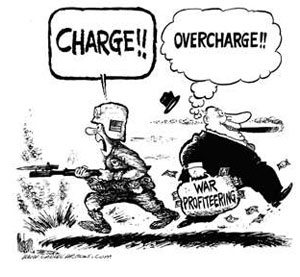
Adding insult to injury, contractors are overcharging the government for the basic weaponry they produce while they rake in cash to enrich their shareholders. In the past 15 years, the Pentagon’s internal watchdog has exposed price gouging by contractors ranging from Boeing and Lockheed Martin to lesser-known companies like TransDigm Group. In 2011, Boeing made about $13 million in excess profits by overcharging the Army for 18 spare parts used in Apache and Chinook helicopters. To put that in perspective, the Army paid $1,678.61 each for a tiny helicopter part that the Pentagon already had in stock at its own warehouse for only $7.71.

The Pentagon found Lockheed Martin and Boeing price gouging together in 2015. They overcharged the military by “hundreds of millions of dollars” for missiles. TransDigm similarly made $16 million by overcharging for spare parts between 2015 and 2017 and even more in the following two years, generating nearly $21 million in excess profits. If you can believe it, there is no legal requirement for such companies to refund the government if they’re exposed for price gouging.

Of course, there’s nothing new about such corporate price gouging, nor is it unique to the arms industry. But it’s especially egregious there, given how heavily the major military contractors depend on the government’s business. Lockheed Martin, the biggest of them, got a staggering 73% of its $66 billion in net sales from the government in 2022. Boeing, which does far more commercial business, still generated 40% of its revenue from the government that year. (Down from 51% in 2020.)

Despite their reliance on government contracts, companies like Boeing seem to be doubling down on practices that often lead to price gouging. According to Bloomberg News, between 2020 and 2021, Boeing refused to provide the Pentagon with certified cost and pricing data for nearly 11,000 spare parts on a single Air Force contract. Senator Elizabeth Warren (D-MA) and Representative John Garamendi (D-CA) have demanded that the Pentagon investigate since, without such information, the department will continue to be hard-pressed to ensure that it’s paying anything like a fair price, whatever its purchases.

Curbing the Special Interest Politics of “Defense”

Reining in rip-offs and corruption on the part of weapons contractors large and small could save the American taxpayer untold billions of dollars. And curbing special-interest politics on the part of the denizens of the military-industrial-congressional complex (MICC) could help open the way towards the development of a truly defensive global military strategy rather than the current interventionist approach that has embroiled the United States in the devastating and counterproductive wars of this century.

One modest step towards reining in the power of the arms lobby would be to revamp the campaign finance system by providing federal matching funds, thereby diluting the influential nature of the tens of millions in campaign contributions the arms industry makes every election cycle. In addition, prohibiting retiring top military officers from going to work for arms-making companies — or, at least, extending the cooling off period to at least four years before they can do so, as proposed by Senator Warren — would also help reduce the undue influence exerted by the MICC.

Last but not least, steps could be taken to prevent the military services from giving Congress their annual wish lists — officially known as “unfunded priorities lists” — of items they want added to the Pentagon budget. After all, those are but another tool allowing members of Congress to add billions more than what the Pentagon has even asked for to that department’s budget.

Whether such reforms alone, if adopted, would be enough to truly roll back excess Pentagon spending remains to be seen. Without them, however, count on one thing: the department’s budget will almost certainly continue to soar, undoubtedly reaching $1 trillion or more annually within just the next few years.  Americans can’t afford to let that happen.

War Without End

What is wrong with the United States of America?

By Philip Giraldi

Source: The Unz Review

Prussian Major General Carl von Clausewitz famously drew on his own experience in the Napoleonic Wars to examine war as a political phenomenon. In his 1832 book “On War” he provided a frequently quoted pithy summary of war versus peace, writing in terms of politico-military strategy that “War is a mere continuation of politics by other means.” In other words, war-making is a tool provided to statesmen to achieve a nation’s political objectives when all else fails.

One can reject the ultimate amorality of Clausewitz’s thinking about war while also recognizing that some nations have historically speaking exploited war-making as a tool for physical expansion and the appropriation of foreigners’ resources. As far back as the Roman Republic, the country’s elected leaders doubled as heads of its consular armies, which were expected to go out each spring to expand the imperium. More recently, Britain notably engaged in almost constant colonial wars over the course of centuries to establish what was to become history’s largest empire.

America’s dominant neocons characteristically believe they have inherited the mantle of empire and of the war powers that go hand-in-hand with that attribute, but they have avoided other aspects of the transition in turning the United States into a nation made and empowered by war. First of all, what comes out the other end after one has initiated hostilities with another country is unpredictable. Starting with Korea and continuing with Vietnam, Afghanistan, Iraq as well as other minor operations in Latin America, Africa and Asia, American war-making has brought nothing but grief on those on the receiving end with little positive to show for the death, destruction and accumulated debt. Also forgotten in the rush to use force is the raison d’etre to have a federal national government at all, which is to bring tangible benefit to the American people. There has been none of that since 9/11 and even before, while Washington’s hard-line stance on what has become a proxy war against Russia over Ukraine promises more pain – perhaps disastrously so – and no real gain.

If one has any doubt that going to war has become the principal function of both Democrats and Republicans in Washington, it is only necessary to consider several stories that have appeared in the past several weeks. The first comes from the Republican side, and it includes a possibly positive development. House Minority leader Republican Kevin McCarthy warned two weeks ago that the GOP will not necessarily continue to write a “blank check” for Ukraine if they obtain the House majority in next month’s election, reflecting his party’s growing skepticism about unlimited financial support for the corrupt regime in place in Kiev. McCarthy explained “I think people are gonna be sitting in a recession and they’re not going to write a blank check to Ukraine. They just won’t do it. … It’s not a free blank check.”

America’s uncritical support for Ukraine, which has been a contrivance by the White House and media since the fighting started, has led to a growing number of Republicans, particularly some of those aligned with Donald Trump’s “America First” approach, to challenge the need for massive federal spending abroad at a time of record-high inflation at home. Since Russia launched its invasion in February, Congress has approved tens of billions in emergency security and humanitarian assistance for Ukraine, while the Biden administration has shipped billions more worth of weapons and equipment from military inventories, all done with only limited or even no oversight of where the money and weapons are winding up.

But, unfortunately, the GOP is far from unified on its approach to Ukraine-Russia. Congressman Liz Cheney demonstrated that her apple did not fall far from her father’s tree, taking some time off from trying to hang Donald Trump to denounce what she refers to as the “Putin wing of the Republican Party.” She put it this way: “You know, the Republican Party is the party of Reagan, the party that essentially won the Cold War. And you look now at what I think is really a growing Putin wing of the Republican Party.”

Cheney criticized Fox News for “running propaganda” on the issue and in particular called out Fox host Tucker Carlson as “the biggest propagandist for Putin on that network… You really have to ask yourself, whose side is Fox on in this battle? And how could it be that you have a wing of the Republican Party that thinks that America would be standing with Putin as he conducts that brutal invasion of Ukraine?”

Cheney notably did not address the issue of how the war developed in the first place because the US and UK preferred saber rattling to diplomacy with Moscow. Or why the United States feels compelled to tip-toe to the brink of a possible nuclear war over a foreign policy issue that is of no real national interest to the American people. And where did she make her comments? At the McCain Institute in Arizona. Yes, that’s a legacy of Senator John McCain another Republican who never saw a war he couldn’t enthusiastically support.

Both President Joe Biden and Speaker of the House Nancy Pelosi have confirmed that the US is in with Ukraine until “victory” is obtained, whatever that is supposed to mean, while other Administration officials have indicated that the actual purpose of the fighting is to weaken Russia and remove President Putin. White House press secretary Karine Jean-Pierre glibly spouted the party line when asked about McCarthy’s comments. She thanked congressional leaders for bipartisan work to “support Ukraine to defend itself from Russia’s war crimes and atrocities,” adding that “We will continue to work with Congress and continue to monitor those conversations on these efforts and support Ukraine as long as it takes. We are going to keep that promise that we’re making to the brave Ukrainians who are fighting every day, to fight for their freedom and their democracy.”

Perhaps more bizarre than Cheney’s comments is the tale of a letter that was prepared by thirty Democratic Party progressives urging US support for negotiations to end the fighting in Ukraine. The letter was prepared in June but not released until last week before being quickly retracted under pressure on the following day. Pramila Jayapal, who heads the Congressional Progressive Caucus, said it was retracted because it “was being conflated with [the] comments” made by McCarthy over his warning about budget cutting for Ukraine. Jayapal referred to the letter as a “distraction,” but what she really meant was that her group had no desire to make common cause with the Republicans over any issue, including war and peace in an escalating conflict that is manifestly pointless.

A clueless Jayapal also took pains to contradict the message put out by her own group, emphasizing that there has been no opposition to the administration’s Ukraine policy from Democrats in Congress. She said Democrats “have strongly and unanimously supported and voted for every package of military, strategic, and economic assistance to the Ukrainian people.” She doubled down on the White House message, affirming that the war in Ukraine will only end with diplomacy after “a Ukrainian victory.”

So basically, anyone talking sense about Ukraine in Washington is being shut down by forces within the political parties themselves working together with a compliant national media that is mis-representing everything that is taking place on the ground. It is a formula for tragedy as the Biden administration has shown no sign of seeking diplomacy with Russia to end the conflict despite the president’s recent surprising warning that the world is now facing the highest risk of nuclear “Armageddon,” which he, of course, blames on Putin. Given all of that, in my humble opinion a government that is unable or unwilling to take reasonable steps to protect its own citizens while also avoiding a possible nuclear catastrophe that could end up engulfing the entire world is fundamentally evil and has lost all legitimacy. It should recognize that fact before submitting its resignation.

Trump escalates war threats after drone shootdown over Iran

By Bill Van Auken

Source: WSWS.org

US President Donald Trump authorized military strikes against Iran Thursday before unexpectedly cancelling them, the New York Times reported. The abrupt move leaves open the imminent possibility of a major new war in the Middle East with the potential to kill millions and spark a global military conflict.

The Times reported on Thursday that “Officials said the president had initially approved attacks on a handful of Iranian targets, like radar and missile batteries.”

The news came after Trump delivered a series of contradictory statements threatening retaliation over the Iranian downing of a unmanned drone spying on Iranian territory, while at the same time suggesting that the action may have been a “mistake” committed by a member of the Iranian military.

“It’s hard to believe it was intentional, if you want to know the truth,” Trump told reporters at the White House. “I think it could have been somebody loose and stupid that day.”

The statement contrasted with his reaction earlier in the day, when he declared that “Iran made a very big mistake” and answered reporters’ questions about whether it would lead to war by declaring, “You’ll find out.”

The US administration’s real intentions remain opaque. Trump summoned top congressional leaders to the White House “situation room” late Thursday for a classified briefing on Iran. Those attending included Senate Majority Leader Mitch McConnell, House Speaker Nancy Pelosi, Senate Minority Leader Charles E. Schumer, House Minority Leader Kevin McCarthy and the chairmen and ranking members of the House and Senate intelligence and armed services committees.

Such a meeting could well be the prelude to US military action.

Trump’s claim that the shootdown of the drone was a “mistake” is wildly at odds with what the Iranian government itself has said.

Iran’s Islamic Revolutionary Guard Corps (IRGC) immediately claimed responsibility for shooting down the drone, which took place near the strategic Strait of Hormuz, declaring that the action was meant to send a message to Washington.

“The message is that the guardians of the borders of Islamic Iran will decisively respond to the violation of any stranger to this land,” Gen. Hossein Salami, commander of the IRGC, said on Thursday. “The only solution for the enemies is to respect the territorial integrity and national interests of Iran,” he added in a speech that was broadcast live on Iranian television.

While Iran immediately acknowledged that it had shot down the drone because it had violated the country’s airspace in an “illegal and provocative” manner, the US military initially made no comment on the shootdown, beyond denying that any US aircraft were “operating in Iranian airspace today.”

The drone that was destroyed by an Iranian surface-to-air missile was an RQ-4B Global Hawk, used by the US Navy as a “Broad Area Maritime Surveillance Unmanned Aircraft System.” These aircraft, which have the wingspan of a 737 passenger jet, are stuffed with electronic surveillance equipment and cost the Pentagon upwards of $200 million apiece.

The drone is capable of flying at altitudes of up to 65,000 feet and has been used in the US military interventions in Iraq and Syria with no concern about it being vulnerable to attacks from the ground. The buildup to war against Iran, however, as the downing of the drone makes clear, is another matter.

Iran has reported that it brought down the drone with the Iranian-manufactured Sevom Khordad missile defense system. The country has also, however, received missile capabilities from Russia including the S400 surface-to-air missile system, which it has just begun to deploy.

The shooting down of the high-priced US drone has come as a shock to the Pentagon and another warning that the costs of an all-out US war against Iran will be far higher than US imperialism’s previous military interventions in the Middle East.

It marks the second time this month that a US drone has been shot down in the region. On June 6, a US MQ-9 Reaper drone was shot down by Houthi rebels over Yemen as it was supporting the near-genocidal war being waged against that country by Saudi Arabia and its allies, which has killed over 80,000 civilians and driven millions to the brink of starvation.

Iran itself has claimed to have downed or taken possession of five other US drones before the latest shootdown. In December 2011, it captured a US Lockheed Martin RQ-170 stealth drone operated from a base in Afghanistan and flying over Iranian territory. It was able to reverse-engineer the drone to produce its own version of the aircraft.

Once the US Central Command (CENTCOM) responded to Thursday’s downing of the drone over Iran, it claimed that the missile strike was an “unprovoked attack” and that the aircraft had been flying over international waters.

As in the case of the claims of Iranian responsibility for the damage to tankers in the Gulf of Oman, no evidence has been provided to substantiate the latest US charges over the downing of the drone.

Both the Pentagon and the Iranian government have provided maps supporting their respective claims that the drone was flying over international versus Iranian territory.

The truth of the matter is that there is no agreement between Washington and Tehran over what constitutes Iranian territory. It was the US-backed dictatorship of the Shah that laid Iran’s claim to territorial waters extending 12 nautical miles from its shores, including into the Strait of Hormuz, which at its narrowest is only 21 nautical miles.

Whatever the flight path of the US spy drone, the claim that its downing by an Iranian missile was “unprovoked” is ludicrous on its face.

The unmanned aircraft was being used to spy on Iran under conditions in which Washington has steadily escalated military threats against the country, with the dispatch of a carrier battle group, a bomber strike force led by nuclear-capable B-52s and an amphibious landing group carrying US Marines. This has been followed by the dispatch to the region of first 1,500 and then another 1,000 US troops, all in the name of “deterring” unsubstantiated claims of Iranian threats to “US interests” in the region.

This military buildup has been carried out in the context of a US economic siege against Iran that is tantamount to a state of war. The Trump administration, having unilaterally ripped up the 2015 Iranian nuclear agreement with the major powers, has carried out what it touts as a “maximum pressure” campaign. This act of economic strangulation is aimed at reducing Iranian energy exports to zero and starving the Iranian population into submission to the re-imposition of a US-backed puppet regime along the lines of the hated dictatorship of the Shah.

The strategic aim of this economic and military siege against Iran–pursued by Republican and Democratic administrations alike over the past 40 years–is to assert US hegemony over the oil-rich Middle East and thereby place Washington in a position to ration, or cut off, energy imports by the principal US global rival, China.

While there are indications of deep divisions within the US state apparatus over the drive toward war against Iran, the US provocations in the Persian Gulf are driving inexorably toward an armed conflict that could quickly claim the lives of tens of thousands.

At the same time, the tensions over the US siege against Iran with both Europe and China are an unmistakable warning that the eruption of a military confrontation could spill over into a new world war.

Israel Lobby Rebuts Omar’s Claims About Its Immense Influence By Exerting Its Immense Influence

By Caitlin Johnstone

Source: CaitlinJohnstone.com

In response to criticisms made by Congresswoman Ilhan Omar that US political leaders have too much allegiance to Israel and its lobbying groups, House Democrats have put forward an entire House resolution in accordance with demands made by AIPAC and the Anti-Defamation League.

“The backlash [over Omar’s comments] continued on Monday, as the Anti-Defamation League wrote a letter to Pelosi calling for a House resolution to specifically reject what the organization calls Omar’s ‘latest slur,’” Politico reports. “‘We urge you and your colleagues to send the unambiguous message that the United States Congress is no place for hate,’ the group’s CEO, Jonathan Greenblatt, wrote in a letter.”

“The charge of dual loyalty not only raises the ominous specter of classic anti-Semitism, but it is also deeply insulting to the millions upon millions of patriotic Americans, Jewish and non-Jewish, who stand by our democratic ally, Israel,” tweeted the Israel lobbying group AIPAC on Friday in response to Omar’s comments.

“I hope @AIPAC isn’t too angry that it took Democratic House leaders almost 48 whole hours to do what they’re told to condemn their own member and will instead be understanding that it was a weekend and that’s what caused the delay,” snarked journalist Glenn Greenwald in response to the news of the House resolution.

US politicians of all faiths and in both parties have indeed been falling all over themselves in a mad scramble to tell the freshman congresswoman that she is wrong and evil for suggesting that there is undue loyalty to Israel among US politicians.

“It is disturbing that Rep. Omar continues to perpetuate hurtful anti-Semitic stereotypes that misrepresent our Jewish community,” tweeted California Congressman Juan Vargas, who is not Jewish. “Additionally, questioning support for the U.S.-Israel relationship is unacceptable,” Vargas continued, inadvertently re-stating Omar’s original argument.

“But serious question: How is it anti-Semitic to question Christian Republican allegiance to Israel?” asked journalist Rania Khalek in response to the controversy. “Because it’s people like Rep. Kevin McCarthy and Sen. Marco Rubio who Ilhan Omar and Rashida Tlaib were initially called anti-Semitic for challenging on loyalty to Israel.”

It is indeed interesting that the label “antisemitism” is being pinned on an argument directed at mostly non-Jewish lawmakers and not at Jews at all. It is also interesting that the House resolution’s current text twists that reality on its head by falsely implying that the comments were directed at Jewish politicians. The most Omar-specific parts of the resolution read as follows:

Whereas the definition further includes ‘‘accusing Jewish citizens of being more loyal to Israel, or to the alleged priorities of Jews worldwide, than to the interests of their own nations’’;

Whereas the myth of dual loyalty, including allegations that Jews should be suspected of being disloyal neighbors or citizens, has been used to marginalize and persecute the Jewish people for centuries for being a stateless minority;

Whereas accusing Jews of dual loyalty because they support Israel, whether out of a religious connection, a commitment to Jewish self-determination after millennia of persecution, or an appreciation for shared values and interests, suggests that Jews cannot be patriotic Americans and trusted neighbors, when Jews have served our Nation since its founding, whether in public life or military service;

Whereas accusations of dual loyalty generally have an insidious, bigoted history, including (1) the discriminatory internment of Americans of Japanese descent during World War II on the basis of race; (2) the Dreyfuss affair; when Alfred Dreyfuss, a Jewish French artillery captain was falsely convicted of passing secrets to Germany based on his Jewish background; (3) when the loyalty of President John F. Kennedy was questioned because of his Catholic faith; and (4) the post-9/11 conditions faced by Muslim-Americans in the United States, including unfounded, vicious attacks on and threats to Muslim-American Members of Congress;

Omar’s comments have nothing to do with Jews, Judaism or Jewishness, but with the geopolitical entanglements between the US and a nation which currently serves as an outpost for US military agendas in the Middle East. It’s a basic, unassailable fact that the agenda to maintain this relationship holds immense sway in America’s capitol, which is why the only arguments you see against it are fallacious, dishonest, irrelevant, or even prove it to be true.

“It is so disingenuous of some of these members of Congress who are lining up to condemn these questioning voices as if they have no campaign finance interest in the outcome,” former congressman Brian Baird told the New York Times today. “If one dares to criticize Israel or dares to criticize AIPAC, one gets branded anti-Semitic, and that’s a danger to a democratic republic.”

Ilhan Omar has sparked one of the most interesting conversations happening in America today, and the smear campaign against her has nothing to do with fighting antisemitism, but with silencing that conversation. The social engineers are not interested in fighting religious bigotry, they are interested in shutting her up.

In an increasingly neoliberalism-weary world, the old smear tactics of labeling a dissident voice a “communist” or a “socialist” don’t pack the kind of punching power they used to, so new ones are needed. The propagandists have been field testing them for a while now, and whenever a successful prototype rolls off the conveyor belt you quickly see it shipped around the world. Smears of Kremlin servitude found purchase in the US, and it wasn’t long before we saw the BBC posing an image of Labour leader Jeremy Corbyn against the backdrop of the Kremlin wearing what was made to resemble a Soviet-era hat. Antisemitism smears found purchase against Corbyn in the UK, and it wasn’t long before we saw those same smear tactics used across the pond against Ilhan Omar. If an imperial smear field tests well in our new political climate, you can be certain you’ll see it used elsewhere within the empire before long.

https://twitter.com/PrettyBadLefty/status/1102748288309231618

This bogus concern trolling about antisemitism has always been about smearing, and the smearing has always been about narrative control. If they can manipulate the public into distrusting someone who voices a dissenting narrative, they can keep that dissenting narrative from entering the bloodstream of mainstream consciousness. The need to keep a nuclear-armed branch of the US-centralized empire in the heart of the most crucial strategic location on earth is too important for our rulers to allow its fate to be left in the hands of the democratic process, so they control the narrative about it with extreme aggression and smear anyone who questions it. That’s all this has ever been.