
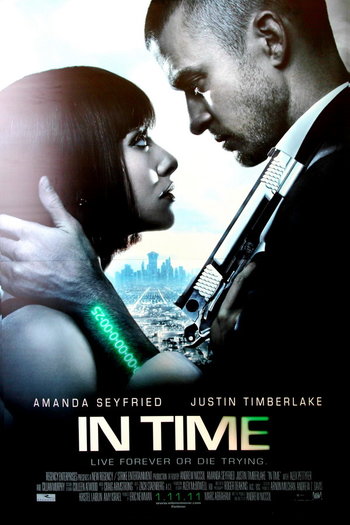
Saturday Matinee: In Time

A thought-provoking sci-fi thriller set in the future that taps into some of the most troubling inequities and problems of our era, the lack of time.

By Frederic and Mary Ann Brussat

Source: Spirituality and Practice

The best science fiction always uses some trend or policy of the present as a foundation and projects it into the future with a picture of some possible results. Through this glimpse of tomorrow, we can ponder anew the spiritual or philosophical ramifications of what we are doing today. In The Adjustment Bureau, we were given a chance to assess the idea of free will or the alternative of following a plan mapped out by God. In Gattaca the idea of genetically engineered perfection is explored. Writer and director Andrew Niccol who wrote and directed the latter thriller is also at the helm of this thought-provoking sci-fi drama that has many resonances with today’s world.

The Preeminence of Time

A search on Google for “time” yields more than 11 billion hits whereas there are fewer than 3 billion hits for “money” and 241 million hits for “sex.” Time is very much on our minds and at the hub of our concerns. We speak of “having” and “saving” and “wasting” time but we never seem to find a way of “conquering” it. We are caught up in the obsessive-compulsive need to make the most of the time we have each day. Pagers and cell phones are taken everywhere. We don’t want to miss a moment of connection.

In Time is set in a future dystopia where living zones separate the rich from the poor. Will Salas (Justin Timberlake) lives in a ghetto zone with his mother Rachel (Olivia Wilde). She looks very young since all aging stops at 25.

Will works in a factory and she has a job as well, but still it is hard to make ends meet. Time in this society is literally money. Each person has a timer on his or her arm and at 25 you are given one year of free time after which you die — unless you can find a way to get more time. Wages are doled out in days of added longevity. All expenses (rent, a cup of coffee, clothes, phone calls) are paid for with time and scanners are used to deduct the time for the purchase. The biggest fear in the ghetto is that your time will run out unexpectedly. That is exactly what happens to Will’s mother.

Time Is Strange

“Time is stranger and deeper than anything else in our lives.”
— Jacob Needleman

The biggest dream in the ghetto is acquiring a surplus of years and the prospect of immortality. When Will saves a young man with a century on his clock, the fellow gives the years to him and then commits suicide. An intrepid “Timekeeper,” Raymond Leon (Cillian Murphy), is convinced that Will stole the years from the dead man. He launches a man hunt for him. Also hot on Will’s trail are some nasty time thieves.

Caught in Time

“Time is the element in which we exist. We are either borne along with it or drowned in it.”
— Joyce Carol Oates

Will begins a daring journey into the zone for the time rich called New Greenwich. After winning more than a millennium at a casino, he meets Sylvia (Amanda Seyfried), the daughter of Philippe Weis (Vincent Kartheiser), an immensely wealthy and powerful banker who has been exploiting the poor by making high interest time loans. A believer in “Darwinian capitalism,” he’s stored up enough years to be immortal. But Sylvia thinks there must be more to life than the favored existence she knows. She is intrigued by Will’s wild ideas about changing the system which favors the rich over the poor and allows many to die so a few can be immortal. After he takes her hostage when the Timekeeper is closing in on him, Sylvia doesn’t take very long to pledge her allegiance to what becomes their own mutual crusade. They begin robbing time banks and giving time to the poor and the down-and-out.

In Time is a winning sci-fi thriller that taps into some of the troubling problems of our era, such as the view of time as money, the growing gap between the rich and the poor, and all the ways that we waste time and fail to value every moment. It is also a meditation on the healing and restorative medicine of generosity and sharing. Writer and director Niccol has given us a cautionary tale about the possible future consequences of class consciousness, the high cost of trying to stay young or live forever, and the need for something more meaningful than just spending time to get ahead of the game.
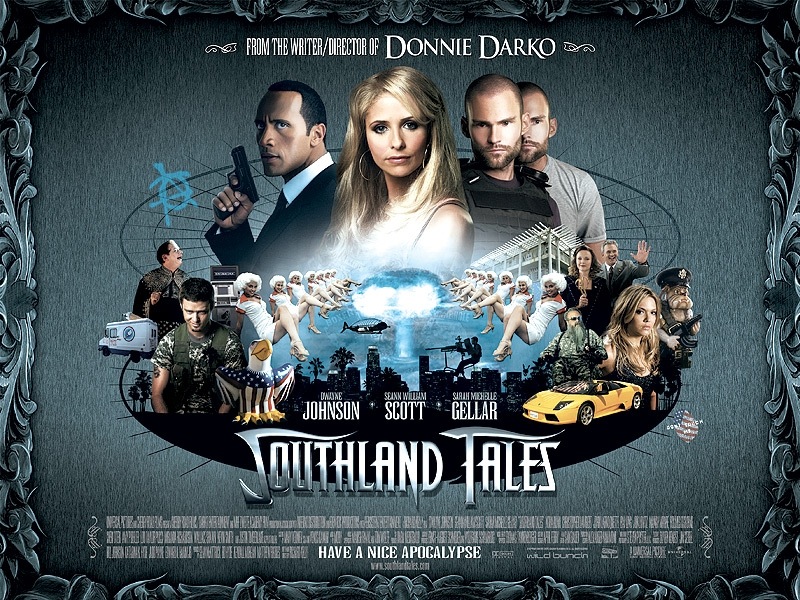
Saturday Matinee: Southland Tales

In defence of Southland Tales – Richard Kelly’s futuristic folly

The director’s much-maligned second feature is a vigorous piece of pulp for the 21st century.

By Dominic Jaeckle

Source: Little White Lies

It’s November 2016, and Richard Kelly is sat in a Los Angeles restaurant dining with a newspaper journalist. They talk a little about the cult consensus surrounding the reissue of his 2001 debut, Donnie Darko, but the main topic on the table is Kelly’s reemergence following a long period of inactivity. Both writer and subject are eager to discuss the director’s ill-fated second feature, Southland Tales, which celebrates its tenth anniversary this year.

Endeavouring to reappraise the film, the journalist would later dub it “a pre-game show for the next decade of global misery” when he finally put pen to paper. Revisiting Southland Tales in 2017, however, it’s not only the speculative powers of the film that sing. What also resonates is the quiet conflict between commercial and contextual providence when we’re trying to read popular cinema, to hold it up against the world.

Kelly’s playbook, defined as it is by hypothetical disorder, frames an associative reservoir of contemporary symbolisms in which critics will swim. Searching for a sense of the inherent value of Southland Tales, some look for its hidden depths; others, the flat veneer of its surface. But the absence of consensus around the film feels entirely appropriate.

Taking the newsfeed as a stylistic turn, Southland Tales weaves together various subplots, dead-ends, and vignettes in the form of a rolling newscast. Set against the backdrop of nuclear war in America – the bomb having landed in Abilene, Texas – we find a country in meltdown. State borders are closed, and extensions of the Patriot Act have allowed intelligence services to function unmonitored. On the west coast, a neo-Marxist revolution is falling into chaotic failure around Venice Beach, and an actor named Boxer Santaros (Dwayne Johnson) – having married the debutante of some Republican house of cards – has lost his memory. Now hiding out in Los Angeles, he runs with Krysta Now (Sarah Michelle Gellar), an ambitious and entrepreneurial ex-porn star.

Together, Gellar and Johnson are penning a screenplay, a cop movie entitled ‘The Power’. But amid its attention to the trappings of genre, the script holds some answers to a spiritual foreboding prompted by an impending energy crisis stayed, only, by the numinous capabilities of a scientist (Wallace Shawn). A figure shrouded in a fog of incense, mystic vagaries and influence owing to the financial backing of a mysterious German multinational.

Seann William Scott stars as two police officers who are not allowed to meet, should they rupture a temporal continuum, and the film is ambiently scored by hotel lobby-era Moby. Justin Timberlake, playing a misanthropic Iraq War veteran, establishes the dynamics of the film’s dénouement. Rather than place or time, Timberlake instead reads us a bastardisation of the Book of Revelation fused, throughout, with misquotes from high-modernist poetry. Repeatedly, he tells us that “this is the way the world ends.”

Southland Tales is a time capsule flirting with end-of-history ideologues. It is a joke on the very idea of the running order of recent history. Self-identifying as a parable playing on a cultural implosion of operatic proportions, it runs as a look-book of early 21st century anxieties. It’s a speculative three-act riff on the catastrophic failings of the last 10 years, a fever dream in two hours and twenty-five minutes. Kelly’s film is a carrion call for a new culture of private consumption. Its characters can do little but watch one another, and the film milks its ignoble examination of mass consumerism through depiction of a dystopian reality defined by tragic inevitability and heavy self-consciousness. “I feel like sometimes things just need time to marinate,” Kelly has said; he always wanted us to read the film forwards.

This is a murky film, no question, but Kelly has suggested that key to understanding its meaning is the intellectual scope of its centrepiece scene: a three-minute dance routine. Around the halfway mark, a doped-out Timberlake slips into an opiate induced coma. In a fantasy sequence – blood down his shirt, Budweiser in hand – he dances through a thoroughly 20th century panorama, a pinball arcade, flanked by a chorus of dancers all legs and vinyl. He looks straight down the camera, lip-syncing his way through The Killer’s ‘All These Things That I’ve Done’, whose anthemic drive is matched only by the empty opacity of its lyrics. “All these things that I’ve done” – the song is about meaning read backwards, the ownership of experience, an inversion of the speculation showcased throughout Southland Tales. The engagement of its terms here feels like a play on use-value; it’s a psalm for our private habits as viewers.

If watching rather than knowing is our active-verb in Southland Tales, then the song proves vital. Meaningless in its aim for universalism, a pop song only resonates in the right room, when played in the right context, and recalling it – personalising its terms – becomes a statement of value. That’s a perfect picture of the vitality of Southland Tales – a vigorous piece of pulp for the 21st century, it courts that very idea. It wants to be used; the film wants to mount a consideration of the cumulative character of meaning, how popular cinema is always contingent on popular feeling.

At first, what we have seems like a mess of ideas. But give it time, let those ideas marinate, and we’re left with something more. Kelly’s joke, still intact 10 years later, is that there will always be a solitary ‘I’ as far as consumption is concerned. In 2007, Southland Tales was simply out of step, waiting for new platforms for personal entertainment, for the semiotic carry-on instigated by streaming cultures. It’s a film honed for the minute when cinema would feel more like a private habit than a public spectacle.


Watch the full film here.