Saturday Matinee: Gremlins 2

By Kevin Lyons

Source: EOFFTV Review

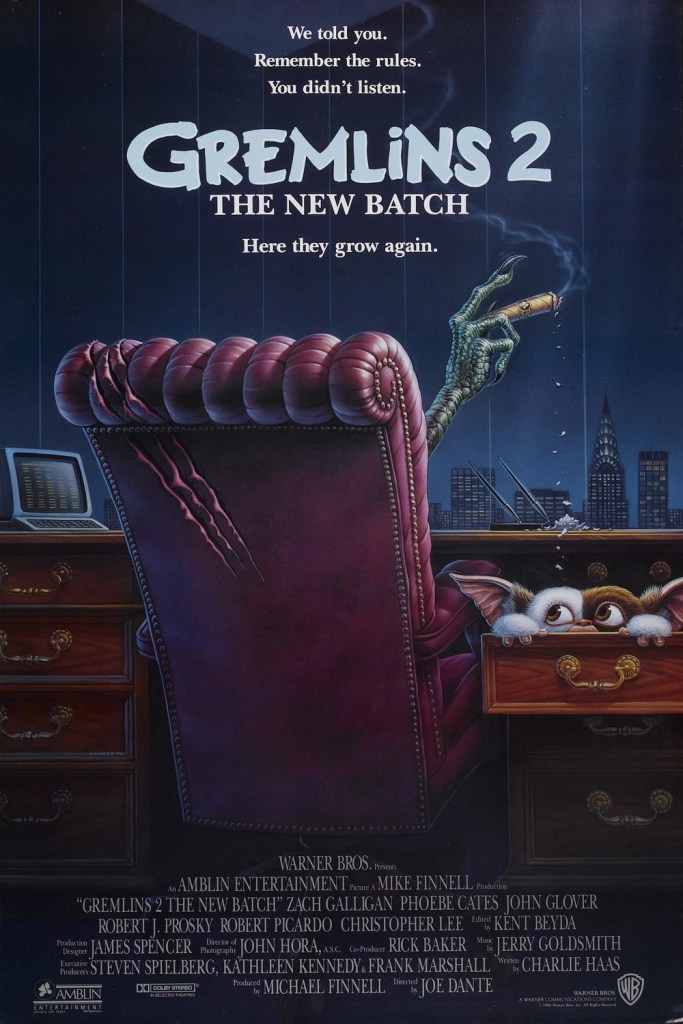
Conventional wisdom has it that Gremlins 2: The Last Batch, Joe Dante’s follow up to his hit 1984 film Gremlins, is an inferior film. In truth, it’s just a very different film – same idea (the first half is pretty much a remake of the original) but with lots of new jokes, some stinging satire, fewer moments of childhood-scarring darkness (you’ll find no analogue for the father-in-the-chimney speech here) and a big city setting. The original will always be the “better” film by virtue of having come first, but that doesn’t mean that this madcap sequel can be so easily dismissed out of hand.

The Christmas setting of the original is largely abandoned, though Gremlins 2 seems to be set in the early half of December. In New York, slimy business tycoon Daniel Clamp (John Glover), a transparent pop at Donald Trump, already a figure of mockery 26 years before he became US president, has plans to redevelop Chinatown into a soulless shopping centre. The only hold out is Mr Wing (Keye Luke) who still lives behind his shop and who has Gizmo the mogwai (voiced by Howie Mandel) with him. When Wing dies, the shop is demolished and Gizmo ends up at Splice of Life, Inc., a genetic engineering lab in Clamp Tower. Elsewhere in the building, Billy Peltzer (Zach Halligan) and his fiancée Kate Beringer (Phoebe Cates), who have located to the Big Apple from Kingston Falls, are working menial jobs for Clamp – he’s an underappreciated and bullied draftsman and designer, she’s a tour guide in the building. When Billy hears someone humming Gizmo’s distinctive song, he rescue the mogwai from the clutches of Dr Catheter (Christopher Lee) and his assistants Martin and Lewis (Don and Dan Stanton).

Inevitably, Gizmo gets wet, spawns dozens of offspring who eat after midnight and transform into a pack of ravening and very aggressive gremlins on the loose (“All they have to do is to eat three or four children and there’d be the most appalling publicity!” frets Catheter.) And so far as plot goes, that’s pretty much it. The rest of the film is one gremlin-based set piece after the other as the curious and ravenous creatures ingest samples from Catheter’s lab (“I could get you diseases – you’d like that, wouldn’t you?” he offers) transforming into a winged creature, a femme fatale who takes a shine to Clamp’s head of security (Robert Picardo) and an urbane and articulate “brain gremlin” (voiced by Tony Randall).

To make up for the lack of a plot, Dante and his writer Charles S. Haas pack the film to the rafters with sight gags, cameos (composer Jerry Goldsmith, actors John Astin, Henry Gibson, Rick Ducommun, Bubba Smith and Hulk Hogan, and even Dante himself all turn up and Dick Miller and Jackie Joseph return as Kingston Falls residents the Futtermans) and in-jokes, most of them film related: Octaman (1971) is being broadcast on Clamp’s cable television network (the film also takes aim at Ted Turner), renamed The Octopus People; Catheter is seen carrying a pod suspiciously similar to that seen in Invasion of the Body Snatchers (1955); any number of Universal classic horrors are quoted; and it goes on and on and on.

Some might find the constant callbacks to the films that informed Dante’s childhood – and even ones he made – all a bit too much, but there’s plenty of other humour to enjoy, much of it of a scabrously satirical bent. Where the earlier film had poked fun at the clichés of small-town American in cinema, principally as imagined by Frank Capra and the film’s producer, Steven Spielberg, the sequel casts a jaundiced eye at big city living – ” this is some crazy city” notes a holidaying Futterman, though the gremlins seem to love it, staging a rousing production number around their rendition of New York, New York. 60s action films, particularly Die Hard (1988) and Rambo: First Blood Part II (1985), genetic engineering, our over-reliance on technology that frequently lets us down, the venality of corporate millionaires and even the film industry itself all come under satirical assault too and the film doesn’t really hold back.

The clever thing about the film is how it manages all this while still somehow being more playful than its predecessor. It feels as though the darker elements of Gremlins had been deliberately toned down to make it more suitable for a family audience, particularly the younger children who had found the first film too scary. It still has its moments – the gremlins covered in pulsating sacs as they prepare to reproduce is a strikingly nasty image – but overall, Dante adopts a lighter touch. Perhaps to reassure anyone still worried by the cartoon-like mayhem (the film begins with a Warner Bros. style cartoon), the film even breaks down at one point, damaged by the gremlins, prompting a moment of weird self-reflexiveness as an angry mother (Dante regular Belinda Balaski, who had also been in the first film) to complain to the cinema manager (Paul Bartel) that “this is worse than the first one!”

The cast tend to play second fiddle to the gremlins created by Rick Baker’s Cinovation Studio but Christopher Lee stands out in a role that requires him to disappear for great lengths, but which gives him plenty of splendid dialogue to savour – “oh splendid, this must be my malaria” he exclaims gleefully when taking delivery of some new samples. He seems to have had a ball on the film, enjoying both the experience of working alongside Baker’s manic creations and the exposure that a big budget – though not entirely successful – blockbuster brought him. It’s often easy to forget that he could do comedy rather well and the chance to deadpan his way through lines like ” I swear to God, young man, I will never hurt anything ever again. There are some things that man is not meant to splice” is one he grasps with real relish.

Gremlins 2: The New Batch is unapologetically unruly, Dante skating perilously close to self-indulgence at times (film critic Leonard Maltin, who had pasted the original film, gets attacked by vengeful gremlins on the set of his new television show, while brandishing a videocassette of Gremlins) but just reins it in in time. You don’t see mainstream Hollywood films as wild and manic as this being made any more.

Sadly, despite toning down the horror, the film didn’t perform anywhere near as well at the box office as the original (it opened on the same day in the States as Dick Tracy and couldn’t compete with all the star power that far lesser film was able to bring to bear). It put a stop to the Gremlins franchise and apart from a few fan films, it remained dormant for many years, despite Dante’s best efforts to get a third film off the ground. And then in mid-2022, a third film, referred to by Dante on social media as Gremlins: Secrets of the Mogwai, seemed to be edging closer to production. Whether it gets made, and whether its as anarchic, silly and as much fun as Gremlins 2 will remain to be seen.

Saturday Matinee: Homecoming

By Michael Gingold

Source: Fangoria


Part of the appeal of Masters of Horror has been the chance to see things on this Showtime series that you won’t see anywhere else on television. So far, that has mostly meant explicit gore, nudity and sexuality, which is all fine and well. But Joe Dante’s Homecoming, premiering December 2, treats us to sights that are not only unique in the TV horror genre, but have been off-limits anywhere else on the tube as well. Like, f’rinstance, rows of flag-draped coffins bearing the bodies of dead soldiers killed in a Mideast war.

Yes, Dante is back in horror-satire mode, and this time he and screenwriter Sam Hamm (adapting the short story “Death and Suffrage” by Dale Bailey) are directly taking on a target that the rest of TV-drama-land and mainstream Hollywood has heretofore largely danced around. The result is as pointed, clever and blackly amusing as anything the genre has seen in ages, a perfect example of horror’s ability to address subjects too touchy to deal with in other genres. It also takes the political subtext of George A. Romero’s Dead series and puts it right up in the forefront, without becoming preachy with its message. Dante and Hamm manage the tricky balancing act of shining a harsh light on current events without losing sight of the fact that they’re telling a horror story first and foremost.

Hamm’s script takes place in the near future, specifically 2008, when a certain Republican president is running for re-election and a war he duped the nation into fighting still rages on. The central characters are campaign consultant David Murch (Jon Tenney) and right-wing author Jane Cleaver (Thea Gill), who has written a popular book attacking the “radical left”—any resemblance to Ann Coulter is, uh, purely coincidental. After meeting on a dead-on parody of an issues-oriented talk show (Terry David Mulligan is perfect as the host), the two find themselves politically and romantically attracted—but their world is shaken up when the dead begin returning to life. Not all the deceased, mind you, just those who were killed in that particular overseas combat, and they’ve got a particular—pardon the pun—ax to grind. It’s an extrapolation of the Vietnam-era ghoul film Deathdream to the nth degree—the image of the first revived corpse pushing its way out from under the Stars and Stripes that cover its casket is the most pointed and arresting image the genre has recently offered.

No more should be said about the plot particulars of Homecoming, which is packed with wonderful details and images; given a document to read, a zombie missing an eye puts on a pair of glasses with a shot-out lens. The way in which Dante and Hamm keep the story twists coming, never losing steam or running in place thematically or dramatically, is kind of breathtaking; every scene has a revelation or line of dialogue that adds new dimension to either the story or the satire. The actors (also including Dante regular Robert Picardo as a political advisor with a secret of his own) adopt just the right tone of straight-faced earnestness, selling every line and never winking at the camera. The behind-the-scenes craftspeople do a good job of substituting Vancouver locations for the D.C. area (this is also the most expansive-looking Masters yet), and Greg Nicotero and Howard Berger contribute undead makeups that get the points across (like that eyeless ghoul) without being showy.

As the film goes on and we learn more about the characters (particularly Murch), Homecoming’s antiwar message gains new levels of resonance, and it comes to a stirring and completely apt conclusion that perfectly ties up the assorted story threads. And even though horror fans are the species of television viewer least likely to be conservative, you don’t get a sense of preaching to the converted here; the writing and filmmaking are so sharp, even some red-staters might respond to the material. For the second year in a row, a satirical zombie project stacks up as the year’s best horror production; here’s hoping someone in Hollywood notices, and gives Dante a shot at a feature that will show off the skills that, on this evidence, are only becoming sharper with time.

Saturday Matinee: Trailer Wars

By Sam Prime

Source: Alamo Drafthouse

Unleashed from the vaults of Austin’s American Genre Film Archive, we present a meticulously-curated selection of the best, strangest, and most amazing coming attraction trailers in the world! Most have never been available in any home format, and all are presented in TRAILER WAR!

From the high flying, explosive metal mayhem of STUNT ROCK to THUNDER COPS’ disembodied flying head chaos, each 3 minute masterpiece is like a beckoning portal to another, more exciting dimension. It’s a crippling overdose of towering flames, mechanized destruction, lurking fear, poor sexual choices and spiritual devastation on an apocalyptic scale. You might want to have a cornea donor standing by just in case…because THIS IS GOING TO BURN!

Presented in collaboration with the American Genre Film Archive, with additional support from Drafthouse Films, we look forward to sharing this evening of eye-popping, gut-punching glory with you!

____________________

Watch Trailer War on Hoopla here: https://www.hoopladigital.com/title/15503471

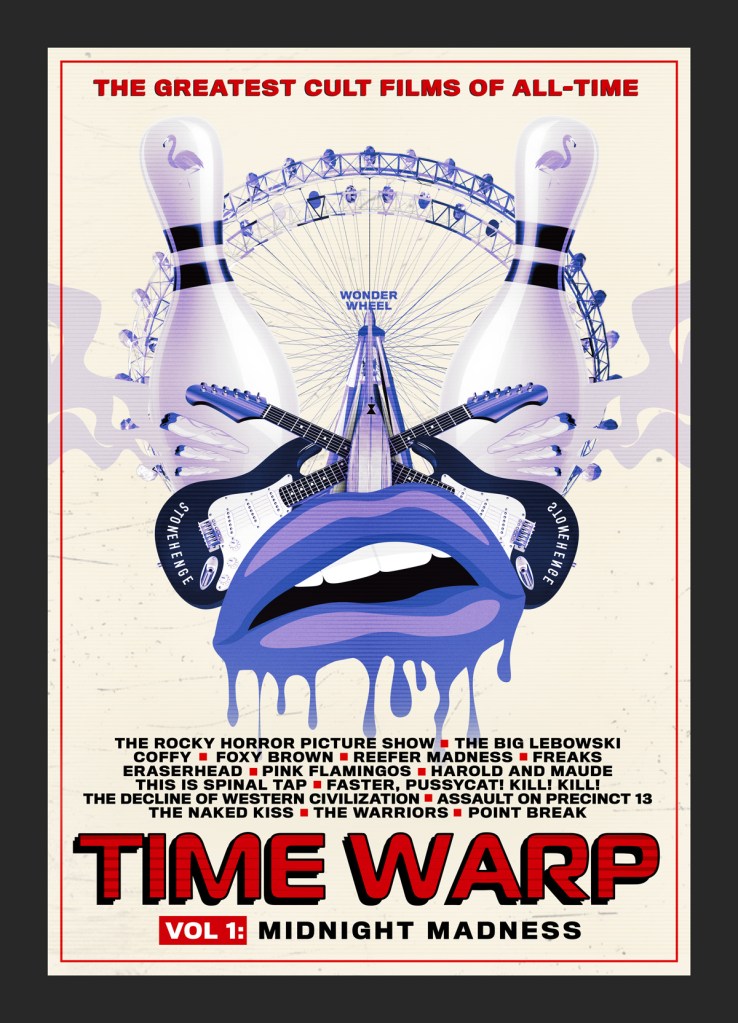
Saturday Matinee: Time Warp Vol 1-3

Documentary Review — “Time Warp: The Greatest Cult Films of All Time”

By Roger Moore

Source: Movie Nation

Ask a hundred film buffs what their favorite cult film is, and you’ll get 500 answers.

Because nobody wants to limit that pick to the obvious — “The Rocky Horror Picture Show,” “Harold & Maude,” “Eraserhead” — to admit how many times they’ve watched “The Evil Dead,” or to interrupt their latest trip to Lebowski Fest to give the question more serious thought.

So it’s no wonder that Quiver and director Danny Wolf couldn’t limit themselves to a single documentary, rounding up stars, directors, academics and critics to swoon over and deconstruct their favorites.

“Time Warp: The Greatest Cult Films of All Time” is a three-part mini-series, covering everything from “Freaks” to “The Warriors,” “Spinal Tap” to “Valley Girl.”

There are lots of opinions about the definition of a “cult” film, taking into account its “edge,” forbidden fruit “danger,” rejection by the mass movie audience (many were bonafide “flops” that found their audience over decades) and that ineffable “something” that makes you want to call your best friend and yell, “Friend, you have GOT to see this.”

I think John Cleese comes the closest to getting that definition right.

A cult film, Our Lord J.C. (of “Monty Python and the Holy Grail”) says, is one “that you think is much better than it is.”

“The Rocky Horror Picture Show (1975)” is celebrated as the greatest cult film of them all, a movie that opened to little notice, but which “never ever left the cinema,” as Patricia Quinn, one of several members of the cast speaking here, declares. Fans and critics and cult director John Waters (“Pink Flamingos”) talk of its impact on the culture, putting a “transvestite transexual” on screens where isolated, closeted fans could see someone that might be closer to their own sexuality than anything mainstream Hollywood was putting out.

Tod Browning’s still alarming “differently-abled” thriller “Freaks” (1932) is titled “the scariest movie ever made” by the likes of comic writer Bruce Vilanch and others.

Pam Grier talks of her glory days in Blaxploitation cinema like “Foxy Brown” and “Coffy.”

Gary Busey goes hyperbolic over “Point Break,” which has gained stature via a growing online fandom.

“Harold & Maude,” “The Decline of Western Civilization” punk documentaries, the films of the cleavage-cultist Russ Meyers and the down and dirty noir classics of Sam Fuller (“The Naked Kiss”), John Carpenter’s “Assault on Precinct 13” — a lot of ground is covered just in “Volume One: Midnight Madness.”

Everybody here is an enthusiast, and director Danny Wolf got Jeff Bridges and John Turturro to talk about “The Big Lebowski,” Rob Reiner and several others to speak about “Spinal Tap” and David Patrick Kelly to reminisce of the glory that was and remains “The Warriors.”

Those big names missing (Tim Curry, Keanu, Kathryn Bigelow, Tarantino, David Lynch, seen only in a ’70s interview) are barely missed.

Not all of it works. The conceit of having a “panel” consisting of directors Joe Dante (“Gremlins”) and John Waters, actress Ileana Douglas (?) and comic and actor Kevin Pollack (!?) could have left the hosting to Waters — the real authority, the Cult King.

There’s a whole subgenre of “revolting cult films” that aren’t so labeled but show up here. “Eraserhead” and any of the early warped Waters movies could turn your stomach.

Later installments will dwell on everything from masterpieces like “A Clockwork Orange” and “Blade Runner” to the obscure “Liquid Sky,” bonafide hits (no “cult” to them) like “Fast Times at Ridgemont High” to the zombie genre — “Living Dead” movies no longer having any cult appeal.

What, no “Stunt Man?” Well, they got to “Show Girls.” That’ll have to do.

But that’s the fun of it all, the arguments it starts. Because what really defines this sub-category of cinema is movies that have taken on a life of their own, taken over by fans.

And if the fans prefer “The Warriors” (popular, enduring, classic) to “Streets of Fire” (a lot more “cultish” for my money), they’re the arbiters.

“Time Warp,” in three installments, shows up via VOD and digital streaming, April 21 (ep. 1), May 19 (ep. 2) and June 23 (ep. 3).

Tune in. All the cool kids will be there.

Watch the Time Warp trilogy on Kanopy here:

Vol 1 – https://www.kanopy.com/en/product/11188290

Vol 2 – https://www.kanopy.com/en/product/11188292

Vol 3 – https://www.kanopy.com/en/product/11188294