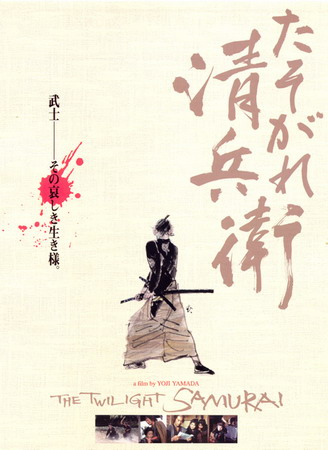
“The Twilight Samurai” (aka Tasogare Seibei たそがれ清兵衛, 2002), is a realist Samurai drama co-written and directed by Yoji Yamada set in mid-19th century Japan. It stars Hiroyuki Sanada as Seibei, a low-ranking samurai widower struggling to support his daughters and dementia-afflicted mother, who is forced by his clan’s leaders to kill a skilled rogue samurai. The film was inspired by the short story “The Bamboo Sword” by Shuhei Fujisawa and was groundbreaking for its approach to the genre; a samurai equivalent to a revisionist western.
“Tokyo Blood” (1993) is an anthology film consisting of four experimental shorts directed by Gakuryû Ishii (formerly known as Sogo Ishii) thematically connected by the theme of entrapment in Tokyo’s urban landscape and desire to escape. The opening film, “Street Noise” is an impressionistic audio/visual collage depicting an anonymous salaryman’s state of mind as he breaks down from sensory overload. The second vignette, “Bicycle” follows the journey of two young strangers bonded by alienation who aimlessly explore the city by bike after a chance encounter. The third chapter begins as a parody of structuralist film theory (not unlike early works by Peter Greenaway) but soon descends into the hyper-kinetic chaos reminiscent of films by fellow Japanese avant-garde director Shinya Tsukamoto (The Tetsuo Trilogy). The concluding film, “Heart of Stone” is seemingly a transmission from a post-human feature combining the styles of Chris Marker’s essay films and Craig Baldwin’s found-footage narratives.
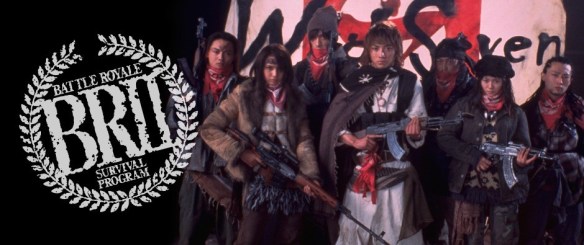
“Battle Royale 2: Requiem” (2003) is an under-appreciated yet boldly provocative sequel taking place three years after the events of the first Battle Royale. The protagonists of the previous film have joined other survivors of past Battle Royales to form a terror cell known as Wild 7. After a major bomb attack, a new class of high-schoolers kidnapped by the government are forced to raid Wild 7’s island hideout and assassinate the group within 72 hours. Battle Royale 2 was director Kinji Fukasaku’s final project, who died of cancer shortly after filming began. The majority of the the film was directed by his son Kenta Fukasaku who wrote the screenplays for both films.
Meet the Harunos, a rather unconventional, but happy and loving family nonetheless. They live in a small town in the mountains just out of Tokyo where life is good and quiet – but that doesn’t mean they don’t have their own little problems.
As 8-year old Sachiko (Maya Banno) tries to get rid of a giant version of herself who seems to pop up everywhere, her older brother Hajime (Takahiro Sato), privately wrestles with his love-struck heart. Meanwhile, their mother Yoshiko (Satomi Tezuka) is working hard, coming out of retirement as an animator, as her husband and professional hypnotist Nobuo (Tomokazu Miura) watches on with slight apprehension. Yoshiko’s brother, Ayano (Tadanobu Asano) is just visiting his hometown and staying with the family, but also has a hidden agenda; he needs to come to terms with a romance that ended years ago. Even Nobuo’s brother and successful manga artist Todoroki has his problems. It’s his birthday soon and he wants to give himself something special. And lastly there’s Grandpa, the most bizarre and perhaps the most perceptive of all, who continues to search for a better way to live life to the full.
Written, directed and edited by Katsuhito ISHII, The Taste of Tea is a unique and gentle family portrait tackling the universal themes of time, people and their lives.
“Sky High” (2003) is a supernatural action thriller directed by Ryuhei Kitamura (“Versus” and “Godzilla: Final Wars”). It’s a prequel film for a television series of the same name in which the spirit of murder victim Mina must help her detective fiance catch her killer in order to find peace in the afterlife. It’s an interesting mash-up of genres elevated by above-average cinematography, acting and action set pieces.
“Vital” (2004) is a film by Shinya Tsukamoto about a med school student who loses his memory after surviving a car crash which kills his girlfriend. Shortly after resuming studies he realizes a cadaver assigned to him to dissect is the body of his girlfriend. Against the advice of everyone around him, he becomes obsessed with his work in an effort to recover his memories and former sense of self. Like other films by Shinya Tsukamoto, Vital has much psychological conflict, Cronenbergian body horror and surreal imagery, but is more subdued and life-affirming than any other feature film he’s made to date. Vital also features a masterful performance from lead actor Tadanobu Asano.
“Tokyo Fist” (1995) can be seen as director Shinya Tsukamoto’s surreal precursor to “Fight Club”, but it also features an unsettling mood and body horror reminiscent of the films of David Lynch and David Cronenberg respectively. Added to the mix is Tsukamoto’s unique brand of visceral and hyper-kinetic filmmaking, making Tokyo Fist an unforgettable experience for fans of global cult cinema (though it’s not for the squeamish).
(Click the “CC” button at the bottom right corner of video window while playing to activate English subtitles.)
With the underground film “Tetsuo: The Iron Man” (1989), writer/director/actor Shinya Tsukamoto broke out into the global cult cinema scene. Made on a shoestring budget and drawing influences from cyberpunk sci-fi and anime such as “Akira”, Tetsuo depicts a man’s transformation into a machine as his psychological state rapidly deteriorates. Two later “sequels”, “Tetsuo II: Body Hammer” (1992) and “Tetsuo: The Bullet Man” (2009) are variations of the same plot with progressively larger budgets and artistic ambition.


 “Battle Royale 2: Requiem” (2003) is an under-appreciated yet boldly provocative sequel taking place three years after the events of the first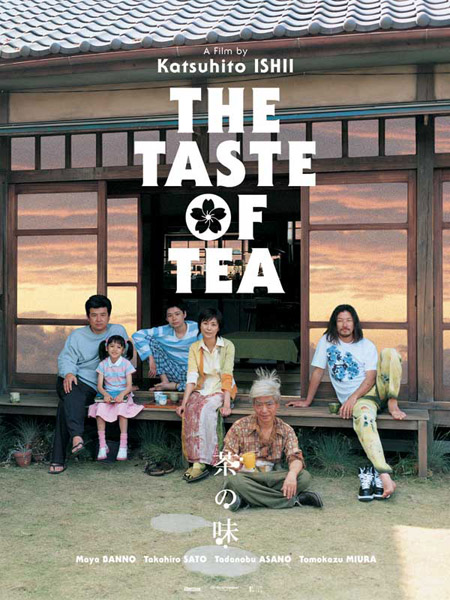


 After the Crash