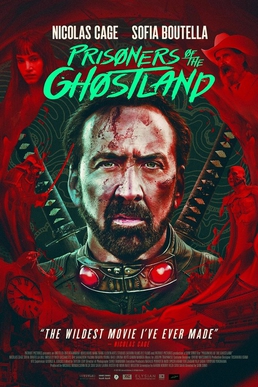
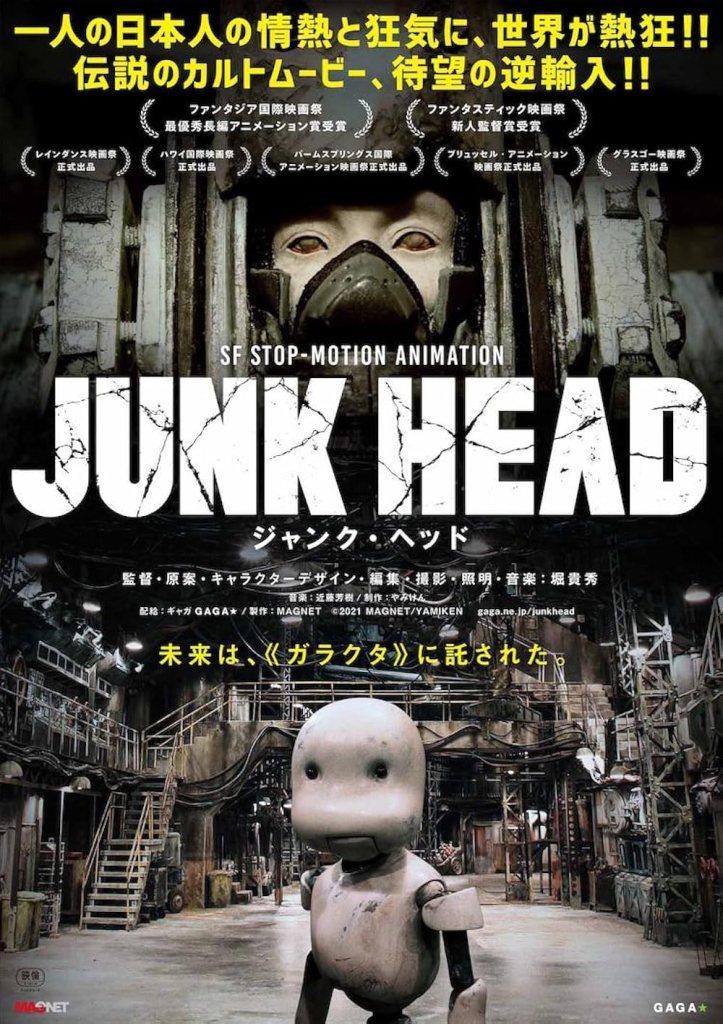
Saturday Matinee: Prisoners of the Ghostland

PRISONERS OF THE GHOSTLAND, Leave Sanity at the Door

Nicolas Cage. Sofia Boutella. Sono Sion. Need we say more? Yes.

By Eric Ortiz Garcia

Source: Screen Anarchy

More than 30 years after his first film, Sono Sion has established himself as a brilliant, prolific and chameleonic director.

In the past decade alone, you can find some of his best work: a hilarious tribute to guerrilla filmmaking and 35mm, with yakuzas, samurais and martial arts, Why Don’t You Play in Hell?; brutally violent and sordid films, Cold Fish and Guilty of Romance; dramas alluding to the nuclear disaster in Fukushima, Himizu and The Land of Hope; a crazy hip hop musical, Tokyo Tribe; and an emotional kaiju and Christmas film with catchy rock songs, Love & Peace.

On the other hand, Nicolas Cage became one of the most prolific Hollywood actors, finding in recent years memorable roles in genre cinema that, beyond subversive, are absolutely delirious. Mandy and Color Out of Space are enough to forget his abundant jobs-for-hire.

Considering that, Prisoners of the Ghostland, Sono’s highly anticipated English-language debut starring Cage, is insane. Truly insane.

Sono has excelled in building his own worlds. When I interviewed him in 2015 about Tokyo Tribe, he revealed that he wasn’t interested in using real locations in that city, because he wanted to “make up a whole fake world.” Prisoners of the Ghostland, one of his productions with the biggest budget, isn’t contained in that regard. Its two main universes – or rather, prisons – come to life and are wonderful madness.

Prisoners of the Ghostland is Sono’s Western and his return to samurai cinema, two genres that he feels affection for like his contemporaries: Miike Takashi (Sukiyaki Western Django) and Quentin Tarantino (Kill BillDjango Unchained). A group that shares influences: Sergio Leone, Ennio Morricone, Sergio Corbucci, Bruce Lee, Fukasaku Kinji, Fujita Toshiya, among many others.

In Sono’s “Old West”, West and East coexist, the mystique of the cowboy and the samurai. In fact, it’s set in “Samurai Town.” The iconic sheriff is an obese, long-haired Japanese cowboy, an Elvis Presley fan. The town’s true “boss”, the Governor (Bill Moseley, in a performance to remember), is a “gringo” with a Southern accent who runs a geisha place. He’s accompanied by his favorite heavy: the skilled samurai Yasujiro, played by Sakaguchi Tak himself, “Bruce Lee” in Why Don’t You Play in Hell? and more recently the protagonist of Crazy Samurai Musashi, the exciting and bloody one-take sequence based on an idea by Sono.

The hybrid and extravagant iconography extends to the town, practically an alternate universe where all kinds of people live together regardless of age (there’s a good number of children). It’s a clash between the traditional and the modern: a classic Western/Oriental town adorned with electronic signs, with interiors worthy of a stylized futuristic movie. Well, the Governor travels in a modern car! It’s the cinema of cool at its most striking expression.

Who better to lead the cast than an actor with a perfect understanding of this type of cinema? Is there a better vehicle for Cage than a film where his character is described as “so cool, so badass”?

The actor has been enjoying himself big time. “Personally I find his stylish performances extremely enternaining,” said Richard Stanley when I interviewed him about the Lovecraftian Color Out of Space, “they say it’s campy and over-the-top, that how can you make a serious but pretty fun movie. That’s just what I love about Nic, he’s capable of being funny and serious at the same time.”

Cage maintains that style in Prisoners of the Ghostland, bringing the classic unnamed antihero to life, although unlike those almost silent figures in the Spaghetti Western – Kurosawa Akira’s samurais were a big influence for Leone– Nic held nothing back. The movie is full of hilariously absurd dialogue and moments. It’s a territory that Sono dominates: just remember the hilarious yakuza leader secretly in love with the daughter of his rival, famous for a jingle that the criminal continues to dance, in Why Don’t You Play in Hell?

The plot of Prisoners of the Ghostland is quite simple: the Governor’s “granddaughter”, Bernice (Sofia Boutella), has disappeared; she’s actually a prostitute who managed to escape from her “prison.” The man with no name is imprisoned in Samurai Town and could regain his freedom if he fulfills the mission of bringing Bernice back.

The sequence that exposes the conflict is an extremely enjoyable display of the iconography around Cage’s character. The best example? The high-tech suit that threatens to blow the antihero to pieces if he treats Bernice badly (a comment from Sono about the supposed “misogyny” of his cinema?), or if he doesn’t fulfill the mission in the allotted time by the Governor.

Ok, maybe that doesn’t sound that crazy, how about adding a couple of explosives to the protagonist’s testicles? And we know that Sono wouldn’t add that detail if it wasn’t going to… explode at any moment!

Prisoners of the Ghostland is Sono’s Mad Maxian post-apocalyptic film. A world in ruins with old mannequins everywhere, a recurring figure in Sono’s filmography, as in Exte: Hair Extensions and in that twisted crime scene in Guilty of Romance. At the center of the stage is a crumbling tower topped by an immense clock, owned by a defunct nuclear empire.

After the Fukishima nuclear disaster in 2011, Sono hasn’t stopped showing concern about it in his cinema. There’s Himizu with its characters who lost everything and went on to live in destitute circumstances. In The Land of Hope, the director imagines that an earthquake and a tsunami cause a new nuclear catastrophe in another area of Japan. It’s a harsh criticism of the actions of the government and of the population with little memory, who forget the pain of ordinary people whose life will never be the same again.

In The Land of Hope, Sono thought of the threat of radiation as inherent in his country. Then, in Love & Peace, he used the frenzy for the imminent Tokyo 2020 Olympics (which haven’t happened yet, of course) as a reflection of a country that has forgotten Hiroshima, Nagasaki and Fukushima. Not for nothing the filmmaker continues to insist: the mythology of Prisoners of the Ghostland, explained in a stylized dreamlike sequence, is another comment on this topic.

Prisoners of the Ghostland is made up of a lot of elements. This post-apocalyptic world, and its background, is a hybrid. To avoid exploding into pieces, Cage’s character must enter a mythical land of ghosts, inhabited by figures distinguished by their distinctive samurai armor; they wander among men dressed in prison clothes, whose leader is a monstrous type, antagonist halfway between horror and exploitation.

The fate of those who cross the road of ghosts is the nuclear ruins. There’s no way out of this place, where an extravagant but well-meaning tribe lives. Some of these characters –like the charismatic Rat Man, a fanatic of vehicles and fuel-gatherer– might very well inhabit a fantastic adventure in a galaxy far, far away. In Prisoners of the Ghostland, Sono again turns his attention to the outcast; to children who have grown up without water or clean air, to ghosts that end up representing the aftermath of worldly horror, nuclear horror.

Prisoners of the Ghostland was filmed in Japan because Sono suffered a heart attack during its pre-production and, although the Japanese auteur doesn’t appear among the writers, the theme of reincarnation and redemption drives the film. Cage’s character is initially painted as a criminal of the worst kind, worthy of the Wild West of Corbucci. One of the ghosts that haunt him is an innocent Japanese boy, who had the misfortune of witnessing a disastrous bank robbery in which many of the characters and elements present in the story participated.

Prisoners of the Ghostland follows the man with no name until he earns the right to appear as a “hero” in the end credits. It’s an always insane absurdly entertaining redemption. Cage doesn’t stop, not even when he has to give the motivational speech as the “chosen one” that will make the impossible possible.

This is a quite violent film, although without reaching the most brutal, horrifying and controversial Sono of Cold Fish; there are stylized duels, sword thrusts, bullets and, of course, blood spurts. Prisoners of the Ghostland is absolutely bonkers and one of the most satisfying efforts by the great Sono Sion.

——————-

Watch Prisoners of the Ghostland on tubi here: https://tubitv.com/movies/100041245/prisoners-of-the-ghostland

Saturday Matinee: Junk Head

By Niels Matthijs

Source: onderhond.com

It must’ve been two or three years ago when I first heard about Takahide Tori’s Junk Head [Janku Heddo]. I didn’t need more than a single screenshot to know this was a film that was going to be right up my ally. Several years and countless geo-locked film festivals later, I was finally able to watch it. Junk Head is one of those rare films that actually managed to surpass my initial expectations, Tori’s passion project is an absolute wet dream for fans of stop-motion and sci-fi, with gleaming bonus appeal for those who have an appetite for the weird and creative.

To brand this film a passion project is in fact a gross understatement. Takahide Tori is an interior decorator by profession, who started this project in 2009 without any of the formal training needed to tackle a project like this. What’s more is that he started this journey all on his own. It took him about 4 years and an endless amount of YouTube tutorials to create a 30-minute short. After garnering the vocal support of some big industry names (Guillermo del Toro being one of them), additional funding and a little outside help pushed him to make a 115-minute version, which was later trimmed down to the 101-minute cut that is currently making the rounds.

Reviewers have cited many influences when writing about Junk Head, the most prominent (and interesting) one for me is Tsutomu Nihei’s Blame (coincidentally Nihei is an architect turned mangaka). But where Nihei’s first masterpiece is all about rising through a superstructure, Junk Head’s hero is descending into an underground one. And sure enough, the creature design borrows happily from H.R. Giger, Tsukamoto’s cyberpunk roots peek around every corner and names like Lynch or Cronenberg make for sane analogies, but when all is said and done, there’s nothing really quite like Junk Head out there.

The plot is set in a distant future. Mankind has lost its ability to procreate, a human-created species has revolted and developed a separate society underground. When a virus wreaks havoc on the surface, an expedition is launched to study how this newly developed species procreate, in an ultimate but somewhat desperate attempt to save humankind. The human delegate immediately finds himself in a pickle and as he travels deeper and deeper underground, his chances to complete his mission diminish with every step taken. Instead, his journey becomes an ultimate struggle for survival.

It’s difficult to overstate the visual grandeur present in Junk Head. Looking at the lushly decorated, detailed and expansive sets, Hori surely benefitted from his experience as an interior decorator, but even then it’s hard to believe what he accomplished here. The camera work is insane, the art design superb, the stop-motion animation on point. It’s crazy to think most of it was done by a single guy, but even without taking that into account Junk Head still looks mighty impressive. Not counting some CG work that was added at a later stage, this is true craftsmanship from start to finish. The style is extremely coherent though, which is great if you love this kind of gritty and ugly bleakness, those hoping for a more colorful and jolly universe better stay clear.

Though Hori’s visual accomplishments may be the obvious standout, it’s worth noting that he also took almost all the sound work upon himself. From the actual score, to the sound effects and character dubs (which aren’t in a decipherable language, but do feature distinct voices), it’s all done by Hori himself. And while this may have been out of necessity, the quality of his work is once again exemplary. The electronic score is very fitting, adding oodles of atmosphere, the voice acting is fun and distinctive and the sound effects are spot on. Together with the visuals it creates a tight and immersive experience, the kind you can only get when an entire team is entirely in sync, or when one guy does everything by himself.

Junk Head is an expansive sci-fi adventure, where the audience is forced to discover a strange and alien underground world together with the main character. Hori does take a little time to explain the broader lore of this universe, but doesn’t get into too much detail. It keeps his world wrapped in a veil of mystery, which probably won’t be to everybody’s liking. Personally, I welcome the mystery and adventure, following the events as they are experienced by the main character. Those who need more grounded explanations for what they see on screen may feel a bit disoriented at times.

As for any additional themes, the broader story offers some food for thought if needed. The premise isn’t all that original though, with humanity’s usual flaws sending us to the brink of extinction, having to resort to desperate measures to find a way out of the mess we created for ourselves. I’m not even certain whether Hori takes any of this too seriously, it could just as well be a convenient excuse for the gritty and uninhabitable world he wanted to depict, but at least it’s there for those who care about such things. The fact that there’s not really a clear-cut ending or an easy way out of this mess certainly helps too.

Every fan of Japanese cyberpunk will tell you not nearly enough films are being produced in this niche. That alone makes Junk Head a notable film. The (admittedly slim) bright side of this is that filmmakers who do try their hand at it are usually very spirited and driven to do the genre justice. With Junk Head, Hori delivers a sprawling sci-fi adventure, meticulously styled, set in a dark and perilous universe that harbors neat surprises around every corner. It’s a living testament that one person can still deliver a professional film, even if it costs him 7 years of his life. An absolute must-see this one, make sure you catch it if the opportunity arises.


Watch Junk Head on Tubi here: https://tubitv.com/movies/100040381/junk-head

Saturday Matinee: The Legend of the Stardust Brothers

The Legend of The Stardust Brothers (1985) review.

By P-J Van Haecke

Source: Psycho Cinema

Introduction

In 1985, the young Makoto Tezuka, son of manga godfather Osamu Tezuka, was approached by the famous musician and tv-personality Haruo Chicada with the question to make a movie for the soundtrack he had created for a non-existing movie. Makoto Tezuka, which by then had already directed various experimental narratives, accepted and directed what would become his feature-debut narrative.

Review

One day, Kan (Kan Takagi) and Shingo (Shingo Kubota), both singers of rival bands and both vying for fame and popularity, are given an invitation by a representative of the president of the talent agency Atomic Promotion, Minami (Kiyohiko Ozaki).

The following day, having arrived at the agency, they meet the innocent and charming Marimo (Kyoto Togawa), a girl who has, driven by her desire to force an audition with the president, been caught trespassing several times. Ultimately, in order to make Kan and Shingo agree to Minami’s proposal,she gives up her desire to become a singer, instead settling for a role as president of their fan-club. But as Kan and Shingo become stars, the will soon learn that fame always comes with nasty side effects.

The Legend of the Stardust Brothers is not just another over-the-top narrative about fame and the side-effects that often go together with fame, e.g. jealousy and addiction. The Legend of the Stardust Brothers – and this is amazing – still manages, even though the narrative is envisioned as pure entertainment, to evoke (intended or unintended) a political message against uniformity (Narra-note 1).  This message, which might be more relevant today than at the time of this narrative’s release, is specifically important for Japan as such, as the concept of harmony still dictates much of the social fabric. One can formulate the ultimate message of the narrative as follows: In order to combat the political forces focused on disciplining society into uniformity and obedience, diversity and the freedom of expression – subjectivity as such – are our only weapons.

The Legend of Stardust Brothers – see the visuals framing Minami’s first song – also criticizes the system of agencies as well as the blind desire for fame that drives many young people.  Besides evoking the problematic power agencies have – a problem persisting up until this day – it also underlines the naivety of people who willingly give up their own agency, their own right to decide. Last but not least, The Legend of The Stardust Brothers questions the often problematic connection between mass media and politics, i.e. media as the mouthpiece of politics, entertainment as crowd-control and political influence.

The Legend of The Stardust Brothers truly deserves the signifier ‘legend’. While the main narrative thread may very well be an approximation of “what truly happened” – as is implied by the very end – the framed and presented narrative is nothing other than the exaggerated and at some times rather absurd version of Shingo and Kan. This absurdity at the level of the narrative is supported by cinematographical absurdity and the energy to be found at the level of the acting performances.

The cinematographical ‘absurdity’ is especially sensible at the level of the effects. While the various cheap special-effects betray the limitations of the budget ‐ and may even cause some frowns – these effects have after 33 years also attained a certain charm. We would even say that the cheapness of various effects help emphasizing the craziness and absurdity of the narrative as such. But these so-called cheap effects should not detract the spectator from those effects that blend fluently into the narrative fabric, e.g. the colour divide in the opening song, the fun practical horror effects, the animation sequence, and the instances of stop-motion. As a matter of fact, it has to be applauded that Makoto Tezuka, in full knowledge of the limitations of his budget, realized, in a rather bold fashion, his cinematographical vision without much compromise.

In Makoto’s framing, it is very easy to realize that, at various instances in the narrative, visual composition took preference over cinematographical continuity. In the catchy opening song, there are some compositional choices – choices deliberately braking the continuity – that have no other effect than heighten the fun. In other words, they function successfully as tongue-in-the-cheek visual puns.Furthermore, many of the visual effects – the effects we mentioned above – applied in the later narrative can be seen in the same way, as visual elements focused on fun.

There is a certain youthful energy that supports the entire narrative, an energy that emanates from Shingo Kubota and Kan Takagi and – as mentioned before – gets empowered by the bold way the narrative is framed as such. It is especially this energy, paired with those moments of charming comedic over-acting – over-acting often function of the amateurism of the concerned actors (see for instance Kiyohiko Ozaki’s performance) – that turn The Legend Of The Stardust Brothers into a 100 minutes long crazy roller-coaster of fun and musical entertainment.

The music of The Legend Of The Stardust Brothers is utterly fantastic. Besides creating the fun eighties vibe that persists throughout the narrative, the infectious songs allow the spectator to enjoy a wide range of genres popular in the eighties. It is also evident that the music genres have also dictated the performances as such – ISSAY’s performance for instance brings the style of David Bowie wonderfully to live.

The Legend of the Stardust Brothers is one of those rare narratives that has become better by aging, instead of turning ugly and sour. While the ripeness of the narrative is not able to beautify all its faults, the pure fun oozing from the narrative and the performances secures the enjoyment the spectator can extract from this energetic and truly irresistible legend. In other words, the time for this narrative to become, thanks to the release of the DVD/Blu-ray by Third Windows Films, a cult-classic has finally arrived.

Narra-note 1: This concerns the revelation of Kaoru’s father. For more information, one can read our exclusive report of our meeting with Makoto Tezuka.


Watch The Legend of the Stardust Brothers on Hoopla here: https://www.hoopladigital.com/movie/the-legend-of-the-stardust-brothers-shingo-kubota/17400468

Saturday Matinee: Beyond the Infinite Two Minutes

Beyond the Infinite Two Minutes (2020) Review

Director: Junta Yamaguchi
Cast: Kazunari Tosa, Riko Fujitani, Gôta Ishida, Masashi Suwa, Yoshifumi Sakai, Haruki Nakagawa, Munenori Nagano, Takashi Sumita, Chikara Honda, Aki Asakura
Running Time: 70 min.

By Paul Bramhall

Source: City on Fire

The concept of time travel is always an interesting one when it’s transferred to screen, and the Japanese film industry has flirted with it just as much as any other. From modern day military units transported to feudal Japan in the likes of G.I. Samurai, to the quirkiness of Summer Time Machine Blues, to of course the countless romantic spins on the genre. What all of them have in common is characters travelling back to the past, whether it be days or decades, and their need to adjust to a different time period or right a wrong. Beyond the Infinite Two Minutes also uses time travel as its key theme, however it does so in an arguably more minutiae way than any of its predecessors (and perhaps anything that’ll come after it), dealing with a café owner who realises the monitor in his room is capable of showing 2 minutes into the future.

Played by Kazunari Tosa (Prisoners of the GhostlandMisono Universe), his character lives in the apartment directly upstairs from the café he runs, and this realisation comes about when he returns home one night and the monitor flickers on, his own face staring back at him from behind the screen. His 2 minutes into the future self is back in the café downstairs, and after explaining the strange phenomenon to his current self, his current self heads back downstairs – completing the loop and setting things in motion. Soon the café’s barista, played by Riko Fujitani (Beautiful DreamerAsahinagu), gets in on the action, who proceeds to call up 3 of the cafes regulars to also come around and check it out as well. Before you know it, the group find themselves interacting between their current and 2 minutes into the future selves with all of the inconsequence you’d imagine 120 seconds can bring.

The directorial debut of Junta Yamaguchi, the creative force behind the indie production is actually a theatre troupe called Europe Kikaku based out of Kyoto, of which Yamaguchi is a member, as are most of the other cast and crew. The fact that the majority of talent involved in Beyond the Infinite Two Minutes comes from a theatre background makes a lot of sense when you consider that 95% of the punchy 70-minute runtime plays out in a single location – the upstairs and downstairs in a low-rise building. The use of the confined environment enables the 2 minutes plot device to play out via a series of comedic interactions involving the cast talking to themselves through a monitor, a feat which Yamaguchi makes look easy, but had to have taken a substantial amount of precision timed planning behind the scenes.

The plot itself is inspired by scriptwriter Makoto Ueda’s (who also scripted the previously mentioned Summer Time Machine Blues) own self-directed and penned short from 2014, Howling, with the motivation being to stretch out the concept from the shorts 11-minute runtime to a feature length production. Admittedly, Beyond the Infinite Two Minutes’ origins do show through on occasion. There can be no denying that the concept is a one-trick pony, and Yamaguchi spends a little too much time with the cafe’s regulars fooling around and being shouty in a slightly aggravating way. The focus initially seems to be on how many comedic vignettes can be pulled off with the concept, not all of which necessarily work, when it would be far more engaging if there was an actual plot to anchor the gimmick off.

As a result, because of the scenes inconsequential nature, topped off with the fact that we have to watch many of them play out twice (current and future), there are moments that feel like padding. Thankfully Yamaguchi has a plot up his sleeve, and once it kicks in it delivers the required narrative thrust just in time, ensuring that the concept alone isn’t left to carry the entire production on its shoulders. Sure it’s nothing we haven’t seen countless times before – a stash of cash with unknown origins and the yakuza who are looking for it – but paired up with the time travel concept it provides a reason for the audience to get behind the characters, as well as some of the biggest laughs.

Yamaguchi goes for the double whammy on the gimmick front, opting for the one-take approach for the 70-minute duration, although he confessed in an interview that it is in fact made up of several 10-minute takes which have then been blended together in post. The authenticity behind the one-take isn’t the important part here though (as opposed to its importance in productions like One Shot and Crazy Samurai Musashi, where the performers endurance is an integral part of enjoying the single take), rather the flow it gives to the time loop allows both the characters and the audience to experience the 2-minute time travel in real time. 

As much as the previously mentioned productions are defined by the performers sustained physicality during the continuous takes, here the admiration goes to how skilfully everyone involved has executed a narrative which essentially involves them talking to themselves for extended periods. I had to frequently remind myself while watching Beyond the Infinite Two Minutes that the actors are actually not talking to themselves in real time (it was done with recordings), and the complexity behind creating such a unique character dynamic must have been vast. It’s a testament to the passion of the cast and crew that onscreen not once does it come across as questionable or contrived, and the fact that the complexity only increases as the plot progresses but the illusion never wavers is an outstanding feat.

As the owner of the café Kazunari Tosa makes for a likable protagonist. His realisation that he has a monitor that can see into the future is one of understated (almost disinterested) bewilderment, and his lack of enthusiasm to utilise its potential makes him a relatable character for the audience. The short runtime doesn’t give much room for character development, but his change from a passive observer (in his own café no less!) into a somewhat man of action is a convincing one, spurred on by the chance of a date with the café owner next door, played by Aki Asakura (the most recognisable name in the cast, having featured in the likes of Whistleblower and 2017’s live action Fullmetal Alchemist).

Despite this though, there should be no doubt that the real star of the show in Beyond the Infinite Two Minutes is the filmmaking technique itself. Whereas just a few years ago saying a movie looked like it was shot on an iPhone would be considered an insult (see my review for 2018’s The Dark Soul), here the entire thing actually was shot on an iPhone, and it looks just fine. In Yamaguchi’s eagerness as a first time director he also took on the role of cinematographer (something which he openly states he likely won’t do again for his next production!), and his commitment to getting certain shots at certain angles can be seen in the behind-the-scenes footage as he scrambles on top of, over, and around tables and various other objects to maintain the integrity of his vision. 

While Beyond the Infinite Two Minutes has had plenty of labels thrown at it already, from being a time travel movie for the Zoom generation, to One Cut of the Dead comparisons due to its micro budget and one-take approach, in the end both only tenuously relate to the end product that Yamaguchi has crafted. While far from perfect and at times a little too stretched for its own good, ultimately the way such a complex tale has been successfully pulled off from both a technical and story standpoint is difficult not to admire. The fact that some genuine laugh out loud moments are thrown in along the way make its shortcomings easy to overlook, and at just 70 minutes Beyond the Infinite Two Minutes self fulfils its title, not sticking around a minute longer than it needs to.

____________________

Watch Beyond the Infinite Two Minutes on Tubi here: https://tubitv.com/movies/671945/beyond-the-infinite-two-minutes

Saturday Matinee: Sanjuro

By Brian Eggert

Source: Deep Focus Review

Answering for the violent thrills of Yojimbo, Akira Kurosawa’s sequel Sanjuro modifies its predecessor’s structure and, in a way, condemns its eponymous hero, reprised by Toshiro Mifune, by depicting his violent existence as a tarnished bushido ideal. Instead of sending up the swordfighting chambara genre as Mifune’s Sanjuro mows down gangs of grotesque, bumbling yakuza criminals, against which he appears superior and even righteous, Kurosawa places his unkempt ronin in the middle of a jidai-geki, a dramatic period piece wherein Mifune’s protagonist remains crafty and skilled in combat, but, shamefully, without nobility nor willingness to restrain his violent instincts. Redefined through introspection and eventual feelings of disgrace about his lifestyle, Kurosawa’s Sanjuro becomes a tragic figure, his mythic stature marked—or soaked, rather—by the blood of his undisciplined existence.

Along with Ryuzo Kikushima and Hideo Oguni, Kurosawa developed Sanjuro from the Shugoro Yamamoto novel Hibi Heian (A Break in the Tranquility) prior to shooting Yojimbo. Yamamoto’s tale, although similarly plotted in its broadstrokes to Kurosawa’s eventual adaptation, features a samurai protagonist without as much idiosyncrasy or skill as Sanjuro. Author of the source novels for Kurosawa’s upcoming pictures Red Beard and Dodes’ka-den, Yamamoto would be associated with Kurosawa for the rest of their careers. For this picture, Kurosawa intended for Hiromichi Horikawa to direct. Horikawa was a former assistant director for Kurosawa on Seven Samurai and Throne of Blood among others, and had become a thriving director in the mid-1950s, with many chambara films among his releases. Nevertheless, producers at Toho Company insisted that Kurosawa direct, given the popularity of Yojimbo under his headship.

Shooting began on Yojimbo in January 1961 and was completed on April 16, and because Kurosawa edited during production, the film was released four days later on April 20, 1961. And since Sanjuro required only minor rewriting to convert the earlier draft into a sequel to Yojimbo, production commenced on September 25, 1961, and ended December 20, with the finished film premiering January 1, 1962. The speed and artistic showmanship with which these films were shot, edited, and released is staggering, especially taking into consideration the detail Kurosawa integrates into his picture. The main setting—a chamberlain’s house and the pond in front, a separating wall with a compound on one side and the sanctuary house on the other—were built as open sets on Toho’s largest stage. Kurosawa oversaw every detail personally, from the vast layout down to the crucial look of camellias on the trees, which the director insisted be hand-made to make sure each one looked just right. At his prime, Kurosawa’s meticulous, even autocratic control over his productions fully justified his nickname: The Emperor.

Sanjuro opens with nine young, incompetent samurai assembled in secret at a forest shrine. Their leader, Iori Izaka (Yuzo Kayama), has recently met with his uncle, the chamberlain, with whom Izaka lobbied to permit his fellow samurai to investigate signs of corruption. The chamberlain refused, which suggested to Izaka that the chamberlain was behind the corruption. And so, Izaka turned to the superintendent for advice; the superintendent agreed to help if they all meet at the present forest shrine. All at once, Mifune’s Sanjuro yawns from the darkness, and casually steps out to offer his thoughts—that the superintendent is, in fact, the corrupt one and the chamberlain was merely being protective of his nephew. He even suspects the superintendent’s men will double-cross the young samurai at their planned meeting, which, as it turns out, takes place at the forest shrine. When Sanjuro learns this, he looks outside and confirms his suspicions are true, then hides the nine young samurai in the floorboards. The superintendent’s men call for surrender and Sanjuro emerges, shouting about the noise and knocking several soldiers down. Believing Sanjuro’s deception, the soldiers’ leader, the idealized samurai warrior Muroto (Tatsuya Nakadai, who also played the gunslinger in Yojimbo), so bound to bushido, recognizes Sanjuro’s skill and offers him a job if he wants it.

Mifune’s introduction recalls the one from Yojimbo, where the ronin is asked his name, and in response, he reveals his first name, “Sanjuro [meaning thirty years old]… going on forty.” He then scans the area and settles on some nearby plantlife for his family name. In Yojimbo, he sees a mulberry field and responds “Kuwabatake [mulberry field],” and in Sanjuro he replies “Tsubaki [camellia]”—an ironic yet apt choice given the camellia’s associations to the chamberlain’s wife and daughter later in the film. In this sequel, Mifune’s Sanjuro proves just as iconic as his performance in the preceding film, only streamlined to highlight those memorable character traits. Unless his sword is drawn, the actor’s arms rarely leave his kimono except to scratch his chin or to itch at his scalp; along with his character’s minimum of dialogue, this places our focus on Mifune’s expressions, ripe with seemingly stoic confidence interrupted by his anger and unease. Sanjuro’s disdain around the hopeless young samurai and his later discomfort around the chamberlain’s wife and daughter are always comical, making Mifune’s performance a subtly complex combination of characterized gestures and reserved emotions.

After the superintendent’s men depart the forest shrine, Sanjuro and the young samurai realize the chamberlain will probably be arrested or worse, as the superintendent has no doubt deduced that the chamberlain suspects him. They resolve to rescue the chamberlain’s wife and daughter (Takako Irie and Reiko Dan) first, before they too are taken. Contemptuous of the young samurai but impelled to assist (for some cash and food) because, as he tells them, they cannot take care of themselves, Sanjuro leads them to the chamberlain’s house, which is guarded by the superintendent’s men. Despite Sanjuro’s constant insults and berating tone, the young samurai follow his every word “like a centipede” astonished by his skill. And, after convincing a servant to get the guards drunk, they quietly take out the sentries and move the women into a nearby barn. Here, Kurosawa pauses for a scene to establish Sanjuro’s lasting themes by differentiating the film’s protagonist from everyone else onscreen. The young samurai, the mannerly women, the dignified warriors serving an upper class—they each follow a particular decorum against which Sanjuro seems incongruous.

When the women first enter their own barn turned hideout, it is a place they have never been; they remark about the lovely smell of hay, the dreamlike quality one feels when resting back on a large mound of the stuff, and reveal their sophisticated obliviousness to the danger of the situation. Their ability to see so much good in the world amid all the bloodshed and unruly politics is not meant to make them look ignorant; rather, they are elevated beyond such unnecessary concerns, achieving a level of paradoxical nescient enlightenment. The chamberlain’s wife asks with polite interest about Sanjuro, and Izaka explains he is a friend. “I hesitate to say this after you so kindly saved us,” remarks the wife, “but killing people is a bad habit. You glisten too brightly… Like a drawn sword… You’re like a sword without a sheath. You cut well, but the best sword is kept in its sheath.” Sanjuro reacts uneasily to this, knowing the wife’s assessment is accurate, but perhaps unwilling to admit it to himself, yet. Sanjuro begins to feel ashamed of his status in the presence of the refined sensibilities of these women. With this, Kurosawa deepens the character throughout the course of the film, allowing Sanjuro to learn something about himself, his eventual victory bittersweet.

One of the young samurai suggests hiding in his house and Sanjuro agrees, but their group quickly learns that the superintendent is keeping the chamberlain locked up next door, just over a compound wall. By the end, Sanjuro, who deceives his enemies by taking Muroto’s job offer to learn of the chamberlain’s exact location, calls the young samurai to rescue the chamberlain, using a downpour of camellias floating down a stream under the compound’s wall as an elegant signal to attack. With this, bloody violence begins to unfold, while on the other side of the wall, the chamberlain’s wife and daughter clap with enchantment at the beauty of the flowers on the water, a scene played both for humor and to emphasize the nonsensicality of violence against the simpler things in life—a message Sanjuro learns by the conclusion. With the chamberlain rescued, the young samurai realize Sanjuro has gone. They find him in a field, preparing to face off against the distinguished samurai Muroto, who, his honor shamed with Sanjuro’s deception, insists they duel. Sanjuro cuts down his opponent with incredible speed, and all of the young samurai, shocked, watch with enthusiasm. After a moment of silent awe, one of them declares the display “brilliant”.

The duel itself remains Sanjuro’s most memorable scene, not only because it concludes the film, but because it does so with such an unforgettable “bang”. Positioned face-to-face, Mifune and Nakadai, mirroring their final scene together in Yojimbo, standoff for a clocked 26 seconds of silence, an excruciatingly long period of suspense. The technician who controlled the pressurized pump to spray Muroto’s fake blood (a batch of chocolate syrup and carbonated water) from Nakadai’s torso worried that the effect would not please Kurosawa, and overcompensated by adding thirty pounds of pressure, so when the scene commenced filming and Mifune cuts with split-second speed, fake blood shot out like a geyser. The larger-than-life outcome, wholly staggering and uncharacteristic when compared to the violence in the rest of the film, pleased Kurosawa, as its exaggerated quality echoes the base thrill both the young samurai and the audience feel toward the spectacle, and how even for a violent film this last act of violence remains the ugliest and most horrible.

A moment later, Sanjuro, enraged by their response, scorns the young samurai for applauding such violence. “Idiots! What do you know about anything? …He was just like me. A drawn sword that wouldn’t stay in its sheath. But you know, the lady was right. The best sword is kept in its sheath. You’d better stay in yours.” Sanjuro begins to walk away and the young samurai follow. “Stop following me or I’ll kill you!” They pause, drop to their knees in honor of their master, confused and shamed by their own ignorance. Scratching, Sanjuro says curtly, “Abayo” or “Bye” and walks off, as composer Masaru Sato’s theme from Yojimbo sends the disillusioned hero on his way. Forced to cut down his opponent, Sanjuro has learned enough about himself to see a level of self-destruction in killing Muroto. Whereas Sanjuro walks away from Yojimbo unaffected by the violence he has caused, he is not so untouched by the end of this sequel.

With Sanjuro a deeper, more thoughtful hero than he was in Yojimbo, this conclusion does not come as a victory. Despite his attempts to instruct them, Sanjuro’s young students have learned nothing of honor, only the thrill of battle. They remain adolescents, swept up in the illusions of the typical jidai-geki, with all of its heroics and courtly politics and romanticized sword fights, and find themselves taken by the rapidly unfolding progression of the plot. Meanwhile, Sanjuro finds the true meaning of bushido by the end, ironically from the words of an inexperienced, naïve but ultimately astute woman whose ideals are shaped by the strictest of Japanese formality. Whereas the young samurai are clinging to their chambara-inspired tales of swordplay and violence, Sanjuro realizes he supplied their myth and feels guilty for his crimes, but in the end reaches a greater plane of wisdom, one aspiring to be more like the strict master swordsman from Seven Samurai.

Among Kurosawa’s most well-balanced films, Sanjuro resounds with equal parts artistic intent and sheer entertainment value—the quality of Kurosawa’s greatest works. An argument can be made that the sequel betters its predecessor by adding a human dimension to the mythological anti-hero from Yojimbo, who, instead of descending upon a small village like a god to unleash retribution, is brought down to earth by humbling comments from the chamberlain’s wife. An undefeatable presence between two pathetic yakuza gangs, Sanjuro stands out as a disheveled bum amid the white-collar setting of a jidai-geki, and because of this, he feels shame. Kurosawa redefines the character in his sequel, complicates his mythology, and avoids that typical sequel mistake of giving audiences more of a proven formula. An audience might walk away from Yojimbo and overlook the social implications, mistaking the picture for escapist entertainment void of commentary; but after Sanjuro, no one can deny the powerful message Kurosawa imparts.


Bibliography:

Galbraith IV, Stuart. The Emperor and the Wolf: The Lives and Films of Akira Kurosawa and Toshiro Mifune. New York: Faber and Faber, 2002.

Kurosawa, Akira. Something Like An Autobiography. New York : Knopf: distributed by Random House, 1982.

Richie, Donald. The Films of Akira Kurosawa, Third Edition, Expanded and Updated. With additional material by Joan Mellen. Berkeley, Calif.: University of California Press, 1996.

Richie, Donald; Schrader, Paul. A Hundred Years of Japanese Film: A Concise History, with a Selective Guide to DVDs and Videos. Tokyo; New York: Kodansha International: Distributed in the U.S. by Kodansha America, 2005.

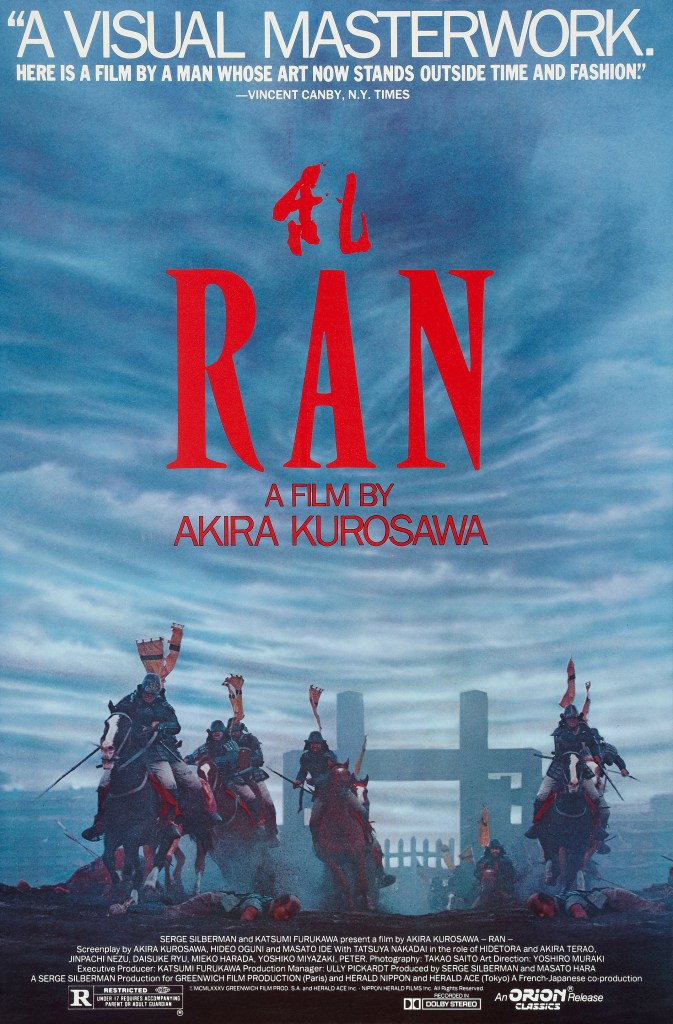
Saturday Matinee: Yojimbo

A fistful of samurai

By Roger Ebert

Source: RogerEbert.com

Almost the first thing the samurai sees when he arrives is a dog trotting down the main street with a human hand in its mouth. The town seems deserted until a nervous little busybody darts out and offers to act as an employment service: He’ll get the samurai a job as a yojimbo — a bodyguard. The samurai, a large, dusty man with indifference bordering on insolence, listens and does not commit. He wants sake and something to eat.

So opens “Yojimbo” (1961), Akira Kurosawa’s most popular film in Japan. He was deliberately combining the samurai story with the Western, so that the wind-swept main street could be in any frontier town, the samurai (Toshiro Mifune) could be a gunslinger, and the local characters could have been lifted from John Ford’s gallery of supporting actors.

Ironic, that having borrowed from the Western, Kurosawa inspired one: Sergio Leone’s “A Fistful of Dollars” (1964), with Clint Eastwood, is so similar to “Yojimbo” that homage shades into plagiarism. Even Eastwood’s Man With No Name is inspired, perhaps, by the samurai in “Yojimbo.” Asked his name, the samurai looks out the window, sees a mulberry field, and replies, “Kuwabatake Sanjuro,” which means “30-year-old mulberry field.” He is 30, and that is a way of saying he has no name.

He also has no job. The opening titles inform us that in 1860, after the collapse of the Tokugawa Dynasty, samurai were left unemployed and wandered the countryside in search of work. We see Sanjuro at a crossroads, throwing a stick into the air and walking in the direction it points. That brings him to the town, to possible employment, and to a situation that differs from Hollywood convention in that the bad guys are not attacking the good guys because there are no good guys: “There is,” the critic Donald Richie observes, “almost no one in the whole town who for any conceivable reason is worth saving.” It’s said Kurosawa’s inspiration was Dashiell Hammett’s novel Red Harvest, in which a private eye sets one gang against another.

Sanjuro’s strategy is to create great interest about himself while keeping his motives obscure. He needs money and so presumably must hire himself out as a bodyguard to one of the two warring factions. There is the silk dealer and the sake merchant, both with private armies, who occupy headquarters at either end of the town. In between, the townspeople cower behind closed shutters and locked doors, and the film’s visuals alternate between the emptiness of the windswept street, shots looking out through the slats of shutters and the chinks in walls, and shots from outdoors showing people peering through their shutters.

Richie, whose writings on Kurosawa are invaluable, notes that Kurosawa’s shots are always at right angles to what they show; they either look straight up and down the street, or straight into or out of the buildings, and “there are very few diagonal shots.” The purpose may be to emphasize the simplicity of the local situation: Two armies face each other, the locals observe the main street as if it’s a stage, and the samurai himself embodies the diagonal — the visitor who stands at an angle to everyone and upsets the balance of power. Indeed, in a crucial early scene, as the two sides face each other nervously from either end of the street and dart forward fearfully in gestures of attack, Sanjuro sits high above the action in the central bell tower, looks down and is vastly amused.

His strategy is to hire himself out as a yojimbo to first one side and then the other, and do no actual bodyguarding at all. His amorality is so complete that we are a little startled when he performs a good deed. A farmer and his wife, possibly the only two good people in the town, are kidnapped. Sanjuro, employed by the side that kidnapped them, kills their six guards, frees them, tears up a house to make it look like there was a fierce struggle, and blames it on the other side. Disloyal to his employer? Yes, but early in the film, he is offered 50 ryo by one of the leaders, only to overhear the man’s wife telling him, “We’d save the whole 50 ryo if we killed him after he wins.”

Sanjuro’s strategy is an elaborate chess game in which he is playing for neither side but plans instead to upset the board. “In this town, I’ll get paid for killing,” he muses, “and this town would be better off if they were dead.” His planning is upset by the unexpected appearance of Unosuke (Tatsuya Nakadai), the younger brother of one of the sake dealer’s bodyguards. The samurai often walk about with their empty sleeves flapping at the sides, their arms folded inside their kimonos. (Eastwood, in the Leone movies, always keeps one hand under his poncho.) When Unosuke finally reveals one of his hands, it holds a pistol — the first one seen in the village. This upsets the balance of power and tilts against Sanjuro’s plans, which depend on his skill as a swordsman who can kill any number of the others without being wounded himself.

The gun provides Unosuke with a sneaky kind of self-confidence, and he produces the weapon gloatingly from time to time. Occasionally, he kills people in cold blood, just to prove that he can, in events leading up to a final bloodbath. One of the first people Sanjuro meets in the town is the coffin-maker, and there is a nice moment when he first goes out to do battle and advises him, “Two coffins. Noon, maybe three.” By the end there is no business for the coffin-maker, because there is no one to pay for coffins.

That kind of dark humor is balanced in the film by other moments approaching slapstick, as when the injured Sanjuro is smuggled away in a large barrel; when his bearers pause in the middle of the street, the samurai tilts up the lid of the barrel to provide a droll commentary on the progress of the manhunt for him.

Richie believes “Yojimbo” is the best-photographed of Kurosawa’s films (by Kazuo Miyagawa, who also shot “Rashomon” and such other Japanese classics as Ozu’s “Floating Weeds” and Mizoguchi’s “Ugetsu“). The wide screen is fully employed for dramatic compositions, as when the armies face each other across an empty space. And there is a dramatic sense of depth in scenes were Sanjuro holds the foreground while forces gather in the background. Shutters, sliding doors and foreground objects bring events into view and then obscure them, and we get a sense of the town as a collection of fearful eyes granted an uncertain view of certain danger.

“Yojimbo” was followed quickly by Kurosawa’s “Sanjuro” (1962), which also stars Mifune, the greatest modern Japanese actor, playing the same character or one so similar as makes no difference. He acts as the adviser for nine uncannily similar brothers who are remarkably inept samurai. The choreography in “Sanjuro” is one of its best jokes; the brothers do everything together: Nod, recoil, agree, laugh, gasp, and they follow Sanjuro in a kind of conga line, until he snaps, “We can’t move around like a centipede.”

The difference between the two films is that “Sanjuro” is a comedy in which ancient samurai traditions are exposed as ludicrous by the pragmatic hero, while “Yojimbo” is more subversive: The samurai were famed for their unyielding loyalty to their employers, but Sanjuro, finding himself unemployed because of the collapse of the feudal system, becomes a modern man and is able to manipulate both sides because they persist in thinking he will be faithful to those who pay him.

There is a moment at the end when old and new hang in the balance. The wounded Sanjuro no longer has his sword, but we have seen him practicing with a knife — skewering a bit of paper as it flutters around a room. He faces Unosuke, the gunman. Without revealing precisely what happens between them, let me ask you to consider the moment when Unosuke aims his pistol at Sanjuro. It may be loaded, it may not be. Sanjuro cannot be absolutely sure. He is free to move away or to disarm Unosuke, but instead he sits perfectly motionless, prepared to accept whatever comes. This, it strikes me, is the act of a samurai aware that his time has passed and accepting with perfect equanimity whatever the new age has to offer.

Saturday Matinee: Labyrinth of Cinema

By Simon Abrams

Source: RogerEbert.com

Japanese filmmaker Nobuhiko Obayashi was diagnosed with lung cancer in 2016, about three years before he completed “Labyrinth of Cinema,” a trippy anti-war drama about Japanese war movies, of which Obayashi re-creates, parodies, and criticizes in one long movie within his movie. Or really, it’s one long movie marathon within Obayashi’s movie since “Labyrinth of Cinema” takes place at an evening-long war film festival hosted by Setouchi Kinema, a small Hiroshima movie theater that’s putting on one last show before permanently closing.

The plot is simple enough to be irrelevant: three bright young things— teeth-picking film historian Hosuke (Takahito Hosoyamada), enthusiastic film buff Mario (Takuro Atsuki), and aspiring gangster Shigeru (Yoshihiko Hosoda)—chase after chaste 13-year-old Noriko (Rei Yoshida) after she tumbles into the Setouchi Kinema’s movie screen, and becomes part of Obayashi’s unstable meta-narrative. By the way: Obayashi died of lung cancer a year and a half ago. You can tell that his death weighed on him just by watching “Labyrinth of Cinema,” his last movie, a three-hour living will, and a dazzling curtain call.

The movie’s Hiroshima setting gives away its personal nature since Onomichi, Hiroshima is director/co-writer/co-editor Obayashi’s hometown and also the main location for some of his movies, including the 1983 bubblegum-psych fantasy “The Girl Who Leapt Through Time.” Obayashi is best known to American cinephiles as the director of the 1977 day-glo nightmare “House,” a fizzy horror-fantasy that only became an international cause célèbre in 2009 after it screened at the New York Asian Film Festival and a few other noteworthy events. In “Labyrinth of Cinema,” Obayashi (along with co-writers Kazuya Konaka and Tadashi Naito) tries to sum up what he’s learned and tried to convey through filmmaking in a volatile auto-critique of movies as both seductive propaganda and palliative empathy machines.

Obayashi uses green-screen technology and cheap (but effective) computer graphics to dramatize folksy anecdotes about filmmakers like John Ford and Yasujiro Ozu, which he sandwiches between brutal and/or sentimental episodes about local war crimes and counter-cultural resistance. Sometimes Obayashi quotes poetry, particularly by Chuya “Japan’s Rimbaud” Nakahara. Sometimes, a cartoon character or samurai folk hero (Musashi Miyamoto?!) steals a scene or two. A few characters, like the time-traveling authorial stand-in Fanta G (drummer Yukihiro Takahashi), talk about movies as a beautiful, essential lie that’s first used as a balm and a distraction, and then also considered as a runway to a brighter and still unimaginable future. You give Obayashi three hours of your time, and he’ll give you a brilliant headache.

You might watch “Labyrinth of Cinema” and wonder where the hell this all came from. Like Obayashi’s recent war trilogy (2011-2017), and many of his earlier features—and short movies and TV commercials—“Labyrinth of Cinema” constantly reminds you that it’s “A Movie.” Before Obayashi’s movies begin, the words “A Movie” are usually presented on-screen in a frame within the image’s frame. So in “Labyrinth of Cinema,” Obayashi’s characters are often re-framed by small circular frames within the camera’s frame. Sometimes these images flip around on-screen, so that a character who was on the left side of the screen is now upside, or on the right, as if they were in conversation with themselves, the viewer, and anyone else who’s watching. There are also a surprising number of fart jokes and some callbacks to older Japanese movies like “I Am a Cat,” “The Rickshaw Man,” and “Wife! Be Like a Rose.” “Labyrinth of Cinema” is a lot of movie.

Obayashi’s various projects are instantly recognizable, given his usual combination of mistrust and fascination with movies as an expression of wish fulfillment and nostalgia. So it’s not surprising that his view of the past—and the cinematic image—is never really seductive in “Labyrinth of Cinema.” Cheerfully naïve characters get lost in their companions’ comforting, half-remembered memories, and never stop to wonder why one thing inevitably leads to another, and another, and another. They float around on-screen, unmoved by the laws of gravity or physics and unable to hide in whatever photo-booth-quality backdrop surrounds them. Obayashi’s characters all half-know and half-hope that they’ll live to see the next scene, so they take their time learning how to ride the ever-breaking tidal wave of Japanese history according to Nobuhiko Obayashi.

“Labyrinth of Cinema” is tremendously affecting, frequently beguiling, usually exhausting, and on, and on, and on. An indulgent ramble from an innovative surrealist who was always sensitive and even suspicious of his own work’s impact—as a tool for advertising, political whitewashing, and pure sentimental indoctrination. On his out way the door, Nobuhiko Obayashi left us wondering how he got all the way from “House” to here without losing faith in humanity and his art; I don’t know, but “Labyrinth of Cinema” is still there anyway.

Saturday Matinee: Samurai Marathon

Don’t Skip SAMURAI MARATHON, the Best Film of its Kind Since 13 ASSASSINS

By Austin Vashaw

Source: Cinapse

Samurai Marathon reteams Bernard Rose and Philip Glass, the director and musical composer of Candyman, and it turns out this unexpected duo have crafted the best chanbara film in a very long time, and certainly my favorite since Takashi Miike’s 13 Assassins (2010).

If that’s enough to whet your appetite, and it should be, then congratulations — you don’t really need to read the rest of this review. Just know that this movie is damn great and that despite the odd title, it is definitely a samurai film with all the drama and swordplay that that suggests (not a “sports movie”). The opening is a little disorienting as it sets the stage with a large cast of characters, but stay with it and narratives soon become beautifully intertwined.

Despite the team-up of Rose and Glass who set the film’s tone with beautiful direction and score, this is in nearly all other respects a Japanese film: in cast, language, and setting.

The film revolves around a clan of samurai in service to the lord of their domain, Annaka. Sensing that the relative peace has dulled their skills, and fearful of new threats posed by political developments and western influence, he assigns them a grueling task: to run a 36-mile foot-race through the region’s rugged terrain, carrying their swords.

Several primary characters emerge: A retired samurai desperate to demonstrate his resilience and usefulness. His new student, a young boy desperate to prove his readyness. The clan’s best runner, tempted by a wealthy gambler’s bribe to throw the race. Various heroes, scoundrels, and cheaters each spurred by the generous prize offered to the winner. Even the lord’s sheltered daughter, the princess, flees the palace and joins in secret as a show of independence.

At the center of the tale is Jinnai, a secret ninja spy whose family has been loyal to the central government for generations. He mistakes the clan’s sudden mobilization as preparation for war and fires off a false warning to Edo, only to realize that his mistake could start a war.

At the height of the marathon, a team of Edo’s assassins attack the defenseless village emptied of its protectors, and as the samurai become aware of the trouble at home, they must run back to Annaka to battle at the very height of their exhaustion. This is where the film truly gets magnificent, as the weary, depleted fighters make their return and try to find their second wind, attacking their invaders (the leader of whom brandishes a pair of death-dealing pistols).

Meanwhile the anguished Jinnai deals with a crisis of conscience, to remain loyal to his family’s secret creed which he is sworn to uphold, or betray his life’s purpose and defend his home and friends from an unjustified attack which he caused.

As I mentioned, the film is dense at the start, as it sets up a lot of framing and context and multiple characters before settling into the narrative. In fact the opening segment (featuring Danny Huston as US Commodore Matthew Perry) is only indirectly tied to the plot, mostly serving as a preface placing the story in historical context: a time when western influence has introduced firearms to Japan, creating a sudden technological disparity and hailing the end of the samurai age with the innovation of instantaneous, convenient, long-range death.

The structure of the film is such that it takes awhile to get to the actual swordplay, but once it starts the action is furious and dramatic, and even a bit humorous — one particular beheading cracked me up because of the convulsive expressions on the relieved head. Overall, I found the level of violence pleasing — appropriately bloody without being gratuitous.

I really loved Samurai Marathon more and more as it went on, and by the end I was fully enamored — my second viewing started the moment the credits rolled on the first (and the first 20 minutes or so made a lot more sense the second time around, given the additional context).

____________________