The End of American “Exceptionalism”?

Failing banks, inflation, soaring interest rates and the flight from the petrodollar could become a disaster for ordinary Americans

Dollar” by Images_of_Money is licensed under CC BY 2.0.

By Philip Giraldi

Source: FreePress.org

Watching a once great nation commit suicide is not pretty. President Joe Biden does not seem to understand that his role as elected leader of the United States is to take actions that directly or indirectly benefit the folks who voted for him as well as the other Americans who did not do so. That is how a constitutional democracy is supposed to work. Instead, Biden and the gang of introverts and neocon war criminals that the has surrounded himself with have done everything that can to inflict fatal damage on the economy through rash initiatives both overseas and at home. A spending spree to buy support from the bizarre constituencies that make up the Democrat Party base while also fighting an undeclared war in Europe have meant that nearly two trillion dollars has been added to the national debt under Biden’s rule, a debt that was already unsustainable at nearly $30 trillion, larger than the United States’ gross national product. Plans to cancel student loan debts will add hundreds of billions of dollars more to the red ink.

And those actions undertaken overseas, to include continuing to expand the war in Ukraine against Russia, will do immeasurable more damage. Consider how the Democratic Party has long had it in for Russian Federal President Vladimir Putin, dating back to when Putin took power in 2000 and started kicking out the western scallywags who were looting his country. Subsequently, false intelligence and other innuendoes were contrived by Hillary Clinton and her team in 2016 to implicate Donald Trump as a Russian stooge who was secretly working for Putin. When that didn’t work and Trump was elected, the Russians were accused by the media and Democrats of willy-nilly interfering in US elections more generally speaking, a much-exaggerated claim in contrast to the overwhelming silence surrounding the real electoral and policy interference, which has been coming from Israel and its fifth column inside the United States, who, not coincidentally, are the chief proponents of the war against Russia.

Placing a target on Vladimir Putin’s back appears to have an unfortunate consequence which Biden has yet to wake up to, namely the fact that the United States now has what might be described as a Ponzi scheme faux economy which is very vulnerable, particularly as much of the world has become disenchanted with the US style of global leadership. Note for example the recent state visit by French President Emmanuel Macron to Beijing, where he embraced a “global strategic partnership with China” to bring about a “multipolar” world, freed of “blocs” that is not sheltering behind “Cold War mentality.” Macron also criticized the “extraterritoriality of the US dollar.”

And threats made by the Bidens against both China and Russia have accomplished little beyond drawing the two major political and military powers closer together. Beijing and Moscow entered into a trade agreement in their own currencies in 2014 and have openly taken steps to challenge US dominance of international currency exchanges, creating instead a global multipolar trading environment. Europe aside, many nations are now eager to cut the tie that binds, which is the decades long American dominance of international financial mechanisms and also the general use of dollars to pay for oil and other energy supplies. The widespread use of petrodollars enables the buffoonish Janet Yellen at the US Treasury and the Federal Reserve banks to print unlimited unbacked fiat currency, knowing that there will always be a market for it.

Which brings us back to the Ukraine war, pursued “until we win” by Biden and his somnolent Secretary of State Antony Blinken. One of the first moves when Russia intervened in Ukraine was to block and eventually confiscate Russia’s 300 billion dollars-worth of foreign reserves in banks in the US and Europe. That sent a shock wave across currency markets all around the world. Biden and Yellen had weaponized the US’s own national currency, which hitherto had been an untouchable step in international relations for nations that were not actually at war. Countries like China and India with large economies then realized that the US Treasury Department and the dominance of the dollar as an exchange currency had now become a weapon of war and a serious threat to the economies of all other nations.

As a consequence, the US Dollar is right now being rejected by many nations as the world’s reserve currency. Some nations all over the world have agreed to use the Chinese Yuan and Indian Rupee for any-and-all international currency transactions. Saudi Arabia continues to use the petrodollar but does not demand it. Recently, Saudi Crown Prince Mohammed bin Salman and Chinese President Xi Jinping agreed to permit the Saudis to sell oil to China in Yuan. Saudi Arabia, the world’s largest oil exporter, is now allowing multiple currencies to be used to purchase its oil, a major attack on the primacy of the US dollar and it also has accepted Chinese mediation to mend fences with the US and Israel’s arch enemy Iran. And the Saudis have even more recently refused a Biden Administration request that it start pumping more oil to reduce energy costs, signaling that the shift is both political and economic in nature. Japan, a major economy, has also started purchasing oil and gas directly from Russia against the US imposed energy embargo while Brazil, another major economy, has agreed to use the Yuan in its increasing trade with China. As fewer nations utilize the US dollar, America’s ability to export and ignore its burgeoning domestic debt and inflation to other countries is being diminished.

This might have a decisive impact on the US currency as the drive to break with the petrodollar continues to grow and could produce something like a “perfect storm” impacting on the US economy. It threatens to drastically lower the standards of living of nearly all Americans within the next several years as the dollar loses value and purchasing power. As the US economy is heavily interconnected with many European economies, Europe is also likely to be a victim of the coming disaster.

The good news, of course, is that the United States will no longer be able to afford its endless wars and international interventions. Lacking its economic power, it will no longer be able to declare itself “exceptional” and the enforcer of a “rules based international order.” It would mean an ending of the funding of developments like the Ukraine proxy war and the troops will have to come home from places like Syria and Somalia. And it might even mark the ending of sending billions of dollars annually to a wealthy Israel.

Ending dollar supremacy would inevitably have an immediate impact on what passes for US foreign policy, making it more difficult for Washington to initiate and sustain Treasury Department sanctions on countries like Iran and North Korea. It could also create economic turmoil for many countries until the situation resolves itself by producing greater volatility in currency markets worldwide. The Federal Reserve Bank will no doubt respond to the unfolding crisis by acting as it always does by raising interest rates to astronomical levels, thereby hurting most the Americans who can least afford the shock therapy.

And it did not have to turn out this way. It could have been avoided. If the US, which had no horse in the race, had left Ukraine alone Vladimir Putin would not have become a symbol of defiance against the “Rules Based International Order” and he would not have worked with China to establish multipolarity in the way the financial world operates. Instead, we have a situation where Europe is being de-industrialized due to soaring energy prices and Washington’s destruction of the Nord Stream pipelines while the US is potentially confronting economic disaster as the dollar’s relevance to international trade sinks. The ultimate irony is that Russia, and also the US/Israeli arch enemy Iran, are by comparison doing quite well economically as they sell their oil and gas to anyone in any currency. One has to conclude that when US Treasury Secretary Janet Yellen recently made her secret trip to Kiev to promise the despicable Volodymyr Zelensky billions of taxpayer dollars the United States might just have been better served if she had stayed in Washington and made some minimal effort to address the mounting economic problems confronting us here at home.

Send in the Clowns

Yellen and Garland perform back-to-back surprise visits to Ukraine

By Philip Giraldi

Source: The Unz Review

Sometimes I think that the script being used by the Biden Administration to manage its foreign and national security policies has been written by George Orwell, though I am not sure if it based on 1984 or Animal Farm. Maybe it is a combination of the two. Either way, it would help explain why there is something seriously wrong here. For example, at the end of February Congress, confronted by a debt ceiling, began discussing cutting Medicare and Social Security while more recently a banking sector crisis seems to be developing so Treasury Secretary Janet Yellen decided to go off doing photo-ops in Kiev embracing Ukraine’s President Volodymyr Zelensky shortly after handing him the keys to the US economy. She explained to Zelensky how the White House had approved an additional $12 billion in aid to Ukraine during the previous week, including $2 billion for the military and $10 billion to support Zelensky’s government and other infrastructure needs. The US Treasury is now de facto the source of the Ukraine government’s entire annual budget. In addition, Yellen described glowingly how the Treasury and State Departments will implement a new round of sanctions against more than 200 entities and individuals with ties to Russia’s military, high-technology industries, and its metals and mining sectors. The US Department of Commerce is also enforcing export restrictions on materials and technology, including semiconductors, sold by American companies to customers in Russia and China.

In defense of her grand mission, Yellen penned an op-ed for the always compliant New York Times explaining the importance of Ukraine to the United States. She wrote how in Ukraine “…Russia’s barbaric attacks continue — but Kyiv stands strong and free. Ukraine’s heroic resistance is the direct product of the courage and resilience of Ukraine’s military, leadership and people. But President Volodymyr Zelensky and the Ukrainians would be the first to admit that they can’t do this alone — and that international support is crucial to sustaining their resistance. I’m in Kyiv to reaffirm our unwavering support of the Ukrainian people. Mr. Putin is counting on our global coalition’s resolve to wane, which he thinks will give him the upper hand in the war. But he is wrong. As President Biden said here last week, America will stand with Ukraine for as long as it takes… Ukrainians are fighting for their lives on the front lines of the free world. Today, and every day, they deserve America’s unyielding support.”

The Yellen op-ed drones on with a lie so large that it is astonishing that the New York Times would even print it: “When confronted with scenes of brutality and oppression, Americans have always been quick to stand up and do the right thing. Our strength as a nation comes from our commitment to our ideals — and our capacity to see in others the same desires that animated our own struggles for freedom and justice.” But then she tops that with assurances from “President Zelensky, [who] has pledged to use these funds in the ‘most responsible way.’ We welcome this commitment, as well as his longstanding agenda to strengthen good governance in Ukraine.” Huh?

And here is Yellen’s version of “Why We Fight!”: “Our support is motivated, first and foremost, by a moral duty to come to the aid of a people under attack. We also know that, as President Zelensky has said, our assistance is not charity. It’s an investment in ‘global security and democracy.’ Let’s look at the strategic impact of our support for Ukraine so far. Mr. Putin’s war poses a direct threat to European security, as well as to the laws and values that underpin the rules-based international system.”

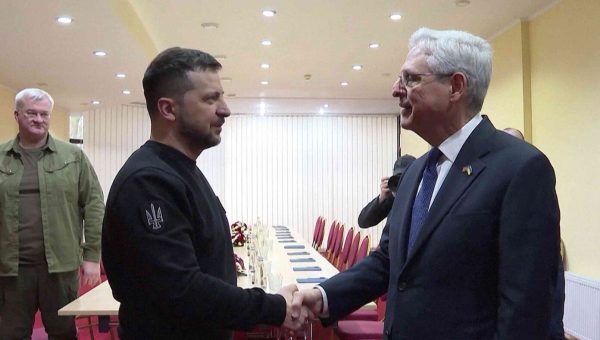
So, Americans have a “moral duty” apparently up to and including sending their sons and daughters to die supporting Ukraine. And ah yes, it’s all about the “free” world, democracy and the notorious rules based international system! Has anyone yet cited Hegel’s observation that the President Joe Biden Administration’s foreign policy has already “repeated itself, first as a tragedy in Afghanistan, second as a farce”? Meanwhile one suspects Zelensky was laughing all the way to the bank as Yellen disappeared over the horizon to come up with the cash, as that old expression goes, and he probably already has one of his buddies shopping for a new villa on the French Riviera to supplement his other real estate! But wait! The story became even more exciting the following week, involving another visit to Mr. Z by America’s nearly invisible Attorney General Merrick Garland, a man who can literally look Z in the eye as they are both very short. Garland is generally engaged in chasing white supremacists and requiring all new FBI hires to learn all about how to identify and pursue antisemites, but he has made two trips to Kiev to meet mano-a-mano with the brave olive drab t-shirt clad warrior who is already being beatified as the twenty-first century’s Winston Churchill.

Garland was in town to do the other thing the engages his sense of law and order, which is to set up a tribunal to arrest, prosecute and punish Russian war criminals after Ukraine emerges triumphant from its conflict with the unimaginably evil President Vladimir Putin. It would be modeled on the Nuremberg Tribunals that tried leading Nazis after the Second World War, and Garland has cited his family’s escape from the so-called holocaust to explain why he is intent on personally being involved in delivering what he describes as “justice.” A Justice Department spokeswoman described Garland’s mission as being in Kiev to personally “reaffirm America’s commitment to help hold Russia responsible for war crimes committed in its unjust and unprovoked invasion against its sovereign neighbor.”

Garland had several meetings with President Volodymyr Zelensky and foreign law enforcement officials including Ukrainian Prosecutor General Andriy Kostin while attending what was billed as the “United for Justice Conference.” Zelensky elaborated that the purpose of the conference was to hold Russia’s leadership accountable for the alleged atrocities carried out by its army. “The main issue of all these meetings is accountability,” he said. The US Justice Department is reportedly actively engaged in the gathering of evidence to indict the Russians. During Garland’s first visit to Ukraine in June 2022 he announced the appointment of Eli Rosenbaum, an Office of Special Investigations prosecutor best known for going after former Nazis, to direct American efforts to identify and track Russian war criminals.

Garland laid it on thick, as was expected from someone responsible for prosecuting the rest of the world when it steps out of line. He told his hosts that “Just over twelve months ago, invading Russian forces began committing atrocities at the largest scale in any armed conflict since the Second World War. We are here today in Ukraine to speak clearly, and with one voice: the perpetrators of those crimes will not get away with them. In addition to our work in partnership with Ukraine and the international community, the United States has also opened criminal investigations into war crimes in Ukraine that may violate US law.” He concluded by throwing out the complete bullshit party line much beloved by Joe Biden and Tony Blinken, that “The United States recognizes that what happens here in Ukraine will have a direct impact on the strength of our own democracy.”

Of course, there is more than a little bit of irony in all this, not to mention top level hypocrisy, as the United States has killed more people directly or indirectly while committing more crimes against humanity dished out in various ways over the past twenty years than any other country, except, predictably, Israel, which currently is committing crimes against humanity on a nearly daily basis. Curiously, however, the normally tone-deaf White House and Pentagon seem to understand, on a certain level, that opening up Pandora’s box might not be a good idea when it comes to war crimes. Last week Secretary of Defense Lloyd Austin refused to share US information on alleged Russian crimes with the International Criminal Court (ICC) in the Hague. The Pentagon is blocking the Biden administration from sharing evidence with the ICC collected by American intelligence agencies regarding Russian activities in Ukraine because helping the court investigate Russians might set a precedent that could help pave the way for it to prosecute Americans. Washington does not recognize the ICC, fearing that it might well seek to examine the sorry record of US military crimes in Asia and Africa. Israel similarly does to recognize the court for roughly the same reason.

So here we are, two top level officials from the Biden regime sneak into Kiev to give an arch crook money and unlimited moral support, together with a pledge that more cash is on the way as are arms and war crimes tribunals await those nasty Russians. And guess what? It is all packaged as being good for America! This sounds like a song that was sung previously in places like Vietnam, Iraq and Afghanistan and it was a tissue of lies then just as it is now. Yellen ought to have stayed home to tend to the banking system and should be giving the billions of dollars earmarked for Zelensky back to the American people. If Garland wants to investigate anyone it should be the Pentagon, the intelligence agencies, and Congress. And yes, his own FBI! And don’t forget how the Bidens and Clintons became multi-millionaires! And then there is the destruction of Nord Stream. Funny how every time one turns over a rock in and around the US government something really smelly surfaces.

Silicon Valley Bank Crisis: The Liquidity Crunch We Predicted Has Now Begun

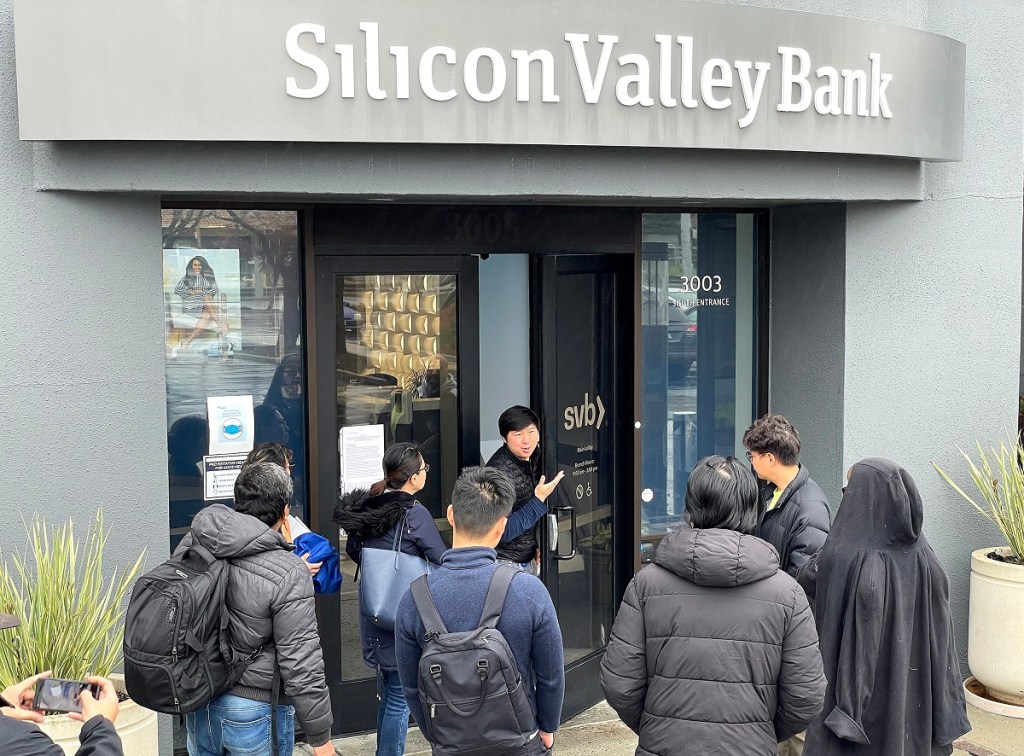
A worker, middle, tells customers that the Silicon Valley Bank headquarters is closed on Friday, March 10, 2023, in Santa Clara, California. Silicon Valley Bank was shut down on Friday morning by California regulators and was put in control of the U.S. Federal Deposit Insurance Corporation. (Justin Sullivan/Getty Images/TNS)

By Brandon Smith

Source: Alt-Market.us

There has been an avalanche of information and numerous theories circulating the past few days about the fate of a bank in California know as SVB (Silicon Valley Bank). SVB was the 16th largest bank in the US until it abruptly failed and went into insolvency on March 10th. The impetus for the collapse of the bank is tied to a $2 billion liquidity loss on bond sales which caused the institution’s stock value to plummet over 60%, triggering a bank run by customers fearful of losing some or most of their deposits.

There are many fine articles out there covering the details of the SVB situation, but what I want to talk about more is the root of it all. The bank’s shortfalls are not really the cause of the crisis, they are a symptom of a wider liquidity drought that I predicted here at Alt-Market months ago, including the timing of the event.

First, though, let’s discuss the core issue, which is fiscal tightening and the Federal Reserve. In my article ‘The Fed’s Catch-22 Taper Is A Weapon, Not A Policy Error’, published in December of 2021, I noted that the Fed was on a clear path towards tightening into economic weakness, very similar to what they did in the early 1980s during the stagflation era and also somewhat similar to what they did at the onset of the Great Depression. Former Fed Chairman Ben Bernanke even openly admitted that the Fed caused the depression to spiral out of control due to their tightening policies.

In that same article I discussed the “yield curve” being a red flag for an incoming crisis:

…The central bank is the largest investor in US bonds. If the Fed raises interest rates into weakness and tapers asset purchases, then we may see a repeat of 2018 when the yield curve started to flatten. This means that short term treasury bonds will end up with the same yield as long term bonds and investment in long term bonds will fall.”

As of this past week the yield curve has been inverted, signaling a potential liquidity crunch. Both Jerome Powell (Fed Charman) and Janet Yellen (Treasury Secretary) have indicated that tightening policies will continue and that reducing inflation to 2% is the goal. Given the many trillions of dollars the Fed has pumped into the financial system in the past decade as well as the overall weakness of general economy, it would not take much QT to crush credit markets and by extension stock markets.

As I also noted in 2021:

We are now at that stage again where price inflation tied to money printing is clashing with the stock market’s complete reliance on stimulus to stay afloat. There are some that continue to claim the Fed will never sacrifice the markets by tapering. I say the Fed does not actually care, it is only waiting for the right time to pull the plug on the US economy.”

But is that time now?  I expanded on this analysis in my article ‘Major Economic Contraction Coming In 2023 – Followed By Even More Inflation’, published in December of 2022. I noted that:

This is the situation we are currently in today as 2022 comes to a close. The Fed is in the midst of a rather aggressive rate hike program in a “fight” against the stagflationary crisis that they created through years of fiat stimulus measures. The problem is that the higher interest rates are not bringing prices down, nor are they really slowing stock market speculation. Easy money has been too entrenched for far too long, which means a hard landing is the most likely scenario.”

I continued:

In the early 2000s the Fed had been engaged in artificially low interest rates which inflated the housing and derivatives bubble. In 2004, they shifted into a tightening process. Rates in 2004 were at 1% and by 2006 they rose to over 5%. This is when cracks began to appear in the credit structure, with 4.5% – 5.5% being the magic cutoff point before debt became too expensive for the system to continue the charade. By 2007/2008 the nation witnessed an exponential implosion of credit…”

Finally, I made my prediction for March/April of 2023:

Since nothing was actually fixed by the Fed back then, I will continue to use the 5% funds rate as a marker for when we will see another major contraction…The 1% excise tax added on top of a 5% Fed funds rate creates a 6% millstone on any money borrowed to finance future buybacks. This cost is going to be far too high and buybacks will falter. Meaning, stock markets will also stop, and drop. It will likely take two or three months before the tax and the rate hikes create a visible effect on markets. This would put our time frame for contraction around March or April of 2023.”

We are now in the middle of March and it appears that the first signs of liquidity crisis are bubbling to the surface with the insolvency of SVB and the shuttering of another institution in New York called Signature Bank.

Everything is tied back to liquidity. With higher rates, banks are hard-pressed to borrow from the Fed and companies are hard-pressed to borrow from banks. This means companies that were hiding financial weakness and exposure to bad investments using easy credit no longer have that option. They won’t be able to artificially support operations that are not profitable, they will have to abandon stock buybacks that make their shares appear valuable and they will have to initiate mass layoffs in order to protect their bottom line.

SVB is not quite Bear Stearns, but it is likely a canary in the coal mine, telling us what is about to happen on a wider scale. Many of their depositors were founded in venture capital fueled by easy credit, not to mention all the ESG related companies dependent on woke loans. That money is gone – It’s dead. Those businesses are quietly but quickly crumbling which also conjured a black hole for deposits within SVB. It’s a terribly destructive cycle. Surely, there are numerous other banks in the US in the same exact position.

I believe this is just the beginning of a liquidity and credit crisis that will combine with overt inflation to produce perhaps the biggest economic crash America has ever seen. SVB’s failure may not be THE initiator, only one among many. I suspect that in this scenario larger US banks may avoid the kind of credit crash that we saw with Bear Stearns and Lehman Brothers in 2008. But, contagion could still strike multiple mid-sized banks and the effects could be similar in a short period of time.

With all the news flooding the wire on SVB it’s easy to forget that all of this boils down to a single vital issue: The Fed’s stimulus measures created an economy utterly addicted to easy and cheap liquidity. Now, they have taken that easy money away. In light of the SVB crash, will the central bank reverse course on tightening, or will they continue forward and risk contagion?

For now, Janet Yellen and the Fed have implemented a limited backstop and a guarantee on deposits at SVB and Signature. This will theoretically prevent a “haircut” on depositor accounts and lure retail investors with dreams of endless stimulus.  It is a half-measure, though – Central bankers have to at least look like they are trying. 

SVB’s assets sit at around $200 billion and Signature’s assets are around $100 billion, but what about interbank exposure and what about the wider implications?  How many banks are barely scraping by to meet their liquidity obligations, and how many companies have evaporating deposits?  The backstop will do nothing to prevent a major contagion.

There are many financial tricks that might slow the pace of a credit crash, but not by much.  And, here’s the kicker – Unlike in 2008, the Fed has created a situation in which there is no escape. If they do pivot and return to systemic bailouts, stagflation will skyrocket even more. If they don’t use QE, then banks crash, companies crash and even bonds become untenable, which puts the world reserve status of the Dollar under threat. What does that lead to? More stagflation. In either case, rapidly rising prices on most necessities will be the consequence.

How long will this process take? It all depends on how the Fed responds. They might be able to drag the crash out for a few months with various stop-gaps. If they go back to stimulus then the banks will be saved along with equities (for a while) but rising inflation will suffocate consumers in the span of a year and companies will still falter. My gut tells me that they will rely on contained interventions but will not reverse rate hikes as many analysts seem to expect.

The Fed will goose markets up at times using jawboning and false hopes of a return to aggressive QE or near-zero rates, but ultimately the trend of credit markets and stocks will be steady and downward.  Like a brush fire in a wind storm, once the flames are sparked there is no way to put things back the way they were.  If their goal was in fact a liquidity crunch, well, mission accomplished.  They have created that exact scenario.  Read my articles linked above to understand why they might do this deliberately.

In the meantime, it appears that my predictions on timing are correct so far. We will have to wait and see what happens in the coming weeks. I will keep readers apprised of events as new details unfold.  The situation is rapidly evolving.

A Smoldering Fuse

By James Howard Kunstler

Source: Kunstler.com

We have pretty much burned our bridges at this point. Unless you’re prepared to mindfuck yourself, and gaslight yourself, and confess, and convert, there’s no going back to “normal” society (which we couldn’t go back to anyway, on account of how it doesn’t exist anymore) — CJ Hopkins

Thirty-seven billion more dollars for Ukraine? (That’s thirty-seven thousand millions of dollars, by the way.) Bringing the total this year to a click-or-two over ninety billion (ninety-thousand millions), on top of whatever Sam Bankman-Fried’s FTX company funneled through that sad-sack international money laundromat — soon to be the darkest backwater of a European failed state since Field Marshal Melchior von Hatzfeldt of Westphalia left Bohemia a corpse-strewn wasteland after the Battle of Jankau (1645).

    It really doesn’t matter how much more money we pound down that rat-hole, you understand, because by the time various parties — the weapons-makers, Volodymyr Zelensky, sundry members of the US House of Representatives, The Biden family, the World Economic Forum — are finished creaming off their fair shares, poor Ukraine won’t have enough cash-on-hand to replace six fuse-boxes in Zaporizhzhia.

    Against this backdrop, the USA enters a holiday season near-death spiral as unspooling scandals battle a collapsing economy for supremacy of the alt news sites. Case-in-point: the aforementioned FTX monkey business, a metastasizing tumor of the body politic. This complex fraud will smolder for a few weeks before it explodes into an extinction-grade event for the Democratic Party. The usual suspects among the mainstream media are trying to ignore it for the moment, but the shreds of this exploding money-borg are already sticking to guilty parties far and wide across the political landscape.

      FTX commander-in-chief Sam Bankman-Fried remains at large after steering the crypto-currency trading platform into a bankruptcy so hideously tangled that the assigned liquidator in court proceedings, one John Ray III, who oversaw the Enron aftermath years ago, was boggled by what he’s found so far (and it’s early in the game): Namely, a company run by a handful of twenty-something drug freaks with no idea what they were doing, no record-keeping, and a slime trail of misappropriated investor’s funds leading to Kiev and Geneva through various crooked American political action committees, and the halls of Congress — with echos in ballot harvesting shenanigans which shaped the outcome of this month’s US elections.

     Mr. Bankman-Fried is still scheduled as a main speaker for Accenture’s Nov. 30 DealBook Conference in New York ($2,499 for a ticket), along with Ukrainian President Volodymyr Zelensky and US Treasury Secretary Janet Yellen. Odds on him showing up? Or even being alive elsewhere on this planet then?

     The extended family Bankman-Fried is the quintessence of Woke aristocracy. Dad Joe Bankman and mom Barbara Fried are both law professors at Stanford. She also acted as a money-bundler for the Democratic Party and ran two non-profit “voter registration” orgs (against the IRS laws which only permit non-partisan organized voter registration). Brother Gabe Bankman-Fried headed a non-profit named Guarding Against Pandemics (funded by Sam), which lobbies Congress to construct new platforms for medical tyranny. Aunt Linda Fried is Dean of the Columbia U’s Public Health school, and is associated with Johns Hopkins, which ran the October 2019 Event 201 pandemic drill (sponsored by the Gates Foundation) months before the Covid-19 outbreak.

Sam’s girlfriend, Caroline Ellison, ran the Alameda Investments arm of the FTX empire (that is, FTX’s own money laundromat). Her dad, Glenn Ellison is chair of MIT’s Econ School. His former colleague on the MIT Econ faculty, Gary Gensler, who specialized in blockchains there, is now head of the Securities and Exchange Commission, an agency that Sam Bankman Fried was attempting to rope into a regulation scheme to eliminate FTX’s crypto-currency competitors. Caroline’s mom, Sara Fisher Ellison is an MIT econ prof specializing in the pharmaceutical industry (fancy that!). Caroline Ellison is currently on-the-run.

     The sum total of all this professional and academic accomplishment is also the quintessence of Woke-Jacobin turpitude in service to a political faction that seeks maximum moneygrubbing while acting to overthrow every norm of behavior in the conduct of elections, and perhaps in American life generally. That’s some accomplishment. It’s also a lesson in why the managerial elite of our country are no longer trustworthy. They have gotten away with crimes against the nation for years, which has only made them bolder and more reckless.

     Wait for the FTX bankruptcy to unwind, along with all the political ramifications it entails, not to mention the financial afterburn in the whole crypto market, very likely extending into and befouling the rest of the banking system. This is going to be a clusterfuck for the ages, and will propel the USA into a depression with no visible horizon.

There is More to BlackRock Than You Might Imagine

By F. William Engdahl

Source: New Eastern Outlook

A virtually unregulated investment firm today exercises more political and financial influence than the Federal Reserve and most governments on this planet. The firm, BlackRock Inc., the world’s largest asset manager, invests a staggering $9 trillion in client funds worldwide, a sum more than double the annual GDP of the Federal Republic of Germany. This colossus sits atop the pyramid of world corporate ownership, including in China most recently. Since 1988 the company has put itself in a position to de facto control the Federal Reserve, most Wall Street mega-banks, including Goldman Sachs, the Davos World Economic Forum Great Reset, the Biden Administration and, if left unchecked, the economic future of our world. BlackRock is the epitome of what Mussolini called Corporatism, where an unelected corporate elite dictates top down to the population.

How the world’s largest “shadow bank” exercises this enormous power over the world ought to concern us. BlackRock since Larry Fink founded it in 1988 has managed to assemble unique financial software and assets that no other entity has. BlackRock’s Aladdin risk-management system, a software tool that can track and analyze trading, monitors more than $18 trillion in assets for 200 financial firms including the Federal Reserve and European central banks. He who “monitors” also knows, we can imagine. BlackRock has been called a financial “Swiss Army Knife — institutional investor, money manager, private equity firm, and global government partner rolled into one.” Yet mainstream media treats the company as just another Wall Street financial firm.

There is a seamless interface that ties the UN Agenda 2030 with the Davos World Economic Forum Great Reset and the nascent economic policies of the Biden Administration. That interface is BlackRock.

Team Biden and BlackRock

By now it should be clear to anyone who bothers to look, that the person who claims to be US President, 78-year old Joe Biden, is not making any decisions. He even has difficulty reading a teleprompter or answering prepared questions from friendly media without confusing Syria and Libya or even whether he is President. He is being micromanaged by a group of handlers to maintain a scripted “image” of a President while policy is made behind the scenes by others. It eerily reminds of the 1979 Peter Sellers film character, Chauncey Gardiner, in Being There.

What is less public are the key policy persons running economic policy for Biden Inc. They are simply said, BlackRock. Much as Goldman Sachs ran economic policy under Obama and also Trump, today BlackRock is filling that key role. The deal apparently was sealed in January, 2019 when Joe Biden, then-candidate and long-shot chance to defeat Trump, went to meet with Larry Fink in New York, who reportedly told “working class Joe,” that, “I’m here to help.”

Now as President in one of his first appointees, Biden named Brian Deese to be the Director of the National Economic Council, the President’s main adviser for economic policy. One of the early Presidential Executive Orders dealt with economics and climate policy. That’s not surprising, as Deese came from Fink’s BlackRock where he was Global Head of Sustainable Investing. Before joining BlackRock, Deese held senior economic posts under Obama, including replacing John Podesta as Senior Adviser to the President where he worked alongside Valerie Jarrett. Under Obama, Deese played a key role in negotiating the Global Warming Paris Accords.

In the key policy post as Deputy Treasury Secretary under Secretary Janet Yellen, we find Nigerian-born Adewale “Wally” Adeyemo. Adeyemo also comes from BlackRock where from 2017 to 2019 he was a senior adviser and Chief of Staff to BlackRock CEO Larry Fink, after leaving the Obama Administration. His personal ties to Obama are strong, as Obama named him the first President of the Obama Foundation in 2019.

And a third senior BlackRock person running economic policy in the Administration now is also unusual in several respects. Michael Pyle is the Senior Economic Adviser to Vice President Kamala Harris. He came to Washington from the position as the Global Chief Investment Strategist at BlackRock where he oversaw the strategy for investing some $9 trillion of funds. Before joining BlackRock at the highest level, he had also been in the Obama Administration as a senior adviser to the Undersecretary of the Treasury for International Affairs, and in 2015 became an adviser to the Hillary Clinton presidential bid.

The fact that three of the most influential economic appointees of the Biden Administration come from BlackRock, and before that all from the Obama Administration, is noteworthy. There is a definite pattern and suggests that the role of BlackRock in Washington is far larger than we are being told.

What is BlackRock?

Never before has a financial company with so much influence over world markets been so hidden from public scrutiny. That’s no accident. As it is technically not a bank making bank loans or taking deposits, it evades the regulation oversight from the Federal Reserve even though it does what most mega banks like HSBC or JP MorganChase do—buy, sell securities for profit. When there was a Congressional push to include asset managers such as BlackRock and Vanguard Funds under the post-2008 Dodd-Frank law as “systemically important financial institutions” or SIFIs, a huge lobbying push from BlackRock ended the threat. BlackRock is essentially a law onto itself. And indeed it is “systemically important” as no other, with possible exception of Vanguard, which is said to also be a major shareholder in BlackRock.

BlackRock founder and CEO Larry Fink is clearly interested in buying influence globally. He made former German CDU MP Friederich Merz head of BlackRock Germany when it looked as if he might succeed Chancellor Merkel, and former British Chancellor of Exchequer George Osborne as “political consultant.” Fink named former Hillary Clinton Chief of Staff Cheryl Mills to the BlackRock board when it seemed certain Hillary would soon be in the White House.

He has named former central bankers to his board and gone on to secure lucrative contracts with their former institutions. Stanley Fisher, former head of the Bank of Israel and also later Vice Chairman of the Federal Reserve is now Senior Adviser at BlackRock. Philipp Hildebrand, former Swiss National Bank president, is vice chairman at BlackRock, where he oversees the BlackRock Investment Institute. Jean Boivin, the former deputy governor of the Bank of Canada, is the global head of research at BlackRock’s investment institute.

BlackRock and the Fed

It was this ex-central bank team at BlackRock that developed an “emergency” bailout plan for Fed chairman Powell in March 2019 as financial markets appeared on the brink of another 2008 “Lehman crisis” meltdown. As “thank you,” the Fed chairman Jerome Powell named BlackRock in a no-bid role to manage all of the Fed’s corporate bond purchase programs, including bonds where BlackRock itself invests. Conflict of interest? A group of some 30 NGOs wrote to Fed Chairman Powell, “By giving BlackRock full control of this debt buyout program, the Fed… makes BlackRock even more systemically important to the financial system. Yet BlackRock is not subject to the regulatory scrutiny of even smaller systemically important financial institutions.”

In a detailed report in 2019, a Washington non-profit research group, Campaign for Accountability, noted that, “BlackRock, the world’s largest asset manager, implemented a strategy of lobbying, campaign contributions, and revolving door hires to fight off government regulation and establish itself as one of the most powerful financial companies in the world.”

The New York Fed hired BlackRock in March 2019 to manage its commercial mortgage-backed securities program and its $750 billion primary and secondary purchases of corporate bonds and ETFs in no-bid contracts. US financial journalists Pam and Russ Martens in critiquing that murky 2019 Fed bailout of Wall Street remarked, “for the first time in history, the Fed has hired BlackRock to “go direct” and buy up $750 billion in both primary and secondary corporate bonds and bond ETFs (Exchange Traded Funds), a product of which BlackRock is one of the largest purveyors in the world.” They went on, “Adding further outrage, the BlackRock-run program will get $75 billion of the $454 billion in taxpayers’ money to eat the losses on its corporate bond purchases, which will include its own ETFs, which the Fed is allowing it to buy…”

Fed head Jerome Powell and Larry Fink know each other well, apparently. Even after Powell gave BlackRock the hugely lucrative no-bid “go direct” deal, Powell continued to have the same BlackRock manage an estimated $25 million of Powell’s private securities investments. Public records show that in this time Powell held direct confidential phone calls with BlackRock CEO Fink. According to required financial disclosure, BlackRock managed to double the value of Powell’s investments from the year before! No conflict of interest, or?

A Very BlackRock in Mexico

BlackRock’s murky history in Mexico shows that conflicts of interest and influence-building with leading government agencies is not restricted to just the USA. PRI Presidential candidate Peña Nieto went to Wall Street during his campaign in November 2011. There he met Larry Fink. What followed the Nieto victory in 2012 was a tight relationship between Fink and Nieto that was riddled with conflict of interest, cronyism and corruption.

Most likely to be certain BlackRock was on the winning side in the corrupt new Nieto regime, Fink named 52-year-old Marcos Antonio Slim Domit, billionaire son of Mexico’s wealthiest and arguably most corrupt man, Carlos Slim, to BlackRock’s Board. Marcos Antonio, along with his brother Carlos Slim Domit, run the father’s huge business empire today. Carlos Slim Domit, the eldest son, was Co-Chair of the World Economic Forum Latin America in 2015, and currently serves as chairman of the board of America Movil where BlackRock is a major investor. Small cozy world.

The father, Carlos Slim, at the time named by Forbes as World’s Richest Person, built an empire based around his sweetheart acquisition of Telemex (later America Movil). Then President, Carlos Salinas de Gortari, in effect gifted the telecom empire to Slim in 1989. Salinas later fled Mexico on charges of stealing more than $10 billion from state coffers.

As with much in Mexico since the 1980s drug money apparently played a huge role with the elder Carlos Slim, father of BlackRock director Marcos Slim. In 2015 WikiLeaks released company internal emails from the private intelligence corporation, Stratfor. Stratfor writes in an April 2011 email, the time BlackRock is establishing its Mexico plans, that a US DEA Special Agent, William F. Dionne confirmed Carlos Slim’s ties to the Mexican drug cartels. Stratfor asks Dionne, “Billy, is the MX (Mexican) billionaire Carlos Slim linked to the narcos?” Dionne replies, “Regarding your question, the MX telecommunication billionaire is.” In a country where 44% of the population lives in poverty you don’t become the world’s richest man in just two decades selling Girl Scout cookies.

Fink and Mexican PPP

With Marcos Slim on his BlackRock board and new president Enrique Peña Nieto, Larry Fink’s Mexican partner in Nieto Peña’s $590 billion PublicPrivatePartnership (PPP) alliance, BlackRock, was ready to reap the harvest. To fine-tune his new Mexican operations, Fink named former Mexican Undersecretary of Finance Gerardo Rodriguez Regordosa to direct BlackRock Emerging Market Strategy in 2013. Then in 2016 Peña Nieto appointed Isaac Volin, then head of BlackRock Mexico to be No. 2 at PEMEX where he presided over corruption, scandals and the largest loss in PEMEX history, $38 billion.

Peña Nieto had opened the huge oil state monopoly, PEMEX, to private investors for the first time since nationalization in the 1930s. The first to benefit was Fink’s BlackRock. Within seven months, BlackRock had secured $1 billion in PEMEX energy projects, many as the only bidder. During the tenure of Peña Nieto, one of the most controversial and least popular presidents, BlackRock prospered by the cozy ties. It soon was engaged in highly profitable (and corrupt) infrastructure projects under Peña Nieto including not only oil and gas pipelines and wells but also including toll roads, hospitals, gas pipelines and even prisons.

Notably, BlackRock’s Mexican “friend” Peña Nieto was also “friends” not only with Carlos Slim but with the head of the notorious Sinaloa Cartel, “El Chapo” Guzman. In court testimony in 2019 in New York Alex Cifuentes, a Colombian drug lord who has described himself as El Chapo’s “right-hand man,” testified that just after his election in 2012, Peña Nieto had requested $250 million from the Sinaloa Cartel before settling on $100 million. We can only guess what for.

Larry Fink and WEF Great Reset

In 2019 Larry Fink joined the Board of the Davos World Economic Forum, the Swiss-based organization that for some 40 years has advanced economic globalization. Fink, who is close to the WEF’s technocrat head, Klaus Schwab, of Great Reset notoriety, now stands positioned to use the huge weight of BlackRock to create what is potentially, if it doesn’t collapse before, the world’s largest Ponzi scam, ESG corporate investing. Fink with $9 trillion to leverage is pushing the greatest shift of capital in history into a scam known as ESG Investing. The UN “sustainable economy” agenda is being realized quietly by the very same global banks which have created the financial crises in 2008. This time they are preparing the Klaus Schwab WEF Great Reset by steering hundreds of billions and soon trillions in investment to their hand-picked “woke” companies, and away from the “not woke” such as oil and gas companies or coal. BlackRock since 2018 has been in the forefront to create a new investment infrastructure that picks “winners” or “losers” for investment according to how serious that company is about ESG—Environment, Social values and Governance.

For example a company gets positive ratings for the seriousness of its hiring gender diverse management and employees, or takes measures to eliminate their carbon “footprint” by making their energy sources green or sustainable to use the UN term. How corporations contribute to a global sustainable governance is the most vague of the ESG, and could include anything from corporate donations to Black Lives Matter to supporting UN agencies such as WHO. Oil companies like ExxonMobil or coal companies no matter how clear are doomed as Fink and friends now promote their financial Great Reset or Green New Deal. This is why he cut a deal with the Biden presidency in 2019.

Follow the money. And we can expect that the New York Times will cheer BlackRock on as it destroys the world financial structures. Since 2017 BlackRock has been the paper’s largest shareholder. Carlos Slim was second largest. Even Carl Icahn, a ruthless Wall Street asset stripper, once called BlackRock, “an extremely dangerous company… I used to say, you know, the mafia has a better code of ethics than you guys.” 

When will the central bankers pay for all the wealth inequality and misery they’ve caused?

By Mitchell Feierstein

Source: RT.com

Janet Yellen’s been nominated by Joe Biden as Treasury Secretary, despite a poor record as Federal Reserve chair. This is typical of the unwarranted confidence placed in the central bankers who’ve caused so much financial pain.

The US Federal Reserve was established on December 23, 1913, and, despite its name, it is not a bank or part of the federal government. The Federal Reserve (or ‘Fed’) is owned and acts on behalf of its members, such as JPMorgan, Goldman Sachs and Berkshire Financial Services. Do you think the Fed cares about the wealth inequality its reckless policies have caused – policies that have benefited the .01 percenters that own it? Since 1913, the US dollar’s value has declined by 97 percent. Can the Fed really be considered to be doing a good job?

Consider, for example, these remarkable comments from central bankers. In March 2007, Fed Chairman Ben Bernanke said the subprime mortgage crisis was “likely to be contained,” and in May of that year, he added, “The vast majority of mortgages, including even subprime mortgages, continue to perform well. We do not expect significant spillovers from the subprime market to the rest of the economy or to the financial system.” 

In October 2007, he said, “It is not the responsibility of the Federal Reserve – nor would it be appropriate – to protect lenders and investors from the consequences of their financial decisions.”

In November 2010, during a Federal Reserve conference on Georgia’s Jekyll Island, former Fed chairman Alan Greenspan said a lesson he learnt from the 2008 crisis is how the taxpayers implicitly subsidized the “financial intermediary system in the US.” He went on to point out that “there was rampant fraud in a lot of what was going on in these markets. We need far higher levels of enforcement of fraud on statutes – not new ones, existing ones. Things were being done that were certainly illegal and clearly criminal.” The look on then Chairman Bernanke’s face when Greenspan dropped this truth bomb was priceless.

In 2015, the Financial Times reported how the Bank of Japan’s Haruhiko Kuroda “reimagined” its monetary policy on the belief in Peter Pan’s ability to fly. No wonder Japan’s economy has had no growth for nearly 40 years. And the frightening part is the West began embracing this failed economic model years ago.

Then there was Fed chief Janet Yellen, who, in 2017, said she didn’t believe we would see another financial crisis in our lifetime. How many times were Yellen’s economic forecasts during and after the global financial crisis proven wrong? Too many to count.

She often repeated how the Fed’s temporary emergency measures would be removed and we would have ‘lift-off’ of interest rates. But, of course, none of this ever happened, and we are still waiting, over 12 years later. Yellen kept bailing out billionaires with near-zero interest rates while killing savers and increasing the wealth inequality gap. The oligarchs of Silicon Valley love Yellen. And Wall Street adores her, as well as the Fed’s magic printing presses, with their unlimited capability.

Yellen’s counterpart at the time, Mark Carney, who was the head of the Financial Stability Board and the Bank of England, as well as the ex-governor of the Bank of Canada, was singing from the same hymn sheet. Carney, mirroring the policies of Bernanke and Yellen, inflated grotesque property bubbles in Canada and the UK by pushing interest rates to 900-year lows, eviscerating savers and elderly retirees while landing taxpayers with the bailout bill for the billionaires and bankers who’d blown up the system.

Carney is another who got it wrong about normalized interest rates in both the economies his policies destroyed. He promised “escape velocity” in the UK, but, like Yellen’s ‘lift-off,’ both crashed on the launch pad. Their policies still protected and enhanced the oligarchy, though.

Central bankers such as Yellen and Carney were paid handsomely for this. One must surmise that their ilk always intended to enrich the powerful oligarchs in the cantons of Wall Street, London, and Silicon Valley to the detriment of everyone else. This is the model: propaganda, lies, and censorship are used to ensure globalism that fosters tyrannical rule, which, in turn, is beneficial to maintaining the status quo demanded by the oligarchy. Be an obedient apparatchik and earn a golden parachute when you exit.

The policies of these two central bankers have created the most significant wealth inequality ever seen and have allowed for the financial plunder that benefited the .01 percent and turbo-charged the oligarchy. But now, Yellen and Carney have transformed themselves into social justice warriors, championing equality, racial equity and climate change. In fact, Joe Biden has deified Yellen, saying, “We might have to ask Lin-Manuel Miranda, who wrote the musical about the first Treasury Secretary, Hamilton, to write another musical for the first woman Treasury Secretary, Yellen.” 

It beggars belief how, after years of lies and economic destruction, lipstick is put on pigs to re-brand the oligarchs’ go-to patsies, Yellen and Carney. And now, Yellen may get a chance to do some serious damage should she become Treasury Secretary. When considering central bankers like these, we should remember the old maxim: beware of false prophets.

The Federal Reserve and the Global Fracture

Octopus 1912

An Interview with Finnish Journalist Antti J. Ronkainen

Michael Hudson

Source: The Unz Review

Antti J. Ronkainen: The Federal Reserve is the most significant central bank in the world. How does it contribute to the domestic policy of the United States?

Michael Hudson: The Federal Reserve supports the status quo. It would not want to create a crisis before the election. Today it is part of the Democratic Party’s re-election campaign, and its job is to serve Hillary Clinton’s campaign contributors on Wall Street. It is trying to spur recovery by resuming its Bubble Economy subsidy for Wall Street, not by supporting the industrial economy. What the economy needs is a debt writedown, not more debt leveraging such as Quantitative Easing has aimed to promote. But the Fed is in a state of denial that the U.S. and European economies are plagued by debt deflation.

The Fed uses only one policy: influencing interest rates by creating bank reserves at low give-away charges. It enables banks too make easy gains simply by borrowing from it and leaving the money on deposit to earn interest (which has been paid since the 2008 crisis to help subsidize the banks, mainly the largest ones). The effect is to fund the asset markets – bonds, stocks and real estate – not the economy at large. Banks also are heavy arbitrage players in foreign exchange markets. But this doesn’t help the economy recover, any more than the ZIRP (Zero Interest-Rate Policy) since 2001 has done for Japan. Financial markets are the liabilities side of the economy’s balance sheet, not the asset side.

The last thing either U.S. party wants is for the election to focus on this policy failure. The Fed, Treasury and Justice Department will be just as pro-Wall Street under Hillary. There would be no prosecutions of bank fraud, there would be another bank-friendly Attorney General, and a willingness to subsidize banks now that the Dodd-Frank bank reform has been diluted from what it originally promised to be.


So let’s go back to beginning. When the Great Financial Crisis escalated in 2008 the Fed’s response was to lower its main interest rate to nearly zero. Why?

The aim of lowering interest rates was to provide banks with cheap credit. The pretense was that banks might lend to help the economy get going again. But the Fed’s idea was simply to re-inflate the Bubble Economy. It aimed at restoring the value of the mortgages that banks had in their loan portfolios. The hope was that easy credit would spur new mortgage lending to bid housing prices back up – as if this would help the economy rather than simply raising the price of home ownership.

But banks weren’t going to make mortgage loans to a housing market that already was over-lent. Instead, homeowners had to start paying down the mortgages they had taken out. Banks also reduced their credit-card exposure by a few hundred billion dollars. So instead of receiving new credit, the economy was saddled with having to repay debts.

Banks did make money, but not by lending into the “real” production and consumption economy. They mainly engaged in arbitrage and speculation, and lending to hedge funds and companies to buy their own stocks yielding higher dividend returns than the low interest rates that were available.


In addition to the near zero interest rates, the Fed bought US Treasury bonds and mortgage backed securities (MBS) with almost $4 trillion during three rounds of Quantitative Easing stimulus. How have these measures affected the real economy and financial markets?

In 2008 the Federal Reserve had a choice: It could save the economy, or it could save the banks. It might have used a fraction of what became the vast QE credit – for example $1 trillion – to pay off the bad mortgages and write them down. That would have helped save the economy from debt deflation. Instead, the Fed simply wanted to re-inflate the bubble, to save banks from having to suffer losses on their junk mortgages and other bad loans.

Keeping these debts on the books, in full, let banks foreclose on defaulting homeowners. This intensified the debt-deflation, pushing the economy into its present post-2008 depression. The debt overhead is keeping it depressed.

One therefore can speak of a financial war waged by Wall Street against the economy. The Fed is a major weapon in this war. Its constituency is Wall Street. Like the Justice and Treasury Departments, it has been captured and taken hostage.

Federal Reserve chairwoman Janet Yellen’s husband, George Akerlof, has written a good article about looting and fraud as ways to make money. But instead of saying that looting and fraud are bad, the Fed has refused to regulate or move against such activities. It evidently recognizes that looting and fraud are what Wall Street is all about – or at least that the financial system would come crashing down if an attempt were made to clean it up!

So neither the Fed nor the Justice Department or other U.S. Government agencies has sanctioned or arrested a single banker for the trillions of dollars of financial fraud. Just the opposite: The big banks where the fraud was concentrated have been made even larger and more dominant. The effect has been to drive out of business the smaller banks not so involved in derivative bets and other speculation.

The bottom line is that banks made much more by getting Alan Greenspan and the Clinton-Bush Treasury officials to deregulate fraud than they could have made by traditional safe lending. But their gains have increased the economy’s overhead.


Do you believe Mike Whitney’s argument that QE was about a tradeoff between the Fed and the government: the Fed pumped the new bubble and saved the banks that the government didn’t need to bail out more banks. The government’s role was to impose austerity so that inflation and employment didn’t rise – which would have forced the Fed to raise interest rates, ending its QE program? source: http://www.counterpunch.org/2016/01/15/the-chart-that-explains-everything/]

That was a great chart that Mike put up from Richard Koo, and you should reproduce it here. It shows that the Fed’s enormous credit creation had zero effect on raising commodity prices or wages. But stock market prices doubled in just six years, 2008-15, and bond prices rose to new peaks. Banks left much of the QE credit on deposit with the Fed, earning an interest giveaway premium.

(Richard Koo: “The struggle between markets and central banks has only just begun,”

http://www.businessinsider.com/richard-koo-struggle-between-markets-and-central-banks-has-only-just-begun-2015-9?r=UK&IR=T

The important point is that the Fed (backed by the Obama Administration) refused to use this $4 trillion to revive the production-and-consumption economy. It claimed that such a policy would be “inflationary,” by which it meant raising employment and wage levels. The Fed thus accepted the neoliberal junk economics proposing austerity as the answer to any problem – austerity for the industrial economy, not the Fed’s own Wall Street constituency.


According to a Fed staff report, QE would lower the exchange rate of dollar to the other currencies causing competitiveness boost for the U.S. firms. Former finance minister of Brazil Guido Mantega, as well as the chairman of Central Bank of India Raghuram Rajan, have described the Fed’s QE as a “currency war.” What’s your take?

The Fed’s aim was simply to provide banks with low-interest credit. Banks lent to hedge funds to buy securities or make financial bets that yielded more than 0.1 percent. They also lent to companies to buy their own stock, and to corporate raiders for debt-financed mergers and acquisitions. But banks didn’t lend to the economy at large, because it already was “loaned up,” and indeed, overburdened with debt.

Lower interest rates did spur the “carry trade,” as they had done in Japan after 1990. Banks and hedge funds bought foreign bonds paying higher rates. The dollar drifted down as bank arbitrageurs could borrow from the Fed at 0.1 percent to lend to Brazil at 9 percent. Buying these foreign bonds pushed up foreign exchange rates against the dollar. That was a side effect of the Fed’s attempt to help Wall Street make financial gains. It simply didn’t give much consideration to how its QE flooding the global economy with surplus dollars would affect U.S. exports – or foreign countries.

Exchange rate shifts don’t affect export trends as much as textbook models claim. U.S. arms exports to the Near East, and many technology exports are non-competitive. However, a looming problem for most countries is what may happen when ending QE increases the dollar’s exchange rate. If U.S. interest rates go back up, the dollar will strengthen. That would increase the cost to foreign countries of paying dollar-denominated debts. Countries that borrowed all dollars at low interest will need to pay more in their own currencies to service these debts. Imagine what would happen if the Federal Reserve let interest rates rise back to a normal level of 4 or 5 percent. The soaring dollar would push debtor economies toward depression on capital account much more than it would help their exports on trade account.


You have said that QE is fracturing the global economy. What do you mean by that?

Part of the flood of dollar credit is used to buy shares of foreign companies yielding 15 to 20 percent, and foreign bonds. These dollars are turned over to foreign central banks for domestic currency. But central banks are only able to use these dollars to buy U.S. Treasury securities, yielding about 1 percent. When the People’s Bank of China buys U.S. Treasury bonds, it’s financing America’s dual budget and balance-of-payment deficits, both of which stem largely from military encirclement of Eurasia – while letting U.S. investors and the U.S. economy get a free ride.

Instead of buying U.S. Treasury securities, China would prefer to buy American companies, just like U.S. investors are buying Chinese industry. But America’s government won’t permit China even to buy gas station companies. The result is a double standard. Americans feel insecure having Chinese ownership in their companies. It is the same attitude that was directed against Japan in the late 1980s.

I wrote about this financial warfare and America’s free lunch via the dollar standard in Super Imperialism (2002) and The Bubble and Beyond (2012), and about how today’s New Cold War is being waged financially in Killing the Host (2015).


The Democrats loudly criticized the Bush administration’s $700 billion TARP-program, but backed the Fed’s QE purchases worth of almost $4 trillion during the Obama administration. How does this relate to the fact that officially, QE purchases were intended to support economic recovery?

I think you’ve got the history wrong. My Killing the Host describes how the Democrats supported TARP, while the Republican Congress opposed it on populist grounds. Republican Treasury Secretary Hank Paulson offered to use some of the money to aid over-indebted homeowners, but President-elect Obama blocked that – and then appointed Tim Geithner as Treasury Secretary. FDIC head Sheila Bair and by SIGTARP head Neil Barofsky have written good books about Geithner’s support for Wall Street (and especially for Citigroup and Goldman Sachs) against the interests of the economy at large.

If you are going to serve Wall Street – your major campaign contributors – you are going to need a cover story pretending that this will help the economy. Politicians start with “Column A”: their agenda to reimburse their campaign contributors – Wall Street and other special interests. Their public relations team and speechwriters then draw up “Column B”: what public voters want. To get votes, a rhetorical cover story is crafted. I describe this in my forthcoming J is for Junk Economics, to be published in March. It’s a dictionary of Orwellian doublethink, political and economic euphemisms to turn the vocabulary around and mean the opposite of what actually is meant.


How do TARP and QE relate to the Federal Reserve’s mandate about price stability?

There are two sets of prices: asset prices and commodity prices and wages. By “price stability” the Fed means keeping wages and commodity prices down. Calling depressed wage levels “price stability” diverts attention from the phenomenon of debt deflation – and also from the asset-price inflation that has increased the advantages of the One Percent over the 99 Percent. From 1980 to the present, the Fed has inflated the largest bond rally in history as a result of driving down interest rates from 20 percent in 1980 to nearly zero today, as you have noted.

Chicago School monetarism ignores asset prices. It pretends that when you increase the money supply, this increases consumer prices, commodity prices and wages proportionally. But that’s not what happens. When banks created credit (money), they don’t lend much to people to buy goods and services or for companies to make capital investments to employ more workers. They lend money mainly to transfer ownership of assets already in place. About 80 percent of bank loans are mortgages, and the rest are largely for stocks and bond purchases, including corporate takeovers and stock buybacks or debt-leveraged purchases. The effect is to bid up asset prices, while loading down the economy with debt in the process. This pushes up the break-even cost of doing business, while imposing debt deflation on the economy at large.

Wall Street isn’t so interested in exploiting wage labour by hiring it to produce goods for sale, as was the case under industrial capitalism in its heyday. It makes its gains by riding the wave of asset inflation. Banks also gain by making labour pay more interest, fees and penalties on mortgages, and for student loans, credit cards and auto loans. That’s the postindustrial financial mode of exploiting labor and the overall economy. The Fed’s QE program increases the price at which stocks, bonds and real estate exchange for labour, and also promotes debt leverage throughout the economy.


Why don’t economists distinguish between asset-price and commodity price inflation?

The economics curriculum has been turned into an exercise for students to pretend that a hypothetical parallel universe exists in which the rentier classes are job creators, necessary to help economies recover. The reality is that financial modes of getting rich by debt leveraging creates a Bubble Economy – a Ponzi scheme leading to austerity and shrinking markets, which always ends in a convulsion of bankruptcy.

The explanation for why this is not central to today’s economic theory is that the discipline has been captured by this neoliberal tunnel vision that overlooks the financial sector’s maneuvering to make quick trading profits in stocks, bonds, mortgages and derivatives, not to take the time and effort to develop long-term markets. Rentiers seek to throw a cloak of invisibility around how they make money. They know that if economists don’t measure their wealth and the public does not see it, voters will be less likely to bring pressure to regulate and tax it.

Today’s central economic problem is that inflating asset prices by debt leveraging extracts more interest and financial charges. When the resulting debt deflation ends up hollowing out the economy, creditors try to blame labour, or government spending (except for bailouts and QE to help Wall Street). It is as if debtors are exploiting their creditors.


If there is a new class war, what is the current growth model?

It’s an austerity model, as you can see from the eurozone and from the neoliberal consensus that cites Latvia as a success story rather than a disaster leading to de-industrialization and emigration. In real democracies, if economies polarize like they are doing today, you would expect the 99 Percent to fight back by electing representatives to enact progressive taxation, regulate finance and monopolies, and make public investment to raise wages and living standards. In the 19th century this drive led parliaments to rewrite the tax rules to fall more on landlords and monopolists.

Industrial capitalism plowed profits back into new means of production to expand the economy. But today’s rentier model is based on austerity and privatization. The main way the financial sector always has obtained wealth has been by privatizing it from the public domain by insider dealing and indebting governments.

The ultimate financial business plan also is to lend with an eye to end up with the debtor’s property, from governments to companies and families. In Greece the European Central Bank, European Commission and IMF demanded that if the nation’s elected representatives did not sell off the nation’s ports, land, islands, roads, schools, sewer systems, water systems, television stations and even museums to reimburse the dreaded austerity troika for its bailout of bondholders and bankers, the country would be isolated from Europe and faced with a crash. That forced Greece to capitulate.

What seems at first glance to be democracy has been hijacked by politicians who accept the financial class war ideology that the way for an economy to get rich is by austerity. That means lowering wages, unemployment, and dismantling government by turning the public domain over to the financial sector.

By supporting the banking sector even in its predatory and outright fraudulent behavior, U.S. and European governments are reversing the trajectory along which 19th-century progressive industrial capitalism and socialism were moving. Today’s rentier class is not concerned with long-term tangible investment to earn profits by hiring workers to produce goods. Under finance capitalism, an emerging financial over-class makes money by stripping income and assets from economies driven deeper into debt. Attacking “big government” when it is democratic, the wealthy are all in favor of government when it is oligarchic and serves their interests by rolling back the past two centuries of democratic reforms.


Does the Fed realize global turbulences what its unconventional policies have caused?

Sure. But the Fed has painted itself in a corner: If it raises interest rates, this will cause the stock and bond markets to go down. That would reverse the debt leveraging that has kept these markets up. Higher interest rates also would bankrupt Third World debtors, which will not be able to pay their dollar debts if dollars become more expensive in their currencies.

But if the Fed keeps interest rates low, pension funds and insurance companies will have difficulty making the paper gains that their plans imagined could continue exponentially ad infinitum. So whatever it does, it will destabilize the global economy.


China’s stock market has crashed, western markets are very volatile, and George Soros has said that the current financial environment reminds him of the 2008 crash. Should we be worried?

News reports make it sound as if debt-ridden capitalist economies will face collapse if the socialist countries don’t rescue them from their shrinking domestic markets. I think Soros means that the current financial environment is fragile and highly debt-leveraged, with heavy losses on bad loans, junk bonds and derivatives about to be recognized. Regulators may permit banks to “extend and pretend” that bad loans will turn good someday. But it is clear that most government reports and central bankers are whistling in the dark. Changes in any direction may pull down derivatives. That will cause a break in the chain of payments when losers can’t pay. The break may spread and this time public opinion is more organized against 2008-type bailouts.

The moral is that debts that can’t be paid, won’t be. The question is, how won’t they be paid? By writing down debts, or by foreclosures and distress sell-offs turning the financial class into a ruling oligarchy? That is the political fight being waged today – and as Warren Buffet has said, his billionaire class is winning it.


That’s all for now. Thank you Michael!