The Third World Revolt vs American Greatness

By Christopher Roach

Source: Covert Geopolitics

Although losing a war and taking a blow to prestige can be a painful process, the American people’s interests require the dismantling of the American empire.

Back in my high-school debating days, policy debate teams frequently concluded their arguments with an extreme and somewhat absurd parade of horribles. This was a testament to their intelligence and creativity, plus being dead wrong carried few consequences. Through convoluted chains of logic, they argued that some small change in environmental or trade policy would lead to nuclear war or America’s domination by the “global south.”

Even then, this all struck me as ridiculous. How could the Third World, with its periodic famines and coups, ever threaten the United States? Back then we were fully dominant over the entire world after the collapse of the Soviet Union and the Warsaw Pact.

A lot has changed.

The Birth of the Nonaligned Movement

During the Cold War, the various nations on the periphery acted, in some ways, as judges of the two competing systems. While the United States and Soviet Union were accused of manipulating the Third World for selfish reasons, the manipulation went both ways. Being coy, Third World leaders often managed to squeeze real benefits, like infrastructure projectsdiscounted military equipment, and other forms of aid by siding with one side or the other.

During the Cold War, the nations of the Third World were wary of being compelled to take sides, risking conflicts orthogonal to their own interests and sacrificing their sovereignty through excessive dependence on a patron. This is why the nonaligned movement gained power, with India in particular at the forefront, where it was joined by interested Middle Eastern, African, and Latin American nations.

These nations, which had gained sovereignty only very recently from their colonial masters, were understandably touchy about their independence. They did not want to exchange a formal colonial structure for an informal one.

When the Cold War ended, the United States remained the sole superpower for some time, but, rather than achieving worldwide assent, this instead fueled envy, fear, and resentment. No longer able to chart their own path, every nation became subordinate on some level to American power.

Aggressive Idealism Fuels Anti-Americanism

At the height of its military power, starting during the Clinton presidency, American leaders began to embrace an aggressive “idealism” that set out to change the character, values, and customs of other countries. Purely “humanitarian” interventions like Kosovo and Somalia became common.

In Iraq and Afghanistan, this idealism meant feminism and democracy. In Eastern Europe, it meant the promotion of gay rights and secularism, alienating the conservative and religious people who once idealized the United States. In Latin America, idealism demanded capitalism and loosened trade restrictions.

The invocation of “Freedom” and “Democracy,” while it sounds noble and idealistic to our ears, began to sound like a threat to nations who were out of step with the West’s ruling classes. Unilateral American military intervention in such diverse places as Panama, Iraq, Serbia, Syria, and Libya made nations on the sidelines wary that they could be next.

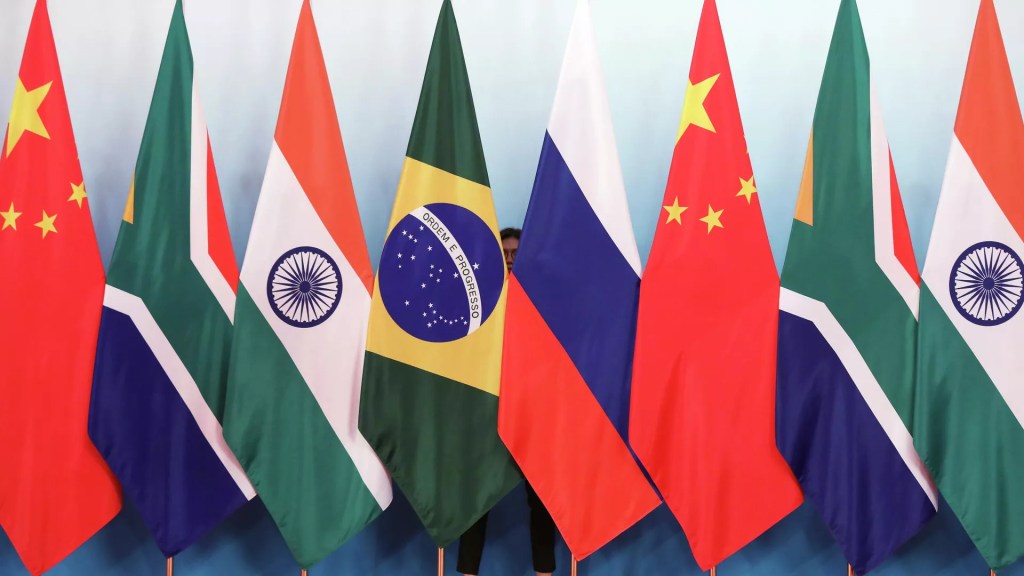
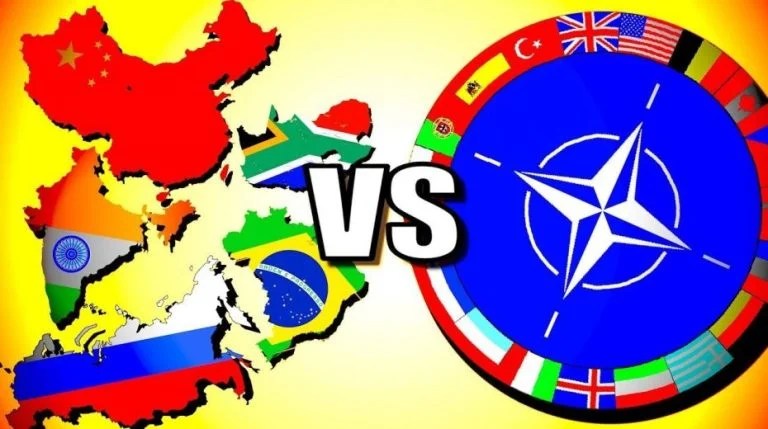
Brazil, Russia, China, India and South Africa—the so-called BRICS—do not have much in common. They have diverse economic and political systems, distinct languages, very different histories, and members appeared on both sides of Cold War alliances. But they share a common orientation to American power:  our aspirations to maintain “sole superpower” status threatens their national power and independence.  Perceiving this as a zero-sum game, they seek to pivot world attention, prosperity, and power away from the United States and its Western European allies.

Among these American competitors, China and Russia stand out most of all. Through their de facto alliance, they now dominate the Eurasian landmass. Their industrial capacity has revealed significant advantages in a war of attrition. And, finally, with their history as former American enemies, they have a habitual and strong resistance to American interference with their destinies.

While Russia and China’s conduct is easily understood, the growing and diverse anti-American coalition, along with these other nations’ willingness to accept Russian and Chinese leadership, needs explanation.  The heart of the matter is sovereignty. American demands and desires currently constrain each of the BRICS nations and the many smaller nations of the Third World, whether it is in energy, central banking, sanctions, trade, or even domestic policies on issues like feminism and gay rights.

The proposed “multipolar world” has a lot of momentum because it does not require submission to a particular Chinese or Russian model for internal governance. Russia and China are mostly agnostic about internal affairs, unlike the “idealistic” United States. Rather, the alternative promotes a more organic (and potentially chaotic) distribution of power from the current system.

Finally, neither Russia nor China could displace the United States. Thus, at most, they can usher in a world of “multipolarity,” where all countries will be less constrained, and larger countries like them have, at most, regional strength.

Ukraine War Now Existential for the American Empire

The current war in Ukraine is bringing a lot of things to a head. The United States and Europe imagined the rest of the world would view the conflict as a morality play: a big, powerful bully dominating its innocent and unassuming neighbor. This, indeed, is how most leaders and many people in the West perceive events.

But this has been a tough sell in the Third World, which is the chief reason sanctions have faced resistance. While Russia is bigger than Ukraine, Ukraine is big relative to its separatist eastern provinces, with whom it has had a conflict since 2014. Since most developing nations began as anti-colonial movements for national liberation, Ukraine’s attempts to forcibly reintegrate the East does not look so different from the types of struggles Brazil and India had during their independence movements.

Moreover, with Ukraine aligned so closely with the West—using NATO tanks, NATO mercenaries, and NATO money to prosecute its defense—much of the world does not perceive a bully pushing around its stalwart neighbor, but rather an American bully using its Ukrainian lackey for realpolitik designs against Russia. This is a particularly popular view in China, of course. But, judging from editorials and open source comments, it is also widely held in places like Africa and India, where many people view Russia in a positive light because of its opposition to the United States.

Until now, American power rested on actual American superiority in economics, military power, and cultural influence.  The United States soundly defeated Iraq in the first Gulf War, emerged from the Cold War intact and wealthy, and soon proceeded to project power with great skill in the early days of the Afghanistan and Iraq campaigns. But since that time, we have departed Afghanistan and Iraq without a victory. In parallel, we spread chaos in Libya and Syria, failing to conclude regime change operations in the latter.

American military prowess is no longer undisputed or inevitable, undermining the broader claim of America as the “sole superpower.” This was all avoidable, but having overextended itself, the visible evidence of American decline is now confirmed. This is what happens when a nation is ruled by disloyal, short-sighted, and foolish people.

To state the obvious, losing wars is never good for an empire. The Ottoman and Russian empires dissolved under the stresses of the First World War. While part of the victorious allies, World War II cemented the subordinate status of France and the United Kingdom, and their empires fell apart after the war. Finally, and most recently, the Soviet Union broke apart after its costly and controversial campaign in Afghanistan.

Russia’s attempts to assert power in its near-abroad fueled America’s interest in the current Ukraine War.  The theory was that we would pursue our interests on the cheap, prevent challenges to American hegemony, with the added benefit that Ukrainians would be doing the dying. Because of our military and economic superiority, supporters claimed the war would kill Russians, weaken their military, and destabilize Putin’s hold on power.

Proponents of the war did not really consider what would happen in the reverse case. What if not Russia, but the United States found itself strained economically, losing critical and hard-to-replace weapons in a war of attrition, visibly demonstrating its impotence and weakness on the world stage? Wouldn’t the same dire consequences intended for Russia now happen to us?

Indeed, they would. Luckily, actual American security does not depend on the continuation of America’s dominance of the globe, nor does American prosperity. Indeed, our prosperity has declined as the requirements of the military industrial complex and the behemoth welfare state devalue our currency and impoverish taxpayers. Further, our aspirations to maintain sole superpower status has endangered us by fueling anti-Americanism, while encouraging significant moral compromise at home.

Although losing a war and taking a blow to prestige can be a painful process, the American people’s interests require the dismantling of the American empire. Our current course risks manifesting the dire and once-implausible scenarios popular on the high school debate circuit. It is time to change course.

Summer of the Hawks

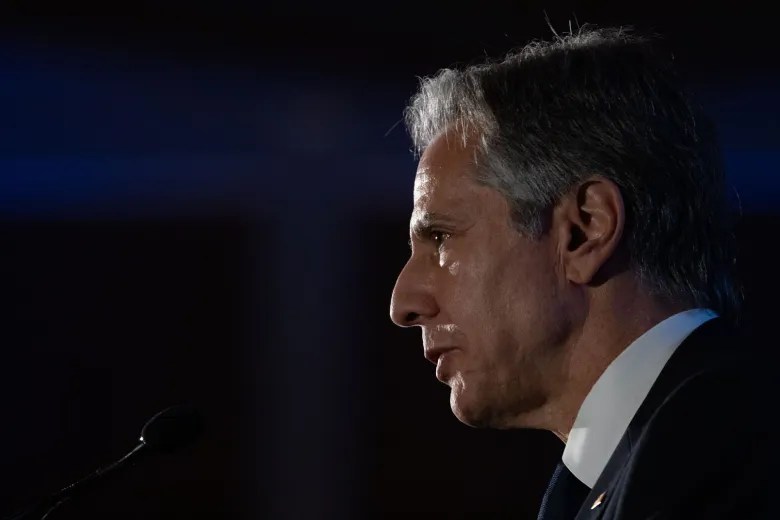
Secretary of State Antony Blinken speaks during the Mandela Washington Fellowship Summit for Young African Leaders in Washington, DC, August 2, 2023. (Official State Department photo by Chuck Kennedy)

By Seymour Hersh

Source: Rise Up Times

It’s been weeks since we looked into the adventures of the Biden administration’s foreign policy cluster, led by Tony Blinken, Jake Sullivan, and Victoria Nuland. How has the trio of war hawks spent the summer?

Sullivan, the national security adviser, recently brought an American delegation to the second international peace summit earlier this month at Jeddah in Saudi Arabia. The summit was led by Crown Prince Mohammed bin Salman, known as MBS, who in June announced a merger between his state-backed golf tour and the PGA. Four years earlier MBS was accused of ordering the assassination and dismemberment of the journalist Jamal Khashoggi at the Saudi consulate in Istanbul, for perceived disloyalty to the state.

As unlikely as it sounds, there was such a peace summit and its stars did include MBS, Sullivan, and President Volodymyr Zelensky of Ukraine. What was missing was a representative of Russia, which was not invited to the summit. It included just a handful of heads of state from the fewer than fifty nations that sent delegates. The conference lasted two days, and attracted what could only be described as little international attention.

Reuters reported that Zelensky’s goal was to get international support for “the principles” that that he will consider as a basis for the settlement of the war, including “the withdrawal of all Russian troops and the return of all Ukrainian territory.” Russia’s formal response to the non-event came not from President Vladimir Putin but from Deputy Minister of Foreign Affairs Sergei Ryabkov. He called the summit “a reflection of the West’s attempt to continue futile, doomed efforts” to mobilize the Global South behind Zelensky.

India and China both sent delegations to the session, perhaps drawn to Saudi Arabia for its immense oil reserves. One Indian academic observer dismissed the event as achieving little more than “good advertising for MBS’s convening power within the Global South; the kingdom’s positioning in the same; and perhaps more narrowly, aiding American efforts to build consensus by making sure China attends the meeting with . . . Jake Sullivan in the same room.”

Meanwhile, far away on the battlefield in Ukraine, Russia continued to thwart Zelensky’s ongoing counteroffensive. I asked an American intelligence official why it was Sullivan who emerged from the Biden administration’s foreign policy circle to preside over the inconsequential conference in Saudi Arabia.

“Jeddah was Sullivan’s baby,” the official said. “He planned it to be Biden’s equivalent of [President Woodrow] Wilson’s Versailles. The grand alliance of the free world meeting in a victory celebration after the humiliating defeat of the hated foe to determine the shape of nations for the next generation. Fame and Glory. Promotion and re-election. The jewel in the crown was to be Zelensky’s achievement of Putin’s unconditional surrender after the lightning spring offensive. They were even planning a Nuremberg type trial at the world court, with Jake as our representative. Just one more fuck-up, but who is counting? Forty nations showed up, all but six looking for free food after the Odessa shutdown”—a reference to Putin’s curtailing of Ukrainian wheat shipments in response to Zelensky’s renewed attacks on the bridge linking Crimea to the Russian mainland.

Enough about Sullivan. Let us now turn to Victoria Nuland, an architect of the 2014 overthrow of the pro-Russian government in Ukraine, one of the American moves that led us to where we are, though it was Putin who initiated the horrid current war. The ultra-hawkish Nuland was promoted early this summer by Biden, over the heated objections of many in the State Department, to be the acting deputy secretary of state. She has not been formally nominated as the deputy for fear that her nomination would lead to a hellish fight in the Senate.

It was Nuland who was sent last week to see what could be salvaged after a coup led to the overthrow of a pro-Western government in Niger, one of a group of former French colonies in West Africa that have remained in the French sphere of influence. President Mohamed Bazoum, who was democratically elected, was tossed out of office by a junta led by the head of his presidential guard, General Abdourahmane Tchiani. The general suspended the constitution and jailed potential political opponents. Five other military officers were named to his cabinet. All of this generated enormous public support on the streets in Niamey, Niger’s capital—enough support to discourage outside Western intervention.

There were grim reports in the Western press that initially viewed the upheaval in East-West terms: some of the supporters of the coup were carrying Russian flags as they marched in the streets. The New York Times saw the coup as a blow to the main US ally in the region, Nigerian President Bola Ahmed Tinubu, who controls vast oil and gas reserves. Tinubu threatened the new government in Niger with military action unless they returned power to Bazoum. He set a deadline that passed without any outside intervention.

The revolution in Niger was not seen by those living in the region in east-west terms but as a long needed rejection of long-standing French economic and political control. It is a scenario that may be repeated again and again throughout the French-dominated Sahel nations in sub-Saharan Africa.

There are distinctions that do not bode well for the new government in Niger. The nation is blessed, or perhaps cursed, by having a significant amount of the remaining natural uranium deposits in the world. As the world warms up, a return to nuclear generated power is seen as inevitable, with obvious implications for the value of the stuff underground in Niger. The raw uranium ore, when separated, filtered and processed is known worldwide as yellowcake.

The corruption so often “talked about in Niger is not about petty bribes by government officials, but about an entire structure—developed during French colonial rule—that prevents Niger from establishing sovereignty over its raw materials and over its development,” according to a recent analysis published by Baltimore’s Real News Network. Three out of four laptops in France are powered by nuclear energy, much of which is derived from uranium mines in Niger effectively controlled by its former colonial overlord.

Niger is also the home of three American drone bases targeting Islamic radicals throughout the region. There  are also undeclared Special Forces outposts in the region, whose soldiers receive double pay while on their risky combat assignments. The American official told me that “the 1,500 US troops now in Niger are exactly the number of American troops who were in South Vietnam at the time John F. Kennedy took over the presidency in 1961.”

Into this scene came Victoria Nuland, who must have drawn the short straw inside the Biden Administration. She was sent to negotiate with the new regime and to arrange a meeting with the ousted President Bazoum, whose life remains under constant threat from the governing junta. The New York Times reported that she got nowhere after talks she described as “extremely frank and at times quite difficult.” The intelligence official put her remarks to the Times in American military lingo: “Victoria set out to save the Niger uranium owners from the barbaric Russians and got a huge single-finger salute.”

Quieter in recent weeks than Sullivan and Nuland has been Secretary of State Tony Blinken. Where was he? I asked that question of the official, who said that Blinken “has figured out that the United States”—that is, our ally Ukraine—“will not win the war” against Russia. “The word was getting to him through the Agency [CIA] that the Ukrainian offense was not going to work. It was a show by Zelensky and there were some in the administration who believed his bullshit.

“Blinken wanted to broker a peace deal between Russia and Ukraine as Kissinger did in Paris to end the Vietnam war.” Instead, the official said, “it was going to be a big lose and Blinken found himself way over his skis. But he does not want to go down as the court jester.”

It was at this moment of doubt, the official said, that Bill Burns, the CIA director, “made his move to join the sinking ship.” He was referring to Burns’s speech earlier this summer at the annual Ditchley conference near London. He appeared to put aside his earlier doubts about expanding NATO to the east and affirmed his support at least five times for Biden’s program.

“Burns does not lack self-confidence and ambition,” the intelligence official said, especially when Blinken, the ardent war hawk, was suddenly having doubts. Burns served in a prior administration as deputy secretary of state and running the CIA was hardly a just reward.

Burns would not replace a disillusioned Blinken, but only get a token promotion: an appointment to Biden’s cabinet. The cabinet meets no more than once a month and, as recorded by C-SPAN, the meetings tend to be tightly scripted affairs and to begin with the president reading from a prepared text.

Tony Blinken, who publicly vowed just a few months ago that there would be no immediate ceasefire in Ukraine, is still in office and, if asked, would certainly dispute any notion of discontent with Zelensky or the administration’s murderous and failing war policy in Ukraine.

So the White House’s wishful approach to the war, when it comes to realistic talk to the American people, will continue apace. But the end is nearing, even if the assessments supplied by Biden to the public are out of a comic strip.

This piece is from Seymour Hersh’s Substack, you may subscribe to it here.

BRICS 11 – Strategic Tour de Force

By Pepe Escobar

Source: The Unz Review

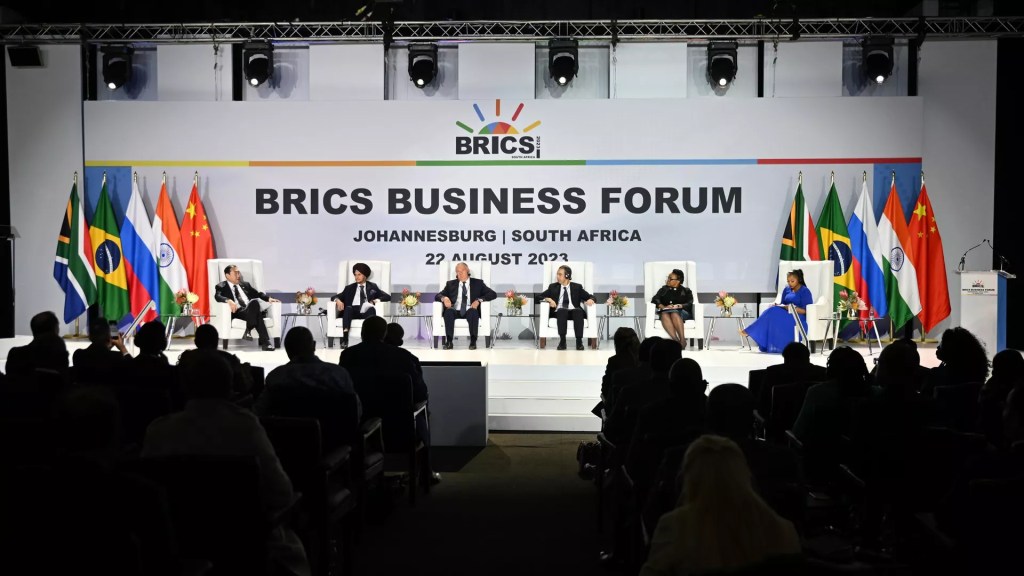
Chinese President Xi Jinping defined all the major decisions embedded in the 15th BRICS summit in South Africa as “historic”. That may be seen as an understatement.

It will take time for the Global South, or Global Majority, or “Global Globe” (copyright President Lukashenko), not to mention the stunned collective West, to fully grasp the enormity of the new strategic stakes.

President Putin, for his part, described the negotiations on BRICS expansion as quite difficult. By now a relatively accurate picture is emerging of what really went down on that table in Johannesburg.

India wanted 3 new members. China wanted as many as 10. A compromise was finally reached, with 6 members: Egypt, Iran, Saudi Arabia, United Arab Emirates (UAE), Argentina and Ethiopia.

So from now on it’s BRICS 11. And that’s just the beginning. Starting with the rotating Russian presidency of BRICS on January 1, 2024, more partners will be progressively included, and most certainly a new round of full members will be announced at the BRICS 11 summit in Kazan in October next year.

So we may soon progress to BRICS 20 – on the way to BRICS 40. The G7, for all practical purposes, is sliding towards oblivion.

Bur first things first. At that fateful table in Johannesburg, Russia supported Egypt. China went all out for Persian Gulf magic: Iran, UAE and the Saudis. Of course: Iran-China are already deep into a strategic partnership, and Riyadh is already accepting payment for energy in yuan.

Brazil and China supported Argentina, Brazil’s troubled neighbor, running the risk of having its economy fully dollarized, and also a key commodity provider to Beijing. South Africa supported Ethiopia. India, for a series of very complex reasons, was not exactly comfortable with 3 Arab/Muslim members (Saudi Arabia, UAE, Egypt). Russia assuaged New Delhi’s fears.

All of the above respects geographic principles and imprints the notion of BRICS representing the Global South. But it goes way beyond that, blending cunning strategy and no-nonsense realpolitik.

India was mollified because Russian Foreign Minister Sergey Lavrov, at the table in Johannesburg negotiating on behalf of President Putin, and highly respected by New Delhi, fully understood that a new, single BRICS currency is a long way away. What really matters, short and medium term, is expanding intra-BRICS trade in their national currencies.

That was stressed by New Development Bank (NDB) president Dilma Rousseff in her report to the South African summit hosts – even as Brazilian President Lula once again emphasized the importance of setting up a work group to discuss a BRICS currency.

Lavrov understood how New Delhi is absolutely terrified of secondary sanctions by the US, in case its BRICS role gets too ambitious. Prime Minister Modi is essentially hedging between BRICS and the completely artificial imperial obsession embedded in the terminology “Indo-Pacific” – which masks renewed containment of China. The Straussian neo-con psychos in charge of US foreign policy are already furious with India buying loads of discounted Russian oil.

New Delhi’s support for a new BRICS currency would be interpreted in Washington as all-out trade war – and sanctions dementia would follow. In contrast, Saudi Arabia’s MbS doesn’t care: he’s a top energy producer, not consumer like India, and one of his priorities is to fully court his top energy client, Beijing, and pave the way for the petroyuan.

It Takes Just a Single Strategic Move

Now let’s get into the strategic stakes. For all practical purposes, in Eurasian terms, BRICS 11 is now on the way to lord over the Arctic Sea Route; the International North South Transportation Corridor (INSTC); BRI’s East West Corridors; the Persian Gulf; the Red Sea; and the Suez Canal.

That blends several overland corridors with several nodes of the Maritime Silk Roads. Nearly total integration in the Heartland and the Rimland. All with just a single strategic move in the geopolitical/geoeconomic chessboard.

Much more than an increase of BRICS 11 collective GDP to 36% of the world’s total (already larger than the G7), with the group now encompassing 47% of the world’s population, the top geopolitical and geoeconomic breakthrough is how BRICS 11 is about to literally break the bank on the energy and commodities market fronts.

By incorporating Iran, Saudi Arabia and the UAE, BRICS 11 instantly shines on as an oil and gas powerhouse. BRICS 11 now controls 39% of global oil exports; 45.9% of proven reserves; and at least 47.6% of all oil produced globally, according to InfoTEK.

With BRICS 11 possibly including Venezuela, Algeria and Kazakhstan as new members as early as in 2024, it may control as much as 90% of all oil and gas traded globally.

Inevitable corollary: operations settled in local currencies bypassing the US dollar. And inevitable conclusion: petrodollar in a coma. The Empire of Chaos and Plunder will lose its free lunch menu: control of global oil prices and means to enforce “diplomacy” via a tsunami of unilateral sanctions.

Already in the horizon, direct BRICS 11-OPEC+ symbiosis is inevitable. OPEC+ is effectively run by Russia and Saudi Arabia.

A ground-shaking geoeconomic reorientation is at hand, involving everything from routes plied by global supply chains and new BRICS roads to the progressive interconnection of BRI, the Saudi Vision 2030 and massive port expansion in the UAE.

By choosing Ethiopia, BRICS expands its African reach on mining, minerals and metals. Ethiopia is rich in gold, platinum, tantalum, copper, niobium and offers vast potential in oil and natural gas exploration. Saudi Arabia and the UAE, incidentally, are also involved in mining.

This all spells out fast, progressive integration of North Africa and West Asia.

How Diplomacy Goes a Long Way

The BRICS 11 Shock of the New, in the energy sphere, is a sharp historical counterpoint to the 1973 oil shock, after which Riyadh started wallowing in petrodollars. Now Saudi Arabia under MbS is operating a tectonic shift, in the process of becoming strategically aligned with Russia-China-India-Iran.

Diplomatic coup does not even begin to describe it. This is the second stage of the Russian-initiated and Chinese-finalized rapprochement between Riyadh and Tehran, recently sealed in Beijing. The Russia-China strategic leadership, working patiently in synch, never lost sight of the ball.

Now compare it with collective West’s “strategies”, such as the G7-imposed oil price cap. Essentially the G7 “coalition of the willing” self-imposed a price cap on Russian crude imported by sea. The result is that they had to start buying way more oil products from Global South nations which ignored the price cap and duly increased their purchase of Russian crude.

Guess who are the top two: BRICS members China and India.

After wallowing in several stages of denial, the collective West may – or may not – realize it’s a fool’s dream to attempt to “de-couple” the West-ruled part of the global economy from China, whatever is spewed out by Washington.

BRICS 11 now shows, graphically, how the “Global South/Global Majority/”Global Globe” is more non-aligned with the West than anytime in recent history.

By the way, the president of the G77, Cuban leader Diaz-Canel, was at the BRICS summit representing the de-facto new Non-Aligned Movement (NAM): the G77 actually incorporates no less than 134 nations. Most are African. Xi Jinping in Johannesburg met in person with the leaders of most of them.

The collective West, in panic, regards all of the above as “dangerous”. So the last refuge is, predictably, rhetorical: “de-coupling”, “de-risking”, and similar idiocies.

Yet that may also get practically dangerous. As in the first ever trilateral summit in Camp David on August 18 between the Empire and two Asian vassals, Japan and South Korea. That may be interpreted as the first move towards a military-political Asian NATO even more toxic than Quad or AUKUS, obsessed to simultaneously contain China, Russia and the DPRK.

The Collective Outstripping of the Global North

The UN lists 152 nations in the world as “developing countries”. BRICS 11 is aiming at them – as they outstrip the Global North on everything from population growth to overall contribution to global GDP growth measured by PPP.

In the past 10 years since the announcement of BRI first in Astana and then in Jakarta, Chinese financial institutions have lent nearly $1 trillion for infrastructure connectivity projects across the Global South. The upcoming BRI forum in Beijing will signal a renewed drive. That’s the BRI-BRICS symbiosis.

In the G20 last year, China was the first nation to lobby for the inclusion of the 55-member African Union (AU). That may happen at the G20 summit next month in New Delhi; in that case, Global South representation will be close to parity with the Global North.

Claims that Beijing was organizing a malign conspiracy to turn BRICS into a weapon against the G7 are infantile. Realpolitik – and geoeconomic indicators – are dictating the terms, configuring the Shock of the New: the G7’s irreversible irrelevance with the rise of BRICS 11.

Geopolitical Chessboard Shifts Against US Empire

By Pepe Escobar

Source: The Unz Review

The geopolitical chessboard is in perpetual shift – and never more than in our current incandescent juncture.

A fascinating consensus in discussions among Chinese scholars – including those part of the Asian and American diasporas – is that not only Germany/EU lost Russia, perhaps irretrievably, but China gained Russia, with an economy highly complementary to China’s own and with solid ties with the Global South/Global Majority that can benefit and aid Beijing.

Meanwhile, a smatter of Atlanticist foreign policy analysts are now busy trying to change the narrative on NATO vs. Russia, applying the rudiments of realpolitik.

The new spin is that it’s “strategic insanity” for Washington to expect to defeat Moscow, and that NATO is experiencing “donor fatigue” as the sweatshirt warmonger in Kiev “loses credibility”.

Translation: it’s NATO as a whole that is completely losing credibility, as its humiliation in the Ukraine battlefield is now painfully graphic for all the Global Majority to see.

Additionally, “donor fatigue” means losing a major war, badly. As military analyst Andrei Martyanov has relentlessly stressed, “NATO ‘planning’ is a joke. And they are envious, painfully envious and jealous.”

A credible path ahead is that Moscow will not negotiate with NATO – a mere Pentagon add-on – but offer individual European nations a security pact with Russia that would make their need to belong to NATO redundant. That would assure security for any participating nation and relieve pressure on it from Washington.

Bets could be made that the most relevant European powers might accept it, but certainly not Poland – the hyena of Europe – and the Baltic chihuahuas.

In parallel, China could offer peace treaties to Japan, South Korea and the Philippines, and subsequently a significant part of the US Empire of Bases might vanish.

The problem, once again, is that vassal states don’t have the authority or power to comply with any agreement ensuring peace. German businessmen, off the record, are sure that sooner or later Berlin may defy Washington and do business with the Russia-China strategic partnership because it benefits Germany.

Yet the golden rule still has not been met: if a vassal state wants to be treated as a sovereign state, the first thing to do is to shut down key branches of the Empire of Bases and expel US troops.

Iraq is trying to do it for years now, with no success. One third of Syria remains US-occupied – even as the US lost its proxy war against Damascus due to Russian intervention.

The Ukraine Project as an existential conflict

Russia has been forced to fight against a neighbor and kin that it simply can’t afford to lose; and as a nuclear and hypersonic power, it won’t.

Even if Moscow will be somewhat strategically weakened, whatever the outcome, it’s the US – in the view of Chinese scholars – that may have committed its greatest strategic blunder since the establishment of the Empire: turning the Ukraine Project into an existential conflict, and committing the entire Empire and all its vassals to a Total War against Russia.

That’s why we have no peace negotiations, and the refusal even of a cease fire; the only possible outcome devised by the Straussian neocon psychos who run US foreign policy is unconditional Russian surrender.

In the recent past, Washington could afford to lose its wars of choice against Vietnam and Afghanistan. But it simply can’t afford to lose the war on Russia. When that happens, and it’s already on the horizon, the Revolt of the Vassals will be far reaching.

It’s quite clear that from now on China and BRICS+ – with expansion starting at the summit in South Africa next month – will turbo-charge the undermining of the US dollar. With or without India.

There will be no imminent BRICS currency – as noted by some excellent points in this discussion. The scope is huge, sherpas are only in the initial debating stages, and the broad outlines have not been defined yet.

The BRICS+ approach will evolve from improved cross border settlement mechanisms – something everyone from Putin to Central Bank head Elvira Nabiullina have stressed – to eventually a new currency way further down the road.

This would probably be a trade instrument rather than a sovereign currency like the euro. It will be designed to compete against the US dollar in trade, initially among BRICS+ nations, and capable of circumventing the hegemonic US dollar ecosystem.

The key question is how long the Empire’s fake economy – clinically deconstructed by Michael Hudson – can hold out in this wide spectrum geoeconomic war.

Everything is a ‘national security threat’

On the electronic technology front, the Empire has gone no holds barred to impose global economic dependency, monopolizing intellectual property rights and as Michael Hudson notes, “extracting economic rent from charging high prices for high-technology computer chips, communications, and arms production.”

In practice, not much is happening other than the prohibition for Taiwan to supply valuable chips to China, and asking TSMC to build, as soon as possible, a chip manufacturing complex in Arizona.

However, TSMC chairman Mark Liu has remarked that the plant faced a shortage of workers with the “specialized expertise required for equipment installation in a semiconductor-grade facility.” So the much lauded TSMC chip plant in Arizona won’t start production before 2025.

The top Empire/vassal NATO demand is that Germany and the EU must impose a Trade Iron Curtain against the Russia-China strategic partnership and their allies, thus ensuring “de-risk” trade.

Predictably, US Think Tankland has gone bonkers, with American Enterprise Institute hacks rabidly stating that even economic de-risking is not enough: what the US needs is a hard break with China.

In fact that dovetails with Washington smashing international free trade rules and international law, and treating any form of trade and SWIFT and financial exchanges as “national security threats” to US economic and military control.

So the pattern ahead is not China imposing trade sanctions on the EU – which remains a top trade partner for Beijing; it’s Washington imposing a tsunami of sanctions on nations daring to break the US-led trade boycott.

Russia-DPRK meets Russia-Africa

Only this week, the chessboard went through two game-changing moves: the high-profile visit by Russian Defense Minister Sergei Shoigu to the DPRK, and the Russia-Africa summit in St. Petersburg.

Shoigu was received in Pyongyang as a rock star. He had a personal meeting with Kim Jong-Un. The mutual goodwill leads to the strong possibility of North Korea eventually joining one of the multilateral organizations carving the path towards multipolarity.

That would be, arguably, an extended Eurasian Economic Union (EAEU). It could start with an EAEU-DPRK free trade agreement, such as the ones struck with Vietnam and Cuba.

Russia is the top power in the EAEU and it can ignore sanctions on the DPRK, while BRICS+, SCO or ASEAN have too many second thoughts. A key priority for Moscow is the development of the Far East, more integration with both Koreas, and the Northern Sea Route, or Arctic Silk Road. The DPRK is then a natural partner.

Getting the DPRK into the EAEU will do wonders for BRI investment: a sort of cover which Beijing does not enjoy for the moment when it invests in the DPRK. That could become a classic case of deeper BRI-EAEU integration.

Russian diplomacy at the highest levels is going all out to relieve the pressure over the DPRK. Strategically, that’s a real game-changer; imagine the huge and quite sophisticated North Korean industrial-military complex added to the Russia-China strategic partnership and turning the whole Asia-Pacific paradigm upside down.

The Russia-Africa summit in St. Petersburg, in itself, was another game-changer that left collective West mainstream media apoplectic. That was nothing less than Russia publicly announcing, in words and deeds, a comprehensive strategic partnership with the whole of Africa even as a hostile collective West wages Hybrid War – and otherwise – against Afro-Eurasia.

Putin showed how Russia holds a 20% share of the global wheat market. In the first 6 months of 2023, it had already exported 10 million tons of grain to Africa. Now Russia will be providing Zimbabwe, Burkina Faso, Somalia and Eritrea with 25-50 thousand tons of grain each in the next 3-4 months, for free.

Putin detailed everything from approximately 30 energy projects across Africa to the expansion of oil and gas exports and “unique non-energy applications of nuclear technology, including in medicine”; the launching of a Russian industrial zone near the Suez Canal with products to be exported throughout Africa; and the development of Africa’s financial infrastructure, including connection to the Russian payment system.

Crucially, he also extolled closer ties between the EAEU and Africa. A forum panel, “EAEU-Africa: Horizons of Cooperation”, examined the possibilities, which include closer continental connection with both the BRICS and Asia. A torrent of free trade agreements may be in the pipeline.

The scope of the forum was quite impressive. There were “de-neocolonialization” panels, such as “Achieving Technological Sovereignty Through Industrial Cooperation” or “New World Order: from the Legacy of Colonialism to Sovereignty and Development.”

And of course the International North South Transportation Corridor (INSTC) was also discussed, with major players Russia, Iran and India set to promote its crucial extension to Africa, escaping NATO littorals.

Separate from the frantic action in St. Petersburg, Niger went through a military coup. Although the end-result remains to be seen, Niger is likely to join neighboring Mali in reasserting its foreign policy independence from Paris. French influence is also being at least “reset” in the Central African Republic (CAR) and Burkina Faso. Translation: France and the West are being evicted all across the Sahel, one-step at a time, in an irreversible process of decolonization.

Beware the Pale Horses of Destruction

These movements across the chessboard, from the DPRK to Africa and the chip war against China, are as crucial as the coming, shattering humiliation of NATO in Ukraine. Yet not only the Russia-China strategic partnership but also key players across the Global South/Global Majority are fully aware that Washington views Russia as a tactical enemy in preparation for the overriding Total War against China.

As it stands, the still unresolved tragedy in Donbass as it keeps the Empire busy, and away from Asia-Pacific. Yet Washington under the Straussian neocon psychos is increasingly mired in Desperation Row, making it even more dangerous.

All that while the BRICS+ “jungle” turbo-charges the necessary mechanisms capable of sidelining the unipolar Western “garden”, as a helpless Europe is being driven to an abyss, forced to split itself from China, BRICS+ and the de facto Global Majority.

It doesn’t take a seasoned weatherman to see which way the steppe wind blows – as the Pale Horses of Destruction plot the trampling of the chessboard, and the wind begins to howl.

The BRICS Reshape the Global Geopolitical Map

By Manuel F. Diaz

Source: InfoBrics.org

Thirty years ago, pluripolarity was far from a reality in a world that had been under U.S. hegemony since the collapse of the Soviet Union in 1991. Today, however, humanity is taking important steps toward forming a plural geopolitics whose protagonists are the emerging countries that challenge Western power.

The turning point towards a new form of integration, which will generate a new world political balance, occurred in 2009 when Brazil, Russia, India, and China held the first BRIC summit.

After the incorporation of South Africa to this group in 2010, the BRICS has generated such real prospects that other nations with productive capacity and diversified economies have expressed interest in joining. Among them are Saudi Arabia, Algeria, Argentina, the United Arab Emirates, and Mexico.

In the article “Can the BRICS Trump the IMF and the World Bank?,” Palestinian-American journalist Ramzy Baroud noted that “one of the biggest opportunities and challenges” the BRICS now faces is expanding its membership while maintaining its current growth.

Recent financial reports revealed that the BRICS have the world’s largest gross domestic product (GDP) and that economic bloc contributes 31.5 percent of global GDP, while the Group of Seven (G7) stuck at 30.7 percent.

The International Monetary Fund (IMF) and the World Bank (WB) are known for providing financial support to developing countries under conditions that, under the pretext of defending human rights or democracy, seek to favor the privatization of public goods and the opening of domestic markets for Western foreign investors.

Due to these politically-driven conditionalities, the struggle for alternatives to the IMF-WB mechanisms becomes a political task. The Global South requires international institutions that are not interested in indirectly manipulating or controlling national economies.

That is the call for the BRICS to evolve towards integration schemes that go beyond the exclusively economic realm, although the basis of the fight against the U.S.-controlled institutions is the formation of an alternative economy.

Recently, the BRICS placed a capital of US$50 billion for the launch of their New Development Bank (NDB), which will be chaired by former Brazilian president Dilma Rousseff.

This happened at a time when presidents Xi Jinping (China) and Lula da Silva (Brazil) showed a shared interest in influencing the peaceful solution of the Ukrainian conflict.

Under these circumstances, to argue that the BRICS are a group with purely economic interests is to ignore much of the its history.

“The timing of the BRICS expansion, the stern political discourse of its members, potential members and allies, the repeated visits by top Russian and Chinese diplomats to Africa and other regions of the Global South, etc… indicate that the BRICS have become the new geopolitical, economic and diplomatic platform for the countries of the South,” said Baroud.

Meanwhile, the Western powers, whose economies are struggling to stay afloat, are closely and suspiciously watching the changes taking place in the Global South at the hands of the BRICS.

The Hegemon Will Go Full Hybrid War Against BRICS+

The Hybrid War 2.0 against the Global South has not even started. Swing states, you have all been warned.

By Pepe Escobar

Source: Global Research

U.S. Think Tank Land hacks are not exactly familiar with Montaigne: “On the highest throne in the world, we still sit only on our own bottom.”

Hubris leads these specimens to presume their flaccid bottoms are placed high above anyone else’s. The result is that a trademark mix of arrogance and ignorance always ends up unmasking the predictability of their forecasts.

U.S. Think Tank Land – inebriated by their self-created aura of power – always telegraphs in advance what they’re up to. That was the case with Project 9/11 (“We need a new Pearl Harbor”). That was the case with the RAND report on over-extending and unbalancing Russia. And now that’s the case with the incoming

American War on BRICS as outlined by the chairman of the New York-based Eurasia Group.

It’s always painful to suffer through the intellectually shallow Think Thank Land wet dreams masquerading as “analyses” but in this particular case key Global South players need to be firmly aware of what awaits them.

Predictably, the whole “analysis” revolves around the imminent, devastating humiliation to the Hegemon and its vassals: what happens next in country 404, also known – for now – as Ukraine.

Brazil, India, Indonesia and Saudi Arabia are dismissed as “four major fence-sitters” when it comes to the U.S./NATO proxy war against Russia. It’s the same old “you’re with us or against us” trope.

But then we are presented with the six major Global South culprits: Brazil, India, Indonesia, Saudi Arabia, South Africa and Turkey.

In yet another crude, parochial remix of a catch phrase referring to the American elections, these are qualified as the key swing states the Hegemon will need to seduce, cajole, intimidate and threaten to assure its dominance of the “rules-based international order”.

Saudi Arabia and South Africa are added to a previous report focused on the “four major fence sitters”.

The swing state manifesto notes that all of them are G-20 members and “active in both geopolitics and geoeconomics” (Oh really? Now that’s some breaking news). What it does not say is that three of them are BRICS members (Brazil, India, South Africa) and the other three are serious candidates to join BRICS+: deliberations will be turbo-charged in the upcoming BRICS summit in South Africa in August.

So it’s clear what the swing state manifesto is all about: a call to arms for the American war against the BRICS.

So BRICS packs no punch

The swing state manifesto harbors wet dreams of near-shoring and friend-shoring moving away from China. Nonsense: enhanced intra-BRICS+ trade will be the order of the day from now on, especially with the expanded practice of trade in national currencies (see Brazil-China or within ASEAN), the first step towards widespread de-dollarization.

The swing states are characterized as “not a new incarnation” of the Non-Aligned Movement (NAM), or “other groupings dominated by the Global South, such as the G-77 and BRICS.”

Talk about exponential nonsense. This is all about BRICS+ – which now has the tools (including the NDB, the BRICS bank) to do what NAM could never accomplish during the Cold War: establish the framework of a new system bypassing Bretton Woods and the interlocking coercion mechanisms of the Hegemon.

As for stating that BRICS has not “packed much punch” that only reveals U.S. Think Tank Land’s cosmic ignorance of what BRICS + is all about.

The position of India is only considered in terms of being a Quad member – defined as a “U.S.-led effort to balance China”. Correction: contain China.

As for the “choice” of swing states of choosing between the U.S. and China on semiconductors, AI, quantum technology, 5G and biotechnology, that’s not about “choice”, but to what level they are able to sustain Hegemon pressure to demonize Chinese technology.

Pressure on Brazil, for instance, is much heavier than on Saudi Arabia or Indonesia.

In the end though, it all comes back to the Straussian neocon obsession: Ukraine. The swing states, in varying degrees, are guilty of opposing and/or undermining the sanctions dementia. Turkey, for instance, is accused of channeling “dual-use” items to Russia. Not a word on the U.S. financial system viciously forcing Turkish banks to stop accepting Russian MIR payment cards.

On the wishful thinking front, this pearl stands out among many: “The Kremlin seems to believe it can make a living by turning its trade south and east.”

Well, Russia is already making excellent living all across Eurasia and a vast expanse of the Global South.

The economy has re-started (drivers are domestic tourism, machine building and the metals industry); inflation is at only 2.5% (lower than anywhere in the EU); unemployment is at only 3.5%; and head of the Central Bank Elvira Nabiullina said that by 2024 growth will be back to pre-SMO levels.

U.S. Think Tankland is congenitally incapable of understanding that even if BRICS+ nations may still have some serious trade credit issues to iron out, Moscow has already shown how even an implied hard backing of a currency can turn out to be an instant game changer. Russia is at the same time backing not only the ruble but also the yuan.

Meanwhile, the Global South de-dollarization caravan moves on relentlessly – as much as the proxy war hyenas may keep howling in the dark. When the full – staggering – scale of NATO’s humiliation in Ukraine unfolds, arguably by mid-summer, the de-dollarization high-speed train will be fully booked, non-stop.

“Offer you can’t refuse” rides again

If all of the above was not already silly enough, the swing state manifesto doubles down on the nuclear front, accusing them of “future (nuclear) proliferation risks”: especially – who else – Iran.

By the way, Russia is defined as a “middle power, but one in decline”. And “hyper-revisionist” to boot. Oh dear: with “experts” like this, the Americans don’t even need enemies.

And yes, by now you may be excused to roar with laughter: China is accused of attempting to direct and co-opt BRICS. The “suggestion” – or “offer you can’t refuse”, Mafia-style – to the swing states is that you cannot join a “Chinese-directed, Russian-assisted body actively opposing the United States.”

The message is unmistakable: “The threat of a Sino-Russian co-optation of an expanded BRICS—and through it, of the global south—is real, and it needs to be addressed.”

And here are the recipes to address it. Invite most swing states to the G-7 (that was a miserable failure). “More high-level visits by key U.S. diplomats” (welcome to cookie distributor Vicky Nuland). And last but not least, Mafia tactics, as in a “nimbler trade strategy that begins to crack the nut of access to the U.S. market.”

The swing state manifesto could not but let the Top Cat out of the bag, predicting, rather praying that “U.S.-China tensions rise dramatically and turn into a Cold War-style confrontation.” That’s already happening – unleashed by the Hegemon.

So what would be the follow-up? The much sought after and spun-to-death “decoupling”, forcing the swing states to “align more closely with one side or the other”. It’s “you’re with us or against us” all over again.

So there you go. Raw, in the flesh – with inbuilt veiled threats. The Hybrid War 2.0 against the Global South has not even started. Swing states, you have all been warned.

In a Multipolar World, the Idea of a New World Order Dies

By Timothy Alexander Guzman

Source: Silent Crow News

When former US President and war criminal George W. Bush and his neocon regime launched their anti-terrorism campaign after the September 11th attacks, he declared that “Every nation, in every region, now has a decision to make. Either you are with us, or you are with the terrorists.”  Western threats against the Global South continues today.  In the recent Munich Security Conference 2023, German Foreign Minister Annalena Baerbock said that “Neutrality is not an option, because then you are standing on the side of the aggressor,” she continued “and this is a plea we are also giving next week to the world again:  Please take a side, a side for peace, a side for Ukraine, a side for the humanitarian international law, and these times this means also delivering ammunition so Ukraine can defend itself.”  Most of the world does not agree with Western leaders that Russia is the aggressor in this conflict.  Ukraine goal is to become a member of NATO which would be a threat to Russia’s security concerns right on its borders.  As history shows, it was Ukraine who has bombed the Donbas region for more than 8 years which includes the areas of Donetsk and Luhansk killing more than 8,000 people with the help of US-NATO forces whose sole purpose is to destroy Russia.  This is the work of the Western powers who want nothing more than to contain Russia’s rise as a major player on the world stage.        

Not only Russia has been a victim of Western aggression, many countries in the Global South has also witnessed endless wars, coups and regime change operations with western-backed color revolutions since the end of World War II.  Since the war started in Ukraine, it is only now that the mainstream media is starting to take notice that the Global South is starting to rebel against Western powers on many levels at least according to France24.com, ‘Ukraine war exposes splits between Global North and South’ reflects on the current situation that “a tectonic chasm appears to have split the Global North from the Global South. Confronted with the sort of aggression and territorial expansionism that the postwar world order was designed to avert, the Western alliance, also called the Global North, has overcome competition and rivalries to maintain unity.” The West defeated their “competition and rivalries” by bombing countries back to the stone age like they did to Iraq and Libya.  It is well known that Saddam Hussein and Muammar Gaddafi wanted to change course in how their countries conducted business with the rest of the world by abandoning the use of US dollars in favor of other currencies.  In the case of Iraq, the US and its allied partners were also doing Israel a favor in destroying an adversary.  So, a shift has taken place with “more than 70 years after the end of World War II, several countries of Asia, Africa, the Middle East, and South America that were “emerging” for decades have essentially emerged on the world stage” forming what is now known as the ‘Global South.’

The war in Ukraine has changed everything for the globalists insane vision for humanity, now they accuse Russia of being the aggressor for expanding its footprint in Ukraine but ignoring the 8-year bombing campaign in the Donbas region by the Ukrainian forces with NATO’s assistance.  Did the US and in most cases their NATO allies “avert” their own “aggressive” wars against Vietnam, Iraq, or Libya?  As for “territorial expansion” doesn’t the US, France, and other Western powers still have colonies around the world?  The US also illegally occupies northern Syria and Iraq with military bases, and that is a form of territorial expansion. 

Newsweek published an interesting opinion piece by Michael Gfoeller and David H. Rundell, ‘Nearly 90 Percent of the World Isn’t Following Us on Ukraine | Opinion’ says that there is a growing anti-Western sentiment in the Global South:

Alliances that were created in part to counter Western economic and political influence are expanding. Egypt, Saudi Arabia, and Turkey have announced their interest in joining the BRICS (Brazil, Russia, India, China, and South Africa). The Shanghai Cooperative Organization currently links China, Russia, India, and Pakistan, among others. Iran plans to join this month while Bahrain, Egypt, Saudi Arabia, and Qatar are likely to become “dialogue partners,” or candidate members.

Additionally, China’s ambitious Belt and Road Initiative is tying many African nations to Beijing with cords of trade and debt. Russia is also reaching out in the form of Foreign Minister Sergey Lavrov, who recently addressed his 22 Arab League counterparts in Cairo before touring a number of African countries.

If that’s not enough to give the West pause, Moscow is again on the offensive in Latin America, strengthening its military relationships with Nicaragua, Venezuela, and Cuba. The two powerhouses of that region, Brazil, and Mexico, have pointedly refused to back Western sanctions against Russia

Gfoeller and Rundell admit on a mainstream media news magazine that dollarsare tools of economic warfare from imposing crippling sanctions to asset seizures on countries who don’t follow Washington’s orders, but it is only an opinion piece, obviously not an article that will make the front-page news:  

The dollar’s reserve currency status remains a pillar of the global economic order, but trust in that order has been damaged. Economic sanctions have weaponized parts of the international banking and insurance sectors including the SWIFT fund transfer system. Assets have been seized and commodity contracts canceled. Calls for de-dollarization have become louder. When Russia demanded energy payments in rubles, yuan or UAE Dirhams, China and India complied.

These concerns are generating considerable anti-Western sentiment across much of the Global South. While a nuclear-armed Russia shows no willingness to end a war its leaders cannot afford to lose; the West is rapidly losing the rest and thus undermining the very rules-based international order it has sought to create. Our most promising solution to this dilemma is likely to be some sort of diplomatic compromise

Yes, it’s true the dynamics of the world order has changed dramatically since the day US President George H.W. Bush (whose father Prescott Bush, a founder of the Union Banking Corporation, an investment bank that had ties to a German businessman, Fritz Thyssen who supported the Nazis) gave a speech on the invasion of Iraq on January 16th, 1991.  Here is part of what he said:

This is an historic moment. We have in this past year made great progress in ending the long era of conflict and cold war. We have before us the opportunity to forge for ourselves and for future generations a new world order—a world where the rule of law, not the law of the jungle, governs the conduct of nations. When we are successful—and we will be—we have a real chance at this new world order, an order in which a credible United Nations can use its peacekeeping role to fulfill the promise and vision of the U.N.’s founders

They had passed the test then, today, it’s a different story, the world is tired of Western hypocrisy, of its continuous wars and CIA-backed coups against their governments who don’t always agree with their prescriptions for democracy.  However, the idea of a new world order did not begin with Bush Sr, it began after the creation of the League of Nations after World War I when US President Woodrow Wilson called for a new world order to enhance global security and democracy.  But the idea of forming a new world order or globalist empire to impose a rules-based order should be a forgone conclusion, they don’t work, and they are destructive.  Globalist power structures or empires eventually destroy themselves from within, so, is it worth it for the regime in power?  Some people would also say that Russia and China want to rule the world.  They don’t, they know managing an empire is immoral, extremely costly, and incredibly ridicules to rule a world full of different ideas, cultures, ethnicities, and languages.  They know that diplomacy, respect, and trade is a better option for the sake of humanity.  Now, does it mean that in a multipolar world, future wars will be prevented? Not necessarily, but at least it’s worth a try given the fact that the US and its Western allies have created nothing but wars and chaos since the end of World War II and now we are at a point that this world order-based system is about to unleash a devastating war involving nuclear weapons.    

Since World War II, it has been the US at the forefront who has been building a world order based on its hegemonic projections to control every nation on earth.  China’s Ministry of Foreign Affairs decided to take the gloves off and publish, ‘US Hegemony and Its Perils’ which exposes how the US has used its superpower status including its economic, financial, political, and military machine to create their ‘hegemonic playbook:

The United States has developed a hegemonic playbook to stage “color revolutions,” instigate regional disputes, and even directly launch wars under the guise of promoting democracy, freedom and human rights. Clinging to the Cold War mentality, the United States has ramped up bloc politics and stoked conflict and confrontation. It has overstretched the concept of national security, abused export controls and forced unilateral sanctions upon others. It has taken a selective approach to international law and rules, utilizing or discarding them as it sees fit, and has sought to impose rules that serve its own interests in the name of upholding a “rules-based international order.”

This report, by presenting the relevant facts, seeks to expose the U.S. abuse of hegemony in the political, military, economic, financial, technological, and cultural fields, and to draw greater international attention to the perils of the U.S. practices to world peace and stability and the well-being of all peoples

China is not seeking to become the next empire as the mainstream media is warning about especially FOX news and others.  In 2018, Dr. Chandra Muzaffar, a Malaysian political scientist and activist wrote ‘China, A New Imperial Power? asked in his introduction “Is China a new imperial power threatening some of the developing economies in Asia and Africa?”  He said that “this is a perception that is being promoted through the media by certain China watchers in universities and think-tanks mainly in the West, various politicians and by a segment of the global NGO community.”  One of the red flags for US and European media networks was that China was offering unpayable loans to poor countries in what was and still is considered a “debt trap” at least to the China war hawks in Washington.  Dr. Muzaffar explains why the West is wrong about China’s debt trap concerning one of the countries who accepted a loan and that is Pakistan:

Pakistan has taken loans from China for projects under the China Pakistan Economic Corridor (CPEC). The US 50 billion CPEC is a network of infrastructure projects that are currently under construction throughout Pakistan that will connect China’s Xinjiang province with Gwadar port in Pakistan’s Balochistan province. A number of these projects will strengthen Pakistan’s energy sector which is vital for its economic growth. They will help to reduce its severe trade deficit. Debt servicing of CPEC loans which will only start this year amounts to less than 80 million.

Pakistan’s largest creditors are not China, but Western countries and multilateral lenders led by the IMF and international commercial banks. Its foreign debt “is expected to surpass 95 billion this year and debt servicing is projected to reach 31 billion by 2022-2023.” There is evidence to show that its creditors “have been actively meddling in Pakistan’s fiscal policies and its sovereignty through debt rescheduling programs and the conditionalities attached to IMF loans”

He also says that the majority of Africa’s long-term debt has been managed by the International Monetary Fund (IMF) and the World Bank but says that “many African states have Chinese debt. This in itself is not a problem — provided loans are utilized for the public good. In this regard, infrastructure financing under the Belt and Road Initiative (BRI) — building ports, railways and fiber-optic cables — appears to be a major component of China’s involvement in Africa.” 

Djibouti had excepted 1.4 billion from China that allowed China to build its first military base.  Western bureaucrats and military officials claimed that China is expanding its empire in Africa according to a report by the US Naval Institute (USNI) on what U.S. Africa Commander Army Gen. Stephen Townsend told the House Armed Services Committee back in April 2021 “that the People’s Liberation Army was expanding its existing naval installation adjacent to a Chinese-owned commercial deep-water port and also seeking other military basing options elsewhere on the continent” and that “Their first overseas military base, their only one, is in Africa, and they have just expanded that by adding a significant pier that can even support their aircraft carriers in the future. Around the continent they are looking for other basing opportunities.” Dr. Muzaffar reminds us that “It should be noted at the same time that Djibouti also hosts the largest US military base in Africa” However, he also makes the case that China’s rise is economic in nature while the West continues its neocolonial agenda:

Djibouti aside, Chinese ventures in Africa have been almost totally economic. The quid pro quo for the Chinese it is true has been access to the continent’s rich natural resources. But it is always access, never control. Control over the natural resources of the nations they colonised was the driving force behind 19th century Western colonialism. Control through pliant governments and, in extreme cases, via regime change continues to be a key factor in the West’s — especially the US’s — quest for hegemony over Africa and the rest of the contemporary world.

It is because China’s peaceful rise as a global player challenges that hegemony that the centres of power in the West are going all out to denigrate and demonise China. Labelling China as a new imperial or colonial power is part of that vicious propaganda against a nation, indeed a civilisation that has already begun to change the global power balance. It is a change — towards a more equitable distribution of power — that is in the larger interest of humanity. For that reason, the people of the world should commit themselves wholeheartedly to the change that is embracing all of us

China understands what invading empires are capable of since they were invaded themselves by Japan’s Imperial forces during World War II which was a horrible occupation that led to the countless deaths and the destruction of Chinese society.  The Soviets also lived through the horrors of Hitler’s invading forces.  Maintaining an empire is immoral and costly, so rising powers such as China, Russia or India are not interested in controlling and occupying any sovereign countries for their political or economic gain.   

A Multipolar World is Inevitable as the UN Vote to Condemn Russia Invasion Fails  

Western nations and their allies including the US, European Union, Canada, Australia, UK, Japan, South Korea, Taiwan, and other puppet governments represent more than 1 billion people which has been held together under a rules-based unipolar world order, as for the Global South, it accounts for more than 6 billion people.  Regarding the war in Ukraine, many countries who are part of the Global South abstained from voting for a UN General Assembly on March 2nd, 2022, to condemn Russia’s invasion including 17 African countries.  The East African ‘17 African countries abstain from UN vote to condemn Russia invasion’ said that more than 35 countries had decided to abstain from voting to condemn Russia’s invasion of Ukraine “Some 35 countries abstained from the vote, including Russia and China, and African states – Burundi, Senegal, South Sudan, South Africa, Uganda, Mali and Mozambique.”  Algeria, Bolivia, Cuba, Iran, Iraq, Laos, Mozambique, Nicaragua, Pakistan, South Africa, and Vietnam also Abstained shows that the tide is turning against the West.  Those who voted against the resolution was Belarus, Eritrea, North Korea, and Syria.  Times are changing indeed. 

The European branch of Carnegie Endowment for International Peace or Carnegieeurope.eu published an article by Senior fellow Stefan Lehne ‘After Russia’s War Against Ukraine: What Kind of World Order?’ began his piece with the European Union’s foreign affairs chief, Josep Borrell and his comments on the difference between Europe and the rest of the world or as Borrell called the “jungle” earned protests and was criticized for it.  Borrel said that “the best combination of political freedom, economic prosperity and social cohesion that humankind has been able to build” as he compared Europe to the Global South by saying that “most of the world is a jungle and the jungle could invade the garden.”  Lehne tried to justify Borrell’s comments by saying that “this was likely a reference to Robert Kagan’s 2018 book, The Jungle Grows Back: America and Our Imperiled World.” Lehne said that Kagan’s book “amounts to a stark warning about the consequences of a U.S. retreat from its global responsibilities. Kagan writes that without determined American leadership, nations would revert to traditional patterns of behavior and the world would relapse into disorder, darkness, and chaos.”  So according to the European establishment and evidently, Robert Kagan who is the husband of Victoria Nuland who supported the coup in Ukraine back in 2014, only Europe and the US can lead the global population into a just, prosperous future even though they are responsible for many of the problems the world faces today.  The fact is that Western powers support and sometimes participate in continues wars, maintain colonial possessions, impose economic and political sanctions against those who did not follow orders to offering poor nations loans from globalist institutions such as the World Bank or the IMF that can never be repaid to organizing regime change and coups against governments they don’t like.  This is not to say that there are a handful of countries in the Global South who will betray their people for political or economic gain who will join the West if the opportunity arises such as the Brazilian president, Lula De Silva.  Overall, it is the West who has created most of the disorder, darkness, and chaos around the world in the first place. 

As for Russia, Lehne says that “Russia turned into an aggressive revisionist power.”  But he fails to mention that the actions by US-NATO forces politically and militarily caused Russia to become aggressive.  “As demonstrated by Russia’s war in Georgia in 2008, its annexation of Crimea and intervention in the Donbas in 2014, and its invasion of Ukraine in 2022, the leadership in Moscow is determined to reverse some of the losses of the 1990s, increase Russia’s territory, and establish robust zones of influence.”  So now Russia wants to expand its territory?  So after, Ukraine the Russians will invade Poland, Finland, perhaps Italy, maybe Spain?    

I disagree with Lehne’s conclusion that “Globalization has slowed but will not be completely reversed.”  The Global South is already reversing the stranglehold of Western powers on many levels.  One good example is what is happening in the African country of Burkina Faso as the government demanded that French troops withdraw from the country during rising tensions between both governments according to an africanews.com in a recent article ‘Burkina Faso confirms demanding France to withdraw troops’ reported that “The Burkina Faso government clarified on Monday that it has asked ex-colonial ruler France to pull its troops out of the insurgency-hit country within a month.”  France has more than 400 special forces troops in what is called the junta-ruled nation.  Spokesman Jean-Emmanuel Ouedraogo told Radio-Television du Burkina that“We are terminating the agreement which allows French forces to be in Burkina Faso,” government.”  He said that diplomatic relations will not end despite increasing tensions between both governments, but that is just one example.  Stepan Lehne believes that economic interdependence and international communications will need Western institutions and that is why he believes that the “the current multilateral system inherited from the postwar period will therefore survive.”  Lehne does see the reality that the world order is becoming irrelevant in the years to come “But the commitment to its rules will continue to diminish, and power politics and transactional dealmaking will often prevail.” 

The US-NATO Agenda: Balkanize Russia and Then Go to War Against China

As we all know, the US-NATO alliance is waging a proxy war in Ukraine to destabilize Russia. The ultimate goal is to balkanize Russia as they did to the former Yugoslavia.  Washington’s war hawks both Democrat and Republican, long dreamed of breaking up Russia to prevent it from becoming a rising political and economic power on the world stage.  Russia hater Zbigniew Brzezinski, a former US national security advisor to President, Jimmy Carter, a professor at Columbia University and a member of the Council of Foreign Relations (CFR) and the Bilderberg group wrote ‘The Grand Chessboard: American Primacy and Its Geostrategic Imperatives’ which was published in 1998 clearly stated that “It is imperative that no Eurasian challenger emerges, capable of dominating Eurasia and thus of also challenging America.”

As for the rise of China, the US is in the stages of planning for a war.   On January 28th, 2023, Reuter’s published ‘U.S. four-star general warns of war with China in 2025’ that “A four-star U.S. Air Force general said in a memo that his gut told him the United States would fight China in the next two years” General Mike Minihan, who heads the Air Mobility Command said, “I hope I am wrong,” he continued “My gut tells me will fight in 2025.”  The bottom line is that the US and European bureaucrats, international bankers, corporations, intelligence agencies and their Military-Industrial Complex known as the MIC all fear a multipolar world and that’s why the talk of war with Russia and China is a major part of their agenda. 

A joint statement between Russia and China was released on February 4th, here is part of the statement:

The sides support the deepened strategic partnership within BRICS, promote the expanded cooperation in three main areas: politics and security, economy and finance, and humanitarian exchanges. In particular, Russia and China intend to encourage interaction in the fields of public health, digital economy, science, innovation and technology, including artificial intelligence technologies, as well as the increased coordination between BRICS countries on international platforms. The sides strive to further strengthen the BRICS Plus/Outreach format as an effective mechanism of dialogue with regional integration associations and organizations of developing countries and States with emerging markets

The West fears the BRICS coalition and their potential to draw in the rest of the Global South.  Speaking of the Global South, an interesting analysis by the Bennet Institute for Public Policy’ sponsored by the University of Cambridge called the ‘War in Ukraine widens global divide in public attitudes to US, China and Russia – report’ suggests that the Global South and their support for China, Russia or both has increased significantly: 

However the report also identifies a zone of illiberal and undemocratic societies, stretching from East Asia through the Middle East and out towards West Africa, characterised by the exact opposite trend: populations that have steadily increased support for China, Russia, or both, in recent years. 

Among the 1.2 billion people who inhabit the world’s liberal democracies, three-quarters (75%) now hold a negative view of China, and 87% a negative view of Russia, according to the report, published today by the University’s Centre for the Future of Democracy (CFD).

Yet among the 6.3 billion who live in the world’s remaining 136 countries, the opposite is the case – with 70% of people feeling positively towards China and 66% towards Russia.  The analysis includes significant public opinion data from emerging economies and the Global South, and suggests this divide is not just economic or strategic but based in personal and political ideology

Is the Idea of a New World Order Dead?  

The Multipolar world is becoming a reality for Washington, Brussels, and the rest of their allies as their relevance is starting to diminish in the coming years, but Washington and its NATO lapdogs are willing to launch World War III against Russia and China and whoever they consider an enemy even if it means starting a nuclear war so that their world order remains relevant.  Is the West willing to risk a nuclear war for the sake of their world order even if it kills them in the process?  In the case of a nuclear war, where will the Western bureaucrats, bankers, corporate leaders, and their families run to?  Patagonia, Argentina? perhaps to one of the small islands in the pacific, maybe Fiji?  These Western leaders do not care about their citizens, they are psychopaths who are power hungry, and they will do anything they can to remain in power even if it means that their own lives will be at risk in the event of a nuclear war between the east and the west.  

Hopefully, the West will come to its senses and try to make peace with the rest of the world and abandon its idea of globalism, but from what we see in the war in Ukraine and their saber-rattling with China over Taiwan, they won’t.  Globalist David Rockefeller once said that “We are on the verge of a global transformation. All we need is the right major crisis and the Nations will accept the New World Order!” well, Rockefeller must be rolling in his grave because the world is experiencing a different kind of crisis that is challenging the economic, political, and military landscape that has been in place for centuries.    

Will there be problems and conflicts in a Multipolar world? maybe, anything is possible, but it is fair to say that the world needs something different because from what has happened in the last 500 years with Britain, France, Spain, and the Netherlands and centuries later, the US as global rulers, they only led the world to endless wars and bloodshed, so it’s time for a change.  What the world needs a new system where diplomacy, respect, and trade is the rule of law rather than wars, regime change, economic sanctions, interfering in foreign elections, biological warfare, and political assassinations.  A Multipolar world has the chance to establish a balanced landscape where no Western power can dictate its rules-based order to its former colonies and to the rest of the planet, a new landscape where even the thought of a nuclear war becomes unthinkable, and that’s the kind of world we all want. 

The international political debacle proves that the unipolar system is crumbling

By Guilherme Wilbert

Source: The Saker

With the recent political events involving such different parts of the world, but usually for the same reasons: popular dissatisfaction, rising prices, and the like. And these causes arise with the decision-making errors of Western leaders, who end up suppressing popular opinion, in what generates a kind of democratic government in the archetype but doesn’t really care about its people.

The most practical example arises when countries try to enter into military alliances without popular consultation as to whether the people agree with what is at stake. The Nordics in NATO were a very clear example of this.

The politicians who now manage the finances of powers within Europe were clearly not prepared for what is happening, mainly because in the global production chain, which involves Russia, now sanctioned, reflects much more on the sanctioning regional economy than on the sanctioned one. Plus it destroys on many economic fronts the Global South, which directly receives the reflections of these mistakes.

People who have been put through a bureaucracy because economic power has a lot of money and unfortunately are leading Europe into disaster, but without realizing it the entire Western world as we know it. With recent cases of foreign attempts to interfere in legitimately elected governments to try to stop the advance to the multipolar world, which at this point of the championship has no more brakes.

The recent death of Shinzo Abe, former prime minister of Japan (which until then was considered one of the safest countries in the world), proves that even a supposedly quiet and peaceful nation can be the target of serious terrorist attacks like the one mentioned, and this proves that the unipolarity system is disappearing, even if it takes some along the way, unfortunately.

The political debacle unfortunately caused by the cited mistakes of Western leaders such as the sanctions, has generated dissatisfaction to the extreme point of an assassination with a homemade artifact against a prominent leader of the Asian world (many may be wondering why in the reasoning Japan would be characterized as part of the “Western World” despite being in Asia and this is because Japanese diplomacy is strongly influenced by Washington, in which it functions as a kind of diplomacy semi-colonized by the Americans).

It was not avoidable, but it could be delayed

The multipolar world was going to emerge one way or another, but the mistakes of the Western leaders accelerated a process that would still take some years, and it can’t cope since it governs for less than 1 billion people (G7 population). And Operation Z in Ukraine was the trigger for a lack of diplomatic tact and will to war that even caused Ukraine’s allied leaders to fall, such as Boris Johnson.

The bankruptcy of Europe was also imminent, since the various economic dependencies, including on Russian gas, prove that the continent, despite being so-called First World, was unable to generate an economy based on a real production of resources. And all attempts to escape from this dependency would lead to at least 10 years of pipeline works and economic agreements-treaties between other countries and them.

So it’s not like it was easy either to have prevented what was predestined to happen, but it could have been delayed if there was the right diplomacy, since the war was avoidable. But how? Simple. I’ll explain.

What was Putin’s key argument? “Ukraine cannot join NATO!”

And what could the West have done? Generated a document in multilateral coordination with the appropriate entities recognizing that the security of Russia, a member of the UN Security Council, was an important issue and Ukraine would not join the Atlanticist military alliance. Or: they could put 50,000 or 100,000 troops inside Kiev to stand up to the Russians since Biden shortly before the Special Military Operation began, acknowledged that Putin would “invade Ukraine,” so they knew the risks. But they did neither.

They wanted this war but it is not going as planned because the political debacle is happening, with the leaders who support the Atlanticist platforms falling away little by little, leaving the enthusiasts of the multipolar world standing like Putin and Xi Jinping in their proper nuclear strongholds.

Moreover, it is interesting to note how parts of the Global South opposed the various diplomatic and economic sanctions on Russia, showing that they were unwilling to continue functioning as American semi-colonies in diplomatic and other matters.

It was inevitable that a totally new world would emerge out of the totally destroyed old world, because that is the natural way of what comes after destruction: reconstruction or new construction. And that is what is happening to the world at present, in that we see prominent leaders being murdered in the open or resignations due to inability of governance, clear signs of destruction.

And after the destruction will come the construction, of which we don’t know what it will look like yet, but the first bricks have already been laid.

The BRICS+ is the only economic bloc capable of guiding the birth of the multipolar world

The BRICS+ unlike any grouping of countries into an economic bloc, has no regional or cultural limitations. On the contrary, countries from all over the world that are so different are aligned in the same multipolar thinking there, in what is seen different if you consider the G7 or NAFTA, which are limiting organizations in their birth, since they don’t carry the discourse of multipolarism ingrained, besides using destabilizing agents such as NATO for a kind of stick to impose their policies on sovereign countries.

The ability to unite so many enthusiasts of the multipolar world will be the driving force of the industrial revolution that we will see happen, which will bring the world into a state of bonanza again because even war will end one day and sanctions will be seen as useless because integration has already begun to happen. Currency baskets are being considered within the BRICS+ to escape the American monetary hegemony, which is a BIG thing!

So, to close the reasoning, I conclude that the multipolar world was something that was inevitably going to happen, but it was accelerated because of the mistakes of its enemies.


Guilherme Wilbert is a law graduate interested in geopolitics and international law.