
P Is for Predator State: The Building Blocks of Tyranny from A to Z

By John W. Whitehead

Source: The Rutherford Institute

“When a population becomes distracted by trivia, when cultural life is redefined as a perpetual round of entertainments, when serious public conversation becomes a form of baby-talk, when, in short, a people become an audience and their public business a vaudeville act, then a nation finds itself at risk; a culture-death is a clear possibility.” — Professor Neil Postman, Amusing Ourselves to Death: Discourse in the Age of Show Business

While America continues to fixate on the drama-filled reality show scripted by the powers-that-be, directed from the nation’s capital, and played out in high definition across the country, the American Police State has moved steadily forward.

Nothing has changed.

The COVID-19 pandemic has been a convenient, traumatic, devastating distraction.

The American people, the permanent underclass in America, have allowed themselves to be so distracted and divided that they have failed to notice the building blocks of tyranny being laid down right under their noses by the architects of the Deep State.

Trump, Obama, Bush, Clinton: they have all been complicit in carrying out the Deep State’s agenda. Unless something changes to restore the balance of power, the next president—the new boss—will be the same as the old boss.

Frankly, it really doesn’t matter what you call the old/new boss—the Deep State, the Controllers, the masterminds, the shadow government, the corporate elite, the police state, the surveillance state, the military industrial complex—so long as you understand that no matter who occupies the White House, it is a profit-driven, an unelected bureaucracy that is actually calling the shots.

If our losses are mounting with every passing day—and they are—it is a calculated siege intended to ensure our defeat at the hands of a totalitarian regime.

Free speech, the right to protest, the right to challenge government wrongdoing, due process, a presumption of innocence, the right to self-defense, accountability and transparency in government, privacy, media, sovereignty, assembly, bodily integrity, representative government: all of these and more are casualties in the government’s war on the American people.

Set against a backdrop of government surveillance, militarized federal police, SWAT team raids, asset forfeiture, overcriminalization, armed surveillance drones, whole body scanners, stop and frisk searches, and the like—all of which have been sanctioned by Congress, the White House and the courts—our constitutional freedoms are being steadily chipped away at, undermined, eroded, whittled down, and generally discarded.

As a result, the American people have been treated like enemy combatants, to be spied on, tracked, scanned, frisked, searched, subjected to all manner of intrusions, intimidated, invaded, raided, manhandled, censored, silenced, shot at, locked up, and denied due process.

None of these dangers have dissipated in any way.

They have merely disappeared from our televised news streams.

It’s time to get educated on what’s really going on. Thus, in the interest of liberty and truth, here’s an A-to-Z primer that spells out the grim realities of life in the American Police State that no one seems to be talking about anymore.

A is for the AMERICAN POLICE STATE. A police state “is characterized by bureaucracy, secrecy, perpetual wars, a nation of suspects, militarization, surveillance, widespread police presence, and a citizenry with little recourse against police actions.”

B is for our battered BILL OF RIGHTS. In the militarized police culture that is America today, where you can be kicked, punched, tasered, shot, intimidated, harassed, stripped, searched, brutalized, terrorized, wrongfully arrested, and even killed by a police officer, and that officer is rarely held accountable for violating your rights, the Bill of Rights doesn’t amount to much.

C is for CIVIL ASSET FORFEITURE. This governmental scheme to deprive Americans of their liberties—namely, the right to property—is being carried out under the guise of civil asset forfeiture, a government practice wherein government agents (usually the police and now TSA agents) seize private property they “suspect” may be connected to criminal activity. Then, whether or not any crime is actually proven to have taken place, the government keeps the citizen’s property and it’s virtually impossible to get it back.

D is for DRONES. It was estimated that at least 30,000 drones would be airborne in American airspace by 2020, part of an $80 billion industry. Although some drones will be used for benevolent purposes, many will also be equipped with lasers, tasers and scanning devices, among other weapons—all aimed at “we the people.”

E is for EMERGENCY STATE. From 9/11 to COVID-19, we have been the subjected to an “emergency state” that justifies all manner of government tyranny and power grabs in the so-called name of national security. The government’s ongoing attempts to declare so-called national emergencies in order to circumvent the Constitution’s system of checks and balances constitutes yet another expansion of presidential power that exposes the nation to further constitutional peril.

F is for FASCISM. A study conducted by Princeton and Northwestern University concluded that the U.S. government does not represent the majority of American citizens. Instead, the study found that the government is ruled by the rich and powerful, or the so-called “economic elite.” Moreover, the researchers concluded that policies enacted by this governmental elite nearly always favor special interests and lobbying groups. In other words, we are being ruled by an oligarchy disguised as a democracy, and arguably on our way towards fascism—a form of government where private corporate interests rule, money calls the shots, and the people are seen as mere economic units or databits.

G is for GRENADE LAUNCHERS and GLOBAL POLICE. The federal government has distributed more than $18 billion worth of battlefield-appropriate military weapons, vehicles and equipment such as drones, tanks, and grenade launchers to domestic police departments across the country. As a result, most small-town police forces now have enough firepower to render any citizen resistance futile. Now take those small-town police forces, train them to look and act like the military, and then enlist them to be part of the United Nations’ Strong Cities Network program, and you not only have a standing army that operates beyond the reach of the Constitution but one that is part of a global police force.

H is for HOLLOW-POINT BULLETS. The government’s efforts to militarize and weaponize its agencies and employees is reaching epic proportions, with federal agencies as varied as the Department of Homeland Security and the Social Security Administration stockpiling millions of lethal hollow-point bullets, which violate international law. Ironically, while the government continues to push for stricter gun laws for the general populace, the U.S. military’s arsenal of weapons makes the average American’s handgun look like a Tinker Toy.

I is for the INTERNET OF THINGS, in which internet-connected “things” monitor your home, your health and your habits in order to keep your pantry stocked, your utilities regulated and your life under control and relatively worry-free. The key word here, however, is control. This “connected” industry propels us closer to a future where police agencies apprehend virtually anyone if the government “thinks” they may commit a crime, driverless cars populate the highways, and a person’s biometrics are constantly scanned and used to track their movements, target them for advertising, and keep them under perpetual surveillance.

J is for JAILING FOR PROFIT. Having outsourced their inmate population to private prisons run by private corporations, this profit-driven form of mass punishment has given rise to a $70 billion private prison industry that relies on the complicity of state governments to keep their privately run prisons full by jailing large numbers of Americans for petty crimes.

K is for KENTUCKY V. KING. In an 8-1 ruling, the Supreme Court ruled that police officers can break into homes, without a warrant, even if it’s the wrong home as long as they think they may have a reason to do so. Despite the fact that the police in question ended up pursuing the wrong suspect, invaded the wrong apartment and violated just about every tenet that stands between the citizenry and a police state, the Court sanctioned the warrantless raid, leaving Americans with little real protection in the face of all manner of abuses by law enforcement officials.

L is for LICENSE PLATE READERS, which enable law enforcement and private agencies to track the whereabouts of vehicles, and their occupants, all across the country. This data collected on tens of thousands of innocent people is also being shared between police agencies, as well as with government fusion centers and private companies. This puts Big Brother in the driver’s seat.

M is for MAIN CORE. Since the 1980s, the U.S. government has acquired and maintained, without warrant or court order, a database of names and information on Americans considered to be threats to the nation. As Salon reports, this database, reportedly dubbed “Main Core,” is to be used by the Army and FEMA in times of national emergency or under martial law to locate and round up Americans seen as threats to national security. There are at least 8 million Americans in the Main Core database.

N is for NO-KNOCK RAIDS. Owing to the militarization of the nation’s police forces, SWAT teams are now increasingly being deployed for routine police matters. In fact, more than 80,000 of these paramilitary raids are carried out every year. That translates to more than 200 SWAT team raids every day in which police crash through doors, damage private property, terrorize adults and children alike, kill family pets, assault or shoot anyone that is perceived as threatening—and all in the pursuit of someone merely suspected of a crime, usually possession of some small amount of drugs.

O is for OVERCRIMINALIZATION and OVERREGULATION. Thanks to an overabundance of 4500-plus federal crimes and 400,000 plus rules and regulations, it’s estimated that the average American actually commits three felonies a day without knowing it. As a result of this overcriminalization, we’re seeing an uptick in Americans being arrested and jailed for such absurd “violations” as letting their kids play at a park unsupervised, collecting rainwater and snow runoff on their own property, growing vegetables in their yard, and holding Bible studies in their living room.

P is for PATHOCRACY and PRECRIME. When our own government treats us as things to be manipulated, maneuvered, mined for data, manhandled by police and other government agents, mistreated, and then jailed in profit-driven private prisons if we dare step out of line, we are no longer operating under a constitutional republic. Instead, what we are experiencing is a pathocracy: tyranny at the hands of a psychopathic government, which “operates against the interests of its own people except for favoring certain groups.” Couple that with the government’s burgeoning precrime programs, which will use fusion centers, data collection agencies, behavioral scientists, corporations, social media, and community organizers and by relying on cutting-edge technology for surveillance, facial recognition, predictive policing, biometrics, and behavioral epigenetics in order to identify and deter so-called potential “extremists,” dissidents or rabble-rousers. Bear in mind that anyone seen as opposing the government—whether they’re Left, Right or somewhere in between—is now viewed as an extremist.

Q is for QUALIFIED IMMUNITY. Qualified immunity allows police officers to walk away without paying a dime for their wrongdoing. Conveniently, those deciding whether a cop should be immune from having to personally pay for misbehavior on the job all belong to the same system, all cronies with a vested interest in protecting the police and their infamous code of silence: city and county attorneys, police commissioners, city councils and judges.

R is for ROADSIDE STRIP SEARCHES and BLOOD DRAWS. The courts have increasingly erred on the side of giving government officials—especially the police—vast discretion in carrying out strip searches, blood draws and even anal and vaginal probes for a broad range of violations, no matter how minor the offense. In the past, strip searches were resorted to only in exceptional circumstances where police were confident that a serious crime was in progress. In recent years, however, strip searches have become routine operating procedures in which everyone is rendered a suspect and, as such, is subjected to treatment once reserved for only the most serious of criminals.

S is for the SURVEILLANCE STATE. On any given day, the average American going about his daily business will be monitored, surveilled, spied on and tracked in more than 20 different ways, by both government and corporate eyes and ears. A byproduct of the electronic concentration camp in which we live, whether you’re walking through a store, driving your car, checking email, or talking to friends and family on the phone, you can be sure that some government agency, whether the NSA or some other entity, is listening in and tracking your behavior. This doesn’t even begin to touch on the corporate trackers that monitor your purchases, web browsing, Facebook posts and other activities taking place in the cyber sphere.

T is for TASERS. Nonlethal weapons such as tasers, stun guns, rubber pellets and the like have been used by police as weapons of compliance more often and with less restraint—even against women and children—and in some instances, even causing death. These “nonlethal” weapons also enable police to aggress with the push of a button, making the potential for overblown confrontations over minor incidents that much more likely. A Taser Shockwave, for instance, can electrocute a crowd of people at the touch of a button

U is for UNARMED CITIZENS SHOT BY POLICE. No longer is it unusual to hear about incidents in which police shoot unarmed individuals first and ask questions later, often attributed to a fear for their safety. Yet the fatality rate of on-duty patrol officers is reportedly far lower than many other professions, including construction, logging, fishing, truck driving, and even trash collection.

V is for VIRUSES AND FORCED VACCINATIONS. What started out as an apparent effort to prevent a novel coronavirus from sickening the nation (and the world) has become yet another means by which world governments (including the U.S.) can expand their powers, abuse their authority, and further oppress their constituents. With millions of dollars in stimulus funds being directed towards policing agencies across the country, the federal government plans to fight this COVID-19 virus with riot gear, gas masks, ballistic helmets, drones, and hi-tech surveillance technology. The road we are traveling is paved with lockdowns, SWAT team raids, mass surveillance and forced vaccinations. Now there’s talk of mobilizing the military to deliver forced vaccinations, mass surveillance in order to carry out contact tracing, and heavy fines and jail time for those who dare to venture out without a mask, congregate in worship without the government’s blessing, or re-open their  businesses without the government’s say-so.

W is for WHOLE-BODY SCANNERS. Using either x-ray radiation or radio waves, scanning devices and government mobile units are being used not only to “see” through your clothes but to spy on you within the privacy of your home. While these mobile scanners are being sold to the American public as necessary security and safety measures, we can ill afford to forget that such systems are rife with the potential for abuse, not only by government bureaucrats but by the technicians employed to operate them.

X is for X-KEYSCORE, one of the many spying programs carried out by the National Security Agency that targets every person in the United States who uses a computer or phone. This top-secret program “allows analysts to search with no prior authorization through vast databases containing emails, online chats and the browsing histories of millions of individuals.”

Y is for YOU-NESS. Using your face, mannerisms, social media and “you-ness” against you, you are now be tracked based on what you buy, where you go, what you do in public, and how you do what you do. Facial recognition software promises to create a society in which every individual who steps out into public is tracked and recorded as they go about their daily business. The goal is for government agents to be able to scan a crowd of people and instantaneously identify all of the individuals present. Facial recognition programs are being rolled out in states all across the country.

Z is for ZERO TOLERANCE. We have moved into a new paradigm in which young people are increasingly viewed as suspects and treated as criminals by school officials and law enforcement alike, often for engaging in little more than childish behavior or for saying the “wrong” word. In some jurisdictions, students have also been penalized under school zero tolerance policies for such inane “crimes” as carrying cough drops, wearing black lipstick, bringing nail clippers to school, using Listerine or Scope, and carrying fold-out combs that resemble switchblades. The lesson being taught to our youngest—and most impressionable—citizens is this: in the American police state, you’re either a prisoner (shackled, controlled, monitored, ordered about, limited in what you can do and say, your life not your own) or a prison bureaucrat (politician, police officer, judge, jailer, spy, profiteer, etc.).

As I make clear in my book Battlefield America: The War on the American People, the reality we must come to terms with is that in the post-9/11 America we live in today, the government does whatever it wants, freedom be damned.

We have moved beyond the era of representative government and entered a new age.

You can call it the age of authoritarianism. Or fascism. Or oligarchy. Or the American police state.

Whatever label you want to put on it, the end result is the same: tyranny.
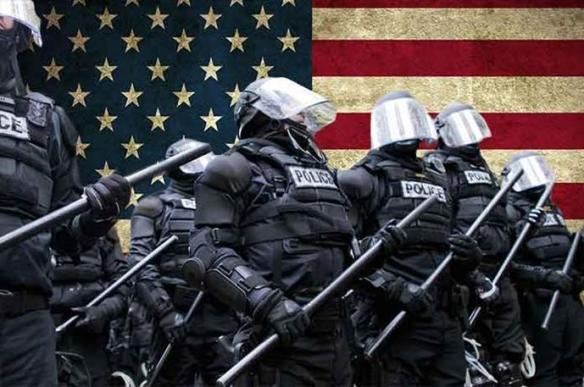
The Long Arm of the Law

On the rise of the global “good cop”

By Lyle Jeremy Rubin

Source: The Baffler

Badges without Borders: How Global Counterinsurgency Transformed American Policing by Stuart Schrader. University of California Press, 416 pages.

Always beware what everyone is saying but no one is talking about. It is often in these spaces of euphemism that the black magic of ideology casts its spell. George Orwell famously warned of how such language, what he called “question-begging” and “sheer cloudy vagueness,” becomes necessary “if one wants to name things without calling up mental pictures of them.” Every now or then a cliché bears some real wisdom and staying power, and Orwell’s counsel happens to be one. Take, for example, what has been said by various Democrats in the wake of the Trump administration’s assassination of Qassim Soleimani. Much of it has been encouraging for anyone interested in avoiding another full-scale bloodbath, but much has also begged additional questions or further clouded the semiotic landscape.

Consider the words of Senator Tammy Duckworth, who told MSNBC’s Andrea Mitchell that the fallout from the assassination is “what the Iranians wanted. They want this. They want Americans pushed out of Iraq. They want greater influence in the Middle East. And they got exactly what they wanted.” The interview began with Duckworth insisting that the American people are not safer now—that, in fact, we’re in more danger. The senator would go on to plead an identical case on The Rachel Maddow Show, and her Democratic colleagues hit similar notes about the cost of “security” and “stability” elsewhere.

I would be the last to deny that the assassination has encouraged more needless violence and tragedy, as we’ve already seen with the accidental downing of a Ukrainian airliner carrying 176 people, or the fatal stampeding of at least fifty people at Soleimani’s funeral. But it is worth asking what U.S. involvement in Iraq Duckworth and her fellows are implicitly supporting, never mind what broader vision of U.S. influence in the region they’re defending. What mental pictures are being obscured by their language?

A short answer to these questions can be found in a January 9 posting on Foreign Policy’s website, co-written by two senior fellows at the Middle East Institute, a reputable think tank known for producing bien pensant foreign policy opinion on the Chevron or United Arab Emirates dime, among others. The authors urge more “defense institution-building,” specifically a 60 percent increase in funding for programs like the Ministry of Defense Advisors and Defense Institute of International Legal Studies, venues where U.S. troops would continue to “actively mentor, advise, and train” Iraqi soldiers. The article focuses on military support, but it is likely these upgrades would be accompanied by a U.S. civilian police presence. Advisors to the bipartisan Task Force on Extremism in Fragile States have long pushed for increased police mentorship in countries like Iraq or Afghanistan, including the repeal of Section 660, an obscure law that constricts the ability of the U.S. government to train police forces abroad.

Section 660, as it happens, was introduced in 1975, and was designed to prevent the kinds of human rights abuses that plagued mentorship programs in Latin America throughout the Cold War. This brings us to the longer answer to the question about what mental pictures are hidden by Duckworth’s verbiage. It is an answer that Stuart Schrader explores in his recent work of scholarship, Badges Without Borders: How Global Counterinsurgency Transformed American Policing.

Badges Without Borders tells the story of America’s post-WWII “global transit of police ideas and personnel.” Its critical framework is indebted to a rich legacy of thought centering on the racist underbelly of the international economic order, what Cedric Robinson called “racial capitalism.” It’s a legacy that can be traced from the oratory and writings of the Black Panther Party to the contemporary investigations of social theorists like abolitionist Ruth Wilson Gilmore—one that continues to expose the connections between the military-industrial complex and the carceral state.

Throughout Badges Without Borders, Schrader seeks to combine this critical tradition with concrete, bureaucratic, fact. Joining a small but formidable band of painstaking researchers like Naomi Murakawa and Elizabeth Hinton, Schrader has dug up or parsed an imposing sum of transcripts, recordings, videos, correspondences, and other ephemera on modern policing within and without the United States. His chief task has been untangling a congeries of alphabet-soup agencies invested in the surveillance, disciplining, and all-too-frequent termination of nonwhite subversives, guerillas, or “criminals” across national borders, the most central being the Office of Public Safety (OPS). Along the way, a crucial leitmotif comes to the fore.

In the course of demonstrating why postwar anticommunist counterinsurgency efforts against postcolonial populations in the global South coincided with the suppression of black and brown communities and protestors across the United States, Schrader advances a theory of an “imperialism without imperialists” and a “racism without racists.” It is not that Bull “Look at ‘em run” Connors or Donald “We’re keeping the oil” Trumps haven’t existed. It’s that, until recently, they’ve been demoted to junior partners in a still shared (if publicly disavowed) project of maintaining fundamental—and fundamentally racialized—power relations across the globe. Their more refined associates, adept at communicating in the tongue of a race-blind, value-neutral social science, a procedural legalism, or even a soft but shallow humanitarianism and anti-racism, have taken the reins of the imperialist enterprise. It is the story of these more outwardly sympathetic but insidious figures, these good cops, that distinguishes Badges Without Borders.

Understanding the rise of the “good cops” requires understanding their origins. The “grandfather” of police professionalization in the United States, August Vollmer, served as a soldier in the Philippine-American war at the turn of the century. The notion that anything worthwhile about law enforcement could be learned from a brutal war of occupation that claimed hundreds of thousands of indigenous lives is itself dark foreshadowing. But what’s notable about Vollmer is his liberal pretensions: he envisioned a modern police officer who functioned as a key agent in the social uplift and economic development of downtrodden communities. Police would be responsible for keeping the peace, of course, but much of that chore could be achieved by introducing newfangled accessories like the bicycle-based patrol or the teletype. That these seemingly benign novelties were intended to ensure an environment compatible with the most stringent of regimes—Vollmer advised the Cuban dictator Gerardo Machado y Morales, for example—came as an afterthought.

Vollmer’s most influential protégé, Orlando W. Wilson, spent more time emphasizing this latter part of his policing theory. As police chief of Wichita, Kansas and Fullerton, California and, later, police commissioner of Chicago, Wilson pushed for a militarized chain of command, code of conduct, division of labor, and demeanor, attributes he saw as solutions to the corruption and ethnic patronage of local precincts. Like Vollmer, he supported technical innovations such as the police car patrol, two-way radio, and crime laboratory. It was a commitment to scaling up his model of policing to the international arena, however, that would leave its most lasting mark. “It looks like the name of Wilson will go down in Arabic annals with the name of Lawrence,” his fellow reformer Theo E. Hall quipped after an Arabic translation of Wilson’s textbook, Police Administration, was disseminated in Iraq and Saudi Arabia.

But if there was one man most responsible for globalizing American policing, it was Kansas City wunderkind and architect of President Kennedy’s Office of Public Safety, Byron Engle. Vollmer was no doubt inspired by his grunt work in the occupied Philippines, and the same could be said for Wilson’s military stint in occupied Germany, but it was Engle, a veteran of occupied Japan, who thought the hardest about forging a world occupied by U.S.-minted police. If Vollmer saw the occupation of the Philippines as a humane improvement on the brutishness of the Spanish empire, and Wilson saw the occupation of Germany as a vindication of liberal governance over illiberal tyranny, Engle saw the occupation of Japan as a blueprint for an internationally integrated future—one defined by a combination of centralized, Washington-derived funding and training, and decentralized discretion.

Schrader describes Engle’s program as “locally grounded, because police had to patrol a beat.” But it was also

forever expansionary, ever seeking the next nation in need of development and modernization, the next imperiled by radicalism. It sought the nooks and crannies of villages or growing metropolises where subversion and crime, or some novel configuration in combination of the two rooted, germinated, and blossomed.

As Schrader reminds his reader, this project ignored the hellscapes lurking behind this kind of “development” and “modernization,” which guaranteed not only a chronically unemployed or underemployed criminal class but a constant stream of radical reactions. Engle, a Democrat for most of his career (he rounded out his life an NRA-affiliated Republican) whose worldview was nevertheless shaped by a slew of affiliations with the FBI and CIA, could never bring himself to consider, in Schrader’s words, “the decentralized despotism of policing that for African Americans in particular amounted to thousands of everyday micro-fascisms.”

Lest one think the phrase “everyday micro-fascisms” is overblown, consider that numerous ex-Nazi policeman and soldiers became not only intelligence assets for the United States, but public safety trainers in places like South Vietnam and Nicaragua. Prior collaborators with the Japanese empire remained in the U.S.-administered Korean police force, while the Korean police were encouraged to retain the same anti-left posture they had assumed under the Japanese. This posture was encouraged worldwide, and not just by supposedly forward-minded, post-racial, police-intellectuals. Many liberal Cold Warriors tolerated right-wing authoritarians while opposing their leftist oppositions, whom they saw as a graver threat to liberal capitalist stability. This Faustian bargain helped lay the ideological and material groundwork for the mass disappearances and murders of leftists throughout Latin America, specifically in Guatemala, where Engle’s OPS was directly implicated. It was this very implication that led, after considerable leftist agitation at home, to Section 660 in 1975.

Whether WASPy mavericks like Vollmer, Wilson, and Engle, or progressive Jewish outsiders like Robert Komer—the man behind the pacification campaign in Vietnam—or Arnold Sagalyn—the counterinsurgency expert who established the blueprint for Lyndon Johnson’s War on Crime—the personalities chronicled in Badges Without Borders appear sincere in their devotion to what they saw as a post-racial politics of universal freedom and prosperity. This devotion manifested itself in myriad ways, from the promotion of “nonlethal weapons” to the championing of Title IX of the Foreign Assistance Act, the stipulation that demands democratic participation in the development and poverty reduction of all assisted nations. But given the men’s refusal to see that the institutions to which they had pledged their allegiance were responsible for perpetuating systemic modes of domination, they couldn’t predict where their favored reforms would lead—that CS (or CN and CR) gas, for instance, embraced by Lyndon Johnson in case “the Negroes started moving in [on] the White House,” would mark a mere addition to the extant repertoire of racist violence. The excessive use of such gas against peaceful protestors drove dissidents underground, only exacerbating racial turmoil. Police ended up killing more civilians after gas was introduced on American streets, since rather than using gas as replacement for violence, they deployed it as a supplement, mimicking tactics used in Vietnam.

The pattern moved in both directions. The first major implementation of CS in South Vietnam happened in 1966, and in a deliberate nod to anti-black subjugation, its perpetrators named it Operation Birmingham. As Schrader recounts, by 1969,

13,736,000 pounds of CS had been dropped on South Vietnam, an amount equivalent to a blanketing layer 80,000 square miles in size: 14,000 square miles more than the country’s total territory. Additionally, CS would have been used repeatedly in some areas and combined with defoliants. It leached into soil and ground water. The United States effectively tear-gassed the entire country, and then some.

As for Title IX, its developmentalist fruits were often consumed by the very national security state intended to protect them. The U.S. Agency for International Development (USAID), for example, trained local Guatemalans, many of them schoolteachers, in leadership programs. According to a study of this period, up to two-thirds of its trainees were murdered by the Guatemalan security apparatus. “They were killed because they were agitators in terms of the powers that be,” the study concluded. “In terms of development, they were the ideal change agent . . . but that was the kiss of death for them.”

Mission creep, threat inflation, profit incentives, preexisting cultures of bigotry and cruelty, and the perceived need to manage the increasingly tumultuous blowback produced by decades of capitalist exploitation and neo-colonialist dispossession—all of these factors have conspired to build the monstrous infrastructures of surveillance and social control the United States exports across the world today. But so has modern liberalism’s failure to anticipate the natural trajectory of its own initiatives—that is to say, its failure to acknowledge the all-encompassing power relations of racial capital in which it has always been embedded. As Schrader writes, the “order police on American streets have created, the order OPS would propagate by proxy abroad, the order the War on Crime facilitated is the order of capital, the order of white supremacy, the order of empire.”

It is also, by its nature, an escalatory order. In the past twenty years alone, America’s wars in the Greater Middle East have claimed 800,000 lives or more directly through violence, and several times that number (at least another 1.6 million) indirectly, through disease, homelessness, forced migration, and the countless other fates borne from armed conflict. Those who have survived in the half-dozen or so countries reshaped by imperial American war, countries like Somalia, Pakistan, Yemen, and Syria, now trudge on inside transnational police states, amid killer robots buzzing from above, paid skeins of unaccountable mercenaries, secret prisons and detention camps, onerous and hazardous checkpoints, and other mundane but vicious routines. In Afghanistan, many must also count their blessings against CIA-trained death squads, a confirmed reality only a handful of journalists and politicians in the United States seem at all concerned about.

In Badges Without Borders, Schrader limns how this nightmare grew up alongside a parallel despotism stateside, one that has disproportionately targeted a not unrelated population of nonwhite disposables. He also shows how this ruthlessness within and without U.S. borders has been propelled forward by a need to oversee the expansion of U.S.-led capitalism while containing the unwanted secondary effects of its exploitation and violence. To be sure, the governments of countries like Russia, China, and yes, Iran, have oppressive workings of their own that are an affront to anyone dedicated to social justice and peace, and public officials like Senator Duckworth are right to be suspicious of their machinations. But to accept U.S. “influence” in the Middle East, or anywhere else for that matter, as a benign or preferable given, is to repeat the same fateful errors of the good cops profiled in Badges Without Borders.

Now, those good cops seem to be everywhere. Democrats have been fond of elevating prosecutors and district attorneys for some time now, and especially fond of rallying behind FBI and CIA figures in recent years. Many of the lawyers in Obama’s administration responsible for providing a thin legal or ethical veneer to its ugliest features, from the drone war to the surveillance leviathan, are now happy household names, former U.S. Attorney General Eric Holder foremost among them. (Holder, it should be noted, oversaw the implementation of “Operation Ceasefire” in the 1990s, which has been described as “basically stop-and-frisk of cars.”) Otherwise excellent broadcast journalists like Chris Hayes still feel a need to conduct softball interviews with unrepentant boosters of America’s imperialist footprint, like former soldier and Congressman Max Rose or Samantha Power, the latter of whom has barely been held to account for helping to turn Libya into a latter-day slave market.

On the other hand, there’s the launch of the well-funded anti-militarist think tank Quincy Institute, with one of the most eloquent critics of Pax Americana, Andrew Bacevich, at its helm. There’s Bernie Sanders and his millions of enthusiastic, anti-war supporters, many of whom are eager to start fighting for a more democratically organized world. There’s the Movement for Black Lives, which has not only widely publicized evils of police brutality and mass incarceration but connected these evils to America’s encroachments across the planet. And there’s the reemergence, in recent public discourse, of Congresswoman Barbara Lee, the only Congressperson to vote against the original Authorization for Use of Military Force Against Terrorists (AUMF) in 2001. These are all promising signs of an incipient anti-imperialist awakening, but as with the coming climate crisis, we are running out of time.