It’s War: The Real Meat Grinder Starts Now

By Pepe Escobar

Source: Strategic Culture Foundation

No more shadow play. It’s now in the open. No holds barred. 

Exhibit 1: Friday, March 22, 2024. It’s War. The Kremlin, via Peskov, finally admits it, on the record.

The money quote:

“Russia cannot allow the existence on its borders of a state that has a documented intention to use any methods to take Crimea away from it, not to mention the territory of new regions.”

Translation: the Hegemon-constructed Kiev mongrel is doomed, one way or another. The Kremlin signal: “We haven’t even started” starts now.

Exhibit 2: Friday afternoon, a few hours after Peskov. Confirmed by a serious European – not Russian – source. The first counter-signal.

Regular troops from France, Germany and Poland have arrived, by rail and air, to Cherkassy, south of Kiev. A substantial force. No numbers leaked. They are being housed in schools. For all practical purposes, this is a NATO force.

That signals, “Let the games begin”. From a Russian point of view, Mr. Khinzal’s business cards are set to be in great demand.

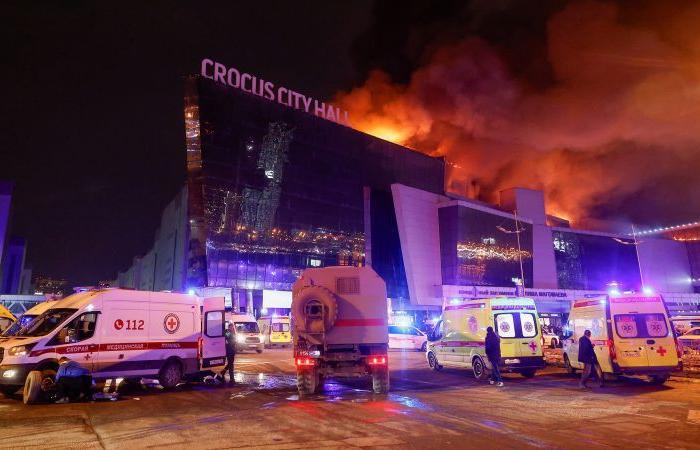
Exhibit 3: Friday evening. Terror attack on Crocus City, a music venue northwest of Moscow. A heavily trained commando shoots people on sight, point blank, in cold blood, then sets a concert hall on fire. The definitive counter-signal: with the battlefield collapsing, all that’s left is terrorism in Moscow.

And just as terror was striking Moscow, the US and the UK, in southwest Asia, was bombing Sana’a, the Yemeni capital, with at least five strikes.

Some nifty coordination. Yemen has just clinched a strategic deal in Oman with Russia-China for no-hassle navigation in the Red Sea, and is among the top candidates for BRICS+ expansion at the summit in Kazan next October.

Not only the Houthis are spectacularly defeating thalassocracy, they have the Russia-China strategic partnership on their side. Assuring China and Russia that their ships can sail through the Bab-al-Mandeb, Red Sea and Gulf of Aden with no problems is exchanged with total political support from Beijing and Moscow.

The sponsors remain the same

Deep in the night in Moscow, before dawn on Saturday 23. Virtually no one is sleeping. Rumors dance like dervishes on countless screens. Of course nothing has been confirmed – yet. Only the FSB will have answers. A massive investigation is in progress.

The timing of the Crocus massacre is quite intriguing. On a Friday during Ramadan. Real Muslims would not even think about perpetrating a mass murder of unarmed civilians under such a holy occasion. Compare it with the ISIS card being frantically branded by the usual suspects.

Let’s go pop. To quote Talking Heads: “This ain’t no party/ this ain’t no disco/ this ain’t no fooling around”. Oh no; it’s more like an all-American psy op. ISIS are cartoonish mercenaries/goons. Not real Muslims. And everyone knows who finances and weaponizes them.

That leads to the most possible scenario, before the FSB weighs in: ISIS goons imported from the Syria battleground – as it stands, probably Tajiks – trained by CIA and MI6, working on behalf of the Ukrainian SBU. Several witnesses at Crocus referred to “Wahhabis” – as in the commando killers did not look like Slavs.

It was up to Serbia’s Aleksandar Vucic to cut to the chase. He directly connected the “warnings” in early March from American and British embassies directed at their citizens not to visit public places in Moscow with CIA/MI6 intel having inside info about possible terrorism, and not disclosing it to Moscow.

The plot thickens when it is established that Crocus is owned by the Agalarovs: an Azeri-Russian billionaire family, very close friends of…

… Donald Trump.

Talk about a Deep State-pinpointed target.

ISIS spin-off or banderistas – the sponsors remain the same. The clownish secretary of the National Security and Defense Council of Ukraine, Oleksiy Danilov, was dumb enough to virtually, indirectly confirm they did it, saying on Ukrainian TV, “we will give them [Russians] this kind of fun more often.”

But it was up to Sergei Goncharov, a veteran of the elite Russia Alpha anti-terrorism unit, to get closer to unwrapping the enigma: he told Sputnik the most feasible mastermind is Kyrylo Budanov – the chief of the Main Directorate of Intelligence at the Ukrainian Ministry of Defense.

The “spy chief” who happens to be the top CIA asset in Kiev.

It’s got to go till the last Ukrainian

The three exhibits above complement what the head of NATO’s

military committee, Rob Bauer, previously told a security forum in Kiev: “You need more than just grenades – you need people to replace the dead and wounded. And this means mobilization.”

Translation: NATO spelling out this is a war until the last Ukrainian.

And the “leadership” in Kiev still does not get it. Former Minister of Infrastructure Omelyan: “If we win, we will pay back with Russian oil, gas, diamonds and fur. If we lose, there will be no talk of money – the West will think about how to survive.”

In parallel, puny “garden-and jungle” Borrell admitted that it would be “difficult” for the EU to find an extra 50 billion euros for Kiev if Washington pulls the plug. The cocaine-fueled sweaty sweatshirt leadership actually believes that Washington is not “helping” in the form of loans, but in the form of free gifts. And the same applies for the EU.

The Theater of the Absurd is unmatchable. The German Liver Sausage Chancellor actually believes that proceeds from stolen Russian assets “do not belong to anyone”, so they can be used to finance extra Kiev weaponizing.

Everyone with a brain knows that using interest from “frozen”, actually stolen Russian assets to weaponize Ukraine is a dead end – unless they steal all of Russia’s assets, roughly $200 billion, mostly parked in Belgium and Switzerland: that would tank the Euro for good, and the whole EU economy for that matter.

Eurocrats better listen to Russian Central Bank major “disrupter” (American terminology) Elvira Nabiullina: The Bank of Russia will take “appropriate measures” if the EU does anything on the “frozen”/stolen Russian assets.

It goes without saying that the three exhibits above completely nullify the “La Cage aux Folles” circus promoted by the puny Petit Roi, now known across his French domains as Macronapoleon.

Virtually the whole planet, including the English-speaking Global North, had already been mocking the “exploits” of his Can Can Moulin Rouge Army.

So French, German and Polish soldiers, as part of NATO, are already in the south of Kiev. The most possible scenario is that they will stay far, far away from the frontlines – although traceable by Mr. Khinzal’s business activities.

Even before this new NATO batch arriving in the south of Kiev, Poland – which happens to serve as prime transit corridor for Kiev’s troops – had confirmed that Western troops are already on the ground.

So this is not about mercenaries anymore. France, by the way, is only 7th in terms of mercenaries on the ground, largely trailing Poland, the US and Georgia, for instance. The Russian Ministry of Defense has all the precise records.

In a nutshell: now war has morphed from Donetsk, Avdeyevka and Belgorod to Moscow. Further on down the road, it may not just stop in Kiev. It may only stop in Lviv. Mr. 87%, enjoying massive national near-unanimity,  now has the mandate to go all the way. Especially after Crocus.

There’s every possibility the terror tactics by Kiev goons will finally drive Russia to return Ukraine to its original 17th century landlocked borders: Black Sea-deprived, and with Poland, Romania, and Hungary reclaiming their former territories.

Remaining Ukrainians will start to ask serious questions about what led them to fight – literally to their death – on behalf of the US Deep State, the military complex and BlackRock.

As it stands, the Highway to Hell meat grinder is bound to reach maximum velocity.
Western War Machine is in Panic Mode

By Salman Rafi Sheikh

Source: New Eastern Outlook

The sheer inability of the collective West to force Russia into submission in Ukraine plus the fast-changing global opinion about the West in the context of the latter’s support for Israel’s brutal war on the Gazans has put the so-called ‘liberal-democratic’ world into a panic mode. The White House has already said that it will run out of money to fund Ukraine into 2024 unless the US Congress gives approval for more funding. This has led the Western war machine – primarily led by the US – to anticipate a possible defeat. “There is no guarantee of success with us, but they are certain to fail without us”, a senior US military official told CNN recently. Without the military support, US officials now estimate, Ukraine would fall by the summer of 2024. But, in Western calculations, Ukraine’s fall does not just mean Russia’s victory; it also implies a possible collapse of NATO and the eventual downfall of the Western-dominated global political, economic, and security order.

recent piece in the Wall Street Journal said,

“Even more important, Russia’s success in Ukraine would increase a threat to NATO’s Eastern flank—in particular the Baltic states and Poland. Outside of Europe it would embolden Moscow’s allies Iran and North Korea and provide a template for China for the military solution of the Taiwan dispute. In all those cases, the U.S. and NATO troops could find themselves in the midst of a military conflict of the sort that Ukraine fights today without direct involvement of NATO”.

Such prospects are causing severe problems. Germany, for instance, is considering shelving voluntary force and making a return to conscription. “I believe that a nation that needs to become more resilient in times like these will have a higher level of awareness if it is mixed through with soldiers,” said Jan Christian Kaack, the chief of the German Navy. This is in addition to the fact that the German army is too small to defend itself against any threat; hence, the renewed emphasis on conscription.

But Germany is not an exceptional case. In fact, it mirrors developments in the rest of Europe.  The UK, otherwise known to possess one of the best fighting forces in the world, is running into some problems of a fundamental nature. The Sky News reported earlier in the year that, a senior US general “privately told Defence Secretary Ben Wallace the British Army is no longer regarded as a top-level fighting force”. It was further reported that the “The armed forces would run out of ammunition in a few days if called upon to fight” and that “The UK lacks the ability to defend its skies against the level of missile and drone strikes that Ukraine is enduring”.

On top of it is the fact that the Russian military position in Ukraine remains strong, making it a lot harder for the West to provide enough funding. The Biden administration is facing its own challenges vis-à-vis more funding for Ukraine. As far as Europe is concerned, a recent report showed that pledges for funding made in August 2023 fell by almost 90 percent compared to the same period last year.

This is war fatigue that is being compounded by a well-sustained Russian resolve to achieve its objectives. For the West, Vladimir Putin remains “stubborn”. As Putin recently reiterated, “There will be peace when we achieve our goals… Now let’s return to these goals – they have not changed. I would like to remind you how we formulated them: denazification, demilitarisation, and a neutral status for Ukraine.”

Speaking from a position of strength – and keeping in mind the war fatigue in the West – Putin further said that Russian forces are “improving their position almost along the entire line of contact. Almost all of them are engaged in active combat. And the position of our troops is improving along [the entire line of contact.]”. This being the case, Putin conveyed no ideas of making a compromise with the West over Ukraine. Speaking from the Russian perspective, it would make no sense to offer negotiations and, thus, turn Russian tactical victories into unsustainable settlements.

Clearly, Russia has no intention of withdrawing from its victories, which is why there is a panic, especially in Europe. If Russia continues to win and the US funding stalls, Europe will be left to fend for itself. Germany’s defence minister minced no words to express this fear last Saturday when he said that the US “was losing interest in European affairs and that security tensions in the Pacific would likely leave the European Union having to fend for itself”, adding that “One can assume that the USA will be more involved in the Pacific region in the next decade than it is today – regardless of who becomes the next president,” he said. His conclusion is: “This means that we Europeans must increase our commitment to ensure security on our continent.”

In a nutshell, for the US, if the war in Ukraine was to unify the West, it is beginning to have an exactly opposite effect. There lies a very strong reason for the US to reconsider its strategy. This reconsideration can go in two directions. First, the US can withdraw from its obsession with expanding NATO to include Ukraine. Second, the US can make one last push and make Ukraine fight for as long as it can, hoping that this might break Russia. The Biden administration favours the second option, which is why it is pushing for the US$61 billion aid package. But will a Republican victory allow this to happen? A Republican victory could not only end support for Ukraine but also leave Europe in a total lurch. Tough times ahead.

Righting a wrong: Burying decades of US-led wars

Today’s global conflicts – whether in Eastern Europe, West Asia, or East Asia – are spawned by a fading US hegemon desperately clinging to power.

By Mohamad Hasan Sweidan

Source: The Cradle

“One era is ending, a new one is beginning, and the decisions that we make now will shape the future for decades to come.”

With these words, US Secretary of State Antony Blinken defined the “turning point” of the American era, the transition from one world order to another. 

“In this pivotal time, America’s global leadership is not a burden. It’s a necessity to safeguard our freedom, our democracy, and our security,” Blinken said in his address to the Johns Hopkins School of Advanced International Studies (SAIS) in September. 

Official US documents, including last year’s National Security Strategy, underscore Washington’s conviction that waiting is a luxury it cannot afford; that it “will act decisively” to maintain its global leadership. As such, the US involvement in conflicts in Ukraine and Gaza, as well as the militarization in Southeast Asia, must be seen through this lens of international dynamics.

Broadly, tensions in Africa and Asia are interconnected with the west’s frenzied initiatives to maintain a dominant position and decisive role in the new multipolar order.

From Eastern Europe to West Asia 

Since the outbreak of war in Ukraine, the US has strategically tied its support for Kyiv to the defense of the “rules-based order.”

With clichéd sound bites, President Joe Biden characterized the conflict as “a battle between democracy and autocracy, between liberty and repression, between a rules-based order and one governed by brute force.”

Many Atlanticist leaders echo the sentiment that unwavering support for Ukraine aims to deter Russia from challenging a world order where the west holds sway.

Most prominently, German Chancellor Olaf Scholz articulated this perspective in his Foreign Affairs article published in early 2023 titled The Global Zeitenwende, (“an epochal tectonic shift”) in which he posits that Russian President Vladimir Putin is challenging a world order where Washington is a decisive power.

Scholz emphasizes the need for collective action by those who believe in a rules-based world order, even cooperating with countries that do not embrace democratic institutions but endorse the US-led principles for global governance. That western rules-based paradigm, it should be noted, is one in which international law and the UN Charter have long been discarded in favor of power and advantage.

Today, those dueling visions are playing out in the Ukraine war: a confrontation between the west seeking to maintain its global superiority and Russia striving to disrupt this dominance. Moscow’s rationale for the war is to prevent NATO from expanding to Russia’s borders, as confirmed by the western military alliance’s Secretary-General Jens Stoltenberg.

Similarly, the war in Gaza must be seen through this international lens, with Israel representing western interests in West Asia and any harm to the occupation state viewed inherently as a blow to US influence in the region. 

As Washington stands at this crucial turning point, according to Blinken, the cost of a blow to Israel is deemed too high, underscoring the resolute US defense of its global influence in the devastated towns and cities of Gaza.

Neo-colonial maneuvers

There are important nuances between these two US-backed wars, however: Ukraine is seen as a tool used by Washington to achieve its interests, while Israel is considered an American interest in itself. That Biden once famously asserted that the US would need to create an Israel if it did not exist illustrates its status as a neo-colonial outpost, protecting western interests in the region. 

This also explains the noticeable shift in US interest away from Eastern Europe to West Asia after the Palestinian resistance breached the occupied territories on 7 October to target military personnel and take prisoners. The deliberate shift of American attention from one war zone to the other was neatly exemplified by the Washington Post’s swift removal of the ‘War in Ukraine’ tab from its homepage. 

As previously mentioned by The Cradle, “Israel’s ongoing war on the Gaza Strip is best understood to be a US-backed one,” one that is being fought to safeguard US influence and interests in West Asia. However, the maneuvering room for Washington’s allies is shrinking dramatically. Unlike the diverse strategic options West Asian countries explored during the Ukraine war, Gaza offers no such latitude. It is fundamentally Washington’s war, demanding collective mobilization to defend the US position.

It is also telling that the US-led multination task force, Operation Guardian of Prosperity in the Red Sea, is already facing major set-backs since its recent inception, with some members pulling out and others choosing to remain unnamed.

White House National Security Council Strategic Communications Coordinator John Kirby had to awkwardly caveat the secrecy like this: “There are some countries that have agreed to participate and be part of the operation in the Red Sea, but they have to decide how much they want that to be public. And I’m going to leave it to them so that they can describe it somehow, because not everyone wants to be public.”

For example, the role of NATO member Turkiye has transformed into that of an energy transmission station for Israel, while the UAE, Saudi Arabia and Jordan serve as a transit bridge for goods bound for the occupation state that Yemen prevents from passing through the Red Sea.

Notably, shipments from Turkiye to Israel surged to 355 after 7 October, with many linked to the Justice and Development Party (AKP) and individuals close to Turkish President Recep Tayyip Erdogan, including his son Buraq. Even Egypt, restricted to allowing aid trucks through the Rafah crossing, could not facilitate aid to Palestinians without US approval.

How conflict spreads

In international relations, there are two main theories that address the relationship between power and the spread of peace. The first is the hegemonic stability theory which posits that the international order is likely to remain stable when one country is the dominant global power. The proponents of this theory believe that the existence of a single hegemon deters all powers in the world and prevents them from spreading tension.

However, given the reality that the United States has dominated a conflict-ridden global order for four decades, it can be argued that the presence of the hegemon did not lead to global stability. Rather, the dominant was the major source and catalyst for spreading tension around the world. It is sufficient to look at the distribution of US bases in the world and the proliferation of military agreements signed by Washington to understand how the US consistently provokes rivals and challengers, and creates strife.

The second is the balance of power theory, in which states seek to protect themselves by preventing any country from acquiring enough military power to control all other nations. If one power dominates – such as the United States – the theory predicts that weaker countries will unite in a defense alliance. 

According to this theory, a balance of power between competing states or alliances raises the cost of tension for everyone and ensures stability in the world. Thus, achieving peace today requires a rise in the level of power among Washington’s rivals, power which will provide the deterrence required to limit the spread of tensions around the world. Increasing the capabilities of Washington’s rivals is now a key requirement for all peaceful peoples and nations. And according to the balance of power theory, uniting against Israel is the most successful way to stabilize West Asia and its environs today.

Post-unipolar realities 

As the war in Gaza is unequivocally an American war, a vertical division emerges in West Asia, dividing those siding with Palestine and the Resistance Axis from those aligning with Israel and the Zionist project. Washington’s allies cannot stay neutral as the US leads the battle directly. 

This clarifies the positions of Saudi Arabia, Jordan, the UAE, Egypt, Turkiye, and other West Asian countries choosing to align with the US at the expense of Palestinian interests.

Observing Washington’s policies reveals global tensions spurred on by the pursuit of US influence. From Eastern Europe to West Asia and Southeast Asia, the US works to counter Eurasian powers Russia and China, and other influential countries, such as Iran and North Korea.

Since the end of the Cold War, Washington’s unipolar moment has resulted in more wars and destruction imaginable in decades often characterized as ones marked by peace. A more stable world order necessitates the achievement of a global balance of power by weakening the US and empowering new rising powers. Thus, peace and stability in West Asia hinges on the weakening of Israel, a colonial project so intricately tied to Washington’s hegemonic agenda.

Humanity Under Assault by the Elites – When Will We Have Had Enough?

By Phil Butler

Source: New Eastern Outlook

“I speak of peace, therefore, as the necessary rational end of rational men. I realize that the pursuit of peace is not as dramatic as the pursuit of war–and frequently the words of the pursuer fall on deaf ears. But we have no more urgent task.” – John F. Kennedy

For most people, it’s difficult to imagine much of what’s happening today. And this is why so many seem in the dark about what we should do to alleviate our problems. Looking at the situation in which a proxy is being waged on Russia from Ukraine, nothing seems to add up. The same is true for the genocide now going on in Gaza. And when we superimpose problems like curing cancer and other diseases, environmental problems, and failing economies, the only thing we can see is that our leaders have failed miserably at prioritising. It’s also obvious that we, the people, are the farthest thing from their minds.

Regarding visualisation, there’s no bigger confusion than grasping just how much money the Western powers are shovelling into the war against Russia. So far, something like $233 billion has been donated to Ukraine. The top donors are the EU($90B) and the United States ($73B). Interestingly, most of the EU funding has been aimed at financial aid, while the US donates are mostly military aid. Neither the EU nor the US spent much on humanitarian aid, at least not by comparison. But then, humanitarian money does not go into the pockets of the elites, now does it? The arms companies and financial institutions seem to be leveraging this Ukraine mess for a return on assets. But that’s another story. Now, I’d like to compare spending on Ukrainian and Israeli wars against efforts that do help human beings.

Let’s look at one of humanity’s most dreaded killers: cancer. In total, global oncology spending in 2022 was $193 billion. The numbers are far more telling in key research, where funding often comes from philanthropy. The Lancet reported recently that some 66,388 awards with a total investment of about $24.5 funded research for 2016–20. And now these figures have nosedived. In 2020, there were 19.3 million cases and 10 million deaths from the dreaded disease.

If we look at how many people are starving on our planet, it’s appalling to think of billions thrown away on unwinnable wars for the sake of selling weapons. In 2021, U.N. World Food Programme Executive Director David Beasley said it would take an estimated $40 billion annually to end world hunger by 2030. Let’s think about that for a moment. Each day, 25,000 people, including more than 10,000 children, die from hunger and related causes. Envision the lost potential of all those children perishing, if you can. Beasley went on to etch the situation in stone with this statement:

“There is 400 trillion dollars’ worth of wealth on the earth today, and the fact that 9 million people die from hunger every year… Shame on us. In the height of COVID, billionaires’ net worth increase was $5.2 billion per day. At the same time, 24,000 people die per day from hunger. Shame on us. Every hour, the net worth of billionaires during the height of COVID was a substantial $216 million per hour. Yet 1000 people per hour were dying from hunger… Shame on us.”

Two-hundred-sixteen million dollars per hour! I’ll wager the vast majority of that wealth had nothing whatsoever to do with helping human beings, curing disease, or stopping the endless wars. Moving on, let’s look at the homeless/poverty situation worldwide. In 2021, there were 150 million homeless people worldwide. While so many people here in Greece and other countries in Europe strive to go live in the United States, few realise that over 18% of the people living in my country live below the poverty line. And no one wanting to become American realises that the overwhelming solution to poverty in my country is to punish and imprison the poor (Homelessness World Cup). Using only what’s been spent on Ukraine so far, the U.S. Government could have issued a check for $1,825 to each of the 40 million homeless people in the country. That’s two or even three months’ rent for all homeless people in the USA.

Even in highly developed countries like Germany, more than 14.8% of the people are living beneath the national poverty line. Interestingly, some Latin American countries equal or better poverty rate than North American or some European countries. Take Argentina as an example. The situation there is no worse than it is in the United States. In Chile, only 9% of the population lives in dire circumstances. Unbelievably, there are countries like Bangladesh, traditionally thought of as the world’s poorest countries, where less than 13% of the population lives below the poverty line. In Romania, 26% of the people live in extreme poverty, and in neighbouring Bulgaria, the rate is almost 24%.

Turning to more practical matters that bear on quality of life and efficiency, we find the United States of America ranks 13th out of 141 countries in overall infrastructure. What a stunning achievement for the richest (supposedly) country in the world! After all, how do we balance what a country’s wealth is? What is the negative value of a dangerous, rusty bridge or a pothole in a road so deep you can hear Chinese being spoken from its depths? How bad is 13th place? Well, the American Society of Civil Engineers estimated that it would take 50 years to complete only the necessary repairs on more than 46,000 deteriorated bridges in the country. Both the Trump and Biden administrations promised to pour more money into the problem, but so far the US of A is still crumbling. So that you understand, Spain, Singapore, South Korea, Japan, and eight other countries have better quality infrastructures than the US. Remember I mentioned at the beginning, prioritisation? Is it possible that the Spaniards are doing more to care for their own people than America? Does Spain start proxy wars on Russia’s borders? I do not see Spanish ships in the South China Sea provoking war.

Since we landed in Spain, let’s take a look at some interesting facts about their quality of life. For instance, the Spanish Constitution includes a right to housing. The reality of homelessness there is that less than 8.5% of the population is homeless, and most of those live in shelters. Spain ranked 27th out of OF 189 countries in the Human Development Index Rankings.  Romania was 49th, the USA was 17th, Chile 43rd, and South Korea was 23rd. For me at least, what is significant in these numbers is the wide disparity in position in a world that was supposed to be some globalisation miracle a couple of decades ago. Despite all the PR and belly-rubbing the people of Earth have received, things in most countries are just not getting better. And trillions are being spent on wars and corporate machinations that steal from our prosperity.

Returning to my thesis, we must add the humongous waste of money that has gone to the state of Israel, Saudi deals, and the new monies soon to flow in that direction simply to eradicate or force migrate the Palestinians. Before the current crisis, the Biden administration had pledged $14.3 billion in aid to Israel since the October 7th Hamas campaign against the Israelis began. But this figure is a bit misleading if we want to see just how massive the American sacrifice for Israel has been. Since World War II, the United States has given Israel more aid than any other nation, currently more than $260 billion. To wrap things up for this report, the U.N. says the conflict in Yemen is one of the world’s worst humanitarian crises. Saudi Arabia does not receive American aid through loans, grants, or gifts pegged for killing Yemenis. However, the US Accounting Office reported that between 2015 and 2021, the US Department of Defense supplied more than $54.6 billion in military support for the Saudis and the United Arab Emirates. Now, imagine what human strife could be alleviated with these hundreds of billions combined with the trillions spent on failed US wars across the globe.

For those who enjoy simple examples of what could be. There are over 33,000 homeless veterans who fought these wars for the United States. The billions in military support only for Saudi Arabia would be enough to gift each one of those vets $1.7 million. You do the math. What is being spent to kill millions of us, could save the millions being killed PLUS millions of others starving, wasting away, or swept away by disasters. Now you tell me when the time will be right to get out the torches and pitchforks.

The Grim Prospects of US Proxies: Ukraine, Israel, and Taiwan

By Brian Berletic

Source: New Eastern Outlook

As Russia’s special military operation (SMO) approaches two years of intense fighting, having parried Ukraine’s “spring counteroffensive” and with the initiative shifting to Russian forces, Western capitals are now admitting they are reaching the limits to remaining support for Kiev.

During the Ukrainian offensive alone, the Western media has admitted Ukrainian forces have suffered catastrophic losses in both manpower and material. The Ukrainian economy has all but been replaced by heavy subsidies from the United States, Europe, and the International Monetary Fund (IMF). Ukrainian infrastructure including its power grid and ports have suffered severe damage the collective West is unable to repair in a timely manner.

Ukraine’s territory has shrunk. Four oblasts, Lugansk, Donetsk, Zaporozhye, and Kherson are now considered by Moscow as part of the Russian Federation. Crimea had already joined the Russian Federation following a referendum conducted in 2014 after the US-backed overthrow of the elected Ukrainian government.

In fact, from 2014 onward, Ukraine’s sovereignty had been stripped away, with the resulting client regime installed into power by the US answering to Washington at the expense of Ukraine’s best interests. To say Ukraine’s status as a viable nation state hangs in the balance because of this arrangement would not be an understatement.

Ukraine, as a US proxy, has suffered irreversible losses economically, politically, socially, and militarily. In a wider sense, Europe is also politically captured, led by the European Union bureaucracy who, like the Ukrainian government, serves Washington’s interests entirely at the expense of Europe’s collective interests.

Germany stands out as a particularly poignant example, having ignored the destruction of the Nord Stream pipelines, imposing sanctions on Russia to restrict any remaining hydrocarbons required by Germany’s industry and public, beginning a process of recession and deindustrialization.

Europe’s wider economy is suffering from similar setbacks, setbacks that cannot be offset by alternatives such as US liquefied petroleum gas (LPG) moved by ship across the Atlantic Ocean which will always be more expensive than Russian hydrocarbons piped in directly to Europe.

The price of subordination to the United States is in reality the existential threat the US claims Russia poses to Europe in fiction.

It should be noted that the US had long-planned to use Ukraine as a proxy to overextend Russia. Laid out in a 2019 policy paper published by the US government and arms industry-funded think tank, RAND Corporation, titled, “Extending Russia: Competing from Advantageous Ground,” US policymakers would recommend providing lethal aid to Ukraine to draw Russia into the ongoing conflict between Kiev and militants in eastern Ukraine. The idea was to “increase the costs to Russia, in both blood and treasure,” as it dealt with the conflict between Kiev and eastern Ukraine along its borders.

The paper also noted, however, the strategy posed a high risk to Ukraine. Such a move, the paper warned, might:

…come at a significant cost to Ukraine and to U.S. prestige and credibility. This could produce disproportionately large Ukrainian casualties, territorial losses, and refugee flows. It might even lead Ukraine into a disadvantageous peace. 

Despite these acknowledged risks, the United States pressed ahead with the plan anyway. Today, we see that fears expressed by US policymakers proposing this strategy have been fully realized, if not entirely surpassed.

Taiwan is Next… 

As Ukraine is destroyed by a US-engineered proxy war against Russia, with members of the US Congress vowing to fight Russia to the “last Ukrainian,” a similar arrangement is being used to organize the Chinese island province of Taiwan as a heavily US-armed proxy against the rest of China.

Just as was the case with Ukraine, US policymakers acknowledge the existential threat Taiwan faces in its role as a US proxy.

The Center for Strategic and International Studies (CSIS), likewise funded by the US government and arms manufacturers, published a 2023 paper titled, “The First Battle of the Next War: Wargaming a Chinese Invasion of Taiwan.” In it, policymakers acknowledge that during any fighting between a US-backed Taiwan administration and the rest of China, heavy damage would be inflicted on the island.

The paper notes that any infrastructure the People’s Liberation Army (PLA) does not destroy in the fighting, because of its possible use to the PLA, the US itself would target and destroy it:

Ports and airfields enable the use of more varied ships and aircraft to accelerate the transport of troops ashore. The United States may attack these facilities to deny their use after Chinese capture. 

Beyond infrastructure useful to Chinese military forces, US policymakers have also explored the possibility of destroying economically useful infrastructure on Taiwan. An October 2022 Bloomberg article titled, “Taiwan Tensions Spark New Round of US War-Gaming on Risk to TSMC,” would report:

Contingency planning for a potential assault on Taiwan has been stepped up after Russia’s invasion of Ukraine, according to people familiar with the Biden administration’s deliberations. The scenarios attach heightened strategic significance to the island’s cutting-edge chip industry, led by Taiwan Semiconductor Manufacturing Co. In the worst case, they say, the US would consider evacuating Taiwan’s highly skilled chip engineers.

The article also stated:

At the extreme end of the spectrum, some advocate the US make clear to China that it would destroy TSMC facilities if the island was occupied, in an attempt to deter military action or, ultimately, deprive Beijing of the production plants. Such a “scorched-earth strategy” scenario was raised in a paper by two academics that appeared in the November 2021 issue of the US Army War College Quarterly.

CSIS’ paper would analyze the possible outcome of a conflict between China and the US-backed administration on Taiwan, surmising:

In most scenarios, the United States/Taiwan/Japan defeated a conventional amphibious invasion by China and maintained an autonomous Taiwan. However, this defense came at high cost. The United States and its allies lost dozens of ships, hundreds of aircraft, and tens of thousands of servicemembers. Taiwan saw its economy devastated. Further, the high losses damaged the U.S. global position for many years. 

In other words, even under the best-case scenario, following a US-backed defeat of any Chinese military operation aimed at reunification, the US would nonetheless have suffered heavy losses in terms of its military while Taiwan would have suffered catastrophic losses both militarily and economically.

Like Ukraine, Taiwan, in its capacity as a US proxy, would be destroyed.

Israel Will Not Be Spared Either 

US policy papers are also abounding with strategies employing Israel as an eager military proxy in the Middle East. Israel is elected to strike at nations across the region with impunity, freeing Washington of the political, military, economic, and diplomatic baggage of carrying out such military operations itself.

Of course, such military operations expose Israel to the same dangers that have threatened Ukraine’s self-preservation and threaten to undermine Taiwan’s.

With the US having demonstrated a fundamental inability to sponsor and win proxy wars against peer and near-peer adversaries in both Ukraine and Taiwan, there is little reason to believe that an already overstretched US military industrial base could somehow give Israel the ability to wage and win protracted proxy war in the Middle East.

Such a proxy war has already unfolded from 2011 onward both in Syria and Yemen with little success. Israel has already played a role in Syria, carrying out missile strikes across the country in an attempt to provoke Syria into a wider conflict.

Syria and its allies Iran and Russia have only strengthened their positions in the region and are driving a fundamental transformation across the Middle East. Even long-time US allies like Saudi Arabia and Turkey find themselves gradually divesting from a US-led regional order to one that better fits with the wider trend toward global multipolarism.

This has left the US and its remaining proxies in the region more isolated and vulnerable than ever. The US itself finds its own troops illegally occupying eastern Syria in an increasingly precarious position.

Israel, in many ways, finds itself likewise isolated. Should it lend itself to a major US proxy war more directly, it may find itself in a similar position as Ukraine – locked in intense, protracted combat with its US allies unable to provide the arms and ammunition necessary to win.

Unlike either Ukraine or Taiwan, Israel is believed to be in possession of between scores to hundreds of nuclear weapons. While Israel will thus never face the same sort of defeat Ukraine faces, a protracted military conflict will leave Israel exhausted economically and isolated diplomatically. Its Arab neighbors will move on with the multipolar world while Israel exhausts itself fighting to reassert US-led unipolarism.

Because of the deliberate, premeditated manner in which the US uses and then disposes of its proxies around the globe, there is little reason to believe it will spare Israel. While Israel has several advantages over other US proxies in terms of its economy, military capabilities, and diplomatic connections, these advantages will only prevent Israel’s use and disposal by US foreign policy if there is a conscious decision to pivot with the rest of the region away from US subordination and toward regional and global multipolarism.

Washington Wakes Up to Harsh Reality Amid Ukraine Proxy War

By Brian Berletic

Source: New Eastern Outlook

Long gone are Western headlines heralding Ukraine’s NATO-trained and armed forces and the prospects of them able to “sweep Putin’s conscripts aside,” as former British Army Colonel Hamish De Bretton-Gordon claimed in an article published as recently as June this year.

As Ukraine’s offensive forces broke across extensive Russian defenses all along the line of contact from Zaporozhye to Kharkov, the realization that Washington, London, and Brussels underestimated the Russian Federation economically, politically, diplomatically, and most importantly, militarily and industrially, began to set in.

Russian Military Production Grows, Western Stockpiles Dry Up 

Today, different kinds of headlines now appear across the collective West’s media.  The New York Times recently reported in an article titled, “Russia Overcomes Sanctions to Expand Missile Production, Officials Say,” that Russia ammunition production was at least seven times greater than the collective West.

The same article acknowledged that Russia had increased its tank production two-fold and was producing 2 million artillery rounds per year, a number that is larger than the combined planned expansion of shell production of the US and European Union some time between 2025 and 2027. Not only is Russia out-producing the West, it is producing weapons and ammunition at a fraction of the cost of Western arms and munitions.

As Russian military industrial production expands, producing more tanks, artillery, cruise missiles, and ammunition for the ongoing special military operation in Ukraine, Ukrainian forces find their sources of arms and ammunition drying up.

The BBC would report in a recent article, “Poland no longer supplying weapons to Ukraine amid grain row,” that:

One of Ukraine’s staunchest allies, Poland, has said it is no longer supplying weapons to its neighbour, amid a diplomatic dispute over Kyiv’s grain exports. 

Prime Minister Mateusz Morawiecki said Poland’s focus was instead on defending itself with more modern weapons.

While both Poland and the BBC attempt to frame the decision as motivated by growing tensions between Poland and Ukraine, the reality is Poland had a finite amount of expendable arms and ammunition it could send Ukraine, and it has expended those stocks. This leaves a much smaller number of more modern systems Poland has acquired for its own defense. Neither Poland nor its foreign arms suppliers produce weapons and ammunition in the quantities required to sustain Ukrainian forces on the battlefield, meaning that should Poland continue supplying Ukraine from this point forward, it will eventually find itself “demilitarized.”

Other nations are failing to deliver much anticipated weapon systems. This includes the ATACMS ballistic missile Ukraine has demanded from the United States for months now, and despite claims of its arrival being imminent, Reuters in a recent article has ruled them out once again ahead of the Pentagon’s next assistance package.

Germany’s air-launched cruise missile, the Taurus, has also failed to turn up in additional assistance packages. Bloomberg in its article, “Germany Plans Additional $428 Million in Military Aid to Ukraine,” noted that Berlin is still weighing “a multitude of political, legal, military and technical aspects,” before finally sending any.

It should be noted that neither missile, along with a wide array of other so-called “wonder weapons,” has any prospect of changing the outcome of the fighting in Ukraine. While the missiles, if delivered, will result in tactical victories for Kiev, they will have little to no impact on the fighting strategically.

What remains of Western military assistance to Ukraine is inadequate amounts of ammunition, older and/or increasingly inappropriate armored vehicles including relics of the Cold War like the Leopard 1 main battle tank, and “training” for Ukrainian soldiers conducted in compressed timelines producing entirely unprepared soldiers almost certain to perish within days of arriving at the battlefield.

The US-led proxy war against Russia in Ukraine is unsustainable, and it appears many in the halls of power across the collective West are coming to grips with that.

Delusion Persists

However, elsewhere in the Western media, a deep sense of delusion is still reflected in articles that, despite admitting Ukraine’s failures, believe a “rethink” of Ukraine’s military strategy could help win what is obviously transforming into a “long war.”

For example, The Economist in its article, “Ukraine faces a long war. A change, of course, is needed,” admits the long-anticipated offensive “is not working,” but goes on to demands more offensive and defensive capabilities for Ukraine, including additional air defense systems and “reliable supplies of artillery,” both of which objectively do not and will not exist in the necessary quantities Ukraine requires for years to come.

At one point in the article, The Economist insists on Europe “beefing up its defense industry,” apparently oblivious to the lead times involved in doing so being measured in years – years Ukraine does not have.

The collective West apparently realizes their plans are failing to end the war in their favor sooner rather than later, but appear unaware that the “long war” they now realize awaits them is beyond their capability to fight by proxy or otherwise. The proxy war, designed to “extend Russia,” is now making Russia stronger militarily and industrially. At the same time, the conflict and the sanctions the West imposed on Russia are serving as a catalyst for other nations to pivot away from the US-led unipolar world and instead invest in a multipolar alternative, fearing that eventually the West may target them in a similar manner.

It is clear that the harder the collective West attempts to place Ukraine in a stronger position at the negotiation table, the weaker Ukraine and its Western sponsors become. The longer this conflict continues, the worse it will be for Ukraine and its sponsors. For the collective West, winning their proxy war is impossible militarily and industrially, but accepting this reality appears equally impossible for the collective West’s leadership psychologically.

Canada, Ukraine, and Nazis

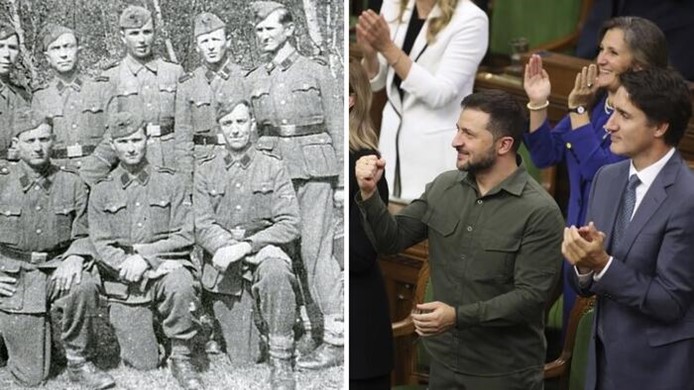
Yaroslav Hunka, center front row, with his Waffen SS unit. Volodomyr Zelensky and Justin Trudeau applaud him in Canada’s parliament. (Image: Zero Hedge)

By Margaret Kimberley

Source: Black Agenda Report

The Canadian government turned what should have been an ordinary photo opportunity with Ukraine’s president into a political debacle when a Ukrainian Nazi collaborator was honored in parliament. Now Canada’s history of admitting Ukrainian SS volunteers is facing new scrutiny as Russia gains the upper hand in the proxy war with the west. 

There is something especially satisfying when one’s opponents help make a case for something they have denied. Recently the Canadian government did just that. Their effort to prop up the failing Ukraine proxy war instead exposed that country’s Nazi past and present.

Ukraine has been a divided nation ever since its founding as a state after World War I. Its population is divided by language with Ukrainian and Russian speakers, with some favoring its status as a Soviet republic while others were vehemently opposed. So strong was that faction that there were many Ukrainians who actively collaborated with German occupation forces during World War II.

That history is well documented and is only denied by rank political cynicism which seeks to justify a proxy war which is trending in Russia’s favor.  Unfortunately the U.S. and its happy vassal allies, like Canada, are trying to keep up the charade as long as possible, no matter the cost to the people they claim to be helping.

Ukrainian president Volodomyr Zelensky’s recent visits to the U.S. and Canada were replete with calls to never give up and to defeat Vladimir Putin and to give Ukraine an endless supply of weapons and money. The Canadians were so eager to impress that they revealed a truth they had been denying.

It should have been enough to have Zelensky address their parliament, but they couldn’t leave well enough alone. They somehow felt compelled to add a special guest, 98-year old Yaroslav Hunka, who was introduced as “…a Ukrainian Canadian war veteran from the Second World War who fought for Ukrainian independence against the Russians…”

An important part of the war propaganda surrounding Ukraine has been to deny that people such as Hunka even exist or that they fought alongside the Germans we are otherwise told to revile. For Canada that also means denying that they brought those forces to emigrate after the war.

Instead of just introducing Zelensky and swearing to defend him no matter what, the Canadian parliament gave Hunka two standing ovations. It was later reported that Hunka served with the  First Ukrainian Division, also known as the Waffen-SS Galicia Division, or the SS 14th Waffen Division, a voluntary unit that was under German command. We are told that these units embody the worst evils committed in modern history. Of course, Germany didn’t have a monopoly on evil or genocide but the narrative of a uniquely evil nation is deeply embedded in western consciousness and the fallout from the incident was both funny and sad.

After Hunka’s history was revealed the amateurish nature of Canadian and all western foreign policy couldn’t be hidden either. The Speaker of the parliament apologized profusely and then resigned. Prime Minister Justin Trudeau admitted to being embarrassed although he felt compelled to add nonsensical warnings against Russian propaganda when his government’s farce was one of its own doing.

Canada is happy to be a U.S. partner in crime. If they’re told to recognize a fake president of Venezuela they do it. If they’re told to arrest the Chief Financial Officer of Huawei and create an international incident they will do that too. If the U.S. decides on another occupation of Haiti then Canada is on board with that too.

As for honoring a Ukrainian who served the Nazis, they are more than willing because that is what they’ve been doing since 1945. There is a large Ukrainian population in Canada who were welcomed with open arms, just as Hunka was. The Canadian government admitted more than 2,000 members of the Galician Waffen SS. In fact, showing an SS tattoo was a means of entry to Canada as it was eager to enhance its anti-left bona fides. some of these men were recruited to work in mining and undermine left wing union activity. Canada’s Minister of Finance and Deputy Prime Minister, Chrystia Freeland, is the grand-daughter of Ukrainian collaborator and propagandist Michael Chomiak.

Of course Canada shares the US history of being a white supremacist colonial state. So much so that they sometimes slip up and ruin their fine tuned image as a nicer version of the U.S. and end up showing their true colors.

The entire incident is an indication that the war they pledge to win isn’t going their way. The U.S., Canada and the rest of the collective west are now caught in a trap of their own making. They have stuffed blue and yellow flags down our throats, taken billions of dollars and euros and pounds that their people need, censored countless individuals and platforms, and even blown up the Nordstream pipeline. But now the game is up and they don’t know how to face their defeat. Instead they found an old Nazi and gave him applause, a sure sign of panic.

But they have done something even worse. Some Ukrainians, like Zelensky’s grandfather, defended the USSR and fought with the Red Army. Any Ukrainian on the other side was a German collaborator. Canada forgot that millions of people haven’t been fooled by heavy handed propaganda that seeks to change historical memory. The Soviet Union played the biggest role in Germany’s defeat, a simple fact which is ignored or disappeared or in the case of the proxy war turned into a perverse retelling of history which requires a willingness to take part in a shameful lie.

The backpedaling and apologizing is undeniably enjoyable to watch. Yet Canada revealed another frightening truth. The collective west is desperate and may do more than sabotage a pipeline. Russia is in no mood to back down after having been lied to about the Minsk Accords and a tentative peace plan early in this conflict. A public relations debacle is not the worst thing they can do. Canada and the U.S. and their friends may convince themselves that escalation is their way out. Foreign policy amateurism may lead to something far worse for humanity.

From Burkina Faso to Niger to Gabon, Western Hegemony Dying in Africa

By Harun Elbinawi

Source: Covert Geopolitics

Berlin Conference of 1884-1885 was undeniably one of the biggest evil summits in modern history. Greedy and racist European colonialists sat down in the German city and divided Africans as if they were sharing bread on a breakfast table.

The conference was organized by Otto von Bismarck, the first chancellor of Germany at the request of King Leopold II of Belgium, the Western genocidal barbarian that murdered more than 10 million innocent Africans in Congo.

Most Africans are not even aware of this genocide in Congo perpetrated by the Belgium colonialists because it is not in our history books written by the white colonialists.

European colonialism in Africa lasted more than a century with only the ancient Kingdom of Ethiopia spared because they defeated the Italian colonialists on the battlefield.

Trillions and trillions of dollars were stolen from Africa, millions of Africans were murdered by the European colonialists and Africans were massively brainwashed that they had no history before European colonialism.

The wave of ‘independence’ in Africa from the 1950s and 1960s did not represent true independence. What actually happened was that colonialism was cleverly replaced with neocolonialism by the genocidal imperialist barbarians of the West.

The massive looting of rich resources in Africa continued under Western puppet leadership. The courageous African leaders who refused to dance to the tune of the European colonialists were eliminated.

This was what happened to African heroes, Patrick Lumumba of Congo and Thomas Sankara of Burkina Faso. Congo has all mineral resources except for crude oil.

The uranium used by the US regime to make the atomic bombs unleashed on Hiroshima and Nagasaki was mined in Congo.

French greed in Africa

Among the European colonialists, French colonialism was more brutal and exploitative.

France killed more than 1.5 million civilians in Algeria alone. They murdered tens of thousands of civilians in other African countries.

One of the Modus Operandi of the French colonialists was to assemble Islamic scholars in a hall and exterminate all of them. They did this in Algeria, Chad, Mali and Senegal.

And the greed of their neocolonialism is extreme. Even after independence, France is still controlling the wealth of its former colonies in Africa.

The rich resources of French nations are still controlled by France and they continue to pay colonial tax to France.

French goods and services dominate their markets. The domineering presence of France in these countries has been excruciating and devastating for local populations.

Niger Republic does not know the quantity of uranium France was taking from there, which is worst than slavery.

No evil lasts forever

There is a popular saying that “No evil lasts forever”.

France’s neocolonialism in Africa will not last forever. Popular military coups against puppets of France imperialism have started and are gathering momentum.

The recent military coup in the West African state of Niger Republic does not stand in isolation but follows similar upheavals in the neighboring countries of Mali, Burkina Faso, and Guinea in recent years.

Mali is facing insurgency that is backed by Western hegemony. Mali expelled French troops because they were actively aiding the insurgents to justify its military presence in the African country.

Now, on Wednesday, we woke up with the news of another puppet of the Western hegemonic barbarians in Gabon overthrown by the military. Ali Bango inherited the Gabon presidency from his corrupt Father, Omar Bongo.

Early on Wednesday, some military personnel appeared on state TV and announced that they were seizing power and dislodging a family that has ruled the country for 56 years.

The military officers introduced themselves as members of the Committee of Transition and the Restoration of Institutions.

“Today the country is undergoing a severe institutional, political, economic, and social crisis,” the officers said in a statement, dubbing the recent election illegitimate.

“In the name of the Gabonese people … we have decided to defend the peace by putting an end to the current regime.”

Pertinently, Gabon’s former president had 70 bank accounts, 39 apartments, 2 Ferraris, 6 Mercedes Benz cars, 3 Porsches and a Bugatti in France. He ruled for 42 years (from 1967 to 2009). French leaders loved Bongo because he was loyal to them.

His son, Ali Bongo has been the president for 14 years (2009 – 2023). He has just been overthrown in a  coup.

Failure of Western liberal democracy

The fact is that the Western liberal democracy has not only failed in Africa but has failed woefully.

Democracy in Africa has become a tool for the corrupt ruling elites to steal the wealth of their respective countries and transfer it to Western financial institutions while the populations remain in abject poverty and hunger.

Democracy is just another system of government hijacked by the Western hegemonic barbarians, the biggest enemies of the human race. Democracy is now an imperialist tool of Western hegemony in Africa. This is a bitter and undeniable fact.

The people of Gabon will definitely celebrate this military coup as it marks the end of French interference and looting in their country. Another setback for the French leaders.

Africa must rise again

The most noticeable current in Mali, Burkina Faso, Guinea, Niger Republic and Gabon is that the change of governments all have popular support as the people of those countries are tired of France’s imperialism, arrogance and terrorism.

Today France has the 4th largest gold reserves in the world and there is no single gold mine in France.

These gold mines are all in Mali, Niger Republic and other African countries. The France neocolonialism in Africa must end. Its time has come.