
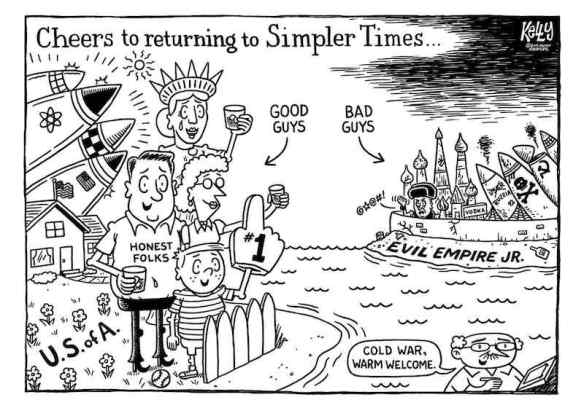
How Fear of Russia Misleads Americans

NSA whistleblower Thomas Drake sees grave dangers in the U.S. government and media exaggerating foreign threats as a means to mislead and control the American public, reports Dennis J Bernstein.

By Dennis J Bernstein

Source: Consortium News

Russia has been made “the go-to scapegoat” for distracting Americans from the serious problems afflicting the U.S. government, says Thomas Drake, a former senior executive at the National Security Agency who blew the whistle on multi-billion-dollar waste and violations of the rights of citizens through secret mass surveillance programs after 9/11.

As retaliation, the Obama Administration indicted Drake in 2010 as the first whistleblower since Daniel Ellsberg charged with espionage, carrying a possible 35-year prison term. However, in 2011, the government’s case against him collapsed and he went free in a plea deal. He became the recipient of the 2011 Ridenhour Truth-Telling Prize.

I sat down with Thomas Drake on June 3, 2017, at the home of ConsortiumNews editor Robert Parry in Arlington, Virginia, on the occasion of the awarding of the 2016 Gary Webb Freedom of the Press Award to Oliver Stone.

Dennis Bernstein: I want to ask you about a story. ConsortiumNews has offered quite a different perspective on the relationship between the U.S. government and Russia [questioning the allegations about] Trump collaborating with Putin. What’s your take on this story? Do you think that ConsortiumNews is onto something in terms of really questioning that whole line?

Thomas Drake: Yes. This hyperbolic narrative that is posited almost to the point of hysteria. They would say that Russians are behind everything. “It’s all the Russians’ fault and you can blame Russia.” It’s just pure political pretension and there is a significant amount of propaganda behind it.

It’s intended to distract. It’s intended to keep people from really looking at some of the deeper truths of our own government and so it is very convenient for the political elites, on both sides of what has become the Democratic/Republican divide, which in fact is not a divide; it’s two sides of the same coin, with slightly different narrative – to project all the blame on Russia and particularly the hyper-conflation of the littlest thing that would appear to be that Trump is ruining the country or Trump is the worst thing that has ever happened. Just really taking this
way, way beyond the pale.

And ConsortiumNews — having written for ConsortiumNews going back several years now as a result of my case and mass domestic surveillance and government abuse of power — is one of the few – it’s surreal for me to say this right now – it’s one of the few alternative media outlets who have the courage to stand up to the elite narrative and get behind this hyper-partisan politicization of blaming it all on external entities.

And, in this case, Russia has become the go-to scapegoat, frankly. And it’s easy to simply focus on that as your excuse without having to concern yourself with the deeper trends in terms of the darker history of American politics.

And Gary Webb – I am quite familiar with his case. Remember he had his own profession turn on him because they wanted to curry favor with power and they wanted to have access to power. So it was full access press and power is an aphrodisiac. Henry Kissinger said that. …

DB: Access press, as in, if you don’t say the right thing […] they can toss you into prison.

TD: Yep, precisely. And so you’re willing to overlook what may be done under the cover or blanket of government, the government structure. And so ConsortiumNews is one of the few. …

I was sort of the pre-Snowden Snowden. …

DB: He cites you for opening that door….

TD: Well, he has said there wouldn’t have been him without me. And he has cited a number of people who have preceded him, right? And I was there at the foundation, at this extraordinary willful violation of, in secret, of what I call the subversion of the Constitution. Really, it was a silent coup against the Constitution….

DB: What are the multiple dangers of the way in which information is used now, and slanted to support policy as opposed to inform?

TD: Well, it’s self-interest. It’s largely self-interest driven. You have, what I have sometimes called Gov-Corp, which is a combination of government and corporations and it’s an extraordinarily pathological relationship because they feed on each other. One protects the other and when you have the government corrupting itself to serve very powerful interests at the expense of public interests, guess what? Something has to give and what gives is public transparency. What gives is accountability. What gives is responsible power. What gives is the promise. What gives is “we the people”, right?

Power just… generally at least, power is about the people and it’s pathological, and so unfortunately the checks and balances that have in the past – Ellsberg is eyewitness to this — he’s certainly a key person by simply standing up with his colleague Edgar Russo, standing up to power in terms of the bright and shiny light called Vietnam, right? He clearly brought into the public purview what was really going on with Vietnam and, ultimately, as we know, I was a very young teen growing up in the ’70s. He was already in his early 40s at the time. That, yeah, the government can use power… and that, yeah, power does tend to corrupt. Lord Acton was right.

So, what became known as the imperial presidency of Nixon, this era makes that era look like a hyper type of person, especially post-9/11. It’s just extremely concerning. It’s what I would call the devolution of democracy and constitutional rights following 9/11 and Ellsberg has said and I have said, what was actually unlawful and unconstitutional has been made legal from his time.

And the old, what became the infamous statement made by Nixon, “You know, if the President says it’s okay, it’s not illegal.” I heard almost those exact same words when I confronted the lead attorney in the Office of General Counsel. That was the first week in October 2001. I had already found out about the massive domestic surveillance program that had been unleashed. And I confronted him and he said, “This is great. The White House has approved the program. It’s all legal.” …. The hairs on the back of my neck were like…. I’m having major flashbacks… Wait a minute, just because the White House approves it, it makes it okay? I mean, history is not kind. He says,” Yep, we’re the executive agent – all approved. Yes. Don’t ask any more questions.”

So, because the White House approved it, then it’s okay to violate the Constitution. All those checks were put in place as a result of the … president resigning, the standing committees and intelligence House and the Senate, the Foreign Intelligence Surveillance Act and a whole lot of others, right? So that was the check and balance, right? Nah, just, hey 9/11, the failure of the government to provide the common defense. 3,000 people murdered that day. It should never have happened. It really should never have happened. And so we are going to use that as sort of a reverse false flag. We’re going to use that as an excuse, because, “Hey, after all, the Constitution is not a suicide pact… you know, we don’t know where the enemy is.”

So just this weird, everything is existential now. We now know how the enemy is because of 9/11. And so it’s weird for me, having been brought up as a very young lad during the Cold War and remembering alarms going off and they’d turn off the lights and block the hall and face your lockers, right? The air raid sign drills and fears of the nuclear winter. It’s like these people want a World War 2.0.

We have far more in common with the Russians than we don’t. We have far in common than our own disputes. I assume there are some differences, right? I recognize, I am well aware, in terms of historical notes, but hey we have far more in common than we have difference.

DB: I guess what we all have in common is the state of the Earth at this point.

TD: The state of the Earth? We are the third rock from the sun. I mean, this is our home. The world is a much smaller place, in part because of technology and in part because we find out that, yeah, we really are dependent on each other.

And yet there is this addiction to conflict. There is this addiction to have threats. There is this addiction to divide. And this is not pretty. I mean, human history, the dark side of human history, and if the 20th century is not an optic lesson, then I don’t know what is….. I could go back to any of the others, in terms of written history that we know of, right? And yet here we are. And so, to me it is a sign of an empire….

The U.S. is an empire… and it is a sign of an empire that is losing it. And so, just like the Roman Empire, I mean, if you go back to the rise and fall of the Roman Empire, you know…. Those who don’t learn the lessons of the past are doomed to repeat them.

DB: Well, and the beat goes on. We’re going to let you join the party.

TD: The beat does go on. Yeah.

DB: But as we speak, there’s a major bombing, frightening bombing in Iran today.

TD: I did not know that. Wow.

DB: After the President of the United States is in Saudi Arabia. When is the last time you heard of a major suicide bomb in Iran?

TD: Not in Iran, no.

DB: So, here we go and who knows what comes next, who know what that’s going to bring in that part of the world. We thank you for all of your courage and all the suffering you did for all of us so we could know more. Thank you very much.

TD: Yeah. No. I have really become a warrior for peace. That’s what I have become. Ultimately it’s about who we are as human beings and who we are for each other and after all it is us, right? And in terms of U.S. culture and background, I think Pogo was right. We have met the enemy and the enemy is us. We are our own worst enemies.

It’s just that, for some of us, it’s critical to hold power accountable. We recognize we don’t govern ourselves very well. If you put people over others, yeah, bad things happen. But bad things tend to happen. And it’s that whole control, power. It’s all about — psychopathy is an area of study that I increasingly have as an issue, because of this idea that people gaining pleasure from the distress of others. So, it’s a disease. It really is. And some of us, at great sacrifice, weren’t going to just sit idly by and watch it all happen.

I care deeply about who we are as human beings. And I’ve spent a lot of time in front of college students and high school students and civic auditoriums and small group settings and churches and college campuses talking about these things. These are things that matter.https://consortiumnews.com/2017/06/20/how-fear-of-russia-misleads-americans/

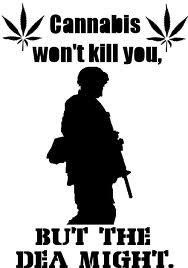
The Hate-Filled Origins of the War on Drugs they Don’t Want you to Know

war-on-drugs-poster

By Jay Syrmopoulos

Source: The Free Thought Project

An eye-opening video produced by the folks at ATTN, lays out how cocaine was banned as a means of social engineering, using racism as the main tool in driving this agenda. The desired results were achieved by utilizing stereotypically false racist attributions, perpetuated in the media as a means of turning public opinion against specific substances.Cannabis was attributed to Hispanics, hence the coining of the term “marijuana,” as a means of correlating the drug with Mexicans immigrants. Cocaine was attributed to blacks while opium was linked to the Chinese, with each being associated with racist depictions relating to use of the drug in question.

As hysteria grew, mainly due to the racial demonization of drugs, Congress took action with the passage of the Harrison Act of 1914, which outlawed the production, distribution or importation of opium and cocaine.

These actions were then followed up with the outlawing of marijuana on a federal level with the Marihuana Tax Act of 1937.

The modern “War on Drugs,” which has been waged disproportionately upon urban minorities, has its roots in the Nixon administration.

Nixon dramatically increased the size and presence of federal drug control agencies and pushed through measures such as mandatory sentencing and no-knock warrants.

In the early 1980’s the crack cocaine epidemic hit the inner cities of urban America with a vengeance. It began the devastation of black communities and the disenfranchising of many of the socially conscious organizations, such as the Black Panthers, which were working towards ending institutionalized racism.

Journalist Gary Webb in his groundbreaking investigative series, Dark Alliance, exposed deep connection between the CIA and large scale drug trafficking, which many attribute to the crack cocaine epidemic.

The violence associated with the crack scourge was steadily fed to the living rooms of middle America on the nightly news, which once again manifested as fear in the public. The public then begged the politicians to save them from the media spoon fed menace.

Thus began the approach to “get tough on crime,” which can be seen in the disparate penalties for crack cocaine vs. powder cocaine. Crack, which was primarily used by blacks, was given a penalty 100 times more severe than that of powder cocaine, which was primarily used by whites. This sentencing difference was in spite of the drugs being the same pharmacologically speaking.

In 2010, the Fair Sentencing Act reduced this disparity down to an 18 times more severe penalty for crack vs. powder cocaine, but a massive difference in the way these almost identical substances are treated remains.

It’s quite clear what the impetus for making drugs illegal has historically been, racial fear. The violence perpetrated upon innocent people under the guise of a “War on Drugs” clearly shows that it’s actually a war being waged on all freedom loving Americans.

The manner in which racial prejudice has been used by the state to forward its agenda throughout history is consistent with the divide and conquer approach that continues to be used domestically and abroad, with the mainstream media seemingly ever ready to assist.

Jay Syrmopoulos is an investigative journalist, free thinker, researcher, and ardent opponent of authoritarianism. He is currently a graduate student at University of Denver pursuing a masters in Global Affairs. Jay’s work has previously been published on BenSwann.com and WeAreChange.org. You can follow him on Twitter @sirmetropolis, on Facebook at Sir Metropolis and now on tsu.

Related Video:

Surprise: The Drug War Isn’t About Drugs

Drug-War1By Kevin Carson

Source: Center for a Stateless Society

On the morning of November 6 the US Federal Bureau of Investigation trumpeted its takedown of the Silk Road 2.0 website and the arrest of  alleged operator Blake Benthall.

In so doing the FBI demonstrated, once again, that the War on Drugs has nothing to do with anything its propagandists claim it’s about. If drug criminalization is a public safety issue — about fighting violent crime and gangs, or preventing overdoses and poisoning — shutting down Silk Road is one of the dumbest things the feds can do. Silk Road was a secure, anonymous marketplace in which buyers and sellers could do business without the risk of violence associated with street trade. And the seller reputational system meant that drugs sold on Silk Road were far purer and safer than their street counterparts.

This is true of all the other selling points for the Drug War. Hillary Clinton, in possibly one of the stupidest remarks ever uttered by a human being, says legalizing narcotics is a bad idea “because there’s too much money in it” — referring, presumably, to the lucrative drug trade and the cartels fighting over it.

But there’s so much money in it, and the cartels fight to control it, only because it’s illegal. That’s what happens when you criminalize stuff people want to buy: You create black markets with much higher prices, which organized crime gangs fight to control. Alcohol prohibition created the gangster culture of the 1920s. It’s been with us ever since. When Prohibition was repealed, organized crime just shifted to fighting over other illegal markets. The more consensual, non-violent activities are made illegal, the larger the portion of the economy that’s turned into black markets for gangs to fight over.

In related news, the Mexican drug cartels are reportedly making less money since the legalization or decriminalization of pot in several American states. I wonder why.

Perhaps the biggest joke is that the War on Drugs is fought to reduce drug use. No doubt many people involved in the domestic enforcement side of the Drug War actually believe this, but the left hand doesn’t know what the right hand’s doing. The narcotics trade is an enormous source of money for the criminal gangs that control it, and guess what? The US intelligence community is one of the biggest criminal drug gangs in the world, and the global drug trade is a great way for it to raise money to do morally repugnant stuff it can’t get openly funded by Congress. It’s been twenty years since journalist Gary Webb revealed the Reagan cabinet’s collusion with drug cartels in marketing cocaine inside the United States, to raise money for the right-wing Contra death squads in Nicaragua — a revelation he was gaslighted and driven to suicide for by the US intelligence community and mainstream press.

Now we hear that the US is “losing the drug war in Afghanistan.” Well, obviously — it’s a war that’s designed to be lost. The Taliban were so easy to overthrown in the fall of 2001 because they really did try to stamp out opium poppy cultivation, and with a fair degree of success. This didn’t sit well with the Afghan populace, which traditionally makes a lot of money growing poppies. But the Northern Alliance — which the United States turned into the national government of Afghanistan — was quite friendly to poppy cultivation in its territory. When the Taliban was overthrown, poppy and heroin cultivation resumed normal levels. Putting the US in charge of a “war on drugs in Afghanistan” is like putting Al Capone in charge of alcohol prohibition.

Besides, actually “winning” the drug war would mean ending it. And who in US domestic law enforcement wants to cut off the source of billions in federal aid and military equipment, militarized SWAT teams and unprecedented surveillance and civil forfeiture powers? This is a war meant to go on forever, just like the so-called War on Terror.

The state always encourages moral panic and “wars” on one thing or another in order to keep us afraid, so we’ll give it more power over our lives. Don’t believe its lies.


At the Stuff They Don’t Want You to Know podcast Ben and Matt share their views on the War on Drugs.

mp3 link: http://podcasts.howstuffworks.com/hsw/podcasts/stdwytk-audio/2014-11-14-stdwytk-war-on-drugs.mp3

The Untold Story Behind Why I Am a Narco News Journalist

GaryWebb2003SAJ

By Bill Conroy

Source: Narco News

“Authenticity Is Not the Easiest Path … But It’s The Only Path That Leads Forward” — Al Giordano

Narco News on July 9 will celebrate its fourteenth anniversary at a bash in the Big Apple. For me, it also will be a tenth anniversary fiesta. I started reporting and writing for Narco News in 2004.

Until now, though, I have never been able to tell fully the story of why I hooked up with Al Giordano and Narco News in the first place, because I was employed by a company that I felt would not appreciate the story being told in real time, as it really happened.

Recently, I stepped down from my position as editor-in-chief for one of the business newspapers owned by that company, American City Business Journals, for reasons I outlined in a past story I penned for Narco News, which can be found here.

Given I no longer work for ACBJ, and am no longer dependent on a paycheck from them to help feed young children — since my four kids now ten years later are adults — I am finally at liberty to tell the story without fear of job-ending retaliation from an employer.

And it’s an important story, I feel, one that needs to be in the public record for journalists who might decide to pursue an authentic path and need to understand the consequences — and the far more substantial benefits.

It all started with a story about an FBI agent who went undercover, posing as a “businessman” in a successful effort to infiltrate Chinese crime syndicates. Those criminal organizations, as it turns out, can be a path into the highest reaches of government power. In this case, they gave the FBI spy access to China’s intelligence apparatus, allowing him to gather intel and cultivate human assets for U.S. intelligence agencies.

It was an extremely dangerous, deep-cover assignment for the FBI agent, named Lok Lau, who was required to exist inside the criminal underworld for years.

Once Lau had completed his mission, however, the US government ignored his resulting Post Traumatic Stress Disorder [PTSD] and difficulty in re-entering normal society. Consequently, the FBI eventually fired Lau for poor performance, prompting him to file a lawsuit in federal court in California alleging wrongful termination and discrimination.

From a declaration filed by Lau in his civil rights case:

The assignment was extraordinarily dangerous and stressful. I was cut off from my family and friends, and the [FBI] “handlers” did not remain constant. I later learned I was not treated as other undercover agents were treated and should have been provided support, emotional, financial and human to ease my stress and anxiety. I was literally on guard 24 hours a day, and I knew my death could come at anytime. The outside world, including my family, knew nothing of what I did or how. In fact, even though I was an FBI Agent, my badge was kept at the field office and I could not even see it or my FBI credentials.

From an amicus curiae brief filed in Lau’s case:

… From a reading of the record, it is not difficult to discern that Lau was involved in espionage activities, kidnappings, trading in human slavery, illegal immigration, murder, torture, kidnapping, extortion, hostage taking and any number of other criminal activities that involved crimes against humanity, then and now, in his undercover work. Lau “penetrated” the Chinese Triads, the Tong and other Chinese Organized Crime Organizations that trade in all of these things as a way of life. There is no way that Lau could have performed his undercover so well that he received awards and other forms of recognition were that not so.

As part of that lawsuit, Lau put into the public record in 2003 certain pleadings that the US government — then controlled by President George W. Bush and Attorney General John Ashcroft — deemed not fit for public consumption, because they revealed too much detail about Lau’s spying mission on China, which remains to this day a highly classified operation.

Unfortunately for me, I had already obtained and made public the details of Lau’s court pleadings in a newspaper article for the San Antonio Business Journal. The US government attorneys handling Lau’s lawsuit found out about my story, and what I knew, because I did the proper journalistic thing and called them for comment.

And so, on the Friday that my Texas-based newspaper was published (after going to press two days earlier, on Wednesday), the Assistant US Attorney defending the Department of Justice against Lau’s charges of discrimination and wrongful termination filed pleadings with a federal court in California asking the judge in the case to retroactively classify portions of Lau’s pleadings. The government attorney in her motion also asked the judge to order that all copies of those pleadings in existence be returned to the FBI — going so far as to demand that “an FBI computer specialist be permitted to remove the specific files containing classified information from [any] unauthorized computer.”

Needless to say, ACBJ (the parent company of my San Antonio newspaper) was not happy about that, since if the judge issued the requested order, then the government could have seized not only my computer, but also any computer in ACBJ’s 40-newspaper chain that they thought might be housing the documents — potentially shutting down the company for a time. That wouldn’t be good for business, nor is crossing the Department of Justice and FBI, in general, good for career security in corporate America, even in the journalism world.

So I was about to get thrown under the bus by my employer, and likely the Bush administration, as I saw it, and the lawyering around the matter behind the scenes led me to believe that would be the result as well.

So I turned to two people I respected to help me out: Gary Webb, author of the Dark Alliance newspaper series that exposed US-sponsored drug-trafficking; and Al Giordano, whose Narco News online investigative publication, then only a bit more than three years old, had exposed the executive of a major bank as a drug trafficker — and emerged victorious in the resulting legal challenge waged by his bank to suppress that information.

I figured these two authentic journalists — whom I had only to that point corresponded with via email (and an occasional phone call in Webb’s case) — would have a trick or two up their sleeves when confronted with a challenge from corrupt power.

And they did.

Each asked me to email to them the court pleadings the US government attorneys and FBI were seeking to classify and remove from my computer. At that point, the documents were still technically in the public record because the judge had not yet ruled on the DOJ attorney’s motion to classify and purge Lok Lau’s pleadings.

I complied with Webb and Giordano’s requests, and within hours of me sending them the court documents via email, the pleadings were spread around the world via the Internet.

As a result, the judge in the case, in an Oct. 15, 2003, ruling, determined that he did not have the power to seize all copies of Lok Lau’s pleadings existing outside of the “court’s possession” (which included the copies on my computers, and now thousands of computers worldwide). In other words, the judge knew, to paraphrase an old nursery rhyme, that “Humpty Dumpty had a great fall”, via the Internet, and his court did not have the power to put “Humpty Dumpty back together again.”

So, in the end, authentic journalism won — well, sort of that is.

After the dust had settled, I received word through my boss that ACBJ’s corporate brass wanted me to cease and desist all investigative reporting at the San Antonio Business Journal.

Following is an excerpt from an email I sent to Webb and Giordano in early December 2003 — a few weeks after publishing what turned out to be the final investigative story in the Business Journal on the Lok Lau case:

My corporate office in Charlotte came calling. They’ve shut me down — from the highest level of the company.

I’m to do no more investigative reporting on the feds. I can only speculate on the real reason, but the one put forward is that the stories aren’t business reporting, in essence. (This is curious as I’ve been writing these stories — Customs, FBI, DEA, Homeland Security — for 4 years now and have won numerous “that ‘a boy” awards, including two from my own company.)

… I suspect the recent Lau FBI spy stuff, and the threat to take our computers, put the corporate blue bloods over the top.

… I expect I’ll be down for a bit, but will resurface somehow, somewhere. So keep in touch.

As it turned out, I did find a loophole. I still had the option of pursuing stories on a freelance basis, something allowed for in company policy. But my investigative-reporting days for the San Antonio Business Journal were done — if I wanted to keep my job and feed my four kids, still all in grade school or high school at that point.

In response to my email, Webb wrote the following:

Fuck. I’m sorry. Wish I could say this is unheard of, but you and I both know it’s not. It’s sad that investigative journalism is the only field whose practitioners are routinely punished for doing their jobs too well. You, obviously, were doing it exceptionally well to draw the attentions of the pinheads in chief.

… Believe me, I know this doesn’t help much when something like this happens but there is a certain honor in being ordered not to write about something. It’s like a dueling scar or a Purple Heart. You’ve been wounded in combat. Many reporters go through an entire career without getting near enough to the power structure to get a scratch. (Plus, you got away with punching the feds in the eye for four years.)

… So you can’t write about this topic any longer (at least not while you’re at your current esteemed organ). Any orders against freelancing future fed whistleblower stories?

… It’s not the end of the world. Who knows, this might set you off on a trail you never would have gone down before. Happened to me.

Giordano, in an email response to me at the time, wrote the following:

Welcome to the club. You can wear that shutdown like a badge of pride… Like Jim Morrison who, after singing censored lyrics was told “You’ll never do the Ed Sullivan show again,” replied: “Man, I just DID the Ed Sullivan show!”

Authenticity is not the easiest path, Bill… but it’s the only path that leads forward. If I can help you in any way, and I’m sure Gary [Webb] feels the same way, let me know. Ya done good.

And so, that’s how I came to Narco News. Giordano opened that door for me some 10 years ago, and I continued to live a double life since that time — serving as editor of a conservative, even stuffy, business weekly during the day; and by night pursuing investigative reporting on the drug war, pro bono, for Narco News.

That double life ended this past May, when I stepped down from my editor position at the Business Journal.

With this story, comes the proof, including the US government’s motion and judge’s order, which I’m putting online for the first time for everyone to see.

Enjoy the reading, and if you’re in the neighborhood next week, make sure to stop by Narco News’ fourteenth anniversary celebration at MV Studios in Long Island City, Queens, on Wednesday, July 9, starting at 7 pm. Directions and other details can be found at this link to the Facebook page for the event.

Gary Webb (1953-2004), who’s David vs. Goliath story will be told in the major motion picture Killing the Messenger, played by Jeremy Renner this October, sadly, isn’t alive to attend. But Giordano will be there, I’ll be there, and more than a few of the younger journalists who have come out of the School of Authentic Journalism’s eleven sessions since 2003 will also be there. We all hope to meet you there, too.

Proof of Authenticity

The US government’s motion that called for seizing Lau’s pleadings, which was broad enough to include my computer

The judge’s ruling in response to the government’s motion

FBI agent Lok Lau’s uncensored pleadings

• My San Antonio Business Journal series on Lok Lau

Lawyers, civil rights group claim government turning up the heat in Lau spy case

Media’s computers are on FBI’s radar screen in Lau spy case

Judge orders previously public court records sealed in case of former FBI agent

Former federal agents’ spy story opens Pandora’s box for FBI

• An investigative story advancing the Lok Lau saga further, written for the Asian Times by Gary Webb

The spy who was left out in the cold