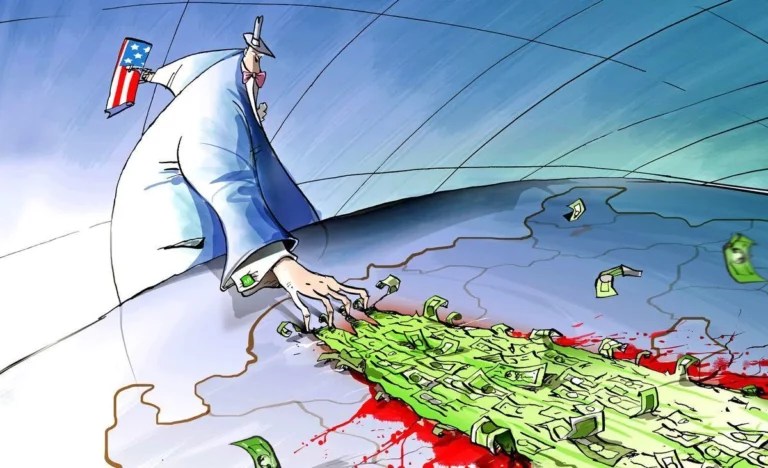
The fundamental crisis of the West

By Veniamin Popov

Source: New Eastern Outlook

A growing number of media outlets in America and in Europe have recently reached the conclusion that “rules-based international order” long espoused by the West has failed.

In essence, this means that the position of the Western powers in the world has weakened: they have failed to destroy the Russian economy by imposing sanctions, and the war in Gaza has demonstrated that the US and the Western European countries are far from all-powerful.

The media frequently claim that Russia’s special military operation in Ukraine has changed the international situation, in that it has made clear the limited capabilities of the West and deepened the rift between the West and the Global South.

The Ukrainian conflict and the war in Gaza have demonstrated to the whole world, and above all to ordinary people in the West, that their ruling elites are unable to grasp this reality, lack strategic vision and are generally guided by their own personal interests.

The ruling elites in the West have demonized Russia in every possible way and have come to believe the myth that Russia can be strategically defeated. This is a huge miscalculation and this conclusion will become obvious to all in the very near future. The present author is reminded of the junker Grushnitsky, in Lermontov’s “A Hero of Our Time,” a fantasist who plays the role of an unworldly romantic for so long that he begins to believe it himself.

As Vladimir Putin has aptly put it, “Russophobia, like any other ideology based on racism, national superiority and exclusivity, blinds the person who subscribes to it and deprives them of reason.”

The state of the “rules-based international order” is becoming increasingly alarming for many Western powers. According to an article published in the weekly journal the Economist on February 15, so-called national conservatives, who “suspect free markets of being rigged by the elites,” are gaining in influence in the US and Europe. They are also hostile to migration, despise pluralism, especially multiculturalism, and are obsessed with dismantling institutions they see as tainted by globalism.

Despite their differences, these national conservatives are united by their hostility to shared enemies, including migrants, especially Muslims, globalists and all their perceived enablers. Donald Trump is leading in the polls in America. The far right is expected to make gains in the European Parliament elections in June. In Germany last December, support for the far-right Alternative for Germany party (AFD) reached a record high of 23 percent, according to polls. Anticipating Rishi Sunak’s loss in the elections, the right wing of Britain’s Conservative Party are hoping to grab power in the party. In 2027, Marine Le Pen may well become president of France.

According to the Economist, the current authorities need to take people’s legitimate concerns seriously: the public in many Western countries see illegal migration as a source of unrest and a drain on the public purse. They worry that their children will grow up poorer than they are. They are concerned about losing their jobs to new technologies. They believe that institutions such as universities and the press have been hijacked by hostile, illiberal, left-wing elites. They view the globalists who have flourished over the last few decades as members of a self-serving, arrogant caste.

These complaints have real merit and mocking them only confirms how detached from reality the elites have become.

The position of Washington and its hangers-on in Europe in relation to Israel’s war crimes against the Palestinians in Gaza has added significantly to the public’s distrust of the West’s ruling elites. By openly supporting the actions of the Netanyahu government, the governments of the Western powers are convincing everyone, including their own populations, of their own policy of double standards: only the lives of Israelis are valued and massacres of Arabs are allowed.

As the Saudi newspaper Arab News reports, Arab and Muslim Americans, and 60 percent of all other Americans, have for months wanted President Joe Biden to pressure Israel into agreeing to an immediate ceasefire in Gaza. The White House has, in effect, ignored these pleas.

In response to this stance, Muslim Americans in nine potentially wavering states met in Dearborn, Michigan, in December 2023 under the slogan “Abandon Biden, Truce Now.” They have vowed not to vote for Biden in the presidential election unless he changes the policies that are enabling Israel’s genocide in the Gaza Strip possible.

The US journal Foreign Affairs, in an article entitled “Gaza and the End of the Rules-Based Order” quotes one G7 diplomat: “We have definitely lost the battle in the Global South. All the work we did with the Global South (around Ukraine) was lost. … Forget the rules, forget the world order. They will never listen to us again.”

The economic recession, which has become a permanent situation for many European states, also provides little room for optimism. In the US, the high inflation and huge government debt are expected to worsen this spring and summer, according to some analysts. The most closely watched indicator of opinions about the economy, a monthly poll conducted by the University of Michigan, has reported that public confidence is at an exceptionally low ebb, about the same level as during the 2007-2009 global financial crisis.

With the presidential election just nine months away, this gloomy mood has become a serious problem for the Democrats. President Joe Biden is already facing a host of challenges to his bid for a second term, starting with concerns about his fitness for office as an 80-year-old man. Another major obstacle to his election bid is the opinion polls that give him low marks for his management of the economy.

The current economic problems are exacerbated by growing inequality, the worsening drug crisis and the proliferation of firearms. The promotion of non-traditional sexual orientation and the encouragement of same-sex couples have cause legitimate outrage to many conservative religious people.

In the European Union between June 6 and 9, more than 400 million voters in 27 countries will elect 720 MEPs to represent them for the next five years. Observers predict an increase in the influence of right-wing conservative parties. One major reason for the heightened interest in the upcoming election is the unprecedented corruption scandal that erupted in the European Parliament in December 2022, when the vice president and several other officials, including three MEPs, were accused of taking bribes. The investigation is ongoing, but it has already revealed instances of illegal activities and immoral behavior on the part of MEPs. Conservatives accuse the EU of being an opaque bureaucracy with vastly overpaid staff, which is disconnected from the reality experienced by ordinary residents of the EU member states, and which spends its vast budgets – totaling hundreds of trillions of euros – not for the common good but for the personal whims and fantasies of its leaders. Inflation and the cost of living are still rising in many European nations, while many blame EU bureaucrats in Brussels for policies such as the Green Deal that have made life more expensive for Europeans by raising the prices of fuel, food and most other essentials. In addition, anti-Russian sanctions, which have led to the rejection of cheap energy from Russia by a number of European countries, have had a negative impact on the well-being of ordinary citizens.

Over the past few weeks, thousands of farmers from across Europe, particularly from Germany, France, Poland, Spain, and Belgium, have taken to the streets to protest against additional spending on Ukraine and against new EU environmental policies that make farming unviable.

The short-sighted policy of the Western elites with regard to the crises in Ukraine and the Gaza Strip is leading to a loss of confidence in the ruling authorities on the part of ordinary citizens. It is easy to imagine their reaction in the event of any further military setbacks by Ukraine or any worsening of the situation within the country.

The position taken by many developing nations with regard to the current international processes is highly symptomatic. In an editorial for the Arabic international newspaper Asharq Al-Awsat, Editor-in-Chief Grhassan Charbel writes: “Zelensky’s position reminded me of remarks by the late Egyptian President Hosni Mubarak to former Iraqi Foreign Minister Hoshyar Zebari, that ‘the one who is covered by the Americans is naked.’ The same phrase could be said by Putin to Zelensky.

Putin has the right to be sarcastic. The leaders of the West did not accept that he could not lose… That he went to Ukraine to punish the entire West and to launch a major coup against a world that was born from the collapse of the (Berlin) Wall and the disappearance of the Soviet Union.”

It is no coincidence that the ruling circles of Western Europe are currently not hiding their anxiety about what they refer to as the “threat posed by Trump and Russia.”

In fact, everything we see happening testifies to the inadequacy of the current ruling elites in the West, who are unable to reasonably and rationally assess the emerging situation, guided as they are solely by short-term personal interests.

It is very possible that they will be swept away by a wave of new unexpected events, and new leaders will come to power.

It is therefore highly likely that 2024 will be a turning point in many respects.
The Everything Bubble and Global Bankruptcy

By Charles Hugh Smith

Source: Of Two Minds

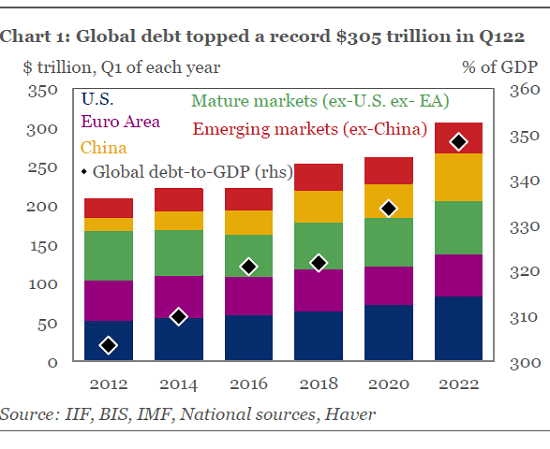
The resulting erosion of collateral will collapse the global credit bubble, a repricing/reset that will bankrupt the global economy and financial system.

Scrape away the complexity and every economic crisis and crash boils down to the precarious asymmetry between collateral and the debt secured by that collateral collapsing. It’s really that simple.

In eras of easy credit, both creditworthy and marginal borrowers are suddenly able to borrow more. This flood of new cash seeking a return fuels red-hot demand for conventional assets considered “safe investments” (real estate, blue-chip stocks and bonds), demand which given the limited supply of “safe” assets, pushes valuations of these assets to the moon.

In the euphoric atmosphere generated by easy credit and a soaring asset valuations, some of the easy credit sloshes into marginal investments (farmland that is only briefly productive if it rains enough, for example), high-risk speculative ventures based on sizzle rather than actual steak and outright frauds passed off as legitimate “sure-fire opportunities.”

The price people are willing to pay for all these assets soars as the demand created by easy credit increases. And why does credit continue increasing? The assets rising in value create more collateral which then supports more credit.

This self-reinforcing feedback appears highly virtuous in the expansion phase: the grazing land bought to put under the plow just doubled in value, so the owners can borrow more and use the cash to expand their purchase of more grazing land. The same mechanism is at work in every asset: homes, commercial real estate, stocks and bonds: the more the asset gains in value, the more collateral becomes available to support more credit.

Since there’s plenty of collateral to back up the new loans, both borrowers and lenders see the profitable expansion of credit as “safe.”

This safety is illusory, as it’s resting on an unstable pile of sand: bubble valuations driven by easy credit. We all know that price is set by what somebody will pay for the asset. What attracts less attention is price is also set by how much somebody can borrow to buy the asset.

Once the borrower has maxed out their ability to borrow (their income and assets-owned cannot support more debt) or credit conditions tighten, then those who might have paid even higher prices for assets had they been able to borrow more money can no longer borrow enough to bid the asset higher.

Since price is set on the margin (i.e. by the last sales), the normal churn of selling is enough to push valuations down. At first the euphoria is undented by the decline, but as credit tightens (interest rates rise and lending standards tighten, cutting off marginal buyers and ventures) then buyers become scarce and skittish sellers proliferate.

Questions about fundamental valuations arise, and sky-high valuations are found wanting as tightening credit reduces sales, revenues and profits. Once the “endless growth” story weakens, the claims that bubble prices are “fair value” evaporate.

As defaults rise, lenders are forced to tighten credit further. The first tumbling rocks are ignored but eventually the defaults trigger a landslide, and the credit-inflated bubble in asset valuations collapses.

As valuations plummet, so too does the collateral backing all the new debt. Debt that appeared “safe” is soon exposed as a potential push into insolvency. When the bungalow doubled in value from $500,000 to $1 million, the trajectory of valuation gains looked predictably rosy: every decade housing prices went up 30% or more. So originating a mortgage for $800,000 on a house that looked to be worth $1.3 million in a few years looked rock-solid safe.

But the $1 million was a bubble based solely on easy, abundant, low-cost credit. When credit tightens, the home is slowly but surely repriced at its pre-bubble valuation ($500,000) or perhaps much lower, if that value was merely an artifact of a previous unpopped bubble.

Now the collateral is $300,000 less than the mortgage. The owner who made a down payment of $200,000 will be wiped out by a forced sale at $500,000, and the lender (or owner of the mortgage) will take a $300,000 loss.

Given the banking system is set up to absorb only modest, incremental losses, losses of this magnitude render the lender insolvent. The lender’s capital base is drained to zero by the losses and then pushed into negative net-worth by continued losses.

The collateral collapses when bubbles pop, but the debt loaned against the now-phantom collateral remains.

This is the story of the Great Depression, a story that’s unloved because it calls into question the current series of credit-inflated bubbles and resulting financial crises. So the story is reworked into something more palatable such as “the Federal Reserve made a policy error.”

This encourages the fantasy that if central banks choose the right policies, credit bubbles and valuations detached from reality can both keep expanding forever. The reality is credit bubbles always pop, as the expansion of borrowing eventually exceeds the income and collateral of marginal borrowers, and this tsunami of cash eventually pours into marginal high-risk speculative vebtures that go bust.

There is no way to thread the needle so credit-asset bubbles never pop. Yet here we are, watching the global Everything Bubble finally start collapsing, guaranteeing the collapse of collateral and all the debt issued on that collateral, and the rabble is arguing about what policy tweaks are needed to reinflate the bubble and save the global economy from bankruptcy.

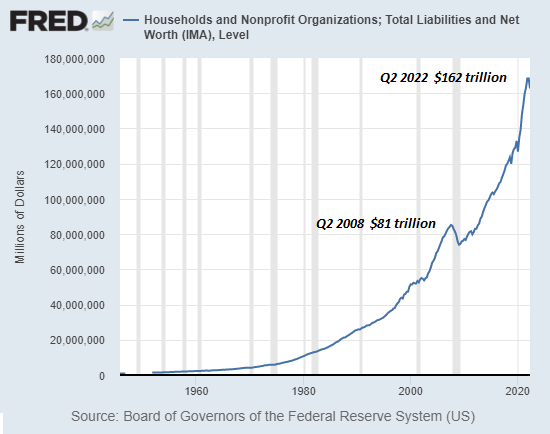
Sorry, but global bankruptcy is already baked in. Too much debt has been piled on phantom-collateral and income streams derived from bubble assets rising (for example, capital gains, development taxes, etc.). The asymmetry is now so extreme that even a modest decline in asset valuations/collateral due to a garden-variety business-cycle recession of tightening financial conditions will trigger the collapse of The Everything Bubble and the mountain of global debt resting on the wind-blown sands of phantom collateral.

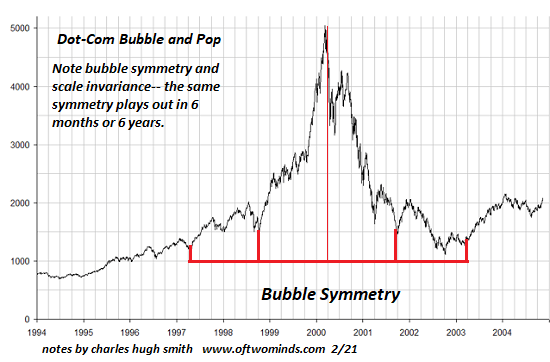
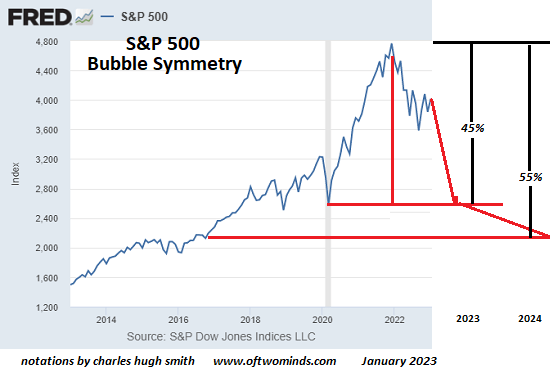
There are persuasive reasons to suspect global debt far exceeds the official level around $300 trillion, most saliently, the largely opaque shadow banking system. When assets roughly double in a few years, bubble symmetry suggests that valuations will decline back to the starting point of the bubble in roughly the same time span.

The resulting erosion of collateral will collapse the global credit bubble, a repricing/reset that will bankrupt the global economy and financial system.

2021 is Already Optimized for Failure

By Charles Hugh Smith

Source: Of Two Minds

One sure way to identify a system “optimized for failure” is if all the insiders are absolutely confident the system is “optimized for my success”.

I often discuss optimization here because it offers an insightful window into how systems become fragile and break down. When we optimize something, we’re aiming to get the most bang for our buck: maximize our efficiency, profit, productivity, etc., while minimizing our costs.

To maximize our goal, whatever it is–profits, power, whatever– we strip away redundancy and buffers because these add costs and don’t boost our desired output. They create resilience, i.e. the ability to survive disruptions, but the logic of optimization is relentless: get rid of all extraneous costs, because resilience doesn’t boost the bottom line.

This trade-off–trading resilience for optimization–looks brilliant when everything goes according to plan. But when events veer outside the narrow parameters of the optimized system, the system breaks down: supply chains break, safety procedures fail, and so on.

Even more consequentially, optimization strips away anti-fragility, Nassim Taleb’s term for the ability to not just survive disruptions but emerge stronger and more adaptable.

What happens when inflexible, sclerotic systems optimized to benefit self-serving insiders encounter chaotic turbulence or conditions outside the expected parameters? They collapse because the system is optimized for failure. Put another way: when a system is optimized to benefit insiders at the expense of resilience and anti-fragility, it is effectively optimized to fail because life is not programmable to a steady-state, predictable stability.

2021 is already optimized for failure in key ways:

1. The mRNA vaccines have not been properly tested to answer essential questions such as: can a vaccinated individual retain enough of the virus to infect an unvaccinated individual?

As I explained before, the only way to really test a viral vaccine is to put the vaccinated volunteers in a controlled setting saturated with the virus for many hours. If none of the volunteers have any virus in their post-exposure serological tests, then the vaccine works. If the volunteers still have the virus but didn’t become severely ill, this doesn’t mean they can’t infect others.

One of the problems is the goal of the Covid vaccine trials wasn’t to determine if the virus was eliminated by the volunteers’ immune system; the goal of the trials was to determine whether the vaccinated individuals became severely ill with Covid or not–with “severely ill” being conveniently left undefined.

Individuals who’d already had Covid and who took the vaccine were not tested separately for safety and after-effects, so this remains an unknown.

The unanswered questions about the vaccines’ real-world results will be answered in due time, but not in the lab; they’ll be answered in a public-health “experiment” without precedent.

If you wanted to design a testing process that was optimized for failure, you’d end up with this haphazard, hurried process careening toward approval. The trials and testing of the Covid vaccines are not equivalent to those applied to previous generations of vaccines.

The bigger the claims and the harder the sell, the greater the number of red flags raised. If a product works as wonderfully as advertised, it will sell itself. If “consumers” have to be coerced into buying the product, that speaks volumes–whether we’re free to discuss it or not.

2. The fiscal-monetary “solution” being readied for 2021–print/borrow as many trillions as needed to prop up zombie corporations and obsolete institutions–is optimized for failure. The unstated goal here is to save everything that’s been rigged to benefit self-serving insiders and never mind the consequences: we’ve “proven” we can print infinite trillions with no ill effects.

This appears to be true until diminishing returns hit the wall and linear dynamics suddenly spin into non-linear semi-chaos. At that point, all the levers that we reckoned were god-like in their stability and power–the Treasury selling bonds which the Federal Reserve then buys, and all the other financial tricks and manipulations–no longer work as expected.

3. The sacrosanct “solutions” that we worship as secular gods–central bank-dominated “markets” and the machinery of politics–are both optimized for failure. The “market” and politics have both incentivized extremes of indebtedness, leverage, corruption, fraud and waste, all under the happy belief that the banquet of consequences will never be served. Alas, the tables are groaning with consequences that have been piling up for 12 long years of excess speculation, manipulation and happy-talk PR.

The policies of the past 20 years boil down to this: if we keep blowing ever-larger private-sector asset bubbles, rewarding the few who own most of these assets, this “wealth” will magically restore our economic health. This is of course completely delusional: by concentrating wealth in the hands ofthe few, the policies have also concentrated political power in these same hands.

Ours is a system perfected for extremes of inequality and corruption.

If you set out to design a social-political-economic system that was supremely optimized for failure, you’d end up with America’s status quo. Today’s financiers are like French nobles being led off in chains discussing their next glorious party, oblivious to the end-game just ahead. The political class are like the elites haggling over games in Rome’s Forum in 475 AD, months before what was left of the empire collapsed in a heap.

4. America’s social cohesion has been lost, leaving only empty platitudes, suppression and coercion. “We’re all in this together” shouts the captain of the galley as those chained to the oars are flogged to keep a thoroughly corrupt and illusory “growth” alive. With civic virtue lost to the moral corruption of maximizing private gain by any means available, the foundations of society have crumbled, as I explained in Moral Decay Leads to Collapse.

One sure way to identify a system optimized for failure is if all the insiders are absolutely confident the system is optimized for my success regardless of how many policies serve the infinite greed of insiders and how many red warning flags are ignored.

The “New Normal” Is De-Normalization

By Charles Hugh Smith

Source: Of Two Minds

Here’s what denormalization means: there was no “New Normal” for the dinosaurs.

Everyone talks about the “New Normal,” as if there’s a guarantee that life will return to normal. But the “New Normal” is De-Normalization, which I define as everything that was normal is gone and will not be replaced with some new normal. In other words, normal is gone, done, over: old normal, new normal, doesn’t matter: normal is history.

Denormalization is currently used to describe a database optimization process, but it’s too valuable a concept to be limited to a narrow geekspeak term.

What I mean by Denormalization is the complete dismantling of what was taken for granted as normal and the loss of any future version of normal. Consider sports as an example. We all know the Old Normal that millions hope will magically return: $100 million player contracts, millions in TV ad revenues, pro franchises worth billions of dollars, NCAA playoffs, etc.: a dominant kingdom in the nation’s media and mindshare.

The dirty little secret that troubled the kingdom long before Covid-19 was a steady erosion in attendance at live games and in the viewing audience. Younger generations have relatively little interest in all the trappings and habits of Boomer sports manias. They’d rather watch the 3-minute highlight video on their phones than blow half a day watching games that are generally lacking in drama and are largely replaceable with some other game.

What few seem to notice is that the Old Normal had become insanely expensive, irksome and boring, activities that were habits coasting on momentum. Those embedded in the Old Normal acclimatized to the absurdly overpriced seats, snacks, beer, parking, etc. of live events and the insanely long commutes required to get to the venue and then back home, as their happy memories of $5 seats decades ago is the anchor of their lifelong devotion and habits.

The old fans coasting on ritual habituated to the cookie-cutter nature of the games, while those who never acquired the habit look with amazement at the seemingly endless dull progression of hundreds of interchangeable sporting events.

Advertisers will eventually notice that younger generations never acquired the habit of worshipping sports and so there is nothing to stem the collapse of the Old Normal but older fans, some percentage of whom will find they don’t miss it once they fall out of the habit.

Some other percentage will find they can no longer afford to attend live games, or they’ll realize they no longer feel it’s worth it to grind through traffic or public transit just to sit for additional hours and then repeat the entire slog back home.

Another percentage will suddenly awaken to the artifice of the whole thing; they will simply lose interest. Others will finally realize the corporate machine (which includes college sports) has long since lost any connection to the era that they remember so fondly.

This same Denormalization will dismantle fast food, dining out, air travel, healthcare, higher education and innumerable other iterations of normal that have become unaffordable even as the returns on the lavish investments of time and money required diminish sharply.

How many of you deeply miss air travel? You’re joking, right? Only certifiably insane people would miss the irksome hassle and discomfort, from the endless delays due to mechanical problems (don’t you people keep any spare parts, or is it all just in time like every other broken system in America?), the seats that keep getting smaller as the passengers keep getting larger, the fetid terminals, and so on.

Like all the other iterations of normal, the entire experience has been going downhill for decades, but we all habituated to the decline because we were stuck with it.

What few seem to understand is all the Old Normal systems can’t restabilize at some modestly lower level of diminishing returns; their only possible future is collapse. Just as fine-dining restaurants cannot survive at 50% capacity because their cost structure is so astronomical, the same is true of sports, airports, airlines, cruise lines, fast food, movie theaters, healthcare, higher education, local government services and all the rest of the incredibly fragile and unaffordable Old Normal.

None of these systems can operate at anything less than about 80% of full capacity and customers paying 80% of full pop, i.e. full retail. Since their fixed cost structures are so high, and their buffers so thin, there’s nothing below the 80% level but air, i.e. a quick plummet to extinction.

Here’s what denormalization means: there was no New Normal for the dinosaurs. A few winged species survived and evolved into the birds of today, but that is by no stretch of the imagination a New Normal that included all the other dinosaur species. For them, denormalization meant extinction.

De-Normalizationeverything that was normal is gone and will not be replaced with some new normal. Normal is gone, done, over: goodbye to all that.


Is This China & USA’s “Thelma & Louise” Moment?

thelma-and-louise

By James Howard Kunstler

Source: Zero Hedge

Why would anybody suppose that the Peoples Bank of China might want to tell the truth about anything that was within their power to lie about? Especially the soundness of any loan portfolio vested unto the grasp of its tentacles? Of course, most of what China has done in speeding toward the wall of financial crack-up, it learned from watching US bankers slime their way into Too Big To Fail nirvana — most particularly the array of swindles, dodges, and frauds constructed in the half-light of shadow banking to hedge the sudden, catastrophic appearance of reality-based price discovery.

When so many loans end up networked as collateral in some kind of bet against previous bets against other previous bets, you can be sure that cascading contagion will follow. And so that is exactly what’s happening as China’s rocket ride into Modernity falls back to earth. Like most historical fiascos, it seemed like a good idea at the time: take a nation of about a billion people living in the equivalent of the Twelfth Century, introduce the magic of money printing, spend a gazillion of it on CAT and Kubota earth-moving machines, build the biggest cement industry the world has ever seen, purchase whole factory set-ups, and flood the rest of the world with stuff. Then the trouble starts when you try to defeat the business cycles associated with over-production and saturated markets.

Poor China and poor us. Escape velocity has failed. Which raises the question: escape from what, exactly? Answer: the implacable limits of life on earth. The metaphor for all this, of course, is the old journey-into-space idea, which still persists in the salesmanship of Elon Musk, the ragged remnants of NASA, and even the nightmares of Stephen Hawking. Get off this messed-up home planet and light out of the territories, say Mars. Of course, this is a vain and stupid idea, since we already have a planet engineered to perfection for all the life systems associated with the human project. We just can’t respect its limits.

So now, that dynamic duo, Nature and Reality, the actual owners of the planet, have showed up to read the riot act to the renters throwing a wild party. The fourth and perhaps ultimate financial crisis of the last twenty years begins to express itself in terms that only the raptors and vultures can see from on high. George Soros, Kyle Bass, and the other flocking shadow banking scavengers prepare to short the living shit out of the old Middle Kingdom. The immortal words of G.W. Bush ring in their ears: This sucker is going down,” and they are sure to win big by betting on the obvious. Trouble is, this sucker could go down so much further than they imagined, that whatever fortunes they gain from its descent will be foiled by the destruction of the very economic system needed for them to enjoy their gains.

For instance, when banking systems go down, governments usually follow, and when governments go down, societies often unravel. It doesn’t take a great effort of imagination to see China’s one party politburo leadership machine lose the respect of its governed masses, and then its control of events, followed by a Great Struggle among the regions and factions to restore some kind of order. And when the smoke clears there will a whole lot of nearly worthless concrete and steel, and a vast loss of notional wealth, and China will be lucky to land back in some approximation of the Twelfth Century.

It must be interesting for China to watch the horrifying disintegration of America’s political party structure currently on view, with the mad bull called Trump rampaging across the land and the designated inevitable Mz It’s-My-Turn hijacking her collective for the greater glory of Goldman Sachs. The last time China got the vapors politically — the so-called Cultural Revolution of the 1960s — the country went batshit crazy. Surely some of the ruling party remembers that with requisite terror.

Or maybe this is China and the USA’s Thelma and Louise moment. Pedal to the metal, they drive into the abyss of history holding hands. Remember, audiences loved that!