
Saturday Matinee: The Blade

qt7-blade

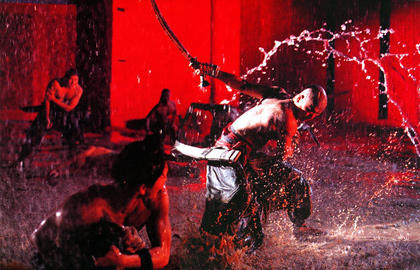
Director Tsui Hark is truly a visionary pioneer of Hong Kong cinema. He was one of the first in the Hong Kong film industry to use Hollywood-style special effects in “Zu Warriors From the Magic Mountain” (1983) and pushed the envelope again with extensive CGI effects for the sequel “The Legend of Zu” (2001). He helped launch Jet Li’s career with his “Once Upon a Time in China” trilogy and was the producer of one of director John Woo’s earliest blockbusters “A Better Tomorrow” (1986). However, for most of the 90s Tsui Hark’s career was in a slump because of a series of failed attempts to break into the U.S. market and an economic downturn of the Hong Kong film industry. One of the films Hark released during this period was “The Blade” (1995). Though it bombed at the box-office, it’s now widely recognized as one of his greatest achievements (so far).

Like many idiosyncratic cult films, The Blade wasn’t palatable to general audiences and was dismissed as a failure upon release. Such films are usually ahead of their time, needing more time to be discovered by fans or for cultural sensibilities to change. The Blade’s unremittingly grim setting and pessimistic tone may have frightened off film-goers who in the mid 90s were drawn more towards lighthearted fare but it’s a quality that makes it stand out today and gives it an oddly contemporary feel. Feudal China has never seemed so brutal and forbidding (yet exotic and multicultural). It’s a fully realized world full of tribalism, hedonism, feral creatures, small pockets of civilization, crude weapons and an unforgiving social and natural environment, not unlike the post-apocalyptic scenario of The Road Warrior.

Other characteristics that contribute to The Blade’s cult status are its archetypal characters, highly stylized art direction, impressionistic photography reminiscent of Wong Kar Wai films, and unforgettable scenes (including one of cinema’s most frenzied and viscerally powerful showdowns). Though its storyline is pretty standard for a wuxia martial arts film, its subtext contains an abundance of philosophical questions about the nature of morality, violence, religion, sex, commerce, disability, pedagogy and memory among other things. The Blade has never had an official DVD release in the U.S. but fortunately this subtitled version was uploaded to YouTube last year:

Saturday Matinee: The Holy Mountain

images

There was once a time when seeking out cult movies was a challenge, involving a combination of dedicated effort and luck to hear about them and to actually be able to see them. Even learning what exactly is a cult film was not so common. Today, with internet communities that thrive on niche interests and novelty, most of us have an idea of what they are. For those who don’t there’s always wikipedia, but it used to be knowledge gained mostly through word of mouth or books discovered in stores or libraries like Midnight Movies by Stuart Samuels and Cult Movies by Danny Peary. To watch such films one had to be lucky enough to live near video stores or independent theaters managed by the right kinds of people (weirdos) or be able to visit such places on trips. Obscure or pirated videotapes could sometimes be ordered by mail through catalogs and magazines or found at comic conventions. Sometimes college campuses would also have small screenings organized by student film societies. Once in a blue moon, some of these films would even air on late night network or cable television.

To do my small part to carry on the cult movie tradition I will feature old and new examples of such films every Saturday that can be viewed in their entirety on YouTube. The first is “The Holy Mountain”, which is appropriate because the director, Alejandro Jodorowsky also created “El Topo”, one of the early acknowledged cult classics.

Wrong is Right

I found a VHS tape of an odd and prescient 1982 Sean Connery film called Wrong is Right at a yard sale shortly after 9/11 and was planning a review drawing parallels between it and different aspects of the war on terror. However, I just discovered E.R. Torres wrote a post similar to what I had in mind last year at his interesting Random Thoughts blog. excerpt:

So, one wonders, might there be another director out there who, upon looking at the events surrounding 9/11 and the second Iraqi war, might not also look at the myriad tragedies involved, from the thousands upon thousands dead, the loss of national treasure, the inept leadership, the media manipulation, and the very questionable motivations for engaging in the conflict in the first place…and decide that this too might be good material in the creation of a black comedy? Thing is, someone already did, and they did it a whopping 20 years before the events of 9/11 and the subsequent Iraqi War. I’m talking about 1982′s Wrong Is Right. As directed by Richard Brooks, the movie features Sean Connery in the role of Patrick Hale, an intrepid, world famous reporter who, in the process of criss-crossing the globe, comes to realize he’s landed himself smack dab in the middle of machinations involving the CIA, an Arabian leader whose land is filled with oil, a weapons dealer, a terrorist intent on getting his hands on two mysterious suitcases, and a U.S. presidential election. The various parties involved actively try to manipulate the story Hale perceives and tells, and ultimately what may appear “true” becomes a matter of convenience. To go into too much debate about the story’s plot would be a disservice. Having said that, this now 30 year old film is incredibly prescient. With some minor modifications, this could easily be a black comedy “take” on the buildup to the Iraqi War. The most eerie element of the whole thing is that the movie’s climax takes place on the roof of the World Trade Center.

You can watch the complete film here.