
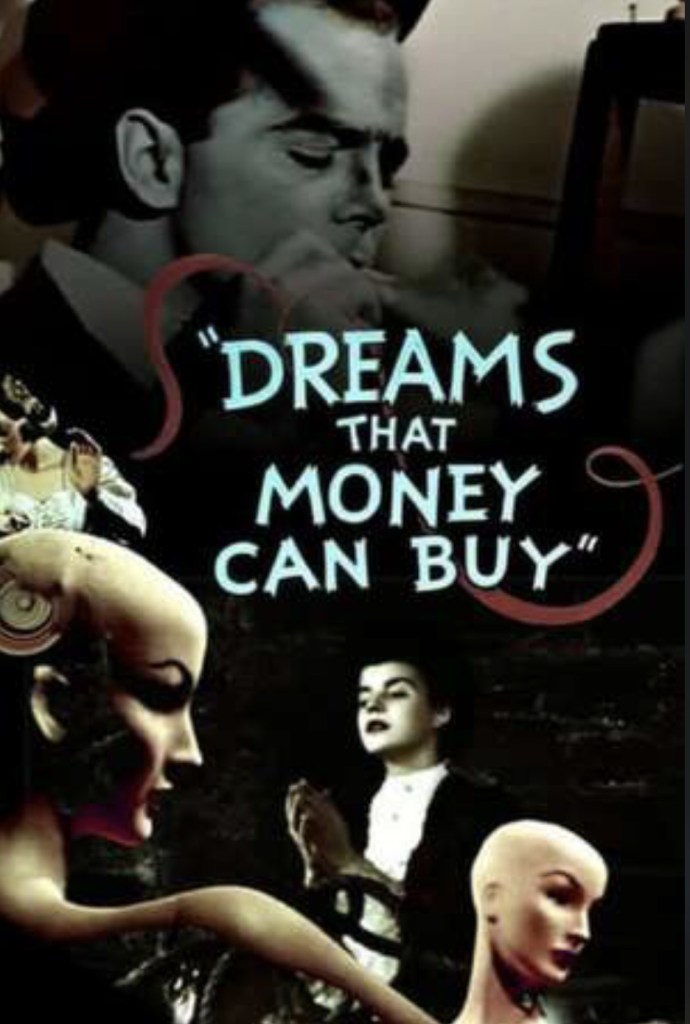
Saturday Matinee: Dreams That Money Can Buy

Watch Dreams That Money Can Buy, a Surrealist Film by Man Ray, Marcel Duchamp, Alexander Calder, Fernand Léger & Hans Richter

By Colin Marshall

Source: Open Culture

“Everybody dreams. Everybody travels, sometimes into countries where strange beauty, wisdom, adventure, love expects him.” These words, a tad floaty and dreamlike themselves, open 1947’s Dreams That Money Can Buy. “This is a story of dreams mixed with reality,” the narrator intones. He can say that again. Directed by Hans Richter, painter, graphic artist, avant-gardist, “film-experimenter,” and energetic member of the Dada movement, the picture takes a storyline that seems mundanely realistic — impecunious poet finds apartment, then must figure out how to pay the rent — and bends it into all manner of surreal shapes. And I do, literally, mean surreal, since several of the scenes come from the minds of noted avant-garde and surrealist artists, including, besides Richter himself, painter and photographer Man Ray, conceptualist Marcel Duchamp, sculptor Alexander Calder, and painter-sculptor-filmmaker Fernand Léger.

Joe, the film’s protagonist, finds he has a sort of superpower: by looking into the eyes of another, he can see the contents of their mind. He promptly sets up a sort of consultation business where he examines the unconscious thoughts of a client: say, an unambitious banker whose wife lives “like a double-entry column: no virtues, no vices.” He then uses the abstract materials of their thoughts to come up with a self-contained, somewhat less abstract dream for them to dream: in the banker’s case, a dream called Desire, which takes the form of a short film by Dadaist painter-sculptor-graphic artist-poet Max Ernst. For Joe’s other, differently neurotic customers, Richter, Man Ray, Duchamp, Calder, and Léger come up with suitable formally and aesthetically distinct dreams. While all these artists imbue Dreams That Money Can Buy with their own inimitable sensibilities (or nonsense abilities, as the case may be), I feel as though certain modern filmmakers would have the time of their lives remaking it. Michel Gondry comes to mind.

Saturday Matinee: David Lynch Presents the History of Surrealist Film (1987)

By Colin Marshall

Source: Open Culture

What living director has drawn the descriptor “surreal” more often than David Lynch? If you’ve seen, or rather experienced, a few of his films — particularly Eraserhead, Lost Highway, Mulholland Dr., or Inland Empire, or even the first half of his television series Twin Peaks — you know he’s earned it. Like any surrealist worth his salt, Lynch creates his own version of reality, with its own set of often unfathomable and inexplicably but emotionally and psychologically resonant qualities. In 1987, the year after his breakthrough Blue Velvet opened in theaters, the BBC apparently thought him enough of an authority on the matter of cinematic surrealism to enlist him to present an episode of Arena on the subject.

And so we’ve highlighted, just above in two parts, the fruit of their collaboration, with apologies for the straight-from-the-VHS quality of the video. (I just think of the slight muddledness as adding another welcome layer of unreality to the proceedings.)

Lynch’s duties on the broadcast include providing facts about the films and filmmakers excerpted throughout to tell the history of surrealist film. (He also provides several choice opinions, as when he calls Philadelphia “one of the sickest, most corrupt, decadent, fear-ridden cities that exists.”) We see bits and pieces of pictures like Luis Buñuel and Salvador Dali’s 1929 Un Chien Andalou, Jean Cocteau’s 1932 Blood of a Poet, Fernand Léger’s 1947 The Girl with the Prefabricated Heart, and Chris Marker’s 1962 La Jetée. Not only does Lynch contextualize them, he discusses their influence on his own work. Casual filmgoers who’ve caught a Lynch movie or two and taken them as the imaginings of an entertaining weirdo will, after watching this episode, come to understand how long a tradition they fit into — and they’ll no doubt want to see not just more of Lynch’s work, but his sources of inspiration as well. (They may, however, after hearing all he has to say here, still regard him as a weirdo.)


Saturday Matinee: Dreams That Money Can Buy

dreams_that_money_can_buy_01

“Dreams That Money Can Buy” (1947) is a surrealist film produced, and directed by artist and dada film-theorist Hans Richter with contributions from Max Ernst, Marcel Duchamp, Man Ray, Alexander Calder, Darius Milhaud, John Cage and Fernand Léger. Joe is a WW2 vet and starving artist who discovers that he can see the contents of his mind unfolding when gazing into a mirror. After realizing he can apply his gift to others, Joe sets up a business selling tailor-made dreams to a variety of neurotic clients in order to pay his rent.