
America’s Economy Cannot Survive Another Lockdown, And The Cult Of The Reset Knows It

By Brandon Smith

Source: Alt-Market.us

The U.S. economy has been on the verge of collapse for at least a decade, ever since the crash of 2008 and the subsequent explosion in fiat stimulus from the Federal Reserve. While the mainstream media has always claimed that central bankers “saved” us from another Great Depression, what they actually did was set us up for a far worse scenario — a stagflationary implosion of our society.

Here is the primary problem: By injecting trillions of bailout dollars into the system, the Federal Reserve prevented the economy from going through its natural purging cycle. This cycle would have been painful for many, but survivable, and it would have removed large amounts of excess debt, parasitic corporations that produce little or nothing of use, as well as numerous toxic assets with no legitimate value. For a real free market to function, weak or corrupt elements must be allowed to fail and die. Instead, central banks around the world and most prominently the Fed kept all of those destructive elements on life support.

This has created what amounts to a “zombie economy:” a system that needs constant outside support (stimulus) in order to continue moving forward. In the process of keeping zombie corporations and other parts of the body alive, healthy parts of the economy, like the small business sector, get devoured.

The zombie economy is, however, highly fragile. All it takes is one or two major shocks to bring it down, and the moment this happens the whole facade will disintegrate, leaving the public in panic and disarray. This is what is happening right now in 2020, and it will get much worse in 2021.

Bailouts encourage and reward unhealthy financial behavior, and this is why national debt, corporate debt and consumer debt have recently hit historic highs. When every pillar of the economy is encumbered with the weight of debt, any instability has the possibility of bringing all those pillars down at once. The Federal Reserve turned the U.S. into an economic time bomb, and the Fed is itself more like a suicide bomber than some kind of fiscal savior.

The “Great Reset”

I first heard the term “global reset” or “great reset” back in 2014/2015. I wrote an article about how the reset was actually a long term process in my article The Global Economic Reset Has Begun. Christine Lagarde was the head of the IMF back then, and she mentioned it briefly in multiple interviews.

I made a mental note of it because it seemed planted into the discussion very awkwardly, as if it was scripted. I rarely heard it mentioned for years after that. In 2020, as we descend into social and economic chaos, I’m seeing the phrase used everywhere in the media and by globalists.

Over the past decade, globalist institutions have come up with numerous phrases that seem to refer to a worldwide planned and dramatic shift in human society sometime in the near future. The “great reset” is just another phrase for “the new world order.” It is important to understand that the reset these people are talking about has actually been engineered and staged for many years. This is not something that just popped up in 2020 — they have been talking about it since at least 2014. And before that, they talked about the new world order, and “multilateralism,” and the “multi-polar world order,” and Agenda 2030, etc.

The reset is the catalyst phase of an agenda that has been in the works for a long time now. The goal, as they have openly admitted many times, is to centralize the entire globe into one monetary structure, one highly interdependent and socialized economy, and eventually one faceless and unaccountable governing body.

One of the biggest obstacles to the finalization of the reset and the formation of the new world order has been liberty-minded populations across the planet — most of all, the liberty-minded people within America. The U.S. has to be destabilized or eliminated; the old world order has to be brought down before the new world order can be introduced. The people have to be beaten down and desperate, so that when the globalists offer their “reset” as the solution, the people will gladly accept it without question — simply because they want the economic pain and uncertainty to stop.

A common statement made by globalists from Klaus Shwab at the World Economic Forum to the current Prime Minister of Canada, Justin Trudeau, is that the coronavirus pandemic is the “perfect opportunity” to trigger the “great reset.” As globalist Rahm Emanuel is famous for admitting, in crisis there is opportunity to do things you were not able to do before.

In other words, when people panic in the face of crisis, they become easy to manipulate. And, if a crisis doesn’t happen naturally, then why not create a crisis from thin air and use that to cause panic?

Enter the economic lockdowns…

The lockdowns have not only been proven to do nothing to stop the spread of the coronavirus, but they are also a clear attack on what’s left of our economic system. The small business sector in particular is being gutted as more than 60% of those that shut down during the first lockdown were unable to reopen. Small businesses provide more than half of all employment in the U.S.. When they collapse, the U.S. economy will have nothing left except the big-box corporations that the Fed put on life support over a decade ago.

Real unemployment, which is already at 26%, will skyrocket even further if a second national lockdown is initiated. The speedy collapse of the U.S. economy will be assured, and the “great reset” can commence. At least, that is what the globalists want to happen…

With the U.S. presidential election currently being contested, it is hard to say how the next few months will play out in detail. As I have been pointing out since July, a contested election is the best possible scenario for the globalists because it creates a Catch-22 situation:

  1. If Trump stays in office, the political left will accuse him of usurping the presidency and there will be mass riots in the streets. Conservatives will be tempted with the idea of bringing in martial law to suppress rioters, and such measures will undermine the flow of the U.S. economy, causing its fragile structure to implode.
  2. If Biden enters the White House, then he will attempt a Level 4 lockdown similar to the lockdowns we have seen in Australia, France, Germany and the UK; perhaps even worse. Our economy will crumble, conservatives will revolt, and Biden will attempt martial law measures.

Either way, the globalists get their crisis, and therein their opportunity.

Surviving the lockdowns and deterring the globalists

But here is where things get less certain for the elites. If liberty-minded Americans organize immediately for security and mutual aid, we can defuse the Catch-22. If we provide for our own security within our own communities, there will be no rationale for Trump to institute martial law. Community security is an awesome deterrent against leftist rioting and looting, and basic economic trade can continue.

By extension, if we organize our own community security as well as localize our economies with barter and trade, we also act as a deterrent to Biden and any ideas he might have of enforcing national lockdowns. The point is, we can’t allow the globalists to dictate the terms of the crisis. We must act to change the rules of the game.

The reset is not a natural inevitability, it is a con, a trap. No matter how bad the crisis in our nation becomes, it is the people — namely the liberty-minded people — who will determine the future, not the globalists. Their plan relies on our panic. Instead of panic, let’s show them a unified front and a plan of our own.

What We Don’t Elect Matters Most: Central Banking and the Permanent Government

By Charles Hugh Smith

Source: Of Two Minds

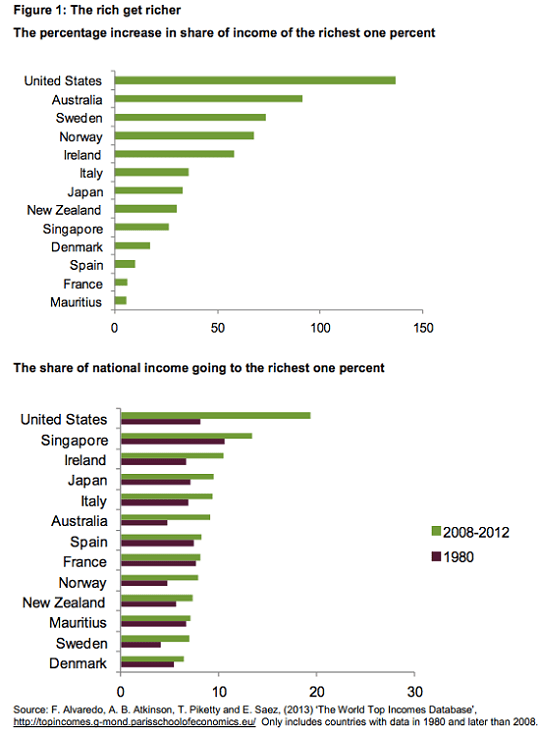
We’re Number One in wealth, income and power inequality, yea for the Fed and the Empire!

If we avert our eyes from the electoral battle on the blood-soaked sand of the Coliseum and look behind the screen, we find the powers that matter are not elected: our owned by a few big banks Federal Reserve, run by a handful of technocrats, and the immense National Security State, a.k.a. the Permanent Government. These entities operate the Empire which hosts the electoral games for the entertainment and distraction of the public.

The governance machinery controlled by elected representatives is tightly constrained in what it can and cannot do. It can’t do anything to stop the debasement of the nation’s currency, which is totally controlled by the Politburo of the Fed, nor can it do much to limit the Imperial Project, other than feel-good PR bits here and there.

The president wields vast powers but even the president is powerless to stop the debasement of the nation’s currency and the enrichment of bankers, financiers, corporations, etc., who fund the campaigns of the gladiators, oops I mean politicians.

If we set aside the term Deep State and simply call it the unelected machinery of governance (Permanent Government), we get a clear picture of its scope and power. Presidents, senators and representatives come and go, but the machinery of Empire grinds on, decade after decade.

A great many people and places in America don’t matter to the Fed or the Permanent Government, and so they’ve been abandoned to their fates. The darlings of the Fed and Empire are clustered in Silicon Valley and other urban hubs where the technological and financial machinery of global hegemony are fabricated and maintained.

Those far from these centers of banking, finance and Big Tech have little to no stake as owners of meaningful capital. All they have to sell is their labor, and that’s been losing purchasing power for decades as financialization and globalization have stripmined rural America and enriched the bankers, financiers and speculators who serve the Fed and unelected Permanent Government.

The Fed and the Permanent Government have been very, very good to the few at the expense of the many. Look at the chart below at America’s complete dominance when measured by the soaring wealth of its top 1% power elite: We’re Number One in wealth, income and power inequality, yea for the Fed and the Empire! And we don’t have to elect them–they elect themselves.


The Economy Continues To Unravel Despite All Stimulus Measures

By Brandon Smith

Source: Alt-Market.com

Since the pandemic lockdowns were first implemented in the US I have been more concerned with the government and central bank response than the virus itself. As I have noted in past articles, the pandemic restrictions and subsequent economic and social crisis events they help to create will cause far more deaths than Covid-19 ever will. Not only that, but the actions of the Federal Reserve continue to con the American public into believing that there is some kind of “plan” to stop the crash that THEY engineered.

The only agenda of the Fed is to increase the pain in the long term; they have no intention of actually preventing any disaster.

This is evidenced in comments by voting members of the Fed, including Neel Kashkari who recently argued for the enforcement of hard lockdowns for at least six weeks in the US, all because the US savings rate was going up. Meaning, because Americans are saving more in order to protect themselves from economic fallout, Kashkari thinks we should be punished with an economic shutdown that would force us to spend whatever we have been able to save.

Do you see how that works?

Fed members and government officials demand hard lockdowns, depleting public savings and destroying small businesses. Then, the public has to beg the Fed and the government for more and more stimulus measures so that they can survive. The people and the system become dependent on a single point of support – fiat money creation and welfare. Yet, the evidence suggests that this strategy is failing to do much of anything except stall the inevitable for a very short time.

If the goal was really to reduce the pain of the pandemic as much as possible, then the strategy should be to keep the economy as open as possible and let the virus run its course.  By initiating lockdowns, all we are doing is extending the economic damage over the span of years instead of months.  We can deal with the comparatively minimal deaths associated with the virus; we cannot handle the disaster that is about to befall the financial system.

The small business sector appears to be the most fragile element of the economy right now. The PPP loans that were supposed to shore up small businesses failed miserably, with data showing only 13% to 19% of applicants getting a loan of any kind. Over 64% of small businesses that received a loan are also worried about being approved for loan forgiveness. In other words, of the few small business owners that got a PPP loan more than half do not have the ability to pay the loan back if they end up not qualifying for exemption.

This problem does not seem to be affecting the corporate sector, however. International companies are enjoying incredible cash infusions from the Fed through overnight loans as well as Fed stimulus propping up stock markets (at least for now). Tech companies in particular are enjoying a rush of investment as the assumption in the daytrading world is that the central bank will not allow these companies to fail.

Maybe they are right, but stock markets today DO NOT reflect the health of our system in any way. Stock tickers are a placebo, a Pavlovian trigger for the public, a tool to make people believe that the situation is improving merely because share values are going up. This is not the case.

Small businesses in the US account for around 50% of all employment and job creation. They are a vital part of the economy. Yet, government and central bank measures seem to have left them out in the cold to die.

To be sure, the $600 weekly unemployment enhancement created through the CARES Act passed in March did boost consumer spending, primarily on durable goods such as computers, TVs, cellphones, etc. Spending on services declined though, which is where the majority of small businesses make their money. And, considering the fact that most durable goods are manufactured overseas, this means that the majority of stimulus dollars that went to consumers did not go into the US economy, but foreign exporters like China.

Now, the unemployment enhancement has ended and its return is in question. It will be interesting to see if the boost to purchases of goods will continue without that extra $600 weekly stimulus. Consumer spending rose in July by 1.9%, but this was already a weak print compared to the increases during the previous two months.

Unemployment numbers have declined due to soft reopenings in numerous states, and at the very least some part time jobs appear to be returning, but nowhere near the level needed to erase the millions of jobs lost since February after the initial lockdowns began. If you count U-6 measurements and unemployed people who have been removed from the rolls for being jobless for too long, the REAL unemployment rate is closer to 30% of working age Americans. This is essentially Great Depression levels of joblessness.

US GDP has continued to decline by 32% according to the Bureau of Economic Analysis (despite statistical rigging by the Fed and government agencies), and while it’s possible that stimulus slowed the effects of GDP loss, there is no indication what the trillions of dollars created by the Fed have actually bought other than a few months of time and a massive bubble in the stock market.

The economy cannot survive extreme lockdown conditions for any length of time, let alone almost two more months. And, if you want to know what it means when elites in government and central banking call for a “hard lockdowns”, just look at Level 4 restrictions in places like Australia and New Zealand, where only one person can leave home at any given time, can only travel 3 miles from home and only for food and supplies, and anyone caught not wearing a mask is subject to arrest or a $10,000 fine.

This mother in Melbourne, Australia was arrested because of a Facebook post calling for protests over the lockdown restrictions.  She later had to take the post down and offered an apology, saying she did not know it was illegal to post such statements on social media:

Yeah, this kind of Orwellian response will do wonders for any economic recovery, and this is what Kashkari is calling for in the US.  It’s almost as if the Fed and certain politicians WANT a financial collapse in America…

The REAL solution is to stop the lockdown restrictions altogether. If the goal is truly to protect as many American lives as possible for the “greater good”, then the pandemic response must stop. Luckily, it seems that more and more people are beginning to see through the facade and are rejecting the restrictions. Even in Europe and Australia there have been some signs of protest and rebellion. The problem is that, at least in terms of the economy, it may be too late.

We have to consider the fact that once a large portion of the business sector (like small businesses) takes a massive hit like the one they have suffered over the past several months, many such businesses and jobs will simply not come back. There are many reasons for this, but primarily it’s a matter of debt. The average small business owner carries almost $200,000 in debt for 3-5 years before he reaches profitability or breaks even. This is assuming that there are no major economic catastrophes in that time.

With the pandemic, the riots, the restrictions, etc., businesses will have to take on much more debt with little guarantee of recovery in the next few years let alone the next few months.  Chapter 11 business bankruptcies in the US rose over 26% in the first half of 2020 alone.

Even if lockdown restrictions were completely eradicated tomorrow, a large number of businesses would go bankrupt anyway.  The “Retail Apocalypse” has been growing over the past decade, LONG before the coronavirus was on issue.  Thousands of businesses shut down last year and tens of thousands more are slated to close this year.   The virus and lockdowns simply accelerated the existing decline.

This is why large banks are cutting off loans to business owners and consumers right now; they know exactly where all this is headed.

Banks act as middlemen for the PPP loans financed by the Fed, yet those loans are not getting to most businesses. Banks have also cut credit card lending in the past few months, and general lending has crashed. All of this despite low interest rates for banks receiving stimulus injections from the Fed. Where is all of the money going? They are keeping it for themselves, buying up hard assets as well as propping up the stock market. As noted above, the elites have NO INTENTION of saving the economy, only themselves.

If the stimulus is not getting to the main-street economy then the only purpose it serves is to give the public a false sense of comfort.  The people who gain the most from the ongoing pandemic chaos are establishment elites that want severe restrictions on personal liberty.  Not to mention, the virus and lockdowns offer a convenient scapegoat for the financial crisis that was already brewing due to central bank mismanagement of stimulus, inflation and interest rates. The bottom line is, the banks do not want the crisis to end.  Why would they?  The longer the panic continues, the more they benefit.

Global billionaire wealth tops $10 trillion as COVID-19 deaths mount

By Jacob Crosse

Source: WSWS.org

The collective wealth of the world’s 2,189 billionaires has risen to $10.2 trillion, an increase of nearly $1.3 trillion in the past three years, according to a new report by the Swiss bank UBS and PricewaterhouseCoopers. The unprecedented surge in wealth takes place amidst a global pandemic that has killed more than one million people worldwide, including more than 215,000 in the United States alone.

The report, “Riding the Storm,” is based on data from 43 markets, including interviews with 60 billionaires, accounting for around 98 percent of global billionaire wealth. It sums up the results: “Most of the decade was a time of exceptional prosperity for billionaires regardless of sector…”

The US continues to have the largest concentration of billionaire wealth, accounting for 36 percent of the world’s total, or $3.6 trillion. China ranked second with $1.6 trillion and saw the largest growth over the decade, by 1,146 percent.

Third was Germany, where billionaire wealth totaled $594.9 billion, an increase of 175 percent from 2009’s $216.1 billion. While fourth in terms of billionaire wealth at $467.6 billion, Russia saw the smallest growth by percentage, 80 percent, from $260.2 billion in 2009 to $467.6 billion in 2020.

The $10.2 trillion amassed by less than .0003 percent of the global population is more than the estimated 2020 Gross Domestic Product of every country on the planet except for the US and China. The staggering total hoarded by less than 2,200 people, or about the number of COVID-19 deaths in the US within the last 72 hours, surpasses the previous high of $8.9 trillion recorded in 2017.

For a household earning the average US median income, it would take over 16 million years to accumulate $1 trillion, not even enough to cover what has been collectively usurped from global society in less than three years. Joel Berg, CEO of Hunger Free America, has calculated the cost of ending hunger in the US at $25 billion, which could be done 400 times over with $1 trillion.

The billionaires who have increased their wealth the most, according to the authors, are in the “technology, healthcare and industrial sectors,” including Amazon CEO Jeff Bezos, Tesla CEO Elon Musk, and Facebook CEO Mark Zuckerberg. The report states: “During 2018, 2019 and the first seven months of 2020, technology billionaires’ total wealth rose by 42.5% to USD 1.8 trillion, supported by the surge in tech shares.”

The surge in technology and medical shares was buoyed by unlimited cash from the Federal Reserve, included as part of the $2.2 trillion CARES Act passed at the end of March in a near-unanimous vote by both Democrats and Republicans.

This financial bailout made a “big difference” in the fortunes of billionaires, with the authors writing: “Billionaire wealth is loosely correlated with equity markets, due to holdings in listed companies, and a few weeks makes a big difference. From the end of March, governments’ huge fiscal and quantitative easing packages drove a recovery in financial markets. By the end of July 2020, billionaire wealth was back above its 2019 level.”

Particularly obscene is the surge in wealth of billionaires in the health care industry, in the midst of a deadly global pandemic. The authors write, “Healthcare billionaires’ total wealth increased by 50.3% to $658.6 billion, boosted by a new age of drug discovery and innovations in diagnostics and medical technology, as well as latterly COVID-19 treatments and equipment.”

The report adds: “The number of tech billionaires grew from 68 in 2009 to 234 in 2020, while the number of healthcare billionaires grew from 48 to 167. Tech and healthcare billionaires’ total wealth both multiplied by four times – from $321.3 billion to $1.3 trillion for tech and from $120.8 billion to $482.9 billion for healthcare.”

And what are these “pandemic profiteers” spending their fortunes on? To get some idea, Christie’s auction house in New York held its latest online auction, “20th Century Evening Sale” live-streamed from the Rockefeller Center in New York on October 6. In one night, the world’s wealthiest spent over $340 million on 59 different 20th and 21st century art pieces. The auction also featured the most expensive dinosaur skeleton ever sold, a fossilized Tyrannosaurus rex, for $27.5 million.

The massive concentration of wealth is a decades’ long and bipartisan policy of redistribution to the rich. The Institute for Policy Studies measured the tax obligations of America’s billionaires as a percentage of their wealth between 1980 and 2018 and found that it had decreased 79 percent. Over the last 20 years, the growth in US billionaire wealth has been 200 times greater than the growth in median wealth.

While the billionaires are richer than ever, the response of the ruling class to the pandemic has produced a massive social catastrophe for the working class. In the United States, tens of millions are unemployed and being cut off of all benefits, facing poverty, homelessness and hunger.

Earlier reports found that the 643 wealthiest Americans increased their wealth by a staggering $845 billion between March 18 and September 15. During that same time, over 62 million people in the US applied for unemployment benefits. An estimated 10.5 million jobs were eliminated, with major companies such as Disney, United Airlines, and Cineworld announcing tens of thousands additional layoffs in the last week.

Inflation Is Stealth Austerity

By Charles Hugh Smith

Source: Of Two Minds

Rather than decry austerity, which demands an open political discussion of trade-offs, we should decry inflation’s stealthy reduction of purchasing power.

Austerity–bad. Inflation–good. Oh wait–they’re the same thing: both are a reduction in purchasing power. The only difference is a reduction via austerity is upfront while inflation is a stealth reduction, obfuscated by “official” distortions and Federal Reserve mumbo-jumbo.

Consider $1,200 in wages, unemployment, stimulus, Social Security payment, etc. If this payment gets cut by 10%–$120–as a result of austerity, pay cut, reduction in hours worked, etc., recipients scream bloody murder.

But if inflation reduces the purchasing power of the $1,200 by 10%, nobody does anything but grumble that “prices keep rising while my income stays the same.” This is the classic boiled frog syndrome: inflation is like the heat being turned up so gradually that the poor frog doesn’t realize he’s about to expire.

Inflation is stealthy because the loss of purchasing power is difficult to monitor. Your $1,200 only buys what $1,080 bought in the recent past; 10% inflation reduced your income exactly the same as if austerity had subtracted the $120 upfront.

Governments and central banks love inflation because the theft goes unnoticed. The public tolerates inflation because it’s easy to passively accept this erosion in their standard of living and difficult to generate the political heat that an outright cut would spark.

Though it’s being openly engineered by the Federal Reserve, inflation appears to be a force nobody controls–unlike austerity which is so clearly a political decision. If Inflation robbed 10% of everyone’s income overnight, people might be roused from their passivity to protest.

But since the theft occurs slowly–what’s 1% a month?–and unevenly across a spectrum of goods and services, this theft doesn’t rouse the same political storm as upfront austerity.

Inflation is a form of sacrifice that few recognize as sacrifice. It seems like everyone’s income is eroded equally, but this isn’t true: the wealthy closest to the Fed’s money spigots are earning multiples of inflation from asset inflation, stock buybacks, etc. Inflation is a pinprick to the wealthy and a stilletto in the kidneys of the bottom 95%.

To the political Aristocracy, inflation is wonderful because they don’t need to ask anyone to sacrifice 10% of their income as they do with austerity; they just steal the 10% a dribble at a time and throw up their hands as if inflation is some mystery force completely beyond their control.

Ironically, austerity–an honest, upfront political decision and sacrifice–is decried, while the dishonest, stealth cut of inflation is passively accepted, even as the Federal Reserve has made a cloaked political decision to reduce the purchasing power of everyone’s income except for the New Nobility (the top 0.1%) that the Fed slavishly serves.

Rather than decry austerity, which demands an open political discussion of trade-offs, we should decry inflation’s stealthy reduction of purchasing power, a Fed policy that benefits the few at the expense of the many.

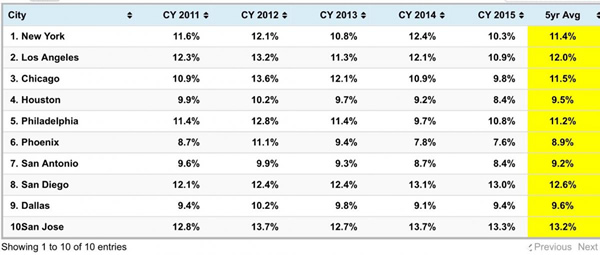
Here is the Chapwood Index of inflation, which carefully measures “apples to apples” costs of essential goods and services in each city:

As inflation erodes purchasing power, workers’ share of the economy has declined dramatically– a double-whammy of declining purchasing power and standard of living.


Sacrifice for Thee But None For Me

By Charles Hugh Smith

Source: Of Two Minds

The banquet of consequences for the Fed, the elites and their armies of parasitic flunkies and factotums is being laid out, and there won’t be much choice in the seating.

Words can be debased just like currencies. Take the word sacrifice. The value of the original has been debased by trite, weepy overuse to the point of cliche. Like other manifestations of derealization and denormalization, this debasement is invisible, profound and ultimately devastating.

Consider the overworked slogan of implied shared sacrifice: we’re all in this together. Pardon my cynicism, but doesn’t this sound like what the first class passengers in the lifeboats shouted to the doomed steerage passengers on the sinking Titanic?

Here is the ice-cold reality of America in 2020: Sacrifice for Thee But None For Me. This isn’t a new trend, of course. Any measurable sacrifices shared by all the socio-economic classes ended with World War II in 1945, and since then it’s been one long slide to Sacrifice for Thee But None For Me.

We’ve seen this slide to decay and collapse many times in history. The elites who once gained social status and political power by making real sacrifices on behalf of the nation / empire become entirely self-serving, accumulating ever greater wealth and power by transferring all the sacrifices and risks onto the lower classes.

Peter Turchin, author of War and Peace and War: The Rise and Fall of Empires, describes how civic virtue is gradually replaced by personal greed and self-interest.

This excerpt perfectly captures the current zeitgeist:

“Virtus included the ability to distinguish between good and evil and to act in ways that promoted good, and especially the common good. Unlike Greeks, Romans did not stress individual prowess, as exhibited by Homeric heroes or Olympic champions. The ideal of hero was one whose courage, wisdom, and self-sacrifice saved his country in time of peril.

Unlike the selfish elites of the later periods, the aristocracy of the early Republic did not spare its blood or treasure in the service of the common interest. When 50,000 Romans, a staggering one fifth of Rome’s total manpower, perished in the battle of Cannae, as mentioned previously, the senate lost almost one third of its membership. This suggests that the senatorial aristocracy was more likely to be killed in wars than the average citizen….

The wealthy classes were also the first to volunteer extra taxes when they were needed… A graduated scale was used in which the senators paid the most, followed by the knights, and then other citizens. In addition, officers and centurions (but not common soldiers!) served without pay, saving the state 20 percent of the legion’s payroll….

The richest 1 percent of the Romans during the early Republic was only 10 to 20 times as wealthy as an average Roman citizen.”

Now compare that to the situation in Late Antiquity when

“An average Roman noble of senatorial class had property valued in the neighborhood of 20,000 Roman pounds of gold. There was no ‘middle class’ comparable to the small landholders of the third century B.C.; the huge majority of the population was made up of landless peasants working land that belonged to nobles. These peasants had hardly any property at all, but if we estimate it (very generously) at one tenth of a pound of gold, the wealth differential would be 200,000! Inequality grew both as a result of the rich getting richer (late imperial senators were 100 times wealthier than their Republican predecessors) and those of the middling wealth becoming poor.”

Compare this to the America of World War II and the America of today. Wealthy, politically influential families such as the Kennedys could only retain their influence if their sons served in positions of combat leadership, and Joe Kennedy was killed in the European theater after volunteering for a highly risky air mission. John F. Kennedy very nearly lost his life in the South Pacific.

And how do our era’s crop of presidents and presidential contenders fare by comparison? The idea that flesh and blood should ever be at risk in defense of the nation /empire–perish the thought.

As Turchin sagely observed, it’s not just the limitless greed and avoidance of sacrifice of the elite that generates destabilizing inequality–it’s the eradication of the middle class as all the risks and sacrifices were shifted from the self-serving top to the middle and lower classes.

As I’ve often noted, risk cannot be made to disappear, it can only be transferred to others. In the grand scheme of things, the inherent risks of globalization and financialization have all been transferred to the middle and working classes (however you define them). The elite class enjoys the near-infinite support of the Federal Reserve and it’s ability to print near-infinite sums of currency to bail out the greediest, most self-serving scum of parasites and speculators.

Meanwhile, all the sacrifices required to support this unfair, corrupt, predatory system have been transferred to the middle and working classes via sleight of hand. The sacrifices weren’t transparent and up front; they were cloaked in the decline of job security, in ever-higher costs, in the decline of social mobility and the erosion of the purchasing power of wages.

The elites’ economist flunkies and factotums claimed that bailing out the freeloaders, parasites and speculators would benefit “the little people” because the grand trade-off delivered by the Federal Reserve (as correspondent R.J. pointed out to me) was: no more financial panics, which caused much misery in the working class due to business failures causing layoffs and unemployment.

But globalization, financialization and the rise of cartel-state monopolies have eviscerated the middle and working classes far more effectively and permanently than any brief financial panic, while greatly enriching the elite class–a rise in wealth that is backstopped by the Federal Reserve: profits are the elites to keep while their losses are socialized, i.e. transferred to the lower classes.

Job security, the purchasing power of wages and social mobility–nothing vital to the middle or working classes is backstopped by the Fed; the Fed’s one and only job is backstopping the wealth of our parasitic, predatory elite.

Sacrifice for Thee But None For Me. The banquet of consequences for the Fed, the elites and their armies of parasitic flunkies and factotums is being laid out, and there won’t be much choice in the seating.

The Fed Has Loaned $1.2 Billion from its TALF Bailout Program to a Tiny Company with Four Employees

By Pam Martens and Russ Martens

Source: Wall Street on Parade

Every Wall Street bailout program that the Fed has created since September 17 of last year has, according to the Fed, been ostensibly created to somehow help the average American.

According to the Fed’s Term Sheet for the Term Asset-Backed Securities Loan Facility (TALF), it’s going to “help meet the credit needs of consumers and businesses by facilitating the issuance of asset-backed securities.” Not to put too fine a point on it, but asset-backed securities and related derivatives are what blew up Wall Street in 2008, creating the worst economic downturn, at that point, since the Great Depression.

According to the Fed’s most recent H.4.1 filing, it has loaned a total $11.1 billion from TALF. Eleven percent of that money, $1.2 billion, went to a company that has 4 employees (outside of clerical workers) according to its filing with the SEC.

Read the rest of the article.

An Unprecedented 1,640 CEOs Departed in 2019; Now Execs Are Dumping Stock at Highest Pace Since 2006

By Pam Martens and Russ Martens

Source: Wall Street on Parade

A rather fascinating picture is emerging that suggests that things were not as rosy in the U.S. economic landscape prior to the pandemic as President Donald Trump and his Director of the National Economic Council, Larry Kudlow, would have the public believe.

Challenger, Gray & Christmas, Inc. has been tracking CEO departures for the past 12 years. Its Vice President, Andrew Challenger, called the numbers for 2019 “staggering.” It was the highest number since their surveys began in 2002. A total of 1,640 CEOs headed for the exits last year. That was 156 more CEOs than those who left their post in 2008 – the year that Wall Street blazed a scorched earth trail through the U.S. economy.

The number of CEOs that did not leave on their own accord last year was 101 out of the 1,640. According to the study, 15 CEOs left over allegations of professional misconduct; 20 left amid a scandal, “typically under investigations for financial wrongdoing or other legal issues”; 24 saw their positions terminated; 39 left due to a merger or acquisition; 3 left due to bankruptcy.

CEOs of old, established companies have the clearest view of what is happening in the overall economy. They can compare sales growth to prior years and prior decades. They can spot negative or positive trends in the economy far ahead of the economic reports that the federal government releases to the public.

When an outsized number of CEOs decide to cash out their stock options, grab their golden parachutes, and flee their corner offices – something smells.

On top of that fishy smell comes a report from TrimTabs Investment Research that corporate insiders have reaped more than $50 billion in stock sales since May, putting insider selling on a pace not seen since 2006 – two years before the stock market and economic crash of 2008.

The above two reports on corporate executive behavior are compatible with Wall Street On Parade’s reports that show that the current financial crisis began in the fall of 2019 – months before the first case of COVID-19 had emerged anywhere in the world. What triggered the financial crisis? The same kind of liquidity crisis on Wall Street that ushered in the crisis of 2008. (See Wall Street’s Financial Crisis Preceded COVID-19: Chart and Timeline and our archive of more than 100 articles on the financial crisis of 2019/2020 here.)

Why does it matter when the financial crisis began? It’s critically important for the following reasons.

First, the U.S. national debt has exploded to $26.69 trillion. To wrap your mind around this explosion of the national debt, you need some historical perspective. At the beginning of the Bill Clinton Presidency in January 1993, the U.S. national debt stood at $4 trillion. At that point, the United States was more than 200 years old. During that 200 years, the U.S. had financed the Revolutionary War, the Civil War, World Wars I and II and the Vietnam War. The country had also been through the greatest economic collapse in its history, the Great Depression, which required a multitude of fiscal spending programs.

It took more than two centuries for the U.S. national debt to reach $4 trillion but in just the past 27 years the national debt has grown by more than $22 trillion – more than a five-fold increase in less than three decades.

This staggering amount of debt puts the nation at risk of a future credit downgrade and cripples its ability to adequately deal with the financial struggles of its citizens during the worst health and financial crisis in a century.

One of the key reasons for this mushrooming debt was the Wall Street financial crisis of 2008 which required massive fiscal spending to keep the economy from sinking into a depression.

But no serious steps were taken by Congress to reform Wall Street. Derivatives remain largely unregulatedDark Pools are still trading in darkness. Wall Street continues to pay credit rating agencies to rate their toxic debt piles. Off balance sheet casinos run rampant at the largest Wall Street banks. Obscene pay for performance via stock options continues to incentive CEOs and CFOs to massage earnings.

The biggest unaddressed problem is the critical need to restore the Glass-Steagall Act. All of the dangers cited above can, and do, bring down an entire financial institution as we learned in 2008. But with the restoration of the Glass-Steagall Act, the giant, federally-insured, deposit-taking banks would be completely separated from the Wall Street casino investment banks.

This handful of mega banks that hold the majority of deposits in this country are too critical to keeping credit flowing to businesses and consumers to be run by the Wall Street bet-the-ranch mentality. These banks are simply too big to be bailed out again.

When Citigroup was disintegrating from all of the evils mentioned above from 2007 to 2010, this is what it took to resuscitate its sinking hull: $45 billion in capital infusions from the U.S. Treasury; over $300 billion in asset guarantees from the federal government; the Federal Deposit Insurance Corporation (FDIC) guaranteed $5.75 billion of its senior unsecured debt and $26 billion of its commercial paper and interbank deposits; and the Federal Reserve secretly, with no authorization or even awareness of Congress, made a cumulative $2.5 trillion in below-market rate loans to Citigroup from 2007 through at least the middle of 2010, according to an audit by the Government Accountability Office (GAO).

And, finally, acknowledging that this latest financial crisis began prior to the pandemic shines a bright light on the incompetency of the Federal Reserve to manage these Wall Street behemoth banks. It’s simply an insane regulatory model to have a bank regulator with the ability to create money out of thin air that can secretly create and spend $29 trillion bailing out the banks to cover up its own incompetency. That’s what happened from 2007 to 2010 and is in the process of happening again. (See The Fed Has Pumped $9 Trillion into Wall Street Over the Past Six Months, But Mnuchin Says “This Isn’t Like the Financial Crisis”.)