

By Dmitry Orlov
Source: Club Orlov
I’ve been holding back on commenting on current events because they are far too silly. At this point it is safe to say that the elections in the US have been thoroughly botched and that, no matter who is ultimately chosen as president for the next four years, enough questions will remain in the minds of enough people to thoroughly delegitimize the national leadership in the eyes of at least half the country.
Just this morning I got a missive from Paul Craig Roberts containing the following bullet points:
• Joe Biden’s Twitter account has 20 million followers. Trump’s Twitter account has 88.8 million followers.
• Joe Biden’s Facebook account has 7.78 million followers. Trump’s Facebook account has 34.72 million followers. How likely is it that a person with four to five times the following of his rival lost the election?
• Joe Biden, declared by the biased presstitutes to be president by landslide, gave a Thanksgiving Day message and only 1,000 people watched his live statement. Where is the enthusiasm?
• Trump’s campaign appearances were heavily attended and that Biden’s were avoided. Somehow a candidate who could not draw supporters to his campaign appearances won the presidency.
• Despite Biden’s total failure to animate voters during the presidential campaign, he received 15 million more votes than Barack Obama did in his 2012 re-election.
• Biden won despite underperforming Hillary Clinton’s 2016 vote in every urban US county, but outperformed Clinton in Democrat-controlled Detroit, Milwaukee, Atlanta, and Philadelphia, the precise cities where the most obvious and most blatant electoral fraud was committed.
• Biden won despite receiving a record low share of the Democrat primary vote compared to Trump’s share of the Republican primary vote.
• Biden won despite Trump bettering his 2016 vote by ten million votes and Trump’s record support from minority voters.
• Biden won despite losing the bellwether counties that have always predicted the election outcome and the bellwether states of Ohio and Florida.
• Biden won in Georgia, a completely red state with a red governor and legislature both House and Senate. Somehow a red state voted for a blue president.
• Biden won despite the Democrats losing representation in the House.
• In Pennsylvania 47 memory cards containing more than 50,000 votes are missing.
• Pennsylvania 1.8 million ballots were mailed out to voters, but 2.5 million mail-in ballots were counted.
Roberts is a Republican and therefore believes that the Democrats stole the election. A Democrat, once it turns out that Trump won after all, would believe the opposite. But that makes no difference because, as I keep repeating, the US is not a democracy and it doesn’t matter who is its president.
It is not a democracy because the vast majority of votes—all Democratic votes in Republican states and all Republican votes in Democratic states—are simply thrown away. That’s roughly half the electorate who have no chance of making their vote count in the state where they live. Of course, they could move to a different state, in which case their vote would be thrown away for the opposite reason—lost as part of a superfluously large majority.
This is easy enough to explain to any rational person—but not to the vast majority of Americans, for whom such logic goes in one ear and comes out the other. In short, they are not rational. Worse than that, their leaders are not rational either. This brings us to the second point—that it doesn’t matter who is president.
Trump keeps talking about making America great—by bringing manufacturing back from China. Except that the opposite has happened over the past four years: China’s industrial production has continued to grow (although more slowly than before) while in the US it has continued to decline. Nor is is there any reason at all to think that this is going to change over the next four years.
Biden keeps talking about America continuing as the leader of the free world—except that America is no longer the leader of much of anything and there is no reason to think that anything can be done to reverse this slide. Thus, no matter who becomes (or remains) president, the US administration will continue to wallow in nostalgia while steadfastly refusing to admit defeat.
This defeat has multiple elements. First, the shale oil gamble is over. Drilling rates have collapsed, many shale oil companies are bankrupt, and US oil production is set to plummet from over 12 million barrels per day at its peak to around 5 million by next June (according to Art Berman, whose opinion I trust). After that point the US will once again become a major oil importer, and since no other swing producers are available this will drive up oil prices, perhaps beyond the previous all-time record of $150/barrel, resulting in a US oil import bill of half a trillion dollars a year. But it is doubtful whether that much extra oil can be produced at almost any price.
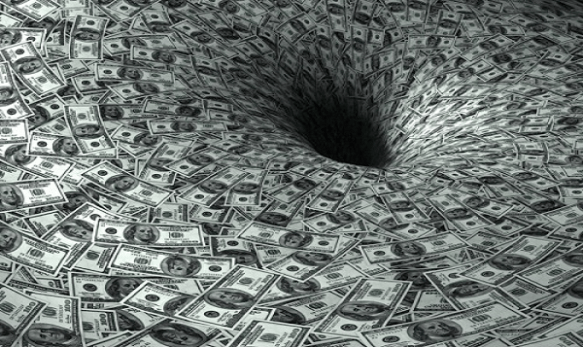
Second, national bankruptcy is looming ever closer. The federal government now overspends its revenues by a factor of two or more, meaning that for every dollar of federal revenue it borrows and spends at least two. Previously, despite its already ridiculous size and exponential growth rate, US federal debt could be given an appearance of legitimacy because enough foreign buyers could be found for it; but this is no longer the case. And so this debt is looking less and less legitimate because it is being monetized—simply printed into existence—as the Federal Reserve degenerates into a pure pyramid scheme.
Third, the US dollar (along with some other currencies to which it is tied) is poised on the edge of a hyperinflationary wipe-out. In an effort to shore up the economy a great deal of money has been unleashed into the economy and it went chasing after stocks, keeping it from triggering hyperinflation. Thus we have the truly bizarre combination of a record-high stock market along with record-high bankruptcies, foreclosures and evictions. At some point confidence in the stock market will evaporate and all of this notional money will go chasing after anything that isn’t made of paper (with the possible exception of toilet paper). Much of this notional money will evaporate as people liquidate their stock holdings, but enough will remain to result in hoarding and hyperinflation. The US dollar will devalue internationally and the US will lose access to imports.
Fourth, the US has lost its lead militarily, definitely to Russia and possibly to China and Iran. Its major military asset is its aircraft carrier fleet, which is by now completely useless because it can be destroyed using conventional weapons from a safe stand-off distance which is greater than the reach of its aircraft. Consequently, it cannot be deployed close enough to an enemy shore to make its aircraft useful. US military bases, hundreds of which are scattered all over the globe, but mostly clustered along Russia’s and China’s borders, are also useless militarily, as demonstrated by Iran’s rocket attacks against two of them in Iraq. In short, the entire US military is by now more of a liability than an asset—likely to draw the US into a military confrontation which it cannot win.
Now, do you hear these points discussed in the national media, in the course of the election campaign or otherwise? Do these points come up at all in conversations with colleagues, neighbors, friends and family? Are these topics of discussion in high school civics classes? (Wait, what high school civics classes?) No? And yet they are real, and their consequences are at this point unavoidable, and refusing to acknowledge them will only exacerbate their effects.
Collapse is bad enough when you and everyone around you can acknowledge it. But if everyone from the president (pick either one) to the lowliest convenience store clerk is incapable of accepting it as real and thinking through some of the immediate consequences, that makes it much, much worse. I refuse to accept any of the responsibility for this dreadful state of affairs; I’ve been doing all I can to warn people for a decade and a half now. It is now pointless for me to issue any more warnings. All I can do now is watch the inevitable unfold.
 After the Crash