
Corporate Media Target Gabbard for Her Anti-Interventionism—a Word They Can Barely Pronounce

Tulsi Gabbard being asked by CBS‘s Stephen Colbert (3/11/19) why she doesn’t see the US as a “force for good in the world.”

By Owen Marsh

Source: FAIR

Presidential hopeful Tulsi Gabbard has not garnered much press coverage since announcing her bid on February 2; she’s the 13th-most-mentioned Democratic candidate on TV news, according to FAIR’s most recent count (4/14/19).

But when corporate media do talk about the Hawaii congressmember, they tend to reveal more about themselves than about her.

A veteran of the Iraq War, Gabbard is centering her presidential campaign around anti-interventionism (2/3/19): the belief that US interference in foreign countries, especially in the form of regime-change wars, increases the suffering of the citizens in those countries.

When corporate outlets talk about this anti-interventionist position, they primarily use it to negatively characterize the candidates who espouse it. Few in establishment media seem interested in going any deeper or considering the veracity of arguments raised by anti-interventionists.

The Washington Post (1/15/19) listed Gabbard’s anti-interventionism as a factor that hurts her electability in a video titled, “Why Some See Tulsi Gabbard as a Controversial 2020 Candidate.” Part of the video’s explanation: “The congresswoman has raised concern among Democrats in the past when she criticized Obama’s strategy on Iran, ISIS and Syria.”

CBS News (2/4/19) briefly interviewed Honolulu Civil Beats reporter Nick Grube regarding Gabbard’s campaign announcement. The anchors had clearly never encountered the term anti-interventionism before, struggling to even pronounce the word, then laughing and saying it “doesn’t roll off the tongue.” When asked to define the candidate’s position, Grube equated it to President Trump’s foreign policy. But “America First” rallying cries aside, it hardly seems accurate to call Trump an anti-interventionist, given his administration’s regime change efforts in Venezuela, his unilateral reimposition of sanctions on Iran (FAIR.org5/2/19) and his escalation of the drone wars (Daily Beast11/25/18).

When Gabbard appears on talkshows, she is typically on the receiving end of baseless questions coated in assumptions of military altruism. Gabbard appeared on ABC’s The View (2/20/19) and articulated her argument that US intervention does more harm than good to the people purportedly being helped. Rather than respond to any of the points she raised, however, the hosts resorted to the kinds of shallow questions that have been supporting interventionism for decades.

Sunny Hostin asked, “So should we not get involved when we see atrocities abroad?” Fellow panelist Ana Navarro elaborated:

I’m very troubled by the tweets about Venezuela that you’ve put out…. [Maduro] is not allowing humanitarian aid, he is a thug, he is a dictator, he is corrupt. And I am very supportive of what the United States is doing right now…. Why are you so against intervention in Venezuela?

On CBS’s Late Show With Stephen Colbert (3/11/19), the host resorted to old-fashioned American exceptionalism and Cold War–style paranoia to counter the congressmember:

Nature abhors a vacuum. If we are not involved in international conflicts, or trying to quell international conflicts, certainly the Russians and the Chinese will fill that vacuum…. That might destabilize the world, because the United States, however flawed, is a force for good in the world, in my opinion.

Comments like these may seem harmless; why not, after all, fight “atrocities”? In fact, they contain the same language that media have used for decades to justify interventionism and quiet dissenters.

Colbert’s exceptionalism argument, in particular, is reminiscent of the centuries-old vision of the US as a “shining city upon a hill.” It’s also a frame historically employed by media to rationalize the country’s foreign policy. As communications scholar Andrew Rojecki wrote in his 2008 research article (Political Communication2/4/08) on elite commentary of George W. Bush’s military interventions in Afghanistan and Iraq, “Over the course of the two crises, American exceptionalist themes made up a constant background presence in elite commentary and opinion.”

In other words, the assurance that Colbert has that the US has been “a force for good in the world” has paved the way for some of the greatest disasters of the modern world, including the 17-year-old war in Afghanistan (or almost 40 years, if you date from the US deliberately provoking the 1979 Soviet intervention) and the half-million-plus killed in the Iraq War. Other difficult cases for proponents of intervention include Libya, where removing an authoritarian ruler devastated the nation and brought back slave markets, and Syria, where hawks evade responsibility for the hundreds of thousands killed in a US-backed effort to overthrow the government by pretending that the US has failed to intervene.

Currently, in Venezuela, where Navarro is “very supportive of what the United States is doing,” Washington has imposed sanctions that are blamed for killing 40,000 in the last two years (CEPR, 4/25/19). Meanwhile, the US offers as a publicity stunt a convoy with “humanitarian aid” valued at less than 1 percent of the assets it has blocked Venezuela from spending.

Another easy to way to discredit anti-war critics is to accuse them of siding with the enemy (FAIR.org4/1/06). So it’s not much of a surprise that when Gabbard gets mentioned in establishment news, a comment about her meeting with Syrian President Bashar al-Assad is usually soon to follow.

Gabbard traveled to Syria in 2017, on what her office called a “fact-finding mission.” During her trip, she met and spoke with al-Assad, prompting the media to question her loyalties ever since, equating her meeting to tacit support of his regime. (Gabbard calls Assad a “brutal dictator,” but says US efforts to overthrow his government are “illegal and counterproductive.”)

New York Times columnist Bari Weiss appeared on the popular Joe Rogan Experience podcast (1/21/19) and confidently called Gabbard an “Assad toadie.” When Rogan asked her what “toadie” meant, she couldn’t define the word, asking the show’s producer to look it up for her. (It means “sycophant”).

The New York Times (1/11/19) and Associated Press (Washington Post5/2/19) both identified Gabbard’s meeting with Assad as a factor that made her a controversial candidate. In an article about Gabbard’s apparent fall from grace within the Democratic party, Vox (1/17/19) characterized Gabbard’s opposition to the funding of Syrian rebels as “quasi-support for Syrian President Bashar al-Assad, the dictator responsible for the outbreak of the Syrian civil war and the conflict’s worst atrocities.”

Interviewers from MSNBC’s Morning JoeABC’s The ViewCBS’s Late Show and CNN’s Van Jones Show all asked Gabbard to justify her meeting with Assad, or pressured her to renounce him as an enemy. None were interested in asking even the most basic question of substance, “What did you and Assad talk about during your meeting?” The implication is clear: When it comes to those designated by the state as official enemies, communication is suspect.

So perhaps the simplest explanation for corporate media’s treatment of Gabbard is that she opposes the kind of intervention that they have historically been complicit in.

FAIR (e.g, 4/913/19/078/11) has documented mainstream media’s consistent support for US intervention across the globe. FAIR has also been documenting corporate media’s support for intervention in Venezuela, finding recently that zero percent of elite commentators opposed regime change in that country (4/30/19) and noting corporate media’s harsh admonishment of Bernie Sanders after he tepidly questioned US intervention in Venezuela (3/5/19).

Gabbard’s campaign is just one small piece of a larger phenomenon in the mainstream media: Space for dissenting opinions on the US’s neoliberal, interventionist foreign policies must not be allowed.
Zero for 40 at Predicting Attacks: Why Do Media Still Take FBI Terror Warnings Seriously?

By Adam Johnson

Source: FAIR

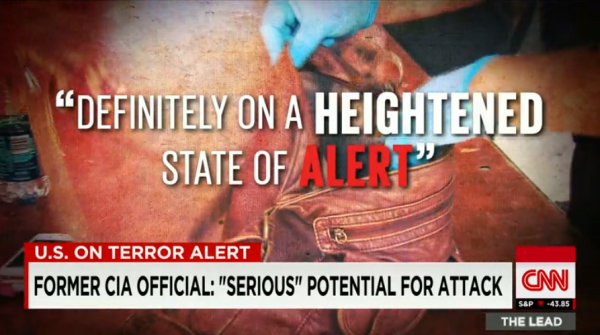
On Monday, several mainstream media outlets repeated the latest press release by the FBI that country was under a new “heightened terror alert” from “ISIL-inspired attacks” “leading up to the July 4th weekend.” One of the more sensational outlets, CNN, led with the breathless warning on several of its cable programs, complete with a special report by The Lead’s Jim Sciutto in primetime:

TerrorAlert

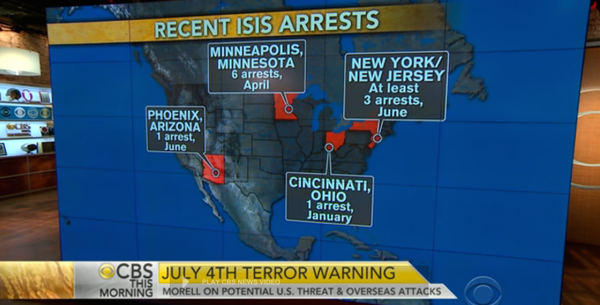
The threat was given extra credence when former CIA director—and consultant at DC PR firm Beacon Global Strategies—Michael Morell went on CBS This Morning (6/29/15) and scared the ever-living bejesus out of everyone by saying he “wouldn’t be surprised if we were sitting [in the studio] next week discussing an attack on the US.” The first piece of evidence Morell used to justify his apocalyptic posture, the “50 ISIS arrests,” was accompanied by a scary map on the CBS jumbotron showing “ISIS arrests” all throughout the US:

RecentISISArrests

But one key detail is missing from this  graphic: None of these “ISIS arrests” involved any actual members of ISIS, only members of the FBI—and their network of informants—posing as such. (The one exception being the man arrested in Arizona, who, while having no contact with ISIS, was also not prompted by the FBI.) So even if one thinks the threat of “lone wolf” attacks is a serious one, it cannot be said these are really “ISIS arrests.”  Perhaps on some meta-level, it shows an increase of “radicalization,” but it’s impossible to distinguish between this and simply more aggressive sting operations by the FBI.

In any event, this nuance gets left out entirely. As I’ve previously shown, in the media’s rush to hype the threat, the fact of FBI-manufactured—or at least “assisted”—terror plots is left out as a complicating factor altogether, and the viewer is left thinking the FBI arrested 50 actual ISIS sleeper cells.

Nevertheless, the ominous FBI (or Department of Homeland Security) “terror warning” has become such a staple of the on-going, seemingly endless “war on terror” (d/b/a war on ISIS), we hardly even notice it anymore. Marked by a feedback loop of extremist propaganda, unverifiable claims about “online chatter” and fuzzy pronouncements issued by a neverending string of faceless Muslim bad guys, and given PR cover by FBI-contrived “terror plots,” the specter of the impending “attack” is part of a broader white noise of fear that never went away after 9/11. Indeed, the verbiage employed by the FBI in this latest warning —“we’re asking people to remain vigilant”—implies no actual change of the status quo, just an hysterical nudge to not let down our collective guard.

There’s only one problem: These warnings never actually come to fruition. Not rarely, or almost never, but—by all accounts—never. No attacks, no arrests, no suspects at large.

Here’s a selection of previous FBI and DHS “terror warnings” over the past 14 years, not a single one of which actually predicted or foiled a terror attack:

October 2001: “Potential use of chemical/biological and/or radiological/nuclear weapons

November 2001: California bridges

February 2002: “Hollywood studios”

May 2002: Statue of Liberty

June 2002: “Around the Fourth of July holiday”

July 2002: Stadiums

August 2002: “Landmarks”

October 2002: “AQ to attack Amtrak

November 2002:Spectacular Al Qaeda attacks

February 2003: “Apartments, hotels, sports arenas and amusement parks

May 2003: “Possibility of multiple attacks”

May 2004: “Attempt to affect the outcome” of presidential election

July 2004: “Military facilities and large gatherings” on July 4th

August 2004: VA hospitals

January 2005: Dirty bomb

March 2005: US/Mexican border

October 2005: NYC & Baltimore subways

March 2006: “Sporting events”

June 2007: Colleges

December 2007:Shopping malls in Chicago and LA”

November 2008: “Al Qaeda to attack transit during Thanksgiving

November 2010: Mass transit in New York City

October 2011: “Americans in Europe” facing “commando-style AQ attack”

February 2011: “Financial institutions”

May 2011: “Threats of retaliation”

June 2011: Al Qaeda “hit list”

July 2011: “Private jets of executives” involved in drone manufacturing

September 2011: “Small planes”

September 2011: “New York City or Washington around…10th anniversary of 9/11

September 2011: Airports

March 2012: “Terrorist hacking”

August 2012: Anarchists blowing up bridge during Tampa RNC

September 2012: “Islamic violence over movie

August 2013: “San Fransisco on high alert

November 2013: “cyber attacks”

April 2014: “College students abroad”

December 2014: ISIS targeting Mississippi River bridge

December 2014: ISIS “sabotaging US military personnel” over social media

April 2015: ISIS targeting “parts of California

May 2015: ISIS targeting “military bases

A casual search reveals the FBI and DHS are a pitiful 0 for 40 warning of terror attacks—some of which were specifically about 4th of July threats, none of which materialized in any way. This should not be considered a comprehensive list of all threat warnings transmitted by media; I tried to narrow the scope to warnings that were at least in some way specific.

The actual terror attacks carried out on US soil—the Times Square bomber, “Underwear bomber,” Boston bombing and Garland attacks—were accompanied by no such warnings. (Nor were the often deadlier terrorist attacks by right-wing white terrorists–but terrorism in this category is rarely if ever the subject of FBI warnings.)

So why, a rational person may ask, does the media keeps repeating them if they’re wrong 100 percent of the time?

The problem is three fold:

  1. The FBI has all the incentive in the world to issue warnings and no incentive whatsoever to not issue warnings. Issuing warnings has no downside, while not doing so is all downside.
  2. The FBI, like all agencies of the government, does not operate in a political vacuum. Emphasizing the “ISIS threat” at home necessarily helps prop up the broader war effort the FBI’s boss, the president of the United States, must sell to a war-weary public. The incentive is to therefore highlight the smallest threats. This was a feature that did not go unnoticed during the Bush years, but has since fallen out of fashion.
  3. It has no actual utility. What does it mean to be “more vigilant”? It’s a vague call to alertness that officials, aside from “beefing up security” by local police, never quite explain what it means. If the FBI wanted to tell local police departments to up their security of the 4th of July weekend, surely they could do so quietly, without the chair of the House Committee on Homeland Security having to go on all major networks talking over b-roll of ISIS in apocalyptic terms.

When I brought up these objections up to CNN’s Sciutto, his response was less than satisfying:

fair question, the point is about the wider threat, FBI encourages people to attend events but be vigilant.

Yes, I would prefer warnings only when attacks were imminent. Which, of course, they never are. Because if they were, the government would actually attempt to stop them, rather than running a three-day PR tour. CNN‘s Jake Tapper, to his credit, would raise my concerns to Michael Chertoff later that day:

View image on Twitter

Ex-DHS head pushes back against terror warning skeptics http://cnn.it/1LyERVV 


While the attempt to introduce some skepticism is very much appreciated, Tapper missed the fundamental problem altogether. Next time he has on a Chertoff or a McCaul discussing a vague government terror warning, I’d like him to ask this simple question: “Has the FBI ever successfully warned, or foreshadowed in anyway, a terror attack in the United States? Because so far the count is 0 for 40+, and I’m curious what makes this time different.”

Put the burden of proof on those who are attempting to scare us, march our men and women off to war, and line their private security firm’s pockets. Don’t demand “FBI warning skeptics” disprove those in power; make those in power justify their own consistently discredited “warnings.”

If journalists still insist on disseminating these vague “threats,” I ask this question: How many false positives would be required for you to eventually stop doing so? Seventy? Two hundred?

Because 14 years on, I’m curious when, if ever, this media trope will ever end.

h/t Kevin Gosztola, who caught a 4th of July warning from 2004 I missed.\


Adam Johnson is an associate editor at AlterNet and writes frequently for FAIR.org. You can follow him on Twitter at @adamjohnsonnyc.