
What is the Big Lesson of the UK ‘Brexit’ Vote for Americans? It Was Done With Paper Ballots

UKandUSvoting.preview

Voting in the UK is done on paper ballots, as her in the ‘Brexit’ referendum. In the US many vote on easily hacked computers that leave no paper trail.

By Dave Lindorff

Source: This Can’t Be Happening

The decision by a majority of UK voters to reject membership in the European Union in Wednesday’s hotly-contested referendum has been a devastating defeat for the corporatist domination of the European political and economic scene. It throws the corporate duopoly in the UK into turmoil, and also has the EU bureaucrats and the banking elite in Brussels and the financial capitals of Europe in a panic, lest other countries’ voters, as in Spain and Italy, or even France and the Netherlands, decide to follow suit. (Spain has a national election tomorrow which could be heavily influenced by the British referendum outcome, since if the united left wins, it could eventually lead to Spain’s exit from the EU.)

But for the US, which is not a party to the EU, there is also a huge lesson: ‘Brexit,’ despite being opposed by the political establishment — Conservative and Labor — and by the corporate elite of London’s City, the financial capital of Europe, won this vote. And the reason the opponents of UK membership in the EU were able to win against all that powerful opposition, has, in no small part, to do with the fact that all the voting was done on paper ballots.

Compare that to the US, where voting, for the vast majority of people, is done on machines, in many cases electronic machines that leave no paper trail of individual votes, or even of vote totals per machine. We are always hearing reports of faulty — or hacked — machines that are “flipping” votes, so that someone can cast a vote for a Democratic candidate or party slate and see it switched to Republican, reports of entire tallies for a day’s voting being simply lost, machines that don’t work, forcing would be voters to wait for hours to vote on a limited number of machines that supposedly are working, limited polling places because county or city governments claim they can’s afford to buy an adequate number of machines, a shortage of paper ballots when machines fail, etc.

The list of excuses goes on and on. And why, one might ask, does America vote by electronic machines instead of on readily verifiable paper ballots? The only possible reason is pressure from the corporate media, whose sole interest in our elections is the “horse race” leading to a meaningless competition to get the results out first. Why should it matter though, if you think about it, whether we learn the results of an election an hour or two after the voting ends, or the next day, or even several days after the voting? Why, in fact, do we allow news organizations like AP or the New York Times to “call” elections based on faulty algorithms that are based on extrapolations of early counts in specific targeted voting districts?

Most recently, we witnessed the outrage of AP calling the Democratic national presidential primary for Hillary Clinton the morning that California and six other states totaling 15% of the total delegate count in the nation were holding primaries and then announcing the victory in California that evening when less than half of the votes cast had actually been counted (the rest were paper ballots — both mailed-in ones, and over a million “provisional” ballots that were given to voters who had registered close to election day, and whose registrations had not been provided in time to local voting district officials. As those votes are counted — and they are still being counted today, some two and a half weeks after the voting! — it is becoming clear that far from a rout by Hillary Clinton, the vote between Clinton and Sanders was very close, as will be the delegate count for each candidate.

A number of analysts have pointed out that there is serious evidence of vote rigging in the Democratic primary in favor of Clinton, with most of the states that she won outside of the deep South which had electronic voting machines having exit polls that showed Sanders should have won. There is no way to check those votes, however, because the machines don’t have a paper trail.

And that’s not all. The primary, like elections in prior years, has been rife with other examples of interfering with the right of Americans to cast their votes. There was massive voter suppression in New York’s Democratic primary, for example, with entire neighborhoods in Brooklyn and other jurisdictions — all of them likely to have favored Bernie Sanders — finding that their voter registration records had been wiped, making them ineligible to vote. Other venues, in New York and other states, found that people who had registered as Democrats were recorded as “independents,” making them, in closed-primary states, ineligible to vote in the primaries.

The list of such abuses and frauds goes on and on and, like the many examples of voter suppression by both Republican and Democratic governments in the past, make it clear that voting in the US is as corrupted as it is in many third-world countries where elections are understood to be only for show.

The lesson of Britain’s ‘Brexit’ referendum, like the hotly contested presidential election I witnessed and covered in Taiwan in 2004, both of which contests were conducted using paper ballots, and the latter which was subjected to a recount that returned an almost identical result after tons of paper and millions of ballots were painstakingly inspected and hand-counted all over again, is that democracy can only work if voting is scrupulously honest and absolutely verifiable. On both those counts the US fails miserably, meaning that besides all the other problems that make American democracy a joke — the grotesquely biased (and inane) media coverage, the widespread voter apathy and ignorance, a stultifying two-party political system that limits candidate choices to two virtually identical candidates and to two political positions that only differ in meaningless, but emotionally powerful ways, and a campaign-funding system that in reality is nothing but legalized bribery — American voters cannot really expect their votes to be honestly counted in the end.

If a referendum like ‘Brexit’ were to be held in a US-type electoral system, involving a major issue affecting powerful economic interests, it would have predictably failed. Of this there is little or no doubt. What in the ’60s we called “The System” would simply not have allowed opponents of EU membership to win.
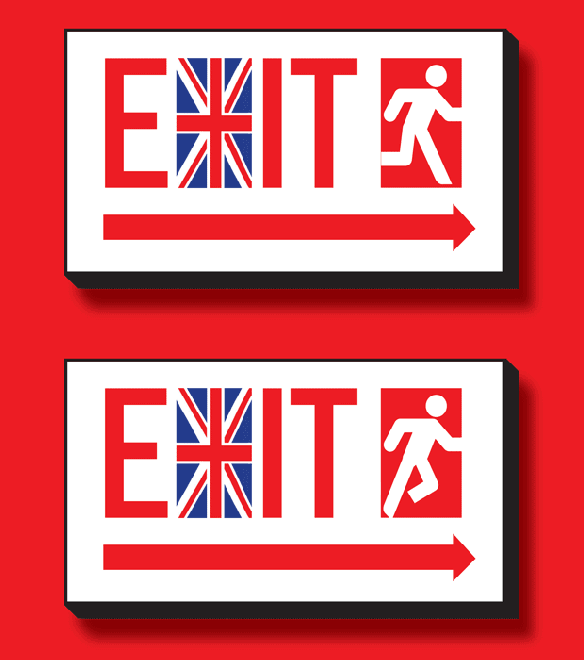

 

Related Article: Freedom Rider: The Good News of Brexit

A ‘Brexit’ Blow to the Establishment

Brexit_Run_620x350

By Robert Parry

Source: Consortium News

The United Kingdom’s “Brexit” vote may cause short-term economic pain and present long-term geopolitical risks, but it is a splash of ice water in the face of the West’s Establishment, which has grown more and more insular, elitist and unaccountable over recent decades.

The West’s powers-that-be, in both the United States and the European Union, too often display contempt for real democracy, maintaining only the façade of respecting the popular will, manipulating voters at election time with red-meat politics and empty promises – before getting back to the business of comforting the comfortable and letting the comfortable afflict the afflicted.

That has been the grim and tiresome reality with America’s two parties and with the E.U.’s bureaucrats. The average American and the average European have every reason to see themselves as a lesser concern to the politicians and the pundits than the special interests which pay the money and call the tune.

In the stunning “Brexit” vote – with 52 percent wanting to abandon the 28-nation European Union – U.K. voters rejected the West’s politics-as-usual despite dire warnings about the downsides of leaving. They voted, in effect, to assert their own nationalistic needs and aspirations over a commitment to continental unity and its more universal goals.

But, in the vote, there was also a recognition that the West’s Establishment has grown corrupt and arrogant, routinely imposing on the people “experts” who claim to be neutral technocrats or objective scholars but whose pockets are lined with fat pay checks from “prestigious” think tanks funded by the Military-Industrial Complex or by lucrative revolving-door trips to investment banks on Wall Street or The City.

Despite the Establishment’s self-image as a “meritocracy,” its corrupted experts and haughty bureaucrats don’t even demonstrate basic competence anymore. They have led Europe and the United States into catastrophe after catastrophe, both economically and geopolitically. And, there is another troubling feature of this Establishment: its lack of accountability.

In the United States, the rewards and punishments have been turned upside-down, with the benighted politicians and pundits who pushed for the Iraq War in 2003 still dominating the government and the media, from Hillary Clinton’s impending Democratic presidential nomination to the editorial pages of The New York Times and The Washington Post.

And, the Iraq War disaster was not a one-off affair. The neocons and their liberal interventionist sidekicks have their fingerprints on other “regime change” messes, from Libya to Ukraine to Syria (still in the works), with their predictable recommendations for more violence and more belligerence. Yet, they have impunity for their crimes and incompetence. They fail up.

Establishment Doesn’t Know Best

So, the West’s Establishment can’t even argue that it knows best anymore, which always had been its ace in the hole. The various insurgents could be painted as the dangerous option – and that is sometimes true as we’ve seen with Donald Trump – but it is arguably a toss-up as to whether Clinton or Trump would be the bigger risk to the world’s future.

Trump may be a blustering buffoon but he challenges the neocon “group thinks” about the wisdom of expanding the West’s war in Syria and launching a costly and existentially risky New Cold War against nuclear-armed Russia and China. Clinton surrounds herself with neocons and liberal hawks and shares their obsession with overthrowing the government of Syria and provoking Russia and China with military operations near their borders.

Trump and “Brexit” advocates also reject the Establishment’s neoliberal consensus on “free trade,” which has depressed (or eliminated) the wages of American and European workers while the benefits accrue mostly to financial and political elites. The Establishment’s embrace of the “winners” and its disdain for the “losers” have further enflamed today’s populism.

Yet, there are undeniably ugly features in the populist sentiment sweeping the U.S. and Europe. Some of it is driven by bigotry toward non-whites, especially immigrants. Some is inspired by wild conspiracy theories from a population that has understandably lost all faith in what it hears from Washington, Brussels and other capitals. Trump has espoused the scary know-nothing notion that the scientific evidence of global warming is “a hoax.”

There is always something unsettling when an incipient revolution takes shape and starts tearing down the old order. What follows is not always better.

In the end, the American election – like the “Brexit” referendum – may come down to whether voters feel more comfortable sticking with the status quo at least for a while longer or whether they want to blow up the Establishment and gamble on the consequences.

Right now, Clinton and the Democrats are carrying the banner of the Establishment, while Trump and his Republican insurgents fly the Jolly Roger. In a political year when the anti-establishment wave seems to be cresting, the Democrats may regret their choice of a legacy, status-quo candidate.


[For more on this topic, see Consortiumnews.com’s “Two Corrupt Establishments”; “Democrats – Too Clever by Half on Clinton”; “The Coming Democratic Crack-up”; “Neocons and Neolibs: How Dead Ideas Kill“; and “The State Department’s Collective Madness.”]

Investigative reporter Robert Parry broke many of the Iran-Contra stories for The Associated Press and Newsweek in the 1980s. You can buy his latest book, America’s Stolen Narrative, either in print here or as an e-book (from Amazon and barnesandnoble.com).

Related Articles:

¡Basta Ya, Brussels! British Voters Reject EU Corporate Slavestate

Global Elite Makes Good on Threats to “Make All of You Poorer” After Britain Independence

Where is the UK Heading Now Due to Cameron’s Policies?

Related Videos:

https://www.youtube.com/watch?v=z62YbkpzL2g


Time Is Running Out For Pax Americana’s Apologists

aa-American-Empire-statue-of-liberty-and-military

By Rostisla Ischenko

Source: Dissident Voice

The paradox of the current global crisis is that for the last five years, all relatively responsible and independent nations have made tremendous efforts to save the United States from the financial, economic, military, and political disaster that looms ahead. And this is all despite Washington’s equally systematic moves to destabilize the world order, rightly known as the Pax Americana (“American peace”).

Since policy is not a zero-sum game; i.e., one participant’s loss does not necessarily entail a gain for another, this paradox has a logical explanation. A crisis erupts within any system when there is a discrepancy between its internal structure and the sum total of available resources (that is, those resources will eventually prove inadequate for the system to function normally and in the usual way).

There are at least three basic options for addressing this situation:

  1. Through reform, in which the system’s internal structure evolves in such a way as to better correspond to the available resources.
  2. Through the system’s collapse, in which the same result is achieved via revolution.
  3. Through preservation, in which the inputs threatening the system are eliminated by force, and the relationships within the system are carefully preserved on an inequitable relationship basis (whether between classes, social strata, castes, or nations).

The preservation method was attempted by the Ming and Qing dynasties in China, as well as the Tokugawa Shogunate in Japan. It was utilized successfully (in the 19th century) prior to the era of capitalist globalization. But neither of those Eastern civilizations (although fairly robust internally) survived their collision with the technologically more advanced (and hence more militarily and politically powerful) European civilization. Japan found its answer on the path of modernization (reform) back in the second half of the 19th century, China spent a century immersed in the quagmire of semi-colonial dependence and bloody civil wars, until the new leadership of Deng Xiaoping was able to articulate its own vision of modernizing reforms.

This point leads us to the conclusion that a system can be preserved only if it is safeguarded from any unwanted external influences; i.e., if it controls the globalized world.

The contradiction between the concept of escaping the crisis, which has been adopted by the US elite, and the alternative concept – proposed by Russia and backed by China, then by the BRICS nations and now a large part of the world – lay in the fact that the politicians in Washington were working from the premise that they are able to fully control the globalized world and guide its development in the direction they wish. Therefore, faced with dwindling resources to sustain the mechanisms that perpetuate their global hegemony, they tried to resolve the problem by forcefully suppressing potential opponents in order to reallocate global resources in their favor.

If successful, the United States would be able to re-enact the events of the late 1980s – early 1990s, when the collapse of the Soviet Union and the global socialist system under its control allowed the West to escape its crisis. At this new stage, it has become a question of no longer simply reallocating resources in favor of the West as a collective whole, but solely in favor of the United States. This move offered the system a respite that could be used to create a regime for preserving inequitable relationships, during which the American elite’s definitive control over the resources of power, raw materials, finance, and industrial resources safeguarded them from the danger of the system’s internal implosion, while the elimination of alternative power centers shielded the system from external breaches, rendering it eternal (at least for a historically foreseeable period of time).

The alternative approach postulated that the system’s total resources might be depleted before the United States can manage to generate the mechanisms to perpetuate its global hegemony. In turn, this will lead to strain (and overstrain) on the forces that ensure the imperial suppression of those nations existing on the global periphery, all in the interests of the Washington-based center, which will later bring about the inevitable collapse of the system.

Two hundred, or even one hundred years ago, politicians would have acted on the principle of “what is falling, that one should also push” and prepared to divvy up the legacy of yet another crumbling empire. However, the globalization of not only the world’s industry and trade (that was achieved by the end of the 19th century), but also global finance, caused the collapse of the American empire through a policy that was extremely dangerous and costly for the whole world. To put it bluntly, the United States could bury civilization under its own wreckage.

Consequently, the Russian-Chinese approach has made a point of offering Washington a compromise option that endorses the gradual, evolutionary erosion of American hegemony, plus the incremental reform of international financial, economic, military, and political relations on the basis of the existing system of international law.

America’s elite have been offered a “soft landing” that would preserve much of their influence and assets, while gradually adapting the system to better correspond to the present facts of life (bringing it into line with the available reserve of resources), taking into account the interests of humanity, and not only of its “top echelon” as exemplified by the “300 families” who are actually dwindling to no more than thirty.

In the end, it is always better to negotiate than to build a new world upon the ashes of the old. Especially since there has been a global precedent for similar agreements.

Up until 2015, America’s elite (or at least the ones who determine US policy) had been assured that they possessed sufficient financial, economic, military, and political strength to cripple the rest of the world, while still preserving Washington’s hegemony by depriving everyone, including (at the final stage) even the American people of any real political sovereignty or economic rights. European bureaucrats were important allies for that elite; i.e., the cosmopolitan, comprador-bourgeoisie sector of the EU elite, whose welfare hinged on the further integration of transatlantic (i.e., under US control) EU entities (in which the premise of Atlantic solidarity has become geopolitical dogma) and NATO, although this is in conflict with the interests of the EU member states.

However, the crisis in Ukraine, which has dragged on much longer than originally planned, Russia’s impressive surge of military and political energy as it moved to resolve the Syrian crisis (something for which the US did not have an appropriate response) and, most important, the progressive creation of alternative financial and economic entities that call into question the dollar’s position as the de facto world currency, have forced a sector of America’s elite that is amenable to compromise to rouse itself (over the last 15 years that elite has been effectively excluded from participation in any strategic decisions).

The latest statements by Kerry and Obama which seesaw from a willingness to consider a mutually acceptable compromise on all contentious issues (even Kiev was given instructions “to implement Minsk“) to a determination to continue the policy of confrontation – are evidence of the escalating battle being fought within the Washington establishment.

It is impossible to predict the outcome of this struggle – too many high-status politicians and influential families have tied their futures to an agenda that preserves imperial domination for that to be renounced painlessly. In reality, multibillion-dollar positions and entire political dynasties are at stake.

However, we can say with absolute certainty that there is a certain window of opportunity during which any decision can be made. And a window of opportunity is closing that would allow the US to make a soft landing with a few trade-offs. The Washington elite cannot escape the fact that they are up against far more serious problems than those of 10-15 years ago. Right now the big question is about how they are going to land, and although that landing will already be harder than it would have been and will come with costs, the situation is not yet a disaster.

But the US needs to think fast. Their resources are shrinking much faster than the authors of the plan for imperial preservation had expected. To their loss of control over the BRICS countries can be added the incipient, but still fairly rapid loss of control over EU policy as well as the onset of geopolitical maneuvering among the monarchies of the Middle East. The financial and economic entities created and set in motion by the BRICS nations are developing in accordance with their own logic, and Moscow and Beijing are not able to delay their development overlong while waiting for the US to suddenly discover a capacity to negotiate.

The point of no return will pass once and for all sometime in 2016, and America’s elite will no longer be able to choose between the provisions of compromise and collapse. The only thing that they will then be able to do is to slam the door loudly, trying to drag the rest of the world after them into the abyss.

Rostislav Ischenko is the President of Centre for System Analysis and Forecasting (Kiev) currently living in Moscow. Read other articles by Rostisla.

Check Mating Washington in its Own Backyard with BRICSIANSE

Vladimir_Putin-6

By Wayne Madsen

Source: Strategic Culture Foundation

The United States and its closest allies have attempted to isolate Russia and President Vladimir Putin from the world stage. As a result of Western support for the Ukrainian regime that came to power through violence in Kiev, actions taken by Western powers against Russia have included expelling Russia from the G-8 of capitalist powers, the freezing of the assets of Russian government officials and Russian banks, and imposing travel bands on Russian citizens.

However, Putin has check-mated U.S. President Barack Obama in the American president’s own backyard. Obama’s defenders fancy their president as a master of «11-dimensional chess». However, what is transpiring in Brazil at the summit of the BRICS nations of Brazil, Russia, India, China, and South Africa has shown the world that it is Putin, not Obama, who is the master of 11-dimensional chess. In fact, Obama could never even make it to the chess board.

Putin is visiting Brazil where he is participating in the 2014 summit in the city of Fortaleza. The BRICS summit comes as members of the Obama administration, including neo-cons like Assistant Secretary of State for European Affairs Victoria Nuland, have instituted plans for increased sanctions against Russia, bringing them to the level as those directed against Iran, Syria, and Cuba.

Putin and his BRICS colleagues will sign an agreement in Fortaleza on establishing a BRICS development bank that will help bypass the neo-cons’ attempt to isolate Russia from international banking networks. Any strengthening of sanctions in the same manner that U.S. sanctions have been imposed by Washington on Iran, Syria, and Cuba runs the risk of punishing Brazilian, Indian, Chinese, and South African banks and other corporations, something that could land the Obama administration in hot water before the World Trade Organization court that rules against trade practices that violate WTO regulations.

The legacy of the Obama administration is that its Cold War-era policies directed against Latin America have permanently ended America’s long-standing political and economic domination of the Western Hemisphere. Obama put the final nail in the arcane Monroe Doctrine that stipulated the United States would bar non-Western Hemisphere nations, including the powers of Europe, from intervention in the Americas. The interventionist policies in countries like Venezuela and Honduras carried out by Nuland’s fellow neocon ideologue Roberta Jacobson, the Assistant Secretary of State for Western Hemisphere Affairs, have resulted in a large contingent of Latin American leaders in joining Putin, Chinese President Xi Jinping, and the other BRICS leaders in Brazil for a summit where the United States will not have a seat at the table. In fact, the United States and its imperialistic policies will be a major subject in Brazil, a country that has seen its telecommunications, including the private calls and e-mail of Brazilian President Dilma Rousseff routinely spied upon by the U.S. National Security Agency.

Putin is making the most of his six-day visit to Latin America. He forgave Cuba’s debt to Russia while visiting Havana and also stopped in Nicaragua and Rio de Janeiro. While in Cuba, Putin met with former Cuban leader Fidel Castro and his brother, Raul Castro, Cuba’s president, two leaders who continue to infuriate the neo-con and right-wing power centers of Washington. Putin also attended the final game of the World Cup in Rio. Russia is the host of 2018 World Cup. Putin also visited Argentina where he signed a deal on nuclear energy.  The interest of Iran, Argentina, Nigeria, Syria, and Egypt in joining BRICS may soon see the group’s acronym become «BRICSIANSE». Such a development would triumph the nations of the world that refuse to take orders from Washington and the presence of Syria would spell ultimate defeat of the Obama doctrine of «R2P», or «Responsibility to Protect» pro-U.S. and Western intelligence agency-financed opposition leaders intent on replacing anti-American governments with pro-U.S. regimes. Syria joining BRICS as a full or associate member would drive a stake through the heart of R2P.

The Obama administration could not convince a single South American leader to avoid the BRICS summit in Brazil. In fact, two of the South American leaders sitting down with Putin, Xi, Rousseff, and the other leaders in Brazil, Venezuela’s President Nicolas Maduro and Suriname’s President Desi Bouterse, have been the subject of CIA- and State Department-linked destabilization efforts and sanctions threats. Also in attendance at BRICS are Argentina’s President Cristina Fernández de Kirchner, Bolivia’s President, Evo Morales Chile’s President Michelle Bachelet, Colombia’s President Juan Manuel Santos, Ecuador’s President Rafael Correa, Guyana’s President Donald Ramotar, Paraguay’s President Horacio Cartes, Peru’s President Ollanta Humala, and Uruguay’s President José Mujica. America’s sanctions against Russia and its saber-rattling against China on behalf of Japan and the Philippines have fallen on deaf ears in South America. The teenager-like antics of Nuland, Jacobson, along with those of U.S. National Security Adviser Susan Rice and U.S. ambassador to the UN Samantha Power, are sure to be discussed in sideline gossip by the leaders gathered in Fortaleza.

The presence of President Santos of Colombia is particularly noteworthy. Santos recently defeated a right-wing candidate supported by the same Obama administration’s interventionists who have helped disrupt the economy of Venezuela. The losing candidate, Oscar Ivan Zuluaga, had the full support of Santos’s right-wing and pro-Israeli/pro-U.S. predecessor Alvaro Uribe. Recent disclosures have shown that Uribe instituted an NSA-like national communications surveillance system aimed at his opponents. Zuluaga’s ties with the same elements who are trying to depose Maduro in Venezuela have not been lost on Santos. He continues to engage in peace negotiations in Havana with left-wing DARC guerrillas and improve ties with Venezuela much to the chagrin of the CIA operatives who live in splendor in the Miami area of Florida.

While in Rio, Putin managed to cast off U.S. efforts to isolate him internationally by meeting with Prime Minister of Trinidad and Tobago Kamla Persad-Bissessar and Antigua and Barbuda Prime Minister Gaston Browne, in addition to Hungary’s Prime Minister Victor Orban, Namibian President Hage Geingob, Gabon’s President Ali Bongo, and Germany’s Chancellor Angela Merkel. Merkel and Rousseff have much in common as both had their personal cell phone conversations monitored by NSA, a fact that Putin, who has provided asylum to NSA whistleblower Edward Snowden, was likely sure to have mentioned in passing.

The only attempt the United States could make to have any Latin American officials criticize contact between Western Hemisphere leaders and Putin was to arrange for Trinidad opposition leader Keith Rowley to condemn his country’s prime minister’s private trip to Brazil. Rowley criticized Persad-Bissessar and her grandson for meeting with Putin and other leaders in Rio because the trip was made during a labor dispute involving Trinidad’s immigration department. The power of Washington to influence events in the Western Hemisphere has truly plummeted to new depths.

The agenda of the BRICS nations is as diversified as that of any G-7 meeting, no longer called G8 after Russia was expelled. On the BRICS summit agenda are trade, development, macroeconomic policy, energy, finance, terrorism, climate change, regional security, drug smuggling and trans-border crime, industrialization of Africa, and, kin what should serve as a wake-up call to Wall Street, the World Bank, European Central Bank, the International Monetary Fund, and other tools of western capitalism, international financial institution (IFI) reform.

The security operations by BRICS in Afghanistan stand to replace those of the United State after the withdrawal of its troops from that country. Russia has led BRICS efforts on dealing with money laundering and cross-border crime and it has drawn the participation of Belarus, India, Kazakhstan, China, Kyrgyzstan, Russia, Tajikistan, Turkmenistan and Uzbekistan in its efforts. Observers from Mongolia and Armenia also joined the talks. In the area of security, synergism is apparent between the BRICS and the Shanghai Cooperation Organization (SCO) that brings Russia and China into a common security policy with central Asian states like Kazakhstan and Uzbekistan. Russia and China appear determined that Ukraine and Georgia will be the «line in the sand» for any further encroachments by George Soros- and CIA-led «R2P» revolutions in the Eurasian space. It is also clear that Putin outsmarted Obama in his own backyard.