
BRICS 11 – Strategic Tour de Force

By Pepe Escobar

Source: The Unz Review

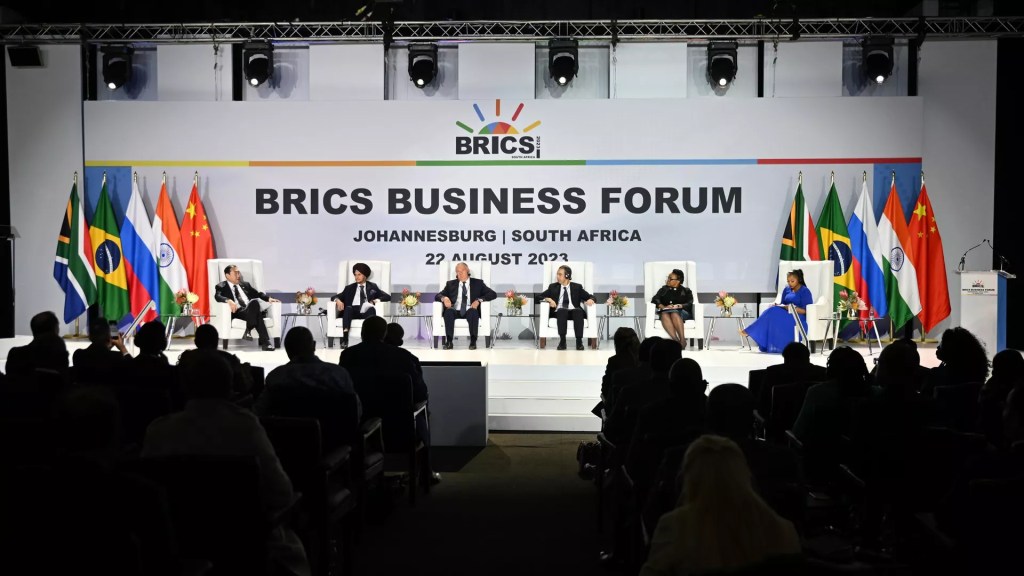
Chinese President Xi Jinping defined all the major decisions embedded in the 15th BRICS summit in South Africa as “historic”. That may be seen as an understatement.

It will take time for the Global South, or Global Majority, or “Global Globe” (copyright President Lukashenko), not to mention the stunned collective West, to fully grasp the enormity of the new strategic stakes.

President Putin, for his part, described the negotiations on BRICS expansion as quite difficult. By now a relatively accurate picture is emerging of what really went down on that table in Johannesburg.

India wanted 3 new members. China wanted as many as 10. A compromise was finally reached, with 6 members: Egypt, Iran, Saudi Arabia, United Arab Emirates (UAE), Argentina and Ethiopia.

So from now on it’s BRICS 11. And that’s just the beginning. Starting with the rotating Russian presidency of BRICS on January 1, 2024, more partners will be progressively included, and most certainly a new round of full members will be announced at the BRICS 11 summit in Kazan in October next year.

So we may soon progress to BRICS 20 – on the way to BRICS 40. The G7, for all practical purposes, is sliding towards oblivion.

Bur first things first. At that fateful table in Johannesburg, Russia supported Egypt. China went all out for Persian Gulf magic: Iran, UAE and the Saudis. Of course: Iran-China are already deep into a strategic partnership, and Riyadh is already accepting payment for energy in yuan.

Brazil and China supported Argentina, Brazil’s troubled neighbor, running the risk of having its economy fully dollarized, and also a key commodity provider to Beijing. South Africa supported Ethiopia. India, for a series of very complex reasons, was not exactly comfortable with 3 Arab/Muslim members (Saudi Arabia, UAE, Egypt). Russia assuaged New Delhi’s fears.

All of the above respects geographic principles and imprints the notion of BRICS representing the Global South. But it goes way beyond that, blending cunning strategy and no-nonsense realpolitik.

India was mollified because Russian Foreign Minister Sergey Lavrov, at the table in Johannesburg negotiating on behalf of President Putin, and highly respected by New Delhi, fully understood that a new, single BRICS currency is a long way away. What really matters, short and medium term, is expanding intra-BRICS trade in their national currencies.

That was stressed by New Development Bank (NDB) president Dilma Rousseff in her report to the South African summit hosts – even as Brazilian President Lula once again emphasized the importance of setting up a work group to discuss a BRICS currency.

Lavrov understood how New Delhi is absolutely terrified of secondary sanctions by the US, in case its BRICS role gets too ambitious. Prime Minister Modi is essentially hedging between BRICS and the completely artificial imperial obsession embedded in the terminology “Indo-Pacific” – which masks renewed containment of China. The Straussian neo-con psychos in charge of US foreign policy are already furious with India buying loads of discounted Russian oil.

New Delhi’s support for a new BRICS currency would be interpreted in Washington as all-out trade war – and sanctions dementia would follow. In contrast, Saudi Arabia’s MbS doesn’t care: he’s a top energy producer, not consumer like India, and one of his priorities is to fully court his top energy client, Beijing, and pave the way for the petroyuan.

It Takes Just a Single Strategic Move

Now let’s get into the strategic stakes. For all practical purposes, in Eurasian terms, BRICS 11 is now on the way to lord over the Arctic Sea Route; the International North South Transportation Corridor (INSTC); BRI’s East West Corridors; the Persian Gulf; the Red Sea; and the Suez Canal.

That blends several overland corridors with several nodes of the Maritime Silk Roads. Nearly total integration in the Heartland and the Rimland. All with just a single strategic move in the geopolitical/geoeconomic chessboard.

Much more than an increase of BRICS 11 collective GDP to 36% of the world’s total (already larger than the G7), with the group now encompassing 47% of the world’s population, the top geopolitical and geoeconomic breakthrough is how BRICS 11 is about to literally break the bank on the energy and commodities market fronts.

By incorporating Iran, Saudi Arabia and the UAE, BRICS 11 instantly shines on as an oil and gas powerhouse. BRICS 11 now controls 39% of global oil exports; 45.9% of proven reserves; and at least 47.6% of all oil produced globally, according to InfoTEK.

With BRICS 11 possibly including Venezuela, Algeria and Kazakhstan as new members as early as in 2024, it may control as much as 90% of all oil and gas traded globally.

Inevitable corollary: operations settled in local currencies bypassing the US dollar. And inevitable conclusion: petrodollar in a coma. The Empire of Chaos and Plunder will lose its free lunch menu: control of global oil prices and means to enforce “diplomacy” via a tsunami of unilateral sanctions.

Already in the horizon, direct BRICS 11-OPEC+ symbiosis is inevitable. OPEC+ is effectively run by Russia and Saudi Arabia.

A ground-shaking geoeconomic reorientation is at hand, involving everything from routes plied by global supply chains and new BRICS roads to the progressive interconnection of BRI, the Saudi Vision 2030 and massive port expansion in the UAE.

By choosing Ethiopia, BRICS expands its African reach on mining, minerals and metals. Ethiopia is rich in gold, platinum, tantalum, copper, niobium and offers vast potential in oil and natural gas exploration. Saudi Arabia and the UAE, incidentally, are also involved in mining.

This all spells out fast, progressive integration of North Africa and West Asia.

How Diplomacy Goes a Long Way

The BRICS 11 Shock of the New, in the energy sphere, is a sharp historical counterpoint to the 1973 oil shock, after which Riyadh started wallowing in petrodollars. Now Saudi Arabia under MbS is operating a tectonic shift, in the process of becoming strategically aligned with Russia-China-India-Iran.

Diplomatic coup does not even begin to describe it. This is the second stage of the Russian-initiated and Chinese-finalized rapprochement between Riyadh and Tehran, recently sealed in Beijing. The Russia-China strategic leadership, working patiently in synch, never lost sight of the ball.

Now compare it with collective West’s “strategies”, such as the G7-imposed oil price cap. Essentially the G7 “coalition of the willing” self-imposed a price cap on Russian crude imported by sea. The result is that they had to start buying way more oil products from Global South nations which ignored the price cap and duly increased their purchase of Russian crude.

Guess who are the top two: BRICS members China and India.

After wallowing in several stages of denial, the collective West may – or may not – realize it’s a fool’s dream to attempt to “de-couple” the West-ruled part of the global economy from China, whatever is spewed out by Washington.

BRICS 11 now shows, graphically, how the “Global South/Global Majority/”Global Globe” is more non-aligned with the West than anytime in recent history.

By the way, the president of the G77, Cuban leader Diaz-Canel, was at the BRICS summit representing the de-facto new Non-Aligned Movement (NAM): the G77 actually incorporates no less than 134 nations. Most are African. Xi Jinping in Johannesburg met in person with the leaders of most of them.

The collective West, in panic, regards all of the above as “dangerous”. So the last refuge is, predictably, rhetorical: “de-coupling”, “de-risking”, and similar idiocies.

Yet that may also get practically dangerous. As in the first ever trilateral summit in Camp David on August 18 between the Empire and two Asian vassals, Japan and South Korea. That may be interpreted as the first move towards a military-political Asian NATO even more toxic than Quad or AUKUS, obsessed to simultaneously contain China, Russia and the DPRK.

The Collective Outstripping of the Global North

The UN lists 152 nations in the world as “developing countries”. BRICS 11 is aiming at them – as they outstrip the Global North on everything from population growth to overall contribution to global GDP growth measured by PPP.

In the past 10 years since the announcement of BRI first in Astana and then in Jakarta, Chinese financial institutions have lent nearly $1 trillion for infrastructure connectivity projects across the Global South. The upcoming BRI forum in Beijing will signal a renewed drive. That’s the BRI-BRICS symbiosis.

In the G20 last year, China was the first nation to lobby for the inclusion of the 55-member African Union (AU). That may happen at the G20 summit next month in New Delhi; in that case, Global South representation will be close to parity with the Global North.

Claims that Beijing was organizing a malign conspiracy to turn BRICS into a weapon against the G7 are infantile. Realpolitik – and geoeconomic indicators – are dictating the terms, configuring the Shock of the New: the G7’s irreversible irrelevance with the rise of BRICS 11.
Domestic Fear Is the Price of Empire

waristerrorism

By Sheldon Richmond

Source: The Future of Freedom Foundation

If you find no other argument against American intervention abroad persuasive, how about this one? When the U.S. government invades and occupies other countries, or when it underwrites other governments’ invasions or oppression, the people in the victimized societies become angry enough to want and even to exact revenge — against Americans.

Is the American empire worth that price?

We should ask ourselves this question in the wake of the weekend news that al-Shabaab, the militant Islamist organization that rules parts of Somalia ISIS-style, appeared to encourage attacks at American (and Canadian) shopping malls.

Maybe the Shabaab video was just a prank to scare us. Maybe it was an attempt to plant violent thoughts in the minds of Somalis living in the United States. No one believes that the organization itself is capable of attacking Americans where they live, but that doesn’t mean Shabaab-inspired violence is impossible.

At any rate, it’s unsettling to be advised to watch out for terrorism when we shop at the mall.

Here’s the thing: We don’t have to live this way. The empire is just not worth it. We must understand that people in the Middle East, Africa, and Central Asia who subscribe to fringe militant interpretations of Islam would not be wishing us harm except for the violence the U.S. government has inflicted or helped to inflict on Muslim societies for many decades. In fact, those militant interpretations wouldn’t be nearly so attractive without the American empire and its ally Israel.

Why won’t the media describe this context? It’s because their job, despite what they say, is to be the government’s megaphone, not its adversary.

Let’s look at Somalia, where the latest threat originated.

U.S. intervention goes back to 1992, when President George H.W. Bush sent the military into a civil war there. Among the military’s activities was the suppression of the Somalis’ use of the intoxicant khat, which has been part of their culture for millennia.

That’s right. The U.S. government imposed a war on the Somali drug of choice.

President Bill Clinton withdrew the forces after two Blackhawk helicopters were shot down, but that was not the end of U.S. intervention. After the September 11 attacks, Somali warlords seeking American largess played on the George W. Bush administration’s concerns about al-Qaeda. The CIA obliged the warlords with suitcases of cash. As a result, everyday life became intolerably violent. So when the Islamic Courts Union (ICU) — a relatively moderate coalition of Sharia courts in the capital, Mogadishu —drove out the warlords and produced a measure of peace and stability, the Somali people were relieved.

That should have been deemed satisfactory, except that the warlords and their American backers were unhappy with the new situation, as Jeremy Scahill reported in 2011. “Most of the entities that made up the Islamic Courts Union did not have anything resembling a global jihadist agenda,” Scahill wrote. “Nor did they take their orders from Al Qaeda.”

Nevertheless, the U.S. government was determined to oust the ICU. To achieve that goal the Bush administration in 2006 backed a military invasion by Ethiopia, Somalia’s long-time Christian adversary, which overthrew the ICU.

“The Ethiopian invasion was marked by indiscriminate brutality against Somali civilians,” Scahill wrote.

Ethiopian and Somali government soldiers secured Mogadishu’s neighborhoods by force, raiding houses in search of ICU combatants, looting civilian property and beating or shooting anyone suspected of collaboration with antigovernment forces.… If Somalia was already a playground for Islamic militants, the Ethiopian invasion blew open the gates of Mogadishu for Al Qaeda. Within some US counterterrorism circles, the rise of the Shabab in Somalia was predictable and preventable.

To make things worse, the U.S. government has waged a drone war, with civilian casualties, and special operations against the Somalis. According to Scahill, the CIA also operates a secret prison and other facilities there.

So the U.S.-sponsored intervention sowed the ground for the most militant group in Somalia, al-Shabaab. Had the ICU been left to govern, we might never have heard of these young Islamists, whom the Obama administration now uses to scare American shoppers.

We can live without the fear of terrorism — but only if the U.S. government stops antagonizing foreign populations that have never threatened us.

Sheldon Richman is vice president of The Future of Freedom Foundation and editor of FFF’s monthly journal, Future of Freedom. For 15 years he was editor of The Freeman, published by the Foundation for Economic Education in Irvington, New York. He is the author of FFF’s award-winning book Separating School & State: How to Liberate America’s Families; Your Money or Your Life: Why We Must Abolish the Income Tax; and Tethered Citizens: Time to Repeal the Welfare State. Calling for the abolition, not the reform, of public schooling. Separating School & State has become a landmark book in both libertarian and educational circles. In his column in the Financial Times, Michael Prowse wrote: “I recommend a subversive tract, Separating School & State by Sheldon Richman of the Cato Institute, a Washington think tank… . I also think that Mr. Richman is right to fear that state education undermines personal responsibility…” Sheldon’s articles on economic policy, education, civil liberties, American history, foreign policy, and the Middle East have appeared in the Washington Post, Wall Street Journal, American Scholar, Chicago Tribune, USA Today, Washington Times, The American Conservative, Insight, Cato Policy Report, Journal of Economic Development, The Freeman, The World & I, Reason, Washington Report on Middle East Affairs, Middle East Policy, Liberty magazine, and other publications. He is a contributor to the The Concise Encyclopedia of Economics. A former newspaper reporter and senior editor at the Cato Institute and the Institute for Humane Studies, Sheldon is a graduate of Temple University in Philadelphia. He blogs at Free Association. Send him e-mail.

Geopolitical Motives Behind Kenya Mass Shooting

Western corporate news has predictably portrayed the recent massacre in Kenya as a senseless terrorist attack by “Muslim fanatics” of Al Shabaab, a Somalian Al Qaeda franchise. If their motive was solely religious, perpetrating a large-scale slaughter drawing international condemnation would be a self-defeating act. Unfortunately, propaganda and mass social conditioning has led many in the West to accept that Muslim terrorists “hate us for our freedoms” and will do anything to wipe out everyone but themselves. Of course this is a stereotype and is no more true than saying fundamentalist Christian or Jewish terrorists want to kill all Muslims. The reality of terrorism is much more complex and convoluted (and often involves covert intelligence agencies).

Tony Cartalucci of Land Destroyer Report puts the Nairobi mall attack in context, describing how in 2011 the Kenyan military participated in attacks against Somalia with U.S. and French forces. But this wasn’t the first attack against Somalia the U.S. was involved in. According to Cartalucci:

Before using Kenya as a proxy for US aggression in Africa, and amidst two decades of unilateral, covert military operations, the US had backed two Ethiopian invasions into Somalia. The first US-backed invasion, under then US President George Bush, was carried out in 2006. USA Today reported in its 2007 article, “U.S. support key to Ethiopia’s invasion,” that:

The United States has quietly poured weapons and military advisers into Ethiopia, whose recent invasion of Somalia opened a new front in the Bush administration’s war on terrorism.

The second US-backed Ethiopian invasion of Somalia, under US President Barack Obama, was carried out in 2011 – coordinated with Kenya’s 2011 US-French-backed extraterritorial adventure into Somali territory. The UK Independent’s December 2011 article, “UN-backed invasion of Somalia spirals into chaos,” reported that:

Kenya’s invasion of Somalia, hailed by the West and the UN Security Council, was meant to deliver a knockout blow to the militant Islamist group al-Shabaab. Instead it has pulled Somalia’s regional rival Ethiopia back into the country, stirred up the warlords and rekindled popular support for fundamentalists whose willingness to let Somalis starve rather than receive foreign aid had left them widely hated.

It was in fact this US-backed military invasion that served as the alleged motivation of the Al Shabaab terrorists who attacked Kenya’s Westgate Mall this week.

In the same article, Cartalucci describes in detail how and why the same terrorists the U.S. is funding and arming in Syria are behind the massacre in Kenya. He also provides a concise description of what Al Qaeda really is and how they support the objectives of Western superpowers:

Al Qaeda: The Perfect Pretext to Invade, The Perfect Mercenary Army to Covertly Wage War

Al Qaeda, for the West, serves as the ultimate geopolitical tool. It can be used as a pretext to invade, as well as a nearly inexhaustible mercenary army to carry out ruthless terrorist campaigns and even full-scale war as seen in Syria and Libya, to achieve Western objectives. Additionally, the omnipresent, nebulous nature of Al Qaeda serves as justification to strip away the rights and liberties of people at home, across Western civilization – perpetuating a climate of fear within which the seeds of very profitable war can be sown and continuously reaped.

How profitable? A Harvard’s Kennedy School research paper titled, “The Financial Legacy of Iraq and Afghanistan,” places the total expenditures of the Afghanistan and Iraq wars alone somewhere between 4-6 trillion dollars. That isn’t 4-6 trillion dollars that went into a black hole. That is 4-6 trillion dollars that went to the Fortune 500 corporations that engineered and sold these conflicts to the American public in the first place.

Read the full article here: http://landdestroyer.blogspot.com/2013/09/kenyan-bloodbath-reaping-benefits-of-us.html#more