Israel is committing an epic war crime with US backing and arms

Where is the U.S. peace movement and the U.S. public outrage?
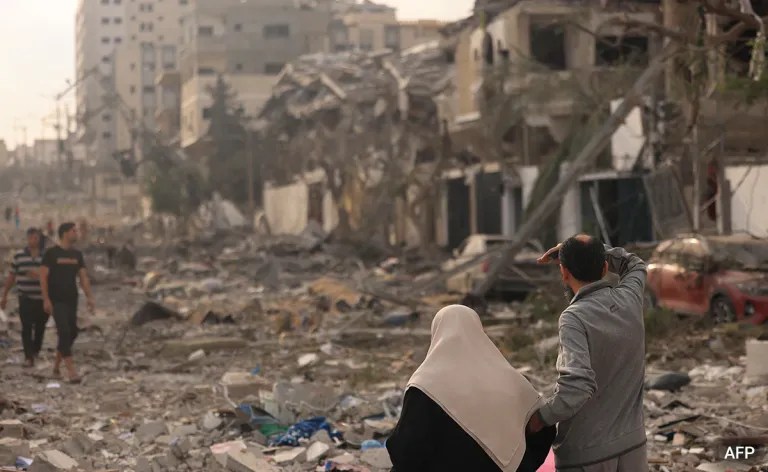
Image Credit: AFP

By Dave Lindorff

Source: Nation of Change

When the U.S. was bombing levees and hospitals in North Vietnam, peasants in Laos and burning villages in South Vietnam, herding those not killed in the process into “strategic hamlets,” Americans took to the streets en masse, occupied the Pentagon mall, brought central Washington D.C. to a standstill, and broke into an FBI office stealing the records of Cointelpro disruption and spying and into a draft ward destroying the records of potential draftees.

When U.S. military “trainers” helped massacre and slaughter peasant guerrillas and their urban supporters fighting a brutal dictatorship in El Salvador, and the Pentagon was running a proxy war against the revolutionary government in Nicaragua, masses of Americans, even in the absence of a draft and of US deaths, rose to the occasion to massively oppose U.S. intervention in those countries’ internal conflicts.  Even in 2003 when America was preparing to invade Iraq, claiming it was making or hiding weapons of mass destruction, chemical or even nuclear, Americans in record numbers turnout out in Washington to oppose going to war. (It didn’t work, but at least they turned out to protest war.)

Now when America is basically bankrolling and arming Israel as it prepares to commit a massive war crime, collectively punishing and killing ordinary Palestinians trapped in the open-air prison of Gaza. When the Israeli ‘Defense’ Force (IDF)  is giving the 1.1 million Palestinians living in the northern 12-mile-long and 7-mile-wide half of the walled-off enclave 24 hours to relocate themselves to the southern half of the strip or face the full destructive force of an all-out  IDF air and ground attack and invasion of the north—an impossible challenge. When Israel has cut off all supplies of food, medicine, water (in a desert!), electricity, and oil for the enclaves on rickety power plant, already for a week, the protests by Americans have been anemic, and have largely been by specifically pro-Palestinian groups, not by what is left of the once large and broad peace movement.

It is a shameful moment. While a few left-leaning progressive Democratic members of Congress like Reps AOC and Ilhan Omar have denounced Israel’s war crime of collective punishment and U.S. support for it, there is actually more criticism of Israel and of U.S. military aid to that country coming from Republicans than Democrats, (though they aren’t talking about the war crimes, since Republicans favor those tactics in other circumstances). The truth is, one of the arguments being used by Democrats to convince House Republicans to get their shit together and elect a House speaker is so they can pass legislation in that chamber to allow the U.S. to give Israel (and Ukraine) even more military aid.

And still, no burgeoning, blooming peace movement.

The U.S. may not be technically at war, but the U.S. war machine is everywhere, on every continent, in every ocean, its military budget, way over $1 trillion a year when everything is counted, bigger than it was in constant dollars than at the height of the Vietnam War when 500.000 U.S. troops were in that country fighting, dying (and losing) a hot war. But its special forces, its arms merchants of death, and its military “trainers” are busy stirring up and supporting local conflicts and pouring oil on fires like those blazing in Ukraine, Yemen, Gaza, Syria, Niger, Haiti, and elsewhere, while also making trouble off the coast of China, on the Korean peninsula (where it still has troops based and has had since 1950, and in Eastern Europe and the Baltic Sea.

Where is the public anger? Where is the organized protest against this warmongering permanent government in Washington, D.C.?

Americans are mad at Washington to be sure, correctly perceiving that it is corrupt and rotten to the core They know it ignores popular calls for taxes on the rich, for a well funded Social Security system that will pay livable retirement benefits as promised to all retirees into the foreseeable future, instead of facing drastic cuts in a decade or sooner, a medical system that doesn’t drive us into bankruptcy when we get sick, that gives everyone access to care they can afford and doesn’t give mega profits to private insurers and hospital executives, good public schools for our kids, affordable public colleges, an end to debt enslavement, police who are social servants not fear-inspiring centurions, clean air and water, and action of preventing a climate emergency. But too many of us don’t grasp that none of those things that huge majorities of us want will happen as long as the leaders in Washington, almost all of them bought and owned by large corporate and financial interests and the rich, are enamored of weapons, wars and militarism.

We need a focused campaign to use all available means to educate the American public to a common-sense reality: you cannot have guns and butter. And you can’t eat guns.

As a  Vietnam War Era war resister and protester I’m disgusted. How can we U.S. Americans be accepting that almost all the income tax we pay each year (including income taxes on our Social Security benefits for gods’ sakes!) goes straight to funding the Pentagon and America’s endless wars and proxy wars, with the rest of federal government operations being funded using borrowed money– loans that we the taxpayers have to then pay five percent or more  in interest on every year. In the end it’s all because of the military budgets.

Get it?

It’s time to take that to the streets.

A good place to start would be demanding that the U.S. stop propping up the intransigent, apartheid, fake democracy of Israel and demand that it stop its collective punishment of 2.3 million Gazan Palestinians. For once, the U.S. should try to solve an international crisis by taking action to de-escalate conflict instead of pouring oil on the fire by mindlessly offering more weapons and ammunition.

If that approach works there, our troglodyte leaders should try the same thing with the Ukraine/Russia conflict.
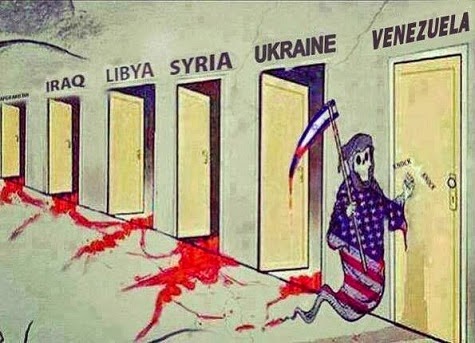
It’s back to the future with Venezuelan ‘Contras,’ the neocons, and the CIA

By Wayne Madsen

Source: Intrepid Report

Donald Trump displayed his full neocon colors on February 18 during a speech at Florida International University in Miami. With convicted Iran-contra felon Elliott Abrams now acting as his “special envoy” in charge of overthrowing the Venezuelan government of President Nicolas Maduro, Trump urged Venezuelan military officers to rise up in a coup d’état and oust Maduro, who Trump called a “Cuban puppet.”

Trump’s call for a coup in Venezuela is ironic when his most loyal supporter in the U.S. Senate, Lindsey Graham (R-SC), claimed that senior Justice Department officials who were discussing legally invoking the 25th Amendment to remove Trump from office in early 2017 were trying to stage a “coup” against Trump. Coups are unconstitutional in any form, while the removal of a president under the 25th Amendment is following the U.S. Constitution to the letter.

As protesters, who carried signs with “No U.S. Coup in Venezuela” and “Hands Off Venezuela,” staged a demonstration on campus and Trump rattled sabers against Venezuela in his speech on the Modesto A. Maidique Campus, covert U.S. operators were busy at Florida airports shipping arms to Venezuelan paramilitary units in Colombia.

At the same time as Trump was threatening Venezuela with a coup, the Haitian government of President Jovenel Moise and Prime Minister Jean-Henry Céant—one of a half dozen remaining allies of the Maduro government in the Western Hemisphere—was faced with an attempted U.S.-led insurrection in his impoverished nation. It is no coincidence that Moise, who was financially buoyed with $2 billion in fuel subsidies and other financial assistance from Venezuela’s state-run PetroCaribe Fund, has faced protests in his country that appear to have been prompted by U.S. “regime change” operatives. Planted in the Haitian media were reports that the Venezuelan fuel assistance funds had been pocketed by Moise and members of his government. That prompted violent protests on the streets of Port-au-Prince, Cap Haïtien, Jeremie, Gonaïves, and Jacmel that have been raging since February 7. More suspicious is that the U.S. State Department ordered all non-essential personnel out of the country following the outbreak of the protests.

On February 17, Haitian police arrested a group of eight heavily-armed men traveling in two cars in the capital of Port-au-Prince. Among the group were five Americans and a Russian, Serbian, and Haitian. The Russian and Serbian may hold permanent residency status in the United States. The Haitian newspaper Le Nouvelliste reported that police discovered in the foreigners’ cars automatic rifles, 45-caliber and Glock pistols, a large amount of ammunition, drones, and satellite phones. Also found in the vehicles were a telescope, backpacks, bullet-proof vests, and various documents, including a list of names of Haitian citizens. The vehicles bore no license plates and the suspects’ passports had no Haitian visa entry stamps. The passports did show extensive travel to other countries prior to being in Haiti. Five Haitian license plates were found in the vehicles.

When arrested by police, the eight men refused to provide identification, insisting that they were on some sort of “government mission.” They did not identify the “government” for whom they were working but insisted that they did not have to talk to the police. One of the arresting police officers said one of those arrested told him, “Our boss would call your boss.” After the eight men were arrested, another vehicle pulled up with a man, who spoke French to the police. He was also arrested. There are unconfirmed reports that the eight men arrested had earlier masqueraded as Haitian National Police officers.

The U.S. corporate media has largely refrained from identifying the arrested Americans and the others. WMR is not bound by protocols with the U.S.

Intelligence Community. The men arrested in Port-au-Prince are:

  • Kent Leland KROEKER, born February 14, 1967, USA partner and chief operating officer of Kroeker Partners, a private security firm. Kroeker is a Marine Corps officer veteran who flew missions in Iraq and Afghanistan
  • Christopher Mark McKINLEY, born September 26, 1969, USA
  • Danilo BAJAVIC, Serbian national, born Belgrade, born May 19, 1982, visa stamp for Karasovici, Croatia, dated July 21, 2017
  • Vlade JANKOVIC, Russian national, born October 9, 1978, Russia
  • Talon R. BURTON, U.S. national, born April 9, 1967, USA
  • Christopher M. OSMAN, U.S. national
  • Dustin Daniel PORTE, U.S. national, born February 12, 1976, USA
  • Michael ESTERA, Haitian national, born October 28, 1980, Haiti

In addition to Kroeker, all of the arrested Americans have U.S. military backgrounds. Estera may be a foreign national employee of the U.S. embassy in Port-au-Prince. It is also noteworthy that Blackwater founder Erik Prince, under investigation for conspiring with Russian, Saudi, and Emirati officials on behalf of the 2016 Trump presidential campaign, employs Serbian and Russian ex-military members in his Reflex Responses (R2) mercenary firm, based in Abu Dhabi. Prince’s sister, Betsy DeVos, is education secretary in the Trump administration.

Haitian police chief Michel-Ange Gedeon told reporters that the men would be charged with violation of weapons laws and criminal conspiracy. The U.S. State Department had no comment on whether the arrested Americans had received U.S. consular assistance, to which they are entitled. The Central Directorate of the Judicial Police (DCPJ) is in charge of the investigation of the foreigners.

The 1980s Contra wars of the Ronald Reagan administration were known for the heavy involvement of U.S. mercenaries, who operated in Central America with a “wink and a nod” from the Central Intelligence Agency and a covert coordination team in the basement of the White House, as well as the Pentagon, and State Department. The mercenaries received their orders from National Security Adviser John Poindexter, Marine Lieutenant Colonel Oliver North, and Elliott Abrams, now Trump’s regime change coordinator for Venezuela. As the Reagan team attempted to overthrow the Sandinista government of Nicaragua, they were also waging a brutal death squad campaign against leftists in El Salvador and Guatemala. In a repetition of history, the Trump administration has authorized a covert campaign to destabilize the government of Nicaragua, while assisting right-wing governments in Guatemala and Honduras to assassinate leftist journalists, activists, and indigenous leaders. Just as during the 1980s, El Salvador is due to become a staging post for a pro-U.S. rightist government under president-elect Nayib Bukele. Bukele replaces the administration led by the leftist Farabundo Marti National Liberation Front (FMLN), which was targeted by the Reagan administration during the 1980s with death squads and paramilitary teams.

At the same time the U.S. mercenaries were arrested in Haiti, Venezuelan authorities seized a Boeing 767 jet, operated by 21Air LLC, said to have been carrying arms to U.S.-backed rebels in Venezuela. The Boeing 767 took off on February 3 from Miami, the same city where Trump, championed by right-wing Cuban-Americans and exiled oligarchs from Venezuela, vowed to overthrow Maduro and “socialism” throughout the hemisphere.

The Boeing’s cargo was seized by Venezuelan authorities at Valencia airport. Included in the secret cargo manifest were 9 assault weapons, including AR-15 rifles, a Micro Draco semi-automatic pistol, and a Colt 7.62 rifle with telescopic sights, in addition to 118 ammunition cartridges and military radio antennas. 21Air LLC’s chairman is Adolfo Moreno, who, according to McClatchy News, is linked to Gemini Air Cargo, an airline involved with the CIA’s “extraordinary rendition” program during the George W. Bush administration and identified as such in a report made by the Council of Europe. The Boeing seized by Venezuela has been busy the last few months, making runs from Miami International Airport to Valencia and Caracas, Venezuela, and Bogota and Medellin, Colombia. 21Air claimed to McClatchy that the Boeing 767 had been chartered by another firm called GPS-Air. 21Air operates a sister firm, 21Cargo, formerly called Solar Cargo C.A.

Moreno is listed in Florida corporation records as also owning South Eastern Aviation LLC of Doral, Florida, Conaire LLC of Miramar, Florida, JW Aviation LLC of Doral; Apple Aviation LLC of Doral; Reliable Transport Logistics LLC of Hialeah, Florida; Freighter 23801 LLC of Hialeah, Freighter 23803 of Doral; Direct Warehouse LLC of Doral; Dynamic Travel LLC of Doral; Enduring Ventures LLC of Miami; and Florida Franchise Development LLC of Miramar. Florida Franchise Development was incorporated by Moreno in 2001 as a subsidiary of Gemini Air Cargo. That firm, along with Airline Management Group, incorporated in 1987, and Gemini Cargo Logistics Inc., the latter a subsidiary of Gemini Air Cargo, all had the same business address of 1750 NW 66th Ave., Miami. According to McClatchy, that address is currently used by Avianca, the Colombian national air carrier. When Trump called for the overthrow of the Venezuelan government, he did so in the midst of dozens of CIA front companies that specialize in carrying out coups, murder, and mayhem.

21Air LLC was incorporated in 2014 and is based in Greensboro, North Carolina, but operates out of Miami International Airport. North Carolina was the location of other CIA proprietary airline front companies involved in the agency’s kidnapping program. These included Air Serv International; Aero Contractors Limited, operating out of Johnston County Regional Airport and the Kinston Regional Jetport; Assembly Pointe Aviation, Inc.; and Water Above Mountain Holdings, LLC of Burlington, North Carolina.

Prior to January, when Maduro was sworn in for a second presidential term, the Boeing 767 had been traveling between Miami, Philadelphia, and other continental U.S. cities.

The smuggling of U.S. weapons to Venezuelan rebels has evoked memories of Elliott Abrams’s antics during the Iran-Contra scandal in the 1980s. CIA contract airlines, including Southern Air Transport, were busy illegally flying U.S. weapons to Honduras and, via air drop, over Nicaragua, for use by the U.S.-backed Nicaraguan Contra guerrillas. One thing about neocons like Abrams and Trump National Security Adviser John Bolton is that they rarely divert from their standard playbooks. Neocons, not being very bright to begin with, find it difficult to “think outside the box,” therefore they repeat the same failed policies and maneuvering over and over again. And that is the clinical diagnosis of insanity.


Wayne Madsen is a Washington, DC-based investigative journalist and nationally-distributed columnist. He is the editor and publisher of the Wayne Madsen Report (subscription required).

THE NEOCON PLAYBOOK IS A RECIPE FOR DISASTER IN VENEZUELA

Neocon Nosferatu: Making South America Great Again. Photo credit: DonkeyHotey / WhoWhatWhy (CC BY-SA 2.0)

By Klaus Marre and Donkeyhotey

Source: Who.What.Why.

When Donald Trump promised that he would only hire the “best people,” maybe he should have been pressed on what, exactly, they would be good at. Because it’s clearly not running the US government. Over the past two years, it has become clear that liars, grifters, conmen, opportunists, and crooks seem to be drawn to the president like flies to … well, you know.

Now, however, a situation is arising for which one of Trump’s “best people” seems ideally suited for forcing regime change somewhere in the Americas.

At a time when the president seems intent on getting the US out of Syria and Afghanistan, he appears to be equally determined to plunge headfirst into the chaos in Venezuela.

His point person for this adventure is Elliott Abrams, who has a long history of mucking around in the US’s backyard — often with dubious methods. In other words, he’ll fit right in.

To those unfamiliar with Abrams, here are the CliffsNotes: In the early 1980s, Abrams served as assistant secretary of state for human rights, which, in retrospect, seems like some kind of cruel joke. In that position, Abrams once stated that former Guatemalan leader General Efraín Ríos Montt “brought considerable progress” to human rights in his country. In case you are not familiar with Ríos Montt, he was convicted of genocide and crimes against humanity in 2013.

Abrams’s motives back then seemed to be consistent with the goals of the military-industrial complex: He wanted an embargo on military aid to Guatemala to be lifted. Just as an aside, and unrelated to Abrams but possibly relevant to Venezuela, the CIA-engineered coup in Guatemala in 1954 did nothing to stabilize the country and led to a brutal and lengthy civil war.

Around the same time, Abrams sought to downplay reports of a massacre in El Salvador and testified before the Senate that the incident was being used for guerilla propaganda. A decade later, however, the UN-approved Salvadoran Truth Commission found that more than 500 civilians were “deliberately and systematically” murdered during that massacre. At the time, the Reagan administration was worried about El Salvador becoming a communist country and falling under the influence of the Soviet Union and spent billions to provide weapons to El Salvador’s military. Oh, and there was a brutal and lengthy civil war.

But Abrams truly left his mark when trying to solicit funding for the Nicaraguan Contras from the Sultan of Brunei. He later tried to cover up what happened and ended up pleading guilty to two counts of withholding information from Congress. He was pardoned by George H.W. Bush. All of this, of course, had to do with the US government supporting far-right “rebels” in Nicaragua and it involves a lengthy civil war that took a terrible toll on the country.

You may be detecting a pattern here.

We were certainly skeptical when it was announced that Abrams would be the special envoy for Venezuela. Throw in John Bolton and you have all of the ingredients you need for another neocon clusterfuck.

While Venezuela seems in urgent need of assistance, history has shown time and again that when the US “helps” in the Americas, almost everybody ends up worse than before — apart from the new US-backed right-wing regime and the people who supply the weapons. Just ask Abrams, who has had a front-row seat for some of the worst examples.

Based on his track record, he will make a terrible situation much worse. But maybe that’s the plan. And then he would certainly be the right man for the job.

The Obsession with and Lies about Nicaragua

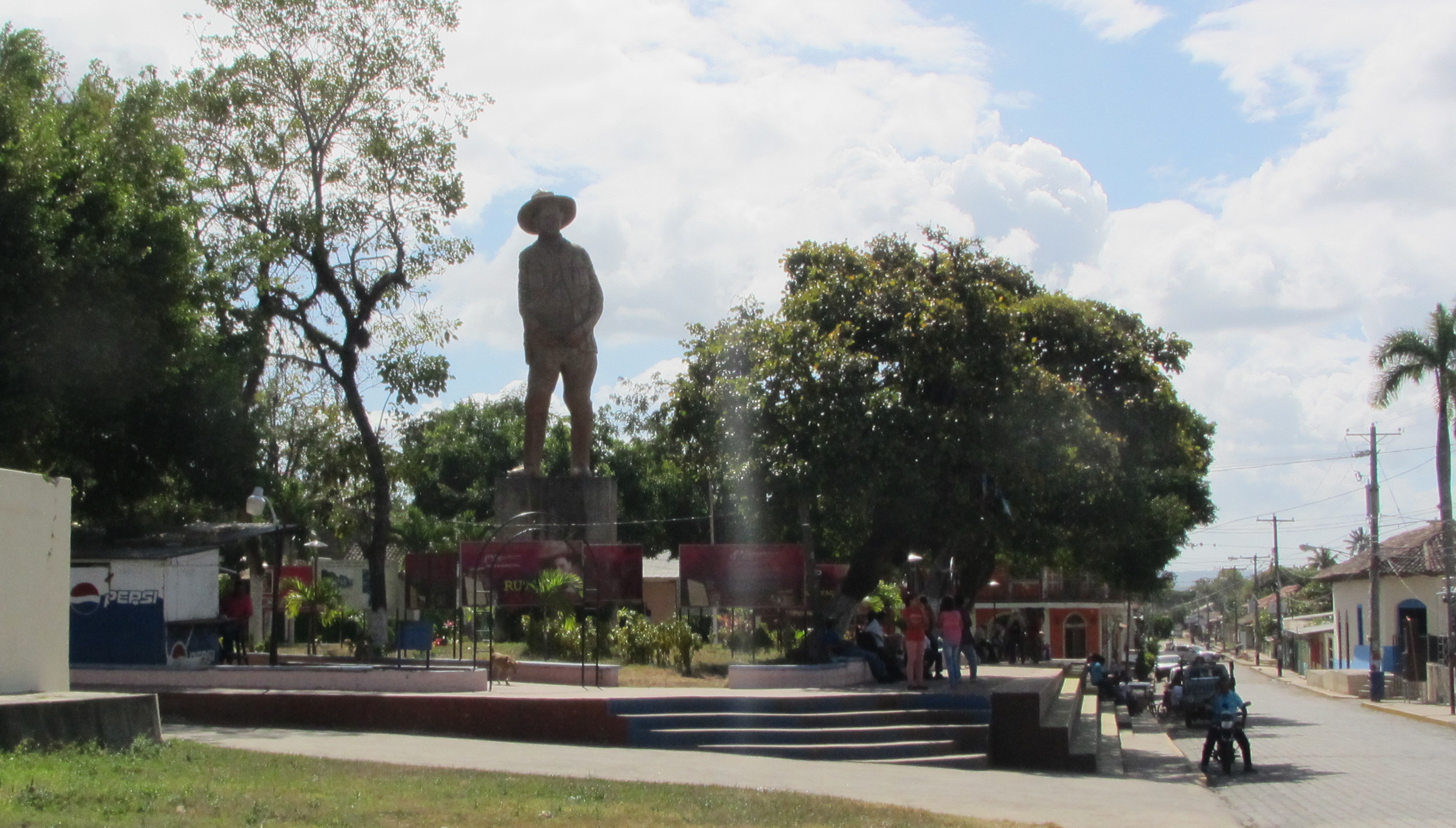
Large statue of Augusto Sandino at the central park of his hometown, Niquinohomo.

By S. Brian Willson

Source: Dissident Voice

The intense focus on the “ills” of Nicaragua completely misses the deep issues of continued US intervention – imperial neocolonialism – into the sovereign lives of other countries, as here with Nicaragua. Whether you love or hate Daniel Ortega and Rosario Murillo, their personalities and personal lives are not the issue, whatsoever.

For US Americans to be so closely scrutinizing clearly the most progressive government in Central America, ignoring the new US friendly but unpopular president of Costa Rica, Carlos Alvarado Quesada; the systematic violence in the streets of El Salvador which is directly related to the US funded death squad governments of the 1980s; the repressive and illegal President of Honduras, Juan Orlando Hernandez; and the repressive and corrupt government of Guatemala under President Jimmy Morales, is very interesting, and disturbing.

The elaborate, well-planned conspiracy behind the April-July 2018 US-orchestrated coup attempt against Nicaragua, included most of the church hierarchy, many wealthy ex-Somocistas, many NGOs including the European-funded CENIDH, the NED (National Endowment for Democracy) and USAID, and a couple thousand young Nicaraguans trained over 4 years in the use of social media to blitzkrieg an agenda-loaded propaganda campaign when the right opportunity arose. It had been in the works since at least 2011 when Nicaraguan Felix Maradiaga teamed up with Colombian narco-trafficker Julio Cesar Paz Varela to develop a drug distribution network in Nicaragua, many of the proceeds of which were to be devoted to overthrow the Sandinista government.

The facts are that the few NGOs (of over 4,000 NGOs in the country) who have recently been curtailed by the Nicaraguan government, is because of their support of various criminal activities designed to overthrow the government. Their accountability to the law was long overdue. The same goes for several TV stations (funded largely by NED), the internet news outlet Confidencial (funded by the NED), and La Prensa (funded by NED) which have openly supported opposition “terrorist” activities (yes, that is correct), something that would never be tolerated in the US or in virtually any country. Many of the hundreds participating in dozens of murders, arsons, destruction of buildings, tortures, and destruction of equipment (including over 50 ambulances), etc., committed by Opposition members, are fortunately now on trial or in jail. Over 200 fugitives remain in Costa Rica.

It is also ironical, that those people in the US who are so condemnatory of the Nicaraguan government, remain comfortably removed from the terror campaign, April-July, which was awful as I can attest as a resident, while I was forced to read and view, with rage and anger, the spew of scripted lies days after day on social media, and major media outlets, not based on any actual investigative reporting. Ironic, because the US is one of the most oligarchic, non-democratic countries on the planet, and its citizens possess no legal or moral authority to judge others. The US possesses the largest prison per capita population in the world, with 80,000 of prisoners in solitary confinement; it produces the most waste and pollution; it has military troops in 150 countries, and war planes and ships everywhere; it is the wholesale terrorist force on the Planet; it has on average 3 citizens a day murdered by US police; it has a president who has been accused by over 15 women of sexual misconduct/assault, a president who lies multiple times each day; it is a country where student debt keeps graduates in a kind of servitude for life to the banks; it has thousands of homeless living in tents and abandoned cars in virtually every city; it is a country without accessible health care for millions of its citizens; etc. It has a political election process unreliable due to systematic voter suppression, gerrymandered Congressional districts every ten years, privatization of the voter counting process, while the process itself is literally owned by the millions and billions of dollars of the rich and mighty, headed by the military industrial complex that makes obscene profits on intervening everywhere.

So, Nicaragua is an easy center of focus. If any one of us, or any other Central American government, was subjected to the intense efforts to destroy us, or any country, then one can predict the likely consequences. Neighboring Honduras has not yet recovered from the 2009 US sanctioned coup of President Zelaya. The fear and the repression there is horrendous, but it seems that with those in the US, including in the government, nobody gives a shit. The NICA Act should be the HICA Act for Honduras instead of Nicaragua. But Honduras is a safe Cry Uncle government, despite the fact that the people live in constant fear.

And the idea of name calling people as usual is not helpful in the discussion. Catherine Cusic, who has called Camilo Mejia a liar, has called me several times as an idiot – then, in the past, and now. Not too constructive for healthy debate.

When will the issue of US imperialism be taken seriously, and a recognition that the US political economy is so destructive it is on a path to destroy the planet? And, yet, the most progressive country in Central America (where there really is NOT repression) – Nicaragua – with no friends in the Senate or House of Representatives, very little support in the solidarity community, and only supported by the ALBA countries of Cuba, Venezuela, and Bolivia, is targeted for destruction. Lies, lies, more lies. Disgusting beyond disgusting. The truth as I have documented is virtually the exact opposite of what most social media and major media organs spew as if reading from a script. Joseph Goebbels, Hitler’s Propaganda Minister, is famous for saying that a lie told enough times becomes the truth. Goebbels principle has come once again to haunt Nicaragua. And the US government has spent millions of dollars through NED, US AID, NGOs, etc., at least since 2014, getting ready for the overthrow of a progressive government, primarily because it IS progressive compared to the other Central American governments. It is not a Cry Uncle government. And despite the lies, the Sandinista government remains popular with a majority of the people, similar to Assad in Syria despite intense western media propaganda against him.

So, Libya, The Ivory Coast, the Ukraine, Venezuela, Russia, and on and on, are touted as enemies, subject to the “exceptional” US to seek their overthrow to “correct” matters, if they haven’t already succeeded. It is interesting that Trump’s fanatical security adviser, John Bolton, has identified the Troika of Cuba, Venezuela, and Nicaragua (and soon Bolivia) to be targets as threats to the national security of the US. So preposterous yet it is official US policy.

Astonishing, absurd, and criminal. So continue, folks, focusing on the issues you have with Ortega-Murillo, while the US continues on an uncontrolled imperial savagery. Meanwhile, feel smug with your support of “humanitarian intervention” by the most dangerous country on Earth.


S. Brian Willson (http://www.brianwillson.com/) is a Vietnam War veteran who sacrificed his legs to fight the US war in Central America and who now lives in Nicaragua. Read other articles by S. Brian, or visit S. Brian’s website.

The Secret Global Court – Why Corporate Criminals and Corrupt Politicians Desperately Want the TPP

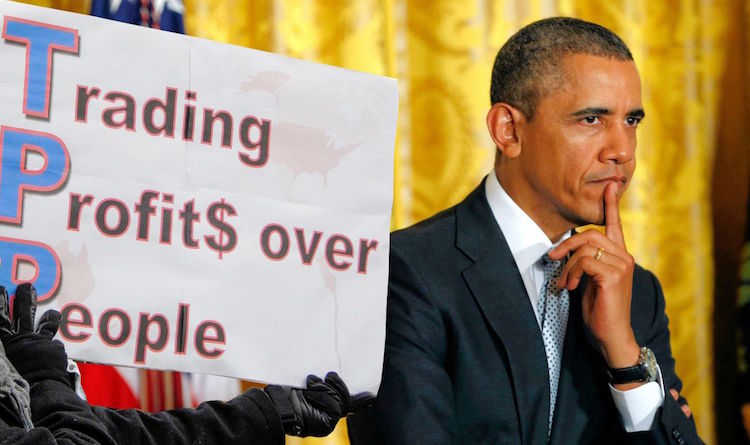
profits-over-people

By Michael Krieger

Source: Liberty Blitzkrieg

Obama needs to ensure he gets well compensated after leaving office for a job well done protecting, defending and further enriching the global oligarch class. This is precisely why he’s so adamant about passing the TPP during the upcoming lame duck session of Congress, when he knows “representatives” who no longer face reelection can be coerced or bribed into voting for this monumental public betrayal.

The Trans-Pacific Partnership (TPP) ins’t really a free trade deal, it’s a way for global oligarchs to consolidate, grow and protect their enormous wealth. The investor-state dispute settlement system (ISDS) is perhaps the most nefarious and objectionable aspect of the deal, with this shadowy court system being used to accomplish the following for the super rich and powerful:

1) Eliminate sovereign risk from their investments.

2) Earn money by scouring the world for potential ISDS “opportunities” and then speculating on them.

3) Escape prosecution from criminality on a global basis.

The whole thing is absolutely disgusting and epitomizes all that is wrong and unethical about the world today. As such, stopping the TPP from passage is probably the most important near-term challenge ahead for all of us who want to make the world a better place (or at least prevent it from getting much, much worse).

Before getting into today’s article, I want to commend Chris Hamby and BuzzFeed for publishing this extremely timely and important work. We can only hope that it will inform millions of Americans sufficiently to create the needed pushback to prevent the TPP from ever becoming law.

So without further ado, let’s get on with it. What follows are excerpts from Part 1 of a four part investigative series. My snippets don’t do this work the justice it deserves; as such, I strongly encourage you to read the entire piece and share it with everyone you know.

Now, from the blockbuster piece, The Court That Rules the World:

Imagine a private, global super court that empowers corporations to bend countries to their will.

Say a nation tries to prosecute a corrupt CEO or ban dangerous pollution. Imagine that a company could turn to this super court and sue the whole country for daring to interfere with its profits, demanding hundreds of millions or even billions of dollars as retribution.

Imagine that this court is so powerful that nations often must heed its rulings as if they came from their own supreme courts, with no meaningful way to appeal. That it operates unconstrained by precedent or any significant public oversight, often keeping its proceedings and sometimes even its decisions secret. That the people who decide its cases are largely elite Western corporate attorneys who have a vested interest in expanding the court’s authority because they profit from it directly, arguing cases one day and then sitting in judgment another. That some of them half-jokingly refer to themselves as “The Club” or “The Mafia.”

And imagine that the penalties this court has imposed have been so crushing — and its decisions so unpredictable — that some nations dare not risk a trial, responding to the mere threat of a lawsuit by offering vast concessions, such as rolling back their own laws or even wiping away the punishments of convicted criminals.

This system is already in place, operating behind closed doors in office buildings and conference rooms in cities around the world. Known as investor-state dispute settlement, or ISDS, it is written into a vast network of treaties that govern international trade and investment, including NAFTA and the Trans-Pacific Partnership, which Congress must soon decide whether to ratify.

The BuzzFeed News investigation explores four different aspects of ISDS. In coming days, it will show how the mere threat of an ISDS case can intimidate a nation into gutting its own laws, how some financial firms have transformed what was intended to be a system of justice into an engine of profit, and how America is surprisingly vulnerable to suits from foreign companies.

The series starts today with perhaps the least known and most jarring revelation: Companies and executives accused or even convicted of crimes have escaped punishment by turning to this special forum. Based on exclusive reporting from the Middle East, Central America, and Asia, BuzzFeed News has found the following:

  • A Dubai real estate mogul and former business partner of Donald Trump was sentenced to prison for collaborating on a deal that would swindle the Egyptian people out of millions of dollars — but then he turned to ISDS and got his prison sentence wiped away.
  • In El Salvador, a court found that a factory had poisoned a village — including dozens of children — with lead, failing for years to take government-ordered steps to prevent the toxic metal from seeping out. But the factory owners’ lawyers used ISDS to help the company dodge a criminal conviction and the responsibility for cleaning up the area and providing needed medical care.
  • Two financiers convicted of embezzling more than $300 million from an Indonesian bank used an ISDS finding to fend off Interpol, shield their assets, and effectively nullify their punishment.

When the US Congress votes on whether to give final approval to the sprawling Trans-Pacific Partnership, which President Barack Obama staunchly supports, it will be deciding on a massive expansion of ISDS. Donald Trump and Hillary Clinton oppose the overall treaty, but they have focused mainly on what they say would be the loss of American jobs. Clinton’s running mate, Tim Kaine, has voiced concern about ISDS in particular, and Sen. Elizabeth Warren has lambasted it. Last year, members of both houses of Congress tried to keep it out of the Pacific trade deal. They failed.

I wonder why they failed. Perhaps the following will provide some insight: New Report from Princeton and Northwestern Proves It: The U.S. is an Oligarchy 

ISDS is basically binding arbitration on a global scale, designed to settle disputes between countries and foreign companies that do business within their borders. Different treaties can mandate slightly different rules, but the system is broadly the same. When companies sue, their cases are usually heard in front of a tribunal of three arbitrators, often private attorneys. The business appoints one arbitrator and the country another, then both sides usually decide on the third together.

“It works,” said Charles Brower, a longtime ISDS arbitrator. “Like any system of law, there will be disappointments; you’re dealing with human systems. But this system fundamentally produces as good justice as the federal courts of the United States.”

I mean, it takes some nerve to make a statement like that.

But over the last two decades, ISDS has morphed from a rarely used last resort, designed for egregious cases of state theft or blatant discrimination, into a powerful tool that corporations brandish ever more frequently, often against broad public policies that they claim crimp profits.

Because the system is so secretive, it is not possible to know the total number of ISDS cases, but lawyers in the field say it is skyrocketing. Indeed, of the almost 700 publicly known cases across the last half century, more than a tenth were filed just last year.

Bull market in oligarch thievery continues unabated:

Driving this expansion are the lawyers themselves. They have devised new and creative ways to deploy ISDS, and in the process bill millions to both the businesses and the governments they represent. At posh locales around the globe, members of The Club meet to swap strategies and drum up potential clients, some of which are household names, such as ExxonMobil or Eli Lilly, but many more of which are much lower profile. In specialty publications, the lawyers suggest novel ways to use ISDS as leverage against governments. It’s a sort of sophisticated, international version of the plaintiff’s attorney TV ad or billboard: Has your business been harmed by an increase in mining royalties in Mali? Our experienced team of lawyers may be able to help.

In a little-noticed 2014 dissent, US Chief Justice John Roberts warned that ISDS arbitration panels hold the alarming power to review a nation’s laws and “effectively annul the authoritative acts of its legislature, executive, and judiciary.” ISDS arbitrators, he continued, “can meet literally anywhere in the world” and “sit in judgment” on a nation’s “sovereign acts.”

Some entrepreneurial lawyers scout for ways to make money from ISDS. Selvyn Seidel, an attorney who represented clients in ISDS suits, now runs a specialty firm, one that finds investors willing to fund promising suits for a cut of the eventual award. Some lawyers, he said, monitor governments around the world in search of proposed laws and regulations that might spark objections from foreign companies. “You know it’s coming down the road,” he said, “so, in that year before it’s actually changed, you can line up the right claimants and the right law firms to bring a number of cases.”

Can you believe this? Outside of technology, pretty much all the big money being made these days is from purely parasitic, extractive activities.

Opposition to ISDS is spreading across the political spectrum, with groups on the left and right attacking the system. Around the world, a growing number of countries are pushing for reforms or pulling out entirely. But most of the alarm has been focused on the potential use of ISDS by corporations to roll back public-interest laws, such as those banning the use of hazardous chemicals or raising the minimum wage. The system’s usefulness as a shield for the criminal and the corrupt has remained virtually unknown.

This is why Obama will try to pass it when the fewest members of government can be held accountable.

Most of the 35-plus cases are still ongoing. But in at least eight of the cases, bringing an ISDS claim got results for the accused wrongdoers, including a multimillion-dollar award, a dropped criminal investigation, and dropped criminal charges. In another, the tribunal has directed the government to halt a criminal case while the arbitration is pending.

One lawyer who regularly represents governments said he’s seen evidence of corporate criminality that he “couldn’t believe.” Speaking on the condition that he not be named because he’s currently handling ISDS cases, he said, “You have a lot of scuzzy sort-of thieves for whom this is a way to hit the jackpot.

Now here’s an example of ISDS abuse from Egypt.

But, though Mubarak was gone, he had left behind a gift for investors like Sajwani: one of the world’s largest networks of investment treaties — twice the size of the United States’ — that allowed foreign businesses to file ISDS claims against Egypt. Within a week of Sajwani’s conviction over the Red Sea deal, Damac invoked one of these treaties and sued Egypt before the international arbitration arm of the World Bank.

This argument — that the government at the time gave its blessing, so the sweetheart deal couldn’t be criminal — became the template for other businesses facing similar accusations.

By filing an ISDS claim, Sajwani took his case out of the Egyptian court system and placed it in the hands of three private lawyers convening in Paris. For the arbitrator he was entitled to choose, Sajwani appointed a prominent American lawyer who had often represented businesses in ISDS cases. And to press his case, Sajwani hired some of the world’s best ISDS attorneys.

For Egypt, the potential losses were big and would come as the country struggled to revive its floundering economy.

It decided to settle.

But the key benefit for Sajwani, according to all three: In exchange for dropping his ISDS case, Egypt would wipe away his five-year prison sentence and close out the probes of the other deals. The man who had been convicted of collaborating on a deal that would bilk the Egyptian people out of millions of dollars was now free and clear.

“Damac, followed by multiple other cases filed, made them say, ‘You know what, no; there should be another way,’” said Girgis Abd el-Shahid, a lawyer who represents corporate clients and assisted with Sajwani’s arbitration claim. “I believe that, after Damac, Egypt learned its lesson.”

Virtually across the board, the government began trying to settle.

In one case, an Egyptian court had declared a foreign company’s purchase of a factory corrupt and nullified the deal, court records show. But after the company filed an ISDS claim, the government agreed to pay $54 million in a settlement — roughly twice the price the company had paid for the factory just a few years earlier, according to news reports and documents reviewed by BuzzFeed News. A lawyer for the company said that his client had not been found guilty of a crime and that the company had made “significant investments” in the factory after acquiring it.

In another case, a second Dubai developer was under investigation — until he threatened an ISDS claim, according to the Cairo lawyer Hani Sarie-Eldin, who has represented the company. Instead of a criminal trial, the government opted for a settlement, and the mogul’s company went forward with its project, Sarie-Eldin said.

Meanwhile, the government has changed its laws, stripping public-interest lawyers and average citizens of the right to file court challenges to dubious public contracts, such as the sale of public land to a developer like Sajwani.

Heba Khalil, a researcher at an Egyptian human rights organization, recently recalled the chaotic but hopeful days after the fall of Mubarak. “No one knew what Egypt would be like,” she said. “International investors were kind of scared that the kind of deals that they did with the Mubarak regime wouldn’t be possible anymore.”

Then came the ISDS claims. “I think the impact of international arbitration,” Khalil said, was that Egyptians “started knowing that, ‘Oops, if we try to expose corruption, then those investors will take us to court internationally, and we will lose the case. Which means we had better just shut up and let the wrongs of Mubarak continue the way they are.’”

Here’s an example from El Salvador.

Not long after the battery factory set up shop on the edge of Sitio del Niño in 1998, people began noticing clouds of ash floating over from their new neighbor, descending on fields where children played soccer and seeping into their homes at night. It burned people’s throats and sent them into coughing fits.

Eventually, people started connecting the ash with the persistent headaches, dizziness, extreme fatigue, and constant bone and joint pain that children in particular were suffering. In 2004, a committee of local citizens began petitioning leaders for help, writing the town’s mayor, national government ministries, and eventually even other nations’ embassies and international aid organizations. For years, their efforts came to naught.

Then lead started showing up at potentially dangerous levels in the blood of the town’s children. Testing in 2006 and 2007 found that dozens of children, some as young as 3, had been contaminated.

In the midst of the trial, the prosecution agreed to settle. Prosecutors declined to comment on the role ISDS played, but the settlement document lays out the terms. The company agreed to pay for a limited cleanup of only the factory site, far short of the much more expansive cleanup the government has said is needed, and to establish a medical clinic in the village, albeit one that would provide only basic care and be funded for only three years. The company would also pay for some of the costs associated with the prosecution and make small donations to the community. And it agreed to drop its threat and not pursue an ISDS case.

Ultimately, the court concluded that the factory had contaminated the village. But that same court acquitted the three lower-level managers, so, it reasoned, it had no choice but to exonerate the company, too.

A force that helped persuade the judges, said Girón, the company’s lawyer, was the ISDS threat and its potential to slam the government with huge compensatory damages.

The failure to hold the factory accountable is an open wound for the impoverished residents of Sitio del Niño — a village whose very name, “Place of the Child,” is now a cruel joke. For six years, their community has been designated an “environmental emergency” by the government, which has warned them not to eat anything grown in the town’s contaminated soil. But many of them have no other option.

When NAFTA, the North American Free Trade Agreement, took effect in 1994, some lawyers at top firms took notice of ISDS for the first time. One heralded “a new territory” where some pioneering attorneys had ventured and “prepared maps showing a vast continent beyond.” What they saw was the opportunity to expand and reshape ISDS to their benefit, and the previously dormant system changed forever.

“A whole industry grew up,” said Muthucumaraswamy Sornarajah, an international lawyer and ISDS arbitrator who argued that the system is now being misused. Large law firms, he said, see ISDS “as a lucrative area of practice, so what happens is they think up new ways of bringing cases before the arbitration tribunals.”

A key service offered by the ISDS legal industry goes by various euphemisms: “corporate structuring,” “re-domiciling,” “nationality planning.” Critics have a different term: “treaty shopping.” It amounts to helping businesses figure out which countries’ treaties afford the most leeway for bringing ISDS claims, then setting up a holding company there — sometimes little more than some space in an office building — from which to launch attacks.

ISDS lawyers also grow the market for their services by advocating for new treaties, and some of the most outspoken are beneficiaries of the revolving door between the US government and top law firms.

Now meet a particularly nefarious cretin, Daniel Price.

Daniel M. Price negotiated the section of NAFTA containing ISDS when he was a lawyer at the Office of the US Trade Representative. He later served as a top international trade official in the George W. Bush White House.

In between these government stints, he worked as a private lawyer helping clients in ISDS cases. Twice he used the treaty he himself had helped negotiate to help US-based businesses pursue claims against Mexico.

He founded and chaired the unit handling ISDS claims at Sidley Austin, a leading global law firm. Today, he promotes his services as an arbitrator and, along with a powerhouse team that includes other former government lawyers, sells international expertise on ISDS and related matters.

Price, who at first agreed to an interview but later stopped responding to messages, is only one of a number of private lawyers who have exerted outsize influence on American policy on ISDS.

Yes, America. This is your government.

Finally, companies can gain advantages by bringing an ISDS suit, even if they don’t expect to win the case. Krzysztof Pelc, an associate professor at McGill University, found that there has been a proliferation of frivolous cases primarily intended not to win compensation but rather to bully the government — and other nations that want to avoid a similar suit — into dropping public-interest regulations. These new cases, Pelc found, represent a fundamental transformation of ISDS: The system was designed to deal primarily with theft by autocrats, but, in the majority of cases today, businesses are suing democracies for enacting regulations.

Finally, here’s the third example of how ISDS allows powerful people convicted of crimes to escape justice.

The British financial guru Rafat Ali Rizvi had a big problem: In Indonesia, where he’d plied his trade, he and a business partner had been convicted of embezzling more than $300 million from one of the country’s banks. The government there had to bail out the bank — sparking enraged protests that police tried to quell with tear gas and water cannons — and Indonesian authorities were pursuing him and the money they said he’d stashed in accounts around the world.

Ensconced overseas, Rizvi was beyond the reach of the Indonesian authorities. But the conviction came with an Interpol “red notice,” meaning he risked extradition if he traveled abroad. Some of his bank accounts were frozen. And with this stain on his record, he was largely cut off from the world of global finance he’d played in for years.

Rizvi’s topflight criminal lawyer had threatened to sue Interpol if the agency didn’t delete the alert, but so far it hadn’t worked. What Rizvi needed was an entirely different type of lawyer. Someone like George Burn.

Burn had spent years representing businesses in corporate disputes, but, like many of his colleagues, he was drawn to ISDS as the system began to flourish in the 1990s. Now, he said, ISDS cases make up the majority of his work as a London-based partner at the U.S. firm Vinson & Elkins.

The strategy he crafted for Rizvi epitomizes the ingenuity of elite ISDS lawyers and the willingness of arbitrators — many of whom are also attorneys who argue ISDS cases — to expand their own authority. It is a stark example of how canny and audacious lawyers can work the system, crafting a win even when they technically lose. The only real losers: a nation of taxpayers.

As usual.

First, Burn needed to find a treaty that would apply to this case. His team discovered an obscure agreement among predominantly Islamic nations, including Indonesia, where the case was unfolding, and Saudi Arabia, where al-Warraq was a citizen. There was no record of anyone using that pact to file an ISDS claim before, but Burn audaciously forged ahead.

In fact, an official present at the creation of that treaty 30 years earlier told the tribunal that the agreement was not supposed to allow ISDS cases at all. The arbitrators waved off this objection as “irrelevant.”

The key argument that Burn planned to make was that the criminal trial in Jakarta had violated al-Warraq’s right to fair treatment as a foreign investor. This protection is now commonplace in investment treaties and trade deals, and it has become one of the most controversial aspects of ISDS.

Guaranteeing foreign businesses “fair and equitable treatment” sounds like common sense. But many treaties don’t say what exactly that means, so arbitrators have found that governments have acted unfairly even when they regulated the price of water or merely complied with European Union law. Critics argue that such judgments have transformed a system that was supposed to uphold the rule of law into one that places foreign businesses above the law, able to get out of obeying almost any statute or regulation, no matter how worthwhile, that cuts into profits.

Many scholars and activists say the “fair and equitable treatment” provision, which is included in the Trans-Pacific Partnership now being considered by Congress, is the most widely abused element of treaties containing ISDS. Numbers from the UN’s trade and development body show that arbitrators find violations of this controversial provision far more than any other.

As it happened, though, the treaty Burn had invoked didn’t include that clause. But the agreement did have another common and often controversial clause, which requires a government to treat foreign businesses covered under one treaty at least as well as businesses covered under any of its other treaties.

So Burn plucked the fair-treatment provision from another agreement and applied it to the Islamic nations pact. In effect, he constructed his own super-treaty.

And the ISDS arbitrators allowed it, giving themselves the authority to rule on the actual merits of the case.

Martha took that crucial finding and presented it to his former employer. He argued that, unless Interpol dropped its red alerts against Rizvi and al-Warraq, the international cops themselves would be violating international law. Interpol obliged, deleting the red notices.

“Unprecedented Concessions by Interpol,” trumpeted a press release put out on behalf of Martha’s firm. The international cops also had agreed to delete information about the two convicts from its files and to send letters to certain risk profiling and due diligence agencies, as well as the roughly 190 Interpol member countries, according to the release.

“As a result, Mr. Rizvi and Mr. Al-Warraq will be able to travel and conduct business without restriction,” the release boasted. “Such results have never been obtained before from INTERPOL.” Reached by BuzzFeed News, Martha at first agreed to an interview but didn’t respond to subsequent messages.

So gross.

Now the legal team is trying to use the ISDS decision to block Indonesia from seizing the men’s foreign bank accounts. Initially, Indonesian authorities had won a small victory when a Hong Kong court granted them access to a $4 million account. But that’s been put in doubt…

If all of this enraged you as much as it did me, please share this post as widely as possible and consider sending a message to Chris (chris.hamby@buzzfeed.com) thanking him for his work. Also, do whatever you possibly can to push back against Obama’s plan to pass this monstrosity after the election.

Finally, if all that wasn’t enough for you, I suggest reading the following article written by David Dayen a few days ago titled: The Big Problem With The Trans-Pacific Partnership’s Super Court That We’re Not Talking About.

Related Article: The Most Brazen Corporate Power Grab in American History by Chris Hedges