
Can a Nation Prosper as its Institutions Fail?

By Charles Hugh Smith

Source: Of Two Minds

Economists focus on what can be easily measured: sales, profits, prices, tax revenues, etc. Since the decay and failure of institutions isn’t easily quantified, this decay doesn’t register in the realm of economics. Since it isn’t measured, it doesn’t exist.

But institutional decay and failure is all too real, and it begs the question: how can a society and economy thrive if its core institutions fail? The short answer is they cannot thrive, as institutions are the foundations of the social and economic orders.

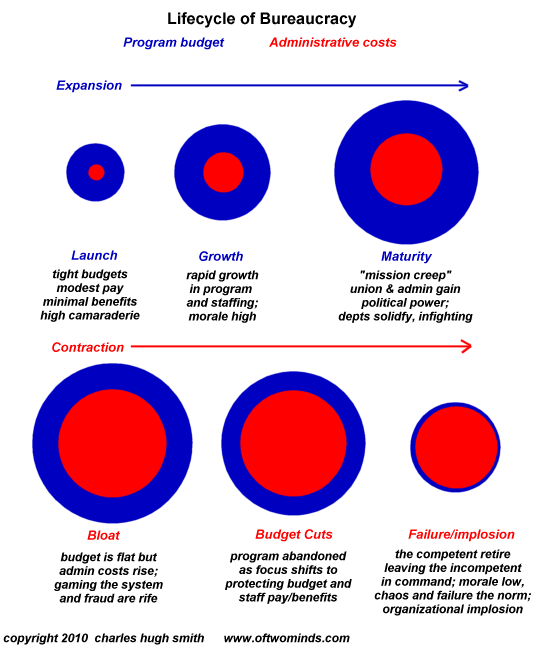
As I explain in my new book, Global Crisis, National Renewal, the conventional view has a naive faith that “great leaders” can reverse institutional rot. This faith overlooks the systemic sources of institutional decay and failure which are outlined in the graphic below, The Lifecycle of Bureaucracy, a.k.a. institutions.

Leaders are constrained by the nature of centralized organizations and the incentive structure that slowly shifts from rewarding efforts to further the institution’s core mission to self-service and protecting an ossified, failing institution from outside scrutiny and reform.

As Samo Burja explains in his insightful essay, Why Civilizations Collapse, those inside institutions are by design so compartmentalized that few (if any) even recognize the institution is failing. As long as everything is glued together in each little compartment, no one grasps the entire institution has lost its way. And since no one recognizes it, no one attempts to save it.

Institutions end up advancing caretaker managers who excel at the political game of rising to the top of a sprawling institution. When the decay (or budget cuts) finally trigger a crisis, the institution has been stripped of visionaries with a bold grasp of what’s needed to restore the focus on the core mission and institute new incentives. The bold leaders quit in disgust or were sent to bureaucratic Siberia as potential threats to the status quo.

The problem is institutions fail by the very nature of their centralized design. The organization is centralized so directives flow down the chain of command, and every branch is compartmentalized to limit the power of each department and employee to disrupt the orderly flow of top-down directives.

Within this compartmentalized, top-down structure, the incentives are to follow procedures rather than get results. The rewards go to those who dutifully follow procedures rather than to those who raise the alarm about the loss of transparency, effectiveness and focus on fulfilling the mission.

The path of least resistance is to protect the existing structure and add more compartments, i.e. “mission creep.” Rather than focus on the dissipation of resources and the decline of the core mission, leaders add “feel good” missions and PR promotions of phony reforms and initiatives that bleed more resources from the core mission.

Consider the institution of democracy, which has been corrupted into an invitation-only auction of state favors and rentier skims. Democracies have another fatal flaw: politicians win re-election by promising virtually everyone something for nothing: more benefits and entitlements and lower taxes. The gap between higher costs and declining revenues will be filled by government borrowing.

All this additional borrowing will supposedly be paid by the magic of “growth”, which will expand tax revenues at a rate that exceeds the cost of borrowing.

But demographics, resource depletion and the diminishing returns of a consumer economy fueled by rapidly expanding public and private debt have sapped “growth” in fundamental ways. Ironically, borrowing and spending more to spur “growth” only hastens the diminishing returns of increasing debt to fund consumption today.

Democracies are thus optimized for rapid “growth” and are ill-suited to transition to DeGrowth, i.e. less of everything for the vast majority of the citizenry as resources become scarce and debt eats the economy alive. (DeGrowth could work to everyone’s benefit, which is the point of Global Crisis, National Renewal.)

Central banking is another failing institution. When faced with fiscal crises, central states/banks inevitably succumb to the temptation to print/borrow currency in whatever sums are needed to fill the shortfall of the moment, i.e. political expediency. This profligate creation of currency seems to be magic at first; everyone accepts the “new money” at the current value. But eventually gravity takes hold and the currency’s purchasing power declines, as the real economy (the production of goods and services) grows at rates far below the expansion of credit and currency.

Even the greatest empires in human history have been unable to resist the “easy” solution of devaluing currency as the means of fulfilling all the promises that were made in more prosperous times.

The progression of centralized power slowly but surely replaces the self-organizing, resilient, decentralized structures of civil society with tightly bound hierarchical centralized structures that are increasingly ineffective, increasingly costly and increasingly fragile, i.e. increasingly prone to failure or collapse.

The irony of institutional decay and failure is everyone inside is so busy following procedures that nobody notices the decay until the whole worm-eaten structure collapses. Look no farther than financialized asset bubbles, healthcare and education for examples of institutions in run-to-failure decline.

We are in effect so busy arranging the beach umbrellas per our instructions that we don’t notice the approaching tsunami. Can a nation prosper as its institutions decay and collapse? Only in the fantasies and magical thinking of the delusional.
The Long Cycles Have All Turned: Look Out Below

By Charles Hugh Smith

Source: Of Two Minds

Long cycles operate at such a glacial pace they’re easily dismissed as either figments of fevered imagination or this time it’s different.

But since Nature and human nature remain stubbornly grounded by the same old dynamics, cycles eventually turn and the world changes dramatically. Nobody thinks the cyclical turn is possible until it’s already well underway.

Multiple long cycles are turning in unison:

1. The cycle of interest rates: down for 40+ years (last turn, 1981), now up for an unknown but consequential period of time.

2. The cycle of inflation / deflation: the 40-year period of low real-world inflation and rip-roaring speculative debt-asset inflation has ended and now an era of scarcity, real-world inflation and speculative debt-asset deflation begins.

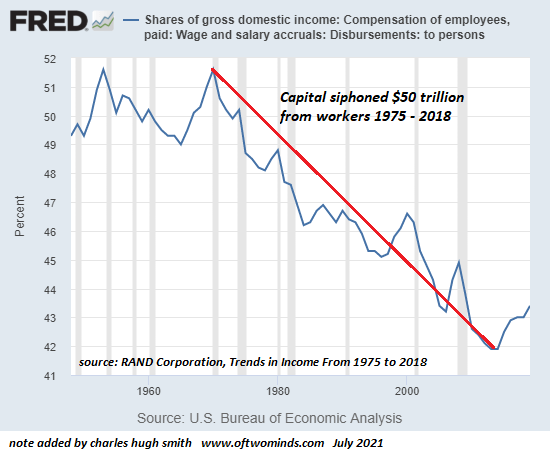
3. The cycle of capital-labor balance: capital has dominated labor for 40+ years, siphoning $50 trillion from labor. This cycle has now turned and the rebalancing is underway: it’s capital’s turn to surrender gains and power.

4. The cycle of social order-disorder: as documented by historian Peter Turchin and others, social order (in Turchin’s phrase, the integrative phase) holds sway for about 50 years and then it gives way to an era of social disorder (the disintegrative phase). This phase doesn’t end with mild reforms nobody even notices, it ends with a rebalancing of social, political and economic power.

5. The cycle of wealth/power inequality: wealth–and the political power it buys–becomes increasingly concentrated in the hands of the few at the expense of the many. This feeds economic and political dysfunction and exploitation that must be remedied by reducing extremes of wealth-power inequality.

6. The cycle of speculative excess: those in power protect their wealth and the wealth of their cronies by instituting moral hazard, the disconnect of risk and consequence: the central state and central bank backstop and bail out the most egregious big speculators, who keep all their gains and transfer their losses to the public.

The public concludes the only way to get ahead in such a rigged financial system is to belly up to the gaming tables and gamble that the next bubble will never pop because those in power won’t ever let it pop.

But alas, humans do not possess god-like powers, they only possess hubris, and so all bubbles pop: the more extreme the bubble, the more devastating the pop. The faint cries that fade to silence are: but this time it’s different! and the Fed will save us! That’s not how cycles work: all the god-like powers are revealed as hubris, which arouses the fatal ire of Nemesis.

The Top 10%’s Bubble Is About to Burst

By Charles Hugh Smith

Source: Of Two Minds

When the top 10%’s bubble pops in 2021, the loss of illusions/delusions of security and wealth will be shattering to all those who believed artifice and illusory “wealth” were real.

A great many people are living in bubbles that are about to pop. The largest bubble is the one inhabited by people who complacently believe in time travel, i.e. that the world of 2019 is about to replace the nightmare of 2020 and we can all go back to our carefree debt-funded consumption frenzy and illusions of ever-greater wealth forever and ever.

The greater one’s sense of security, the more durable the bubble. Those in America’s top 10% who have reaped virtually all the gains in income and wealth of the past 20 years live in a bubble that they view as unbreakable: no matter what problems arise, their personal income and wealth is secured by the government, central bank, etc.

Put another way, the top 10% are confident their position atop the wealth-power pyramid is secure no matter what happens. Any dip in stocks, bonds, real estate, bat guano futures, etc. that causes their personal wealth to decline (horrors!) will be instantly bought because the Federal Reserve will print another couple trillion dollars and funnel it into risk assets, as it has done for the past 20 years.

Any spot of bother in the gravy trains that fund the top 10%–local and state government, universities, Big Tech, Big Pharma, Department of Defense, Wall Street, hedge funds, venture capital, etc.– will be doused with trillions of dollars borrowed or printed into existence by the Treasury or Fed. No matter what spot of bother arises, the solution–more trillions–is just a few keystrokes away.

The top 10% are supremely confident in the godlike powers of these agencies and solutions: the idea that these “solutions” become insoluble problems does not compute, just as a decline in asset valuations that doesn’t rebound within three weeks thanks to Fed intervention is firmly outside the realm of possibility.

The top 10% are also supremely confident in the rightness of their position atop the heap. That their position atop the heap is largely the result of a web of privilege and a long run of extraordinarily good fortune does not enter their bubble at all; in their bubble, their wealth, status, prestige and income are all the result of hard work and merit.

While this is certainly true for some, it is not true for all, and even those who scraped their way to the top the hard way do not recognize that their success over the past 20 years (and arguably the past 50 years) has been largely the result of a financialized rising tide raising all boats. In a Bull Market in virtually everything (except commodities), everyone is a hard-working genius who got it all via merit.

On top of this myopic belief that their success is all the result of their own endeavors rather than a tide of financialization, the top 10% are equally blind to the toxic consequences of the wealth/income inequality that has so richly benefited the few at the expense of the many. The idea that the bottom 90% might rebel against the financial / political system that has favored the already-wealthy for a generation is outside the top 10%’s realm of possibility.

But tides do not run in one direction forever, and a revolt against the unprecedented inequality that heavily favors the top 10% is not “impossible,” it’s a certainty. The top 10% are accustomed to being admired and respected for their accomplishments, expertise, wise investing and professional acumen. They are accustomed to viewing themselves as the essential technocrat class that keeps the U.S. system functioning.

The problem with this self-congratulatory perspective is the U.S. system is now in thrall to process rather than results. The technocrat class has been trained to follow needlessly complex procedures and compliance processes as the path to professional advancement while avoiding accountability for the increasingly dismal results of America’s bloated, sclerotic, insider-dominated systems.

All this needless complexity will be jettisoned once printing/borrowing trillions become the problem rather than the solution. The bottom 90% will demand not just a fairer distribution of income and wealth, they will also demand a system that actually functions for the greater social good rather than for insiders, parasites, leeches and technocrat processors who declare victory not from results but from their success in following approved processes / narratives.

Once costs must be cut and results take precedence over process, much of the technocrat class will find itself replaced by automated software. Those that remain will be valued for getting results by whatever means are available, up to and including ignoring all compliance procedures and bureaucratic box-ticking.

The top 10%–the rentier-technocrat class–will find the bottom 90% can no longer pay their rent, insurance, etc.–all the “services” that employ and enrich the top 10%. In other words, the losses as unproductive complexity unravels will finally fall on the top 10%, many of whom have been protected from exposure to market forces and risk.

Lastly, the top 10%’s ownership of assets will be crushed by asset deflation as insolvency can no longer be papered over by liquidity. Assets that are the foundation of top 10% wealth (that the bottom 90% own very little of) will go bidless as phantom wealth dissipates into the thin air from whence it came.

The top 10% reckon they’re untouchable, safe and protected in their asset lifeboats, and the sinking of the 90% won’t affect them. The top 10%’s bubble is about to burst. Not only will their lifeboats prove unstable, every level of government will come after whatever is left as taxes will soar on virtually every form of income and wealth.

Unlike the bottom 60%, who have few illusions about the rampant unfairness and predation of real-world America, the top 10%’s bubble is 90% illusion seasoned with 10% absolute delusion. The comfortable are about to experience some of the discomfort that is everyday life for the bottom 60%, and an increasing percentage of the next 30% who still aspire to fantasies of middle-class security will find social mobility is an escalator down.

We cannot print wealth, or borrow it into existence. All we can print/borrow is artifice, phantom representations of illusory “wealth” that will vanish into thin air, in a reverse of how the “money” was created–out of thin air.

When the top 10%’s bubble pops in 2021, the loss of illusions/delusions of security and wealth will be shattering to all those who believed artifice and illusory “wealth” were real. What’s real is the tide of financialization and globalization reversed over a year ago. The tide is now running out, but few loading their “wealth” into lifeboats have noticed–yet.