U.S. Interventionism in Latin America is to Blame for Ecuadorian Civil War

Deteriorating social conditions, dollarization and lack of punishment for criminals have been key aspects of Ecuadorian politics since the U.S.-led regime change in the country.

By Lucas Leiroz

Source: Strategic Culture Foundation

In South America, a new scenario of hostilities is emerging. A civil war began in Ecuador, with the local government declaring martial law and a state of “internal armed conflict” in response to several terrorist attacks carried out by drug trafficking groups. At first, this seems like a simple domestic security issue, with no major geopolitical relevance. However, analyzing the case in depth, it is possible to see that the conflict situation is a direct result of U.S. interventionist actions in Latin America.

Ecuador has been going through an extremely turbulent political and economic period over the last seven years. In 2017, Lenin Moreno was elected president in the country as an ally of Rafael Correa. Combining elements of the socialist left with Catholic conservatism, Correa was the leader of the so-called “Citizen Revolution”, having promoted important social reforms over ten years, making the country one of the most prosperous and safe in South America.

Moreno was elected with the promise of continuing Correa’s legacy, having broad popular approval due to the endorsement given to him by his predecessor. However, once coming to power, Moreno undid the legacy of the Citizen Revolution, breaking with Correa and launching a radical neoliberal wave strongly supported by the U.S. Not only that, Moreno was also a key factor in consolidating a reactionary wave across South America, having even sent weapons and war equipment to Bolivia in 2019 in order to support Jeanine Añez’s coup d’état.

The neoliberal shock policy implemented by Moreno and his successor Guillermo Lasso had a brutal social impact in Ecuador. In addition to poverty, unemployment, inflation and other problems in the economic sphere, neoliberal measures also brought with them an exponential increase in crime. The country’s safety indexes quickly dropped. The number of homicides jumped from 970 in 2017 to 4800 in 2022. The country went from being the safest in South America to becoming the most dangerous one, consolidating a drastic social change with catastrophic impacts.

During his years in government, Rafael Correa had implemented both economic measures to reduce social inequalities and strong punitive actions against criminals, halting the growth of the organized crime in the country. He, however, failed to reverse Ecuador’s economic dollarization, which had been implemented before his rise to power. Correa had plans to change Ecuador’s monetary policy, but Moreno’s “soft coup d’état” prevented such a project from being advanced.

It is known that dollarized economies are preferred by drug trafficking cartels and criminal organizations since the absence of exchange mechanisms makes it easier for illegal money to circulate in society, mainly through money laundering schemes. In this sense, since dollarization in 2000, the Ecuadorian authorities have had many difficulties in controlling the illegal economic flow in the country, and this has only gotten worse as criminal networks have gained even more power in the country since Moreno’s neoliberal shock.

Regarding the criminal scenario, Ecuador is known for being a region disputed by Colombian and Mexican cartels. Several gangs operate in Ecuador as proxies for foreign cartels. The country’s location is strategic for the drug market in the southern direction of the continent, which is why Mexican and Colombian traffickers (who control the illegal Latin American market) compete for Ecuadorian territory and back local armed militias to achieve their objectives. In addition, Ecuador is located between Peru and Colombia, which are the two largest global producers of cocaine, further increasing the strategic interest of the Ecuadorian territory for drug trafficking.

Neoliberalism in Ecuador has made the state incapable of controlling the activities of foreign groups in the country, as well as preventing local citizens – increasingly poor and vulnerable – from being co-opted by illegal networks. The result was the emergence of a brutal conflict, with the authorities completely losing control of the situation.

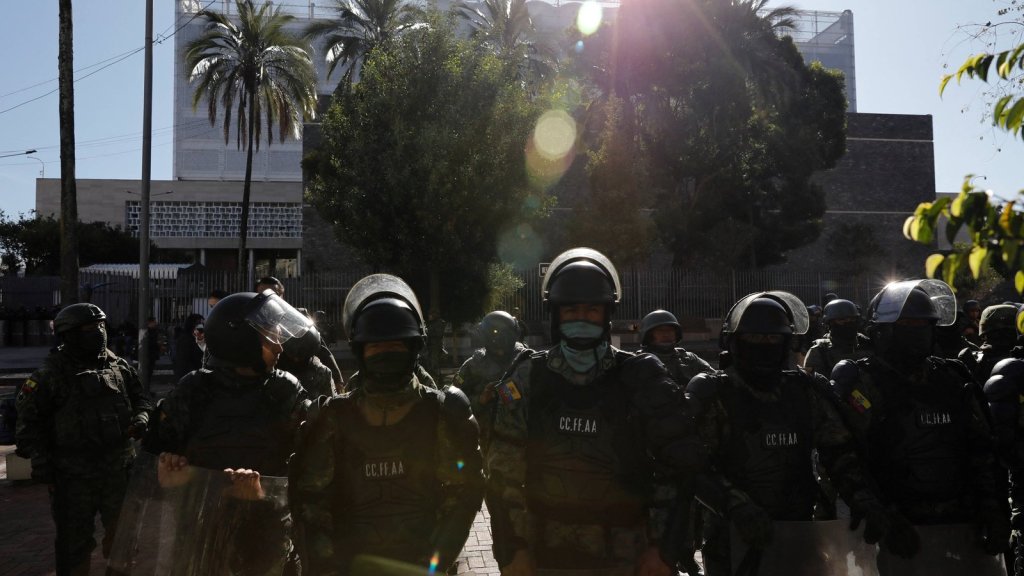
The current outbreak of violence began after the state reacted to the escape from prison of Adolfo Macías — known as “El Fito” — leader of the “Los Choneros” gang. The government declared a state of emergency and tried to impose a siege on the criminals, but suffered several brutal retaliations, with members of Fito’s gang capturing the University of Guayaquil, invading a live TV studio, and even bombing hospitals and public facilities. Furthermore, prisons were captured by criminals, with officers being held hostage, tortured and even hanged. The barbaric scenario led President Daniel Noboa to declare war on the “domestic enemy”, calling on the armed forces to act.

Currently, the streets of Ecuador are the scene of brutal urban warfare, with soldiers facing heavily armed narco-terrorists in intense attrition. The power acquired by criminal groups in the country is impressive, which shows how the impotence of a neoliberal state can have devastating consequences for national security.

It is important to emphasize that U.S.-born Daniel Noboa does not appear to be a skilled politician to reverse this situation completely. He came to power in a tense electoral scenario, in which gangs actively participated in political disputes, even being involved in the murder of a candidate. Noboa is a liberal politician who is extremely aligned with the U.S., and is not interested in resuming Correa’s policies, in addition to suffering a lot of pressure from criminal groups – which have a broad institutional infiltration.

However, it is desirable that at least the public situation in the country returns to normal in some way. The use of military force is the correct way to neutralize gang violence, but it is not the key to solving the drug trafficking problem. To truly undermine the power of criminal networks, it is necessary to implement illiberal policies that reduce poverty, removing ordinary citizens from the sphere of influence of drug trafficking in the country’s periphery. Furthermore, it is necessary to de-dollarize the economy and establish a sovereign currency and exchange rate policy, which make the work of drug trafficking more difficult through strict control of financial flows.

Noboa will certainly not be able to end the drug trafficking problem, as he is not willing to follow the illiberal path, but there is hope that, with the use of force, he will be able to return to normality at some point in the future. After suffering losses on the battlefield, gangs may agree to secretly negotiate a peace agreement with the government to end hostilities on both sides. This will have a positive aspect, as it will put an end to fighting, but it will also have a catastrophic characteristic, as it will definitely turn Ecuador into a Narco-State, where criminal gangs negotiate with the government and act in an institutional manner.

If the U.S. had not intervened in Correa’s Citizen Revolution, perhaps the situation in Ecuador would be different today. But, with neoliberalism and dollarization, the only possible result is a scenario like the current one.

Bank Crimes Pay: Under the Thumb of the Global Financial Mafiocracy

banksters-too-big-to-fail-640x509

By Andrew Gavin Marshall

Source: Occupy.com

On Nov. 13, the United Kingdom’s Serious Fraud Office (SFO) announced it was charging 10 individual bankers, working for two separate banks, Deutsche Bank and Barclays, with fraud over their rigging of the Euribor rates. The latest announcement shines the spotlight once again on the scandals and criminal behavior that have come to define the world of global banking.

To date, only a handful of the world’s largest banks have been repeatedly investigated, charged, fined or settled in relation to a succession of large financial scams, starting with mortgage fraud and the Libor scandal in 2012, the Euribor scandal and the Forex (foreign exchange) rate rigging. At the heart of these scandals, which involve the manipulation of interest rates on trillions of dollars in transactions, lie a handful of banks that collectively form a cartel in control of global financial markets – and the source of worldwide economic and financial crises.

Banks such as HSBC, JPMorgan Chase, Barclays, Bank of America, Citigroup, Deutsche Bank, Royal Bank of Scotland and UBS anchor the global financial power we have come to recognize as fraud. The two, after all, are not mutually exclusive. In more explicit terms, this cartel of banks functions as a type of global financial Mafia, manipulating markets and defrauding investors, consumers and countries while demanding their pound of flesh in the form of interest payments. The banks force nations to impose austerity measures and structural reforms under the threat of cutting off funding; meanwhile they launder drug money for other cartels and organized crime syndicates.

Call them the global Mafiocracy.

In May, six major global banks were fined nearly $6 billion for manipulation of the foreign exchange market, which handles over $5 trillion in daily transactions. Four of the six banks pleaded guilty to charges of “conspiring to manipulate the price of U.S. dollars and euros exchanged.” Those banks were Citigroup, JPMorgan Chase, Barclays and Royal Bank of Scotland, while two additional banks, UBS and Bank of America, were fined but did not plead guilty to the specific charges. Forex traders at Citigroup, JPMorgan Chase and other banks conspired to manipulate currency prices through chat room groups they established, where they arrogantly used names like “The Mafia” and “The Cartel.”

The FBI said the investigations and charges against the big banks revealed criminal behavior “on a massive scale.” The British bank Barclays paid the largest individual fine at around $2.3 billion. But as one trader at the bank wrote in a chat room conversation back in 2010, “If you aint cheating, you aint trying.” The total fines, while numerically large, were but a small fraction of the overall market capitalization of each bank – though the fine on Barclays amounted to some 3.4% of the bank’s market capitalization, the highest percentage by far among the group.

Despite the criminal conspiracy charges covering the years 2007 through 2013, the banks and their top officials continue to lay the blame squarely at the feet of individual traders. Axel Weber, the former president of the German Bundesbank (the central bank of Germany), who is now chairman of Switzerland’s largest bank, UBS, commented that “the conduct of a small number of employees was unacceptable and we have taken appropriate disciplinary actions.”

Looking at the larger scale of bank fines and fraud in the roughly eight years since the global financial crisis, the numbers increase substantially. In addition to a 2012 settlement for mortgage-related fraud in the U.S. housing market, which amounted to some $25 billion, several large banks paid individual fines related to mortgage and foreclosure fraud – including a $16 billion fine for Bank of America, and $13 billion for JPMorgan Chase. Added to these are fines related to the rigging of the Libor rate (the interest rate at which banks lend to each other) and the Forex rigging, as well as money laundering, violating sanctions, manipulating the price of gold, manipulating the U.S. electricity market and assisting tax evasion, among other crimes.

According to a research paper published in June, the total cost of litigation (fines, penalties, settlements, etc.) paid by 16 major global banks since 2010 has reached more than $300 billion. Bank of America paid the most, amounting to more than $66 billion, followed by JPMorgan Chase, Lloyds, Citigroup, Barclays, RBS, Deutsche Bank, HSBC, BNP Paribas, Santander, Goldman Sachs, Credit Suisse, UBS, National Australia Bank, Standard Chartered and Société Générale.

Virtually all of these banks also appear on a list of data, compiled through 2007, revealing them to be among the most interconnected and powerful financial institutions in the world. This core group of corporations forms part of a network of 147 financial institutions that Swiss scientists refer to as the “super-entity,” which, through their various shareholdings, collectively controland own each other and roughly 40% of the world’s 43,000 largest transnational corporations.

In other words, the big banks – along with large insurance companies and asset management firms – do not simply act as a cartel in terms of engaging in criminal activities, but they form a functionally interdependent network of global financial and corporate control. Further, the banks work together in various industry associations and lobbying groups where they officially represent their collective interests.

The largest European banks and financial institutions are represented by the European Financial Services Round Table (EFR), whose membership consists of the CEOs or Chairmen of roughly 25 of the top financial institutions on the continent, including Deutsche Bank, AXA, HSBC, Allianz, RBS, ING, Barclays, BNP Paribas, UBS, and Credit Suisse, among others.

In the United States, the Financial Services Forum (FSF) represents the largest American along with some European banks and financial institutions. The Forum’s membership consists of less than 20 executives, including the CEOs or Chairmen of such firms as Bank of America, Morgan Stanley, JPMorgan Chase, Goldman Sachs, Citigroup, UBS, HSBC, AIG, Bank of New York Mellon, State Street Corporation, Deutsche Bank and Wells Fargo, among others.

And on a truly global scale, there is the Institute of International Finance (IIF), the premier global association representing the financial industry, with a membership of nearly 500 different institutions from more than 70 countries around the world, including banks, insurance companies, asset management firms, sovereign wealth funds, central banks, credit ratings agencies, hedge funds and development banks.

In addition to these various groups and associations, many of the same large banks and their top executives also serve as members, leaders or participants in much more secretive groups and forums – for example, the International Monetary Conference (IMC), a yearly meeting of hundreds of the world’s top bankers hosted by the American Bankers Association, which invites selected politicians, central bankers and finance ministers to attend their off-the-record discussions. In addition, there is the Institut International d’Etudes Bancaires (International Institute of Banking Studies), or IIEB, which brings together the top officials from dozens of Europe’s major financial institutions for discussions with central bankers, presidents and prime ministers in “closed sessions” with virtually no coverage in the media.

These financial institutions are major owners of government debt, which gives them even greater leverage over the policies and priorities of governments. Exercising this power, they typically demand the same thing: austerity measures and “structural reforms” designed to advance a neoliberal market economy that ultimately benefits those same banks and corporations. The banks in turn create the very crises that require governments to bail them out, racking up large debts that banks turn into further crises, pressuring economic reforms in return for further loans. The cycle of crisis and control continues, and all the while, the big banks and financial institutions engage in criminal conspiracies, fraud, manipulation and money-laundering on a massive scale, including acting as the financial services arm of the world’s largest drug cartels and terrorists organizations.

Welcome to the world governed by the global financial Mafiocracy – because if you’re not concerned, you’re not paying attention.

Assassination as Policy in Washington and How It Failed: 1990-2015

War on Drugs

By Andrew Cockburn

Source: Counterpunch

As the war on terror nears its 14th anniversary — a war we seem to be losing, given jihadist advances in Iraq, Syria, and Yemen — the U.S. sticks stolidly to its strategy of “high-value targeting,” our preferred euphemism for assassination.  Secretary of State John Kerry has proudly cited the elimination of “fifty percent” of the Islamic State’s “top commanders” as a recent indication of progress. Abu Bakr al-Baghdadi himself, “Caliph” of the Islamic State, was reportedly seriously wounded in a March airstrike and thereby removed from day-to-day control of the organization. In January, as the White House belatedly admitted, a strike targeting al-Qaeda leadership in Pakistan also managed to kill an American, Warren Weinstein, and his fellow hostage, Giovanni Lo Porto.

More recently in Yemen, even as al-Qaeda in the Arabian Peninsula took control of a key airport, an American drone strike killed Ibrahim Suleiman al-Rubaish, allegedly an important figure in the group’s hierarchy.  Meanwhile, the Saudi news channel al-Arabiya has featured a deck of cards bearing pictures of that country’s principal enemies in Yemen in emulation of the infamous cards issued by the U.S. military prior to the 2003 invasion of Iraq as an aid to targeting its leaders.  (Saddam Hussein was the ace of spades.)

Whatever the euphemism — the Israelis prefer to call it “focused prevention” — assassination has clearly been Washington’s favored strategy in the twenty-first century.   Methods of implementation, including drones, cruise missiles, and Special Operations forces hunter-killer teams, may vary, but the core notion that the path to success lies in directly attacking and taking out your enemy’s leadership has become deeply embedded.  As then-Secretary of State Hillary Clinton put it in 2010, “We believe that the use of intelligence-driven, precision-targeted operations against high-value insurgents and their networks is a key component” of U.S. strategy.

Analyses of this policy often refer, correctly, to the blood-drenched precedent of the CIA’s Vietnam-era Phoenix Program — at least 20,000 “neutralized.” But there was a more recent and far more direct, if less noted, source of inspiration for the contemporary American program of murder in the Greater Middle East and Africa, the “kingpin strategy” of Washington’s drug wars of the 1990s. As a former senior White House counterterrorism official confirmed to me in a 2013 interview, “The idea had its origins in the drug war.  So that precedent was already in the system as a shaper of our thinking.  We had a high degree of confidence in the utility of targeted killing. There was a strong sense that this was a tool to be used.”

Had that official known a little more about just how this feature of the drug wars actually played out, he might have had less confidence in the utility of his chosen instrument.  In fact, the strangest part of the story is that a strategy that failed utterly back then, achieving the very opposite of its intended goal, would later be applied full scale to the war on terror — with exactly the same results.

The Kingpin Strategy Arrives

At the beginning of the 1990s, the Drug Enforcement Administration (DEA) was the poor stepsister of federal law enforcement agencies.  Called into being by President Richard Nixon two decades earlier, it had languished in the shadow of more powerful siblings, notably the FBI.  But the future offered hope.  President George H.W. Bush had only recently re-launched the war on drugs first proclaimed by Nixon, and there were rich budgetary pickings in prospect.  Furthermore, in contrast to the shadowy drug trafficking groups of Nixon’s day, it was now possible to put a face, or faces, on the enemy.  The Colombian cocaine cartels were already infamous, their power and ruthless efficiency well covered in the media.

For Robert Bonner, a former prosecutor and federal judge appointed to head the DEA in 1990, the opportunity couldn’t have been clearer.  Although Nixon had nurtured fantasies of deploying his fledgling anti-drug force to assassinate traffickers, even soliciting anti-Castro Cuban leaders to provide the necessary killers, Bonner had something more systematic in mind.  He called it a “kingpin strategy,” whose aim would be the elimination either by death or capture of the “kingpins” dominating those cartels.

Implicit in the concept was the assumption that the United States faced a hierarchically structured threat that could be defeated by removing key leadership components.  In this, Bonner echoed a traditional U.S. Air Force doctrine: that any enemy system must contain “critical nodes,” the destruction of which would lead to the enemy’s collapse.

In a revealing address to a 2012 meeting of DEA veterans held to commemorate the 20th anniversary of the kingpin strategy’s inauguration, Bonner spoke of the corporate enemy they had confronted.  Major drug trafficking outfits, he said, “by any measure are large organizations. They operate by definition transnationally. They are vertically integrated in terms of production and distribution. They usually have, by the way, fairly smart albeit quite ruthless people at the top and they have a command and control structure. And they also have people with expertise that run certain essential functions of the organization such as logistics, sales and distribution, finances, and enforcement.”  It followed therefore that the removal of those smart people at the top, not to mention the experts in logistics, would render the cartel ineffective and so cut off the flow of narcotics to the United States.

Pursuit of the kingpins promised rich institutional rewards.  Aside from the overbearing presence of the FBI, Bonner had to contend with another carnivore in the Washington bureaucratic jungle eager to encroach on his agency’s territory. “DEA and CIA were butting heads,” recalled the former DEA chief in a 2013 interview. “There was real tension.” Artfully, he managed to negotiate peace with the powerful intelligence agency, “so now we had a very important ally. CIA could use DEA and vice versa.”

By this he meant that the senior agency could use the DEA’s legal powers for domestic operations to good advantage.  This burgeoning relationship brought additional potent allies. Not only was his agency now closer to the CIA, Bonner told me, but “through them, the NSA.” A new Special Operations Division created to work with these senior agencies was to oversee the assault on the kingpins, relying heavily on electronic intelligence.

This new direction would swiftly gain credibility after the successful elimination of the most famous cartel leader of all.  Pablo Escobar, the dominant figure of the Medellín cartel, was an object of obsessive interest to American law enforcement.  He had long evaded U.S.-assisted manhunts before negotiating an agreement with the Colombian government in 1991 under which he took up residence in a “prison” he himself had built in the hills above his home city. A year later, fearing that the government was going to welsh on its deal and turn him over to the Americans, Escobar walked out of that prison and went into hiding.

The subsequent search for the fugitive drug lord marked a turning point. The Cold War was over; Saddam Hussein was defeated in the first Gulf War in 1991; credible threats to the U.S. were scarce; and the danger of budget cuts was in the air. Now, however, the U.S. deployed the full panoply of surveillance technology originally developed to confront the Soviet foe against a single human target. The Air Force sent in an assortment of reconnaissance planes, including SR-71s, which were capable of flying at three times the speed of sound. The Navy sent its own spy planes; the CIA dispatched a helicopter drone.

At one point there were 17 of these surveillance aircraft simultaneously in the air over Medellín although, as it turned out, none of them were any help in tracking down Escobar.  Nor did the DEA make any crucial contribution. Instead, his deadly rivals from Cali, Colombia’s other major trafficking group, played the decisive role in the destruction of that drug lord’s power and support systems, combining well-funded intelligence with bloodthirsty ruthlessness.

His once all-powerful network of informers and bodyguards destroyed, Escobar was eventually located by homing in on his radio and gunned down as he fled across a rooftop on December 2, 1993.  Though the matter is open to debate, a former senior U.S. drug enforcement official assured me unequivocally that a sniper from the U.S. Army’s Special Operations Delta Force had fired the killing shot.

Following this triumph, the DEA turned its attention to the Cali cartel, pursuing it with every resource available: “We really developed the use of wiretaps,” Bonner told me.  Patience and the provision of enormous resources eventually yielded results. In June and July 1995, six of the seven heads of the Cali cartel were arrested, including the brothers Gilberto and Miguel Rodríguez-Orijuela, and the cartel’s cofounder, José “Chepe” Santacruz Londoño.  Although Londoño subsequently escaped from jail, he would in the end be hunted down and killed.  Continued U.S. pressure for the rest of the decade and beyond resulted in a steady flow of cartel bosses into prisons with life sentences or into coffins.

Cartel Heads Go Down and Drugs Go Up

The strategy, it appeared, had been an unqualified success.  “When Pablo Escobar was on the run, for all practical purposes, his organization started going down… ultimately it was destroyed.  And that’s the strategy we have called the kingpin strategy,” crowed Lee Brown, Bill Clinton’s “drug czar,” in 1994.

In public at least, no officials bothered to point out that if that strategy’s aim was to counter drug use among Americans, it had achieved precisely the opposite of its intended goal.  The giveaway to this failure lay in the on-the-street cost of cocaine in this country.  In those years, the DEA put enormous effort into monitoring its price, using undercover agents to make buys and then laboriously compiling and cross-referencing the amounts paid.

The drugs obtained by these surreptitious means, however, were of wildly varying purity, the cocaine itself often having been adulterated with some worthless substitute. That meant that the price of a gram of pure cocaine varied enormously, since a few bad deals of very low purity could cause wide swings in the average. Dealers tended to compensate for higher prices by reducing the purity of their product rather than charging more per gram. As a result, the agency’s price charts showed little movement and so gave no indication of what events were affecting the price and therefore the supply.

In 1994, however, a numbers-cruncher with the Institute for Defense Analysis, the Pentagon’s in-house think tank, began subjecting the data to more searching scrutiny. The analyst, a former Air Force fighter pilot named Rex Rivolo, had been tasked to take an independent look at the drug war at the request of Brian Sheridan, the hardheaded director of the Defense Department’s Office of Drug Control Policy who had developed a healthy disrespect for the DEA and its operations.

Having tartly informed DEA officials that their statistics were worthless, mere “random noise,” Rivolo set to work developing a statistical tool that would eliminate the effect of the swings in purity of the samples collected by the undercover agents. Once he had succeeded, some interesting conclusions began to emerge: the pursuit of the kingpins was most certainly having an effect on prices, and by extension supply, but not in the way advertised by the DEA. Far from impeding the flow of cocaine onto the street and up the nostrils of America, it was accelerating it. Eliminating kingpins actually increased supply.

It was a momentous revelation, running entirely counter to law enforcement cultural attitudes that reached back to the days of Eliot Ness’s war against bootleggers in the 1920s and that would become the basis for Washington’s twenty-first-century counterinsurgency wars. Such a verdict might have been reached intuitively, especially once the kingpin strategy in its most lethal form came to be applied to terrorists and insurgents, but on this rare occasion the conclusion was based on hard, undeniable data.

In the last month of 1993, for example, Pablo Escobar’s once massive cocaine smuggling organization was already in tatters and he was being hunted through the streets of Medellín. If the premise of the DEA strategy — that eliminating kingpins would cut drug supplies — had been correct, supply to the U.S. should by then have been disrupted.

In fact, the opposite occurred: in that period, the U.S. street price dropped from roughly $80 to $60 a gram because of a flood of new supplies coming into the U.S. market, and it would continue to drop after his death.  Similarly, when the top tier of the Cali cartel was swept up in mid-1995, cocaine prices, which had been rising sharply earlier that year, went into a precipitous decline that continued into 1996.

Confident that the price drop and the kingpin eliminations were linked, Rivolo went looking for an explanation and found it in an arcane economic theory he called monopolistic competition. “It hadn’t been heard of for years,” he explained. “It essentially says if you have two producers of something, there’s a certain price. If you double the number of producers, the price gets cut in half, because they share the market.

“So the question was,” he continued, “how many monopolies are there? We had three or four major monopolies, but if you split them into twenty and you believe in this monopolistic competition, you know the price is going to drop. And sure enough, through the nineties the price of cocaine was plummeting because competition was coming in and we were driving the competition. The best thing would have been to keep one cartel over which we had some control. If your goal is to lower consumption on the street, then that’s the mechanism. But if you’re a cop, then that’s not your goal. So we were constantly fighting the cop mentality in these provincial organizations like DEA.”

The Kingpin Strategy Joins the War on Terror

Deep in the jungles of southern Colombia, coca farmers didn’t need obscure economic theories to understand the consequences of the kingpin strategy. When the news arrived that Gilberto Rodríguez-Orijuela had been arrested, small traders in the remote settlement of Calamar erupted in cheers. “Thank the blessed virgin!” exclaimed one grandmother to a visiting American reporter.

“Wait till the United States figures out what it really means,” added another local resident. “Hell, maybe they’ll approve, since it’s really a victory for free enterprise. No more monopoly controlling the market and dictating what growers get paid. It’s just like when they shot Pablo Escobar: now money will flow to everybody.”

This assessment proved entirely correct. As the big cartels disappeared, the business reverted to smaller and even more ruthless groups that managed to maintain production and distribution quite satisfactorily, especially as they were closely linked either to Colombia’s Marxist FARC guerrillas or to the fascist anti-guerrilla paramilitary groups allied with the government and tacitly supported by the United States.

Much of Rivolo’s work on the subject remains classified. This is hardly surprising, given that it not only undercuts the official rationale for the kingpin strategy in the drug wars of the 1990s, but strikes a body blow at the doctrine of high-value targeting that so obsesses the Obama administration in its drone assassination campaigns across the Greater Middle East and parts of Africa today.

Rivolo was, in fact, able to monitor the application of the kingpin strategy in the following decade.  In 2007, he was assigned to a small but high-powered intelligence cell attached to the Baghdad headquarters of General Ray Odierno, who was, at the time, the operational U.S. commander in Iraq.  While there he made it his business to inquire into the ongoing targeting of “high-value individuals,” or HVIs.  Accordingly, he put together a list of 200 HVIs — local insurgent leaders — killed or captured between June and October 2007.  Then he looked to see what happened in their localities following their elimination.

The results, he discovered when he graphed them out, offered a simple, unequivocal message: the strategy was indeed making a difference, just not the one intended. It was, however, the very same message that the kingpin strategy had offered in the drug wars of the 1990s.  Hitting HVIs did not reduce attacks and save American lives; it increased them. Each killing quickly prompted mayhem. Within three kilometers of the target’s base of operation, attacks over the following 30 days shot up by 40%. Within a radius of five kilometers, a typical area of operations for an insurgent cell, they were still up 20%. Summarizing his findings for Odierno, Rivolo added an emphatic punch line: “Conclusion: HVI Strategy, our principal strategy in Iraq, is counter-productive and needs to be re-evaluated.”

As with the kingpin strategy, the causes of this apparently counter-intuitive result became obvious upon reflection.  Dead commanders were immediately replaced, and the newcomers were almost always younger and more aggressive than their predecessors, eager to “make their bones” and prove their worth.

Rivolo’s research and conclusions, though briefed at the highest levels, made no difference.  The kingpin strategy might have failed on the streets of American cities, but it had been a roaring success when it came to the prosperity of the DEA.  The agency budget, always the surest sign of an institution’s standing, soared by 240% during the 1990s, rising from $654 million in 1990 to over $1.5 billion a decade later.  In the same way, albeit on a vaster scale, high-value targeting failed in its stated goals in the Greater Middle East, where terror recruits grew and terror groups only multiplied under the shadow of the drone.  (The removal of al-Baghdadi from day-to-day control of the Islamic State, for instance, has apparently done nothing to retard its operations.)  The strategy has, however, been of inestimable benefit to a host of interested parties, ranging from drone manufacturers to the CIA counterterrorism officials who so signally failed to ward off 9/11 only to adopt assassination as their raison d’être.

No wonder the Saudis want to follow in our footsteps in Yemen. It’s a big world. Who’s next?

Andrew Cockburn is the Washington editor of Harper’s Magazine.  An Irishman, he has covered national security topics in this country for many years.  In addition to publishing numerous books, he co-produced the 1997 feature film The Peacemaker and the 2009 documentary on the financial crisis American Casino.  His latest book is Kill Chain: The Rise of the High-Tech Assassins (Henry Holt).



Surprise: The Drug War Isn’t About Drugs

Drug-War1By Kevin Carson

Source: Center for a Stateless Society

On the morning of November 6 the US Federal Bureau of Investigation trumpeted its takedown of the Silk Road 2.0 website and the arrest of  alleged operator Blake Benthall.

In so doing the FBI demonstrated, once again, that the War on Drugs has nothing to do with anything its propagandists claim it’s about. If drug criminalization is a public safety issue — about fighting violent crime and gangs, or preventing overdoses and poisoning — shutting down Silk Road is one of the dumbest things the feds can do. Silk Road was a secure, anonymous marketplace in which buyers and sellers could do business without the risk of violence associated with street trade. And the seller reputational system meant that drugs sold on Silk Road were far purer and safer than their street counterparts.

This is true of all the other selling points for the Drug War. Hillary Clinton, in possibly one of the stupidest remarks ever uttered by a human being, says legalizing narcotics is a bad idea “because there’s too much money in it” — referring, presumably, to the lucrative drug trade and the cartels fighting over it.

But there’s so much money in it, and the cartels fight to control it, only because it’s illegal. That’s what happens when you criminalize stuff people want to buy: You create black markets with much higher prices, which organized crime gangs fight to control. Alcohol prohibition created the gangster culture of the 1920s. It’s been with us ever since. When Prohibition was repealed, organized crime just shifted to fighting over other illegal markets. The more consensual, non-violent activities are made illegal, the larger the portion of the economy that’s turned into black markets for gangs to fight over.

In related news, the Mexican drug cartels are reportedly making less money since the legalization or decriminalization of pot in several American states. I wonder why.

Perhaps the biggest joke is that the War on Drugs is fought to reduce drug use. No doubt many people involved in the domestic enforcement side of the Drug War actually believe this, but the left hand doesn’t know what the right hand’s doing. The narcotics trade is an enormous source of money for the criminal gangs that control it, and guess what? The US intelligence community is one of the biggest criminal drug gangs in the world, and the global drug trade is a great way for it to raise money to do morally repugnant stuff it can’t get openly funded by Congress. It’s been twenty years since journalist Gary Webb revealed the Reagan cabinet’s collusion with drug cartels in marketing cocaine inside the United States, to raise money for the right-wing Contra death squads in Nicaragua — a revelation he was gaslighted and driven to suicide for by the US intelligence community and mainstream press.

Now we hear that the US is “losing the drug war in Afghanistan.” Well, obviously — it’s a war that’s designed to be lost. The Taliban were so easy to overthrown in the fall of 2001 because they really did try to stamp out opium poppy cultivation, and with a fair degree of success. This didn’t sit well with the Afghan populace, which traditionally makes a lot of money growing poppies. But the Northern Alliance — which the United States turned into the national government of Afghanistan — was quite friendly to poppy cultivation in its territory. When the Taliban was overthrown, poppy and heroin cultivation resumed normal levels. Putting the US in charge of a “war on drugs in Afghanistan” is like putting Al Capone in charge of alcohol prohibition.

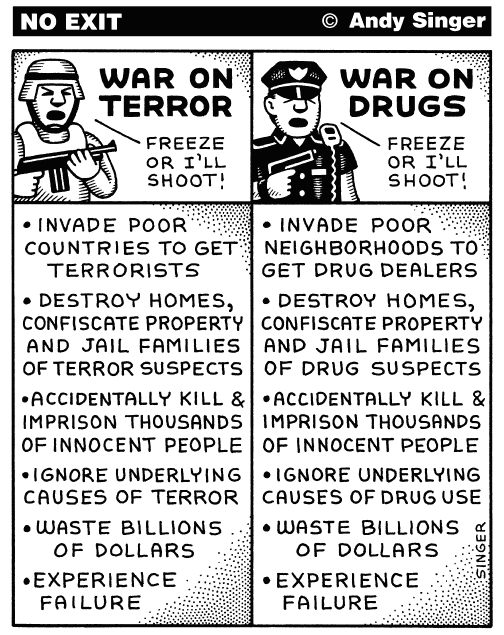
Besides, actually “winning” the drug war would mean ending it. And who in US domestic law enforcement wants to cut off the source of billions in federal aid and military equipment, militarized SWAT teams and unprecedented surveillance and civil forfeiture powers? This is a war meant to go on forever, just like the so-called War on Terror.

The state always encourages moral panic and “wars” on one thing or another in order to keep us afraid, so we’ll give it more power over our lives. Don’t believe its lies.


At the Stuff They Don’t Want You to Know podcast Ben and Matt share their views on the War on Drugs.

mp3 link: http://podcasts.howstuffworks.com/hsw/podcasts/stdwytk-audio/2014-11-14-stdwytk-war-on-drugs.mp3