
Saturday Matinee: Donnie Darko

By Caleb Quass

Source: Medium

Enigma as a thematic device in itself is something I’ve applied to the films of David Lynch and his surrealist ilk, but until my third viewing of Donnie Darko, it’s not something I had considered for Richard Kelly’s debut film. Viewing once again the theatrical cut of the film, I started wondering whether or not the significantly-extended director’s cut could actually offer anything significant in its additional footage, or if it would merely obfuscate such an atmospherically uneasy movie through its clarity.

Like the characters’ immature dialogue and the mostly non-nostalgic depiction of a recently bygone era, the mysterious and almost unknowable nature (at least from casual viewings) of Donnie Darko’s happenings come across as a manifestation of the turbulence and teenage angst that define the titular character (Jake Gyllenhaal). That the film features such subtly brilliant performances and an alluringly spooky atmosphere are just the icing on the cake but just as important in rendering this a truly brilliant film.

Plot summaries have always been weirdly difficult for me, and that’s especially the case with the disorienting stream of events that Donnie Darko offers. The psychologically-unstable social outcast is awakened by a giant bunny rabbit and lead from his bedroom, where shortly after a jet engine mysteriously crashes through the roof in what would have almost certainly been his demise. This “imaginary friend” Frank continually appears and speaks to Donnie, compelling him to commit destructive acts with far-reaching consequences.

All the while, he regularly sees his therapist, forms a relationship with a new student (Jena Malone), experiences “daylight” hallucinations related to time travel, researches time travel via a book written by the town’s unspeaking hermit “Grandma Death” (Patience Cleveland), and generally copes with the frustrations of being a precocious, cynical teenager in a conformist society — all as Frank forebodingly counts down the “28 days, 6 hours, 42 minutes, 12 seconds” until the world ends.

There’s a lot going on, but even as Donnie Darko climaxes without the sort of resolution that audiences may expect, it’s never unwatchable or less than compelling. From the opening minutes of the film where Donnie rides his bike around a darkly-photographed suburbia to the post-punk stylings of Echo and the Bunnymen, a mood is established and never broken. It’s typical Midwest American iconography through the lens of a disillusioned adolescent, and though the slow-motion, pop music-infused high school sequences, as well as the dialogue of aimless friendships and budding romances, are reminiscent of coming-of-age dramadies, Donnie Darko never embraces these things as genuine or even necessarily normal. Scenes have a tendency to bleed into one another with the slightly-hurried pace of the “paranoid schizophrenia” which Donnie’s therapist (Katherine Ross) offers as an explanation for the hallucinations, and the already somewhat downbeat pop music is complimented by a jittery, melancholy score by Michael Andrews.

Perhaps most peculiar of all, though, is the look of the film in general. The interiors of Donnie Darko are just a little too dark, and its daylight scenes just don’t feel sunny, as though constantly threatened by an impending storm. Something is extra dismal and extra drab about every classroom, street, and upper-middle-class household, and though this is an extraordinarily subjective designation, it just looks depressed. Donnie never forms an especially healthy relationship with anyone in the film, and his extrasensory premonitions are apt counterparts to his frustrations with society, labeling as an outsider, and all the implicit complexities of puberty.

Though admirable for its thematic strengths, Donnie Darko ultimately makes its impact through its sneaky emotional core, which continually grows in the background until exploding in the film’s fatalistic conclusion. Here again the movie embraces a pubescent concept, the notion that one’s own life is a direct burden on others, but with a sobering shift in perspective. After his mind-bending odyssey results in the literal death and figurative destruction of multiple people, Donnie’s ultimate fate is to sacrifice himself to undo his supposed harm upon the world, harm which, paradoxically, only occurred through his quest to stop it. On the level of pure logic, this might not make sense, but on a dramatic level, it’s pure poetic tragedy. The film’s “Mad World” montage could have been a miserable failure in its sudden spike in melodrama, but instead it is the culmination of the sorrow and emotional terror that was just beneath the surface all along.

The entirety of human emotion cannot, as the delusional teacher played by Beth Grant suggests, be divided into “fear and love” or any other two extremes. Donnie understood that, but what neither he nor anyone else understands is exactly how it does function. Donnie Darko is a masterpiece not because its convoluted story offers any answers, but because unlike the majority of shallow coming-of-age narratives, it knows that it can’t.
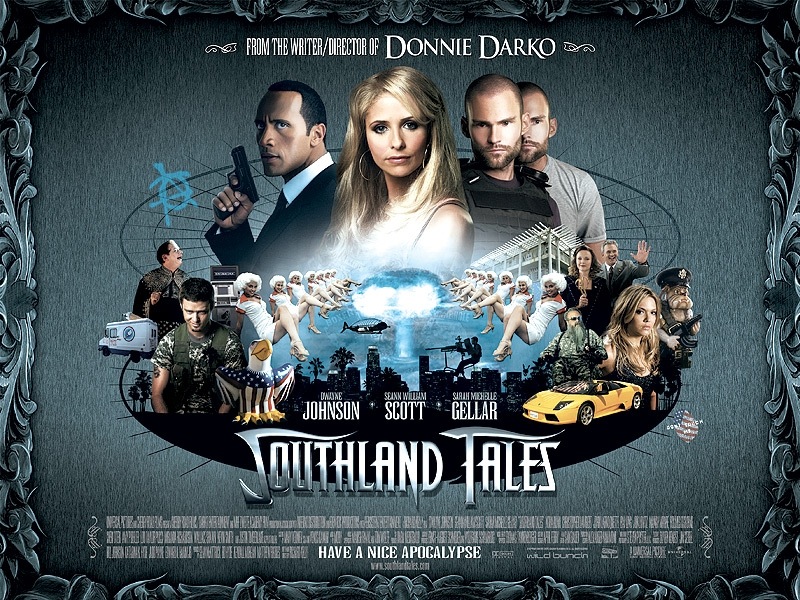
Saturday Matinee: Southland Tales

In defence of Southland Tales – Richard Kelly’s futuristic folly

The director’s much-maligned second feature is a vigorous piece of pulp for the 21st century.

By Dominic Jaeckle

Source: Little White Lies

It’s November 2016, and Richard Kelly is sat in a Los Angeles restaurant dining with a newspaper journalist. They talk a little about the cult consensus surrounding the reissue of his 2001 debut, Donnie Darko, but the main topic on the table is Kelly’s reemergence following a long period of inactivity. Both writer and subject are eager to discuss the director’s ill-fated second feature, Southland Tales, which celebrates its tenth anniversary this year.

Endeavouring to reappraise the film, the journalist would later dub it “a pre-game show for the next decade of global misery” when he finally put pen to paper. Revisiting Southland Tales in 2017, however, it’s not only the speculative powers of the film that sing. What also resonates is the quiet conflict between commercial and contextual providence when we’re trying to read popular cinema, to hold it up against the world.

Kelly’s playbook, defined as it is by hypothetical disorder, frames an associative reservoir of contemporary symbolisms in which critics will swim. Searching for a sense of the inherent value of Southland Tales, some look for its hidden depths; others, the flat veneer of its surface. But the absence of consensus around the film feels entirely appropriate.

Taking the newsfeed as a stylistic turn, Southland Tales weaves together various subplots, dead-ends, and vignettes in the form of a rolling newscast. Set against the backdrop of nuclear war in America – the bomb having landed in Abilene, Texas – we find a country in meltdown. State borders are closed, and extensions of the Patriot Act have allowed intelligence services to function unmonitored. On the west coast, a neo-Marxist revolution is falling into chaotic failure around Venice Beach, and an actor named Boxer Santaros (Dwayne Johnson) – having married the debutante of some Republican house of cards – has lost his memory. Now hiding out in Los Angeles, he runs with Krysta Now (Sarah Michelle Gellar), an ambitious and entrepreneurial ex-porn star.

Together, Gellar and Johnson are penning a screenplay, a cop movie entitled ‘The Power’. But amid its attention to the trappings of genre, the script holds some answers to a spiritual foreboding prompted by an impending energy crisis stayed, only, by the numinous capabilities of a scientist (Wallace Shawn). A figure shrouded in a fog of incense, mystic vagaries and influence owing to the financial backing of a mysterious German multinational.

Seann William Scott stars as two police officers who are not allowed to meet, should they rupture a temporal continuum, and the film is ambiently scored by hotel lobby-era Moby. Justin Timberlake, playing a misanthropic Iraq War veteran, establishes the dynamics of the film’s dénouement. Rather than place or time, Timberlake instead reads us a bastardisation of the Book of Revelation fused, throughout, with misquotes from high-modernist poetry. Repeatedly, he tells us that “this is the way the world ends.”

Southland Tales is a time capsule flirting with end-of-history ideologues. It is a joke on the very idea of the running order of recent history. Self-identifying as a parable playing on a cultural implosion of operatic proportions, it runs as a look-book of early 21st century anxieties. It’s a speculative three-act riff on the catastrophic failings of the last 10 years, a fever dream in two hours and twenty-five minutes. Kelly’s film is a carrion call for a new culture of private consumption. Its characters can do little but watch one another, and the film milks its ignoble examination of mass consumerism through depiction of a dystopian reality defined by tragic inevitability and heavy self-consciousness. “I feel like sometimes things just need time to marinate,” Kelly has said; he always wanted us to read the film forwards.

This is a murky film, no question, but Kelly has suggested that key to understanding its meaning is the intellectual scope of its centrepiece scene: a three-minute dance routine. Around the halfway mark, a doped-out Timberlake slips into an opiate induced coma. In a fantasy sequence – blood down his shirt, Budweiser in hand – he dances through a thoroughly 20th century panorama, a pinball arcade, flanked by a chorus of dancers all legs and vinyl. He looks straight down the camera, lip-syncing his way through The Killer’s ‘All These Things That I’ve Done’, whose anthemic drive is matched only by the empty opacity of its lyrics. “All these things that I’ve done” – the song is about meaning read backwards, the ownership of experience, an inversion of the speculation showcased throughout Southland Tales. The engagement of its terms here feels like a play on use-value; it’s a psalm for our private habits as viewers.

If watching rather than knowing is our active-verb in Southland Tales, then the song proves vital. Meaningless in its aim for universalism, a pop song only resonates in the right room, when played in the right context, and recalling it – personalising its terms – becomes a statement of value. That’s a perfect picture of the vitality of Southland Tales – a vigorous piece of pulp for the 21st century, it courts that very idea. It wants to be used; the film wants to mount a consideration of the cumulative character of meaning, how popular cinema is always contingent on popular feeling.

At first, what we have seems like a mess of ideas. But give it time, let those ideas marinate, and we’re left with something more. Kelly’s joke, still intact 10 years later, is that there will always be a solitary ‘I’ as far as consumption is concerned. In 2007, Southland Tales was simply out of step, waiting for new platforms for personal entertainment, for the semiotic carry-on instigated by streaming cultures. It’s a film honed for the minute when cinema would feel more like a private habit than a public spectacle.


Watch the full film here.