Neocons and Neolibs: How Dead Ideas Kill

hillary-aipac

By Robert Parry

Source: Consortium News

For centuries hereditary monarchy was the dominant way to select national leaders, evolving into an intricate system that sustained itself through power and propaganda even as its ideological roots shriveled amid the Age of Reason. Yet, as monarchy became a dead idea, it still killed millions in its death throes.

Today, the dangerous “dead ideas” are neoconservatism and its close ally, neoliberalism. These are concepts that have organized American foreign policy and economics, respectively, over the past several decades – and they have failed miserably, at least from the perspective of average Americans and people of the nations on the receiving end of these ideologies.

Neither approach has benefited mankind; both have led to untold death and destruction; yet the twin “neos” have built such a powerful propaganda and political apparatus, especially in Official Washington, that they will surely continue to wreak havoc for years to come. They are zombie ideas and they kill.

Yet, the Democratic Party is poised to nominate an adherent to both “neos” in the person of Hillary Clinton. Rather than move forward from President Barack Obama’s unease with what he calls the Washington “playbook,” the Democrats are retreating into its perceived safety.

After all, the Washington Establishment remains enthralled to both “neos,” favoring the “regime change” interventionism of neoconservatism and the “free trade” globalism of neoliberalism. So, Clinton has emerged as the clear favorite of the elites, at least since the field of alternatives has narrowed to populist billionaire Donald Trump and democratic socialist Bernie Sanders.

Democratic Party insiders appear to be counting on the mainstream news media and prominent opinion-leaders to marginalize Trump, the presumptive Republican nominee, and to finish off Sanders, who faces long odds against Clinton’s delegate lead for the Democratic nomination, especially among the party regulars known as “super-delegates.”

But the Democratic hierarchy is placing this bet on Clinton in a year when much of the American electorate has risen up against the twin “neos,” exhausted by the perpetual wars demanded by the neoconservatives and impoverished by the export of decent-paying manufacturing jobs driven by the neoliberals.

Though much of the popular resistance to the “neos” remains poorly defined in the minds of rebellious voters, the common denominator of the contrasting appeals of Trump and Sanders is that millions of Americans are rejecting the “neos” and repudiating the establishment institutions that insist on sustaining these ideologies.

The Pressing Question

Thus, the pressing question for Campaign 2016 is whether America will escape from the zombies of the twin “neos” or spend the next four years surrounded by these undead ideas as the world lurches closer to an existential crisis.

The main thing that the zombie “neos” have going for them is that the vast majority of Very Important People in Official Washington have embraced these concepts and have achieved money and fame as a result. These VIPs are no more likely to renounce their fat salaries and overblown influence than the favored courtiers of a King or Queen would side with the unwashed rabble.

The “neo” adherents are also very skilled at framing issues to their benefit, made easier by the fact that they face almost no opposition or resistance from the mainstream media or the major think tanks.

The neoconservatives have become Washington’s foreign policy establishment, driving the old-time “realists” who favored more judicious use of American power to the sidelines.

Meanwhile, the neoliberals dominate economic policy debates, treating the “markets” as some new-age god and “privatization” of public assets as scripture. They have pushed aside the old New Dealers who called for a robust government role to protect the people from the excesses of capitalism and to build public infrastructure to benefit the nation as a whole.

The absence of any strong resistance to the now dominant “neo” ideologies is why we saw the catastrophic “group think” over Iraq’s WMD in 2003 and why for many years no one of great significance dared question the benefits of “free trade.”

After all, both strategies benefited the elites. Neoconservative warmongering diverted trillions of dollars into the Military-Industrial Complex and neoliberal job outsourcing has made billions of dollars for individual corporate executives and stock investors on Wall Street.

Those interests have, in turn, kicked back a share of the proceeds to fund Washington think tanks, to finance news outlets, and to lavish campaign donations and speaking fees on friendly politicians. So, for the insiders, this game has been a case of win-win.

The Losers

Not so much for the “losers,” those average citizens who have seen the Great American Middle Class hollowed out over the past few decades, watched America’s public infrastructure decay, and worried about their sons and daughters being sent off to fight unnecessary, perpetual and futile wars.

But inundated with clever propaganda – and scrambling to make ends meet – most Americans see the reality as if through a glass darkly. Many of them, as Barack Obama indelicately said during the 2008 campaign, “cling to guns or religion.” They have little else – and many are killing themselves with opiates that dull their pain or with those guns that they see as their last link to “freedom.”

What is clear, however, is that large numbers don’t trust – and don’t want – Hillary Clinton, who had a net 24-point unfavorable rating in one recent poll. It turns out that another indelicate Obama comment from Campaign 2008 may not have been true, when he vouched that “you’re likable enough, Hillary.” For many Americans, that’s not the case (although Trump trumped Clinton with a 41-point net negative).

If the Democrats do nominate Hillary Clinton, they will be hoping that the neocon/neolib establishment can so demonize Donald Trump that a plurality of Americans will vote for the former Secretary of State out of abject fear over what crazy things the narcissistic billionaire might do in the White House.

Trump’s policy prescriptions have been all over the place – and it is hard to know what reflects his actual thinking (or his genuine ignorance) as opposed to what constitutes his skillful showmanship that made him the “survivor” in the real-life reality TV competition for the Republican nomination.

Does Trump really believe that global warming is a hoax or is he just pandering to the know-nothing element of the Republican Party? Does he actually consider Obama’s Iran nuclear deal to be a disaster or is he just playing to the hate-Obama crowd on the Right?

Opposing the ‘Neos’

But Trump is not a fan of the “neos.” He forthrightly takes on the neocons over the Iraq War and excoriates ex-Secretary of State Clinton for her key role in another “regime change” disaster in Libya. Further, Trump calls for cooperation with Russia and China rather than the neocon-preferred escalation of tensions.

In his April 27 foreign policy speech, Trump called for “a new foreign policy direction for our country – one that replaces randomness with purpose, ideology with strategy, and chaos with peace. …It’s time to invite new voices and new visions into the fold. …

“My foreign policy will always put the interests of the American people, and American security, above all else. That will be the foundation of every decision that I will make. America First will be the major and overriding theme of my administration.”

Such comments – suggesting that “new voices” are needed and that “ideology” should be cast aside – were fighting words for the neocons, since it is their voices that have drowned out all others and their ideology that has dominated U.S. foreign policy in recent years.

To make matters worse, Trump outlined an “America First” strategy in contrast to neocon demands that the U.S. military be dispatched abroad to advance the interests of Israel and other “allies.” Trump is not interested in staging “regime changes” to eliminate leaders who are deemed troublesome to Israel.

The real estate tycoon also has made criticism of “free trade” deals a centerpiece of his campaign, arguing that those agreements have sold out American workers by forcing them to compete with foreign workers receiving a fraction of the pay.

Sen. Sanders has struck similar themes in his insurgent Democratic campaign, criticizing Hillary Clinton’s longtime support for “free trade” and her enthusiasm for “regime change” wars, such as those in Iraq and Libya.

Examining her long record in public life, there can be little doubt that Clinton is a neocon on foreign policy and a neolib on economic strategies. She stands firmly with the consensus of Official Washington’s establishment, which is why she has enjoyed its warm embrace.

She has followed Wall Street’s beloved neoliberal attitude toward “free trade,” which has been very good for multinational corporations as they shipped millions of U.S. manufacturing jobs to low-wage countries. (She has only cooled her ardor for trade deals to stanch the flow of Democratic voters to Bernie Sanders.)

Wars and More Wars

On foreign policy, Clinton has consistently supported neoconservative wars, although she might shy from the neocon label per se, preferring its less noxious synonym “liberal interventionist.”

But as arch-neocon Robert Kagan, who has recast himself as a “liberal interventionist,” told The New York Times in 2014, “I feel comfortable with her on foreign policy. If she pursues a policy which we think she will pursue it’s something that might have been called neocon, but clearly her supporters are not going to call it that; they are going to call it something else.”

Summing up the feeling of thinkers like Kagan, the Times reported that Clinton “remains the vessel into which many interventionists are pouring their hopes.”

In February 2016, distraught over the rise of Trump, Kagan, whose Project for the New American Century wrote the blueprint for George W. Bush’s Iraq War, openly threw his support to Clinton, announcing his decision in a Washington Post op-ed.

And Kagan is not mistaken when he views Hillary Clinton as a fellow-traveler. She has often marched in lock step with the neocons as they have implemented their aggressive “regime change” schemes against governments and political movements that don’t toe Washington’s line or that deviate from Israel’s goals in the Middle East.

She has backed coups, such as in Honduras (2009) and Ukraine (2014); invasions, such as Iraq (2003) and Libya (2011); and subversions such as Syria (from 2011 to the present) all with various degrees of disastrous results. [For more details, see Consortiumnews.com’s “Yes, Hillary Clinton Is a Neocon” and “Would a Clinton Win Mean More Wars?”]

Seeking ‘Coercion’

A glimpse of what a Clinton-45 presidency might do could be seen in a recent Politico commentary by Dennis Ross, a former special adviser to Secretary of State Clinton now working at the staunchly pro-Israel Washington Institute for Near East Policy.

In the article, Ross painted a surreal world in which the problems of the Middle East have been caused by President Obama’s hesitancy to engage militarily more aggressively across the region, not by the neocon-driven decision to invade Iraq in 2003 and the similar schemes to overthrow secular governments in Libya and Syria in 2011, leaving those two countries in ruin.

Channeling the desires of right-wing Israeli Prime Minister Benjamin Netanyahu, Ross called for the United States to yoke itself to the regional interests of Israel, Saudi Arabia and other members of the Gulf Cooperation Council (GCC) in their rivalry against Shiite-led Iran.

Ross wrote: “Obama believes in the use of force only in circumstances where our security and homeland might be directly threatened. His mindset justifies pre-emptive action against terrorists and doing more to fight the Islamic State. But it frames U.S. interests and the use of force to support them in very narrow terms. …

“The Saudis acted in [invading] Yemen in no small part because they feared the United States would impose no limits on Iranian expansion in the area, and they felt the need to draw their own lines.”

To counter Obama’s hesitancy to apply military force, Ross calls for a reassertion of a muscular U.S. policy in the Middle East, much along the lines that the neocon establishment and Hillary Clinton also favor, including:

–Threatening Iran with “blunt, explicit language on employing force, not sanctions” if Iran deviates from the Obama-negotiated agreement to constrain its nuclear program (the bomb-bomb-bomb-Iran zombie lives!);

–“Contingency planning with GCC states and Israel … to generate specific options for countering Iran’s growing use of Shiite militias to undermine regimes in the region”;

–A readiness to arm Sunni tribes in Iraq if Iraq’s prime minister doesn’t;

–Establish “safe havens with no-fly zones” inside Syria if Russian President Vladimir Putin does not force Syrian President Bashar al-Assad to step down.

Employing the classic tough talk of the neocons, Ross concludes, “Putin and Middle Eastern leaders understand the logic of coercion. It is time for us to reapply it.”

One might note the many logical inconsistencies of Ross’s arguments, including his failure to note that much of Iran’s supposed meddling in the Middle East has involved aiding the Syrian and Iraqi governments in their battle against the Islamic State and Al Qaeda. Or that Russia’s intervention in Syria also has been to support the internationally recognized government in its fight against Sunni extremists and terrorists.

But the significance of Ross’s prescription to “reapply” U.S. “coercion” across the region is that he is outlining what the world can expect from a Clinton-45 presidency.

Clinton made many of the same points in her speech before the American Israel Public Affairs Committee and in debates with Bernie Sanders. If she stays on that track as president, there would be at least a partial U.S. military invasion of Syria, a very strong likelihood of war with Iran, and an escalation of tensions (and possible war) with nuclear-armed Russia.

The logic of how all that is supposed to improve matters is lost amid the classic neocon growling about showing toughness or reapplying “coercion.”

So, the Democratic Party seems to be betting that Hillary Clinton’s flood of ugly TV ads against Trump can frighten the American people enough to give the neocons and the neolibs one more lease on the White House – and four more years to wreak their zombie havoc on the world.


Investigative reporter Robert Parry broke many of the Iran-Contra stories for The Associated Press and Newsweek in the 1980s. You can buy his latest book, America’s Stolen Narrative, either in print here or as an e-book (from Amazon and barnesandnoble.com).
There Will Be No Lesser Evil

a1e0lul3thq1zmgdlw7q

By Jack Balkwill

Source: Dissident Voice

Damned by a corrupt system, it appears voters will be given a choice between Hillary Clinton and her friend Donald Trump this year, with no realistic alternative allowed by corporate media and their establishment patrons.

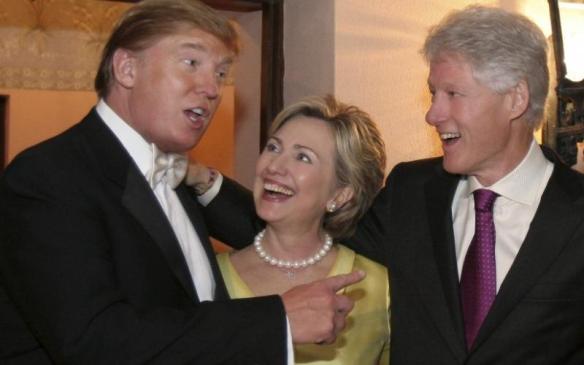
I say “friend” because the Clintons and Trumps have a relationship going back for years.

Seeing Trump as their enemy, many liberals are opining that Hillary is the lesser evil, saying they will vote for her.

I am not so sure Hilary’s the lesser evil.  I told friends years ago that I thought she would be the next president.  Long before she announced she would run again, corporate media repeatedly suggested her inevitability, tipping off that the establishment is firmly behind her by pushing her candidacy.

The establishment wants her badly, as she may be counted on to sell out the environment, enrich defense cheats and give the banksters direct access to the treasury among other corrupt things indicated by the Clinton past.  After her husband sold out the poor and working classes during his presidency, Bill and Hillary got rich from corporate speeches, the preferred delayed bribe for official corruption in The Land of the Free, in this case amounting to over a hundred million dollars for the pair.

Even Republicans are saying they will vote for her instead of Trump.  Because she is to the right of Richard Nixon, this will not be difficult for them (compare what Bill Clinton signed into law to Nixon’s bills, and there is no contest – all the while Hillary claiming the American people got two for the price of one).

As for The Donald, he’s often boasted that he rented Hillary’s vote when she was a New York senator, through several campaign donations (his son also contributed).  Trump also donated to her 2008 presidential campaign when she ran against Obama.  He calls her “Crooked Hillary,” and you can bet he will campaign hard against her with that slogan.

Not that they’ve been enemies.

On the Daily Show last year, Bill Clinton said of Trump, “He thought Hillary was a good senator for New York after 9/11 and he has actually, he’s one of the many Republicans who supported our foundation before they got the memo.”

A picture search shows Bill Clinton with his golf buddy Trump, Bill and Hillary posing beside Donald and his wife Melania, and even daughters Chelsea and Ivanka as close friends, although, like their parents, they are not socializing during the campaign, as part of the insider scam to convince voters that the Democrats and Republicans are somehow not connected.

National archives released last month show that when President, Bill Clinton posed with Trump at Trump Towers for a photo shoot, and Trump made several visits to the White House though we may never know what was on the table.  Trump would perform a magnificent public service if he disclosed what deals were made, but one wonders if he’d go to prison with the Clintons were such disclosures made.

One is reminded that, during the 2008 presidential campaign, Bill Clinton, thinking his wife was going to win the Democratic nomination, remarked that he didn’t know how she was going to run against her close friend John McCain.  It’s happening again, with corporate media playing their usual role of not noticing that both candidates are vying to see who gets to sell out the working class on behalf of a stifling plutocratic oligarchy.

Corporate media pretends like the Democrats and Republicans are at each other’s throats, but it should be obvious to anyone who digs a bit beyond the propaganda, that they are in bed with each other and represent the same interests – selling out the American people, primarily for money.

Rupert Murdoch’s New York Post has endorsed Trump, but the right wing billionaire gave a big fundraiser for Hillary Clinton when she ran in 2008, so it’s all one happy family.  The billionaires and transnational corporations make sure both sides are obligated in what corporate media play up as “free and fair elections.”

The polls reveal that Hillary and The Donald are two of the most unpopular candidates imaginable, with most Americans despising both. The two have appeared on television more than all other candidates combined, so they’ve been largely catapulted to the top by the corporate media, who pretend to be objective journalists.

Has anyone seen Jill Stein at all on television?  Polling shows she is for bringing the troops home and shutting down the wars, just like what the American people say they want in polling.  Corporate media is making certain she is hidden behind the curtain, as they whine that they just don’t understand how such unpopular candidates as Clinton and Trump have become finalists.

Will Trumps and Clintons go back to being friends after the election?  Probably not, as it looks like this battle will be the biggest mud fight in US presidential history, the only certainty that someone extremely unpopular will win the right to sell us out.


Jack Balkwill is an activist in Virginia. He can be reached at libertyuv@hotmail.com Read other articles by Jack.

Hillary Clinton’s Business of Corporate Shilling & War Making

download

Source: Media Roots

As the circus of the 2016 presidential election grinds on, Hillary Clinton has posited herself as the candidate of the people. But not many “candidates of the people” have vacation homes in the Hamptons that cost $200,000 per month, or hang out with the world’s billionaires.

It’s hard to know who she is really–while once being a proponent of Donald Trump type positions, like building a wall at the Mexican border, supporting torture, and opposing same-sex marriage until 2013, today she presents herself as the anti-Trump, anti-Republican candidate.

There’s been a lot of outrage about the impression that the establishment has already anointed her as the Democratic nominee, and has carved out her path to the presidency.

But like in 2008, her guaranteed seat on the throne is being derailed by the unpredictable moods of the masses, and millions of young progressive voters. She continues to play her shape shifting game, morphing her positions to try to capture the support for her opponent, but the real Hillary is still inside.

In fact, every layer of Hillary’s career shows why, far from being a candidate of the people, she’s the top pick by corporations to do the real job of any US president: CEO of the Empire.

Digging deep into Hillary’s connections to Wall Street, Abby Martin reveals how the Clinton’s multi-million-dollar political machine operates. This episode of The Empire Files chronicles the Clinton’s rise to power in the 90s on a right-wing agenda, the Clinton Foundation’s revolving door with Gulf state monarchies, corporations and the world’s biggest financial institutions, and the establishment of the hyper-aggressive “Hillary Doctrine” while Secretary of State.

Thomas Frank on How Democrats Went From Being the ‘Party of the People’ to the Party of Rich Elites

download

Democrats have gone from the party of the New Deal to a party that is defending mass inequality.

By Tobita Chow

Source: In These Times

The Democratic Party was once the party of the New Deal and the ally of organized labor. But by the time of Bill Clinton’s presidency, it had become the enemy of New Deal programs like welfare and Social Security and the champion of free trade deals. What explains this apparent reversal? Thomas Frank—best known for his analysis of the Republican Party base in What’s the Matter with Kansas?attempts to answer this question in his latest book, Listen Liberal: Or, What Ever Happened to the Party of the People?

According to Frank, popular explanations which blame corporate lobby groups and the growing power of money in politics are insufficient. Frank instead points to a decision by Democratic Party elites in the 1970s to marginalize labor unions and transform from the party of the working class to the party of the professional class. In so doing, the Democratic Party radically changed the way it understood social problems and how to solve them, trading in the principle of solidarity for the principle of competitive individualism and meritocracy. The end result is that the party which created the New Deal and helped create the middle class has now become “the party of mass inequality.” In These Times spoke with Frank recently about the book via telephone.

The book is about how the Democratic Party turned its back on working people and now pursues policies that actually increase inequality. What are the policies or ideological commitments in the Democratic Party that make you think this?

The first piece of evidence is what’s happened since the financial crisis. This is the great story of our time. Inequality has actually gotten worse since then, which is a remarkable thing. This is under a Democratic president who we were assured (or warned) was the most liberal or radical president we would ever see.  Yet inequality has gotten worse, and the gains since the financial crisis, since the recovery began, have gone entirely to the top 10 percent of the income distribution.

This is not only because of those evil Republicans, but because Obama played it the way he wanted to. Even when he had a majority in both houses of Congress and could choose whoever he wanted to be in his administration, he consistently made policies that favored the top 10 percent over everybody else. He helped out Wall Street in an enormous way when they were entirely at his mercy.

He could have done anything he wanted with them, in the way that Franklin Roosevelt did in the ‘30s. But he chose not to.

Why is that? This is supposed to be the Democratic Party, the party that’s interested in working people, average Americans. Why would they react to a financial crisis in this way? Once you start digging into this story, it goes very deep. You find that there was a transition in the Democratic Party in the ‘70s, 80’s and ‘90s where they convinced themselves that they needed to abandon working people in order to serve a different constituency: a constituency essentially of white-collar professionals.

That’s the most important group in their coalition. That’s who they won over in the ’70s, ’80s and ’90s. That’s who they serve, and that’s where they draw from. The leaders of the Democratic Party are always from this particular stratum of society.

A lot of progressives that I talk to are pretty familiar with the idea that the Democratic Party is no longer protecting the interests of workers, but it’s pretty common for us to blame it on mainly the power of money in politics. But you start the book in chapter one by arguing there’s actually something much deeper going on. Can you say something about that?

Money in politics is a big part of the story, but social class goes deeper than that. The Democrats have basically made their commitment [to white-collar professionals] already before money and politics became such a big deal. It worked out well for them because of money in politics. So when they chose essentially the top 10 percent of the income distribution as their most important constituents, that is the story of money.

It wasn’t apparent at the time in the ‘70s and ‘80s when they made that choice. But over the years, it has become clear that that was a smart choice in terms of their ability to raise money. Organized labor, of course, is no slouch in terms of money. They have a lot of clout in dollar terms. However, they contribute and contribute to the Democrats and they almost never get their way—they don’t get, say, the Employee Free Choice Act, or Bill Clinton passes NAFTA. They do have a lot of money, but their money doesn’t count.

All of this happened because of the civil war within the Democratic Party. They fought with each other all the time in the ‘70s and the ‘80s. One side hadn’t completely captured the party until Bill Clinton came along in the ‘90s. That was a moment of victory for them.

Bill Clinton’s presidency is what progressives usually cite as the time when things went bad. But there’s a trend that goes back to the ’70s, right?

Historians always cite the ’68 election as the turning point. The party was torn apart by the controversy over the Vietnam war, protesters were in the streets in Chicago and the Democratic candidate Hubert Humphrey went on to lose. Democrats thought this was terrible, and it was. So they set up a commission to reorganize the party, the McGovern Commission.

The McGovern Commission basically set up our modern system of primaries. Before the commission, we didn’t have these long primary contests in state after state after state. Primaries are a good thing, as were most things the McGovern Commission did.

But they also removed organized labor from its structural position of power in the Democratic Party. There was a lot of resentment towards labor during the Vietnam War. A lot of unions took President Johnson’s side on Vietnam. There was also this sense—which I think was correct at the time—that labor was a dinosaur, that it was out of touch and undemocratic and very white.

There were a lot of reasonable objections to organized labor at the time. The problem is, when you get rid of labor in your party, you also get rid of issues that matter to working people. That’s the basic mistake that Democrats made in the ’70s. Of course, labor still is a big part of the Democratic coalition—it gives them their money, it helps out at election time in a huge way. But unions no longer have the presence in party councils that they used to. That disappeared.

One of the most shocking quotes in the book is from Alfred Kahn, an advisor to Jimmy Carter, who said, “I’d love the Teamsters to be worse off. I’d love the automobile workers to be worse off.” He then basically says that unionized workers are exploiting other workers.

Isn’t that amazing? He’s describing a situation in the 1970s. There was all this controversy in the 1970s about labor versus management—this was the last decade where those fights were front and center in our national politics. And he’s coming down squarely on the side of management in those fights.

And remember, Kahn was a very important figure in the Carter administration. The way that he describes unions is incorrect—he’s actually describing professionals. Professionals are a protected class that you can’t do anything about—they’re protected by the laws of every state that dictate who can practice in these fields. It’s funny that he projects that onto organized labor and holds them responsible for the sins of another group.

This is a Democrat in an administration that is actually not very liberal. This is the administration that carried out the first of the big deregulations. This is the administration that had the great big capital gains tax cuts, that carried out the austerity plan that saw the Federal Reserve jack its interest rates sky high. They clubbed the economy to the ground in order to stop “wage inflation,” in which workers, if they have enough power, can keep demanding higher wages. It was incredible.

What’s the content of the ideology of the professional class and how does it hurt working people? What are their guiding principles?

The first commandment of the professional class is the idea of meritocracy, which allows people to think that those on top are there because they deserve to be. With the professional class, it’s always associated with education. They deserve to be there because they worked really hard and went to a good college and to a good graduate school. They’re high achievers. Democrats are really given to credentialism in a way that Republicans aren’t.

If you look at the last few Democratic presidents, Bill Clinton and Obama, and Hillary Clinton as well, their lives are a tale of educational achievement. This is what opened up the doors of the world to them. It’s a party of who people who have gotten where they are by dint of educational accomplishment.

This produces a set of related ideas. When the Democrats, the party of the professionals, look at the economic problems of working-class people, they always see an educational problem, because they look at working class people and say, “Those people didn’t do what I did”: go and get advanced degrees, go to the right college, get the high SAT scores and study STEM or whatever.

There’s another interesting part of this ideology: this endless search for consensus. Washington is a city of professionals with advanced degrees, and Democrats look around them there and say, “We’re all intelligent people. We all went to good schools. We know what the problems are and we know what the answers are, and politics just get in the way.”

This is a very typical way of thinking for the professional class: reaching for consensus, because politics is this ugly thing that you don’t really need. You see this in Obama’s endless efforts to negotiate a grand bargain with Republicans because everybody in Washington knows the answers to the problems—we just have to get together, sit down and make an agreement. The same with Obamacare: He spent so many months trying to get Republicans to sign on, even just one or two, so that he could say it was bipartisan. It was an act of consensus. And the Republicans really played him, because they knew that’s what he’d do.

To go back to your point about education: At one point you quote Arne Duncan, who was Obama’s secretary of education, saying that the only way to end poverty is through education. Why can’t that work?

The big overarching problem of our time is inequality. If you look at historical charts of productivity and wage growth, these two things went hand in hand for decades after World War II, which we think of as a prosperous, middle-class time when even people with a high school degree, blue-collar workers, could lead a middle class life. And then everything went wrong in the 1970s. Productivity continued to go up and wage growth stopped. Wage growth has basically been flat ever since then. But productivity goes up by leaps and bounds all the time. We have all of these wonderful technological advances. Workers are more productive than ever but they haven’t benefited from it. That’s the core problem of inequality.

Now, if the problem was that workers weren’t educated enough, weren’t smart enough, productivity would not be going up. But that productivity line is still going up. So we can see that education is not the issue.

It’s important that people get an education, of course. I spent 25 years of my life getting an education. It’s basic to me. It’s a fundamental human right that people should have the right to pursue whatever they want to the maximum extent of their individual potential. But the idea that this is what is holding them back is simply incorrect as a matter of fact. What’s holding them back is that they don’t have the power to demand higher wages.

If we talk about the problem as one of education rather than power, then the blame goes back to these workers. They just didn’t go out and work hard and do their homework and get a gold star from their teacher. If you take the education explanation for inequality, ultimately you’re blaming the victims themselves.

Unfortunately, that is the Democratic view. That’s why Democrats have essentially become the party of mass inequality. They don’t really have a problem with it.

So really, the solution would have to be solidarity and organized power.

That was an essential point that I try to make in Listen Liberal: that there is no solidarity in a meritocracy. A meritocracy really is every man for himself.

Don’t get me wrong. People at the top of the meritocracy, professionals, obviously have enormous respect for one another. That is the nature of professional meritocracy. They have enormous respect for the people at the top, but they feel very little solidarity for people beneath them who don’t rise in the meritocracy.

Look at the white-collar workplace. If some professional gets fired, the other professionals don’t rally around and go on strike or protest or something like that. They just don’t do that. They feel no solidarity because everything goes back to you and whether or not you’ve made the grade. If somebody gets fired, they must’ve deserved it somehow.

I have my own personal experience. Look at academia over the last 20 years. They’re cranking out these Ph.D.s in the humanities who can’t get jobs on tenure track and instead have to work as adjuncts for very low pay, no benefits. One of the fascinating parts about this is that, with a few exceptions, the people who do have tenure-track jobs and are at the top of their fields, do very little about what’s happened to their colleagues who work as adjuncts. Essentially this is the Uberizing of higher education. The professionals who are in a position of authority have done almost nothing about it. There are academics here and there who feel bad about what’s happened to adjuncts and do say things about it, but by and large, overall, there is no solidarity in that meritocracy. They just don’t care.

Do you think there’s a connection between the fact that the Democratic Party has turned against workers and the rise of Donald Trump?

Yes. Because if you look at the polling, Trump is winning the votes of a lot of people who used to be Democrats. These white, working-class people are his main base of support. As a group, these people were once Democrats all over the country. These are Franklin Roosevelt’s people. These are the people that the Democrats essentially decided to turn their backs on back in the 1970s. They call them the legatees of the New Deal. They were done with these guys, and now look what’s happened—they’ve gone with Donald Trump. That’s frightening and horrifying.

But Trump talks about their issues in a way that they find compelling, especially the trade issue. When he talks about trade, they believe him. Ironically, he’s saying the same things that Hillary Clinton and Bernie Sanders are saying about trade, but for whatever reason people find him more believable on this subject than they do Hillary Clinton.

Do you think that the rise of the Bernie campaign could herald a new era in the history of the Democratic Party?

I hope so. Both Trump and Bernie are turning their respective parties upside down. What Bernie is doing is very impressive. I interviewed him a few years ago and have always admired him. I think he’s a great man. To think that he could beat a Clinton in a Democratic primary anywhere in this country, let alone many primaries, was unthinkable a short time ago. And he’s done it without any Wall Street or big-business backing. That is extraordinary. It shows the kind of desperation that’s out there.

He has shown the way, and whether he gets the nomination or not (he probably won’t), there’ll be another Bernie four years from now. And there’ll also be another Trump. The Republican Party is being turned on its head much more violently than the Democrats. Hillary will probably get the nomination. I live in Washington, D.C., and I spend time around Hillary-style Democrats. They really think that they’ve got this thing in the bag. And I don’t just mean her versus Bernie. I mean the Democratic Party winning the presidency for the rest of our lives. From here to eternity. They can choose whoever they want. They could nominate anybody and they would win. They think they’re in charge.

One of your villains from the ’70s is Frederick Dutton, who wrote a book about how the Democratic Party needed to realign itself. You have a quote from him saying, “Every major realignment in U.S. political history has been accompanied by the coming of a large new group into the electorate.” You’re very critical of how he uses that idea in the ‘70s. But if you look at the newer voters attached to the Bernie campaign, it looks like the Democratic Party is experiencing something like that now.

Yes, in both cases you’re talking about a generational shift. That’s what he meant in 1971. He was talking about the counterculture and the “Now Generation” and the idea that they would come into the electorate and demand a different kind of politics—specifically his kind of politics.

Everybody always sees this new group that’s coming in as supporting what they want. That’s what he thought. I have a certain amount of contempt for that. Many years ago I wrote a book about the counterculture and how it was used for this purpose—specifically by the advertising industry. But Bernie’s doing the same thing. He’s using it for his own purposes.

Millenials’ take on the world is fascinating. Just a few years ago, people thought of them as very different. But now they’re coming out of college with enormous student debt, and they’re discovering that the job market is casualized and Uberized. The work that they do is completely casual. The idea of having a middle-class lifestyle in that situation is completely off the table for them.

Every time I think about these people, it burns me up. It makes me so angry what we’ve done to them as a society. It really gives the lie to Democratic Party platitudes about the world an education will open up for you. That path just doesn’t work anymore. Millenials can see that in their own lives very plainly.

So I’m very excited that they’re pro-Bernie. They really are the future.


Tobita Chow is chair of The People’s Lobby, an independent political organization based in Chicago, and co-author of “The Movement We Need,” a pamphlet on analysis and strategy for the progressive movement. He has been involved in faith-based community organizing on the South Side of Chicago since 2009, and is a leader in the “Moral Mondays Illinois” campaign against state budget cuts. He is an MDiv student at the Lutheran School of Theology at Chicago.

Trump and Hillary Refuse to Explain Why They Both Share the Same Address in Delaware

a1e0lul3thq1zmgdlw7q

By Claire Bernish

Source: AntiMedia

As it turns out, Hillary Clinton and Donald Trump share something pertinent in common, after all — a tax haven cozily nested inside the United States.

This brick-and-mortar, nondescript two-story building in Wilmington, Delaware would be awfully crowded if its registered occupants — 285,000 companies — actually resided there. What’s come to be known as the “Delaware loophole” — the unassuming building at 1209 North Orange Street — has become, as the Guardian described, “famous for helping tens of thousands of companies avoid hundreds of millions of dollars in tax.” 

Reportedly dozens of Fortune 500 companies — Coca-Cola, Walmart, American Airlines, and Apple, to name a few — use Delaware’s strict corporate secrecy laws and legal tax loopholes by registering the North Orange Street address for official business.

“Big corporations, small-time businesses, rogues, scoundrels, and worse — all have turned up at the Delaware address in hopes of minimizing taxes, skirting regulations, plying friendly courts or, when needed, covering their tracks,” the New York Times’ Leslie Wayne described in 2012. “It’s easy to set up shell companies here, no questions asked.”

While the legitimacy of taxes as a concept may be up to personal interpretation, what matters in Clinton’s use of the so-called Delaware loophole, in particular, is her constant harping on the need for corporations and elite individuals to pay their fair share. In other words, Clinton’s employment of North Orange Street amounts to a telling, Do As I Say, Not As I Do. And, as the Guardian notes, both of “the leading candidates for president – Hillary Clinton and Donald Trump – have companies registered at 1209 North Orange, and have refused to explain why.”

As Rupert Neate explained for the Guardian, being registered in the tiny state allows “companies to legally shift earnings from other states to Delaware, where they are not taxed on non-physical incomes generated outside of state.”

In fact, some have claimed — all revelations of Panamanian documents aside — the use of tax-friendly locations inside the U.S. makes it the biggest tax haven in the world, with Delaware, alone, costing other states some $9 billion in lost taxes over the past decade. Clinton has repeatedly touted the needs for tax transparency and to shut down foreign havens with similar loopholes.

“Some of you may have just heard about these disclosures about outrageous tax havens and loopholes and superrich people across the world are exploiting in Panama and elsewhere,” Clinton told the Pennsylvania AFL-CIO annual Constitutional Convention earlier this month. “We are going after all these scams and make sure everyone pays their fair share here in America.”

Oh, the irony.

According to Neate, a Clinton spokesman explained, “ZFS [Holdings, LLC] was set up when Secretary Clinton left the State Department as an entity to manage her book and speaking income. No federal, state, or local taxes were saved by the Clintons as a result of this structure.”

Why, if what the spokesman claims to be true, would Clinton bother using an address in Delaware?

Of the 515 companies Trump officially registered with the Federal Election Commission, “We have 378 entities registered in the state of Delaware,” the billionaire told the Guardian, “meaning I pay you a lot of money, folks. I don’t feel guilty at all, OK?”

Delaware’s incredibly business-friendly structure that allows for such a crowded address is completely legal, though the ability to create shell corporations lends to shady dealings and is “a magnet … which individuals and corporations can use to evade an inestimable amount in federal and foreign taxes,” as a report by the Institute on Taxation and Foreign Policy has described.

Still, Clinton’s constant moralizing on tax transparency — and her spokesperson’s claims she hasn’t benefited from the North Orange Street address — proves, yet again, her stances offer little in the way of a solid foundation.

2016: The Year the Americans Found out Our Elections Are Rigged

march_of_tyranny

“Now it’s just an oligarchy, with unlimited political bribery being the essence of getting the nominations for president or to elect the president. And the same thing applies to governors, and U.S. senators and congress members.” – Former President Jimmy Carter

By Nick Bernabe

Source: AntiMedia

The 2016 election has been a wild ride, with two insurgent grassroots campaigns literally giving the political establishment a run for its money. But as the events of this presidential primary season play out, it’s becoming clear the U.S. election — and even more so, the presidential race — is a big scam being perpetrated on the American people.

Events from the last week have exposed the system as an illusion of choice and a farce. They have reinforced at least one study showing the U.S. is an oligarchy rather than a democratic republic.

The Wyoming democratic caucus took place on Saturday, purportedly to allow voters to have their voices heard in the race between Bernie Sanders and Hillary Clinton. Sanders lost the Wyoming caucus by winning it with a 12 percent margin.

Wait, what?

How does one lose by winning 56 percent of the votes? This happens when the political process is, according to the New York Post, “rigged” by superdelegates. The Post summed up this “strange” phenomenon:

“[U]nder the Democratic Party’s oddball delegate system, Sanders’ winning streak — he has won seven out of the past eight contests — counts for little.

“In fact, despite his win, he splits Wyoming’s 14 pledged delegates 7 to 7 under the caucus calculus.

“Clinton, meanwhile, also gets the state’s four superdelegates — who had already pledged their allegiance to her in January. So despite ‘losing,’ she triumphs 11-7 in the delegate tally.”

Even media pundits on MSNBC openly called the process rigged:

The superdelegate process is complicated, as we’ve noted before, but they have one essential function: to prevent candidates like Bernie Sanders from winning the Democratic nomination.

Don’t believe me? Here’s a video of Democratic National Committee chairwoman Debbie Wasserman Schultz explaining superdelegates:

Adding insult to injury, even when Sanders does win states (despite Hillary’s advantage in superdelegates), the media can be reliably counted on to discount Sanders’s wins as nothing more than prolonging the electoral process, which will inevitably elect the presumptive nominee, Hillary Clinton. This pervasive commentary continues despite the fact Sanders only trails her by several hundred pledged delegates.

Meanwhile, according to the same media, the non-establishment Trump campaign is threatened every time Ted Cruz beats him — even though Trump leads by a larger percentage of pledged delegates than Clinton does. When Clinton loses, it doesn’t matter because she already has the nomination locked up. When Trump loses, his campaign is in big trouble. Starting to see the problem with the media coverage?

When you examine these media narratives, a troubling pattern emerges that goes beyond the political establishment’s self-interest. You begin to see that American corporate media also functions as an arm of the political machine, protecting establishment candidates while attacking — or dismissing — candidates who seem non-establishment.

This brings us to the events that transpired during the Republican nomination process in Colorado on Saturday. The Republican Party of Colorado didn’t even bother letting people vote before using arcane rules to strip the democratic process of its democracy. According to the Denver Post:

“Colorado GOP leaders canceled the party’s presidential straw poll in August to avoid binding its delegates to a candidate who may not survive until the Republican National Convention in July.

“Instead, Republicans selected national delegates through the caucus process, a move that put the election of national delegates in the hands of party insiders and activists — leaving roughly 90 percent of the more than 1 million Republican voters on the sidelines.”

Unsurprisingly, Trump’s non-establishment campaign walked away with zero delegates. They were all “awarded” to Ted Cruz.

“How is it possible that the people of the great State of Colorado never got to vote in the Republican Primary? Great anger — totally unfair!” Trump said on Twitter. “The people of Colorado had their vote taken away from them by the phony politicians. Biggest story in politics. This will not be allowed!”

In an interview on Monday, Trump was even more frank. “The system is rigged, it’s crooked,” he said.

The Colorado GOP didn’t even bother hiding its intentions, tweeting — then quickly removing — what was possibly the most honest insight into the back-door dealing so far this election season:

colorado-gop

The Republican party chooses the nominee, not the voting public. Still in disbelief? Watch a Republican National Committee member explain it better than I can:

What we are witnessing — for the first time on a large scale — is the political establishment’s true role in selecting the president of the United States. The illusion of choice has become apparent. The establishment anoints their two picks for president, and the country proceeds to argue vehemently over the two candidates they are spoon-fed. This dynamic is reminiscent of a prophetic 1998 quote from philosopher Noam Chomsky:

“The smart way to keep people passive and obedient is to strictly limit the spectrum of acceptable opinion, but allow very lively debate within that spectrum.”

Ahh, the illusion of choice. Sure, in reality there are third party candidates who should be given a fair shake, but in our mainstream media-augmented reality, third parties do not exist. They aren’t mentioned. They aren’t even included in presidential debates. This is another way the media stifles healthy debate, stamps out dissenting opinions, and preserves the status-quo.

We The People don’t choose our presidents; they are hand-picked by a powerful group of political party insiders — parties that have long since sold out to the highest bidders. What we have on our hands in America is a rigged oligarchy, and that’s not a conspiracy theory — it’s fact. Now, however, millions of Americans are becoming aware of it thanks to the populist campaigns of Bernie Sanders and Donald Trump. America’s elections are controlled by a big club, but unfortunately, “you ain’t in it!”

Sports Bar Politics and Corporate Duopolies

GLEN_JackAssaPhant

You don’t have to feel “The Bern” to root for Sanders in the primaries, nor must you be a white supremacist to hope that Trump wins the GOP contest. Both campaigns have the potential to fracture the duopoly electoral system that “ensnares the whole U.S. electoral apparatus and ensures that one of the rich men’s parties will triumph at the end of each electoral cycle.” So, cheers for whatever brings chaos and fracture to the duopoly.

By Glen Ford

Source: Black Agenda Report

“Those who seek fundamental change in U.S. political alignments and structures should root for whatever primary election results that contribute to the dissolution of the Democratic-Republican duopoly system.”

From the perspective of a sports bar, Bernie Sanders’ 57% – 43% victory over Hillary Clinton’s Corporate Demo Crusaders, in Wisconsin, keeps his Leftish Upstarts in the playoffs, although their chances of grabbing the brass ring in Philadelphia this summer are slim to none. Donald Trump’s White Knights stumbled, but may still rally to shut out the Corporate GOP Avengers, in Cleveland, in July.

The problem with sports bar elections is that the Black and progressive teams aren’t playing, and may not even exist. As in professional sports, the “home team” isn’t really from your city: it is comprised of high-paid mercenary athletes beholden to multi-millionaire owners who are bound together in a cabal that manipulates the whole spectacle for their own mega-profits.

The corporate duopoly electoral system is the equivalent of the sports league cabal: whatever the score, the owners win. The best possible outcome of their quadrennial games would be a breakup of the duopoly, through a split in one or both of the corporate parties. For the first time in at least a century, such an earth-shaking fracture is possible, and even likely. Therefore, those who seek fundamental change in U.S. political alignments and structures should root for whatever primary election results that contribute to the dissolution of the Democratic-Republican duopoly system.

“Trump reckoned that the Republican masses wanted a real White Man’s Party – so he’s trying to give them one.”

Donald Trump has done a great service by pushing the Republican Party to the brink of disintegration. For 40 years the GOP has provided its section of the tiny capitalist class with a popular base by acting as the White Man’s Party within the duopoly structure. (Throughout U.S. history, one of the two parties has always been the White Man’s Party, whose organizing principle is white supremacy. This position is permanent, although it may be occupied by different parties at different times.) Until now, racial dog whistles sufficed to inform the white supremacist masses where to caste their ballots. Donald Trump has pumped up the volume to a (Queens-accented) rebel yell, stripping away the GOP “establishment’s” pretenses to civilized bigotry. Trump reckoned that the Republican masses wanted a real White Man’s Party – so he’s trying to give them one.

Such overt misbehavior threatens the post-civil rights ruling class consensus on race and the maintenance of political hegemony in the United States. Far worse, however, are Trump’s heresies regarding U.S. Empire. The billionaire believes he can wheel-and-deal America to continued supremacy in the world, while discarding much of global U.S. military infrastructure, halting wars of “humanitarian” intervention, and confronting China and Russia economically, rather than at the point of a missile. As we wrote in these pages, last week, “If the Trump candidacy can continue to thrive while rejecting the holiest shibboleths of the bipartisan War Party, then we must conclude that the whole U.S. foreign policy debate is a construct of the corporate media and the corporate-bought duopoly political establishments.”

“Two Republican Parties, splitting roughly the same voting constituency, are weaker than one.”

The GOP “establishment” – meaning, the Republican wing of the corporate/financial ruling class – has loudly signaled that it will abandon the Republican emblem if it cannot be retrieved from Trump’s overtly racist and “isolationist” clutches. Trump, for his part, says his followers might “riot” if he is unfairly denied the nomination – and most observers seem to believe them.

Two Republican Parties, splitting roughly the same voting constituency, are weaker than one. Therefore, anti-duopoly “fans” at the political sports bar ought to be cheering for whatever primary election outcomes bring the GOP closer to the breaking point – especially if one of the fractured parts is militarily less bellicose than the current party, while indistinguishable from it on actual racial policy. That’s not cheering for Trump; it’s rooting for a fracturing of the duopoly that ensnares the whole U.S. electoral apparatus and ensures that one of the rich men’s parties will triumph at the end of each electoral cycle.

A similar logic applies to the Democrats that bookend the Republicans. Bernie Sanders eagerly agreed to be a “sheep dog” for Hillary Clinton if she won the nomination. However, polls show that many of his supporters do not feel bound by Sanders’ promise. (And, who knows, at the end of the process, he might not feel honor-bound either, especially if Clinton keeps questioning whether he is a “real” Democrat). By far the greatest contribution the Sanders campaign could make to history would be if it resulted in a genuine and lasting split in the Democratic Party, which is the duopoly holding pen for all but the most radical elements of the U.S. polity. The Democratic Party cannot be transformed from below – and the question will be rendered moot by Clinton’s victory, which is mathematically all but certain. However, with every primary victory won by the Sandernistas, their righteous anger at the corporate stranglehold on the party and their estrangement from its structures, will increase. If Hillary loses discipline and insults them once too often, a real break from the party by a critical mass of Sanders’ left-most followers is possible – whether he swears fealty to Clinton or not.

“By far the greatest contribution the Sanders campaign could make to history would be if it resulted in a genuine and lasting split in the Democratic Party.”

There is no hope that the electoral system can play any positive role as long as the Democrats monopolize all the political terrain to the left of the White Man’s Party(s). The fracturing of the Republican Party – which seems inevitable – is a good thing under any circumstances. However, Hillary will use the crisis in the GOP to create a “big tent” Democratic campaign to absorb millions of disaffected Republicans. No matter what the Democratic Party platform says, Clinton will wage a ferociously “centrist” campaign designed to accommodate refugees from Republican chaos, and she will govern from even further to the right. The Sandernistas historical duty – if they are to have any lasting relevance at all – is to refocus their energies outside the Democratic Party. This is more likely to occur if they do as well as possible in the remaining primary contests, and emerge from the experience with an intense sense of anti-corporate mission – one that is incompatible with the Clinton agenda.

The seats on the left side of the political sports bar should, therefore, be cheering for Bernie in the primaries – and hoping that Hillary behaves like the cackling witch she is, and totally alienates them before, and at, the Philadelphia convention.


BAR executive editor Glen Ford can be contacted at Glen.Ford@BlackAgendaReport.com.

Fascism, American style

fascism1

By John W. Whitehead

Source: Intrepid Report

“If we define an American fascist as one who in case of conflict puts money and power ahead of human beings, then there are undoubtedly several million fascists in the United States.”―Henry A. Wallace, 33rd Vice President of the United States

This is an indictment of every politician who has ever sold us out for the sake of money and power, it is a condemnation of every politician who has ever lied to us in order to advance their careers, and it is a denunciation of every political shill who has sacrificed our freedoms on the altar of Corporate America.

They’re all fascists.

If Donald Trump is a fascist—as nearly half of Americans surveyed believe—then so is every other politician in office or running for office in America who has ever prioritized money and power over human beings.

Truly, apart from Trump’s virulently bombastic comments and his metaphorical willingness to spit in the wind in order to garner media coverage and notoriety, how is he any more of a fascist than Hillary Clinton and the millions she has amassed from the financial sector?

How is Trump any more of a fascist than Barack Obama, whose willingness to march in lockstep with the military industrial complex has resulted in endless wars, covert drone strikes that have killed hundreds of civilians abroad, and militarized police who have killed thousands of American citizens here at home?

How is Trump any more of a fascist than Congress, the majority of whom are millionaires and who are more inclined to do the bidding of their corporate sponsors and benefactors, all the while remaining deaf to their less affluent constituents?

For that matter, how is Trump any more of a fascist than the Supreme Court whose decisions in recent years have been characterized most often by an abject deference to government authority, military and corporate interests?

Writing for the New York Times in 1944, Vice President Henry A. Wallace noted that “American fascists are most easily recognized by their deliberate perversion of truth and fact. Their newspapers and propaganda carefully cultivate every fissure of disunity, every crack in the common front against fascism. They use every opportunity to impugn democracy. They use isolationism as a slogan to conceal their own selfish imperialism. They cultivate hate and distrust . . .”

As Wallace concluded, American fascists are not pro-Constitution:

They are patriotic in time of war because it is to their interest to be so, but in time of peace they follow power and the dollar wherever they may lead . . . They claim to be super-patriots, but they would destroy every liberty guaranteed by the Constitution. They demand free enterprise, but are the spokesmen for monopoly and vested interest. Their final objective toward which all their deceit is directed is to capture political power so that, using the power of the state and the power of the market simultaneously, they may keep the common man in eternal subjection.

We are being played for fools. Again.

The United States of America, that dream of what a democratic republic ought to be, has become the Fascist States of America. We have moved beyond the era of representative government and entered a new age. You can call it the age of authoritarianism. Or fascism. Or oligarchy. Or the American police state.

Whatever label you want to put on it, the end result is the same.

Driven by our fears, we have entered into a corporate-controlled, militaristic state where all citizens are suspects, security trumps freedom, and the U.S. government does not represent the majority of American citizens but instead is ruled by the rich and powerful.

Any semblance of constitutional government that we might still enjoy today is a mere shadow, a mockery of what the founders envisioned. Constitutional government today—much like the farcical circus that purports to be the presidential election—is a sham, a hoax, an elaborate ruse maintained by the powers-that-be to mollify us into believing that we still have a say in the workings of our government. We do not.

Shortly after World War II, historian William L. Shirer predicted that America may be the first country in which fascism comes to power through democratic elections.

Former presidential advisor Bertram Gross also warned that we would not recognize fascism when it took over:

Anyone looking for black shirts, mass parties, or men on horseback will miss the telltale clues of creeping fascism . . . In America, it would be supermodern and multi-ethnic—as American as Madison Avenue, executive luncheons, credit cards, and apple pie. It would be fascism with a smile. As a warning against its cosmetic facade, subtle manipulation, and velvet gloves, I call it friendly fascism. What scares me most is its subtle appeal.

They were both right.

However, what we failed to realize is that the fascist coup took place long ago. It was that subtle and that incremental.

We are now ruled by the velvet-gloved, technologically savvy, militarized iron fist of what Gross termed “friendly fascism” or fascism with a smile. Having studied Shirer and Gross, tracked the rise of fascism in past regimes, and assimilated the necessary ingredients for a fascist state, I can attest to the fact—as I document in my book Battlefield America: The War on the American People—that the parallels to modern America are impossible to ignore.

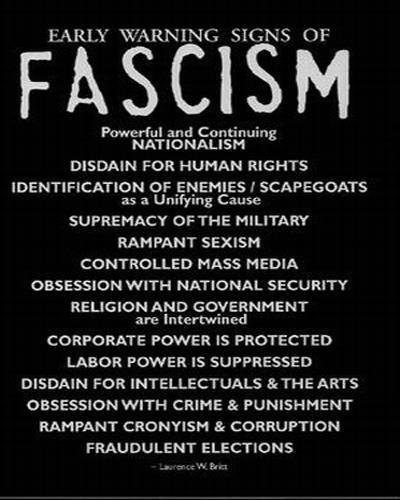
Under fascism, the government:

  • is managed by a powerful leader (even if he or she assumes office by way of the electoral process)
  • assumes it is not restrained in its power (this is authoritarianism, which eventually evolves into totalitarianism)
  • ostensibly operates under a capitalist system while being undergirded by an immense bureaucracy
  • emits powerful and continuing expressions of nationalism through its politicians
  • has an obsession with national security while constantly invoking terrifying internal and external enemies
  • establishes a domestic and invasive surveillance system and develops a paramilitary force that is not answerable to the citizenry
  • and its various agencies (federal, state, and local) develop an obsession with crime and punishment (this is overcriminalization)
  • becomes increasingly centralized while aligning closely with corporate powers to control all aspects of the country’s social, economic, military, and governmental structures
  • uses militarism as a center point of its economic and taxing structure
  • and is increasingly imperialistic in order to maintain the military-industrial corporate forces.

Compare that to America today where, as economist Jeffrey Tucker rightly observes, “every industry is regulated. Every profession is classified and organized. Every good or service is taxed. Endless debt accumulation is preserved. Immense doesn’t begin to describe the bureaucracy. Military preparedness never stops, and war with some evil foreign foe, remains a daily prospect.”

Fascism thrives by hiding behind the entertainment spectacle that is partisan politics. As Tucker points out, “It’s incorrect to call fascism either right wing or left wing. It is both and neither . . . fascism does not seek to overthrow institutions like commercial establishments, family, religious centers, and civic traditions. It seeks to control them . . . it preserves most of what people hold dear but promises to improve economic, social, and cultural life through unifying their operations under government control.”

In this way, American-style fascism is deceptively appealing.

It appears friendly.

The news media covers the entertainment and political trivia. The basic forms of government remain intact. The legislators remain in session. There are elections.

Consent of the governed, however, no longer applies. Actual control has finally passed to the oligarchic elite controlling the government behind the scenes.

Yet the most crucial ingredient for fascism to succeed in America is that the majority of the people would have to agree that it’s not only expedient but necessary for the government to assume greater powers in order to keep them safe and secure, whether it’s by militarizing the police, stripping them of basic constitutional rights, criminalizing virtually every form of behavior, or spying on their communications, movements and transactions.

Sound familiar?

When you really drill down to what the various presidential candidates believe about the issues that will impact the future of our freedoms long-term—war, surveillance, civil liberties—you’ll find that most of them support the government’s position, which, conveniently enough, profits the corporate sector.

This is not freedom.

It is despotism, which Gross refers to as “faceless oligarchs [who] sit at command posts of a corporate-government complex that has been slowly evolving over many decades.” Gross explains:

In efforts to enlarge their own powers and privileges, they are willing to have others suffer the intended or unintended consequences of their institutional or personal greed. For Americans, these consequences include chronic inflation, recurring recession, open and hidden unemployment, the poisoning of air, water, soil and bodies, and, more important, the subversion of our constitution. More broadly, consequences include widespread intervention in international politics through economic manipulation, covert action, or military invasion . . .

It is, in Gross’ words, “pretended patriots who desecrate the American flag by waving it while waiving the law”:

I see at present members of the Establishment or people on its fringes who, in the name of Americanism, betray the interests of most Americans by fomenting militarism, applauding rat-race individualism, protecting undeserved privilege, or stirring up nationalistic and ethnic hatreds.

It is, concludes Gross, Big Business and Big Government in bed together:

In this present, many highly intelligent people look with but one eye and see only one part of the emerging Leviathan. From the right, we are warned against the danger of state capitalism or state socialism, in which Big Business is dominated by Big Government. From the left, we hear that the future danger (or present reality) is monopoly capitalism, with finance capitalists dominating the state. I am prepared to offer a cheer and a half for each view; together, they make enough sense for a full three cheers.Big Business and Big Government have been learning how to live in bed together and despite arguments between them, enjoy the cohabitation. Who may be on top at any particular moment is a minor matter—and in any case can be determined only by those with privileged access to a well-positioned keyhole.

When the votes have all been counted, “we the people” will be the losers.

The joke will be on us. Whether we ever realize it not, the enemy is not across party lines, as they would have us believe. It has us surrounded on all sides.

Even so, we’re not yet defeated.

We could still overcome our oppressors if we cared enough to join forces and launch a militant nonviolent revolution—a people’s revolution that starts locally and trickles upwards—but that will take some doing.

It will mean turning our backs on the political jousting contests taking place on the national stage and rejecting their appointed jesters as false prophets. It will mean not allowing ourselves to be corralled like cattle and branded with political labels that have no meaning anymore. It will mean recognizing that all the evils that surround us today—endless wars, drone strikes, invasive surveillance, militarized police, poverty, asset forfeiture schemes, overcriminalization, etc.—were not of our making but came about as a way to control and profit from us.

It will mean “voting with our feet” through sustained, mass civil disobedience. As journalist Chris Hedges points out, “There were once radicals in America, people who held fast to moral imperatives. They fought for the oppressed because it was right, not because it was easy or practical. They were willing to accept the state persecution that comes with open defiance. They had the courage of their convictions. They were not afraid.”

Ultimately, it will mean refusing to be divided, one against each other, as Democrats versus Republicans, and instead uniting behind the only distinction that has ever mattered: “we the people” against tyranny.


Constitutional attorney and author John W. Whitehead is founder and president of The Rutherford Institute. His new book “The Freedom Wars” (TRI Press) is available online at www.amazon.com. Whitehead can be contacted at johnw@rutherford.org. Information about The Rutherford Institute is available at www.rutherford.org.