
The Democrats’ Dangerous Diversion

By Nicolas J S Davies

Source: Consortium News

The current debate over “fake news” has reminded me of a conversation I had several years ago with a former citizen of East Germany, now living in the United States. He explained that, in East Germany, everybody knew that what the media told them about their own country was a bunch of lies and propaganda. So they assumed that what the media told them about the West was just propaganda, too.

Now living in the U.S., he had come to realize that a lot of what the East German media said about life in the U.S. was actually true. There really are people living on the street, people with no access to healthcare, widespread poverty, a lack of social welfare and public services, and many other problems, as the East German media accurately reported, and as the Chinese government also noted in its latest report on human rights in the U.S.

My friend wished he and his countrymen had understood the difference between what their media told them about their country and what they reported about the West. Then they could have made more intelligent choices about which aspects of life in the West to adopt, instead of allowing Western experts to come in and impose the entire neoliberal model on their country.

In the West, of course, the state media of East Germany and other Communist countries were held up to ridicule. I remember hearing that people in the U.S.S.R. would open their newspapers in the morning and have a good laugh at the latest “fake news” in Pravda. But, as my German friend eventually understood, there was some truth amongst the propaganda, and the hidden danger of such a corrupted media system is that people end up not knowing what to believe, making informed democratic choices almost impossible.

In the end, people all over Eastern Europe were cornered into a false choice between two ideological systems that both came as top-down package deals, instead of being able to take charge of their own societies and democratically decide their own future.

In the U.S., we live under a two-party political system, not a one-party system as in East Germany, and our media reflect that. As each of our two main political parties and our media have fallen more totally under the sway of unbridled plutocratic interests, our mass media has devolved into a bifurcated version of what my friend observed in East Germany, triply corrupted by commercial interests, partisan bias and ideological and nationalist propaganda.

Down the Rabbit Hole 

Since the 2016 election campaign, our political system seems to have devolved into something like the nonsense world of Lewis Carroll’s Alice In Wonderland, with Donald Trump as the Queen of Hearts, Hillary Clinton as Humpty Dumpty, the Republicans and Democrats as Tweedledum and Tweedledee, the election as the Caucus Race (which Lewis Carroll based on U.S. political caucuses) and the whipsawed American public as the permanently baffled Alice.

In Lewis Carroll’s Caucus Race, an assortment of creatures ran randomly around a racetrack with no start or finish line, until the Dodo called the race over, declared them all winners and told Alice (the public?) she had to give them all prizes.

In similar fashion, the 2016 election between two of the most unpopular presidential candidates in U.S. history seems to have no finish line, but to live on in round-the-clock campaigns to corral the public into one of its two camps. The artificial, top-down nature of both these campaigns should be a warning that, like the election campaigns they grew out of, they are designed to corral, control and direct masses of people, not to offer real solutions to any of the serious problems facing our country and the world.

On one hand, we have President Trump, Republican Congressional leaders, Breitbart, Fox News and Rush Limbaugh, spouting nonsense worthy of Lewis Carroll, even in major presidential speeches, while dismissing criticism as “fake news.”

The Trump camp will never acknowledge that only a quarter of voting-age Americans voted for him, nor that even less of us share his views or the interests he represents. In this corrupt two-party system, no effort or expense is spared to persuade the public that we must vote for one of the two major party presidential candidates, whether we agree with either of them or not. But that cuts both ways, leaving most of the public unrepresented no matter who wins, and depriving any new government of a genuine popular mandate.

But Republican leaders play a more straightforward winner-take-all game than the Democrats. So they will try to ride Trump’s victory and their Congressional majorities as far as they will take them on all fronts: more tax breaks for the wealthy and corporations; more draconian cuts in social spending; more privatization of healthcare, education and other public services; more detention and deportation of immigrants; a more aggressive police response to social problems and public protest; more destruction of the natural world and the climate; and more increases in a military budget that already broke post-WWII records under Bush and Obama, to fuel a more openly aggressive and dangerous war policy – in other words, more of all the things that most Americans would agree we have already had too much of.

On the other side, Democratic Party leaders and the CIA, supported by the New York Times, the Washington Post, CNN and MSNBC, have conjured up unproven charges that Russia stole the election for Trump as the heart of their campaign against him. In Trump, history has handed them a political opponent with a piñata of vulnerabilities, from unprecedented conflicts of interest to policies that benefit only his own wealthy class to willful ignorance of how almost everything he is responsible for as president really works.

And yet the cabal formerly known as the Clinton campaign shows little interest in pointing out that our new Emperor has no clothes on, let alone in seriously resisting his repressive, plutocratic policies, and is instead obsessed with convincing the public that a birthmark on his naked bum looks like a hammer and sickle.

A Saving Grace?

Paradoxically, if Trump really reduced tensions between the U.S. and Russia, as his hawkish Democratic opponents fear, that could be the saving grace of his entire presidency. George W. Bush’s and Barack Obama’s regime change wars, NATO expansion and the U.S.-backed coup in Ukraine have ignited a new Cold War that many respected scientists believe has raised the risk of human mass extinction to its highest level since the 1950s.

In the pursuit of false security based on post-Cold War triumphalism and a fleeting mirage of military supremacy, our corrupt leaders have jeopardized not just our security but our very existence, leaving us at two and a half minutes to midnight on the Bulletin of the Atomic Scientists (BAS)Doomsday Clock.

As Jonathan Marshall at Consortiumnews.com reported on March 10, experts from the Federation of American Scientists, the Natural Resources Defense Council and MIT wrote in a recent BAS article that new “super-fuzes” installed on U.S. nuclear warheads since 2009 have significantly increased the danger of nuclear war by giving the U.S. the ability to destroy all Russia’s fixed land-based nuclear missiles with only a fraction of U.S. own weapons.

Coupled with President Obama’s deployment of a formerly illegal ABM (anti-ballistic missile) system on Aegis missile destroyers and at bases in Eastern Europe, the authors wrote that this upgrade to U.S. nuclear warheads is “exactly what one would expect to see if a nuclear-armed state were planning to have the capacity to fight and win a nuclear war by disarming enemies with a surprise first strike.” They concluded that “Russian planners will almost surely see the advance in fuzing capability as empowering an increasingly feasible U.S. preemptive nuclear strike capability.”

In the case of a suspected Russian nuclear missile launch, the U.S. satellite-based early warning system can give President Trump 30 minutes to judge whether we are really facing a nuclear attack or not. But Russia’s land-based early warning system is not so generous. In the case of a suspected U.S. nuclear launch targeting Russia, President Putin would have as little as 7 to 13 minutes to decide whether Russia was really under nuclear attack and whether to retaliate.

In the midst of escalating tensions over Syria, Ukraine, Iran or some other new crisis, a realistic fear of a U.S. first strike could force a hasty decision by Russian officials and seal the fate of humanity. The BAS authors believe that this predicament leaves Russia little choice but to pre-delegate its nuclear launch authority to lower levels of command, increasing the risk of an accidental or mistaken launch of nuclear weapons.

In an epitome of understatement, they point out that, “Forcing this situation upon the Russian government seems likely to be detrimental to the security interests of the United States and its Western allies.”

While U.S. officials are largely silent about the dangers of these developments in U.S. nuclear weapons policy, President Putin has spoken frankly about them and expressed dismay that the U.S. has rejected every Russian offer of cooperation to reduce these risks. Talking to a group of journalists at the St. Petersburg International Economic Forum in June 2016, he concluded, “I don’t know how this is all going to end. … What I do know is that we will need to defend ourselves.”

But despite the existential dangers of deteriorating relations with Russia, Democratic Party leaders have grasped the CIA’s unproven “assessments” that Russia may have tried to influence the outcome of the U.S. election as a lifeline by which to salvage their positions of power after their party’s electoral implosion.

Since the leadership of the Democratic Party was taken over by the corporate-backed Democratic Leadership Council (DLC) a generation ago, it has followed an unwritten rule that it must never accept responsibility for losing an election, nor respond to signs of public disaffection with any weakening of its commitment to pro-corporate, neoliberal policies. In its desperation to prevent the democratic reform of the Democratic Party, it is aggressively tarring nuclear-armed Russia with the same brush it used to tar and feather Ralph Nader after the 2000 election.

The mortal aversion of Democratic Party leaders to progressive reform suggests that they prize their own control of the party even above winning elections, the rational purpose of any political party. Their ugly smear campaign against Keith Ellison, the progressive candidate for Democratic National Committee (DNC) chair, mirrored the DNC’s corrupt campaign to undermine Sen. Bernie Sanders in the Democratic primaries and the DLC cabal’s bare-knuckles response to progressive challengers for the past 30 years.

For the DLC Democrats to snatch defeat from the jaws of the long-term victory that the country’s shifting demographics seem to guarantee their party requires a truly historic level of corruption.

Their unshakable commitment to fight tooth and nail for the interests of their wealthy campaign contributors over those of poorer, younger and darker-skinned voters in every election, every national, state and local party committee and on every issue, even as they pretend they are doing the exact opposite, could only be a viable political strategy in Lewis Carroll’s Wonderland. In the real world, their demonstrated disdain for the people from whose votes they derive their power is a strategy for political suicide.

Different Kind of Politics

These corrupt party leaders and their corporate media cheerleaders dare not remind us that Bernie Sanders’s candidacy for president inspired more enthusiasm and drew bigger crowds than Trump’s or Clinton’s, despite one eightieth of the early media promotion lavished on Trump by some corporate media and the fact that almost the entire Democratic Party establishment lined up against him.

For decades, DLC Democrats have run on vague messages about “values” to avoid being cornered into explicit progressive policy positions that might alienate their wealthy patrons. Sanders was greeted with open arms by younger voters ready for a renaissance of real politics based on actual policies that solve real problems, like universal healthcare, free college tuition, progressive taxation to pay for it all and a more cautious approach to U.S.-backed “regime change” in other countries.

By contrast, an analysis of campaign messaging by the Wesleyan Media Project found that “Clinton’s message was devoid of policy discussions” when compared to other recent presidential campaigns, including even Trump’s, and that this was a critical factor in her failure.

According to opinion polls, Bernie Sanders may now be the most popular politician in America. Polls consistently showed that Sanders was likely to beat Trump in the general election if the Democratic Party allowed him to get that far, but the DNC fundraising machine pulled out every trick in the book to make sure that didn’t happen. If truth be told, Sanders’s success was probably a more accurate reflection of the evolving political views of a majority of Americans in 2016 than the billion-dollar auction of the presidency between the Game Show King and the Queen of Chaos.

These two camps represent factions of the powerful interests that have controlled American politics for decades, from the military-industrial complex and the CIA to the dirty energy and for-profit “healthcare” industries, to say nothing of the commercial media industry itself, which covered this election all the way to the bank and for whom the show must go on and on and on … and on.

Lies of Both Sides.

Like the people of East Germany in the 1980s, we now face the challenge of a society in crisis, compounded by a treacherous media environment, with not just one, but two competing camps presenting us with false, self-serving interpretations of the multi-faceted crisis their corruption has spawned. While they compete for our trust, they share a common interest in insisting that one of the two mythological worldviews they have staked out must be right.

But as Cornel West recently told the students at my local high school in Miami in a Black History Month speech, “You don’t have to choose between the lies on one side and the lies on the other side.” So the question becomes where to turn for something other than lies, and how to recognize the truth when we stumble across it.

The paradox of our Internet age is that we nearly all have access to a wider range of media than ever before, yet we are still exposed and susceptible to corporate, partisan and ideological propaganda. In theory, we no longer have to be victims of for-profit media whose business models prioritize their profits over their duty to inform the public. But in reality, we do not form our views of the world as independently as we think we do.

This is easier to grasp in the case of commercial advertising than in the arena of political or ideological indoctrination. There is a well-known dictum in the business world that goes, “I know that half the money we spend on advertising is wasted. I just don’t know which half.” The flip-side of this is that the other half is not wasted.

So the advertising industry in the United States spends $220 billion per year, $700 for each man, woman and child in the country, to sell us products and services. And yet we still like to think that we make independent, rational choices about our spending, based on enlightened self-interest and cultivated tastes, not on the work of copywriters churning out pitches, images and jingles in ad agency cubicles.

One of the by-products of the mass monetization of American politics since the 1980s is that politics has become a profitable new arena for advertising, marketing and public relations firms. Its practitioners apply the techniques and experience they’ve developed in other areas to the world of politics, helping politicians and parties to convert the money they raise from wealthy campaign contributors into votes, and ultimately into power over all our lives. So we should be just as wary of political marketing and advertising as of the commercial variety. We should also be more humble in recognizing our own vulnerability to these profitable forms of persuasion and deception.

My copy of Alice in Wonderland has a quotation from James Joyce in the front of the book: “Wipe your glasses with what you know.” What we know is often our best protection against being misled by advertisers, politicians and pundits, if we will only remember what we know and trust it over the misinformation that surrounds us.

“Wiping our glasses with what we know” can provide a reality check on the current Russophobia campaign. We know very well that the U.S. and Russia possess the bulk of the world’s nuclear weapons, and that war between our two countries would likely mean death for ourselves and our families and the end of life as we know it for people everywhere.

We also know that it is our country and its allies, not Russia, that have launched invasions, military occupations, bombing campaigns, coups and drone wars against at least ten countries in the past 20 years, while Russia only recently become engaged in two of these conflict zones when its interests were directly impacted by our actions.

So we can see that the greatest danger in this relationship is not the threat of some unprovoked and unprecedented act of Russian aggression. The more real and serious danger is that a confrontation with Russia over one of the hot spots we have ignited will lead to an escalation of tensions in which a mistake, a misunderstanding, a miscalculation, a bluff called, a “red line” crossed or some other kind of failed brinksmanship will trigger a war that will escalate to the use of nuclear weapons, and from there to Armageddon.

Even with the lines of communication set up after the Cuban missile crisis and the stabilization of the Cold War balance of terror by the principle of Mutually Assured Destruction (MAD), we now know that we came very close to Armageddon many times, including simply by accident.

Instead of being corralled by either side in the “Russia did it” campaign, we should be urging our leaders to sit down and talk seriously with Russia’s leaders, to stop taking dangerous actions that exacerbate tensions, uncertainties and mutual isolation, and to return to serious negotiations to leave our children and grandchildren a peaceful world, free of nuclear weapons, where these dangers will no longer threaten them.

Amid lies and distortions on all sides, the corruption of politics and media by commercial interests and the billion dollars per year our government spends directly on public relations and propaganda, James Joyce’s advice can still serve us well. Make sure to wipe your glasses with what you know as you read or watch “news” from any source or listen to politicians of any party, and we may just find a way out of this rabbit hole before the roof crashes in on us.


Nicolas J S Davies is the author of Blood On Our Hands: the American Invasion and Destruction of Iraq.  He also wrote the chapters on “Obama at War” in Grading the 44th President: a Report Card on Barack Obama’s First Term as a Progressive Leader.
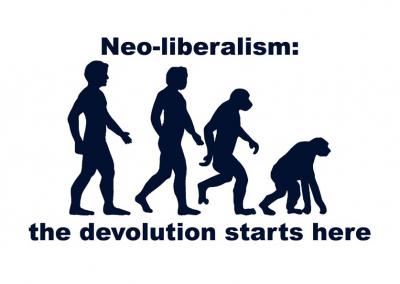
This Is Our Neoliberal Nightmare: Hillary Clinton, Donald Trump, and Why the Market and the Wealthy Win Every Time

neo_liberalism_devolution_via_permanentculturenow.com_

The rage driving our politics stems from cruelty of capitalism. So why do we vote for those who worship the market?

By Anis Shivani

Source: AlterNet

Over the last fifteen years, editors often asked me not to mention the word “neoliberalism,” because I was told readers wouldn’t comprehend the “jargon.” This has begun to change recently, as the terminology has come into wider usage, though it remains shrouded in great mystery.

People throw the term around loosely, as they do with “fascism,” with the same confounding results. Imagine living under fascism or communism, or earlier, classical liberalism, and not being allowed to acknowledge that particular frame of reference to understand economic and social issues. Imagine living under Stalin and never using the communist framework but focusing only on personality clashes between his lieutenants, or likewise for Hitler or Mussolini or Mao or Franco and their ideological systems! But this curious silence, this looking away from ideology, is exactly what has been happening for a quarter century, since neoliberalism, already under way since the early 1970s, got turbocharged by the Democratic party under the Democratic Leadership Council (DLC) and Bill Clinton. We live under an ideology that has not been widely named or defined!

Absent the neoliberal framework, we simply cannot grasp what is good or bad for citizens under Cruz versus Trump, or Clinton versus Sanders, or Clinton versus Trump, away from the distraction of personalities. To what extent does each of them agree or disagree with neoliberalism? Are there important differences? How much is Sanders a deviation? Can we still rely on conventional distinctions like liberal versus conservative, or Democrat versus Republican, to understand what is going on? How do we grasp movements like the Tea Party, Occupy, and now the Trump and Sanders insurgencies?

Neoliberalism has been more successful than most past ideologies in redefining subjectivity, in making people alter their sense of themselves, their personhood, their identities, their hopes and expectations and dreams and idealizations. Classical liberalism was successful too, for two and a half centuries, in people’s self-definition, although communism and fascism succeeded less well in realizing the “new man.”

It cannot be emphasized enough that neoliberalism is not classical liberalism, or a return to a purer version of it, as is commonly misunderstood; it is a new thing, because the market, for one thing, is not at all free and untethered and dynamic in the sense that classical liberalism idealized it. Neoliberalism presumes a strong state, working only for the benefit of the wealthy, and as such it has little pretence to neutrality and universality, unlike the classical liberal state.

I would go so far as to say that neoliberalism is the final completion of capitalism’s long-nascent project, in that the desire to transform everything—every object, every living thing, every fact on the planet—in its image had not been realized to the same extent by any preceding ideology. Neoliberalism happens to be the ideology—unlike the three major forerunners in the last 250 years—that has the fortune of coinciding with technological change on a scale that makes its complete penetration into every realm of being a possibility for the first time in human history.

From the early 1930s, when the Great Depression threatened the classical liberal consensus (the idea that markets were self-regulating, and the state should play no more than a night-watchman role), until the early 1970s, when global instability including currency chaos unraveled it, the democratic world lived under the Keynesian paradigm: markets were understood to be inherently unstable, and the interventionist hand of government, in the form of countercyclical policy, was necessary to make capitalism work, otherwise the economy had a tendency to get out of whack and crash.

It’s an interesting question if it was the stagflation of the 1970s, following the unhitching of the United States from the gold standard and the arrival of the oil embargo, that brought on the neoliberal revolution, with Milton Friedman discrediting fiscal policy and advocating a by-the-numbers monetarist policy, or if it was neoliberalism itself, in the form of Friedmanite ideas that the Nixon administration was already pursuing, that made stagflation and the end of Keynesianism inevitable.

It should be said that neoliberalism thrives on prompting crisis after crisis, and has proven more adept than previous ideologies at exploiting these crises to its benefit, which then makes the situation worse, so that each succeeding crisis only erodes the power of the working class and makes the wealthy wealthier. There is a certain self-fulfilling aura to neoliberalism, couched in the jargon of economic orthodoxy, that has remained immune from political criticism, because of the dogma that was perpetuated—by Margaret Thatcher and her acolytes—that There Is No Alternative (TINA).

Neoliberalism is excused for the crises it repeatedly brings on—one can think of a regular cycle of debt and speculation-fueled emergencies in the last forty years, such as the developing country debt overhang of the 1970s, the savings and loan crisis of the 1980s, the Asian currency crisis of the 1990s, and the subprime mortgage crisis of the 2000s—better than any ideology I know of. This is partly because its very existence as ruling ideology is not even noted by the population at large, which continues to derive some residual benefits from the welfare state inaugurated by Keynesianism but has been led to believe by neoliberal ideologues to think of their reliance on government as worthy of provoking guilt, shame, and melancholy, rather than something to which they have legitimate claim.

It is not surprising to find neoliberal multiculturalists—comfortably established in the academy—likewise demonizing, or othering, not Muslims, Mexicans, or African Americans, but working-class whites (the quintessential Trump proletariat) who have a difficult time accepting the fluidity of self-definition that goes well with neoliberalism, something that we might call the market capitalization of the self.

George W. Bush’s useful function was to introduce necessary crisis into a system that had grown too stable for its own good; he injected desirable panic, which served as fuel to the fire of the neoliberal revolution. Trump is an apostate—at least until now—in desiring chaos on terms that do not sound neoliberal, which is unacceptable; hence Jeb Bush’s characterization of him as the “candidate of chaos.” Neoliberalism loves chaos, that has been its modus operandi since the early 1970s, but only the kind of chaos it can direct and control.

To go back to origins, the Great Depression only ended conclusively with the onset of the second world war, after which Keynesianism had the upper hand for thirty-five years. But just as the global institutions of Keynesianism, specifically the IMF and the World Bank, were being founded at the New Hampshire resort of Bretton Woods in 1944, the founders of the neoliberal revolution, namely Friedrich Hayek, Ludwig von Mises, Milton Friedman, and others were forming the Mount Pelerin Society (MPS) at the eponymous Swiss resort in 1947, creating the ideology which eventually defeated Keynesianism and gained the upper hand during the 1970s.

So what exactly is neoliberalism, and how is it different from classical liberalism, whose final manifestation came under Keynesianism?

Neoliberalism believes that markets are self-sufficient unto themselves, that they do not need regulation, and that they are the best guarantors of human welfare. Everything that promotes the market, i.e., privatization, deregulation, mobility of finance and capital, abandonment of government-provided social welfare, and the reconception of human beings as human capital, needs to be encouraged, while everything that supposedly diminishes the market, i.e., government services, regulation, restrictions on finance and capital, and conceptualization of human beings in transcendent terms, is to be discouraged.

When Hillary Clinton frequently retorts—in response to demands for reregulation of finance, for instance—that we have to abide by “the rule of law,” this reflects a particular understanding of the law, the law as embodying the sense of the market, the law after it has undergone a revolution of reinterpretation in purely economic terms. In this revolution of the law persons have no status compared to corporations, nation-states are on their way out, and everything in turn dissolves before the abstraction called the market.

One way to sum up neoliberalism is to say that everything—everything—is to be made over in the image of the market, including the state, civil society, and of course human beings. Democracy becomes reinterpreted as the market, and politics succumbs to neoliberal economic theory, so we are speaking of the end of democratic politics as we have known it for two and a half centuries. As the market becomes an abstraction, so does democracy, but the real playing field is somewhere else, in the realm of actual economic exchange—which isnot, however, the market. We may say that all exchange takes place on the neoliberal surface.

Neoliberalism is often described—and this creates a lot of confusion—as “market fundamentalism,” and while this may be true for neoliberal’s self-promotion and self-presentation, i.e., the market as the ultimate and only myth, as were the gods of the past, I would argue that in neoliberalism there is no such thing as the market as we have understood it from previous ideologies.

The neoliberal state—actually, to utter the word state seems insufficient here, I would claim that a new entity is being created, which is not the state as we have known it, but an existence that incorporates potentially all the states in the world and is something that exceeds their sum—is all-powerful, it seeks to leave no space for individual self-conception in the way that classical liberalism, and even communism and fascism to some degree, were willing to allow.

There are competing understandings of neoliberal globalization, when it comes to the question of whether the state is strong or weak compared to the primary agent of globalization, i.e., the corporation, but I am taking this logic further, I am suggesting that the issue is not how strong the state is in the service of neoliberalism, but whether there is anything left over beyond the new definition of the state. Another way to say it is that the state has become the market, the market has become the state, and therefore both have ceased to exist in the form we have classically understood them.

Of course the word hasn’t gotten around to the people yet, hence all the confusion about whether Hillary Clinton is more neoliberal than Barack Obama, or whether Donald Trump will be less neoliberal than Hillary Clinton. The project of neoliberalism—i.e., the redefinition of the state, the institutions of society, and the self—has come so far along that neoliberalism is almost beyond the need of individual entities to make or break its case. Its penetration has gone too deep, and none of the democratic figureheads that come forward can fundamentally question its efficacy.

I said almost. The reason why Bernie Sanders, self-declared democratic socialist, is so threatening to neoliberalism is that he has articulated a conception of the state, civil society, and the self that is not founded in the efficacy and rationality of the market. He does not believe—unlike Hillary Clinton—that the market can tackle climate change or income inequality or unfair health and education outcomes or racial injustice, all of which Clinton propagates. Clinton’s impending “victory” (whatever machinations were involved in engineering it) will only strengthen neoliberalism, as the force that couldn’t be defeated even when the movement was as large and transcendent as Sanders’s. Although Sanders doesn’t specify “neoliberalism” as the antagonist, his entire discourse presumes it.

Likewise, while Trump supporters want to take their rebellion in a fascist direction, their discomfort with the logic of the market is as pervasive as the Sanders camp, and is an advance, I believe, over the debt and unemployment melancholy of the Tea Party, the shame that was associated with that movement’s loss of identity as bourgeois capitalists in an age of neoliberal globalization. The Trump supporters, I believe, are no longer driven by shame, as was true of the Tea Party, and as has been true of the various dissenting movements within the Republican party, evangelical or otherwise, in the recent past. Rather, they have taken the shackles off and are ready for a no-holds barred “politically incorrect” fight with all others: they want to be “winners,” even at the cost of exterminating others, and that is not the neoliberal way, which doesn’t acknowledge that there can be winners and losers in the neoliberal hyperspace.

In the current election campaign, Hillary Clinton has been the most perfect embodiment of neoliberalism among all the candidates, she is almost its all-time ideal avatar, and I believe this explains, even if not articulated this way, the widespread discomfort among the populace toward her ascendancy. People can perceive that her ideology is founded on a conception of human beings striving relentlessly to become human capital (as her opening campaign commercialso overtly depicted), which means that those who fail to come within the purview of neoliberalism should be rigorously ostracized, punished, and excluded.

This is the dark side of neoliberalism’s ideological arm (a multiculturalism founded on human beings as capital), which is why this project has become increasingly associated with suppression of free speech and intolerance of those who refuse to go along with the kind of identity politics neoliberalism promotes.

And this explains why the 1990s saw the simultaneous and absolutely parallel rise, under the Clintons, of both neoliberal globalization and various regimes of neoliberal disciplining, such as the shaming and exclusion of former welfare recipients (every able-bodied person should be able to find work, therefore under TANF welfare was converted to a performance management system designed to enroll everyone in the workforce, even if it meant below-subsistence wages or the loss of parental responsibilities, all of it couched in the jargon of marketplace incentives).

The actual cost to the state of the AFDC program was minimal, but its symbolism was incalculable. The end of welfare went hand in hand with the disciplinary “crime bill” pushed by the Clintons, leading to an epidemic of mass incarceration. Neoliberalism, unlike classical liberalism, does not permit a fluidity of self-expression as an occasional participant in the market, and posits prison as the only available alternative for anyone not willing to conceive of themselves as being present fully and always in the market.

I believe that the generation of people—in their forties or older—supporting Hillary have already internalized neoliberal subjectivity, which they like to frame as realism or pragmatism, refusing for instance to accept that free college or health care are even theoretical possibilities. After all, they have maintained a measure of success in the past three or four decades after conceptualizing themselves as marketplace agents. Just as the Tea Party supporters found it intolerable that government should help irresponsible homeowners by bailing them out of unsustainable debt, the Clinton supporters hold essentially the same set of beliefs toward those who dare to think of themselves outside the discipline of the market.

I spoke of the myth of the market, as something that has no existence in reality, because none of the elements that would have to exist for a market to work are actually in place; this is even more true for neoliberalism than it was for the self-conscious annihilation of the market by communism, because at least in that system the market, surreptitiously, as in various Eastern European countries, kept making an appearance. But when the market takes neoliberal shape, i.e., the classical conceptions of the buyer and seller as free agents are gone, then radical inequality is the natural outcome. And inequality in the last four decades, as statistics for the U.S. and everywhere neoliberalism has made inroads prove beyond a doubt, has exploded, thereby invalidating neoliberalism’s greatest claim to legitimacy, that it brings about a general increase in welfare. So neoliberalism, to the extent that the inequality discourse has made itself manifest recently, must insist all the more vocally on forms of social recognition, what Clinton, for example, likes to call the “fall of barriers.”

Neoliberalism likes to focus on public debt—in the Clinton years debt reduction became a mania, though George W. Bush promptly spent all the accumulated surpluses on tax cuts for the wealthy and on wars of choice—rather than inequality, because the only way to address inequality is through a different understanding of public debt; inequality can only be addressed through higher taxation, which has by now been excluded from the realm of acceptable discourse—except when Sanders, Trump, or Jeremy Corbyn in England go off script.

So to recapitulate neoliberalism’s comprehensive success, let us note that we have gone from a liberal, Keynesian, welfare state to a neoliberal, market-compliant, disciplinary state.

Neoliberalism expects—and education at every level has been redesigned to promote this—that economic decision-making will be applied to all areas of life (parenthood, intimacy, sexuality, and identity in any of its forms), and that those who do not do so will be subject to discipline. Everyone must invest in their own future, and not pose a burden to the state or anyone else, otherwise they will be refused recognition as human beings.

This supposed economic “rationality” (though it is the greatest form of irrationality) applies to civil society as much as the state, so that none of the ideals of classical liberalism, or previous ideologies rooted in humanism, are valid any longer, the only value is the iteration of the market (as myth, not reality); in other words, neoliberalism, unlike the elevation of the individual in classical liberalism or the state in fascism or the collectivity in communism, has erected something, the market, that has no real existence, as the only god to serve! And it is just like a god, with an ethereal, unchallengeable, irrefutable, ubiquitous presence. Whatever in state policy does not serve market-conformity is to be banned and banished from memory (the secular scriptures are to be rewritten), which explains neoliberalism’s radical narrowing of public discourse, including the severance of identity politics from any class foundation.

Neoliberalism will continue to perpetuate reduced opportunity, because one of its characteristics—as in any system that wants to thrive on the world stage—is to constantly refine the field upon which the human subject can operate.

As such, those displaced workers who have suffered the most from the erosion of the old industries in the former manufacturing centers of the world are not even factors to contend with, they are invisible and cannot be part of the policy equation. To the extent that their actual presence is reckoned with, the economy can be said to have crashed; but the problem doesn’t arise because of the management of unemployment or underemployment statistics, unlike a housing crash which is palpable and cannot escape statistical definition.

The danger for neoliberalism—as is clear from the support of millions of displaced human beings for Trump—is that with each crisis neoliberalism sheds more workers, makes individuals and firms more “disciplined,” narrows the scope of opportunity even further. At times, the disciplining of the non-neoliberal other—as with the killing of Michael Brown or Eric Garner—explodes to surface consciousness in an unsavory way, so an expert manager like Clinton or Obama is required to tamp down the emotions of such unruly entities as Black Lives Matter which arise in response. If climate change, according to Clinton and her cohort, can and should have market solutions, then surely racial disparity, or police violence, should also have market solutions and no others; it is here that neoliberal multiculturalism, operating in the academy, is so insidious, because at the elite level it functions to validate market discourse, it does not step outside it.

The present breakdown of both major political parties can be explained by the frustration that has built up in the body politic over the past decade, because after the crash there was no sustained intellectual movement to question the myth of the market. The substitution of economic justice with identity politics is something Ralph Nader, Howard Dean, and now Bernie Sanders have contested in a humane manner, while the same process is at work, admittedly in an inhumane way, in the Trump phenomenon.

Thus, also, Hillary Clinton’s animus against free college education; that form of expansion of opportunity, which was a reality from the 1950s to the 1980s, cannot be allowed to return, human beings are supposed to invest in their own future earnings potential, they are not entitled to a transcendent experience without barriers manifesting in discipline and self-correction. Education, like everything else, including one’s own health, becomes an expensive consumer good, not a right, no longer an experience that might lead to a consciousness beyond the market but something that should be fully encapsulated by the market. If one is a capable market player, education as we have classically understood it becomes redundant.

Unlike the interregnum between 1945-1973, the rising tide—no matter the befuddlements Arthur Laffer and his fellow Reaganite ideologues proffered—does not lift all boats today, it is outside the logic of neoliberalism that it do so, so the idea of reforming neoliberalism, or what is often called “globalization with a human face,” is a rhetorical distraction. All of the policy innovations—interpreted as “socialism” by the Tea Partiers—offered by Barack Obama fall within the purview of neoliberalism, above all the Affordable Care Act, whose genesis was hatched in neoliberal think tanks decades ago.

It is important to note that neoliberal economic restructuring necessarily means social restructuring, i.e., a movement toward disciplinarity and away from liberalism; the disciplinarity can take a Bushian, Clintonian, or Trumpian form, but these are manifestations of the same tendency.

When wage growth is decoupled from economic growth (as it has been since Friedman and others inaugurated the revolution in the early 1970s), this means that the human subject is ripe for discipline. Furthermore, wage fairness cannot be rationally discussed (hence the obfuscation surrounding the $15 minimum wage orchestrated by Clinton and others) because the concept of the market has been disembedded from society; the market as abstraction, not a concrete reality, makes any notion of reform or restructuring impossible. Like the minimum wage, something like free child care also remains outside the bounds of discourse, because public policy cannot accommodate discussions that do not take the self-regulating market as unassailable myth.

What neoliberalism can accommodate is relentless tax cuts (Trump has already offered his huge tax cut plan, as Bush did as his first order of business), which only exacerbate the problem, leading to increasing concentrations of wealth. It has to be said, though, that Ted Cruz more comfortably fit the neoliberal paradigm, with his familiar calls for lower taxes along with reduced regulation and further limits on social welfare, whereas Trump shows, for now, some elements of apostasy. If neoliberalism were to get a Cruz, it would have no problem working with him, or rather, Cruz would have had no problem executing neoliberalism, beyond the surface dissimilarities from Hillary Clinton.

As Sanders has consistently noted, economic inequality leads to political inequality, which means that democracy, after a certain point, becomes only theoretical (viz. Citizens United and the electoral influence of such powerful entities as the Koch brothers). Both processes—economic inequality and political inequality—have accelerated after each downturn in the forty-five-year history of neoliberalism, therefore a downturn is always exciting, and even preordained, for a Bush, a Trump, or a Clinton. Again, economic inequality and political polarity (polarity is simply a manifestation of democracy having become dysfunctional) strongly correlate, and both have come to a head in this election.

Neoliberalism’s task, from this point on, is to mask and manage the increasing inequalities that are likely to befall humanity, especially as the planet reaches a crisis point in its health. In a way, George W. Bush threw a wrench—he was a perverted Keynesian in a way, believing in war to prime the pump, or inflating unsustainable bubbles, or spending exorbitantly on grandiose gestures—into the process of neoliberal globalization that was going very smoothly indeed under Bill Clinton and would likely have flourished under Al Gore as well. With Hillary Clinton, the movement will be toward further privatization of social welfare, “reforming” it along market principles, as has been true of every neoliberal avatar, whether it was Bill Clinton’s incentives to work in the performance management makeover of welfare, George Bush’s proposed private social security accounts, Mitt Romney’s proposed private health care accounts, or the school vouchers that tempt all of them from time to time.

What remains to be seen is the extent to which the millennial generation might be capable of thinking outside the neoliberal paradigm, i.e., they don’t just want more of what neoliberal promises to give them yet fails to deliver, but want things that neoliberalism does not or cannot promise. On this rests the near-term future of the neoliberal project.

Beyond Sanders himself, the key question is the ability of the millennial generation to conceive of themselves outside the neoliberal subjectivity they have been pushed to internalize. They have been encouraged to think of themselves as capital producers, turning their intellectuality into social media popularity for the benefit of capital, in the service of the same abstract market that has no place, no role, no definition beyond the fallen liberal calculus. Does the millennial generation believe, even about its most intimate core, that everything has been privatized?

I am not necessarily making a pessimistic prediction. I am merely outlining the strength of an opponent that has refused to be named for forty-five years, although it has been the ruling ideology that long! In defining neoliberalism, I have sought to distance myself from the distraction of personalities, and tried to expose the dark side of our politics which we can only see when we name and understand the ideology as such. We are up against a system that is so strong that it has survived, for the most part, the last crash, as citizens couldn’t get their heads around the idea of nationalizing banks or health care.

It is existentially imperative to ponder what happens beyond Sanders, because neoliberalism has its end-game in sight, letting inequality continue to escalate past the crash point (meaning the point where the economy works for most people), past any tolerable degradation of the planet (which is being reconceptualized in the shape of the market).

What, indeed, does happen beyond Sanders, because as we have seen Hillary Clinton is one of the founders of neoliberal globalization, one of its central historical figures (having accelerated the warehousing of the poor, the attack on trade unions, and the end of welfare and of regulatory prowess), while Trump is an authoritarian figure whose conceptions of the state and of human beings within the state are inconsistent with the surface frictionlessness neoliberalism desires? To go back to Hillary Clinton’s opening campaign commercial, to what extent will Americans continue to believe that the self must be entrepreneurially leveraged toward maximum market gains, molded into mobile human capital ever ready to serve the highest bidder?

As to whether a non-neoliberal globalization is possible and what that might look like on the international stage after a quarter-century of Clinton, Bush, and Obama—which is essentially the frustration Trump is tapping into—I’ll take that up in a follow-up essay, which will further clarify the differences between Sanders versus Clinton, and Trump versus Clinton.

I would suggest that it is not that globalization causes or has caused neoliberalism, but that neoliberalism has pushed a certain form of globalization that suits its interests. This is a crucial distinction, on which everything else hinges. The neoliberal market doesn’t actually exist; at the moment it is pure abstraction; what is actually filling up economic and political space can only be discussed when we step away from this abstraction, as Sanders has so ably done, and as the Occupy and Black Lives Matter movements tentatively set in motion.


Anis Shivani is the author of several books of fiction, poetry, and criticism, including, most recently, My Tranquil War and Other Poems. His novel Karachi Raj (HarperCollins/Fourth Estate) was released this summer. His next book is the poetry collection Whatever Speaks on Behalf of Hashish, out in October.

Wasserman Schultz Has a Change of Heart, but Too Little, Too Late

debbie-wasserman-schultz

Just follow the money on this one.

By Bill Moyers and Michael Winship

Source: Alternet

Return with us now to the saga of Debbie Wasserman Schultz and the soul of the Democratic Party.

First, a quick recap: Rep. Wasserman Schultz (D-FL), chair of the Democratic National Committee, also has been an advocate for the payday loan industry. The website Think Progress even described her as the “top Democratic ally” of “predatory payday lenders.” You know — the bottom-feeding bloodsuckers of the working poor. Yes, them.

Low-income workers living from paycheck to paycheck, especially women and minorities, are the payday lenders’ prime targets — easy pickings because they’re often desperate. Twelve million Americans reportedly borrow nearly $50 billion a year through payday loans, at rates that can soar above 300 percent, sometimes even beyond 500 percent. Bethany McLean at The Atlantic recently reported that the government’s Consumer Financial Protection Bureau (CFPB) studied millions of payday loans and found that “67 percent went to borrowers with seven or more transactions a year and that a majority of those borrowers paid more in fees than the amount of their initial loan.”

Yet when the CFPB was drawing up new rules to make it harder for payday predators to feast on the poor, Rep. Wasserman Schultz co-sponsored a bill to delay those new rules by two years. How, you ask, could the head of the party’s national committee embrace such an appalling exploitation of working people?

Just follow the money. Last year, the payday loan industry spent $3.5 million lobbying; and as we wrote two weeks ago, in Wasserman Schultz’s home state, since 2009, payday lenders have bought protection from Democrats and Republicans alike by contributing $2.5 million or so to candidates from both parties, including her. That’s how “Representative” Wasserman Schultz, among others, wound up representing the predators instead of the poor.

That position became a major issue in her campaign for reelection to the House this year — she has a primary opponent for the first time since she entered Congress — and was even threatening the prospect of her continuing as DNC chair and presiding over the Democratic National Convention next month in Philadelphia. More than 40,000 have signed a petition calling for her removal from that post.

She had become a symbol of the failure of Democratic elites to understand that there is an uprising in the land. Millions of Americans are rebelling against the leadership of both parties. They are fed up with inside-the-Beltway politicians who pay only lip service to the deep needs of everyday people and the country; fed up with incumbents who ask for their votes, are given them in good faith, and then return to Washington to do the bidding of the donor class and its lobbyists.

Donald Trump gets it. He has roiled and humiliated and conquered an out-of-touch Republican establishment in Washington that also ignored the popular uprising against corporate domination and crony capitalism, and now GOP titans such as Senate Majority Leader Mitch McConnell and Speaker of the House Paul Ryan, spear carriers for Big Money, are being hauled around the talk-show circuit in Trump’s tumbrel, eating crow and swearing fealty to the misogynistic, bigoted and pathologically lying brute who bestrides their party.

Democratic insiders like Wasserman Schultz, however, continued to whistle past the graveyard, believing that the well-funded and well-connected Clinton machine — and general fear of a Trump regime — were enough to carry them to victory in November, despite the grass-roots disgust with a party that reeks of rot from the top. Once the champions of people who came home from work with hands dirty from toil and sweat, too many establishment Democrats went over to the dark side, taking up the cause of the well-manicured executives (think: Goldman Sachs) who write the checks and the mercenaries who deliver them (for a substantial cut, of course).

The lust for loot, which now defines the Democratic establishment, became pronounced in the Bill Clinton years, when the Clinton-friendly Democratic Leadership Council (DLC) abandoned its liberal roots and embraced “market-based solutions” that led to deregulation, tax breaks, and subsidies for the 1 percent. Seeking to fill coffers emptied by the loss of support from a declining labor movement, Democrats rushed into the arms of big business and crony capitalists.

Another case in point (and, alas, there are many): the Democratic governor of Connecticut, Dan Malloy, who seems to treat his state’s corporate residents far better than the 1 in 10 of his citizens who live at or below the poverty line.

At International Business Times last week, investigative reporter David Sirota analyzed the proposed merger of Cigna and Anthem Blue Cross Blue Shield, a deal that would create the biggest health insurance company in the country. Cigna is based in Connecticut and Katharine Wade, the state’s insurance commissioner, appointed by Governor Malloy, is a former Cigna lobbyist with deep family ties to the company.

Sirota reported, “Malloy’s decision to appoint Wade to such a powerful regulatory post on the eve of the merger was not made in a vacuum,” Sirota reported. “It came after employees of Cigna, its lobbying firm Robinson & Cole and Anthem delivered more than $1.3 million to national and state political groups affiliated with Malloy, including the Democratic Governors Association (DGA), the Connecticut Democratic Party, Malloy’s own gubernatorial campaign and a political action committee supporting Connecticut Democrats [our italics].

“Since Malloy’s first successful run for governor in the 2010 election cycle, donors from the insurance companies and the lobbying firm have given more than $2 million to Malloy-linked groups, according to the figures compiled by PoliticalMoneyLine and the National Institute on Money In State Politics. Almost half that cash has come in since 2015, the year the merger was announced.”

Sirota now reports that since his investigation first was published, the state has “formally denied open records requests for information about their meetings with Cigna and Anthem, and declared that ‘any’ documents about the health insurance companies’ proposed merger that haven’t already been made public will be kept secret.” His FOIA request was turned down “one day after Anthem requested [state insurance commissioner] Wade approve an average 26 percent increase in health insurance premiums for individual plans.” So much for transparency.

And while we’re in Connecticut, let’s also take a look at what Malloy is doing for the world’s biggest hedge fund — Bridgewater Associates, based in his state, with an estimated worth of $150 billion. The founder of the firm, Ray Dalio, is the richest man in Connecticut, by one estimate weighing in at $14.3 billion.

Dalio made $1.4 billion in 2015 alone, according to Institutional Investor’s Alpha magazine. That same year, his top two executives pulled in $250 million each. Yet as part of Connecticut’s campaign to keep companies from leaving the state, Malloy is taking $22 million of the public’s money and giving it to Dalio to stay put.

You might think a Democratic governor would have thrown down the gauntlet and told Bridgewater’s top three, “Get outta here! You guys made almost $2 billion among yourselves. Shake your piggy bank or look under your sofa cushions for the $22 million; we’re not milking the public for it.”

But no, Malloy and his fellow Democrats buckled. Buckled to the one-tenth of the one-tenth of the one-hundredth percent of the rich. Ordinary taxpayers will now ante up.

So given all of that, guess who’s the chairman of the platform committee for the upcoming Democratic National Convention? Right: Dan Malloy, governor of Connecticut, subsidizer of billionaires. Guess who named him? Right again: Wasserman Schultz, “top Democratic ally” of “predatory payday lenders.” We’re not making this up.

Not only will Malloy be presiding over the priorities of the Democratic platform at the convention next month, he doubtless will be making the rounds with Wasserman Schultz and other party elites as they genuflect before the corporate sponsors and lobbyists she has invited to pay for the lavish fun-and-games that will surround the coronation. Many of those corporate sponsors and lobbyists have actively lobbied against progressive policies like health-care reform and a Wall Street cleanup and even contributed large sums to Republicans. Yes, we know, shocking.

So take the planks in the platform and the platitudes and promises in the speeches with a grain of salt. It’s all about the money.

Except when it’s not. Except for those moments when ordinary people rise up and declare: “Not this time!”

Which brings us back to predatory lenders and their buddy, Debbie Wasserman Schultz.

Look around: There’s an uprising in the land, remember, and it isn’t going away after Hillary Clinton, now the presumptive nominee, is crowned. This year even Wasserman Schultz couldn’t ignore the decibel level of an aroused public. Unaccustomed to a challenge in the Democratic “wealth primary” where money usually favors incumbents, she now finds herself called to account by an articulate opponent who champions working people, Tim Canova. Across the country tens of thousands of consumer advocates — and tens of thousands of other progressives angry at her perceived favoritism toward Hillary Clinton — have been demanding that Wasserman Schultz resign as the party’s chair or be dumped before the convention opens Philadelphia.

So last week the previously tone-deaf Wasserman Schultz perked up, did an about-face and announced she will go along with the proposed new rules on payday lending after all. At first blush, that’s good; the rules are a step in the right direction. But all that lobbying cash must have had some effect, because the new rules only go so far. A New York Times editorial calls them “a lame response” to predatory loans and says the final version of the new regulations “will need stronger, more explicit consumer protections for the new regulatory system to be effective.”

Nick Bourke, director of small-dollar loans for the Pew Charitable Trusts, is a man who closely follows these things and got to the heart of the matter: Not only do the proposed new rules “fall short,” they will allow payday lenders to lock out attempts at lower-cost bank loans.

His judgment is stark: “As drafted, the CFPB rule would allow lenders to continue to make high-cost loans, such as a line of credit with a 15-percent transaction fee and 299-percent interest rate, or a $1,250 loan on which the borrower would repay a total of $3,700 in fees, interest and principal,” Bourke wrote. “These and many other high-cost payday installment loans are already on the market in most states, and they will thrive if the regulation takes effect without change.”

Nonetheless, the new rules were improvement enough for Allied Progress, an organization that has taken on Wasserman Schultz in Florida’s late August primary, to declare victory. And they were enough for Wasserman Schultz to do a 180-degree turn which she clearly hopes will not too dramatically reveal her hypocrisy. “It is clear to me,” she said, “that the CFPB strikes the right balance and I look forward to working with my constituents and consumer groups as the CFPB works toward a final rule.”

All well and good, but if she survives her primary to return to Washington, be sure to keep the lights on in those rooms where the final version of the rules are negotiated. A powerful member of Congress with support from a Democrat in the White House could seriously weaken a law or a rule when the outcome is decided behind closed doors and money whispers in the ear of a politician supplicant: “I’m still here. Remember. Or else.”

But the times, they really may be a-changing, as the saga of Wasserman Schultz reveals. You can be deaf to the public’s shouts for only so long. The insurgency of popular discontent that has upended politics this year will continue no matter the results in November. For much too long now it’s been clear that money doesn’t just rule democracy, it is democracy.

Until we prove it isn’t.