
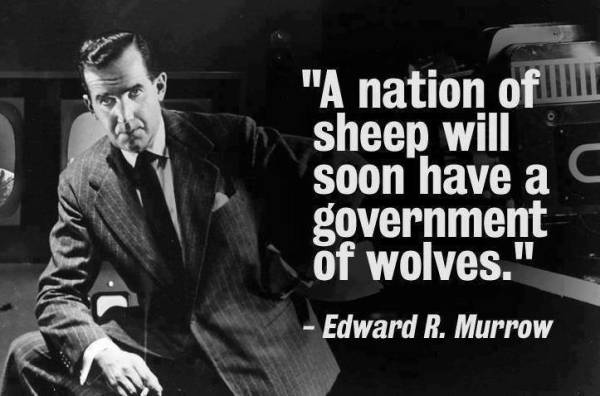
Don’t Trust the Government with Your Privacy, Property or Your Freedoms

By John & Nisha Whitehead

Source: The Rutherford Institute

How do you trust a government that continuously sidesteps the Constitution and undermines our rights? You can’t.

When you consider all the ways “we the people” are being bullied, beaten, bamboozled, targeted, tracked, repressed, robbed, impoverished, imprisoned and killed by the government, one can only conclude that you shouldn’t trust the government with your privacy, your property, your life, or your freedoms.

Consider for yourself.

Don’t trust the government with your privacy, digital or otherwise. In the two decades since 9/11, the military-security industrial complex has operated under a permanent state of emergency that, in turn, has given rise to a digital prison that grows more confining and inescapable by the day. Wall-to wall surveillance, monitored by AI software and fed to a growing network of fusion centers, render the twin concepts of privacy and anonymity almost void. By conspiring with corporations, the Department of Homeland Security “fueled a massive influx of money into surveillance and policing in our cities, under a banner of emergency response and counterterrorism.” For instance, all across the country, police are installing Flock Safety license plate readers as part of a public-private partnership program between police and the surveillance industry. These cameras, which upload data in real time to fusion crime centers, signal a turning point in the transition from a police state to a police-driven surveillance state.

Don’t trust the government with your property. In yet another effort to legitimize warrantless searches, police are employing “hit-and-hold” tactics in which police enter a home, carry out an initial sweep of the property, handcuff the occupants, then wait for official search warrants to be secured and applied retroactively. In the meantime, police have managed to bypass the Fourth Amendment. The rationale, to prevent possible destruction of evidence, is the same one used to deadly effect with no-knock raids. If government agents can invade your home, break down your doors, kill your dog, damage your furnishings and terrorize your family, your property is no longer private and secure—it belongs to the government. Hard-working Americans are having their bank accounts, homes, cars electronics and cash seized by police under the assumption that they have allegedly been associated with some criminal scheme.

Don’t trust the government with your finances. The U.S. government—and that includes the current administration—is spending money it doesn’t have on programs it can’t afford, and “we the taxpayers” are being forced to foot the bill for the government’s fiscal insanity. The national debt is $31.3 trillion and growing, and we’re paying more than $300 billion in interest every year on that public debt, yet there seems to be no end in sight when it comes to the government’s fiscal insanity. According to Forbes, Congress has raised, extended or revised the definition of the debt limit 78 times since 1960 in order to allow the government to essentially fund its existence with a credit card.

Don’t trust the government with your health. For all intents and purposes, “we the people” have become lab rats in the government’s secret experiments, which include MKULTRA and the U.S. military’s secret race-based testing of mustard gas on more than 60,000 enlisted men. Indeed, you don’t have to dig very deep or go very back in the nation’s history to uncover numerous cases in which the government deliberately conducted secret experiments on an unsuspecting populace—citizens and noncitizens alike—making healthy people sick by spraying them with chemicals, injecting them with infectious diseases and exposing them to airborne toxins. Unfortunately, the public has become so easily distracted by the political spectacle out of Washington, DC, that they are altogether oblivious to the grisly experiments, barbaric behavior and inhumane conditions that have become synonymous with the U.S. government, which has meted out untold horrors against humans and animals alike.

Don’t trust the government with your life: At a time when growing numbers of unarmed people have been shot and killed for just standing a certain way, or moving a certain way, or holding something—anything—that police could misinterpret to be a gun, or igniting some trigger-centric fear in a police officer’s mind that has nothing to do with an actual threat to their safety, even the most benign encounters with police can have fatal consequences. The number of Americans killed by police continues to grow, with the majority of those killed as a result of police encounters having been suspected of a non-violent offense or no crime at all, or during a traffic violation. According a report by Mapping Police Violence, police killed more people in 2022 than any other year within the past decade. In 98% of those killings, police were not charged with a crime.

Don’t trust the government with your freedoms. For years now, the government has been playing a cat-and-mouse game with the American people, letting us enjoy just enough freedom to think we are free but not enough to actually allow us to live as a free people. Freedom no longer means what it once did. This holds true whether you’re talking about the right to criticize the government in word or deed, the right to be free from government surveillance, the right to not have your person or your property subjected to warrantless searches by government agents, the right to due process, the right to be safe from militarized police invading your home, the right to be innocent until proven guilty and every other right that once reinforced the founders’ belief that this would be “a government of the people, by the people and for the people.” On paper, we may be technically free, but in reality, we are only as free as a government official may allow.

Whatever else it may be—a danger, a menace, a threat—the U.S. government is certainly not looking out for our best interests, nor is it in any way a friend to freedom.

Remember the purpose of a good government is to protect the lives and liberties of its people.

Unfortunately, what we have been saddled with is, in almost every regard, the exact opposite of an institution dedicated to protecting the lives and liberties of its people.

As I make clear in my book Battlefield America: The War on the American People and in its fictional counterpart The Erik Blair Diaries, “we the people” should have learned early on that a government that repeatedly lies, cheats, steals, spies, kills, maims, enslaves, breaks the laws, overreaches its authority, and abuses its power at almost every turn can’t be trusted.

ABOUT JOHN W. WHITEHEAD

Constitutional attorney and author John W. Whitehead is founder and president of The Rutherford Institute. His most recent books are the best-selling Battlefield America: The War on the American People, the award-winning A Government of Wolves: The Emerging American Police State, and a debut dystopian fiction novel, The Erik Blair Diaries. Whitehead can be contacted at staff@rutherford.org. Nisha Whitehead is the Executive Director of The Rutherford Institute. Information about The Rutherford Institute is available at www.rutherford.org.

Punching Down: How the “anti-disinformation” movement worked with Big Tech to protect Big Pharma

By Paul D. Thacker

Source: The Disinformation Chonicle

The COVID-19 pandemic saw the greatest acceleration of online censorship in the short history of the internet. In response, the field dedicated to upholding human rights online—the digital rights movement—remained near silent to this massive government and corporate over-reach. Worse, digital rights activists sometimes even collaborated with censors in the name of protecting the public from “disinformation.”

I’ve spent more than 20 years in digital rights, freedom of expression and open technology communities, and co-founded an organisation dedicated to these ideas: EngageMedia. Over the 17 years I ran Engage Media, we built a team that stretched across 10 countries, from India to Australia—one of the biggest digital rights organisations in the Asia-Pacific, hosting hundreds of workshops and large events, and leading multiple international networks. In short, I’m not a newbie or outsider in this field.

But during the pandemic, I watched the digital rights movement lose its voice as champions of online freedom of expression. Instead, they began to echo the positions of governments and companies with far from stellar records on human rights and corporate integrity. This recasting of governments and corporations as allies, rather than institutions to be held to account, has perverted the mission of digital rights and harmed public health.

The Digital Rights Movement

Digital Rights is an umbrella term that captures multiple concepts from “internet freedom” to “open technology” to “digital public policy.” Over the past several decades, it has become a major force in advocating for online rights and freedoms. Hundreds of universities, institutes, and non-profit organizations work in this arena on every corner of the planet. Whilst I know of no exact calculations, funding for the field is surely in the hundreds of millions of dollars annually—sourced from a mix of liberal foundations, governments, and Big Tech itself.

Core to this fundamentally left-leaning field was anti-censorship and a libertarian ethos. If the movement has a founding document, it is the 1996 Declaration of the Independence of Cyberspace, which begins:

Governments of the Industrial World, you weary giants of flesh and steel, I come from Cyberspace, the new home of Mind. On behalf of the future, I ask you of the past to leave us alone. You are not welcome among us. You have no sovereignty where we gather.

We have no elected government, nor are we likely to have one, so I address you with no greater authority than that with which liberty itself always speaks. I declare the global social space we are building to be naturally independent of the tyrannies you seek to impose on us. You have no moral right to rule us nor do you possess any methods of enforcement we have true reason to fear.

Left-libertarianism and techno-utopianism dominated Internet culture in the 90s and 2000s, yet withered rapidly in the Trump era, as it was unable to move quickly enough to address issues of online discrimination and harassment. In response, a new wing took root that was less hippy, more helicopter parent.

Internet parentalism, with its emphasis on safety over freedom, addressed concerns about the dark side of the Internet, but it did so with top-down regulation and control. And just as the former left-libertarianism created an imperfect system, so has the current left-parentalism. This became quite clear during the pandemic. During COVID, general skepticism of authority was replaced by respect for authority. Once suspect governments and businesses were now to be shielded from critique.

Content moderation is key to the new left-parentalism, and the pandemic radically accelerated and solidified a new digital authoritarianism. It is worth revisiting Hillary Clinton’s seminal 2010 “internet freedom” speech, to see how far thinking has shifted:

Now, all societies recognise that free expression has its limits. We do not tolerate those who incite others to violence… And hate speech that targets individuals on the basis of their race, religion, ethnicity, gender, or sexual orientation is reprehensible… But these challenges must not become an excuse for governments to systematically violate the rights and privacy of those who use the internet for peaceful political purposes.

How different content moderation is today, where comments deemed “offensive” might be censored. In those days liberals even thought about balancing safety and freedom when dealing with terrorists, yet this was not the case with COVID. With Musk now taking over Twitter, the Internet-parentalism wing may be on its back-foot but it has made headway in altering culture, so much so that supporting the left-libertarian approach (or the 2010 Clintonian position) is now considered “right-wing.”

New Zealand Prime minister Jacinda Arden personifies the progressive authoritarian shift. In her recent UN speech she compared “disinformation” to “weapons of war,” expressing a deep frustration with those who stray from the “consensus” and emphasising strong government control for “disinformation.” The Arden approach is now the default setting in the digital rights field where government and corporate censorship have replaced debate and persuasion as the answer to “wrong” ideas. For example, Ardern gave the opening speech at the 2022 RightsCon, the biggest digital rights conference on the calendar (EngageMedia co-hosted the 2015 edition).

That government determines truth to protect citizens is a boom to authoritarians everywhere – from the Philippines, to Ethiopia, to Russia—while also limiting government and corporate accountability. To be clear, both Clinton’s and Ardern’s policy served the needs of power. The difference is that Clinton was largely in step with the previous 200 years of liberal theory, while Arden returns society to levels of government authority and control that people have struggled to overcome for centuries.

Growth and change of “anti-disinformation”

Disinformation was already an established sector prior to the pandemic. But it focused on top level malfeasance: for example, Myanmar military social media accounts promoting violence against the Rohingya or former Philippine President Duterte’s use of bots to attack dissidents. Advocacy took a mostly Clintonian approach to counter such state power—minimising overt censorship, while educating the public and notifying Big Tech of egregious incidents of disinformation (mostly by government).

The Trump election and Cambridge Analytica scandal changed these rules as many blamed social media greed and wilful ignorance for the election loss. Claims of Russian disinformation compounded these problems. Big Tech’s alleged lack of action put it at odds with its core, liberal constituencies. Anger and disillusionment allowed the speech control wing of the digital rights movement to ascend, shifting the movement’s mission from watching the powerful to policing the fringe.

Newer disinformation initiatives also sought to rebuild trust in Big Media, legacy organisations whose legitimacy crumbled for a variety of reasons: from supporting the Iraq war, to failing to predict Trump and Brexit. To recapture authority, elites made themselves the adults who discern the truth, as the rest of society cannot be trusted make competent decisions.

Anti-disinformation amid the pandemic

I went into the pandemic with a wide variety of doubts, but was among the majority in supporting government restrictions, though never on access to information. Banning discussion of a possible lab accident at the pandemic’s beginning triggered me to reevaluate. My own Australian government and the former CDC Director Robert Redfield both considered the lab-leak a plausible reason for how the pandemic started. Meanwhile, leading anti-disinformation organisations labelled it a conspiracy theory, and suggested that journalists not amplify it.

After the lab leak theory became mainstream, I saw no reconsideration of facts among the anti-disinformation and digital rights sectors, as any straying meant being called far-right. Unfortunately, silence only shields the powerful, and civil liberties and human rights groups went AWOL on their duties, or even swapped sides. Witness the ACLU advocating for the violation of bodily autonomy and in favour of widespread vaccine mandates.

The digital rights field seem oblivious to how much information is now controlled. Despite all the changes during COVID, the 2022 iteration of RightsCon had no sessions on the pandemic and disinformation. The digital rights community has also ignored news of the White House directing Twitter to deplatform journalists, and of Harvard and Stanford Professors suing the White House for social media related free speech violations.

Other few key examples of how pandemic censorship protected the powerful:

Questioning of lockdowns was once banned, yet it is now widely acknowledged that lockdowns resulted in serious harm including delays in childhood learning, lack of early treatment for serious illness, a rise in domestic abuse, as well as inflation and a massive transfer of wealth to the rich.

Across the board social media sought to disallow information that is “inconsistent with health authorities’ guidance”. But authorities are not all-knowing and this policy blew away previously held norms around open scientific debate and went against the crowd-sourcing ethos of progressives.


Why the conformity?

Some level of conformity is to be expected; however, it reached uncanny levels during the pandemic. Public relations campaigns hid how information controls have worked, as many aren’t even aware of policies and repeated “fact check” failures. PR campaigns also succeeded in associating those seeking to limit pandemic controls as being right-wing and therefore selfish, or worse, racist and misogynist—even as vaccine hesitancy was highest among communities of colour.

Second, the “anti-disinformation” and digital rights field maintains rigorous class solidarity and is overwhelmingly upper-middle and middle class. The upper and middle classes have a higher trust in institutions because they run those institutions and those institutions have worked for them. The field is also the ultimate laptop class, along with others working in tech. Work from home and other lockdown policies benefited them, even as it harmed others.

Third, digital rights melted into the “follow the science” movement. Populism dented the prestige of the expert and professional managerial class, while COVID energized their authority with “science” and gave them back power. Questioning “the science” and acknowledging mistakes means re-diminishing that power.

Finally, Big Tech has compromised the field with tens of millions of dollars (possibly hundreds) annually, yet this funding bias is rarely discussed. Imagine if Shell, BP, and ExxonMobil were core funders of the climate change movement. Added to this financial influence is a revolving door between Big Tech and those meant to hold it to account

Moving forward

Allegations of “disinformation” have become a tool to delegitimize opposition to orthodoxy and power, and have been weaponised to shield government and Big Pharma from scrutiny. Just as criticism of the automobile industry in the 60s and 70s led to improved car safety, today’s public fora must hold the powerful to account.

By aligning with Big Tech and Big Pharma, the “anti-disinformation” and digital rights sectors have neglected their responsibilities, and have come to serve power rather than people, contributing to a broader chilling effect.

To improve digital rights, we must:

  • Ensure funders, non-profits, journalists, and media organisations more clearly stand up for free speech and invite dissenting views;
  • Remain courageous while suffering the slings and arrows of nasty online criticism. And support those who speak out;
  • Highlight bullying that closes down conversation and benefits institutional interests;
  • Generate greater public awareness of government and corporate manipulation on social media;
  • Refuse Big Tech and Big Pharma funding for work that is meant to keep these same industries accountable;
  • Create more watchers to watch the “anti-disinformation” watchers;
  • Develop alternative media platforms so the conversation can’t be so easily controlled;
  • ·Ensure regulation that protects free speech;
  • Break up Big Tech and Big Media to limit government and corporate control of public discourse and increase diversity of opinion.

Pandemic information controls and restrictions on free speech had real world consequences that contributed to poorer, not better, public health outcomes. By neglecting to address corporate and government pandemic censorship, the digital rights movement failed in its core mission of securing online freedom of expression.