
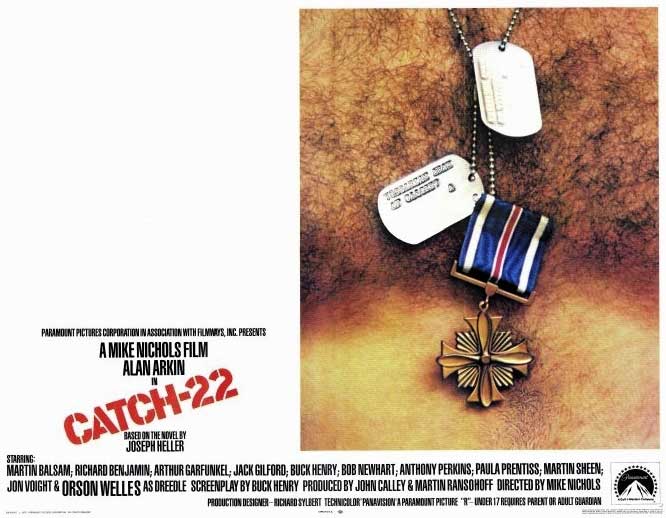
Saturday Matinee: Catch-22

Classic Film Review: So was “Catch-22” the failure we remember it to be?

By Roger Moore

Source: Movie Nation

Perhaps it took a humorless, career-crippling George Clooney TV version of Joseph Heller’s novel to make us better appreciate Mike Nichols’ daring, infamously-expensive version of “Catch-22.”

Released at the height of the Vietnam War, suffering in comparison to Robert Altman’s equally anti-war dramedy “M*A*S*H,” seemingly more on a par with with equally cynical action comedy “Kelly’s Heroes,” which has had the benefit of a lot more TV exposure, “Catch” still plays the way it did way back in 1970 — as a pricey, “difficult” satire with a “difficult” shoot as baggage.

But wipe away the “Catch-22 lore,”the people cast and cast-aside, the fact that Nichols wanted the more age-appropriate Al Pacino as Yossarian, the young bombardier/anti-hero, and grapple with the film’s disordered narrative, the nightmarish focus of the story — an active-duty combat airman flying through and ranting through what we now call Post Traumatic Stress Syndrome, coupled with a tinge of guilt.

It’s amazing to see now. And considering how our war movies, from “300” to “Midway,” “Greyhound” to “Flyboys” and even at times, “Dunkirk,” are made now — with digital planes and ships and sometimes tanks — they really don’t make’em like this any more.

Nichols made the most of his coastal Mexican location, showing off all 17 WWII vintage B-25s taking off and landing every chance he got. You couldn’t do that today.

And that cast. Alan Arkin makes a fine, perplexed and outraged Yossarian, a sane man trapped in the insanity of war, an actor who never hits a punchline too hard, never takes the character’s exasperation into parody.

“Let me see if I’ve got this straight. In order to be grounded, I’ve got to be crazy. And I must be crazy to keep flying. But if I ask to be grounded, that means I’m not crazy anymore, and I have to keep flying.”

“You got it,” Doc Daneeka (Jack Gilford) tells him. “That’s Catch-22.

“Whoo… That’s some catch, that Catch-22.”

Orson Welles as a grumpy general, Tony Perkins as a put-upon chaplain, Martin Balsam as the murderously vain Col. Cathcart, Buck Henry as his venal sidekick, Col. Corn (screenwriter Henry was never better, as an actor), baby-faced Bob Balaban as the always-crashing, always-tinkering, even-tempered Orr, it’s a dazzling corps.

Bob Newhart half-stammering through Major Major Major, a very young Martin Sheen raging as the pilot Dobbs, Art Garfunkel as the innocent co-pilot Nately who falls for an Italian hooker, Charles Grodin as an upper-class twit navigator, a smarmy, befuddlingly upbeat Richard Benjamin (cast, with his wife Paula Prentiss as a nurse Yossarian chases), the famous French star who fled to Hollywood Marcel Dalio is the wizened old Italian who figures Italy has already won the war, since it has surrendered and Americans are still fighting and dying. And there’s a sea of actors we’d come to recognize on TV (“The Bob Newhart Show” is over-represented) in the years that followed.

Jon Voight stands out, just enough, as the grinning opportunist Milo Minderbender, a stand-in for every war profiteer you’ve ever read about, working the angles, an impersonal unpatriotic multinational corporation who wins no matter who loses.

Like its two contemporaries, “M*A*S*H” and “Kelly’s Heroes,” it’s a guy’s movie with a dated leering quality about the opposite sex. It’s heavy-handed, here and there, betraying Nichols — feeling his oats after “The Graduate” — indulging in some serious “blank check” filmmaking.

And reading, over the years, of all the people Nichols wanted to cast, or cast and then replaced, you kind of wish he’d moved on from Gilford, a future Oscar nominee who doesn’t bring enough cowardly sniveling to the good doc.

“Catch-22” was popular enough that they did a pilot for a sitcom based on it, as was the case with “M*A*S*H.” Richard Dreyfuss had the lead in that.

Over the years, I’ve interviewed half a dozen actors from that all-star cast, and often, without prompting, they’d bring it up. It took half a year of their lives, most of them, and burned itself into their memories, even if it wasn’t the blockbuster Paramount expected it to be.

Watching it again, outside of the academic settings where it turned up in “film as satire” classes and the like, it feels more cinematic than the scruffy, Altmanesque “M*A*S*H,” a movie marred by that stupid screen-time-chewing football game. It’s less fun than the more-watchable “Patton” and even “Kelly’s Heroes” (which is FAR longer).

But as a darker-than-dark comedy about the futility and insanity of war, it towers above its contemporaries in ways that should have scared-off George Clooney. It’s the best film of a seemingly-unfilmmable classic novel we’re ever going to get.

MPAA Rating: R, graphic violence, blood, nudity, profanity

Cast: Alan Arkin, Martin Balsam, Buck Henry, Tony Perkins, Bob Newhart, Paula Prentiss, Richard Benjamin, Marcel Dalio, Bob Balaban, Art Garfunkel, Martin Sheen, Jack Gilford, Peter Bonerz, Norman Fell, Austin Pendleton, Jon Voight and Orson Welles.

Credits: Directed by Mike Nichols, script by Buck Henry, based on the Joseph Heller novel. A Paramount release.

Running time: 2:02

____________________

Watch Catch-22 on Kanopy here: https://www.kanopy.com/en/product/3216674
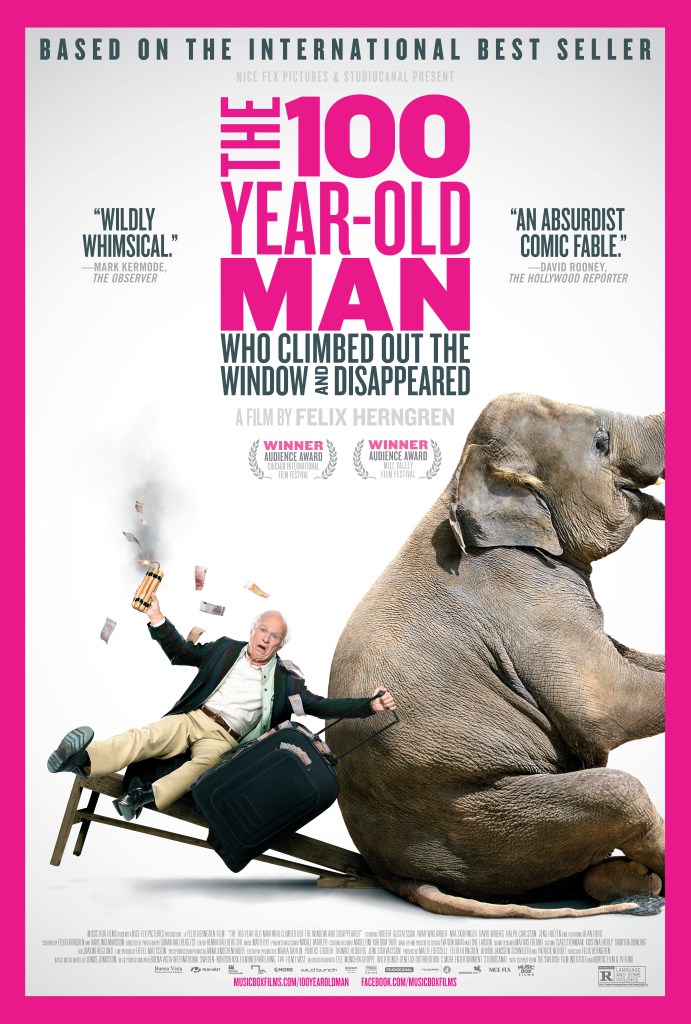
The 100 Year-Old Man Who Climbed Out the Window and Disappeared

By Josh Kupecki

Source: Austin Chronicle

A whimsical comedy based on the bestselling Swedish novel (and book-club fodder) by Jonas Jonasson, The 100-Year-Old Man Who Climbed out the Window and Disappeared begins with exactly that, as Allan Karlsson (Gustafsson) escapes his retirement home on the day of his inauguration into the centenarian club with a “fuck this” attitude and little more than the slippers that bear his first name in Magic Marker. He shuffles off to the bus station where he buys a ticket to the next bus leaving town and inadvertently steals a suitcase with 50 million krona from some local thugs. He hooks up with a retired train attendant, Julius (Wiklander), and together they hit the road, picking up stray characters to add to their entourage while (often unknowingly) skirting the tattooed gangsters after that jackpot. One character owns an elephant. Another can’t decide on a career path, so has almost completed a half-dozen degrees. It is all very fanciful and droll, a mildly subversive and ramshackle Scandinavian version of the Grumpy Old Men on-the-road formula.

But that’s only half the story. Through flashbacks that seem to come whenever the present-day action hits a lull, we see Allan’s life unfold, and what a life that was. From his humble beginnings as the son of a revolutionary, young Allan develops a passion for blowing things up that parlays him into becoming a demolitions expert. There follows a stumbling and drunken shuffle through the history of the major conflicts of the 20th century (the film will be endlessly compared to Forrest Gump), as Allan travels to Franco’s Spain for the Spanish Civil War, helps Robert Oppenheimer develop the atomic bomb, pisses off Josef Stalin to the point where he gets sent to a gulag, becomes a double agent for the CIA during the Cold War, confers with Ronald Reagan, etc. Throughout it all, Allan is oblivious to the impact he has on world events, holding true to the theory espoused by his mother that “life is what it is and does what it does.”

These two narrative threads are constantly jockeying for dominance in a story that has a refreshing nonchalance, but is hindered by the lack of any tension whatsoever. Obviously better served as a novel, The 100-Year-Old Man… still entertains for the majority of its running time, but it feels like two separate movies, a dual shaggy dog story stitched together like Frankenstein’s monster, never breaking free of its quirky literary origins.

Watch The 100-Year-Old Man… on Kanopy here: https://www.kanopy.com/en/product/1053322

Saturday Matinee: Death to Smoochy

In defence of Death to Smoochy – the most absurd kids’ TV satire ever made

By Sophie Yapp

Source: Little White Lies

Once a film has been critically tarnished, it’s hard to come back from that. As soon as the negative reviews start to drop, public perceptions are formed and the box office is often affected accordingly. Yet it’s fairly common for a film to be met with critical apathy upon its initial release, only to assume the mantle of overlooked gem later on. Fourteen years after its disappointing theatrical run in 2002, Danny DeVito’s absurd black comedy, Death to Smoochy, exists as one such film.

The twisted satire both illuminates and mocks the brutality and corruption behind the ruthless industry of children’s television, and makes no bones about it. Rainbow Randolph (Robin Williams) is fired from his job as a children’s TV host and replaced by Smoochy (Edward Norton), an overly optimistic performer in a fluffy, fuchsia rhinoceros costume who skyrockets to fame, despite not being able to fathom the idea that his colleagues, unlike him, are solely in it for the money. Inevitably, the cutthroat nature of the industry means that Smoochy becomes a target of not only Randolph’s vengeance, but also the people pulling the strings.

Death to Smoochy flopped at the box office, grossing a little shy of $8.5m domestically. Critics were quick to slam the film as ‘odd’, ‘inexplicable’ and ‘unpleasant’. Such descriptions were not wrong. Indeed, Death to Smoochy is all of these things, but as a cynical comedy, this is all part of its charm. While the film pivots around children’s characters, it is not a children’s movie in the slightest. The seedy, deeply disturbing underlying nature of the film is disguised by the colourful, child-like context of the industry which it mocks. Essentially, it’s about sociopaths pursuing and trying to kill their rivals, demonstrating how money is the root of all evil.

Above all, though, it’s about greed. DeVito has been known to both direct and act in films that poke fun at society’s weaknesses in equal measures of maliciousness and light-heartedness. Here he ridicules the children’s entertainment industry while bringing to light the commercial, dog-eat-dog aspect of children’s television by exemplifying the profitable agenda of selling plastic and sugary commercial products off the back of the television shows. “We’re not looking at kids, we’re looking at wallets with pigtails,” are DeVito’s own words, echoed by Smoochy as he struggles to comprehend the sheer magnitude of manipulative scheming that goes on beneath the surface of an industry that, as he sees it, exists to provide entertainment for children.

The film’s morbid sense of humour is perhaps most prominent in Robin Williams’ highly amusing performance as a corrupt kiddy-host bordering on clinically insane. His twisted take on Rainbow Randolph is evidence of his acting diversity, also evoking some of his early stand-up work. What explicitly seeps through in Williams’ performance is his former relation to the backstabbing side of the business based on his own experiences in television, with the popular sitcom Mork & Mindy being cancelled after its fourth season.

Whether it’s framing Smoochy into performing live at a neo-Nazi rally, or replacing a batch of cookies with penis-shaped biscuits on Smoochy’s live show before proceeding to run on stage shouting obscenities such as “It’s a one-eyed wonder weasel!” in front of the preteen studio audience, Williams only adds to his hilarious legacy. It’s his outrageous performance that makes this tremendously funny, admittedly absurd satire well worth revisiting.

Saturday Matinee: Hi, Mom!

“Hi, Mom!” (1970) is a dark comedy directed by Brian De Palma and stars Robert De Niro. It’s a sequel to Greetings (1968) in which De Nero reprises his role of John Rubin who is now a voyeuristic filmmaker. John later falls in with a group of militant black activists leading to the film’s most memorable scene in which he participates in an experimental theater performance. The show is called “Be Black, Baby” and requires its white audience to don blackface and be subjected to an escalating series of abuses by black actors in whiteface until John arrives as a seemingly real NYPD officer and proceeds to put the white audience members under arrest. De Palma and De Niro’s next collaboration would be 17 years later for The Untouchables.

Saturday Matinee: Happiness

“Happiness” (1998) is a bleakly dark comedy written and directed by Todd Solondz. It follows the lives of three sisters and their respective problematic relationships. Joy (Jane Adams), is the youngest sister and is viewed by her family as the least successful by conventional standards. Helen (Lara Flynn Boyle) is the middle sister who is a famous writer but remains unfulfilled. The oldest sister is Trish (Cynthia Stevens), an upper middle-class housewife whose family seems perfect on the surface. The film was best described by Roger Ebert who wrote in his review: “…the depraved are only seeking what we all seek, but with a lack of ordinary moral vision… In a film that looks into the abyss of human despair, there is the horrifying suggestion that these characters may not be grotesque exceptions, but may in fact be part of the mainstream of humanity…. It is not a film for most people. It is certainly for adults only. But it shows Todd Solondz as a filmmaker who deserves attention, who hears the unhappiness in the air and seeks its sources.”

Watch the full film here.

Saturday Matinee: Bringing Out the Dead

“Bringing Out the Dead” (1999) is the fourth collaboration between director Martin Scorsese and screenwriter Paul Schrader (and their most underrated). Based on a novel by Joe Connelly, the plot follows New York paramedic Frank Pierce (Nicolas Cage), who’s on the verge of a nervous breakdown as he struggles to save a steady stream of victims of a heroin plague in the early 90s. As could be expected, the film is full of grim and harrowing situations but is punctuated by darkly humorous moments as well. Given the current wave of opiate overdoses caused primarily by the drug war and big pharma, Bringing Out the Dead is unfortunately more topical than ever.

Watch the full film here.

Saturday Matinee: Britannia Hospital

“Britannia Hospital” (1982) is the third installment of director Lindsay Anderson’s “Mick Travis Trilogy”. Like the other films in the series, it’s a dark comedy following a particularly eventful chapter in the life of Mick Travis (Malcolm McDowell) as he confronts various disturbing and absurd aspects of Britain and western society in general. In Britannia Hospital, Travis is a muckraking investigative journalist covertly filming a documentary on the prestigious Britannia Hospital as it faces a variety of challenges including the opening of a new wing, the arrival of the Queen Mother and other dignitaries, and protesters opposing an African dictator’s stay at the hospital as well as extravagant meals for VIP guests. As he gets further into his investigation Travis becomes embroiled in a secret transhumanist project directed by the head of the new wing. The Film’s central thesis is summed up by the following statement from Lindsay Anderson:

“The absurdities of human behaviour as we move into the Twenty-first Century are too extreme — and too dangerous — to permit us the luxury of sentimentalism or tears. But by looking at humanity objectively and without indulgence, we may hope to save it. Laughter can help.”

Watch the full film here.

Saturday Matinee: Buffalo Soldiers

buffalo_soldiers_film_poster

“Buffalo Soldiers” (2001) is a dark satire directed by Gregor Jordan based on the 1993 novel by Robert O’Conner. The story centers on U.S. Army soldier Ray Elwood (Joaquin Phoenix), whose drug and black market schemes are disrupted when his company gets assigned a new First Sergeant, Robert E. Lee (Scott Glenn). The battle between Elwood and Lee rapidly escalates leading to a fiery showdown. The film’s original theatrical run was delayed by two years due to fears that its unflattering depiction of the military would offend the sensibilities of the culture which was still caught up in a (partly real, partly media-induced) post-9/11 patriotic fervor.

Watch the full film here.