Saturday Matinee: Land of the Blind

By Ms Mary Lou

Source: The News Blender

“A stale piece of bread is better than nothing.”

LAND OF THE BLIND is a 2006 film directed by Robert Edwards, and written by Edwards five years before. Its message about political corruption and complacency is so resonant that, even though it takes cues from historical figures throughout the centuries, we can still see our current climate reflected in it .

The film starts “Five Years Before” during the reign of President-For-Life Maximilian II (Tom Hollander). Having inherited the position from his father, Maximilian is equal parts politically clueless and personally gluttonous. He doesn’t understand why his constituents aren’t grateful when he commutes those sentenced to the gallows…by sending them to firing squads instead. Unable to stand any critique of himself, he murders his opponents when he can get away with it and sends them to the not-so-secret prisons when he can’t.

One of these prisoners is the de facto leader of the resistance, playwright turned political prisoner Thorne (Donald Sutherland). He’s been imprisoned for years for the crime of being critical of Maximilian. Despite having nearly all communication with the outside world cut off, his followers “The Citizens for Justice and Democracy” continue the movement he inspired. While they wage wars against the administration outside, Thorne is left to write his manifesto on the walls of his cell using any means available.

One of the guards assigned to him, Joe (Ralph Fiennes), serves as our everyman narrator. In the beginning he doesn’t consider himself political, just a man doing his job. The more he has conversations with Thorne, however, the more he sees the corruption in Maximiliam’s regime and becomes determined to help achieve change. From his cell Thorne runs for–and is elected to–parliament and is thus released to serve his term. Now that their leader is accessible the Citizens for Justice and Democracy spring into action.

Quickly Joe helps Thorne and his followers get into Maximilian’s castle. Within minutes Thorne puts Maximilian and his wife through a two minute trial in their bedroom, convicts, and executes them. The Maximilian II regime is over.

“Nothing is better than a big, juicy steak.”

With Thorne in the position of President-For-Life, change definitely happens. Maximilian’s indulgences are replaced with a strict moral code. All females are now forced to wear hijabs when outside the house. Re-education camps are opened to make sure everyone is in line with the nation’s moral code. This includes teachers, doctors, people who insist on wearing glasses, and anyone else not in line with the new morality. Children are separated from their parents in order to “fight the narcissism of family.” The revolution has occurred. Long live the revolution.

Joe is retired from the military and held up as a hero for his part in the revolution. He isn’t as thrilled with Thorne’s changes. When pressured to sign a loyalty oath, Joe refuses out of principle. He points out to Thorne that “before the revolution man exploited man. Since the revolution it’s the other way around.” That is enough to get Joe sent to the re-education camps.

What happens in the camps would be unfathomable if I didn’t know how much of this movie was based on historical events. There is physical torture, psychological torture, relentless pressure to accept anything and everything he’s told to believe. Can Joe survive with himself intact and is it worth it if he does?

“Therefore, a stale piece of bread is better than a big, juicy steak.”

LAND OF THE BLIND is not a movie for everyone. There are a lot of questions left unanswered. We don’t learn the characters’ histories. In the end there is no comfortable resolution. The movie will be fascinating for those who know history; they’ll be able to recognize the patterns that have happened and even recognize some that are still going on. Even those who can’t see when Idi Amin or the Khmer Rouge are referenced can still appreciate the movie on its own. The actors are all well cast in their roles and their journeys are completely believable. The music, composed by Guy Farley, is appropriately unsettling and comes in at just the right moments to keep the viewer on edge. Robert Edwards is a master at balancing actual history with a compelling story. I like to watch this movie whenever I find myself getting politically complacent. It’s a reminder that it’s not enough to stand against something; you have to also know what you’re standing for.

Watch Land of the Blind on Hoopla here: https://www.hoopladigital.com/title/14779187

Saturday Matinee: Dragons Forever

By Chrichton

Source: Chrichton’s World

If the majority of the Peking Opera School brothers are involved then you just know it is going to be good. Next to usual suspects Jackie Chan, Sammo Hung and Yuen Biao Yuen Wah (on screen) and Corey Yuen (off screen) are brought into the mix to deliver this martial arts gem. The combination of action and comedy is nothing new to these guys. But romance? That one surprised me because that is not something they do often. And even when it borders to the more sentimental and cheesy kind I could appreciate it since most of it seemed sincere and convincing.

But there are other little surprises that makes Dragons Forever a lot of fun. The first one that sticks out is Yuen Biao’s character Timothy Tung. Timothy is not quite right in the head. No real explanation is given other than that even friend Jackie Lung is surprised by his insanity.  When Jackie visits his friend he is met with a lot of hostility. At first he thinks it’s because he doesn’t recognize him. But even when saying who he is and showing his face up close Timothy still has trouble recognizing him. It’s so weirdly disturbing that it becomes hilarious. Especially since throughout the film he seems to be living in his own little world and his friend Jackie just leaves him be. Dismissing his behaviour as quirky and lovable. For example his Goldfish don’t live in aquariums but in tubes placed all over in his home. Actually it looked really cool. It did look like the fish were enjoying themselves. The other surprise is Jackie as a ladies man. I remember him playing a character like this in City Hunter but prior to this I had never actually seen him coming on to women in this fashion. Because usually he plays the straight and righteous guy who rarely crosses the line and in this film he has no trouble being unethical or hiring his friends to do some spying on the plaintiff. Even going so far in allowing friend Luke Wong (Sammo Hung) to seduce the plaintiff and he himself to become more than amicable with the plaintiff’s niece who also is a witness in the court case. This is where the romantic elements come in. Surprisingly these elements gave this film an edge. That and the tone change in the third act. Up until that time Dragons Forever is pretty light and comedic. But then things become real serious and super dark. In most films tone changes like this don’t work. But here they do since in the first two acts you have gotten to know the main characters and that despite their silly antics they do have their hearts in the right place. 

On top of that the action is top notch. Mostly combat based and the kind I really like and enjoy. It’s beautifully choreographed and exciting. The fights between the three dragons also are delightful since they seemed to be having a lot of fun beating each other up. What I really liked was how this action was blended with the comedy and romantic elements. The film flowed incredibly well and not once did I think that any of the elements fell out of place. Even when it became super dark at the end. But I think we got Sammo Hung and Corey Yuen to thank for that since they both directed this film. 

I don’t think I am the type who uses this term very quickly but when I do you can be sure that I mean it wholeheartedly. Dragons Forever is a masterpiece. If you never have seen this film you owe it to yourself to do so. It is easily one of the best films in the genre. 

Saturday Matinee: Natural Born Killers

By Richard Propes

Source: The Independent Critic

Is “Natural Born Killers” an indictment of our current society that is so completely fascinated with crime, criminals and everything that waxes dramatic? Or, is it simply a glossy, stylized romp through random acts of violence?

Oliver Stone’s “Natural Born Killers” takes the life of two of society’s rejects, Mickey and Mallory, and allows them to fall in love and embark on a nationwide killing spree that becomes fodder for the press, an obsession for law enforcement and, ultimately, they become folk heroes to the common man across America.

The film, which on the surface appears to be incredibly and over-the-top violent, is actually far less violent than many films with a lesser rating. While we see shootings and killings, the vision is seldom graphic in nature. These events are much more about attitude and atmosphere than they are the violence itself.

The word “intoxication” is the word I think of most when I think of the film “Natural Born Killers.” Mickey (Woody Harrelson) and Mallory (Juliette Lewis) become intoxicated by killing and the fame it brings…Reporter Wayne Gale (Robert Downey, Jr.) becomes intoxicated by the story, the ratings, the spotlight…Warden McClusky (Tommy Lee Jones) is intoxicated by his power and justice.

The script, by Stone and Quentin Tarantino, vividly brings to life this intoxication in scenes that often resemble television shows and other times take on such a psychedelic feeling that it almost feels like we’re in the middle of one of those lava lamps where you look through the hole and you see different visions every time you look in it.

“Natural Born Killers”, for me, is a visionary film because it sees the truth of our society and where we are headed. We are living in a world where celebrity allows you to get away with most anything, such as in the O.J. Simpson trial, and where even the most heinous criminal becomes an overnight celebrity. In “Natural Born Killers,” Stone and Tarantino are, to me, clearly saying that we can’t just blame the criminals for the deterioration of our society…it’s all of us who buy into the drama, the glamour and the excitement that allows the cycle to perpetuate.

Stellar performances, a powerful, insightful script, groundbreaking camerawork and the unique vision of Oliver Stone combine to make “Natural Born Killers” a bold, visionary film that may shock, may offend, may alienate…but, in the end, it is a film you will remember.

Watch Natural Born Killers on Hoopla here: https://www.hoopladigital.com/title/14507250

Saturday Matinee: Din of Celestial Birds

By Jason Hoffman

Source: The Third Eye

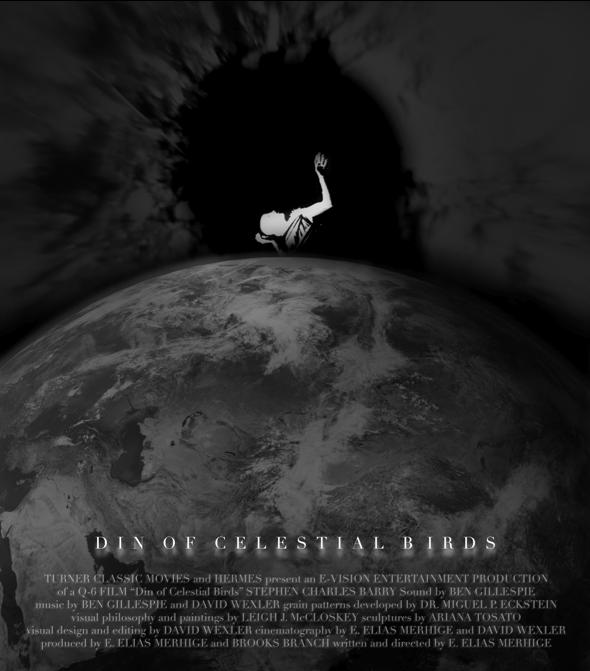
Din of Celestial Birds (2006) A film by E. Elias Merhige. Black and white, sound, 16mm, 14 mins.

American filmmaker E. Elias Merhige’s experimental film Din of Celestial Birds (2006) is the second part of an as yet unfinished trilogy of films, the first part being his bold and visionary debut feature Begotten. Most people coming to Din of Celestial Birds will have watched Begotten and are presumably expecting more of the gruesome and haunting imagery that distinguished the style of that feature, however as the movie begins, we are reassured to “Not be afraid … Be comforted … Remember … Our origin…”.

“A transcendental meditation on creation and consciousness”

I came away from the film thinking of it as Begotten enacted on a microscopic scale: a depiction of the divine mystery of creation through an exploration of processes prior to it, but where Begotten did so as a metaphorical psychodrama, Din of Celestial Birds does this as if a nature documentary of life, in a style reminiscent of Man Ray and other Surrealists.

The opening credits actually attribute the film to Q6, a collective consisting of a visual philosopher (whatever that is), a computational visual neuroscientist, a multi-media performance artist, a composer, and a sculptor; all of whom Merhige collected around him to produce the movie in a hands-on fashion employing techniques used by the work of cinema pioneers like the Lumiere brothersFritz Lang, and Jean Cocteau, in addition to software and technology created specifically for the film.

Though Din of Celestial Birds arguably ploughs the same furrow as its conceptual predecessor, the film is nevertheless testament to a unique artistic vision, exploring representations of the fringes of consciousness by challenging the limits of cinema.

Saturday Matinee: Voyage of the Rock Aliens

By Chris Scullion

Source: That Was a Bit Mental

Director: James Fargo

Starring: Pia Zadora, Tom Nolan, Craig Sheffer, Michael Berryman, Ruth Gordon, Alison La Placa

“I still can’t believe you’re an alien. What a novelty act!” (Dee Dee, Voyage Of The Rock Aliens)

One day in the future, when I have children, there will come a day when I’m asked “dad, what were the ’80s like?”

I already know how I’ll respond. Without saying a single word I’ll gesture to the couch, insist they sit down, turn the telly on and make them watch Voyage Of The Rock Aliens. Just to fuck with them.

After all, as a massive fan of anything ’80s I reckon I’ve seen enough movies and TV shows to determine what best sums up the decade. And this, quite frankly, is the most ’80s thing I’ve ever seen by a long way.

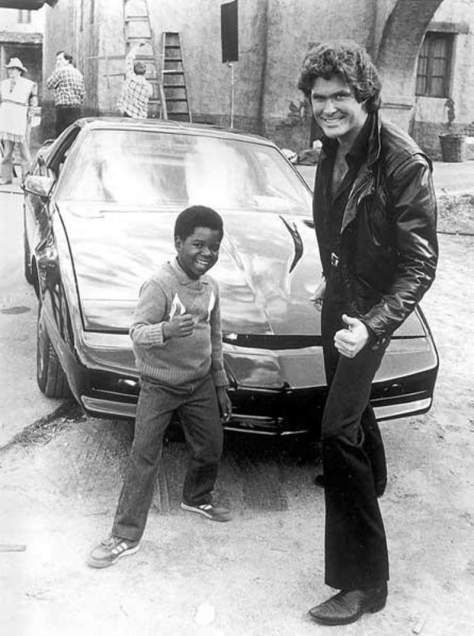
And I’ve seen this photo:

You see, what we have here, friends, is a sci-fi musical comedy in which all the songs are the catchiest, cheesiest ’80s pop you can imagine. And it’s brilliant.

It tells the story of a bunch of aliens, led by the super-serious ABCD (pronounced ‘Absid’, naturally), who fly around space in a ship shaped like a massive Flying V guitar.

These aliens are tasked with exploring the galaxy and studying anything they find in order to try to locate the source of Rock & Roll. Guess where they end up? That’s right, Venus Earth.

Here’s one of them, STUVWXYZ. About as inconspicuous as a toe up the arse

More specifically, they land in the town of Speelburgh (ahem), where local prettyboy Frankie rules his fellow teenagers with an iron fist.

As the lead singer of his band The Pack, he’s somehow managed to impose some sort of musical dictatorship banning anyone else in the town from playing instruments or singing.

This includes his girlfriend Dee Dee (singer Pia Zadora), who fancies herself as the next big musical sensation but is being held back by Frankie’s harsh singbargo.

Enter the Rock Aliens, who you’d better believe are going to ruddy well sing and dance all they want because it’s all they know. And once they do, the rest of the Speelburgh teens – Dee Dee included – are blown away by their new musical style (which is basically Devo).

Mind you, Dee Dee’s got some singing skills too. Pia Zadora’s pretty good in this, actually

ABCD quickly takes a shine to Dee Dee, by which I mean his head literally explodes and his limbs fall off the first time he sees her. That’s not a figure of speech, that actually happens.

For some reason this doesn’t put Dee Dee off and the two fall for each other, with ABCD asking Dee Dee to join his band.

Dee Dee is thrilled, but how will she react when she discovers that ABCD and his bandmates are aliens? And is Frankie really going to let this weird prick win his girlfriend over? Dramaaaaaa.

I genuinely uttered the phrase “what the fuck is this all about” five or six times throughout the course of Voyage Of The Rock Aliens. And that’s no bad thing.

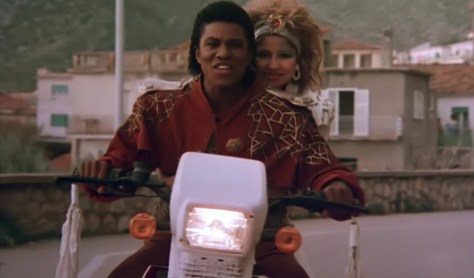
For example, you’ve got the opening sequence, set on another planet, in which Pia Zadora (playing someone else) and Jermaine Jackson sing their new single for no reason at all: after which Jackson fucks off and is never seen again.

“Let’s get out of here, Michael.” “I’m not Michael.” “You’re not?” “No, I’m Pia Zadora.” HAHAHA, YOU THOUGHT I MEANT JERMAINE JACKSON, OH CHRIST WHAT A TWIST

Then there’s the bizarre subplot involving two escaped mental patients, one of whom (The Hills Have Eyes‘ Michael Berryman) falls in love and sees the error of his ways.

These are but a few moments of madness: others include a robot helper (voiced by Peter ‘Optimus Prime’ McCulloch) disguising itself as a fire hydrant, an odd dance number set in a ladies’ toilet, and a giant mutant octopus thing which is sitting in the nearby lake waiting to take over the town.

Then there’s Ruth Gordon playing a bizarre sheriff who has a surprising lack of tact when phoning the families of accident victims:

“Am I speaking to the widow of John S. Lamont?”

“You must be mistaken, I’m not a widow.”

“The hell you’re not!”

This being a musical, the songs are naturally of great importance, and anyone into cheesy ’80s pop will be in heaven.

Each track is delightfully catchy and yet charmingly shit, with nonsensical lyrics all over the shop (“It’s the nature of the beast / I’m keeping up my status quota”) that often don’t have anything to do with the story. Which is sort of the point of songs in a musical, but fuck it, I’m giving it a pass.

The best of the bunch is definitely the opening track though (the one with Jermaine Jackson in it). Curious? Enjoy:

Of all the ’80s sci-fi musical comedies I’ve seen over the years, Voyage of The Rock Aliens is undoubtedly the best. It’s also undoubtedly the only, but let’s not try to ruin the mood.

Get some similarly ’80s-minded friends around, shit fancy dress optional, turn the volume as loud as it can go without the neighbours coming round to cave your face in, and enjoy a helping of delicious ’80s cheese so plentiful that you’ll having dreams about hairspray, synthesisers and robot fire hydrants for weeks to come.

Saturday Matinee: Capricorn One

By Ken Zurski

Source: Unremembered

In 1976, a controversial new book was released that contended the Apollo 11 moon mission never happened. We Never Went to the Moon: America’s Thirty Million Dollar Swindle was written by Bill Kaysing, a Navy midshipman and rocket specialist, who claimed to have inside knowledge of a government conspiracy to fake the moon landing.

Kaysing believes NASA couldn’t safely put a man on the moon by the end of the 1960’s (a promise made by President Kennedy) so they staged it instead. Kaysing’s theories were technical and persuasive and soon a movement of nonbelievers, inspired by the book, was born.

Whether you believed Kaysing or not was a moot point for American screenwriter and director Peter Hyams.  A former TV news anchor, Hyams was more interested in how such a thing could actually be pulled off?

“I grew up in the generation where my parents basically believed if it was in the newspaper it was true,” Hyams said in an interview with a film trade magazine.  For him, he admits, it was the same with television. “I wondered what would happen if someone faked a whole story.”

So he wrote a story based on the concept.

That was in 1972, four years before Kaysing’s book was released. Hyams shopped the script around but got no takers.  Then something unexpected happened. Watergate broke and America was thrown into a government scandal at its highest levels. Interest in a story like a fake moon landing (in the movie’s case, the first manned mission to Mars) had appeal. In 1976, Hyams was given the green light to make his movie as part of deal with ITC Entertainment to produce films with a conspiracy bent.

“Capricorn One” was released in the Summer of 1977. “Would you be shocked to find out the greatest moment of our recent history may not have happened at all?” the movie posters read.

Reviews were mixed. Chicago Tribune film critic Gene Siskel called it “a surprisingly good thriller” while another critic Harry Themal said it was a “somewhat feeble effort at an adventure film.” Variety was even less complimentary calling it “underdeveloped” and the cast “scattershot.”

In the movie, Sam Waterston, James Brolin and O.J. Simpson play the three astronauts. Elliott Gould, Hal Holbrook, Telly Savalas, Brenda Vaccaro and Karen Black round out the cast. While Brolin was known mostly for his television role as Dr, Steven Kiley on Marcus Welby, M.D. Simpson was a celebrity athlete whose acting career was just beginning.

In hindsight the cast was impressive, but the actors weren’t as important as the story.

After the landing is staged and broadcast as real, the nation is told the three astronauts died instantly in a failed reentry.  But Gould, as journalist Robert Caulfield, is suspicious. The astronauts, who are harbored, realize they have no recourse but to escape or be killed. “If we go along with you and lie our asses off, the world of truth and ideals is, er, protected,” say’s Waterston’s Lt Col. Peter Willis. “But if we don’t want to take part in some giant rip-off of yours then somehow or other we’re managing to ruin the country.”

From there its a cat and mouse game between the good guys and bad. A dramatic helicopter chase scene ensues. In the end, Caulfield with the help from Brolin’s character exposes the conspiracy.

The movie’s tag-line accentuated the drama:

The mission was a sham. The murders were real.

“In a successful movie, the audience, almost before they see it, know they’re going to like it,” remarked Hyams. “I remember standing in the back of the theater and crying because I knew that something had changed in my life.”

The film’s final chase scenes were pure escapism. “People were clapping and cheering at the end,” Brolin relayed to a reporter shortly after the film’s release.

Today, the film’s legacy may be in the conspiracy only.  It’s impact may also have been diminished by the negative attitudes towards O.J. Simpson who in 1994 was charged and acquitted in the brutal murder of his ex-wife, Nicole Brown.

Even Hyams concedes to his own bizarre trivia: “I’ve made films with two leading men who were subsequently tried for the first degree murder of their wives,” he said referring to Simpson in Capricorn One and Robert Blake in his first film Busting (1974).  

Fifty years later, on the 2019 anniversary date of July 20, 1969, the moon landing is still celebrated as one of man’s greatest achievements. “We choose to go to the Moon in this decade and do the other things, not because they are easy, but because they are hard,” President Kennedy prophetically said in 1962.

For some, apparently, that was just too hard to believe.

Several years after it happened, a movie showed how it could be done…Hollywood style.

Saturday Matinee: District B13

By Brian Eggert

Source: Deep Focus Review

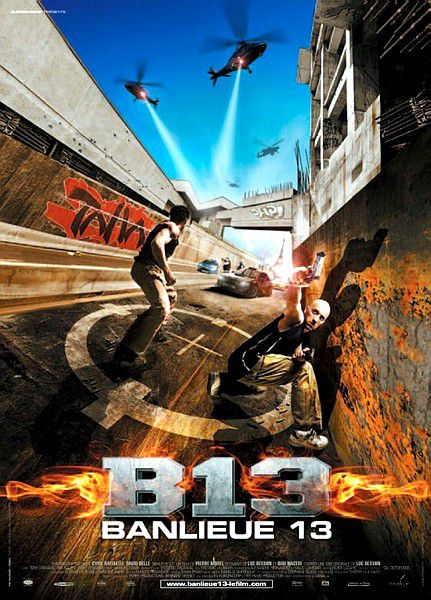
If the movies from French producer Luc Besson’s factory of B-grade actioners, District 13 (Banlieue 13, 2004) stands among the best. This is your typical martial arts-laden action extravaganza, filled with thumping techno music, a thin plot, and impressive stunts. But the increasingly prosaic clichés evident in Besson’s other films, which are also evident here, electrify with an uncommon kinetic energy. The action feels and looks real thanks to its stuntmen stars. The plot seems to have a social resonance behind it. And indeed the French soundtrack of techno and rap augments the no-holds-barred attitude of the movie.

The setting is Paris, 2010, which upon the release of this movie in 2004 was the future. Use your imagination. The city is plagued by unruly slums, and to isolate the problem areas, the government has erected a wall around a particular neighborhood known as District 13. The walls create a makeshift ghetto wherein all schools, all civil servants, and all hope has been evacuated. Inside, two million people are divided into various gangs and the police have no say, except that no one can leave through the guarded checkpoints. Drugs and crime run rampant on the streets within. Meanwhile, Elitist politicians would prefer to wipe this blotch off their maps entirely and start over.

Two heroes ban together to fight both a crime boss polluting the inside and political corruption stewing from outside the walls. One hero, Leïto (David Belle), comes from the slums. After being double-crossed by the local police, Leïto watches as his sister, Lola (Dany Verissimo), is taken hostage by the seedy gangster Taha (Bibi Naceri), and then he’s put in jail for 6 months to rot. Enter the other hero, supercop Damien (Cyril Raffaelli), who is commissioned by his superiors to go undercover, befriend Leïto, stage a prison break, and then use Leïto to sneak into District 13 to defuse a deadly bomb. The bomb was supposedly stolen from the government by the District 13 gangs, but this McGuffin proves to be slightly more complicated. And of course, Damien has only 24 hours to complete his mission.

Nevermind the plot, though. You’re not watching to find out what happens with Leïto, Damien, and the bomb. You’re watching to see the physical bravado of the two leads, as they demonstrate some of the most impressive stunts you’ve ever seen in any action movie. Belle and Raffaelli run across rooftops, leaping from building to building with ease. They scale obstacles and scuttle across walls like Spider-man. Whenever surrounded by a horde of goons, the heroes take them down without a minimum of fuss, exacting fisticuffs with a seemingly effortless precision. Through it all, they keep up a light banter that keeps the tone chummy and enjoyable.

Belle and Raffaelli are actual stuntmen and practitioners of a street-born, pseudo-martial art known as Parkour. According to the definition of those who practice it, “Parkour is the physical discipline of training to overcome any obstacle within one’s path by adapting one’s movements to the environment.” As opposed to a direct defensive strategy such as karate or jujitsu, Parkour involves running and jumping with fluidity, dodging obstructions with competence and speed through a complete awareness of one’s surroundings. But all you need to understand Parkour exists within this movie. The most amazing scenes aren’t those brimming with violence, they’re the chase scenes where Parkour skills are used to escape.

Director Pierre Morel, who would later helm Taken and From Paris with Love for the American market, exhibits clear and decisive action. The editing captures all the movements of Belle and Raffaelli with amazing clarity, whereas action movies nowadays so often rely on shaky-cam to disguise the stuntmen standing in for big-name stars. There’s nothing to hide in District 13, however, as Belle and Raffaelli complete the stunts and the fights themselves. Comparable to Jackie Chan in his heyday, these actors have the charisma, humor, and ability to advance themselves from stuntmen to stars, and they advance this movie from another dull actioner to must-see entertainment.

Watch District B13 on Tubi here: https://tubitv.com/movies/439503/district-b13

Saturday Matinee: The Secret of Roan Inish

By Roger Ebert

Source: RogerEbert.com

One day, many years ago, an ancestor of Fiona spied a beautiful creature sunning by the sea. She was both woman and seal. We would call her a mermaid, but on that western coast of Ireland such creatures were well-known as Selkies.

The ancestor trapped the creature and married her, and they had children together and lived happily, although she seemed to long for the sea. One day she learned where her husband had hidden her sealskin, up under the roof, and she put it back on, and returned to the sea.

Fiona (Jeni Courtney), who is 12 or 13 years old, is told this story by a relative. It is not told as a “fairy tale” but as an account of family history, to be taken quite seriously. And well might Fiona believe it, because ever since there have been dark-haired children in her family who were said to throw back to the Selkie, and whose eyes turned yearningly to the sea.

The year is about 1946. Fiona’s mother has died, and her father can barely be budged from his mourning in the pub. She is sent to live with her grandparents, on a sea coast across from the island of Roan Inish, where the whole family once lived. There she learns the story of her little brother Jamie, whose cradle was carried off by the waves. And there, with her grandparents and her cousin Eamon (Richard Sheridan), she first explores Roan Inish, which means, in Gaelic, “island of the seals.” The secret of John Sayles‘ “The Secret of Roan Inish” is that it tells of this young girl with perfect seriousness. This is not a children’s movie, not a fantasy, not cute, not fanciful. It is the exhilarating account of the way Fiona rediscovers her family’s history and reclaims their island. If by any chance you do not believe in Selkies, please at least keep an open mind, because in this film Selkies exist in the real world, just like you and me.

On Roan Inish, the girl sees a child’s footprint. Then she sees the child – Jamie! – running on the sand. She calls to him, but he gets back into his cradle, which is borne out to sea by friendly seals. Of course it is hard to convince grownups of what she has seen.

In the meantime, her grandparents face eviction from their cottage, which is to be sold to rich folks from the city. They may have to move inland. “To move off of Roan Inish was bad enough,” Fiona’s grandmother says, “but to move out of sight of the sea . . .” She shakes her head, making it clear that it would kill the grandfather, who thinks of the city as “nothing but noise and dirt and people that’s lost their senses!” Can Fiona and Eamon, her young cousin, restore the family’s old cottages on Roan Inish? Can she reclaim Jamie from the sea? I found myself actually caring. John Sayles and Haskell Wexler, who has photographed this movie with great beauty and precision, have ennobled the material. There is a scene where a person numbed by the cold sea is warmed between two cows, and we feel close to the earth, and protected.

One can easily guess how this legend could have been simplified and jollied up in other hands – how it could have been about cute little Selkies. But legends are, after all, told by adults, not children, and usually they record something essential to the culture that produces them. What this legend says, I think, is that the people who tell it live on the land but live from the sea, so that their loyalties are forever divided.

Of course this is a wonderful “family film,” if that term has not been corrupted to mean simpleminded and shallow. Children deserve not lesser films but greater ones, because their imaginations can take in larger truths and bigger ideas. “The Secret of Roan Inish” is a film for children and teenagers like Fiona, who can envision changing their family’s fate. It is also for adults, of course, except for those who think they do not want to see a film about anything so preposterous as a seal-woman, and who will get what they deserve.