Saturday Matinee: Conquest of the Planet of the Apes

Conquest of the Planet of the Apes: The

Most Violent and Bleak of the Franchise

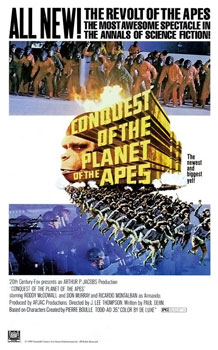
The fourth Apes movie, Conquest of the Planet of the Apes, showcased Caesar’s controversial and timely fight for freedom.

By Don Kaye

Source: Den of Geek

On June 30, 1972, 20th Century Fox released the fourth film in the original Planet of the Apes cycle, titled Conquest of the Planet of the Apes. It followed up the previous year’s Escape from the Planet of the Apes, the first of the Apes films to deliberately end with the promise of a sequel. In that film, two intelligent chimps from the future, Cornelius (Roddy McDowall) and Zira (Kim Hunter), traveled back to our time only to be brutally slain by the U.S. government over fears that they would plant the seeds for the apes’ eventual domination of humankind. Their baby, however, secretly survived, hidden away by the circus owner Armando (Ricardo Montalban) and already beginning to form words.

As Conquest of the Planet of the Apes opens, Armando and the child ape, now grown and named Caesar (played by McDowall), arrive at an unnamed North American city. The year is 1991 and the U.S. government has turned totalitarian. A virus from space has destroyed all the world’s cats and dogs, leading humans to turn toward apes as first pets and then slaves. When Caesar expresses outrage at the cruel treatment of an ape by police, he’s forced to flee and hide — since he was officially declared dead 20 years earlier and his very existence is a threat to humanity.

Caesar makes his way to the ape training facilities and assimilates himself there, eventually going up for auction — where he is sold to the city’s ape-hating governor Breck (Don Murray) and placed under the command of Breck’s assistant MacDonald (Hari Rhodes), who is sympathetic to the plight of the apes. But when Armando is killed while in the government’s custody, an enraged Caesar begins to plot a revolution — slowly but surely organizing his fellow apes for a violent uprising that will be the first step toward the downfall of the human race.

By the time that Conquest of the Planet of the Apes was in production, Apes producer Arthur P. Jacobs and his studio partner Fox were in truly uncharted territory. Even though Planet of the Apes (1968) was a critical success and a box office smash, sequels at the time were considered quick, disposable vehicles to milk a few more bucks out of the audience. Instead, what Jacobs did — aided by the inspired efforts of screenwriter Paul Dehn — was create an ongoing sci-fi story and intricate future history over the course of his Apes movies, the likes of which had never been attempted before in the genre.

Jacobs, however, was still up against the studio mindset that sequels had to cost less, so by the time he made Conquest the budget for the film was a third of the price of the original Planet of the Apes. He had a meager $1.7 million to visualize the ape revolution that had been discussed in the previous films, economizing by using the brand new Century City high-rise complex in Los Angeles as the exterior of the city of the future — but also skimping on the makeup budget, resulting in some clearly fake-looking ape masks.

Dehn’s third screenplay for the series, following Beneath the Planet of the Apes (1970) and Escape from the Planet of the Apes, was the most explicitly political of the series. The previous Apes films had commented obliquely on race and other social issues, but against the backdrop of ongoing racial tensions in America, Dehn crafted a story that drew directly upon the 1965 Watts riots in Los Angeles for the imagery of his ape revolution. His screenplay was also the most violent of the franchise, initially ending in a bleak standoff that found Caesar ordering the cold-blooded execution of the sadistic Governor Breck and forecasting the complete subjugation of the human race.

To direct, Jacobs hired J. Lee Thompson (Cape FearThe Guns of Navarone), who had been approached for Planet of the Apes but had to turn it down due to a previous commitment. Thompson was skilled at handling both large-scale action and low budgets, making him uniquely suited to the twin challenges of Conquest. He embraced the themes of Dehn’s screenplay with relish, giving a documentary quality to the third act’s scenes of revolution that was both realistic and unnerving in its ferocity.

As with all the Apes sequels, Conquest of the Planet of the Apes works on a very simplistic and often slapdash logic, a flaw evident in many key scenes of the film (how does Caesar, for example, know to fake being electrocuted? How does female ape Lisa magically acquire the power of speech?).

At the same time, however, Dehn’s screenplay is bolstered in a huge way by McDowall’s performance, perhaps the finest of his four in the series. His makeup similar to but also different from the appliances he wore as Cornelius, the actor makes Caesar’s transformation from frightened youth to fiery revolutionary leader believable and powerful. His climactic speech, in which he prophesizes that humanity will ultimately turn on itself and allow the apes to ascend in its place, is one of Dehn’s best pieces of writing and a haunting high point for the franchise.

That ending, as first conceived, proved controversial. The pitch-black original climax did not play well with test audiences already disturbed by the movie’s intense violence (which Thompson also trimmed to avoid a series-first R rating). With no time left for reshoots, the use of existing takes and dubbed dialogue by McDowall created a more optimistic ending, in which Caesar halts the murder of Breck and decides that it’s time for the apes to lay down their arms and find a way to live in peace with their former captors. While the idea that Caesar takes his first step toward being a true leader and not just a vengeful warrior is a sound one, the re-edited scene is clumsily handled: the timbre of McDowall’s voice is noticeably different on the new lines, and the scene uses just close-ups of his eyes or wide shots of him from a distance so that we can’t see that his mouth is not actually saying the added dialogue.

Conquest of the Planet of the Apes is a powerful film in either version (the original is available on the Blu-ray edition alongside the theatrical cut) and, despite its shortcomings, remains a riveting and frequently chilling entry. In depicting the events that launch the eventual ascendancy of the apes, it also brings the clever circular structure of the entire series dramatically into focus. The series’ 2011 reboot, Rise of the Planet of the Apes, is a loose remake of Conquest (albeit with many different plot elements) and it’s easy to see why: the ape uprising is narratively and emotionally a strong starting point from which to retell this still unique and even eccentric saga. 

The 100 Year-Old Man Who Climbed Out the Window and Disappeared

By Josh Kupecki

Source: Austin Chronicle

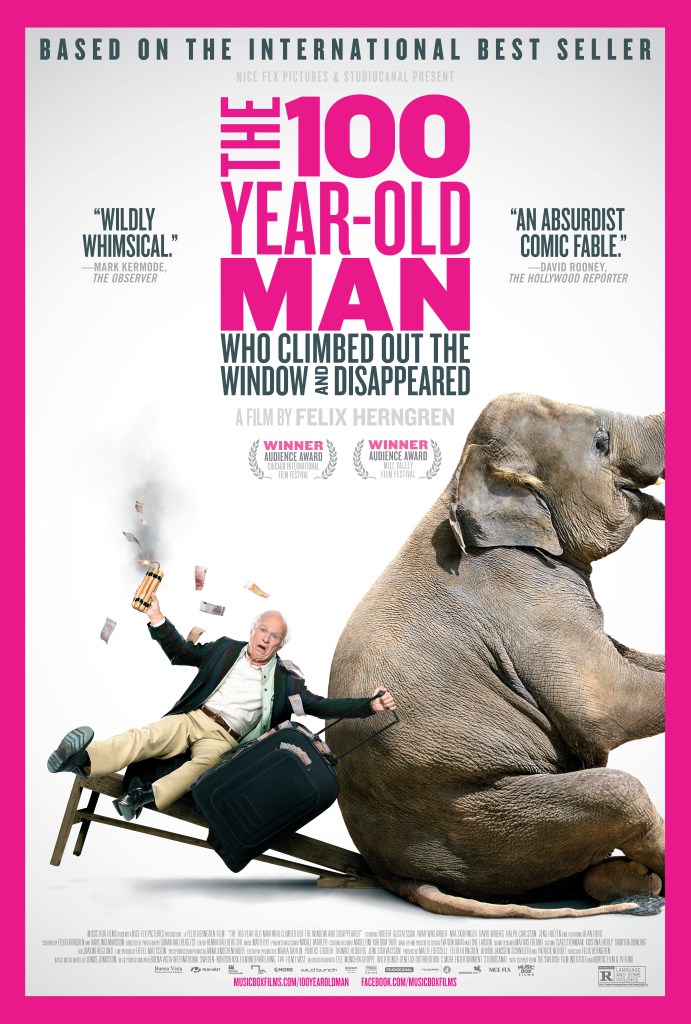
A whimsical comedy based on the bestselling Swedish novel (and book-club fodder) by Jonas Jonasson, The 100-Year-Old Man Who Climbed out the Window and Disappeared begins with exactly that, as Allan Karlsson (Gustafsson) escapes his retirement home on the day of his inauguration into the centenarian club with a “fuck this” attitude and little more than the slippers that bear his first name in Magic Marker. He shuffles off to the bus station where he buys a ticket to the next bus leaving town and inadvertently steals a suitcase with 50 million krona from some local thugs. He hooks up with a retired train attendant, Julius (Wiklander), and together they hit the road, picking up stray characters to add to their entourage while (often unknowingly) skirting the tattooed gangsters after that jackpot. One character owns an elephant. Another can’t decide on a career path, so has almost completed a half-dozen degrees. It is all very fanciful and droll, a mildly subversive and ramshackle Scandinavian version of the Grumpy Old Men on-the-road formula.

But that’s only half the story. Through flashbacks that seem to come whenever the present-day action hits a lull, we see Allan’s life unfold, and what a life that was. From his humble beginnings as the son of a revolutionary, young Allan develops a passion for blowing things up that parlays him into becoming a demolitions expert. There follows a stumbling and drunken shuffle through the history of the major conflicts of the 20th century (the film will be endlessly compared to Forrest Gump), as Allan travels to Franco’s Spain for the Spanish Civil War, helps Robert Oppenheimer develop the atomic bomb, pisses off Josef Stalin to the point where he gets sent to a gulag, becomes a double agent for the CIA during the Cold War, confers with Ronald Reagan, etc. Throughout it all, Allan is oblivious to the impact he has on world events, holding true to the theory espoused by his mother that “life is what it is and does what it does.”

These two narrative threads are constantly jockeying for dominance in a story that has a refreshing nonchalance, but is hindered by the lack of any tension whatsoever. Obviously better served as a novel, The 100-Year-Old Man… still entertains for the majority of its running time, but it feels like two separate movies, a dual shaggy dog story stitched together like Frankenstein’s monster, never breaking free of its quirky literary origins.

Watch The 100-Year-Old Man… on Kanopy here: https://www.kanopy.com/en/product/1053322

Saturday Matinee: Death to Smoochy

In defence of Death to Smoochy – the most absurd kids’ TV satire ever made

By Sophie Yapp

Source: Little White Lies

Once a film has been critically tarnished, it’s hard to come back from that. As soon as the negative reviews start to drop, public perceptions are formed and the box office is often affected accordingly. Yet it’s fairly common for a film to be met with critical apathy upon its initial release, only to assume the mantle of overlooked gem later on. Fourteen years after its disappointing theatrical run in 2002, Danny DeVito’s absurd black comedy, Death to Smoochy, exists as one such film.

The twisted satire both illuminates and mocks the brutality and corruption behind the ruthless industry of children’s television, and makes no bones about it. Rainbow Randolph (Robin Williams) is fired from his job as a children’s TV host and replaced by Smoochy (Edward Norton), an overly optimistic performer in a fluffy, fuchsia rhinoceros costume who skyrockets to fame, despite not being able to fathom the idea that his colleagues, unlike him, are solely in it for the money. Inevitably, the cutthroat nature of the industry means that Smoochy becomes a target of not only Randolph’s vengeance, but also the people pulling the strings.

Death to Smoochy flopped at the box office, grossing a little shy of $8.5m domestically. Critics were quick to slam the film as ‘odd’, ‘inexplicable’ and ‘unpleasant’. Such descriptions were not wrong. Indeed, Death to Smoochy is all of these things, but as a cynical comedy, this is all part of its charm. While the film pivots around children’s characters, it is not a children’s movie in the slightest. The seedy, deeply disturbing underlying nature of the film is disguised by the colourful, child-like context of the industry which it mocks. Essentially, it’s about sociopaths pursuing and trying to kill their rivals, demonstrating how money is the root of all evil.

Above all, though, it’s about greed. DeVito has been known to both direct and act in films that poke fun at society’s weaknesses in equal measures of maliciousness and light-heartedness. Here he ridicules the children’s entertainment industry while bringing to light the commercial, dog-eat-dog aspect of children’s television by exemplifying the profitable agenda of selling plastic and sugary commercial products off the back of the television shows. “We’re not looking at kids, we’re looking at wallets with pigtails,” are DeVito’s own words, echoed by Smoochy as he struggles to comprehend the sheer magnitude of manipulative scheming that goes on beneath the surface of an industry that, as he sees it, exists to provide entertainment for children.

The film’s morbid sense of humour is perhaps most prominent in Robin Williams’ highly amusing performance as a corrupt kiddy-host bordering on clinically insane. His twisted take on Rainbow Randolph is evidence of his acting diversity, also evoking some of his early stand-up work. What explicitly seeps through in Williams’ performance is his former relation to the backstabbing side of the business based on his own experiences in television, with the popular sitcom Mork & Mindy being cancelled after its fourth season.

Whether it’s framing Smoochy into performing live at a neo-Nazi rally, or replacing a batch of cookies with penis-shaped biscuits on Smoochy’s live show before proceeding to run on stage shouting obscenities such as “It’s a one-eyed wonder weasel!” in front of the preteen studio audience, Williams only adds to his hilarious legacy. It’s his outrageous performance that makes this tremendously funny, admittedly absurd satire well worth revisiting.

Saturday Matinee: Beasts Clawing at Straws

Director: Kim Young-Hoon
Cast: Jeon Do-Yeon, Jung Woo-Sung, Bae Sung-Woo, Youn Yuh-Jung, Jeong Man-Sik, Shin Hyun-Bin, Jung Ga-Ram, Jin Kyung, Park Ji-Hwan, Kim Joon-Han 
Running Time: 108 min.

By Paul Bramhall

Source: City of Fire

Adapted from a Japanese novel by Keisuke Sone, Beasts Clawing at Straws marks the directorial debut of Kim Yong-hoon, who also penned the script after being impressed by the novels intertwining story. Onscreen it’s easy to see why it made for a compelling big screen outing, as an impressively cast ensemble come together for an almost Shakespearean comedy of errors that focuses on 10 characters, all of whom are looking to get their hands on a Luis Vuitton bag stuffed with cash.

Taking place in the North Western harbour city of Pyeongtaek, giving the surrounds of Beasts Clawing at Straws a welcomely different aesthetic from the usual Seoul set thrillers, we initially meet a down on his luck bathhouse worker played by Bae Sung-woo (MetamorphosisThe Great Battle). Life’s been giving Sung-woo a tough time after going bankrupt, which isn’t made any easier by living with his mother, played by Youn Yuh-jung (Minari, Keys to the Heart). Suffering from the onset of dementia, she feels sure his wife (Jin Kyung – The WitnessVeteran) is trying to kill her, and matters are confounded further by their daughter having to take a break from studying to work so she can afford the tuition fees. Sung-woo and his family are fundamentally good people, the only ones in the entire cast, however when he finds the bag in question stuffed in one of the bathhouse lockers, the contents understandably prove hard to resist.

Meanwhile a frazzled immigration officer played by Jung Woo-sung (Steel RainAsura: City of Madness) is also in debt and being pressured to repay a vicious loan shark, played by Jung Man-sik (The SwordsmanRampant). His limbs are on the line, and to make matters worse his girlfriend has disappeared, although in reality she’s running a hostess bar across town. Played by Jeon Do-yeon (The ShamelessMemories of the Sword), she’s always on the make and seems to be two steps ahead in whatever shifty deals are afoot. Working in the hostess bar is a newcomer played by Shin Hyun-bin (Seven Years of NightConfidential Assignment), a character forced into the world of hostessing after she fell victim to a financial scam, but equally to get away from her abusive husband. When a Chinese customer (Jung Ga-ram – The Odd Family: Zombie On SaleBeliever) falls for her, he offers to assist with getting rid of her violent spouse.

All of these disparate scenarios gradually end up connecting with each other in different ways across the 108 minute runtime, and for a first time director Yong-hoon does an amicable job of balancing them all in a way that lets us get to know each character just enough to be invested in them. While the synopsis may indicate that Sung-woo is as close as we get to a main character as the everyman who ends up out of his depth, onscreen we get to spend just as much time with Woo-sung as the immigration officer and Do-yeon as the hostess bar madame. It’s the first time for the pair to share the screen together, and as 2 of the most recognisable faces in Korean cinema for more than 20 years, it’s a fitting vehicle to show off their talents. Woo-sung here is in the same hyper tense state that we saw him in Asura: City of Madness (although he doesn’t end up half as bloodied), and it’s undeniably fun to see him return to this kind of role.

As with almost any production she appears in though, it’s Do-yeon that steals the show whenever she’s onscreen. One of the world’s best actresses, after recent appearances in disaster flicks like Ashfall and Emergency Declaration which offered solid but unremarkable roles, it’s a real pleasure to see her here in a role fitting to her talents. Perhaps even more ruthless than the loan sharks who turn out to be as much on her tail as they do Woo-sung’s, it’s Do-yeon’s character who lingers most in the memory as the end credits roll.

It’s also another of Do-yeon’s movies that I was reminded of the most when watching Beasts Clawing at Straws, with the whole concept of various unsavoury characters in pursuit of a stash of dubiously acquired cash recalling Ryoo Seung-wan’s 2002 crime caper No Blood No Tears. Yong-hoon employs a similar caper style feel to his debut, and despite the fact that characters repeatedly get killed off left right and centre (in various gruesome ways), the violence never feels like its breaking from the black comedy tone which is established from the outset. At its core it’s a tale of dog-eat-dog, with each dog never knowing if there’s a bigger dog just around the corner, and it’s a scenario which allows for a brisk pace and some unexpected surprises.

The tension is ratcheted up further by the arrival of a cop from Seoul looking into a dismembered body that’s washed ashore. Played by the always welcome Yoon Je-moon clocking in a special appearance, ironically the last time he clocked in a special appearance was also playing a cop alongside Jung Woo-sung in 2017’s Asura: City of Madness. Je-moon’s character, who seems just as keen on hanging out in the local hostess bars and downing a few beers, has a habit of turning up at the most inconvenient of times, pushing half the cast who are already on edge just that little bit closer to it. Indeed it’s the concoction of the characters that populate the narrative that makes Beasts Clawing at Straws so much fun, with everyone suffering from some kind of bad luck, debt, or simply a case of being in the wrong place at the wrong time (or right, depending on which way you look at it).

The biggest surprise that Yong-hoon has up his sleeve is that it’s only revealed mid-way through that we’re in fact watching a non-linear tale play out, and have been watching a number of timelines that are playing out concurrently rather than chronologically. It’s executed in an unassuming way, and shows off first time director Yong-hoon’s strong grasp of storytelling, almost certainly making him a talent to watch out for in the future. Matched with the scripts unbiased approach to who gets killed off next, while there’s been countless movies that prove going after a bag stuffed with cash of unknown origin always turns out to be a bad idea, Beats Clawing at Straws does enough with the concept to keep it feeling fresh.

With that being said there are moments when Yong-hoon’s inexperience shows through. In particular the plot thread involving Shin Hyun-bin’s rookie escort pairing with Jung Ga-ram as the customer that falls for her, and the subsequent sub-plot that sees Ga-ram offering to kill off her husband, feels undercooked. The scenario plays out, however in the end it doesn’t feel particularly important to the overall plot, coming across more like an inconsequential aside that should have either been dropped or spent more time connecting to the bigger picture. Similarly for Youn Yuh-jung as the meddling and paranoid mother, who’s character ultimately just feels kind of there, but fails to serve any real purpose.

These are minor flaws though in what’s an undeniably fun movie, and it’s easy to imagine the tagline for its western release going something alone the lines of “No Country for Old Men meets Pulp Fiction!” There’s arguably traces of both the Coen Brothers and Quentin Tarantino’s filmmaking DNA throughout both the tone and structure of Beasts Clawing at Straws, but Yong-hoon’s success is that it never feels like it’s being derivative of either. The distinctive locales of hostess bars, late night saunas, and scrappy apartments forever bathed in the neon of the surrounding nightlife mean there’s no question we’re in Korean territory. With a healthy mix of black comedy, typically brutal violence, and colourful characters, the lesson on offer is one we should already know, but as a reminder to leave bags stuffed full of cash exactly where they are, Beasts Clawing at Straws is an entertaining one.

Watch Beasts Clawing at Straws on Hoopla here: https://www.hoopladigital.com/title/15296509

Saturday Matinee: Pi

By Roger Ebert

Source: RogerEbert.com

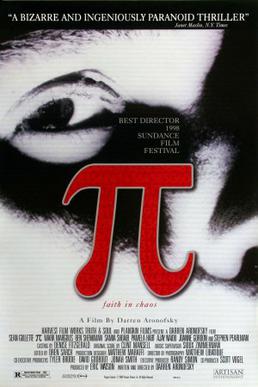
The film “Pi” is a study in madness and its partner, genius. A tortured, driven man believes (1) that mathematics is the language of the universe, (2) nature can be expressed in numbers, and (3) there are patterns everywhere in nature. If he can find the patterns, if he can find the key to the chaos, then he can predict anything–the stock market, for example. If the man is right, the mystery of existence is unlocked. If he is wrong, the inside of his brain begins to resemble a jammed stock ticker.

The movie, written and directed by Darren Aronofsky, is a study in mental obsession. His hero, named Maximillian Cohen, lives barricaded behind a triple-locked door, in a room filled with high-powered, customized computer equipment. He wants nothing to do with anybody. He writes programs, tests them, looks for the pattern, gets a 216-digit bug, stomps on his chips in a rage, and then begins to wonder about that bug. Exactly 216 digits. There is a theory among some Jewish scholars, he learns, that the name of God has 216 letters.

The movie is shot in rough, high-contrast black and white. Max, played by Sean Gullette, is balding, restless, paranoid and brilliant. He has debilitating headaches and nosebleeds. Symptoms of high blood pressure–or of the mental torment he’s putting himself through. He’s suspicious of everyone. The friendly Indian woman next door puts food by his door. He avoids her. He trusts only his old teacher, Sol (Mark Margolis). They play Go, a game deeper than chess, and Sol tells him to stop with the key to the universe business, already. He warns that he’s spinning away from science and toward numerology.

Not everybody thinks so. His phone rings with the entreaties of Marcy (Pamela Hart), who works for a high-powered Wall Street analysis firm. They want to hire him as a consultant. They think he’s onto something. He has predicted some prices correctly. At the deli, he runs into a Hasidic Jew named Lenny (Ben Shenkman), who seems casual and friendly but has a hidden mission: His group believes the Torah may be a code sent from God and may contain God’s name.

Of course if one finds the mathematical key to everything, that would include God, stock prices, the weather, history, the future, baseball scores and the response to all moves in Go. That assumes there is a key. When you’re looking for something that doesn’t exist, it makes you crazier the closer you get to it.

The seductive thing about Aronofsky’s film is that it is halfway plausible in terms of modern physics and math. What was numerology a century ago now has now been simplified into a very, very vast problem. Chaos theory looks for patterns where common sense says there are none. A computer might be able to give you the answer to anything, if (1) it is powerful enough, and (2) it has all the data. Of course, you might need a computer the size of the universe and containing everything in it, but we’re talking theory here.

“Pi” is a thriller. I am not very thrilled these days by whether the bad guys will get shot or the chase scene will end one way instead of another. You have to make a movie like that pretty skillfully before I care. But I am thrilled when a man risks his mind in the pursuit of a dangerous obsession. Max is out on a limb. There are hungry people circling him. He may be on to something. They want it, too. For both the stock market people and the Hasidic cabal, Max’s formula represents all they believe in and everything they care about.

And then there is a level at which Max may simply be insane, or physically ill. There are people who work out complicated theories involving long, impenetrable columns of numbers. Newspapers get envelopes filled with their proofs every day. And other people who sit in their rooms, wrapping themselves in the webs of chess or numbers theory, addicted to their fixes. And game players, gamblers, horseplayers–people bewitched by the mirage of a system.

The beautiful thing about mathematics is that you can’t prove it except by its own terms. There’s no way to put some math in a test tube and see if it turns purple or heats up. It sits there smugly in its own perfect cocoon, letting people like Max find anything he wants in it–or to think that he has.

Saturday Matinee: The Little Hours

A raunchy convent comedy loosely based on The Decameron, a 14th century classic

By Frederic and Mary Ann Brussat

Source: Spirituality & Practice

The Decameron by Giovanni Bocccaccio is a literary classic written in medieval times; it’s a bawdy collection of humorous and irreverent tales.
The unconventional Italian director Pier Paolo Pasolini took a crack at this erotic material with his 1971 film. Now Jeff Baena (the writer of I Heart Huckabees) has come up with a convent comedy based on some of the same material. It focuses on the uncontrollable sexual urges of three rowdy nuns. In one of the first scenes, they unleash a torrent of abusive rants on the gardener; this is not language you’d expect from women in habits!

The young nuns are out-of-control women who really do not belong in the convent. Sister Alessandra (Alison Brie) is anxiously awaiting her father (Paul Reiser) to pay her dowry so she can get married. Sister Generva (Kate Micucci) is an unruly woman addicted to gossip, and Sister Fernanda (Aubrey Plaza) is a wild explorer of witchcraft who participates in forbidden pagan rituals at night in the woods.

Trying to keep these three troublesome nuns in line proves to be an impossible task for Father Tommasso (John C. Reilly) who drinks too much, and Sister Marea (Molly Shannon), who has her own longings. All hell breaks loose when a handsome servant called Massetto (Dave Franco) arrives. He has just barely escaped the wrath of a nobleman (Nick Offerman) whose lusty wife (Lauren Weedman) had made him her sexual toy.

Father Tommasso takes this strapping young man under his wings. To keep him safe from the sisters, he suggests he act like he’s a deaf-mute. Massetto’s presence soon becomes a raunchy sex adventure for the three insatiable nuns who cannot get enough of him. When a puritanical Bishop (Fred Armisen) arrives, he is stunned and taken aback by the avid pursuit of pleasure at the convent. His tirades against “loving the world” fall on deaf ears.

This film is not for everyone, but given its source material, it is not likely to do much damage to the reputation of religious folk, and it actually might amuse quite a few of us!

Watch, The Little Hours on Kanopy here: https://www.kanopy.com/en/product/2257210

Saturday Matinee: The Long Kiss Goodnight

The Long Kiss Goodnight (1996), Lookback/Review

Overlooked, underappreciated, Geena Davis headlining an action flick with Samuel L. Jackson as her wisecracking, foulmouthed sidekick. White girl, Black guy buddy movie. Some of us here LOVE this movie.

By Tony Sokol

Source: Den of Geek

There are rumors and rumors of rumors that a sequel to Renny Harlin’s The Long Kiss Goodnight is in the works. I inexplicably missed the original when it came out and dismissed it as just another action flick. I was more than surprised at how prescient a movie it was at the time. The nineties was an adventurous time for filmmaking. Increasingly influenced by music videos, a lot of the art showed dark overtones, in bright colors and quick cuts. Quentin Tarantino’s Reservoir Dogs brought a sense of low-budget high-octane fun and breakaway banter back into the movies. He also expanded on the naturalistic acting styles in Barry Levinson’s conversational film Diner that let everyday small talk happen while allowing the plot to move along as it might. On the surface, The Long Kiss Goodnight is a fast-paced adventure movie with a quick wit, an accelerating pace, famous locations, and a female hero that performs too many impossible physical feats. Underneath it is an allegory to the growing paranoiac conspiracy theories that are now flooding into the mainstream. The movie references the 1993 World Trade Center bombing and Samantha Caine’s transformation into the regrettably-named Charly Baltimore can be seen as an allusion to sleeper-agent multiple personality assassins.

1996’s The Long Kiss Goodnight was the second movie in a row that director Renny Harlin made with his then-wife Geena Davis. Davis played a pirate in the previous year’s Cutthroat Island. Harlin previously directed The Adventures of Ford Fairlane and Die Hard 2 which were edited simultaneously and released just a week apart. Die Hard 2 was a huge hit and Ford Fairlane starred Andrew Dice Clay.  Harlin started his career by directing Finland’s most expensive film and the slashers Prison and A Nightmare on Elm Street 4: The Dream Master. The screenplay was written by action movie pioneer Shane Black who also wrote Lethal Weapon, Lethal Weapon 2, The Last Boy Scout and The Last Action Hero. Alan Silvestri composed the Original Music and the Cinematography was by Guillermo Navarro.

Geena Davis plays Samantha/Charly, the ultimate sleeper agent. Davis was probably best known as Thelma from Thelma and Louise, but had also made Dustin Hoffman stutter in Tootsie and acted in a string of movies including The Fly, Beetlejuice, A League of Their Own, Quick Change, Earth Girls are Easy and won an Oscar for Accidental Tourist. Besides being an actress, Davis is also a late-blooming Olympic archer and a member of Mensa. According to the Gene Mustain and Jerry Capeci true-crime book Murder Machine, Geena Davis occasionally babysat for mobster Dominick Montiglio’s kids. Montiglio was a member of Roy DeMeo’s assassination crew. The DeMeo crew hired  sociopathic family guy Richard “The Iceman“ Kuklinski (who lived across the street of a friend of mine when I was a kid) for wet jobs and Hollywood made a movie out of The Iceman in which Geena Davis snorts coke in a cameo. Davis was nominated for a Saturn Award for her performances as Samantha/Charlie. Samuel Jackson seems to be lit by some inner fire. He brings a damaged humanity and vulnerability to the wildest of roles. He brings more than wisecracks to private detective Mitch Hennessy. He puts tangible fear and uncertainty behind the bluster.

Amnesia chick Samantha Caine thinks she is a single mother and schoolteacher living in the small, suburban town of Honesdale, Pa. who is dating a nice guy. She suffers from “focal retrograde amnesia.” She has a daughter, Caitlin (Yvonne Zima), but she can’t remember the father. She hires Mitch Hennessy, a private detective who pulls small extortion cons, to find out who she used to be. An automobile accident activates Samantha’s “inner landscape” and she begins to remember her other personality, Charly, the woman she used to be. Originally mistaking herself for a chef, because she’s very handy with large kitchen knives, she begins to have more realizations of her past. Hennessy’s partner, Trin (played by Melina Kanakaredes, who has gone on to become a TV fixture as Dr. Sydney Hansen on Providence and as Det. Stella Bonasera on CSI: NY ), gets a major clue to her identity from a suitcase left in the attic of a boarding house. Saved from an assassination attempt by a very durable refrigerator door, Samantha takes off with Hennessy to unravel the clues and assemble a Remington rifle. They contact Dr. Nathan Waldman (Brian Cox) who tells Samantha that she never existed, that she was created as a cover identity for Charlene Elizabeth “Charly” Baltimore, a CIA assassin who disappeared eight years ago to resurface as a one of Santa’s elves on a parade float. Samantha and Hennessy take a trip to the Garden State to see her former fiancé Luke (David Morse), who turns out to be Daedalus, her last assassination assignment. Awkward. Charly kills Daedalus for reminding her who she is, grabs Hennessy and goes after her old CIA boss Leland Perkins (Patrick Malahide) who’s now working with an old nemesis from PsyOps Timothy (Craig Bierko), who is probably Caitlin’s daddy, to do a fund raiser for the CIA. No, they’re not gonna bake cookies. They’re going to tease conspiracy theorists for years:

Hennessy:

Fund raiser?

Perkins:

1993, World Trade Center bombing, remember? During the trial one of the bombers claimed the CIA had advanced knowledge; the diplomat who issued the terrorists visa was CIA, it’s not unthinkable they paved the way for the bombing, purely to justify a budget increase.”

Hennessy:

You’re telling me that you’re gonna fake some terrorist thing just to scare some money outta congress?

Perkins:

Well unfortunately Mr. Hennessy I have no idea how to fake killing 4,000 people, so we’re just going to have to do it for real. Oh, blame it on the Muslims naturally, then I’ll get my funding.

Sound familiar? It should, dozens of 9-11 references are supposedly found in movies and TV shows (Short-lived X-File spinoff Lone Gunmen’s pilot was about a thwarted World Trade Center bombing) made before 2001. There is a movement of people who believe that Hollywood power brokers knew all about it.

Geena Davis does a magnificent job playing the dual roles of Samantha and Charly. Although we are led to believe that Charly is the real person that she used to be, there are enough hints that she may be a Delta programmed assassin with multiple personalities. This might explain her enhanced abilities. Charly’s almost a superhero, she can grab a gun from a burning man while in free-fall and shoot a target dead in the eye, she can shoot open a block of ice for a soft landing with an automatic weapon, she can outrun an incendiary bomb, she’s better than Xena. She has an epiphany while standing naked in front of a mirror. A lot of people who say they are MK Ultra mind control survivors use mirror imagery. She switches between alters, from gleefully skewering a tomato into a wall with a carving knife, because “chefs do that” to threatening her kid to skate, “Life is pain, get used to it.” We learn that Charly has been around the intelligence community from the time she was a kid, her father was in the Irish military. Recruited into spy work in spite of her violent tendencies, Charly sometimes also changes into a sex kitten personality, another theme from MK Ultra conspiracy threads.

The Long Kiss Goodnight was prescient about quite a few things besides the growing trend to female action heroes. For every “the last time I got blown candy bars cost a nickel” there is a subtle nod to mind-blowing paranoid possibilities. This is a conspiracy movie posing as an adventure flick.

Watch The Long Kiss Goodnight on Pluto TV here: https://pluto.tv/en/on-demand/movies/the-long-kiss-goodnight-1996-1-1?utm_medium=textsearch&utm_source=google

Saturday Matinee: Little Shop of Horrors (1986)

By Roger Ebert

Source: RogerEbert.com

At a time when so many movies show such cold-blooded calculation, here’s one heedless enough to be fun. “Little Shop of Horrors” arrives with enough baggage to make it into a thoroughly timid project – what is less likely to make a fresh movie than a long-running stage hit? – and yet the movie has the offhand charm of something that was concocted over the weekend.

This is not only a musical and a comedy, as we expected, but also a revue of sorts: Comic actors such as Bill Murray, John Candy and James Belushi have walk-ons, and Steve Martin almost steals the show as a sadistic, motorcycle-riding dentist. Yet at the heart of the movie is a basic sweetness, an innocence that extends even to the centerpiece of the story, which is a man-eating plant named Audrey II.

The plant makes its appearance one day in a flower shop window, having arrived from another planet. It immediately begins to grow, to look around itself, to attract attention and to exhibit an appetite for human blood. It also changes the lives of the three people who work in the store: the shop assistant, Seymour (Rick Moranis); the salesclerk, Audrey (Ellen Greene), and their kindly, blustering old boss, Mr. Mushnik (Vincent Gardenia). Suddenly, they have the sort of fame thrust on them that is usually reserved for lottery winners and people who survive freak accidents.

There are all sorts of people with ideas about how to exploit the wonderful plant, and others who wish it no good. The movie uses them as the occasion for gentle satire and broad comedy, and there’s the sense that “Little Shop” is amused by just about whatever comes into its mind. There is also a romance; Seymour falls in love with Audrey (I), but must win her away from the evil dentist (Martin), who roars around on a motorcycle and gives her black eyes.

Meanwhile, Audrey (II) inexorably grows, nourishing itself with blood from a nick on Seymour’s finger and developing a taste for human flesh. The progressive growth of the alien plant was, of course, one of the glories of the stage version of “Little Shop,” and the movie’s Audrey, designed by Lyle Conway and directed by Frank Oz, is a marvel of technique. The plant actually does seem to have a personality and is remarkably accomplished during its musical numbers.

Moranis also has developed a personality in this movie and, in a way, that’s as surprising as Audrey II’s achievement. After being typecast as a nerd on SCTV and in such limited and predictable films as “Strange Brew,” he emerges here as a shy, likable leading man in the Woody Allen mode. The movie sometimes makes his work look easy. But he has to carry a lot of the exposition and hold most of the conversations with the plant, and without him the movie might not have been half as confident.

Greene repeats her New York and London role as the human Audrey, and by now the wide-eyed, daffy blond with the pushup bra has become second nature. Her big musical number, “Suddenly Seymour,” has the bravado of a Broadway show-stopper even while undermining itself with satire.

The show is punctuated by musical commentary delivered by a Supremes-style trio (Tichina Arnold, Tisha Campbell and Michelle Weeks), that bounces around the flower shop’s inner-city neighborhood with a message of hope that seems somewhat optimistic, inspired as it is by a carnivorous plant, but fits right in with the movie’s good heart.

All of the wonders of “Little Shop of Horrors” are accomplished with an offhand, casual charm. The movie doesn’t labor its jokes or insist on its virtuoso special effects, but devotes its energies to seeming unforced and delightful. The big laughs, when they come, are explosive (such as the payoff of Martin’s big musical number), but the quiet romantic moments are allowed to have their coy innocence.

This is the kind of movie that cults are made of, and after “Little Shop” finishes its first run, I wouldn’t be at all surprised to see it develop into a successor to “The Rocky Horror Picture Show,” as one of those movies that fans want to include in their lives.

Watch Little Shop of Horrors for free here: https://soap2day.cool/watch-movie/watch-little-shop-of-horrors-free-10873.5306743