Saturday Matinee: Pump Up the Volume

Looking back at Pump Up The Volume

By Simon Brew

Source: Den of Geek

“Do you ever the feeling that everything in America is completely fucked up?”

When writer/director Allan Moyle’s work is celebrated, it’s generally Empire Records that gets the acclaim (and with some justification). Furthermore, if the conversation then moves on to cult movies starring Christian Slater, then it’s almost sacrilege to not start with Heathers.

Me? In both cases, I go for Pump Up The Volume every time, a thoughtful film masquerading behind a name that doesn’t necessarily do it a lot of justice. It’s certainly not the first story about a shy-by-day high school kid who assumes an anonymous identity out of hours – although this is a film in pre-Internet days, remember – but it’s comfortably one of the best.

“I didn’t talk to one person today, not counting teachers”

The film centres on Christian Slater’s Mark, a meek, lonely teenager, moved into a strange area by his parents, and attending a high school where he knows nobody. Actually, scratch that, he knows the youngest school commissioner in the history of Arizona – that’d be his father – but other than that, he’s very much alone.

He’s also nervous and shy: early in the film, his writing is read out to the class by an impressed teacher, and his discomfort at his talent being aired in such a way is evident. Mark prefers flying under the radar.

That’s until 10pm every night, when he takes his one piece of company in life, his radio broadcasting equipment (given to him by his parents so he can keep in touch with his old friends), finds an available frequency, and broadcasts for as long as he wants as pirate DJ Happy Harry Hard-On. His collection of music is quite brilliant, and the film’s soundtrack is most definitely worth checking out (although it lacks the version of Leonard Cohen’s Everybody Knows that’s heard more prominently in the film), but it’s what Harry has to say that grabs the attention.

Because in Harry, Mark has an outlet to say what he actually thinks. And say it he does. His views aren’t, in the scheme of things, massively radical. His parents have sold out (his father used to fight the system, we’re told, and now he “is the system”), the school system is warped, and everyone conforms. There’s nobody to look up to, nothing to do. Oh, and he simulates masturbation. A lot.

As if to reinforce the two sides of his life, after one of his early broadcasts, Mark attempts to talk to a girl at school, and she blanks him.

That notwithstanding, though, he inadvertedly becomes the lone voice of protest in the midst of a messed up system. The film centres around the fictional school of Hubert Humphrey High, whose principal, Loretta Cresswell, firmly knows how to get the academic results that her own superiors judge her school on (her eventual demise in the film, arguably, doesn’t solve that much). Root out the problem students, with the below average scores, then find a reason to expel them, and just keep those who get decent grades on the register.

Interestingly, the story does have its roots in a real life situation. Appreciating Hubert Humphrey High doesn’t exist, what does exist is a school that it’s based on, and where Moyle’s sister, according to the Toronto Star, taught.

“This dancing is a privilege, and it’ll be taken away if it’s abused”

Back to Harry, then. His listeners are everywhere, and his audience unites the people who simply don’t talk to each other when they’re together at school. The nerdy overweight kid, the jocks, the prim and proper swot girl: Moyle draws together the usually clichéd characters of the high school movie, and pretty much gathers them around the radio. Some of them have very swish radios, too.

This wins him a gradually building word-of-mouth audience, which is where Mark’s problems begin. Kids start ringing each other up, to help pass the broadcast on. Tapes do the rounds. More people start to notice. Moyle demonstrates this by gradually congregating more and more people at the physical spot where the reception for Harry’s show is at its best.

Consequently, much to the growing consternation of his father and the principal, more and more people take seriously what Harry has to say. A calm school population starts to take on a rebellious flavour, and a small system that works on complicity starts to unravel.

It doesn’t help, of course, that Mark/Harry has access to documents and information that don’t show Hubert Humphrey High in the best of lights. And when he particularly highlights the case of one student who has been expelled for her problems, although really for her grades, then suddenly, Harry is on lots of people’s radar.

The turning point for the movie, though, comes surprisingly early: it’s the suicide of one of Harry’s listeners. As his army of followers know, if you include a number in your letter to Harry (he’s a pirate radio DJ with a  PO box), you get a call back. In this case, it’s all a little too late. One on-air conversation with Harry later, said caller commits suicide, and the system has its scapegoat. Moyle’s film makes no bones about the way the system looks for the obvious, public fix rather than examining what really drove a youngster to kill himself, and it’s in moments like these when it’s at its best.

There’s also a foil of sorts to Mark/Harry, and that’s with Samantha Mathis’ Nora. The film was made in 1990, and it shows just what my predictive powers are like that I was fairly convinced at the time she’d go on to be a bigger star than she became. Her choices of films didn’t massively help – the Super Mario Bros movie is a stain on most people’s CV – but there’s real potential in her performance here.

For Nora is a far more popular person than Mark by day, yet she too feels the need to express herself anonymously. In her case, it’s her letters to his show, signed from the Eat Me Beat Me lady. It’s Nora who fairly quickly works out Mark’s true identity, and the irony of their relationship is that by them both talking to nobody, they both find somebody.

“Like everything else, you have to read the fine print”

It’s around then, though, that the film starts to run out of steam. It lands lots of punches in its first hour, in pretty quick succession, yet its momentum falters a little, and it goes just a little more conventional (the romance, certainly, is well done, but less interesting). Thus, the final act of the film is more concerned with those in authority tracking down Harry, and shutting down his show. And it all comes together via Harry’s last broadcast, which ends up taking place from the back of a 4×4.

It’s worth acknowledging too, that some points jar just a little. Some of the reaction moments to people listening to Harry’s broadcasts feel a little out of place. Furthermore, while Moyle takes time to briefly explore why the parents, staff and authorities act the way they do, he doesn’t invest too much in it.

Why do they come up with daft schemes such as BIONIC (‘Believe It Or Not I Care’)? Why do Mark’s parents not see beyond the tick box obvious? There are moments with Mark’s dad in particular, to be fair, where you get a glimpse of what he was, and contrast that with what he’s become (check out the moment where he catches Mark and Nora in the basement). But Moyle is, understandably, a little harder on their side of the story.

Still, for its few foibles, and appreciating that the film tailors off a little, at no point in its 102 minute running time does it feel like it’s outstaying its welcome. There’s sometimes a rawness to it, and there’s also a bunch of strong performances from the predominantly young cast.

I should focus on Christian Slater in particular, though. He’s electric here, in the midst of Harry’s raging monologues, but it shouldn’t be overlooked how well he conveys Mark’s innate shyness. It’s one of the more trickier characters he’s tackled, and the issues he has to talk about – sexual abuse, suicide, sexuality, loneliness – mean he has to balance the tone just right. I’d suggest he very much does. Moyle’s writing, too, is at times exquisite. The monologue he pens for Slater to deliver on the simplicity of suicide is dark, gripping material for a supposed teen movie

“I am not perfect. I have just been going through the motions of being perfect”

I find it odd that Pump Up The Volume, a film with a misjudged title and a not wonderful promotional campaign behind it, seems to have been lost a little. Appreciating that at most we’ve had a basic DVD release of the film, and it’s never likely to be ripe for Blu-ray, it’s still comfortably one of the best teen movies of the 90s (and the 90s were hardly short of strong teen movies), and also, a qualityaddition to the unnaturally strong genre of radio DJ movies (seriously: how many bad ones can you name?)

Even if you take just the romance element in isolation (arguably the weakest ingredient) between Mark and Nora, the scene where Harry takes to the airwaves to tell her his feelings, unable to look her in the eye and voice them face to face, is really well done. It’s the kind of stuff that romcoms stumble over all the time. Here’s a teen movie that handles it with class.

When the film is quiet in particular, and when good actors are being trusted with long passages of dialogue, Pump Up The Volume is brilliant. And it still is. Moyle has fashioned here an intelligent, well made and strongly written film, with something to say, that – in an age of Internet anonymity – might even be more resonant over two decades later.

And if it isn’t? Well, to take the works of Harry himself, “so be it”…

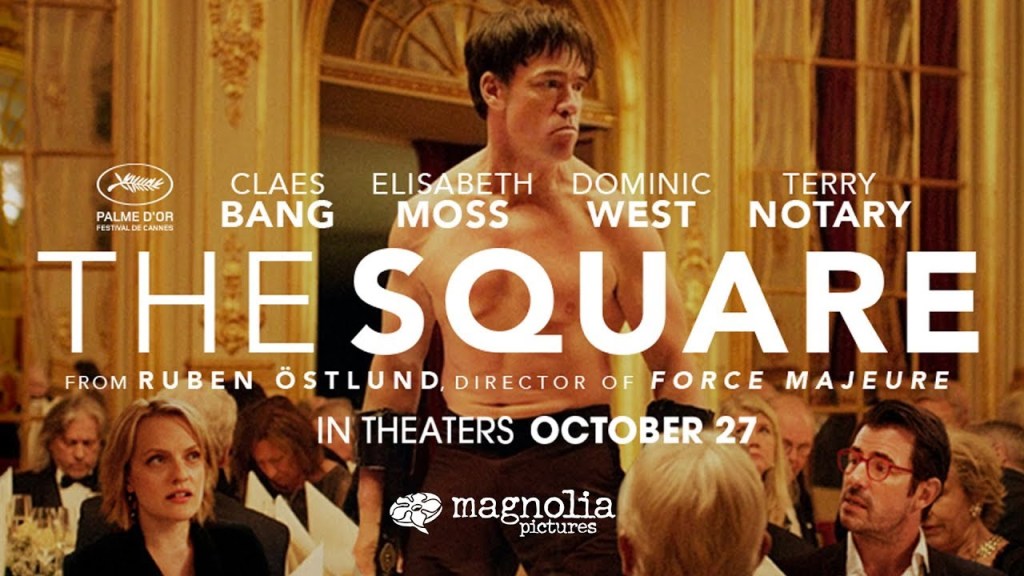
Saturday Matinee: The Square

By Freda Cooper

Source: Flickering Myth

SYNOPSIS:

A museum curator is preparing to launch a major art exhibition.  He sees himself as having a social conscience, but when his wallet and phone are stolen, the other side of his character emerges and he badly mis-handles the situation – and does the same thing when it comes to promoting his new show.

A film from Ruben Ostlund isn’t going to be cozy.  Compelling and fascinating, yes, but never easy and sometimes impenetrable.  His previous offering, Force Majeure, was well received and won the Un Certain Regard prize at Cannes in 2014.  His latest, The Square, went one step further and scooped the Palme D’Or last year.

Force Majeure centred on a spontaneously cowardly act by a father.  This has another act from another father at its centre, but this time one that’s thought out.  Badly.  And it’s followed by a second one, which is equally ill-considered.   The Square of the title is an art installation, the centrepiece of an exhibition supervised by museum curator Christian (Claes Bang).  He’s a man under pressure, both professionally and domestically, but still believes he has a social conscience – until his wallet and phone are stolen.  His reaction is extreme, a more accurate reflection of the real man, and he’s responsible for something equally rash when it comes to launching his beloved exhibition.

That’s putting it simply.  Ostlund has a number of targets for what is, at times, a savage satire.  At the heart of it is how those with money treat others – the homeless, the poor or those who are just not as wealthy.  Society encourages tolerance and kindness, but it’s easier to ignore them.  “Would you take a moment to save a life?” asks a charity worker and everybody who walks past her says no.  Are they just saying no to her or to her actual question?  Or both?

The art establishment, in the form of The Square installation, comes in for attack as well.  It’s meant to represent a space where everybody is safe and responsible for each other – but that can apply to any space, from a circle to a pentagon. It’s nonsense.  As are some of the other exhibits, especially one made up of conical piles of gravel.  It’s no surprise that some are accidently vacuumed up by the cleaner.  The exhibition’s marketing team is equally ridiculous, but also irresponsible in its creation of a promotional video of a little, impoverished girl.  It goes viral and causes an outcry – all because Christian doesn’t take the time to think it through properly.

Much of this creates uncomfortable laughter, but lurking in the background in the museum is another installation featuring an ape like man, brought to life by a performance artist.  His actual appearance at the exhibition launch is breath-stoppingly unsettling, as he lumbers around the room, aggressively whooping and pawing at the guests.  The end of the scene is even more deeply disturbing.  Yet again, the idea is mis-judged, with the guests initially alarmed and scared and then turning on the man in the most vicious of ways.

That scene marks a change in tone, but it’s also where the film starts to unravel.  Christian delivers a speech, videoed on his phone, which essentially explains the plot.  Except that, by that stage, the point is already clear, so it’s hardly necessary.   His explanation of the marketing video to a packed press conference is equally superfluous and more than a little disingenuous.  But Claes Bang holds both halves of the film together with the arrogant, flawed but not wholly unlikeable Christian, although talents like Dominic West and Elizabeth  Moss are under-used and have only a handful of scenes apiece.  Terry Notary, in that exhibition launch sequence delivers the piece of acting that sticks in your mind and, disturbing as  it is, it’s powerfully excellent.

The Square doesn’t have the clarity of Force Majeure, but it does have the ability to grab the audience firmly by the shoulders for the duration.  Given the complexity and occasional obscurity of the story, the film needs it.  It isn’t always satisfying, but it is never less than compelling.

____________________

Watch The Square on Tubi here: https://tubitv.com/movies/590338/the-square?start=true

Saturday Matinee: Let the Bullets Fly

By Josh Larsen

Source: Larsen on Film

Little visual gags fly as fast as the bullets in this 2010 Chinese action comedy, starring co-writer and director Jiang Wen as Pocky Zhang, a bandit leader who poses as governor of a southern outpost. One of the first things we see is a bandit leaning down to listen for an approaching train on railroad tracks—but first he ostentatiously sticks his finger in his ear to clear it out.

Mistaken identity is at the core of much of the movie’s comedy. Let the Bullets Fly opens with Zhang and his band hijacking that train, which is carrying the actual governor (Ge You) to his post in Goose Town. During his interrogation of the governor (captured in a shot-reverse-shot sequence that’s edited at light speed), Zhang decides that pretending to be the governor might be more lucrative than simply robbing him. But upon arriving in Goose Town (with the real governor in tow, disguised as Zhang’s counselor), Zhang finds that things are actually run by the local crime boss, Master Huang (Chow Yun-Fat). This leads to a series of strategic chess moves between the two men, culminating in a comic set piece where Zhang’s crew and Huang’s henchmen square off while wearing the same bandit masks with red circles on them, unable to tell who is who. It’s a face-off as farce.

With its manic comic sensibility, Let the Bullets Fly recalls the work of Hong Kong’s Stephen Chow (Shaolin SoccerKung Fu HustleCJ7), whose own films seem inspired by Looney Tunes cartoons (the opening train sequence here could easily be a Wile E. Coyote short). Physics takes a back seat to fun, so that much of the film seems to be occurring in fast motion. As director, Jiang looks for every opportunity to be showy; at one point an alarm clock is thrown in the air and shot to pieces, causing a metal circle to sail over the camera like a collar.

As an actor, Jiang seems to understand that his face has a comic appeal—those big ears—that allows him to underplay the gags by keeping a straight face. He’s a delight. The legendary Chow (The KillerCrouching Tiger, Hidden Dragon) gets a double role as the villainous Master Huang and Huang’s dim-witted body double. He’s quite a bit broader than Jiang, but equally amusing.

The disparate tones Jiang juggles can make for some uncomfortable moments. There are sudden bits of graphic violence, for instance, and a rape scene that isn’t given nearly the serious consideration it deserves. (Like much of the movie, it’s a setup for a later gag.) But as a political satire, Let the Bullets Fly is pointed and precise. “I want to make money standing tall,” Zhang says at one point, trying to explain why he’s left forest robbery behind. “Impossible,” the real governor replies, knowing bureaucratic corruption all too well. The best joke in Let the Bullets Fly might be that a bandit is the movie’s moral center.

____________________

Watch Let the Bullets Fly on Hoopla here: https://www.hoopladigital.com/title/10088666

Saturday Matinee: OSS 117: Cairo, Nest of Spies

By Marc Savlov

Source: Austin Chronicle

As Hollywood increasingly relies on ever less entertaining parodies of whole cinematic genres to sate an apparently insatiable public appetite for seriously dumb humor, the comparatively sophisticated yuks of Airplane! and The Naked Gun have devolved into the lowest-common-denominator yucks of the Scary Movie franchise and the viciously unfunny gurgles of Not Another Teen Movie, et al. Truly great parody relies in equal measure on both finely calibrated nuance and audience familiarity with the object of comic ridicule and not on how many fart jokes you can jam into an already bloated 90-minute running time. Austin Powers, for example, succeeded as much on the merits of its hyper-detailed production and art design as it did on Mike Myers’ groovy, hirsute mugging. Its swinging, Bond-esque London looked, or at least felt, as real as its modern-day counterpart, and its subject of parody, the 007 films, was universally known. Leave it to the French to beat us at our own bizarrely self-reflexive comic shenanigans. OSS 117: Cairo, Nest of Spies is a model of smart, often very silly, but never, ever stupid comic perfection. Set in 1955, back when Cairo was bristling with anti-English antipathy over a looming Suez canal crisis and radical Islam was just getting warmed up, the French Office of Strategic Services sends its best man, Hubert Bonisseur de la Bath, aka OSS 117 (Dujardin), to Egypt to discover the whereabouts of vanished agent Jack Jefferson (Lefebvre). OSS 117 is, of course, a fatuous, self-involved, debonair jerk who attracts the leggiest ladies and trouble of every sort. But Cairo, Nest of Spies, is far more than a Clouseau-on-holiday knockoff. Simple, period touches like the frequent use of obvious rear-projection (a nod to Hitchcock and a wonderfully evocative gag in and of itself), an ongoing bit about OSS 117’s nicotine independency, and an unexpectedly hilarious undercurrent of homoeroticism among spies of all nations conspire to make this a consistently entertaining parody that never once makes you feel like an idiot for laughing out loud at its idiocy.

___________________

Watch OSS 117: Cairo, Nest of Spies on Crackle here: https://www.crackle.com/details/cde3fda4-76e8-4b82-b612-ba0ae52fa27c/oss-117:-cairo-nest-of-spies

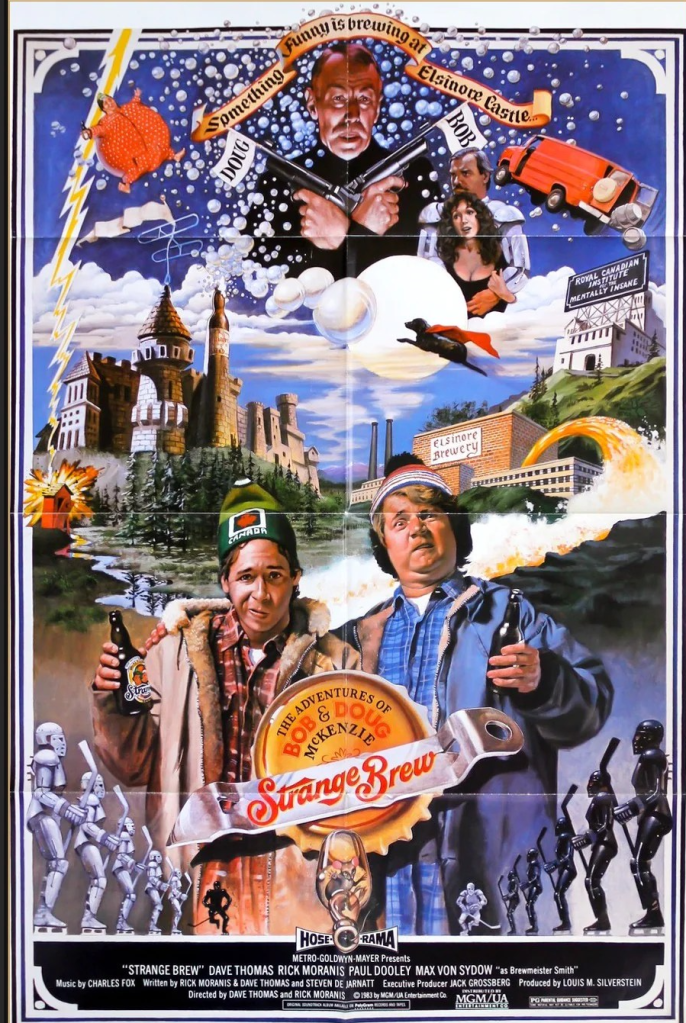
Saturday Matinee: Strange Brew

‘Strange Brew’: The Cult Comedy Classic that Married Canadiana with ‘Hamlet’

Beer. Hockey. Shakespeare. Beauty, eh?

By Lloyd Farley

Source: Collider

It’s August, 1983 at the local movie theatre.The lights go down, the curtains part. A trailer or two roll, maybe A Christmas Story, or the hilarious Yentl. The iconic MGM lion then comes on screen, and you wait breathlessly for his mighty roar to begin the film. And then…BURP.

No, this movie can’t possibly begin with such comedic absence of reverence, can it? The camera pans around to capture two parka and toque clad men, one of which is turning the lion’s tail like a crank to get it to roar. Absence of reverence, confirmed. The two men see the camera is running, so they run to the set, riddled with cases of beer and a backdrop with a large map on it, the words Great White North spread across, and so wide it includes England, Russia and Hawaii. The hilarious, absurd, Shakespearian, James Bond villainous, rife with all manner of Canadian stereotype film Strange Brew has begun.

The two men are brothers Bob and Doug McKenzie, played by Rick Moranis and Dave Thomas. The duo came to life on SCTV as The Great White North, an improvised bit by Moranis and Thomas for more Canadian content. They used every stereotype — toques, parkas, back bacon, beer, the iconic “coo-roo-coo-coo” loon call, “hosers” — and simply talked. They would add “eh?” to the end of every sentence, a tic as Canadian as “oh yea, no, for sure”. The McKenzie’s took off with syndication in the US. Capitalizing on their popularity, they released the comedy album The Great White North, which included the song “Take Off” with collaborator Geddy Lee (his highest charting single, including his work with Rush). The success of the album begat the movie, which Thomas pitched as having creative ties with Hamlet.

The beginning of the film is a movie within the movie: Mutants of 2051 A.D., a home-made sci-fi classic, like the works of The Goldbergs‘ Adam (Sean Giambrone). When the film breaks, the brothers, watching the film in the theatre, flee from angered moviegoers, and lose their dad’s (Mel Blanc) beer money. Forced to get beer for their dad the next morning, they place a mouse in an empty bottle of Elsinore beer, hoping to leverage it for free beer. They are told to go to the brewery, where the new owner, Pam Elsinore (Lynne Griffin), gives them jobs watching for mice in beer bottles (and cases of free beer). They wander around the brewery and into Brewmeister Smith’s (Max von Sydow) operations room, where they can see patients from the nearby Royal Canadian Mental Health Facility playing hockey.

Wait, back up. Esteemed Swedish actor Max von Sydow, of Bergman‘s The Seventh Seal? Yep. His son was a huge fan of SCTV, and encouraged his father to take the role. The character has been working on a plan to take over the world by adding a mind control drug to Elsinore beer, testing on the patients from the nearby facility. Through certain musical tones, those under the drug can be made aggressive (shown in an amusing bit where Doug plays the iconic loon theme on the keyboard), with those results tested through games of hockey. Because, you know, Canada.

Tranquilized by Smith and his accomplice, Pam’s Uncle Claude (Paul Dooley), the brothers wake up and make a delivery in their van, not knowing that the brakes are cut and that the beer kegs in the back have Pam and her father’s friend Henry (Douglas Campbell) inside. They careen down the hill into the lake, and then…Intermission.

Police divers find the boys in the van, alive and drinking beer. Charged with attempted murder, they are found insane by the judge. The brothers are sent to the asylum and placed in Smith’s care, where they are straitjacketed, prompting a game of steamroller, and take turns using electric shocks on one another. Freed by Rosie, they return to the brewery to stop Smith.

Pam and Bob are captured by Smith and placed in a brewery tank, which begins filling with beer. Rosie and Doug find them, discovering that Bob drank the entire contents of the tank and is now cartoonishly bloated, and needing to ‘take a leak’, which he does by, um, expelling and putting out a fire at the asylum. Knowing Smith has shipped tainted beer to Oktoberfest, Bob and Doug stop at home to get the help of Hosehead (Buddy), who flies off — you read that right — to stop the party and indulge in beer and sausages. The brothers take the remaining beer away, and presumably home. The film ends…

… no, it doesn’t. Bob and Doug reappear on the set of The Great White North and talk throughout the credits, sending off those that stayed behind – not the hosers that took off after the movie was done — with a beer whistle and a “happy trails”. Right now you’re thinking, “Geez, we got hosed! What about Hamlet, you knob?”

Strange Brew‘s retelling of Hamlet ranges from the painfully obvious to a much subtler degree. An intellectual ribbon throughout the lunacy. The name Elsinore is the easiest reference, a clear nod to the Danish royal castle Elsinore from the play. Pam is the Hamlet, the heiress of the brewery/kingdom after the death of her father, who is still reeling from her mother Gertrude (Jill FrappierQueen Gertrude) marrying her uncle Claude (Claudius) within days of the loss. Pam is shown by the ghost of her father, John (Eric House), how Claude and Smith murdered him. The ghost recounting the details of his death is taken directly from Hamlet, but the fact that he appears via a Galactic Border Patrol videogame in the movie is a clever reference to a feared invasion of Denmark by neighboring Norway. The presence of the Mental Health Facility would suggest a reference to the role of madness in Hamlet, from Hamlet’s acting as such to Ophelia’s descent into true madness, while the tinged beer a bow to the poisoned glasses of wine in the play’s final act. The McKenzie brothers themselves have a link to the play as a modern-day Rosencrantz and Guildenstern.

Strange Brew is as much an experience as a comedy, and, with the Canadian penchant for self-deprecation and a highbrow Shakespearian tint, its lighthearted jabs at the Canadian identity should be mandatory (well, at least suggested) viewing every July 1st on Canada Day. Happy trails indeed, eh?

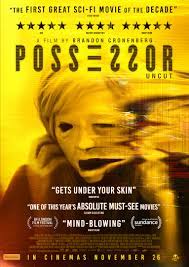
Saturday Matinee: Possessor

By Norman Gidney

Source: Film Threat

In just his second feature, Brandon Cronenberg, son of David, has delivered the first great sci-fi horror movie of the decade with Possessor. In the future, corporations use internal agents to inhabit innocent people’s bodies to carry out high-profile assassinations for strategic gains. Tanya Vos (Andrea Riseborough) is one such agent. In fact, she’s the star player at her secretive killing firm. But when the brain implant process takes its toll during an assignment, she begins to lose a grip on her own identity. Exploring self and identity, Cronenberg deftly explores heady material in a sci-fi horror candy coating, delivering a challenging ferocious film.

The action and concept are presented straight away with a bloody assassination in a nightclub. Miles away, Tanya lays on a white leather chaise with her head in a contraption guiding the host body from afar. After the assassination, she is to kill the host body with a shot to the head. Yet with this latest contract, her boss, Girder (Jennifer Jason Leigh), notices that Tanya is losing her grip on her true identity. Hesitant, Tanya accepts one last job in the form of Colin (Christopher Abbott), a coked-out rich boy with access to the CEO of a major tech company. The goal is to inhabit Colin’s body and have it murder Colin’s soon-to-be father in law John Parse (Sean Bean).

After going home to visit her estranged husband and 7-year-old son, Tanya returns to the facility to complete her final assassination. After the transfer, trouble ensues as various glitches in the technology are creating artifacts, hallucinations, and unpredictable behavior. Worse still, Colin’s hijacked personality begins fighting its way back to the surface. Will Tanya get the job done? Will Colin take over and trap Tanya in his body forever?

Cronenberg’s script for Possessor deftly convinces the audience that its world is real. It sprinkles random details of the technology in context rather than laboriously over-explaining all of it. We watch the process and hear just enough technobabble to believe it, and then we are off and running. To this end, Leigh’s understated performance as the calm puppetmaster at the firm is grounded and unsettling.

After kidnapping Colin and implanting the device in his brain, Tanya transfers into Colin’s body and assumes his life. In a brilliant pair of performances, Abbot and Riseborough make us believe that Tanya is inhabiting a very alien male body. Standing before a mirror just after the transfer, Abbot portrays Tanya exploring her new host, lightly feeling the skin, looking at the odd genitalia in the front, and trying to act as normal. The two create a seamless illusion of a single personality.

Possessor explores all of the existential dilemmas this idea can afford to a frightening degree while telling an absorbing tale of corporate espionage. Cronenberg has created a mind-bending trip of a movie with more to say than your average actioner and is supported by spectacular performances and make-up and practical effects that seal the deal. Brace yourself. The film is brilliant.

____________________

Watch Possessor on Kanopy here: https://www.kanopy.com/en/product/13106284

Saturday Matinee: The Green Knight

By Brian Tallerico

Source: RogerEbert.com

Light snow, misty fog, and falling ash blend in the opening scenes of David Lowery’s magnificent “The Green Knight,” setting a surreal tone for what’s to come. You can feel the chill and smell the air. Immediately, you feel outside yourself, far from daily concerns, set for an experience that’s unlike anything else in nearby theaters. That feeling won’t subside for over two hours.  

Lowery has adapted the 14th century chivalric romance Sir Gawain and the Green Knight into one of the most memorable films of the year, a fascinating swirl of masculinity, temptation, heroism, and religion. Arthurian experts may quibble with some of Lowery’s decisions and it is certainly a film that challenges traditional expectations of stories about heroic knights for modern audiences, but fans will be drawn to this mesmerizing journey guided by Lowery’s incredibly poetic eye, career-best work from Dev Patel, and an artistic sensibility that transports audiences to another world. It’s a film that embeds the concept of storytelling and performance into its narrative—whether it’s a King asking for a heroic tale or children watching a puppet show—while also weaving its own enchanting spell on audiences. More than any movie in a long time, I would have immediately watched it again, but it’s also a film that really strengthens in memory, swirling around your brain like the falling flakes of the opening scenes.

Sir Gawain (Dev Patel) is the nephew of King Arthur (Sean Harris) and Queen Guinevere (Kate Dickie), and the son of Morgan Le Fay (Sarita Choudhury), accused by some in the village of witchcraft. After a brief opening scene with his lover (Alicia Vikander) and mother, Gawain is off to a lavish Christmas banquet with the King and Queen, at which he is surprised to be asked to sit by their side. Arthur speaks to him of taking young Gawain for granted, and immediately Patel conveys depth with his striking eyes, relaying both the emotional pride that comes with finally feeling seen. (He does so much throughout the film in terms of physical performance, using his eyes and body to find emotion without dialogue.) Long, deliberately slow exchanges between Gawain and Arthur set the tone: This is not an action film. Arthur asks to hear a tale.

One unfolds in front of their eyes. The doors to the hall burst open and the Green Knight (Ralph Ineson) enters. Half-man, half-tree, he casts an imposing figure, and he wants to play “The Christmas Game.” He offers a deal. He challenges any of Arthur’s knights to strike him. If they can, the knight will get his imposing weapon in exchange. But there’s a cost. A year hence, the knight must come to the Green Chapel, where the Green Knight will return the exact strike given him a year earlier. Gawain steps forward, and despite being reminded that this is a game by Arthur, beheads the Green Knight. The mythical creature picks up his head, which doesn’t seem too concerned about its detachment, and laughs as it rides off. Gawain is about to have a long year.

This is all really prologue to “The Green Knight,” the bulk of which consists of Sir Gawain’s journey to the Green Chapel to meet his fate. Along the way, he meets a scavenger played by Barry Keoghan, a mysterious young woman played by Erin Kellyman, and a Lord played by Joel Edgerton. Lowery’s script deftly matches the poetic structure of its source, circling back to themes like the rhyming structure of a poem, and unfolding his story in what almost feel like cinematic stanzas that repeat and comment on each other. Gawain’s journey becomes a spiral, feeling more and more like a dream, as if he never really left that banquet with the Green Knight to begin with, and the film gains momentum through a cumulative sense of disorientation. It becomes not so much a story of a physical journey but a mental and emotional one, a series of challenges before a young man faces his ultimate fate.

With its loose storytelling structure, the tech elements of “The Green Knight” become even more essential to its success. Lowery has brought his remarkable team, including regular composer Daniel Hart and cinematographer Andrew Droz Palermo. (He edits the film himself, and reportedly re-cut it dramatically from the version that was supposed to premiere at SXSW in March of 2020.) The fluid cinematography alternates between dreamlike and something deeply connected to Mother Nature. “The Green Knight” is about many things—and some of the best film writing of this year will unpack its themes in more depth—but a sense of man’s relatively minor role in the grand scope of history and nature is essential, and Palermo beautifully captures the lush greens of the world around Gawain, as if the Knight himself is already everywhere. Vikander gets a phenomenal speech about how much we all return to the earth and Gawain is constantly being reminded of his insignificance and fragility. If The Green Knight doesn’t get him, something else will.

While it may be his most ambitious film, Lowery has played with complex themes before in projects like “A Ghost Story,” and this reflects that film’s questioning of meaning in the relatively small window of a human existence. Once again, Lowery leaves just enough open to interpretation and yet never lacks in confidence. That’s the incredibly fine line that great films often walk—when a work can feel both assured in the voices of its creators and yet open enough to spark conversation. “The Green Knight” is one of those films. One never questions that Lowery knows exactly what he’s doing, and yet people will walk away with very different readings of “The Green Knight.” Again, that’s akin to a great poem that means something unique to each person that reads it, and some of those readings may even surprise the original author. 

“The Green Knight” asks a lot of its viewers—to stay engaged with what could be called its slow pace, to consider its themes without them being underlined for easy consumption, to be willing to see a film about famous knight that contains very little in the way of traditional heroism. It is scary, sexy, and strange in ways that American films are rarely allowed to be, culminating in a sequence that cast the whole film in a new light for this viewer. We’re all just sitting in that banquet hall, listening to the story requested by King Arthur, told by a master storyteller.

Saturday Matinee: Acción Mutante

By Steve Harcourt

Source: NerdSpan

Although made in a ’90s ‘B-Movie’ style, Acción Mutante can be either viewed as a schlocky, gore laden, science fiction romp or a politically astute piece of social commentary in an innocuous wrapper. It could also, potentially, be both.

In a dystopian future where the world is ruled by the glamorous and ‘good looking’ people, the disfigured and disabled are marginalised and treated as second class citizens destined for a life of poverty.  Fighting against this tyranny is a disparate band of characters, who call themselves mutants, using the name ‘Acción Mutante’ for their terrorist acts.  For several years since the imprisonment of their leader ‘Ramon’ (Antonio Resines), the group, comprising of conjoined twins ‘Alex’ (Álex Angulo) & ‘Juan’ (Juan Viadas), ‘Quimicefa’ (Saturnino García), ‘Manitas’ (Karra Elejalde), ‘Chepa’ (Ion Gabella), and ‘M.A’ (Alfonso Martínez), have been ineptly continuing the fight, leading to many high profile blunders, especially when they try to kidnap someone.  Upon his release, ‘Ramon’ immediately puts into motion a new plan to kidnap Patricia Orujo (Frédérique Feder), the daughter of the boss of the Orujo business empire (Fernando Guillén), and ransom her for 10,000,000 ‘ecus’ on a distant mining planet.  This plan rapidly spirals out of control…

As a writer, producer and director, Álex de la Iglesia has become more well known for films such as The Oxford MurdersLa Comunidad, and The Last Circus since Acción Mutante, his first directorial feature. This film was a brash introduction to what was he was later to create.  With production being aided by Augustin and Pedro Almodóvar, and with several well known Spanish actors on board, this was by no means an effort made with little talent behind him and it shows what people saw in him, even then.

What he has made is, essentially, an obvious attack on the bourgeoisie and their ilk with commentary on the disabled and the way society treats them, all put together in a ‘Troma-esque’ black comedy. In the amount of gore, and especially the style of the gore, the Troma influence is apparent and it would sit comfortably alongside many Troma films.  There is also an obvious influence in some scenes from Almodóvar, such as the party scene, where you may even notice Rossy De Palma, an Almodóvar regular. There are also some similarities to other European directors’ early work, such as Jean Pierre Jeunet & Marc Caro (Delicatessen), especially in terms of characters, which is not a bad thing.

These characters are a mixed bag, with some being broadly comedic and others being very one dimensional heroes or villains.  What is clear is that a certain amount of hokey fun was had by the cast. They do a good job in hamming it up in the right manner for this kind of B-Movie with some good interplay, some clever idiosyncrasies, and some nice set pieces.  Plot-wise, the pacing and structure are a little flawed. As the second half falls apart a bit, losing some of the good premise along the way, which is a shame. Much more could have been made of this premise and instead it treads a slightly simpler path with a cheaper, trashier angle.  Having said that, it does still tend to work, but just not quite how you thought it was going to.

There are a couple of problematic areas, namely some excessive violence that is unnecessary and some misogynistic elements which are troubling.  When the film originally came out on VHS, the BBFC (British Board of Film Classification) made some cuts, which have been put back in this DVD version, and we probably would have been better off without them as they do not enhance the plot or its coherence at all. I had previously only seen the VHS version and in no way was this better.  As for the misogyny, it is pretty obvious that these elements are there, but I would be interested to hear what Álex de la Iglesia and producer Pedro Almodóvar have to say about it and whether they were making a particular point, as Almodóvar has a history of strong female characters and is often called a feminist.

Overall, I would say that if you’re a fan of the Troma-style of bonkers, splatter, comedy B-Movie, then you will find something to like here. This needs to be taken as a relatively stupid, schlocky comedy with some obvious social and political points to be made. However, I have read that there are some more specific points made for a Spanish audience that may not be immediately apparent for an international audience.  As someone from the UK, I didn’t pick up on anything in particular, but that doesn’t mean it’s not there. Potentially, it could contain further depth.  So, while it is problematic, it does show the signs of better work that was to come from Álex de la Iglesia, and can be enjoyed as an oddball thing of its own.

____________________

Watch Acción Mutante on Hoopla here: https://www.hoopladigital.com/title/15772689