
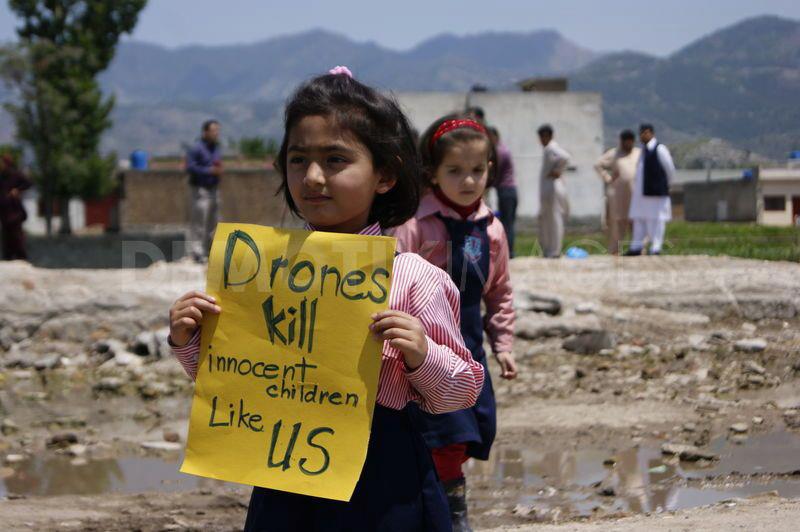
Drone warfare whistleblower sentenced to 45 months in prison for telling the American people the truth.

Drone warfare whistleblower sentenced to 45 months in prison for telling the American people the truth.

By Chris Hedges

Source: ScheerPost.com

Daniel Hale, a former intelligence analyst in the drone program for the Air Force who as a private contractor in 2013 leaked some 17 classified documents about drone strikes to the press, was sentenced today [7/27/21] to 45 months in prison.

The documents, published by The Intercept on October 15, 2015, exposed that between January 2012 and February 2013, US special operations airstrikes killed more than 200 people. Of those, only 35 were the intended targets. For one five-month period of the operation, according to the documents, nearly 90 percent of the people killed in airstrikes were not the intended targets. The civilian dead, usually innocent bystanders, were routinely classified as “enemies killed in action.”

The Justice Department coerced Hale, who was deployed to Afghanistan in 2012, on March 31 to plead guilty to one count of violating the Espionage Act, a law passed in 1917 designed to prosecute those who passed on state secrets to a hostile power, not those who expose to the public government lies and crimes. Hale admitted as part of the plea deal to “retention and transmission of national security information” and leaking 11 classified documents to a journalist. If he had refused the plea deal, he could have spent 50 years in prison. 

Hale, in a handwritten letter to Judge Liam O’Grady on July 18, explained why he leaked classified information, writing that the drone attacks and the war in Afghanistan “had little to do with preventing terror from coming into the United States and a lot more to do with protecting the profits of weapons manufacturers and so-called defense contractors.”

At the top of the ten-page letter Hale quoted US Navy Admiral Gene LaRocque, speaking to a reporter in 1995: “We now kill people without ever seeing them. Now you push a button thousands of miles away … Since it’s all done by remote control, there’s no remorse … and then we come home in triumph.”

“In my capacity as a signals intelligence analyst stationed at Bagram Airbase, I was made to track down the geographic location of handset cellphone devices believed to be in the possession of so-called enemy combatants,” Hale explained to the judge. “To accomplish this mission required access to a complex chain of globe-spanning satellites capable of maintaining an unbroken connection with remotely piloted aircraft, commonly referred to as drones. Once a steady connection is made and a targeted cell phone device is acquired, an imagery analyst in the U.S., in coordination with a drone pilot and camera operator, would take over using information I provided to surveil everything that occurred within the drone’s field of vision. This was done, most often, to document the day-to-day lives of suspected militants. Sometimes, under the right conditions, an attempt at capture would be made. Other times, a decision to strike and kill them where they stood would be weighed.”

He recalled the first time he witnessed a drone strike, a few days after he arrived in Afghanistan.

“Early that morning, before dawn, a group of men had gathered together in the mountain ranges of Patika province around a campfire carrying weapons and brewing tea,” he wrote. “That they carried weapons with them would not have been considered out of the ordinary in the place I grew up, much less within the virtually lawless tribal territories outside the control of the Afghan authorities. Except that among them was a suspected member of the Taliban, given away by the targeted cell phone device in his pocket. As for the remaining individuals, to be armed, of military age, and sitting in the presence of an alleged enemy combatant was enough evidence to place them under suspicion as well. Despite having peacefully assembled, posing no threat, the fate of the now tea drinking men had all but been fulfilled. I could only look on as I sat by and watched through a computer monitor when a sudden, terrifying flurry of hellfire missiles came crashing down, splattering, purple-colored crystal guts on the side of the morning mountain.”

This was his first experience with “scenes of graphic violence carried out from the cold comfort of a computer chair.” There would be many more.

“Not a day goes by that I don’t question the justification for my actions,” he wrote. “By the rules of engagement, it may have been permissible for me to have helped to kill those men — whose language I did not speak, customs I did not understand, and crimes I could not identify — in the gruesome manner that I did. Watch them die. But how could it be considered honorable of me to continuously have laid in wait for the next opportunity to kill unsuspecting persons, who, more often than not, are posing no danger to me or any other person at the time. Never mind honorable, how could it be that any thinking person continued to believe that it was necessary for the protection of the United States of America to be in Afghanistan and killing people, not one of whom present was responsible for the September 11th attacks on our nation. Notwithstanding, in 2012, a full year after the demise of Osama bin Laden in Pakistan, I was a part of killing misguided young men who were but mere children on the day of 9/11.” 

He and other service members were confronted with the privatization of war where “contract mercenaries outnumbered uniform wearing soldiers 2 to 1 and earned as much as 10 times their salary.”

“Meanwhile, it did not matter whether it was, as I had seen, an Afghan farmer blown in half, yet miraculously conscious and pointlessly trying to scoop his insides off the ground, or whether it was an American flag-draped coffin lowered into Arlington National Cemetery to the sound of a 21-gun salute,” he wrote. “Bang, bang, bang. Both served to justify the easy flow of capital at the cost of blood — theirs and ours. When I think about this, I am grief-stricken and ashamed of myself for the things I’ve done to support it.”

He described to the judge “the most harrowing day of my life” that took place a few months into his deployment “when a routine surveillance mission turned into disaster.” 

“For weeks we had been tracking the movements of a ring of car bomb manufacturers living around Jalalabad,” he wrote. “Car bombs directed at US bases had become an increasingly frequent and deadly problem that summer, so much effort was put into stopping them. It was a windy and clouded afternoon when one of the suspects had been discovered headed eastbound, driving at a high rate of speed. This alarmed my superiors who believe he might be attempting to escape across the border into Pakistan.”

Now, whenever I encounter an individual who thinks that drone warfare is justified and reliably keeps America safe, I remember that time and ask myself how could I possibly continue to believe that I am a good person, deserving of my life and the right to pursue happiness.

— Daniel Hale, of learning about children killed by indiscriminate US drone attacks he participated in.

“A drone strike was our only chance and already it began lining up to take the shot,” he continued. “But the less advanced predator drone found it difficult to see through clouds and compete against strong headwinds. The single payload MQ-1 failed to connect with its target, instead missing by a few meters. The vehicle, damaged, but still driveable, continued on ahead after narrowly avoiding destruction. Eventually, once the concern of another incoming missile subsided, the driver stopped, got out of the car, and checked himself as though he could not believe he was still alive. Out of the passenger side came a woman wearing an unmistakable burka. As astounding as it was to have just learned there had been a woman, possibly his wife, there with the man we intended to kill moments ago, I did not have the chance to see what happened next before the drone diverted its camera when she began frantically to pull out something from the back of the car.”

He learned a few days later from his commanding officer what next took place. 

“There indeed had been the suspect’s wife with him in the car,” he wrote. “And in the back were their two young daughters, ages 5 and 3 years old. A cadre of Afghan soldiers were sent to investigate where the car had stopped the following day. It was there they found them placed in the dumpster nearby. The eldest was found dead due to unspecified wounds caused by shrapnel that pierced her body. Her younger sister was alive but severely dehydrated. As my commanding officer relayed this information to us, she seemed to express disgust, not for the fact that we had errantly fired on a man and his family, having killed one of his daughters; but for the suspected bomb maker having ordered his wife to dump the bodies of their daughters in the trash, so that the two of them could more quickly escape across the border. Now, whenever I encounter an individual who thinks that drone warfare is justified and reliably keeps America safe, I remember that time and ask myself how could I possibly continue to believe that I am a good person, deserving of my life and the right to pursue happiness.”

“One year later, at a farewell gathering for those of us who would soon be leaving military service, I sat alone, transfixed by the television, while others reminisced together,” he continued. “On television was breaking news of the president giving his first public remarks about the policy surrounding the use of drone technology in warfare. His remarks were made to reassure the public of reports scrutinizing the death of civilians in drone strikes and the targeting of American citizens. The president said that a high standard of ‘near certainty’ needed to be met in order to ensure that no civilians were present. But from what I knew, of the instances where civilians plausibly could have been present, those killed were nearly always designated enemies killed in action unless proven otherwise. Nonetheless, I continued to heed his words as the president went on to explain how a drone could be used to eliminate someone who posed an ‘imminent threat’ to the United States. Using the analogy of taking out a sniper, with his sights set on an unassuming crowd of people, the president likened the use of drones to prevent a would-be terrorist from carrying out his evil plot. But, as I understood it to be, the unassuming crowd had been those who lived in fear and the terror of drones in their skies and the sniper in this scenario had been me. I came to believe that the policy of drone assassination was being used to mislead the public that it keeps us safe, and when I finally left the military, still processing what I’d been a part of, I began to speak out, believing my participation in the drone program to have been deeply wrong.”

Hale threw himself into anti-war activism when he left the military, speaking out about the indiscriminate killing of hundreds, perhaps thousands, of noncombatants, including children in drone strikes. He took part in a peace conference held in Washington, D.C. in November 2013. The Yemeni Fazil bin Ali Jaber spoke at the conference about the drone strike that killed his brother, Salem bin Ali Jaber, and their cousin Waleed. Waleed was a policeman. Salem was an Imam who was an outspoken critic of the armed attacks carried out by radical jihadists.

“One day in August 2012, local members of Al Qaeda traveling through Fazil’s village in a car spotted Salem in the shade, pulled up towards him, and beckoned him to come over and speak to them,” Hale wrote. “Not one to miss an opportunity to evangelize to the youth, Salem proceeded cautiously with Waleed by his side. Fazil and other villagers began looking on from afar. Farther still was an ever present reaper drone looking too.”

“As Fazil recounted what happened next, I felt myself transported back in time to where I had been on that day, 2012,” Hale told the judge. “Unbeknownst to Fazil and those of his village at the time was that they had not been the only watching Salem approach the jihadist in the car. From Afghanistan, I and everyone on duty paused their work to witness the carnage that was about to unfold. At the press of a button from thousands of miles away, two hellfire missiles screeched out of the sky, followed by two more. Showing no signs of remorse, I, and those around me, clapped and cheered triumphantly. In front of a speechless auditorium, Fazil wept.”

A week after the conference Hale was offered a job as a government contractor.  Desperate for money and steady employment, hoping to go to college, he took the job, which paid $ 80,000 a year.  But by then he was disgusted by the drone program.

“For a long time, I was uncomfortable with myself over the thought of taking advantage of my military background to land a cushy desk job,” he wrote. “During that time, I was still processing what I had been through, and I was starting to wonder if I was contributing again to the problem of money and war by accepting to return as a defense contractor. Worse was my growing apprehension that everyone around me was also taking part in a collective delusion and denial that was used to justify our exorbitant salaries, for comparatively easy labor. The thing I feared most at the time was the temptation not to question it.”

“Then it came to be that one day after work I stuck around to socialize with a pair of co-workers whose talented work I had come to greatly admire,” he wrote. “They made me feel welcomed, and I was happy to have earned their approval. But then, to my dismay, our brand-new friendship took an unexpectedly dark turn. They elected that we should take a moment and view together some archived footage of past drone strikes. Such bonding ceremonies around a computer to watch so-called “war porn” had not been new to me. I partook in them all the time while deployed to Afghanistan. But on that day, years after the fact, my new friends gaped and sneered, just as my old one’s had, at the sight of faceless men in the final moments of their lives. I sat by watching too; said nothing and felt my heart breaking into pieces.”

“Your Honor,” Hale wrote to the judge, “the truest truism that I’ve come to understand about the nature of war is that war is trauma. I believe that any person either called-upon or coerced to participate in war against their fellow man is promised to be exposed to some form of trauma. In that way, no soldier blessed to have returned home from war does so uninjured. The crux of PTSD is that it is a moral conundrum that afflicts invisible wounds on the psyche of a person made to burden the weight of experience after surviving a traumatic event. How PTSD manifests depends on the circumstances of the event. So how is the drone operator to process this? The victorious rifleman, unquestioningly remorseful, at least keeps his honor intact by having faced off against his enemy on the battlefield. The determined fighter pilot has the luxury of not having to witness the gruesome aftermath. But what possibly could I have done to cope with the undeniable cruelties that I perpetuated?”

“My conscience, once held at bay, came roaring back to life,” he wrote. “At first, I tried to ignore it. Wishing instead that someone, better placed than I, should come along to take this cup from me. But this too was folly. Left to decide whether to act, I only could do that which I ought to do before God and my own conscience. The answer came to me, that to stop the cycle of violence, I ought to sacrifice my own life and not that of another person. So, I contacted an investigative reporter, with whom I had had an established prior relationship, and told him that I had something the American people needed to know.”

Hale, who has admitted to being suicidal and depressed, said in the letter he, like many veterans, struggles with the crippling effects of post-traumatic stress disorder, aggravated by an impoverished and turbulent childhood.

“Depression is a constant,” he told the judge. “Though stress, particularly stress caused by war, can manifest itself at different times and in different ways. The tell-tale signs of a person afflicted by PTSD and depression can often be outwardly observed and are practically universally recognizable. Hard lines about the face and jaw. Eyes, once bright and wide, now deep-set, and fearful. And an inexplicably sudden loss of interest in things that used to spark joy. These are the noticeable changes in my demeanor marked by those who knew me before and after military service. To say that the period of my life spent serving in the United States Air Force had an impression on me would be an understatement. It is more accurate to say that it irreversibly transformed my identity as an American. Having forever altered the thread of my life’s story, weaved into the fabric of our nation’s history.”

Imperialism and the Logic Of Mass Destruction

By Carl Boggs

Source: CounterPunch

As throughout much of its war-obsessed history, the United States is currently engaged in military conflict – or threatening such action – across a broad contested terrain.   In the cases of Iraq, Afghanistan, and Syria, Washington has resorted to its familiar global modus operandi: sending off barrages of missiles and bombs, much of it hitting civilian populations and resources needed for their survival.   Death tolls mount, the largest numbers lately in the protracted battle for Mosul.   Heavier casualties are being visited upon non-combatants in Yemen, thanks to U.S.-backed Saudi aerial savagery.

We have been told by the media that President Trump has apparently relaxed the rules of warfare, thus allowing civilians to be more easily victimized the midst of armed conflict.   Innocent noncombatants are being made increasingly vulnerable to ravages of the largest and most aggressive war machine in history.  That, however, would be a serious misreading of the situation: Trump, like Obama, the Bushes, and Clinton before him, is simply operating within an historical pattern of imperial war making for which rules of engagement matter little, if at all.    There is no deviation from the norm.

In fact Pentagon elites insist nothing has changed in their methods of warfare – and they are right.   While the U.S. accuses, threatens, and attacks others for their (real or imputed) transgressions, its own apparatus of mass destruction continues with few legal or moral constraints.  In particular, Washington long ago turned aerial terrorism into a normalized mode of technowar that reduces civilians to dispensable objects.

In recent weeks U.S. aerial bombardments in Syria alone have reportedly killed several hundred people, mainly civilians.   Daily raids in Iraq, mostly targeting ISIS in Mosul, have accounted for more than 3000 civilian deaths, according to AirWars sources.    To believe this is a departure from the past – or that civilian casualties are simply an inevitable by-product of combat – is to ignore the American history of savage warfare, which since World War II has meant bringing horrendous death and destruction from the skies.

There is actually nothing “indiscriminate” about this savagery: all too often it has been planned, deliberate, systematic – and discriminate.    Moreover, the U.S. has far surpassed any other nation in the production, deployment, and use of WMD, its military doctrines now as in the past embracing the virtues of weaponry designed to bring mass destruction.  Consider that WMD comes in four distinct types: nuclear, biological, chemical, conventional (mainly saturation bombing).    We could add to this list economic sanctions of the sort the U.S. (through the United Nations) imposed on Iraq during the 1990s that killed hundreds of thousands of civilians.  As the U.S. resorted to sanctions continuously in the postwar era – targeting Iran, Cuba, Yugoslavia, North Korea, and Russia as well as Iraq – the civilian death toll (well past a million) has far exceeded that from nuclear, biological, and chemical weapons combined.

Yet it is conventional warfare that has brought the greatest destruction, for both combatants and civilians – and it remains the most imposing threat today.    The WMD threat arrives in the form of strategic (alternatively saturation, area, carpet, or scorched-earth) bombing, introduced by the British and Americans during World War II and refined across the decades.   Worth noting is that the U.S. is the only nation to have manufactured, stored, deployed, and used all five types of WMD.

In densely-populated centers like Mosul and Raqqa – and where hundreds of drone strikes are carried out – efforts to distinguish between combatants and civilians are virtually impossible; large numbers of civilian dead and wounded tolls are inevitable.   That has never deterred U.S. military decision-makers at the Pentagon or in the field, whatever “rules” are set forth in the Universal Code of Military Justice (UCMJ) or international statutes. From World War II to Korea, Indochina, Iraq, Yugoslavia, and beyond, this carnage is alternately blamed on mistakes, inescapable “collateral damage”, intelligence failures, enemy use of “human shields” – all while boasting of the latest “precision weaponry”.   Unfortunately, the U.S. military rarely conducts genuine investigations into the devastation it produces, and for good reason: it does want to come face-to-face with its flagrant war crimes.

Since late 2014 U.S. (or Coalition) planes have carried out more than 20,000 strikes in Iraq and Syria, resulting in an estimated 70,000 “militant” deaths – a number that surely includes civilian losses that will never be known and based on a calculus that is routinely understated.  According to AirWars, at least 3325 civilians were killed from a total of 566 air strikes in the region, but that is only where evidence is clearly available.  Meanwhile, recent non-combatant deaths in Mosul alone have reached more than 2500, as reported by AirWars.  Important civilian objects – residences, public buildings, markets, etc. – have been repeatedly hit with high-explosive weaponry.  The bombing raids have only intensified.

What is taking place in Iraq, Afghanistan, and Syria replicates a familiar disregard for long-established international law, as even the corporate media unwittingly acknowledges by attributing a “loosening of rules” to the out-of-control Trump.   California Representative Ted Lieu recently sent a letter to Defense Secretary James Mattis seeking clarification of American global behavior: “The substantial increases in civilian deaths caused by U.S. military force in Syria and Iraq brings into question whether the Trump administration is violating the Laws of War.”  Trump is indeed violating such laws – specifically the 1949 Geneva Protocol prohibiting wanton attacks on civilians – but, as noted, he is simply following deeply-entrenched American practices.

For more than a century American imperialism has been fueled by a combustible mixture of national exceptionalism, militarism, racism, and pursuit of global supremacy.  Civilian inhabitants and their necessary supports have never stood in the way of these powerful forces, even where it has meant resort to WMD.    Demonized Asian populations have been mercilessly targeted, with impunity – and unbelievably savage consequences.   Looking at the apparent willingness of the Trump administration to consider nuclear warfare on the Korean peninsula, with its unthinkable horrors, we can readily see that little has changed over the decades.

As Washington looks to reassert economic, political, and military leverage in the Asia-Pacific region – the so-called “Asian Pivot” to contain China – escalating U.S. threats should be taken seriously.   Whether conventional or nuclear, the Pentagon is poised to strike first against North Korea.  For several months, indeed years, the U.S. has done everything short of all-out war to intimidate and subvert the Kim Jung Un regime: large-scale military exercises, economic sanctions, cyberattacks, new troop deployments, constant threats of attack.   There is much talk in Washington and the media of “preemptive war”, including efforts to “decapitate” the regime.   A supposedly impenetrable missile-defense system (THAAD) is being installed across South Korea.

Koreans already know far more than they would prefer about the horrors of mass destruction emanating from the U.S.   What can only be called a war of annihilation, carried out by the U.S. to secure battlefield victory over endless stalemate, in the face of strong Chinese and North Korean forces, left a death toll on the peninsula with estimates reaching as high as five million, nearly 80 percent civilian.   Political, legal, and moral constraints were routinely tossed aside, as American military culture eagerly took up the World War II code that mass killing of civilians was legitimate – actually vital – to the kind of war of attrition the U.S. had waged against the Japanese.

When the U.S. Army was forced into a perilous retreat in fall 1950, General Douglas MacArthur ordered his air force to destroy “every means of communication, every installation, factory, city, town, and village” in Korea.   Food sources and water facilities were systematically targeted and obliterated.   Nonstop raids, employing napalm and other incendiary devices, left the main centers of human life (including the capital Pyongyang) in smoking ruins.   Stephen Endicott and Edward Hagerman, in their eye-opening book The United States and Biological Warfare, write: “As it had been in World War II, strategic bombing was extended to the mass destruction of civilian populations, and as in World War II the reservations that the U.S. had about saturation bombing of Europeans in that earlier war were not extended to Asians.”

In December of 1950 the Joint Chiefs of Staff endorsed President Truman’s readiness to use atomic bombs in Korea to avoid further stalemate or defeat.   This “option” was retained throughout the war, finally to be jettisoned by President Eisenhower in 1953.  White House and Pentagon officials also favored employing both chemical and biological weapons in a theater where mass destruction was already far advanced.

In fact the U.S. did launch a phase of biological warfare in Korea, a criminal project the warfare state has tried to keep secret.  Evidence uncovered by the Koreans and Chinese revealed a U.S. military campaign to disseminate a wide variety of deadly biological agents, hoping to create epidemics, panic, and social breakdown in the north.  In late 1950 large outbreaks of plague, cholera, smallpox, and encephalitis were reported in Pyongyang and several provinces, according to Endicott and Hagerman.   This was part of a scorched-earth policy U.S. troops employed as they retreated southward throughout 1950 and 1951.

Endicott and Hagerman add: “The U.S. had substantial stocks of biological weapons on hand.  Moral qualms about using biological or atomic weapons had been brushed aside by top leaders and biological warfare might dodge the political bullet of adverse public and world opinion if it were kept secret enough to make plausible denial of its use.”  Moreover, Washington had not signed the 1925 Geneva Protocol banning such weaponry.  Later investigations and reports found the U.S. guilty as charged, a finding naturally dismissed by Americans as “Communist propaganda”.

The Pentagon’s biological program was kept intact until early 1953.   Meanwhile, the U.S. Air Force was busy destroying every Korean target in sight, including agricultural fields and hydroelectric dams, dropping an endless supply of fragmentation bombs, napalm, and high-explosive devices.  In August 1952 Pyongyang was leveled by a series of saturation-bombing raids.  Still unable to break the military stalemate, the USAF transferred a large stock of atomic weapons to Okinawa as it prepared for a new phase of warfare that, fortunately, was never set in motion.

Embracing the great benefits of WMD, the U.S. military was able to revitalize its strategy of total war, understood by many at the summits of power as God’s work.   General Matthew Ridgway, Eighth Army commander, could say in 1951: “The real issues are whether the power of Western civilization, as God has permitted it to flower in our own beloved lands, shall defy and defeat Communism . . . [and] whether we are able to survive with God’s hand to guide and lead us, or to perish in the dead existence of a Godless world.”  Before Korea, the God of a privileged imperial nation had similarly blessed the American takeover of the Philippines at a cost of several hundred thousand lives – and before that the massacre of Indian tribes (by Andrew Jackson’s troops) at Horseshoe Bend and (by Colonel John Chivington’s marauders) at Sand Creek, among many other atrocities.

An imperialist ideology that embellished, even celebrated, warfare against civilians reached its first methodical expression during World War II.   In the Pacific, this meant a war of annihilation against the Japanese, who at that time stood for the “Asian masses” or “hordes”.    In such a war everything was permissible, starting with the deliberate and ruthless obliteration of entire cities, including those with little or no military significance. Saturation bombing launched by waves of the most technologically-developed warplanes raised barbarism to new levels.  Admiral William Halsey, U.S. Pacific Fleet commander, vowing revenge for Pearl Harbor, promised that Japanese would henceforth be spoken only in hell while ordering his personnel to “kill Japs, kill Japs, kill more Japs.”  (Worth noting: only military targets were hit at Pearl Harbor.)  The remarkable American hatred of Japanese was destined to produce, in John Dower’s words (War without Mercy “a spellbinding spectacle of brutality and death.”

On March 9-10, 1945, U.S. planes dropped 1,665 tons of incendiary bombs on Tokyo, with the aim of destroying the city; at least 100,000 civilians were instantly killed.   Aerial terrorism then turned to Osaka, Nagoya, Kobe, and more than 60 other cities, targeting mostly defenseless civilian areas with vengeful frenzy.   A few cities remained – Hiroshima and Nagasaki among them – until they were obliterated by the new superweapon developed at the Manhattan Project, leaving another 150,000 dead amid unimaginable mass destruction.

There could be no justification for such criminality.   A.J. Grayling, in his book All the Dead Cities, surveyed the history of strategic bombing and concluded that World War II pilots should have refused orders to carry out such raids.   (None in fact did.)  General Curtis LeMay, architect of the firebombing attacks on Japanese cities, later conceded: “If we had lost the war we would all have been prosecuted as war criminals.”   Allied prosecutors at the Nuremberg and Tokyo tribunals moved to exclude that very possibility, so aerial mass murder was exempted from wartime culpability.

World War II set in motion an elevated trajectory of imperial atrocities that would continue throughout the postwar years.   While nations were generally expected to follow international law and wartime rules of engagement, and the vast majority have chosen to do so, the U.S. simply took another path: contempt for the norms of universality.   To this day Washington steadfastly refuses participation in the International Criminal Court (ICC), understandably fearing prosecution of its own government and military personnel for war crimes.  The plain fact is that American elites can routinely launch wars against peace and target civilian populations without even the pretense of any legal rationale.

Less than a decade after the Korean War the U.S. commenced a new phase of barbarism in Vietnam, Laos, and Cambodia, dropping eight million tons of bombs compared to the two million tons dropped on all countries in World War II.   This was equivalent to 640 Hiroshimas.   Saturation bombing was perfected beyond its usage against Japan and Korea:  B-52s systematically carpet-bombed large zones, followed by a torrent of anti-personnel weapons including cluster bombs, white-phosphorous, and a specially-upgraded napalm.   By 1974, the U.S. military had dropped seven bombs for every person in Indochina.   As for napalm, a staggering 373,000 tons was unleashed in Vietnam, compared to 32,000 tons in Korea.

In Vietnam, the Pentagon relied heavily on chemical warfare:  roughly 6500 flights to spray Agent Orange and other toxic agents were carried out between 1962 and 1971, the intent being to destroy crops and foliage.   Operation Ranch Hand contaminated more than 31,000 square kilometers, poisoning at least four million people and leaving hundreds of thousands afflicted with cancer, lung diseases, and birth defects.  Such warfare could never distinguish combatants from civilians, nor did the U.S. military command make any real efforts to do so.

In more recent decades, civilian death tolls resulting from U.S. military operations in the Middle East and beyond have easily surpassed one million.   Harsh economic sanctions imposed on Iraq, Yugoslavia, Iran, Syria, Cuba, and others could have reached that same figure.   Aerial bombardments have devastated large, densely-populated areas of Iraq, Panama, Yugoslavia, Afghanistan, Libra, and Syria.    Weapons “upgraded” with depleted uranium (DU) have left a toxic legacy in Iraq and Serbia, overwhelmingly harming civilians.

Back to Korea:  the Trump administration says it has “lost all patience” with North Korean leaders and their “reckless behavior”, and has (again) “opened the door” to military attack while seemingly holding out prospects of diplomacy that, however, depend on rigid stipulations.   Secretary of State Rex Tillerson said that for any talks to occur North Korea would first have to “exhibit good faith commitment” by jettisoning its nuclear program – a complete non-starter.  Given such imperial arrogance, can mounting confrontation be avoided?

With all that is at stake – perhaps one million people killed within the first day or so of a new Korean War, vast urban centers decimated, a potential nuclear exchange – rational leadership might be expected to retreat from such a nightmarish scenario and consider a more peaceful modus vivendi.   (For the U.S., a peaceful option is exactly what is “off the table”.)     From the standpoint of Washington, “rational” pursuits are also imperial pursuits and imperial pursuits generally lead to military pursuits, as history demonstrates.   Technowar managers are not especially sensitive to the prospects of massive civilian losses.  Normal behavioral assumptions therefore do not apply to U.S. war calculations, whoever occupies the White House.

Carl Boggs is the author of The Hollywood War Machine, with Tom Pollard (second edition, forthcoming), and Drugs, Power, and Politics, both published by Paradigm.     

The Real Reasons America Used Nuclear Weapons Against Japan

Hiroshima_Capp

Today marks the anniversary of the atomic bombing of Hiroshima in 1945, an event responsible for the deaths of up to 166,000 lives, most of whom were innocent civilians. This was followed by the use of another atomic bomb (using plutonium instead of uranium) on Nagasaki three days later, claiming at least 80,000 (mostly civilian) lives. As the U.S. continues to kill innocent people through long distance weapons such as drones, it’s more important than ever to question official claims about what they are doing in the name of “freedom” and “democracy” and the real reasons why. Historians such as Howard Zinn have long known that official government justifications for the bombings were lies. The fundamental reasons were economic and geopolitical, and much supporting documentation has been helpfully compiled in the following post.

The REAL Reason America Used Nuclear Weapons Against Japan (It Was Not To End the War Or Save Lives)

Source: Washington’s Blog

Atomic Weapons Were Not Needed to End the War or Save Lives

Like all Americans, I was taught that the U.S. dropped nuclear bombs on Hiroshima and Nagasaki in order to end WWII and save both American and Japanese lives.

But most of the top American military officials at the time said otherwise.

The U.S. Strategic Bombing Survey group, assigned by President Truman to study the air attacks on Japan, produced a report in July of 1946 that concluded (52-56):

Based on a detailed investigation of all the facts and supported by the testimony of the surviving Japanese leaders involved, it is the Survey’s opinion that certainly prior to 31 December 1945 and in all probability prior to 1 November 1945, Japan would have surrendered even if the atomic bombs had not been dropped, even if Russia had not entered the war, and even if no invasion had been planned or contemplated.

General (and later president) Dwight Eisenhower – then Supreme Commander of all Allied Forces, and the officer who created most of America’s WWII military plans for Europe and Japan – said:

The Japanese were ready to surrender and it wasn’t necessary to hit them with that awful thing.

Newsweek, 11/11/63, Ike on Ike

Eisenhower also noted (pg. 380):

In [July] 1945… Secretary of War Stimson, visiting my headquarters in Germany, informed me that our government was preparing to drop an atomic bomb on Japan. I was one of those who felt that there were a number of cogent reasons to question the wisdom of such an act. …the Secretary, upon giving me the news of the successful bomb test in New Mexico, and of the plan for using it, asked for my reaction, apparently expecting a vigorous assent.

During his recitation of the relevant facts, I had been conscious of a feeling of depression and so I voiced to him my grave misgivings, first on the basis of my belief that Japan was already defeated and that dropping the bomb was completely unnecessary, and secondly because I thought that our country should avoid shocking world opinion by the use of a weapon whose employment was, I thought, no longer mandatory as a measure to save American lives. It was my belief that Japan was, at that very moment, seeking some way to surrender with a minimum loss of ‘face’. The Secretary was deeply perturbed by my attitude….

Admiral William Leahy – the highest ranking member of the U.S. military from 1942 until retiring in 1949, who was the first de facto Chairman of the Joint Chiefs of Staff, and who was at the center of all major American military decisions in World War II – wrote (pg. 441):

It is my opinion that the use of this barbarous weapon at Hiroshima and Nagasaki was of no material assistance in our war against Japan. The Japanese were already defeated and ready to surrender because of the effective sea blockade and the successful bombing with conventional weapons.

The lethal possibilities of atomic warfare in the future are frightening. My own feeling was that in being the first to use it, we had adopted an ethical standard common to the barbarians of the Dark Ages. I was not taught to make war in that fashion, and wars cannot be won by destroying women and children.

General Douglas MacArthur agreed (pg. 65, 70-71):

MacArthur’s views about the decision to drop the atomic bomb on Hiroshima and Nagasaki were starkly different from what the general public supposed …. When I asked General MacArthur about the decision to drop the bomb, I was surprised to learn he had not even been consulted. What, I asked, would his advice have been? He replied that he saw no military justification for the dropping of the bomb. The war might have ended weeks earlier, he said, if the United States had agreed, as it later did anyway, to the retention of the institution of the emperor.

Moreover (pg. 512):

The Potsdam declaration in July, demand[ed] that Japan surrender unconditionally or face ‘prompt and utter destruction.’ MacArthur was appalled. He knew that the Japanese would never renounce their emperor, and that without him an orderly transition to peace would be impossible anyhow, because his people would never submit to Allied occupation unless he ordered it. Ironically, when the surrender did come, it was conditional, and the condition was a continuation of the imperial reign. Had the General’s advice been followed, the resort to atomic weapons at Hiroshima and Nagasaki might have been unnecessary.

Similarly, Assistant Secretary of War John McLoy noted (pg. 500):

I have always felt that if, in our ultimatum to the Japanese government issued from Potsdam [in July 1945], we had referred to the retention of the emperor as a constitutional monarch and had made some reference to the reasonable accessibility of raw materials to the future Japanese government, it would have been accepted. Indeed, I believe that even in the form it was delivered, there was some disposition on the part of the Japanese to give it favorable consideration. When the war was over I arrived at this conclusion after talking with a number of Japanese officials who had been closely associated with the decision of the then Japanese government, to reject the ultimatum, as it was presented. I believe we missed the opportunity of effecting a Japanese surrender, completely satisfactory to us, without the necessity of dropping the bombs.

Under Secretary of the Navy Ralph Bird said:

I think that the Japanese were ready for peace, and they already had approached the Russians and, I think, the Swiss. And that suggestion of [giving] a warning [of the atomic bomb] was a face-saving proposition for them, and one that they could have readily accepted.

***

In my opinion, the Japanese war was really won before we ever used the atom bomb. Thus, it wouldn’t have been necessary for us to disclose our nuclear position and stimulate the Russians to develop the same thing much more rapidly than they would have if we had not dropped the bomb.

War Was Really Won Before We Used A-Bomb, U.S. News and World Report, 8/15/60, pg. 73-75.

He also noted (pg. 144-145, 324):

It definitely seemed to me that the Japanese were becoming weaker and weaker. They were surrounded by the Navy. They couldn’t get any imports and they couldn’t export anything. Naturally, as time went on and the war developed in our favor it was quite logical to hope and expect that with the proper kind of a warning the Japanese would then be in a position to make peace, which would have made it unnecessary for us to drop the bomb and have had to bring Russia in.

Alfred McCormack – Director of Military Intelligence for the Pacific Theater of War, who was probably in as good position as anyone for judging the situation – believed that the Japanese surrender could have been obtained in a few weeks by blockade alone:

The Japanese had no longer enough food in stock, and their fuel reserves were practically exhausted. We had begun a secret process of mining all their harbors, which was steadily isolating them from the rest of the world. If we had brought this project to its logical conclusion, the destruction of Japan’s cities with incendiary and other bombs would have been quite unnecessary.

General Curtis LeMay, the tough cigar-smoking Army Air Force “hawk,” stated publicly shortly before the nuclear bombs were dropped on Japan:

The war would have been over in two weeks. . . . The atomic bomb had nothing to do with the end of the war at all.

The Vice Chairman of the U.S. Bombing Survey Paul Nitze wrote (pg. 36-37, 44-45):

[I] concluded that even without the atomic bomb, Japan was likely to surrender in a matter of months. My own view was that Japan would capitulate by November 1945.

***

Even without the attacks on Hiroshima and Nagasaki, it seemed highly unlikely, given what we found to have been the mood of the Japanese government, that a U.S. invasion of the islands [scheduled for November 1, 1945] would have been necessary.

Deputy Director of the Office of Naval Intelligence Ellis Zacharias wrote:

Just when the Japanese were ready to capitulate, we went ahead and introduced to the world the most devastating weapon it had ever seen and, in effect, gave the go-ahead to Russia to swarm over Eastern Asia.

Washington decided that Japan had been given its chance and now it was time to use the A-bomb.

I submit that it was the wrong decision. It was wrong on strategic grounds. And it was wrong on humanitarian grounds.

Ellis Zacharias, How We Bungled the Japanese Surrender, Look, 6/6/50, pg. 19-21.

Brigadier General Carter Clarke – the military intelligence officer in charge of preparing summaries of intercepted Japanese cables for President Truman and his advisors – said (pg. 359):

When we didn’t need to do it, and we knew we didn’t need to do it, and they knew that we knew we didn’t need to do it, we used them as an experiment for two atomic bombs.

Many other high-level military officers concurred. For example:

The commander in chief of the U.S. Fleet and Chief of Naval Operations, Ernest J. King, stated that the naval blockade and prior bombing of Japan in March of 1945, had rendered the Japanese helpless and that the use of the atomic bomb was both unnecessary and immoral. Also, the opinion of Fleet Admiral Chester W. Nimitz was reported to have said in a press conference on September 22, 1945, that “The Admiral took the opportunity of adding his voice to those insisting that Japan had been defeated before the atomic bombing and Russia’s entry into the war.” In a subsequent speech at the Washington Monument on October 5, 1945, Admiral Nimitz stated “The Japanese had, in fact, already sued for peace before the atomic age was announced to the world with the destruction of Hiroshima and before the Russian entry into the war.” It was learned also that on or about July 20, 1945, General Eisenhower had urged Truman, in a personal visit, not to use the atomic bomb. Eisenhower’s assessment was “It wasn’t necessary to hit them with that awful thing . . . to use the atomic bomb, to kill and terrorize civilians, without even attempting [negotiations], was a double crime.” Eisenhower also stated that it wasn’t necessary for Truman to “succumb” to [the tiny handful of people putting pressure on the president to drop atom bombs on Japan.]

British officers were of the same mind. For example, General Sir Hastings Ismay, Chief of Staff to the British Minister of Defence, said to Prime Minister Churchill that “when Russia came into the war against Japan, the Japanese would probably wish to get out on almost any terms short of the dethronement of the Emperor.”

On hearing that the atomic test was successful, Ismay’s private reaction was one of “revulsion.”

Why Were Bombs Dropped on Populated Cities Without Military Value?

Even military officers who favored use of nuclear weapons mainly favored using them on unpopulated areas or Japanese military targets … not cities.

For example, Special Assistant to the Secretary of the Navy Lewis Strauss proposed to Secretary of the Navy James Forrestal that a non-lethal demonstration of  atomic weapons would be enough to convince the Japanese to surrender … and the Navy Secretary agreed (pg. 145, 325):

I proposed to Secretary Forrestal that the weapon should be demonstrated before it was used. Primarily it was because it was clear to a number of people, myself among them, that the war was very nearly over. The Japanese were nearly ready to capitulate… My proposal to the Secretary was that the weapon should be demonstrated over some area accessible to Japanese observers and where its effects would be dramatic. I remember suggesting that a satisfactory place for such a demonstration would be a large forest of cryptomeria trees not far from Tokyo. The cryptomeria tree is the Japanese version of our redwood… I anticipated that a bomb detonated at a suitable height above such a forest… would lay the trees out in windrows from the center of the explosion in all directions as though they were matchsticks, and, of course, set them afire in the center. It seemed to me that a demonstration of this sort would prove to the Japanese that we could destroy any of their cities at will… Secretary Forrestal agreed wholeheartedly with the recommendation

It seemed to me that such a weapon was not necessary to bring the war to a successful conclusion, that once used it would find its way into the armaments of the world…

General George Marshall agreed:

Contemporary documents show that Marshall felt “these weapons might first be used against straight military objectives such as a large naval installation and then if no complete result was derived from the effect of that, he thought we ought to designate a number of large manufacturing areas from which the people would be warned to leave–telling the Japanese that we intend to destroy such centers….”

As the document concerning Marshall’s views suggests, the question of whether the use of the atomic bomb was justified turns  … on whether the bombs had to be used against a largely civilian target rather than a strictly military target—which, in fact, was the explicit choice since although there were Japanese troops in the cities, neither Hiroshima nor Nagasaki was deemed militarily vital by U.S. planners. (This is one of the reasons neither had been heavily bombed up to this point in the war.) Moreover, targeting [at Hiroshima and Nagasaki] was aimed explicitly on non-military facilities surrounded by workers’ homes.

Historians Agree that the Bomb Wasn’t Needed

Historians agree that nuclear weapons did not need to be used to stop the war or save lives.

As historian Doug Long notes:

U.S. Nuclear Regulatory Commission historian J. Samuel Walker has studied the history of research on the decision to use nuclear weapons on Japan. In his conclusion he writes, “The consensus among scholars is that the bomb was not needed to avoid an invasion of Japan and to end the war within a relatively short time. It is clear that alternatives to the bomb existed and that Truman and his advisors knew it.” (J. Samuel Walker, The Decision to Use the Bomb: A Historiographical Update, Diplomatic History, Winter 1990, pg. 110).

Politicians Agreed

Many high-level politicians agreed.  For example, Herbert Hoover said (pg. 142):

The Japanese were prepared to negotiate all the way from February 1945…up to and before the time the atomic bombs were dropped; …if such leads had been followed up, there would have been no occasion to drop the [atomic] bombs.

Under Secretary of State Joseph Grew noted (pg. 29-32):

In the light of available evidence I myself and others felt that if such a categorical statement about the [retention of the] dynasty had been issued in May, 1945, the surrender-minded elements in the [Japanese] Government might well have been afforded by such a statement a valid reason and the necessary strength to come to an early clearcut decision.

If surrender could have been brought about in May, 1945, or even in June or July, before the entrance of Soviet Russia into the [Pacific] war and the use of the atomic bomb, the world would have been the gainer.

Why Then Were Atom Bombs Dropped on Japan?

If dropping nuclear bombs was unnecessary to end the war or to save lives, why was the decision to drop them made? Especially over the objections of so many top military and political figures?

One theory is that scientists like to play with their toys:

On September 9, 1945, Admiral William F. Halsey, commander of the Third Fleet, was publicly quoted extensively as stating that the atomic bomb was used because the scientists had a “toy and they wanted to try it out . . . .” He further stated, “The first atomic bomb was an unnecessary experiment . . . . It was a mistake to ever drop it.”

However, most of the Manhattan Project scientists who developed the atom bomb were opposed to using it on Japan.

Albert Einstein – an important catalyst for the development of the atom bomb (but not directly connected with the Manhattan Project) – said differently:

“A great majority of scientists were opposed to the sudden employment of the atom bomb.” In Einstein’s judgment, the dropping of the bomb was a political – diplomatic decision rather than a military or scientific decision.

Indeed, some of the Manhattan Project scientists wrote directly to the secretary of defense in 1945 to try to dissuade him from dropping the bomb:

We believe that these considerations make the use of nuclear bombs for an early, unannounced attack against Japan inadvisable. If the United States would be the first to release this new means of indiscriminate destruction upon mankind, she would sacrifice public support throughout the world, precipitate the race of armaments, and prejudice the possibility of reaching an international agreement on the future control of such weapons.

Political and Social Problems, Manhattan Engineer District Records, Harrison-Bundy files, folder # 76, National Archives (also contained in: Martin Sherwin, A World Destroyed, 1987 edition, pg. 323-333).

The scientists questioned the ability of destroying Japanese cities with atomic bombs to bring surrender when destroying Japanese cities with conventional bombs had not done so, and – like some of the military officers quoted above – recommended a demonstration of the atomic bomb for Japan in an unpopulated area.

The Real Explanation?

History.com notes:

In the years since the two atomic bombs were dropped on Japan, a number of historians have suggested that the weapons had a two-pronged objective …. It has been suggested that the second objective was to demonstrate the new weapon of mass destruction to the Soviet Union. By August 1945, relations between the Soviet Union and the United States had deteriorated badly. The Potsdam Conference between U.S. President Harry S. Truman, Russian leader Joseph Stalin, and Winston Churchill (before being replaced by Clement Attlee) ended just four days before the bombing of Hiroshima. The meeting was marked by recriminations and suspicion between the Americans and Soviets. Russian armies were occupying most of Eastern Europe. Truman and many of his advisers hoped that the U.S. atomic monopoly might offer diplomatic leverage with the Soviets. In this fashion, the dropping of the atomic bomb on Japan can be seen as the first shot of the Cold War.

New Scientist reported in 2005:

The US decision to drop atomic bombs on Hiroshima and Nagasaki in 1945 was meant to kick-start the Cold War rather than end the Second World War, according to two nuclear historians who say they have new evidence backing the controversial theory.

Causing a fission reaction in several kilograms of uranium and plutonium and killing over 200,000 people 60 years ago was done more to impress the Soviet Union than to cow Japan, they say. And the US President who took the decision, Harry Truman, was culpable, they add.

“He knew he was beginning the process of annihilation of the species,” says Peter Kuznick, director of the Nuclear Studies Institute at American University in Washington DC, US. “It was not just a war crime; it was a crime against humanity.”

***

[The conventional explanation of using the bombs to end the war and save lives] is disputed by Kuznick and Mark Selden, a historian from Cornell University in Ithaca, New York, US.

***

New studies of the US, Japanese and Soviet diplomatic archives suggest that Truman’s main motive was to limit Soviet expansion in Asia, Kuznick claims. Japan surrendered because the Soviet Union began an invasion a few days after the Hiroshima bombing, not because of the atomic bombs themselves, he says.

According to an account by Walter Brown, assistant to then-US secretary of state James Byrnes, Truman agreed at a meeting three days before the bomb was dropped on Hiroshima that Japan was “looking for peace”. Truman was told by his army generals, Douglas Macarthur and Dwight Eisenhower, and his naval chief of staff, William Leahy, that there was no military need to use the bomb.

“Impressing Russia was more important than ending the war in Japan,” says Selden.

John Pilger points out:

The US secretary of war, Henry Stimson, told President Truman he was “fearful” that the US air force would have Japan so “bombed out” that the new weapon would not be able “to show its strength”. He later admitted that “no effort was made, and none was seriously considered, to achieve surrender merely in order not to have to use the bomb”. His foreign policy colleagues were eager “to browbeat the Russians with the bomb held rather ostentatiously on our hip”. General Leslie Groves, director of the Manhattan Project that made the bomb, testified: “There was never any illusion on my part that Russia was our enemy, and that the project was conducted on that basis.” The day after Hiroshima was obliterated, President Truman voiced his satisfaction with the “overwhelming success” of “the experiment”.

We’ll give the last word to University of Maryland professor of political economy – and former Legislative Director in the U.S. House of Representatives and the U.S. Senate, and Special Assistant in the Department of State – Gar Alperovitz:

Though most Americans are unaware of the fact, increasing numbers of historians now recognize the United States did not need to use the atomic bomb to end the war against Japan in 1945. Moreover, this essential judgment was expressed by the vast majority of top American military leaders in all three services in the years after the war ended: Army, Navy and Army Air Force. Nor was this the judgment of “liberals,” as is sometimes thought today. In fact, leading conservatives were far more outspoken in challenging the decision as unjustified and immoral than American liberals in the years following World War II.

***

Instead [of allowing other options to end the war, such as letting the Soviets attack Japan with ground forces], the United States rushed to use two atomic bombs at almost exactly the time that an August 8 Soviet attack had originally been scheduled: Hiroshima on August 6 and Nagasaki on August 9. The timing itself has obviously raised questions among many historians. The available evidence, though not conclusive, strongly suggests that the atomic bombs may well have been used in part because American leaders “preferred”—as Pulitzer Prize–winning historian Martin Sherwin has put it—to end the war with the bombs rather than the Soviet attack. Impressing the Soviets during the early diplomatic sparring that ultimately became the Cold War also appears likely to have been a significant factor.

***

The most illuminating perspective, however, comes from top World War II American military leaders. The conventional wisdom that the atomic bomb saved a million lives is so widespread that … most Americans haven’t paused to ponder something rather striking to anyone seriously concerned with the issue: Not only did most top U.S. military leaders think the bombings were unnecessary and unjustified, many were morally offended by what they regarded as the unnecessary destruction of Japanese cities and what were essentially noncombat populations. Moreover, they spoke about it quite openly and publicly.

***

Shortly before his death General George C. Marshall quietly defended the decision, but for the most part he is on record as repeatedly saying that it was not a military decision, but rather a political one.

Related Articles:
Truman Knew
The Bombing of Nagasaki August 9, 1945. Unwelcome Truths for Church and State