Saturday Matinee: The Legend Of Billie Jean

What Went Right With… The Legend Of Billie Jean (1985)?

By WWRW

Source: What Went Right With

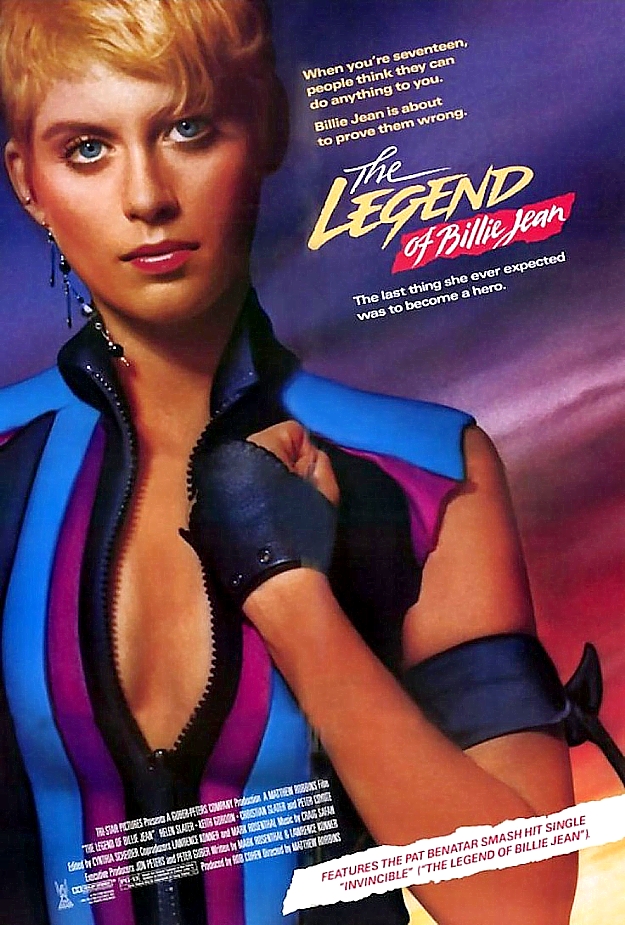
The 1980s were a crap time for politics and economics but in terms of entertainment, the decade was responsible for some great movies, especially those geared toward kids and teens. Most ’80s movies like Back To The Future and Breakfast Club are well known, then there’s the second-tier which includes not-so-famous-but-still-recognisable stuff such as Flight Of The Navigator and WarGames. But then there’s the section below that; films that have now become cult classics because the mainstream were either unaware or too snobbish to watch them when they were first released. The Legend Of Billie Jean is one of these forgotten gems; it has nothing to do with the classic Michael Jackson song, but it’s a fantastic teen film that’s unfortunately underexposed and underrated, even to this day. Starring Helen Slater (Secret Of My SuccessRuthless People) and an early role for Christian Slater (HeathersYoung Guns) (no relation by the way) the story is about sister and brother Billie Jean Davy and Binx Davy played by Helen and Christian respectively. After Binx’ beloved Honda Elite scooter is vandalised by local bullies, Jean asks the alpha bully’s father for $608 to repair it. It seems however, that being a prick runs in their family as the dad, Mr. Pyatt, will only hand over the money in exchange for sexual favours, which of course leads to refusal, and ends in an unintended shooting. Billie Jean, Binx, and her two friends then have to go on the run but infamy and fame go hand-in-hand with being an outlaw…

The Legend Of Billie Jean is all about how role models and heroes are made. Like Alex Rogan in The Last Starfighter, Billie Jean lives in a trailer park and isn’t someone who anyone would look up to. But, as she stands-up for what’s right and becomes a fugitive in the process, she becomes an inspiration to all teenagers and is even helped by them to evade the cops. Billie Jean is asked to autograph a newspaper, her Joan Of Arc-inspired haircut is copied by local teens and her image is adorned on t-shirts, caps, posters, frisbees, bumper stickers, and even airplane banners as she becomes the “legend” in the title. You could see this as a comment on how consumerism and capitalism is an unavoidable by-product of causes and activism, but that’s not the message here. This film is a precursor to the overrated Queen & Slim whose narrative essentially did the same thing but stereotypically and depressingly rather than upbeat and uplifting as is the case here. Unlike Queen & SlimThe Legend Of Billie Jean doesn’t just focus on the original “crime”. Whilst on her Texan Riviera outlaw odyssey, Billie Jean rescues a kid from his abusive father, and thus becomes a genuine hero akin to Supergirl.

Set in the height of summer in Corpus Christi, Texas, the cinematography isn’t Do The Right Thing (which made relatively cold days look blisteringly hot) and the direction isn’t something that stands-out either (although there’s a Larry Cohen-esque interviewing of what looks like real people in “Ocean Park Mall”). That being said, the look and feel is appropriate to the setting and the target audience. In terms of cast, Helen Slater is great as the principled lead character and her friends are an oddball mixture which includes Yeardly Smith (Maximum Overdrive) who most people will know as the voice of Lisa in The Simpsons. Richard Bradford is particularly believable as the rapey Mr. Pyatt who then sets-up a stall to sell Billie Jean merch, and the always likeable Peter Coyote plays the cop who isn’t just out for blood but the one bloke who’s looking to discover what really happened. Keith Gordon (Dressed To KillChristine) also plays a pre-Pretty In Pink love interest across the class divide.

Being an ’80s teen movie, there’s the obligatory mall scene (the fictional Ocean Park Mall is shot in Sunrise Mall in Corpus Christi which is sadly now closed), our protagonists somehow use toy walkie-talkies long-range, and there’s inept cops chasing but never catching our heroes. In terms of soundtrack, this isn’t a John Hughes movie so the music is a little bit ropey and too “old” for the intended target audience (Pat Benatar instead of Simple Minds) but that being said, now that almost four decades have passed, even crappy pop music of the day sounds tolerable.

The Legend Of Billie Jean has an unrealistic and idealist narrative; it’s a feel-good adventure rather than a depressing drama. It could also be seen as a Feminist film whether it was originally intended to be or not. Like a reverse of The Goonies or Stranger Things, the girls outnumber the boys here. With the female lead sticking-up for her brother as well and fighting against a male sexual assaulter, plus a screenplay that isn’t shy about menstruation, if it was made today, critics would be slobbering over it as it ticks all their boxes in regards to female empowerment. That being said, on Rotten Tomatoes, The Legend Of Billie Jean is rated at 40% which makes it sound like a sub-par, throwaway flick which it quite clearly isn’t. I think mainstream critics need their heads testing or need to recognise that their reviews were wrong. After all…

Fair Is Fair.

Saturday Matinee: Pump Up the Volume

Looking back at Pump Up The Volume

By Simon Brew

Source: Den of Geek

“Do you ever the feeling that everything in America is completely fucked up?”

When writer/director Allan Moyle’s work is celebrated, it’s generally Empire Records that gets the acclaim (and with some justification). Furthermore, if the conversation then moves on to cult movies starring Christian Slater, then it’s almost sacrilege to not start with Heathers.

Me? In both cases, I go for Pump Up The Volume every time, a thoughtful film masquerading behind a name that doesn’t necessarily do it a lot of justice. It’s certainly not the first story about a shy-by-day high school kid who assumes an anonymous identity out of hours – although this is a film in pre-Internet days, remember – but it’s comfortably one of the best.

“I didn’t talk to one person today, not counting teachers”

The film centres on Christian Slater’s Mark, a meek, lonely teenager, moved into a strange area by his parents, and attending a high school where he knows nobody. Actually, scratch that, he knows the youngest school commissioner in the history of Arizona – that’d be his father – but other than that, he’s very much alone.

He’s also nervous and shy: early in the film, his writing is read out to the class by an impressed teacher, and his discomfort at his talent being aired in such a way is evident. Mark prefers flying under the radar.

That’s until 10pm every night, when he takes his one piece of company in life, his radio broadcasting equipment (given to him by his parents so he can keep in touch with his old friends), finds an available frequency, and broadcasts for as long as he wants as pirate DJ Happy Harry Hard-On. His collection of music is quite brilliant, and the film’s soundtrack is most definitely worth checking out (although it lacks the version of Leonard Cohen’s Everybody Knows that’s heard more prominently in the film), but it’s what Harry has to say that grabs the attention.

Because in Harry, Mark has an outlet to say what he actually thinks. And say it he does. His views aren’t, in the scheme of things, massively radical. His parents have sold out (his father used to fight the system, we’re told, and now he “is the system”), the school system is warped, and everyone conforms. There’s nobody to look up to, nothing to do. Oh, and he simulates masturbation. A lot.

As if to reinforce the two sides of his life, after one of his early broadcasts, Mark attempts to talk to a girl at school, and she blanks him.

That notwithstanding, though, he inadvertedly becomes the lone voice of protest in the midst of a messed up system. The film centres around the fictional school of Hubert Humphrey High, whose principal, Loretta Cresswell, firmly knows how to get the academic results that her own superiors judge her school on (her eventual demise in the film, arguably, doesn’t solve that much). Root out the problem students, with the below average scores, then find a reason to expel them, and just keep those who get decent grades on the register.

Interestingly, the story does have its roots in a real life situation. Appreciating Hubert Humphrey High doesn’t exist, what does exist is a school that it’s based on, and where Moyle’s sister, according to the Toronto Star, taught.

“This dancing is a privilege, and it’ll be taken away if it’s abused”

Back to Harry, then. His listeners are everywhere, and his audience unites the people who simply don’t talk to each other when they’re together at school. The nerdy overweight kid, the jocks, the prim and proper swot girl: Moyle draws together the usually clichéd characters of the high school movie, and pretty much gathers them around the radio. Some of them have very swish radios, too.

This wins him a gradually building word-of-mouth audience, which is where Mark’s problems begin. Kids start ringing each other up, to help pass the broadcast on. Tapes do the rounds. More people start to notice. Moyle demonstrates this by gradually congregating more and more people at the physical spot where the reception for Harry’s show is at its best.

Consequently, much to the growing consternation of his father and the principal, more and more people take seriously what Harry has to say. A calm school population starts to take on a rebellious flavour, and a small system that works on complicity starts to unravel.

It doesn’t help, of course, that Mark/Harry has access to documents and information that don’t show Hubert Humphrey High in the best of lights. And when he particularly highlights the case of one student who has been expelled for her problems, although really for her grades, then suddenly, Harry is on lots of people’s radar.

The turning point for the movie, though, comes surprisingly early: it’s the suicide of one of Harry’s listeners. As his army of followers know, if you include a number in your letter to Harry (he’s a pirate radio DJ with a  PO box), you get a call back. In this case, it’s all a little too late. One on-air conversation with Harry later, said caller commits suicide, and the system has its scapegoat. Moyle’s film makes no bones about the way the system looks for the obvious, public fix rather than examining what really drove a youngster to kill himself, and it’s in moments like these when it’s at its best.

There’s also a foil of sorts to Mark/Harry, and that’s with Samantha Mathis’ Nora. The film was made in 1990, and it shows just what my predictive powers are like that I was fairly convinced at the time she’d go on to be a bigger star than she became. Her choices of films didn’t massively help – the Super Mario Bros movie is a stain on most people’s CV – but there’s real potential in her performance here.

For Nora is a far more popular person than Mark by day, yet she too feels the need to express herself anonymously. In her case, it’s her letters to his show, signed from the Eat Me Beat Me lady. It’s Nora who fairly quickly works out Mark’s true identity, and the irony of their relationship is that by them both talking to nobody, they both find somebody.

“Like everything else, you have to read the fine print”

It’s around then, though, that the film starts to run out of steam. It lands lots of punches in its first hour, in pretty quick succession, yet its momentum falters a little, and it goes just a little more conventional (the romance, certainly, is well done, but less interesting). Thus, the final act of the film is more concerned with those in authority tracking down Harry, and shutting down his show. And it all comes together via Harry’s last broadcast, which ends up taking place from the back of a 4×4.

It’s worth acknowledging too, that some points jar just a little. Some of the reaction moments to people listening to Harry’s broadcasts feel a little out of place. Furthermore, while Moyle takes time to briefly explore why the parents, staff and authorities act the way they do, he doesn’t invest too much in it.

Why do they come up with daft schemes such as BIONIC (‘Believe It Or Not I Care’)? Why do Mark’s parents not see beyond the tick box obvious? There are moments with Mark’s dad in particular, to be fair, where you get a glimpse of what he was, and contrast that with what he’s become (check out the moment where he catches Mark and Nora in the basement). But Moyle is, understandably, a little harder on their side of the story.

Still, for its few foibles, and appreciating that the film tailors off a little, at no point in its 102 minute running time does it feel like it’s outstaying its welcome. There’s sometimes a rawness to it, and there’s also a bunch of strong performances from the predominantly young cast.

I should focus on Christian Slater in particular, though. He’s electric here, in the midst of Harry’s raging monologues, but it shouldn’t be overlooked how well he conveys Mark’s innate shyness. It’s one of the more trickier characters he’s tackled, and the issues he has to talk about – sexual abuse, suicide, sexuality, loneliness – mean he has to balance the tone just right. I’d suggest he very much does. Moyle’s writing, too, is at times exquisite. The monologue he pens for Slater to deliver on the simplicity of suicide is dark, gripping material for a supposed teen movie

“I am not perfect. I have just been going through the motions of being perfect”

I find it odd that Pump Up The Volume, a film with a misjudged title and a not wonderful promotional campaign behind it, seems to have been lost a little. Appreciating that at most we’ve had a basic DVD release of the film, and it’s never likely to be ripe for Blu-ray, it’s still comfortably one of the best teen movies of the 90s (and the 90s were hardly short of strong teen movies), and also, a qualityaddition to the unnaturally strong genre of radio DJ movies (seriously: how many bad ones can you name?)

Even if you take just the romance element in isolation (arguably the weakest ingredient) between Mark and Nora, the scene where Harry takes to the airwaves to tell her his feelings, unable to look her in the eye and voice them face to face, is really well done. It’s the kind of stuff that romcoms stumble over all the time. Here’s a teen movie that handles it with class.

When the film is quiet in particular, and when good actors are being trusted with long passages of dialogue, Pump Up The Volume is brilliant. And it still is. Moyle has fashioned here an intelligent, well made and strongly written film, with something to say, that – in an age of Internet anonymity – might even be more resonant over two decades later.

And if it isn’t? Well, to take the works of Harry himself, “so be it”…

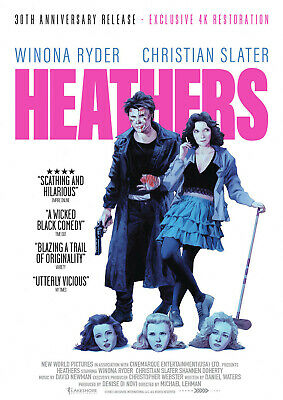
Saturday Matinee: Heathers

“Heathers” (1988) is a dark high school comedy written by Daniel Waters and directed by Michael Lehmann. “The Heathers” of the title refers to Westerburg High School’s elite clique of popular girls, whose  newest member is Veronica Sawyer (Winona Ryder). Fed up with the Heathers’ constant peer pressure and obnoxious social circle she becomes increasingly attracted to J.D. (Christian Slater), a mysterious, rebellious – and possibly psychotic – new student. This 80’s cult film was most likely inspired by a thematically similar (but tonally different) 70’s high school film called “Massacre at Central High“.

Watch Heathers on Hoopla here: https://www.hoopladigital.com/title/11896270