Saturday Matinee: The Sorcerer and the White Snake

By Vern

Source: Vern’s Reviews

After I watched DR. WAI IN “THE SCRIPTURE WITH NO WORDS” for the specific reason that it was a Jet Li movie directed by Ching Siu-Tung, I realized I should watch the more recent movie that fits the same description. THE SORCERER AND THE WHITE SNAKE (2011) is another fantasy martial arts romance, outlandish in a different way than the other one because it’s based on a Chinese legend about animal demons.

Li plays the titular sorcerer, a truck trying to carry explosives across a shaky rope bridge, and of course Whitesnake play themselves, performing many of their hits as well as debuting songs from that year’s album Forevermore. At least I assume that was what Ching intended, but he caved to the bean-counters, so instead Li plays a skilled Buddhist demon hunter called Abbott Fahai, and early in the movie we are abruptly confronted with the sight of two beautiful human lady torsos with scale-covered breasts and giant snake body lower halves, rolling around sexily on top of each other. It’s one of those things where I’m kind of icked out by it but also very happy for whatever number of people there are out there who are into snake ladies and are sorely underserved by mainstream cinema. Merry Christmas, you pervs.

Anyway, they seem to be going at it, but I guess they’re supposed to be sisters frolicking. The green snake is Quingqing (Charlene Choi, THE TWINS EFFECT, TWINS MISSION) and the white snake is Susu (Eva Huang, KUNG FU HUSTLE, DRAGON SQUAD). They’re spying on some humans climbing a mountain to find herbs, and Quingqing decides to go play a prank on them – appearing in giant snake form to hiss at young herbalist Xu Xian (Raymond Lam, SAVING GENERAL YANG), scaring him so bad he falls off the mountain into the water.

Susu has a conscience and/or thinks Xu Xian is a cutey, so she switches to human form and resuscitates him in the form of a romantic underwater kiss. And then it becomes a thing where she comes into civilization in human form and courts him, but he rejects her at first, thinking he’s in love with this person he doesn’t quite remember who saved his life. (Rather than tell him “That’s me, stupid” she knocks him into the water and does it again.) Tagging along, Quingqing befriends Abbott Fahai’s assistant Neng Ren (Wen Zhang, THE GUILLOTINESTHE MERMAID), who luckily is bad at using his little dial that detects demons.

Well, maybe not lucky, because he doesn’t notice the ENTIRE BOAT FULL OF LADY BAT DEMONS that Quingqing casually points out to him. This leads to one of the better action sequences, when the Abbott flies in and leapfrogs across a succession of boats, including several canoes that are mid-air after being launched by a big wave. He and Neng Ren battle a swarm of humans with with bat wings as well as a more monstrous digital character. That part seems kinda like a Hong Kong take on VAN HELSING.

Xu Xian and Susu end up getting married, but he doesn’t know she’s a snake demon, and those type of secrets are not good for marriages. So the scene where Fahai attacks her and she turns into a snake and he sees it is kind of like somebody walking in on their wife straddling some dude. Luckily he forgives her, but only after accidentally stabbing her with a magic dagger (you know how it is) so it becomes a quest to get a rare magic root that will heal her.

The style of the movie is a little schizophrenic. Much of it has a very clean digital look that seems chintzy compared to Hollywood movies. For example, in the opening scene Abbott Fahai and Neng Ren step out into a blizzard and battle an ice harpy (Vivian Hsu, THE ACCIDENTAL SPY) and it’s all extremely green-screeny, with an FX-based battle where Li and his doubles are spinning a staff around and doing moves, but the frame drops, flying and ice beam FX make it seem like it’s pretty much an animated movie. (It’s also one of those movies that is very clearly designed to take advantage of 3D.) But then it cuts to some beautiful actual locations, and the lantern festival sequence looks like a huge set on a soundstage – it kind of feels like a Disneyland ride, which is a compliment.

I love the unashamed way movies like this present their mythological reality – it’s so different from the west, where artists fear straying from realism and the literal. Ching, of course, has no such hangups. Not long after he’s given us “Yes, they are sexy half lady/half snakes who can turn into a snake or a lady, fuckin deal with it, buddy,” he also has a computer animated turtle, rabbit and mouse just walk in (upright, but they’re regular animal sizes and not humanoid at all) and start talking, like it’s normal. I wasn’t sure if they were also demons and could turn into people, but they never did, so I decided they were just animals. The mouse continues to be a major character throughout the movie, treated as a peer with the demons and humans. (He should get a spin-off buddy movie with the puppet rat mutant from DR. WAI.)

Apparently there’s some part I didn’t pick up on with a “Chicken Devil” played by the great Lam Suet. I don’t know if this means I wasn’t paying enough attention or if it’s one of those Easter eggs. They don’t have Easter in Buddhism, though.

The story spends more time on the melodrama of the young lovers than on the Abbott, but Li’s performance is good and it’s a pretty interesting character. Rather than killing demons he catches them in little pots like he’s an ancient Ghostbuster, and he keeps them imprisoned in his pagoda, with the promise that if they meditate and improve themselves they can be freed. This seems pretty enlightened at first, but when we meet the snakes we realize that it’s still unfair to assume that every demon is evil and deserving of this kind of punishment. They’re just creatures trying to live their lives, and they should be able to slither around doing what they want, they shouldn’t have to hide out at Midian or something to be safe from guys like him. So, while being well-intentioned, he sort of becomes the antagonist.

And SPOILER due to these events he does learn that his attitude toward demons has been too rigid. I like that it ends on a sweet little character moment – Fahai throwing Neng Ren an apple and talking to him as a friend even though he’s been turned into a bat-demon.

Much of this movie looks beautiful, and some of the stuff that looks cheesier is bizarre enough to still be appealing. But there are definitely points where the digital look is off-putting to me. I can imagine myself being much more drawn into its operatic emotions if it was one of those soft-focus ‘90s Hong Kong fantasies like THE BRIDE WITH THE WHITE HAIR. (I guess I’ll have to check out Tsui Hark’s GREEN SNAKE, a 1993 variation on the same legend.) Still, I gotta respect a movie with the line, “Before I met you I meditated for a thousand years, but those thousand years were worth less than a moment with you.” That’s some passionate love shit only a snake demon could say. I bet you don’t get that in, like, a Nicholas Sparks movie. (I don’t think I’ve seen any, though, so correct me if I’m wrong.)


Watch The Sorcerer and the White Snake on Kanopy here: https://www.kanopy.com/en/kcls/video/15557900
Saturday Matinee: The Wandering Earth II

By Simon Abrams

Source: RogerEbert.com

Time runs out in carefully marked units in the mainland Chinese sci-fi disaster pic “The Wandering Earth II,” a sturdy prequel to the record-smashing adaptation of Liu Cixin’s novel. In “The Wandering Earth II,” the apocalyptic problems faced by this movie’s Chinese characters—along with their international peers from the United Earth Government (UEG)—have already happened. Because in “The Wandering Earth,” the planet has already left its orbit thanks to some high-powered rocket engines, which have pushed the Earth out of harm’s way (aka a crash course with the Sun). Set in the near-future—a range of dates that includes 2044, 2058, and 2065—“The Wandering Earth II” follows China’s men and women of action as they lead the planet out of the solar system and into the previous movie.

Both “The Wandering Earth” and its sequel are flashy, state-approved cornball spectacles about humanity’s resilience (especially the Chinese). Both movies were produced with gargantuan budgets that would make even James Cameron blink, and they both look fantastic thanks to director Frant Gwo’s eye for panoramic scope and paperback cover-worthy details. The main difference between these two blockbusters is that the protagonists of “The Wandering Earth II” must repeatedly choose to be hopeful despite perpetually impending disasters, each one of which is neatly labeled and foregrounded with pulpy on-screen text like “The Lunar Crisis in 12 hours” and “Nuclear explosion in 3 hours.”

In this way, Gwo (“The Sacrifice”) and his five credited co-writers succeed in refocusing our attention on scenes of ticking-clock suspense, sandwiched between syrupy—and mostly satisfying—melodramatic interludes, where square-jawed astronauts and UEG diplomats struggle to do what we know is a foregone conclusion.

Most of “The Wandering Earth II” follows the superhuman efforts needed to jumpstart the Moving Mountain Project, the mission to first build and then deploy the globe-shifting engines needed to push the Earth out of harm’s way. The UEG’s Chinese delegation, led by the paternal diplomat Zhezhi Zhou (Li Xuejian), recommends prioritizing the Moving Mountain Project instead of the Digital Life Project. This radical initiative would transfer human participants’ consciousnesses into artificially intelligent computer programs. Some Digital Life supporters try to sabotage the Moving Mountain Project, including a deadly attack on the Space Elevator transportation ships that send UEG representatives from the Earth to the Moon.

Nobody living through the events of “The Wandering Earth II” knows what we know: That the Moving Mountain project succeeds and eventually becomes the Wandering Earth project, which comes under threat by a HAL 9000-esque artificial intelligence (A.I.) named MOSS in the first film. Still, multiple scientists, government officials, and space adventurers—mostly Chinese—believe in their work’s vital necessity, whether they’re punching out saboteurs or detonating one of a couple hundred nuclear devices scattered around the moon. There’s a lot of hand-wringing and teeth-gnashing along the way, mostly from English and Russian-speaking UEG members, all of whom speak in stilted, poorly dubbed dialogue. But Chinese astronauts, like “The Wandering Earth” co-leads Liu Peiqiang (“Wolf Warrior 2” star Wu Jing) and Han Duoduo (Wang Zhi), always prove Zhou’s slogan-simple maxim: “In times of crisis, unity above all.”

Some melancholic (and occasionally maudlin) flashbacks and dialogue emphasize the personal motives of one-note characters who, in the movie’s best scenes, are just parts of a beautiful post-human landscape. Liu remembers his wife and young daughter while melancholic scientist Tu Hengyu (Andy Lau) talks with his dead child after he uploads her personality into an experimental A.I. program; she cries a lot and sometimes responds with existentially troubling questions like, “Where am I, daddy? I want to get out.” We’re then periodically reminded of the next impending crisis—“the moon disintegrates in 50 hours”—in between solar storms and nuclear explosions. Somehow, “The Wandering Earth II” never feels tonally unbalanced or narratively convoluted, partly because Gwo and his collaborators keep their movie’s plot focused on feats of action-adventure heroism.

“The Wandering Earth II” only seems relatively unambitious because it’s more focused on sap-happy human emotions than on dystopian intrigue. Both movies are still essentially showcases for beautiful and expensive-looking computer graphics. But “The Wandering Earth II”—a brittle and, at heart, old-fashioned space opera—would be insufferable if Gwo and his ensemble cast members didn’t sell you on the possibility that someday, people who are as selfless, monomaniacal, and capable as Liu and Tu could exist.

“The Wandering Earth II” is also like “The Wandering Earth” because it’s just the right mix of silly and somber. Hurt, scared people wonder about the recent past, but always from a rare position of forward-thinking emotional clarity. (“She’s dead, and that’s it. That’s the reality.”) So when humanity must inevitably save the day, their accomplishments are appropriately surreal and awesome. 

Saturday Matinee: Shadow

By Matt Zoller Seitz

Source: RogerEbert.com

In retrospect, it seems hard to believe that director Zhang Yimou didn’t make his first wuxia-influenced historical action film until two decades into his career, after a string of intimate yet visually striking dramas. But the double-hit of “Hero” and “House of Flying Daggers” (both released in 2004 in North America) reinvented him as one of cinema’s foremost directors of intricate mayhem, designed, lit, and edited with such care as to make the cliche comparison between action pictures and musicals feel not just fresh, but deep. Zhang never quite climbed to that peak of global crossover again. His family drama “Coming Home” and his remake of the Coen brothers’ “Blood Simple,” titled “A Woman, a Gun, and a Noodle Shop” were more intriguing than compelling, and his recent big-budget international coproductions (“The Flowers of War” and “The Great Wall“) felt more like ambitious financial undertakings than artistic ones. 

“Shadow,” a tale of court intrigue sprinkled with giddy duels and scenes of armored soldiers clashing, isn’t quite a return to form; Zhang’s first two action pictures were so nearly miraculous that it’s hard to imagine them being equalled. But it’s filled with so many remarkable images, particularly in its middle section, that fans of palace intrigue and metaphorically ripe violence will find plenty to like. 

Be warned going in that the first half-hour of “Shadow” is a pretty laborious setup: mostly characters walking in and out of rooms and announcing how they are related to each other, in terms of both bloodline and power dynamics. King of Pei (Zhang Kai), a snippy little despot, is still angry that a neighboring city that used to belong to his kingdom is now in the control of a general named Yang (Hu Jun), who won it in a duel. The king wants to get the city back somehow, or at least gain a foothold in it, so he offers his sister Princess Qingping (Guan Xiaotong) as a wife for Yang’s son, only to be insulted by a counteroffer of making her a concubine and presenting a ceremonial dagger as a gift. To further complicate things, the king’s Commander (Chinese star Deng Chao) just returned from challenging the general to a duel without authorization from higher up. 

And wouldn’t you know it: the Commander isn’t even really the commander. He’s a double named Jing (also played by Chao) who’s been trained from childhood to take over for the Commander if circumstances demand it. And they do: the Commander is hiding in a secret chamber beneath the royal city, recovering from a grievous wound he sustained in the aforementioned duel with the general that resulted in the other city being lost. The only person who knows about the subterfuge is the Commander’s wife Madam (Sun Li), who quite naturally starts to develop feelings for her husband’s double. 

The expository stuff at the front of the film isn’t inherently awful—it’s necessary to understand the large-scale violence that dominates the rest of the story, and the cast does a fine job of balancing simplicity and stylization with psychology. But aesthetically, it doesn’t begin to hint at the splendors that await, and it promises a richness of characterization (particularly among the secondary players) that the movie, which is often pitched at the level of a brilliantly designed video game, doesn’t quite deliver. (Japanese filmmaker Akira Kurosawa—a major influence on Zhang whose works include “Kagemusha,” another historical action/military movie with a secret double at its heart—was better at making the talky bits exciting, too.) 

Once the action kicks in, though, “Shadow” is on rails. Zhang, co-screenwriter Li Wei, cinematographer Zhao Xiaoding, production designer Horace Ma, and costumer Chen Minzheng work in seemingly perfect harmony to create a visual scheme that the director has said is based on the brush techniques of Chinese painting and calligraphy. The world they present would read as black and white (and grey) were it not for the flesh tones of the actors’ faces and bodies, and the voluptuous dark blood that splatters the screen whenever swords, knives, arrows, and crossbow bolts start to fly. 

It’s impossible to understate how thrilling “Shadow” is during its middle section, when Zhang is crosscutting between the increasingly knotty intrigue in two cities, a second duel that we’ve been building toward for 45 minutes, the romantic tension between the Commander and his wife and his double, and a large-scale military action that’s intended to retake a city. 

Confidently showy in a manner that evokes the most dazzling sequences in Zhang’s action classics, the movie takes symbolism that might seem simplistic and overdone (such as the prominent display of the yin and yang symbol in both dialogue and sets) and makes them feel organic to the tale, not in the manner of a novel or play, but an opera or art installation or graphic novel. The true yin and yang of the film is its expressive balance of masculine and feminine elements of design and choreography, especially as they’re expressed in combat. 

The bluntly macho shapes of swords and halberds (as swung and thrust by confident, scowling men) are contrasted against razor-edged umbrella weapons deployed with deliberately feminine motions (by men as well as women; when combatants get in touch with their feminine side, the movie suggests, they’re able to achieve their goals in different, often surprising ways). The bearers of these killer umbrellas practically waltz into combat with them, hips swaying demurely, then use them as toboggans to carry them down steep, muddy hills. A sequence where an umbrella battalion tries to retake an occupied thoroughfare during a rainstorm attains a peak of controlled madness reminiscent of some of the wildest scenes in “Kung Fu Hustle,” a classic that wasn’t afraid to go full Looney Tunes. When Zhang crosscuts between a duel on a rainy mountaintop and a zither battle happening in a subterranean chamber, with the zither music providing the sequence’s melody and the clanging blades percussion, the essence of action cinema is distilled.

When the movie decelerates in its third act, the better to resolve all the plot particulars laid out in the first section, it’s hard not to feel let down. It’s like that feeling where you disembark a roller coaster and can still feel vertigo in your belly. But “Shadow” is so masterful during its wilder sections that a bit of tedium eventually seems a rather small price to pay. Zhang’s action is so magnificently imagined—not just in the bigger, more brazen touches, but in grace notes, like the way a weapon’s gory blade grinds as it’s dragged over rainy cobblestones, trailing plumes of muck and blood—that it shames the current industry norm as expressed in Marvel and DC films and most action thrillers post-Jason Bourne, which consist mainly of swinging the camera around and cutting as fast as possible, often (it seems) to disguise the fact that the performers aren’t all that graceful, and the director doesn’t really have a style, just money. 

Zhang’s best work here is old-school craft, practiced with the latest filmmaking equipment and processes. The movie knows not just what do to technically, but how to make it resonate with the story and themes, and how to make images sing and dance. In a time of diminished expectations for big screen spectacle, and “content” replacing cinema, it takes a master to remind us of what’s been lost. 

____________________

Watch Shadow on Tubi here: https://tubitv.com/movies/649980/shadow

Saturday Matinee: Let the Bullets Fly

By Josh Larsen

Source: Larsen on Film

Little visual gags fly as fast as the bullets in this 2010 Chinese action comedy, starring co-writer and director Jiang Wen as Pocky Zhang, a bandit leader who poses as governor of a southern outpost. One of the first things we see is a bandit leaning down to listen for an approaching train on railroad tracks—but first he ostentatiously sticks his finger in his ear to clear it out.

Mistaken identity is at the core of much of the movie’s comedy. Let the Bullets Fly opens with Zhang and his band hijacking that train, which is carrying the actual governor (Ge You) to his post in Goose Town. During his interrogation of the governor (captured in a shot-reverse-shot sequence that’s edited at light speed), Zhang decides that pretending to be the governor might be more lucrative than simply robbing him. But upon arriving in Goose Town (with the real governor in tow, disguised as Zhang’s counselor), Zhang finds that things are actually run by the local crime boss, Master Huang (Chow Yun-Fat). This leads to a series of strategic chess moves between the two men, culminating in a comic set piece where Zhang’s crew and Huang’s henchmen square off while wearing the same bandit masks with red circles on them, unable to tell who is who. It’s a face-off as farce.

With its manic comic sensibility, Let the Bullets Fly recalls the work of Hong Kong’s Stephen Chow (Shaolin SoccerKung Fu HustleCJ7), whose own films seem inspired by Looney Tunes cartoons (the opening train sequence here could easily be a Wile E. Coyote short). Physics takes a back seat to fun, so that much of the film seems to be occurring in fast motion. As director, Jiang looks for every opportunity to be showy; at one point an alarm clock is thrown in the air and shot to pieces, causing a metal circle to sail over the camera like a collar.

As an actor, Jiang seems to understand that his face has a comic appeal—those big ears—that allows him to underplay the gags by keeping a straight face. He’s a delight. The legendary Chow (The KillerCrouching Tiger, Hidden Dragon) gets a double role as the villainous Master Huang and Huang’s dim-witted body double. He’s quite a bit broader than Jiang, but equally amusing.

The disparate tones Jiang juggles can make for some uncomfortable moments. There are sudden bits of graphic violence, for instance, and a rape scene that isn’t given nearly the serious consideration it deserves. (Like much of the movie, it’s a setup for a later gag.) But as a political satire, Let the Bullets Fly is pointed and precise. “I want to make money standing tall,” Zhang says at one point, trying to explain why he’s left forest robbery behind. “Impossible,” the real governor replies, knowing bureaucratic corruption all too well. The best joke in Let the Bullets Fly might be that a bandit is the movie’s moral center.

____________________

Watch Let the Bullets Fly on Hoopla here: https://www.hoopladigital.com/title/10088666

Saturday Matinee: Call of Heroes

CALL OF HEROES: Old School Story, New School Style

By Alexander Miller

Source: Film Inquiry

Hong Kong has been making genre films for decades, and many of them adhere to the formulaic structure that has maintained their reputation as foremost purveyors of action movies. Benny Chan is one of the few noted Hong Kong directors to have transitioned from the early nineties action movies through the handover into current action films, from period wuxia films like Shaolin 2010, to contemporary actioners like the Gen X Cops, and Jackie Chan vehicles Who am I? and New Police Story. Although Benny Chan’s filmography might suggest that of a hired gun working amid the many cogs in the modicum of action films in Hong Kong, there’s a slightly transgressive and gritty tone throughout his career.

Taking place in 1914, Call of Heroes opens when our napping protagonist, an amiable rapscallion Ma Feng (Eddie Peng), pummels some thugs who try to rob a noodle bar in the country; did the bandits offend his sense of honor and propriety? Not really, it seems Ma Feng is more annoyed that they interrupted what should have been a peaceful lunch.

After the introductory clobbering, he meets a teacher, Ms. Pak (Jiang Shuying), who has narrowly escaped (with a group of children in tow) a military siege on her school led by the sinister Cao Shaolun, who murders with impunity being the son of a general.

Meanwhile, in the village of Pucheng, led by the honorable Sheriff Yang (Lau Ching-Wan), there is an area that has become a haven for refugees as a result of the murderous military campaigns going on through the lands. While Ms. Pak and her accompanying travelers are met with resistance, they are welcomed by the locals; however, the mysterious wanderer arrives around the same time as the nefarious Cao Shaolun, and our seemingly ambivalent loner is intertwined in the ensuing intrigue.

In concert with the cultural influence, what with John Ford inspiring Kurosawa, whose samurai epics were later remade into westerns in Hollywood and Italy, Call of Heroes has the dirty look of a Cinecittà production, with the twangy electric guitar echoing Ennio Morricone as a tasteful homage.

Old School, New School

Does this incidental hybrid of east-west convey an entertaining action yarn? Considering some edges that need sanding off, Call of Heroes is a fun trip to the dusty plains of both samurai and western movies, with the now prototypical stray dog hero. Here Eddie Peng’s Ma Feng is equal parts Toshiro Mifune’s Sanjuro character with Clint Eastwood’s laconic ‘Man With No Name’ and a hint of Elliott Gould’s iteration of Phillip Marlowe – Benny Chan’s film isn’t shy about its modernist mashup, and we’re all the better for it too, because the action is fun and the drama feels genuine.

This crossover of revisionist platitudes retains its accumulative power while sturdily fitting the wuxia formula; there’s good versus bad, and the moral boundaries are clearly drawn. Its black and white ethics are a perfect fit for this handsome little epic of quality, and in the past few years Hong Kong has gotten closer to reclaiming their throne as the foremost purveyors of fun action films. Not in the bullet ballets of John Woo and Ringo Lam, but in the period dramas that have populated the Chinese film market in their post-handover era. Benny Chan’s latest is just as much a return to form as it is a continuation of (relatively) recent hits like 7 AssassinsBrotherhood of Bladesand Bodyguards & Assassins.

“A Hero is Only as Good as His Villain”

Call of Heroes has an air of familiarity in its execution, but plays towards a more mature demeanor. Koo’s performance of Cao Shaolun is more than a mustache-twirling baddie; he’s homicidal, sadistic and it shows as he mercilessly guns down man, woman, and child. The film doesn’t shy from the nasty bits of his bastardly demeanor.

Veteran actor Koo might seem hammy, but he succeeds in filling out the archetypal story, and in concert with the rest of the leading cast who are delivering top-notch work. Johnnie To mainstay Lau Ching-Wan, (who starred in LifelineMad Detective, and Running out of Time) is powerful as the Pucheng village chief, but it’s baby-faced Eddie Peng who steals the show as the unkempt defender of the innocent; rightfully so, he’s funny, charming, and convincingly tough.

Influence of International Action

Deviating from the “cleaner” titles before it, Call of Heroes is as much a full-blooded action film as it is a martial arts movie; the blood flow makes the tenor of Chan’s feature feel more developed. Instead of anonymous henchman (who cease to be when they’re kicked out of frame), swords, bullets, spikes, fists and spears injure people, and violence has consequence.

The fight choreography, courtesy of martial arts guru Sammo Hung, employs a handful of fighting styles, from blunt punches and kicks, gravity-defying swordplay, as well as classic hand-to-hand combat. Call of Heroes might not have any headline martial artists such as Jackie Chan or Donnie Yen, but there’s no shortage of carefully choreographed action. Eddie Peng, under the tutelage of Sammo Hung, carries the film with stalwart Lau Ching-Wan doing some heavy lifting as well. Men, women, and children get in on the collective ass kicking, during some of the film’s exciting group brawls.

For the gravitas offered throughout, Hung and director Chan aren’t trying to mask the fantastical wire work, and in the spirit of high-flying fun it works to the film’s advantage; it’s the myth of heroism that we romanticize, and that comes off the screen every time someone trapezes themselves during the many scenes of combat.

Conclusion

What we are presented with is a thoroughly modern and satisfyingly self-aware action film; both classic, old fashioned, and authentically exciting. Fight sequences are plentiful and inventive; some standout moments include a waterside skirmish with walls of wooden spikes, a moonlit brawl with weaponized baskets and cookware; capped with a knockout finale involving Peng and accomplished martial artist Wu Jing duking it out with a mountain of clay pots.

I’d like to think of this inventive set piece as a nod to the 1976 John Woo/Jackie Chan vehicle Strike of Death (aka Hand of Death, choreography thanks to Sammo Hung), but this might be wishful thinking on my part.

Evolution in action films might take the form of stoic warriors abiding by Buddhist mantras in Jean-Pierre Melville’s heist films, or the operatic violence hyperbolized in the westerns of Sergio Leone. At the risk of evoking a cliché, action speaks every language and the more international cross pollinating that occurs the better off we all are; Hollywood’s been drawing from the eastern well for decades, and seeing the inverse in Call of Heroes is a pleasure.

Watch Call of Heroes on Hoopla here: https://www.hoopladigital.com/title/11726006

Saturday Matinee: The Thousand Faces Of Dunjia

“The Thousand Faces of Dunjia” (2017) is a Chinese fantasy film directed by Yuen Woo-ping; scripted and produced by Tsui Hark, and starring Chengpeng Dong, Aarif Lee, Ni Ni, and Zhou Dongyu as the central core of a ragtag group whose mission is to defend humankind from ancient aliens. It’s a remake of Yuen’s 1982 film The Miracle Fighters.

Watch The Thousand Faces Of Dunjia on Hoopla here: https://www.hoopladigital.com/title/12064080

Saturday Matinee: The Monkey King

“The Monkey King” (2014) is a Hong Kong/Chinese fantasy film directed by Cheang Pou-soi and based on an episode of Journey to the West, a Chinese literary classic written in the Ming Dynasty by Wu Cheng’en. The film focuses on the origin of Sun Wukong (Donnie Yen), the titular protagonist who’s the only one who can prevent the Bull Demon King (Aaron Kwok) from taking over the heavenly kingdom.

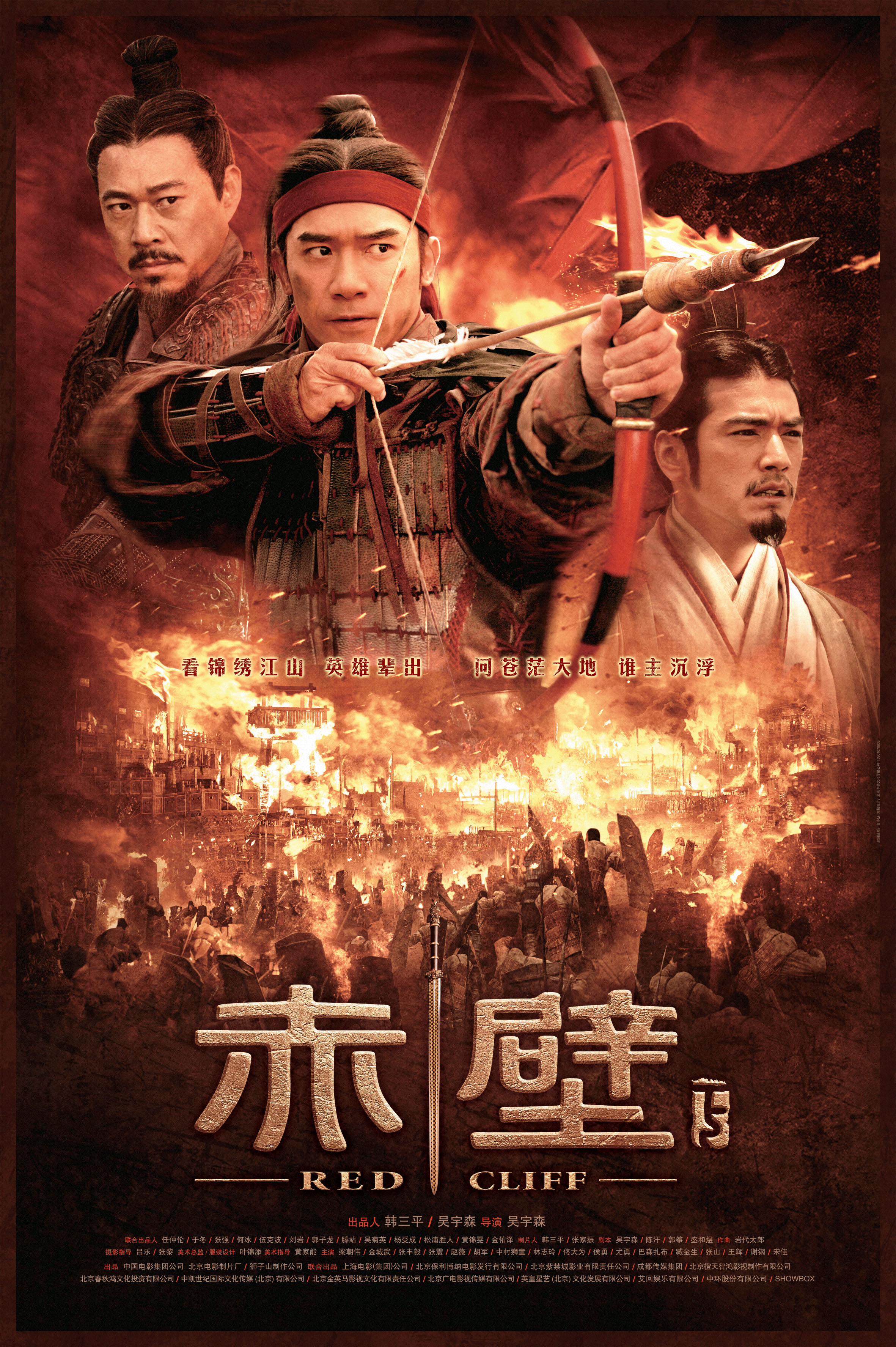
Saturday Matinee: Red Cliff

“Red Cliff” (2008) is Chinese historical war film loosely based on the Battle of Red Cliffs (AD 208–209) and events at the end of the Han dynasty preceding the Three Kingdoms period in imperial China. The film was directed by John Woo, and stars Tony Leung, Takeshi Kaneshiro, Zhang Fengyi, Chang Chen, Zhao Wei, Hu Jun, and Lin Chi-ling. There’s plenty of action-oriented costume epics from China but few come close to Red Cliff in terms of acting, screenplay, direction, special effects, and other criteria.